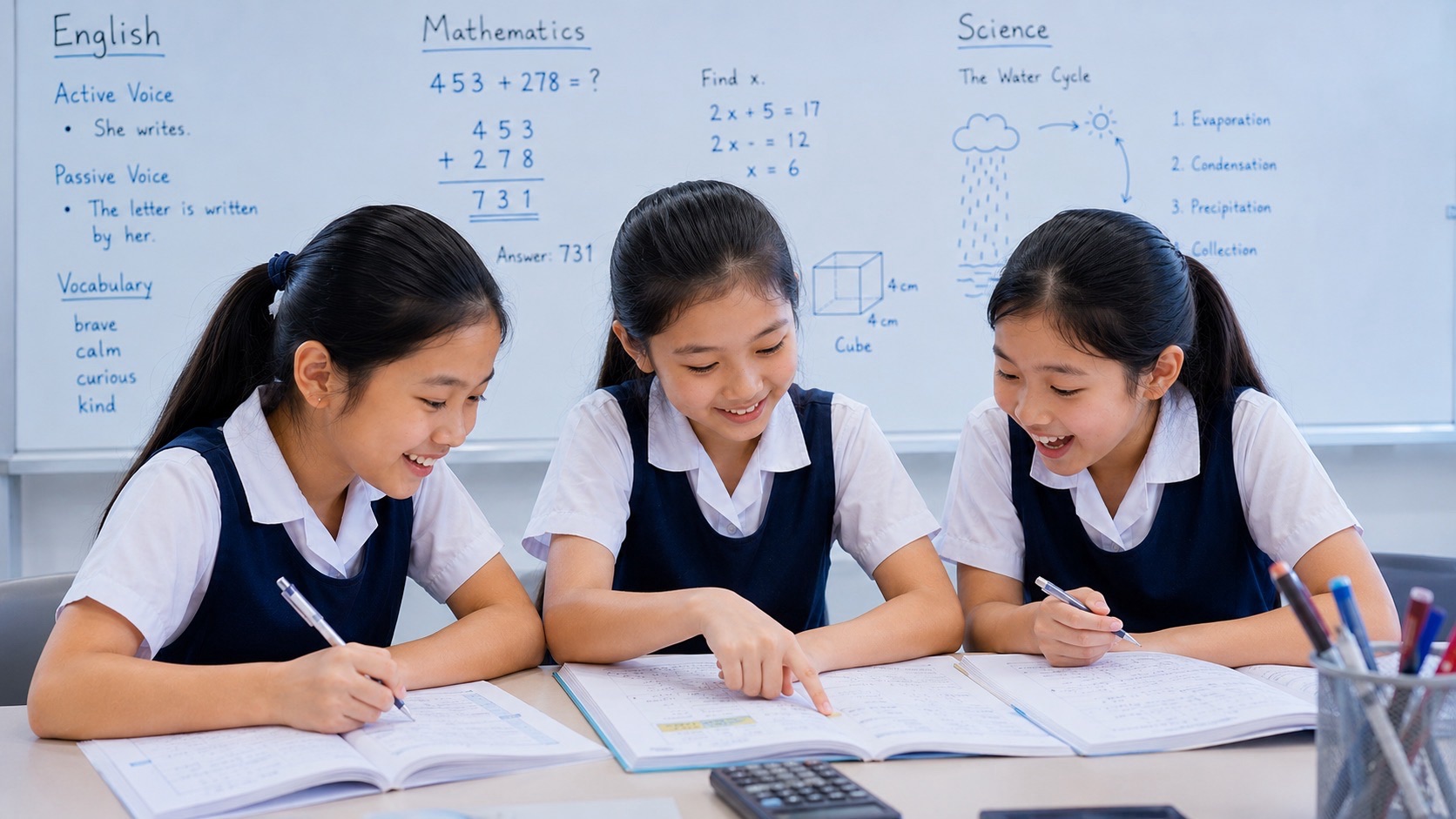
Primary 2 Mathematics multiplication and division tuition in Bukit Timah should help a child see how equal groups work before expecting fast answers to every multiplication-table question. A child who knows that four groups of three objects total twelve should also be able to explain what twelve divided into three equal groups means, and what changes when the size of each group is specified instead. In a well-managed three-student lesson, counters, drawings and explanations make that reasoning visible.
Parents often notice memorised products before noticing the deeper difficulty: the same numbers can describe equal sharing, grouping or a total, and an unfamiliar sentence may ask for something different from the familiar worksheet. This original teaching guide develops arrays, multiplication tables of 2, 3, 4, 5 and 10, the division symbol, inverse relationships and short word problems. It includes worked examples and independent checks. The focus is on meaningful Primary 2 mathematics, not national examination drills or a promised tuition outcome.
- Core syllabus: tables of 2, 3, 4, 5 and 10, division notation and relationships between multiplying and dividing.
- First principle: equal groups require the same number of items in every group.
- Multiplication: count a fixed number of equal groups or use a structured array.
- Division: find a group size or the number of groups, depending on the story.
- Representation: connect objects, drawings, equations and verbal explanations.
- Learning check: let each pupil solve a fresh story without simply copying a worked example.
Chapter index | Find the next small step
- 1. The P2 syllabus · 2. What makes groups equal · 3. Arrays · 4. Repeated addition
- 5. Grouping language · 6. Tables 2, 5 and 10 · 7. Tables 3 and 4 · 8. Product with units
- 9. Equal sharing · 10. Forming groups · 11. Fact families · 12. Diagnose mistakes
- 13. Word problems · 14. Practice with answers · 15. Three-pupil lesson · 16. Parents’ guide
1. Start with the actual Primary 2 multiplication and division syllabus
The MOE Primary Mathematics syllabus updated in October 2025 identifies multiplication tables of 2, 3, 4, 5 and 10 in Primary 2. It also includes use of the division symbol, the relationship between multiplication and division, calculations within those tables, and mental calculation using these facts. These are useful boundaries for preparing lessons without adding unnecessary older-student demands.
The syllabus names content, but a child’s understanding still needs teaching and observation. A pupil may be able to recite ‘three times four is twelve’ and yet not identify three groups of four in a drawing. Another may understand the objects perfectly but need practice writing the corresponding symbol. A tutor should distinguish the conceptual problem from a notation problem before assigning more exercises.
A practical starting task uses equal groups with small objects. Show three trays containing four counters each. Ask what is equal, what is being counted and how many counters there are in total. Only after the child understands the arrangement should the adult move to an equation. The objects are not a decorative extra; they explain what each number means.
MOE has removed weighted assessments and examinations for P1 and P2 since 2019. A teaching check can still be valuable if it reveals where a pupil needs help. Do not describe a privately created worksheet as an official P2 examination or assign significance to an invented grade. The immediate goal is a child who can explain and use the mathematics.
Back to chapter index · Next chapter
2. Make equal groups visible before calculating
Begin with two pictures: in picture A, three boxes each contain four buttons; in picture B, the boxes contain two, four and six buttons. Both pictures contain twelve buttons in total, but only picture A has equal groups. Ask the child to identify what is the same and what differs. An equal-group multiplication story depends on the equality of group sizes.
Invite the child to rearrange twelve counters into four groups of three. Then make three groups of four. The number of counters stays twelve, while the description of the groups changes. This can introduce the related multiplication facts without starting with a rule about changing the order of factors.
Now add a group with only two counters to an arrangement where the others contain three. Ask whether the arrangement still has the same number in every group. A child who answers ‘yes, because all the groups have counters’ has confused having groups with having equal groups. Ask the child to count each group explicitly.
Equal groups do not need to be arranged in neat rows. Three small bags, each containing five beads, still form three equal groups even when they are placed in different positions. The important property is the repeated amount, not the shape of the diagram.
After the child has counted physically, hide the counters and give the same description verbally. If understanding transfers to the sentence ‘three groups of five’, the child is beginning to move from objects to language. Keep the numbers small enough that arithmetic speed does not hide the grouping concept.
Back to chapter index · Next chapter
3. Learn multiplication through rows and columns
An array places objects in equal rows and columns. Draw four rows, with three dots in each row. Count the rows and the dots per row. The total is four groups of three, or twelve dots. The array lets the child inspect the structure rather than count each dot again and again.
Rotate the paper by a quarter turn. The drawing can now be described as three rows of four dots, but the total is still twelve. This gives a visible reason that 4 × 3 and 3 × 4 have the same product. The interpretation of each factor may change even though the number of objects does not.
Use a small table showing arrangements of twelve counters: two rows of six, three rows of four and four rows of three. Each arrangement is a different representation of twelve. Ask whether the number of rows alone reveals the total; it does not, unless the number in each row is known.
An array also supports division. If twelve dots are arranged in three equal rows, four dots appear in each row. If they are arranged in rows of four, there are three rows. The same drawing can answer different questions depending on what the story gives and what it asks to find.
Do not assume that every child instantly understands an array viewed sideways. Ask the child to trace one row, then one column, and explain which is being counted in the chosen equation. If the representation is confusing, return to separate physical groups before using a tight grid.
Back to chapter index · Next chapter
4. Connect repeated addition to multiplication
Multiplication gives a compact way to describe repeated equal amounts. Three groups of four can be counted as 4 + 4 + 4 = 12, then written 3 × 4 = 12. The three identifies how many groups are present in that reading, and the four identifies how many objects each group contains.
Have the child explain why 4 + 4 + 3 does not match three equal groups of four. Its total is eleven, and one term is different. Merely spotting three addends is not enough: the equal-group relationship is what the multiplication describes.
Use a gradual move from counting by ones to counting by groups. With four bags holding five buttons each, the learner can count five, ten, fifteen, twenty. Then connect those four jumps to 4 × 5 = 20. The answer is supported by an arrangement and a counting pattern.
Not every addition should be transformed into multiplication. A story with two blue counters and five red counters has a total of seven, but it is not two groups of five. Ask children to decide whether the amounts are equal before choosing multiplication as the operation.
After showing several examples, give a new equal-group description and ask for both an addition sentence and a multiplication sentence. Comparing the two explains what the multiplication symbol is doing. It should not become a rule that the child writes a long addition before every multiplication once the concept is understood.
Back to chapter index · Next chapter
5. Make the words ‘groups of’, ‘each’ and ‘altogether’ precise
Children may know the computation but misread the story. In ‘five packets each contain three pencils’, five tells us the number of packets and three tells us the pencils in each packet. The question ‘How many pencils altogether?’ asks for the total. A suitable equation is 5 × 3 = 15.
Contrast that with ‘There are five pencils in one packet and three in another’. The groups are not stated to be equal, so multiplying the two numbers would be unjustified. The total is eight pencils. Ask the child what in the sentence allows or prevents the equal-group interpretation.
The word ‘each’ identifies a repeated quantity when the context supports it. It is not a magical instruction to multiply every time it appears. In a division story, ‘each child receives the same number’ may signal the size of an equal share. The question determines which quantity needs to be found.
Teach children to label the answer with the thing counted. A computation of fifteen could mean pencils, packets, rows or stickers. In the five-packet example, the total is fifteen pencils. A child who writes ’15 packets’ has not answered the original question, even when the numerical multiplication is correct.
Encourage the child to paraphrase the story briefly: ‘There are five equal groups and three in every group; find the total.’ This is a useful stepping stone. Remove the script once the child can identify the quantities without it.
Back to chapter index · Next chapter
6. Build reliable facts for 2, 5 and 10
The tables of 2, 5 and 10 offer visible patterns. Counting pairs gives 2, 4, 6, 8 and 10. Counting five at a time gives 5, 10, 15, 20 and 25. Counting tens gives 10, 20, 30 and so on. The patterns are helpful when the child connects each step to another equal group.
For 6 × 5, show six groups of five or an array with six rows of five. The total is thirty. The child’s explanation might be ‘five, ten, fifteen, twenty, twenty-five, thirty.’ It demonstrates the repeated quantity, rather than merely recognising the written product.
A child may use a known ten fact to check a five fact. For example, 4 × 10 is forty; four groups of five make half as many, which is twenty. Treat this as one possible strategy. Use counters if the relation between five and ten is not yet secure.
Number patterns can generate errors when they become detached from groups. A child may say ‘2, 4, 6, 9’ while moving along the twos. Return to adding one more group of two: from six, another two gives eight. The correction should explain the equal increase.
Mix table questions rather than practising only a long unbroken recitation. Ask 3 × 5, then 2 × 7, then 4 × 10 and invite a short explanation when needed. A child who recalls products from different positions in a table has a more flexible fact network than one who must start every sequence at the beginning.
Back to chapter index · Next chapter
7. Develop the 3 and 4 tables with structure
Three-times facts can be built from groups of three. Five groups of three are fifteen; six groups of three add one more three and make eighteen. This ‘one more group’ strategy helps a child retrieve a nearby fact when the next one is uncertain.
The table of four can be built by doubling groups of two. For example, four groups of six contain the same number as two groups of six doubled, giving twenty-four. A learner can also count six, twelve, eighteen, twenty-four with an array of four rows. Both are useful methods if the child can explain the groups.
Some children memorise 3 × 7 as twenty-one but cannot draw seven groups of three. Give seven little circles and place three marks in each one. Ask the child to point to the factors in the picture. This distinguishes recall from understanding without treating either achievement as unimportant.
Use nearby facts to reduce memory burden: if 4 × 5 is twenty, then 4 × 6 is four more, or twenty-four. The group size has stayed four while the number of groups has increased by one. Reversing the change gives 4 × 4 = sixteen.
During teaching, accept a sensible strategy such as an array, skip counting or a nearby fact. Later, build fluent recall gradually. Children need accurate facts, but pressuring them to answer instantly before the structure is secure can make it harder to discover the actual misunderstanding.
Back to chapter index · Next chapter
8. Understand what the product represents
In a multiplication equation, the product is a number. In a word problem, the answer also has a meaning. If four shelves each hold three books, the equation 4 × 3 = 12 gives twelve books. It does not give twelve shelves. Ask the child to name what is being counted before writing the final sentence.
Show a comparison using the same arithmetic: four children each receive three stickers, and four boxes each contain three balls. Both situations give twelve, but the objects counted are stickers in the first story and balls in the second. A numerical fact can be used across settings because the equal-group structure matches.
If an answer is too large or too small, return to the known group size. Seven groups of four must be more than one group of four. It must also be less than ten groups of four. These simple bounds can help a child recognise a product that does not fit, without requiring exact calculation first.
Use the inverse problem as a check when the child is ready. If 4 × 3 = 12, then dividing twelve objects into four equal groups gives three in each. The check explains how the factors and total relate; it is not a separate unexplained rule.
Encourage a clear written answer: ‘There are 12 books altogether.’ A child who places the number 12 in an appropriate equation and writes a complete answer has connected arithmetic and language. Where writing is difficult, let the child explain orally before recording.
Back to chapter index · Next chapter
9. Division can mean sharing a total equally
Imagine twelve counters shared equally among three children. Ask the learner to place one counter in each child’s tray, then repeat until all twelve are distributed. Each child receives four counters. The corresponding equation is 12 ÷ 3 = 4, where the three represents the number of groups and the four represents the number in each group.
Check the word ‘equally’. If one tray contains five and another contains three, the distribution is not equal even when all twelve counters have been used. Ask the child to compare the group sizes rather than judge the arrangement by how tidy it looks.
Use the answer to reconstruct the starting quantity. Three groups with four in each group contain twelve, so 3 × 4 = 12. This connection helps a child see why multiplication and division are related without needing to memorise a pair of isolated rules.
Change the story to twenty sweets shared equally among five pupils. Each receives four. Use counters, an array or knowledge that 5 × 4 = 20. The learner can choose a representation that makes the relationship clear, then translate it into 20 ÷ 5 = 4.
Some children distribute objects accurately but write the division sentence backwards. Ask which number is the total being shared and how many equal recipients there are. Building the expression from the story can resolve the difficulty before introducing harder numbers.
Back to chapter index · Next chapter
10. Division can also mean forming groups of a known size
Now consider twelve counters packed into bags with three counters in each bag. The question is not how many counters each bag receives; that is already given. The unknown is the number of bags. Place counters into groups of three until all twelve are used. Four equal bags result, so 12 ÷ 3 = 4.
Compare this with the previous sharing example. Both use 12 ÷ 3 = 4, but the ‘3’ means three recipients in one story and three counters per bag in the other. The answer also uses a different unit: four counters per child versus four bags.
A child can obtain the correct number by memorising a division fact while still confusing the story. Ask for a sentence explaining the answer: ‘Four bags are needed because each bag holds three of the twelve counters.’ That shows what the four represents.
Try twenty-four counters placed in groups of four. Six groups can be made because 4 × 6 = 24. Count the groups to check. This is a useful problem within the table of four, and the solution should name six groups rather than six counters.
If the total does not divide evenly into the selected group size, an extra idea about leftovers may arise. Begin with examples that form whole equal groups when teaching the core relationship. Leftovers can be an optional discussion, not a reason to hide the main P2 equal-group meaning.
Back to chapter index · Next chapter
11. Read a multiplication–division fact family
A fact family connects related equations using the same numbers. With twelve counters arranged in three rows of four, write 3 × 4 = 12 and 4 × 3 = 12. Then write 12 ÷ 3 = 4 and 12 ÷ 4 = 3. Each equation describes a relationship that can be shown using the same collection.
Instead of handing the child all four sentences at once, ask one question at a time. ‘How many rows?’ ‘How many in each row?’ ‘How many altogether?’ ‘If we put all twelve into groups of four, how many groups?’ The child’s answers gradually reveal the whole family.
Teach the direction of each operation. Multiplication uses known group numbers and group sizes to find a total. Division may use a total and one group-related quantity to find another. The numbers are connected, but the question determines which arrangement is appropriate.
Fact families can also reveal errors. If a pupil writes 3 × 4 = 12 but 12 ÷ 3 = 5, ask them to reconstruct three groups of five. That would require fifteen counters, not twelve. The multiplication fact provides a check on the division result.
Use a fresh family, such as 5, 6 and 30. Ask for 5 × 6, 6 × 5, 30 ÷ 5 and 30 ÷ 6. The learner should check each with an equal-group model or the relevant multiplication table rather than copy a known pattern with unexplained numerals.
Back to chapter index · Next chapter
12. Identify whether the error is in groups, calculation or language
If a child draws five groups but places different numbers of objects in them, return to what ‘equal’ means. Count each group. Rearrange until they match, then record the repeated amount. Correcting a multiplication fact without repairing this arrangement would miss the deeper issue.
If the child draws three equal groups of four and writes 3 + 4 = 7, the drawing is useful evidence. Ask the child to count all the objects, then show how the repeated addition should be 4 + 4 + 4. The error is an operation choice, not necessarily a failure to understand the picture.
If 18 ÷ 3 is answered as ‘three’ because the child sees the numeral three in the question, ask whether three represents the number of groups or the group size in the given story. Build six groups of three to show 18 ÷ 3 = 6. The role of each number matters.
If a learner knows multiplication facts but fails to connect them to division, ask for an inverse check. For 20 ÷ 4, which multiplication fact would produce twenty using groups of four? Four groups of five make twenty; the answer is five. Work with a small array if the inverse idea remains abstract.
If the student makes errors only in long written stories, read the problem aloud and observe whether the mathematical action becomes clear. The difficulty may be understanding a sentence, locating the unknown or holding several details in memory. Address the specific obstacle rather than labelling the child weak at every multiplication and division skill.
Back to chapter index · Next chapter
13. Solve realistic-sounding but clearly invented stories
Story A: displays. A class prepares four rows of five picture cards. How many cards are displayed? Show four rows and five in each, then calculate 4 × 5 = 20 cards. The physical arrangement makes it clear why multiplication is appropriate and why the answer has the unit ‘cards’.
Story B: sharing. Eighteen counters are shared equally among three teams. How many counters does each team receive? Draw three labelled circles and distribute the total. Each receives six, because 18 ÷ 3 = 6. Check with 3 × 6 = 18.
Story C: packing. Twenty counters are packed into groups of four. How many groups are made? The answer is five groups, because five fours total twenty. Notice that the question supplies the group size and asks for the number of groups, unlike the previous story.
Story D: comparing representations. One child draws two rows of ten dots; another draws four rows of five dots. Both drawings contain twenty dots. Ask which has more rows and which has more dots altogether. The child with four rows has more rows, yet the totals are equal. Counting groups and counting objects are different questions.
After teaching, change one number in a story. If there are five rows of five instead of four rows of five, the total becomes twenty-five. If the child changes the product without rebuilding the groups, ask for a brief explanation. This protects against choosing an operation only because of a keyword.
Back to chapter index · Next chapter
14. Sixteen original practice questions and explained answers
Questions 1–4. (1) Three boxes each hold four pencils; find the total. (2) Write repeated addition for five groups of two. (3) Draw a four-by-three array and count its dots. (4) Is 3, 3, 4 an arrangement of three equal groups? Explain.
Questions 5–8. (5) Calculate 4 × 6. (6) Use a known ten-times fact to explain 5 × 7. (7) Twelve objects are shared equally among four children; how many per child? (8) Fifteen objects are placed in groups of three; how many groups?
Questions 9–12. (9) Fill in the missing number: 3 × __ = 21. (10) Write the two related division facts for 4 × 5 = 20. (11) Which is the total in ‘six bags with four counters each’? (12) Is 2 × 9 equal to 9 × 2? Explain with groups or an array.
Questions 13–16. (13) Eighteen counters are arranged into groups of three; how many groups? (14) Four rows of five cards are changed to five rows of four cards; has the total changed? (15) Complete 30 ÷ 5 = __. (16) A child says that 12 ÷ 4 = 8 because 4 + 8 = 12. How would you correct the reasoning?
Answers 1–4. (1) 12 pencils, because 3 × 4 = 12. (2) 2 + 2 + 2 + 2 + 2 = 10. (3) Twelve dots, arranged as four rows each containing three. (4) No; one group contains four while the others contain three, so their sizes are not equal.
Answers 5–8. (5) 24. (6) 5 × 7 = 35, for example by taking half of seven tens. (7) Three objects per child, because 4 × 3 = 12. (8) Five groups, because 5 × 3 = 15.
Answers 9–12. (9) Seven. (10) 20 ÷ 4 = 5 and 20 ÷ 5 = 4. (11) Twenty-four counters altogether. (12) Yes; both arrangements contain eighteen objects, even though the described rows and group sizes change.
Answers 13–16. (13) Six groups, because 6 × 3 = 18. (14) No; both arrangements contain twenty cards. (15) Six, since 5 × 6 = 30. (16) Four equal groups from twelve contain three each, so 12 ÷ 4 = 3; addition of four and eight answers a different question.
Ask for explanations on a selection of problems and vary their order. A child who answers familiar products quickly may still benefit from fresh equal-sharing and grouping stories. The goal of the practice is to discover which representation can be used independently, not to rank children by speed.
Back to chapter index · Next chapter
15. Design a purposeful small-group learning cycle
A three-pupil lesson should begin with each child making an initial attempt. The tutor can use three connected tasks: one pupil draws groups, another arranges an array and another writes a multiplication sentence. After the individual work, the group compares how the representations match.
For division, give the pupils different stories using the same numerical fact. One may distribute twelve objects among three teams, while another packs twelve objects in groups of three. The shared answer can be four, but the unit and meaning differ. Discussing that difference prevents the group from treating word problems as interchangeable calculations.
Rotate speaking opportunities so that a quick answer from one student does not replace the others’ thinking. The tutor can first ask each pupil to write or point to a representation and then invite explanations. One child should not permanently become the checker while others do all the mathematics.
End with a fresh independent problem within the targeted tables. Record whether each pupil identified equal groups, selected the operation, used a fact accurately and labelled the result. This is more useful feedback than announcing that everyone revised the ‘times tables’.
Before enrolling, parents should confirm whether the present group matches the child’s readiness, who teaches it, how independent work is checked and what the tutor will do when a child repeatedly misunderstands a representation. Group size helps only when teaching uses the opportunity well.
Back to chapter index · Next chapter
16. Questions to ask when multiplication and division feel difficult
Should a P2 child know the 6, 7, 8 and 9 tables? The October 2025 MOE P2 list specifically names tables 2, 3, 4, 5 and 10. A factor such as six can still appear in an equation from those listed tables, for example 4 × 6. Do not present every later table as an additional compulsory P2 memorisation requirement.
What if my child can recite facts but cannot solve a story? Start with physical equal groups. Ask the child what the groups and total represent. If the representation is clear but the equation is not, teach the notation. If the equation is clear but the written story is not, work on identifying the unknown and the units.
How quickly should my child respond? Fluent recall is useful, but accuracy and understanding are necessary foundations. Track whether the child needs counting by ones, can skip-count by groups, uses related facts, or recalls the result independently. Teaching can gradually reduce the amount of support.
Is tuition automatically needed? No. A short teacher discussion, appropriate classroom practice or manageable home games may be enough. Additional lessons are most useful when they target a difficulty that persists. Ask a prospective tutor to demonstrate the first explanation and agree on how progress will be observed.
Use the broader Primary 2 multiplication and division guide for surrounding context. For now, ask your child to explain the difference between ‘twelve objects shared among three groups’ and ‘twelve objects arranged in groups of three’. That small distinction reveals a great deal about the understanding beneath the answer.
Source review 17 November 2026: MOE Primary Mathematics Syllabus (October 2025), Primary 2 whole numbers, multiplication and division. All teaching stories, counters, arrays and worked questions are original examples, not national examination papers.