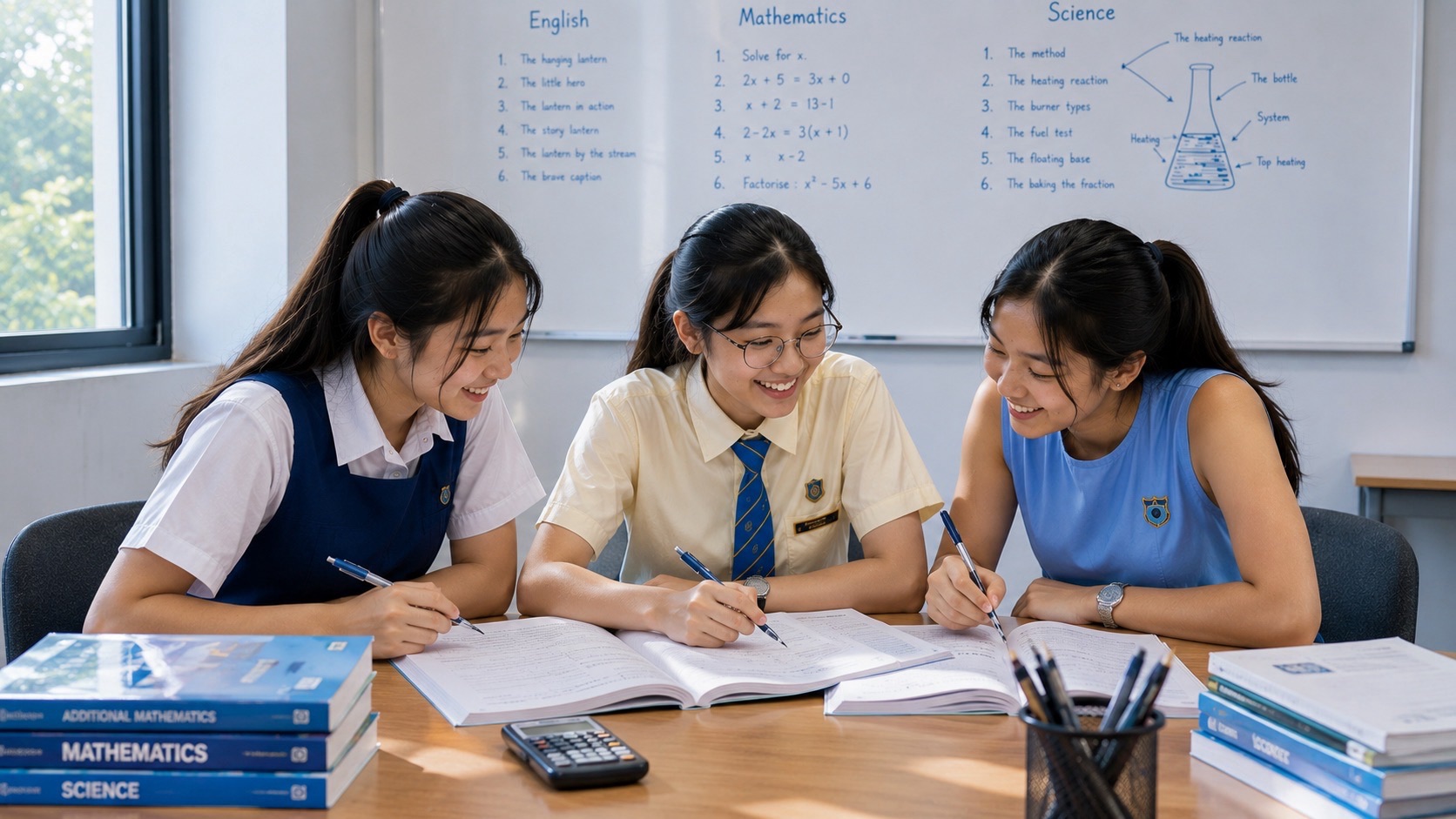
Secondary 1 G3 English small-group tuition can help Toa Payoh students turn a long passage into a short answer that keeps the writer’s meaning. In a group of three, each student can choose points independently, compare what they kept and then try a new passage after feedback. The tutor can see who missed a condition, who kept the same idea twice and who understood the passage but changed its meaning while paraphrasing.
Start with one marked summary from school, its question and the original text. Ask your child to explain what each sentence in the answer contributes. If the problem starts before writing, practise selecting the right ideas. If it appears during rewriting, practise carrying the same meaning into a shorter sentence. Use the school’s current instructions and build the skill steadily towards the later Singapore–Cambridge Secondary Education Certificate (SEC).
- Circle what the prompt asks you to explain, then check each potential point against those words.
- Keep details that change the meaning, especially who is affected, when a condition applies and whether an outcome is certain or possible.
- Combine repeating ideas and shorten examples only after identifying what they demonstrate.
- Look for a three-student lesson with an independent attempt, individual feedback and a fresh task for each student.
- Follow school instructions for Secondary 1 assessments and check the national syllabus for your child’s eventual examination year.
In this guide
Start here
Keep going
What changes when a Toa Payoh student starts G3 English?
In Primary 6, a child may already know how to locate an answer in a passage, recognise a useful clue or explain what a writer means. Those habits give them a good start. In secondary school, the same child may have to find ideas scattered across a text, check how they relate and write a response that covers only a specific part of what they read. They may need to make the wording shorter while keeping the original relationships intact. A useful short answer depends on reading the whole question carefully before reaching for a highlighter.
Imagine a school report about a reading corner. It explains why teachers proposed it, what students used it for and what difficulties appeared during the first month. “Summarise why the school set up the reading corner” calls for the initial reasons. “Summarise what the school learnt after opening it” asks about the later experience. A child can understand every sentence in the report and still produce an unsuitable summary by answering the wrong question. Ask them where their attention went when they first read the instruction. Their answer helps you identify whether the next practice should focus on the prompt, the passage or the writing.
The same habit matters across English. A reader deciding what to keep in a summary is choosing evidence for a purpose. A listener deciding what to note is filtering spoken information. A writer deciding what to include in a short report has to think about the reader’s needs. Oral communication calls for similar choices when a speaker takes a long explanation and makes its important point clear. The secondary curriculum brings these skills together alongside grammar and vocabulary, which help the student describe relationships and limits accurately. Secondary English Language curriculum
Check the school’s subject offer and assessment instructions
Under Full Subject-Based Banding, G3 describes the level at which a particular subject is studied. A Posting Group helps determine admission and a child’s starting subject profile. Students can take subjects at different levels. Check the school’s actual English Language subject offer or subject record if the family wants to confirm that a child is studying English at G3. For questions about future choices or a possible change of level, ask the school what applies to the student’s situation and when the school reviews it. Full Subject-Based Banding overview · Guide to Full SBB and the SEC
The national G3 English Language syllabus published for the 2027 SEC gives families a view of later expectations. The school-candidate listing identifies the 2027 syllabus code as K300 and shows 1184 as the earlier reference code. In that 2027 specification, Writing and Comprehension each account for 35 per cent, Listening for 10 per cent and Oral Communication for 20 per cent. The comprehension paper includes a summary based on a non-narrative text. The published description calls for about 80 words, excluding the introductory words provided. 2027 G3 subject listing · 2027 G3 English Language syllabus
A Secondary 1 teacher may teach selection first with a short paragraph, then ask students to combine ideas from a longer source. Use the word range, scope and format printed on the school’s task. The examples here use their own shorter limits so a family can see precisely which decisions to practise. Check the national specification published for your child’s eventual sitting year when you reach that stage.
Find out where the summary starts to go wrong
Bring one complete example from school, including the instructions and passage. A marked paragraph without its question can leave out the clue that explains the mark. The comment “too much detail” might mean that the child included off-topic sentences, used several examples to repeat one point or kept the right points but took too long to express them. Each of those problems needs different work. Before asking your child to rewrite, put the question beside the answer and work out which one it is.
Start without timing. Ask your child to restate the question in their own words, using one short phrase or sentence. Then have them mark two places in the text they believe are relevant. Ask what the first passage detail says and what the second adds. Once you see the ideas they selected, read the summary and look for any change in meaning. Finish by giving them a short new passage. The first task shows what happened before. The second shows whether the child can still make the decision with the old answer covered.
See which skill the sample reveals
A child may underline the reason a project started and its first result when asked only about its results. Read the question together and name the difference in time. Mark ideas that came before the project with a small “before” and later changes with an “after”. The labels are a brief aid for this question. The student can replace them with better labels when a different prompt asks about causes, difficulties, solutions or benefits.
Another child may know which information belongs and still write an inaccurate sentence. The source says “some pupils who travelled alone requested clearer directions”. The summary says “pupils who travelled alone needed help finding the room”. The summary drops the limit of “some”, changes a request into a demonstrated need and narrows the request to finding a room when the original directions could cover several parts of the journey. Ask the child to name the actor, action and limits in both versions. A closer rendering would be “Some unaccompanied pupils asked for clearer directions.” If “unaccompanied” is unfamiliar, “Some pupils travelling alone wanted clearer directions” keeps the meaning in ordinary words.
A third child may overrun the limit with ideas that are all relevant. If two sentences say that asking about available places delayed entry and that students had to wait while helpers confirmed the available places, see whether they describe a single delay. “Checking vacancies held up entry” can carry that point in five words. If the second sentence actually says a second queue formed because helpers checked names after confirming spaces, both events might matter. Similar words are a reason to inspect the relationship between ideas. The source and the prompt determine whether the details belong together.
Choose a repair you can observe
A useful target describes something the student can do. “Improve summary” is broad. “Keep the source’s limit on who gets priority in the answer” gives the child a test. Read two clauses aloud and ask which one applies to everyone. Then give a short example about a different event where a restriction matters. The first exercise helps the student notice the feature. The second shows whether the student can look for it without being told exactly where it is.
Where the difficulty is copying, ask the child to explain the selected idea in a conversation after looking away from the passage. Write down the phrase they use if it is accurate and simpler. Then reopen the passage and check the actor, action and qualifier. Some original terms will still be useful. A notice about a ballot can stay a notice about a ballot. Changing the order and emphasis of the sentence often gives more freedom than searching for a different word for every noun.
Contents · Previous section · Next section
Select points by the question you actually have
A worked reading routine can begin with three decisions. First, identify the subject of the summary. Is it a project, a set of changes or a problem experienced by particular people? Next, identify which part of that subject the question wants. A passage may include origins, outcomes and plans. Finally, check any limits on where to look or whose experience counts. In an exercise with named paragraphs, read the whole text for context, then collect answer points within the stated range. Where a question identifies a group, test every selected point against that group.
During a first reading, let the child get the gist of the passage. During a second reading, mark possible points with brief notes. Two or three key words are often enough to hold an idea while the child reads on. At the end of a paragraph, ask “What will this contribute to the answer?” A student can then spot when two different phrases carry one idea and when two similar-looking phrases describe two different effects.
Suppose one sentence says “The room stayed open during lunch because some students had coaching immediately after lessons.” If asked why the room stayed open during lunch, include the after-school commitment and explain the link. If asked what the school changed, the opening time is the answer. If asked who benefited, identify the students who had coaching and use the passage to judge whether there were other groups. The same line can supply different information. The prompt decides what survives.
Preserve the relationship when you group ideas
A list of selected facts is a workable plan. To write with clarity, show which facts belong together. Two conditions may apply at the same time. An original account may say a notice should be displayed only when there are volunteers available and the event has actually been confirmed. If a summary uses “or”, either condition becomes enough. That small word changes a rule. If a summary drops the time phrase in “available during the first week”, it can also make a short arrangement sound permanent.
Causal words deserve similar care. “The notice arrived late and some pupils missed the briefing” reports two events. “Some pupils missed the briefing because the notice arrived late” says one produced the other. Read the lines around the claim to see whether the passage establishes that link. Where a writer explicitly gives a reason, carry it over. Where the passage gives only an order of events, words like “after” or a simple “and” may be more accurate. A student who uses “because” lightly can turn a careful report into a confident explanation the writer never made.
Compress explanations without making them vague
When two examples show the same feature, try to name the feature. A source may say the new signs help visitors find the stairs, the lift and the main entrance. If all the prompt needs is the benefit, “The signs help visitors find their way” may be sufficient. If the question asks what specific access problems the signs address, the lift and stairs may need to remain. A good summary can give more space to an important detail than to a long, colourful paragraph. Importance comes from the question and from the part that detail plays in the passage.
Test a proposed short version by asking whether the original writer would recognise the claim. “Some volunteers were concerned that early arrivals blocked the corridor” can become “Some volunteers worried early arrivals obstructed the corridor.” “The corridor was unsafe” is a different statement. The original reports concern about obstruction. It leaves the broader judgement open. A student who remembers whose view is being reported can use this skill in comprehension questions about attitude, in a school report and in a discussion with a classmate.
Contents · Previous section · Next section
Practice one — Summarise changes to a book exchange
The events and people in these exercises are fictional. Imagine that a student committee in Toa Payoh runs a lunchtime book exchange and reviews a trial. Read the passage once with the model answer covered. Try the question in the suggested practice range of 45 to 60 words.
The passage
The committee chose an exchange after classmates said finished books often sat unread at home. On the trial day, students entered through whichever door was closest. Some visitors asked the same volunteer about bringing damaged books, finding books for younger readers and checking whether a swap was compulsory. Students arriving during the busiest part of lunch struggled to see the titles on the tables. The committee heard that visitors liked browsing beside friends, especially when they had similar interests.
For the next exchange, the committee plans to give visitors one entrance. The other door will remain clear for people leaving so the two lines do not cross. A volunteer at the entrance will answer questions about what may be brought and how the exchange works. The committee will put books for younger readers on a separate shelf, after several visitors said those titles were hard to find. When the room becomes crowded, the next group will wait outside until people leave. The organisers want to try these changes on one more lunch period before deciding whether to use them regularly.
Before the trial, a teacher had suggested collecting extra books to lend to another class. The committee will consider that idea after reviewing the second exchange. One student also suggested adding a poster competition. The class representative said it would be easier to decide on extra activities after the room arrangements were settled.
Question. Summarise the changes the committee plans to try at the next book exchange and what it intends to do before making them regular.
Work through the choice of points
The question focuses on the next exchange, then the decision about regular use. The reason for starting the first exchange gives context and has no place in the answer to this question. The possible loans and poster competition are later suggestions. Keep your place in the paragraph that signals the committee’s plan. Find specific changes to entry and exit, help with questions, book arrangement and handling a crowd. Then find the last step the organisers want to take before deciding whether to keep the arrangement.
Check which words matter to each idea. A separate exit has a stated purpose, preventing lines from crossing. If a school task asks only for what the changes are, specifying “separate entrance and exit” may be enough. The entrance volunteer has a particular job. “There will be more volunteers” introduces a claim about numbers the passage does not make. For crowd management, preserve when the waiting happens. “The next group will always wait outside” changes a measure for crowded periods into a general rule.
Worked answer. The committee will separate the entrance and exit, station a volunteer at the entrance to explain the exchange rules, and shelve books for younger readers separately. When the room gets crowded, newcomers will wait outside until others leave. The organisers will test the changes over another lunchtime before deciding whether to keep them.
This answer groups the door arrangements into one clause and keeps the crowd condition next to its consequence. It includes the plan to make a decision after a further trial. “Another lunchtime” captures the proposed duration. The source described several questions asked at the first trial. The model answer groups the related questions as “exchange rules”, which makes the volunteer’s role clear within the available space. The success of the first exchange and the teacher’s suggestion remain outside the requested scope.
Try a question that asks for a different kind of information
Now ask “What made the first exchange difficult for some visitors and volunteers?” Keep the same passage and put the previous model away. The volunteer faced repeated questions. During the busiest part of lunch, some students struggled to see titles. Some visitors found books for younger readers hard to locate. The proposed separation of the entrance and exit suggests a practical concern, although the passage does not say that queues actually crossed during the first trial. A careful answer can stay with the difficulties the account reports.
A possible response is “One volunteer repeatedly answered questions about what pupils could bring, how to find books for younger readers and whether swapping was compulsory. At the busiest time, visitors had trouble seeing the displayed titles. Some visitors also found books for younger readers hard to locate.” The first line describes the work of the volunteer. The last line describes what visitors experienced. If space is tight, combine the two visitor difficulties into a single sentence and keep the distinction between seeing titles generally and locating a particular group of books.
A tutor can draw a conclusion from how a student handles this change. If the student copied the original response about what the organisers will do, they need practice switching the question. If they identified the right period but included the concern about crossing queues as something that occurred, they need practice separating an inference from a reported fact. If they got the right points but wrote three separate sentences about the entrance volunteer, examine how one sentence could capture the common idea. Each diagnosis leads to a small task the child can try again that day.
Contents · Previous section · Next section
Practice two — Keep the condition attached to the outcome
In an invented school project near Toa Payoh, students test a borrowed equipment system for group activities. The report below describes what happened at two points in the trial.
The passage
Before the new system, groups sometimes waited while their teacher looked for spare tape, scissors or rulers. Some groups brought extra materials from home. The teacher wanted students to know what was available before a lesson started. During the first week of the trial, each group collected a labelled tray at the beginning of the activity. Groups finished setting up more quickly when a class helper had checked the trays beforehand. When the helper was absent, a few groups still had to wait for missing materials.
The tracking sheet helped the teacher see which trays had been borrowed. It did not show which items were returned damaged until students added comments about their equipment. The teacher began reading those comments the next morning and replacing damaged items before the following activity. Groups which returned their trays after the end of the lesson had less time to record what was missing. Some of their comments were completed the next day, after the teacher had already checked the sheet.
The equipment monitor suggested placing a return tray by the door. She expected this to save more time, although the class had yet to use the proposed location. The teacher agreed to test it during the next activity if there was space beside the entrance. One group suggested buying more supplies. The teacher planned to review the comments before deciding what extra equipment was needed.
Question. In 50 to 65 words, summarise what the trial showed about setting up faster and finding out which items needed replacement. Keep the limits of the evidence.
Show what belongs and why
Select the link between faster setup and the helper’s preliminary checks. Preserve the exception when the helper was absent. Select the distinction between knowing which trays were out and learning what had been damaged. The comments supplied damage information. The timing of the comments also mattered. Some were completed after the next morning’s check. The possible return tray is a future plan. The equipment monitor’s expectation can be recorded as a proposal if a different task asks what might happen next.
Worked answer. Groups set up faster when a helper checked trays beforehand. Some still waited for missing items without the helper. The tracking sheet recorded which trays groups borrowed, while students’ comments identified damage so the teacher could replace equipment. Groups returning trays late had less time to comment, and some comments missed the teacher’s next morning check.
A common first version is “The new system helped all students set up quickly, and the list told the teacher what to replace.” Try asking which phrase establishes “all”. The trial showed faster setup under a condition and recorded some waiting without it. Ask where the information about damage came from. The teacher could see tray loans from the sheet and needed the added comments for damaged items. These tests show why the initial version, although short, is too broad.
Repair three unfinished attempts
“Trays were labelled so all groups finished setting up earlier.” Labelling is reported. The condition attached to quicker setup is the helper’s check. A more accurate repair is “Groups set up more quickly when a helper had checked the trays.” The useful relationship is between checking and speed. Including the label may be reasonable in a wider summary of how the system operated.
“The teacher read the tracking sheet and replaced every damaged tool.” The teacher used comments to find out about damage and began replacing damaged items before the following activity. Late comments could be missed at the next check. A narrower repair is “Students recorded damage in comments the teacher used to replace items before the next activity.” Use a second clause if the question requires the limits on when the information was available.
“The new return station made the system faster.” The location had been suggested. The monitor expected a benefit, and the teacher planned to test it if space permitted. A faithful version is “The monitor expected a return point near the door to save time, and the teacher planned a trial if space permitted.” This sentence is relevant to a follow-up about proposals. It can be left out of the original task because the question asks what the trial showed.
Try the variation by replacing the question with “Summarise what the class planned to test next and why.” A complete short response could say the teacher would try a return point by the entrance if space allowed because the monitor thought it could speed up returns. If the task also asks about equipment purchases, state that the teacher would check comments before deciding what more to buy. Ask the child how they decided which earlier results to leave out. That explanation often reveals how well the student can keep a question in mind.
Contents · Previous section · Next section
Practice three — Combine examples and keep different benefits separate
At an imagined school near Toa Payoh, a teacher asks two students to report on changes to a classroom display. This passage gives examples and consequences across several paragraphs. Try to write 55 to 70 words about the benefits students actually experienced after the display changed.
The passage
The science club originally pinned every news item to one board in order of arrival. Younger pupils often needed help finding the current week’s instructions. Visitors could see photos of completed experiments but could rarely tell which materials had been used. The teacher proposed moving the display to a larger wall. The students asked to try making better use of the original board first.
The club gave each section a clear heading and marked the latest instructions with a date. The dated heading helped several pupils check that they had found the right week. Some pupils who previously asked a club member for directions found the instructions independently. The club also added short notes about the experiments. Students visiting the board could recognise how a paper bridge had been folded and which materials a water filter used. In one case a class used those details when planning its own demonstration.
During the first week, the club displayed unfinished sketches with a note asking for suggestions. Readers left ideas about how to make a bridge hold more weight. Several pupils later recognised their ideas in the revised display, and one group said it felt more involved in the project. The teacher saw people asking questions around the board, although no one counted whether visits had increased overall. One student proposed adding a recording that visitors could play. The school would need to consider equipment and background noise before deciding.
Question. Summarise the benefits pupils experienced after the display changed. Leave out future suggestions and claims about effects the report did not establish.
Sort examples into useful points
The passage discusses finding instructions, learning about experiments and contributing ideas. Examples belong under those three benefits when they explain what changed for students. The folded bridge and water filter materials both illustrate how the notes helped students understand the displayed work. If the question asks for benefits generally, “short notes helped pupils understand how projects were made” can cover these examples. The demonstration is a further use of the information. It might be worth a separate clause. Being able to explain how a project works and using that information to plan another piece of work are related benefits with different effects.
The new date helped some pupils identify the right week, and some found instructions without help. Combine these without claiming that the same pupils did both if the passage gives the reports separately. A short version could say “Clear sections and dated headings helped pupils check the week and sometimes find instructions independently.” One group felt more involved after seeing suggested ideas contribute to the revision. Avoid changing “one group” to “everyone” when making this point.
Worked answer. Pupils could check that instructions were for the right week, and some found them independently. The notes explained how projects were made and what materials pupils used. One class used those details to plan its own demonstration. Readers contributed suggestions for unfinished work, several pupils recognised their ideas in the revised display, and one group felt more involved.
The model uses three sentences to carry connected points from three parts of the account. It skips the examples about specific materials and folds because the prompt asks for benefits. It keeps the single class and group limits where they matter. The increase in overall visits remains unproven. A teacher seeing conversations can report conversations. The passage has no count to support a general comparison with previous visits.
Rewrite a sentence for a narrower question
Ask the child to use the same passage to answer “How did the display give pupils a chance to contribute?” A short answer can name the unfinished sketches, the invitation to suggest improvements, what a contribution might look like and how pupils recognised their ideas later. The display heading and date have helped people use the board, but belong outside the narrower answer. At this point, cover both model answers and ask the child to explain to a partner how the question changed the stopping point. Listening to that explanation reveals whether the decisions have started to become independent.
Contents · Previous section · Next section
Take the same decisions into listening and writing
A passage stays on the page. A spoken announcement keeps moving, so a listener has less time to check where an exception belongs. Give your child a listening purpose before reading an announcement. Ask them to note the details that change what a particular person should do. After listening, they can say the information back in one or two sentences, then compare their response with the script. A parent can read the following example aloud at a normal pace.
Announcement. “The class will discuss the next reading project in the usual room on Thursday, just after lunch. The job of labelling donated books will move to Friday morning because the labels have yet to arrive. Students who signed up to label books should check in with the teacher on Thursday only if they are unavailable on Friday. The people who signed up to carry the books still need to come to the classroom on Thursday morning. They will move the boxes before the discussion.”
Question. Your friend signed up to label books and is free on Friday. What should they do, and why did the plan change?
Worked answer. They should go to the labelling session on Friday morning because the labels have not arrived. The Thursday check-in applies to people who cannot make the new session, so your friend can skip that check-in. The boxes are being moved on Thursday by another group. That detail does not change this friend’s plan and can be left out of the short answer.
Ask your child to take only a few notes after the first hearing. They might write “label Fri morning”, “labels delayed” and “Thu check only if unavailable”. On replay, check whether each note has kept the right people and time. If the child wrote “all helpers Thu”, ask which group was due to arrive that morning. The exercise lets you see whether the student heard the phrase, attached it to the correct group and kept the exception. The 2027 G3 English syllabus includes an informational note-taking task in Listening. The school will tell the student what practice format to expect in Secondary 1.
Carry a fair summary into a report or oral response
A class asks one student to write a short note to the teacher about a trial. The source says some pupils found the instructions independently after the board changed. The source also says one class used the information to help plan its own demonstration. A useful note could say “The dated instructions helped some pupils find their way through the display independently. One class also used information from the display to plan a demonstration.” The reader can see what each change achieved. If the writer wants the teacher to approve a larger board, the student still needs to supply a separate reason for that proposal.
In an oral exchange, a parent can ask whether the display should become permanent. Begin with a fair account of what the trial showed, then add a reasoned view. The student could say “One class used the display for project planning, and some pupils found instructions without help. I would keep the trial going for another month to see whether students from more classes use it.” The first sentence reports evidence. The second makes a recommendation and says what further observation would help. Separating those jobs makes it easier to answer a follow-up, such as “Why another month?” or “How will the class know who used it?”
Contents · Previous section · Next section
See why a three-student lesson can work
A group of three gives students two other readers whose selections may differ. Use that variation by asking everyone to select points silently before any discussion. One child may underline too much, another may have selected the right idea without a condition and a third may have found the exception but missed the main outcome. The tutor can ask each student to name the strongest point they chose. After comparing two different explanations, all three pupils still write their own revision. Then they try a short fresh text individually.
A suitable lesson leaves the student with a visible change. Ask your child to show the first answer and explain one decision they made in the revision. They might say they put the limit “when the room gets crowded” back because the original plan applied only then. If the child replies that the class copied the final answer, ask what they later tried on their own. The work that matters is the attempt in which the child makes and checks the choice independently. A school sample, a tutor’s exercise and a short home attempt can tell different parts of that story over time.
Match the support to the actual difficulty. A student who selects the right ideas but keeps changing small words in ways that distort them may benefit from carefully targeted discussion about tone and certainty. A student who reads slowly may need an untimed start and shorter passages before practising full school tasks. A classmate working on a different action can still be a useful reader if there is independent work and targeted feedback for each child. Ask how the tutor handles differences in confidence, particularly whether an outspoken learner has room to contribute while someone quieter still gets to explain their own decisions.
For a Toa Payoh family, look at the whole week. Include travel from school or home, the child’s other commitments and the time they usually need for dinner, independent work and rest. Ask where the lesson would take place, whether the available group fits the child’s actual subject level and what the tutor will ask the child to bring. Families can start with help from school and short practice at home if the difficulty is clear and improvement is already visible. Consider extra support when the student keeps meeting the same difficulty across tasks and needs more guided attempts or feedback than the current routine provides.
Contents · Previous section · Next section
Use four weeks to see what has become independent
Begin in the first week with a marked school summary and a new passage with a similar scope. Keep the attempt intact. Ask the student to point to the phrase in the question that decided what to include. Compare their chosen ideas with the prompt and identify one place where their selection went beyond what was requested. If the child spotted the right set of ideas, check what happened during paraphrasing before setting the next exercise.
In the second week, make the target small. For instance, choose five short examples where a claim depends on “some”, “only when” or “may”. Ask your child to paraphrase them while preserving those limits and explain whom or what each limit affects. Later in the week, use a passage with several tempting examples and a qualifier elsewhere. Let the student find the qualifier themselves. A parent can check whether they retained it without giving a reminder beforehand.
In the third week, work on organisation and length. Use the word range from one school task where available, or pick a practice range appropriate to the passage you have chosen. Time the final rereading after the main decisions are sound. Give the child a chance to build a short first draft and shorten one sentence by combining repeated ideas. Check that the shortened version still keeps the right participants, conditions and degree of certainty. A sentence that takes up several fewer words yet loses a limit is a less useful edit for this purpose.
In the fourth week, cover all previous work and try a fresh passage on a different topic. Let the student explain the task, mark possible points, write a short answer and check it. Compare the result with the first independent attempt. Count relevant ideas as well as any additions the passage does not support. Check whether the child caught a needless repetition or restored a qualifier before an adult pointed it out. Use that evidence alongside school feedback when deciding whether to keep the current routine or adjust the help.
Help your child count words with a purpose
Check the school’s directions about counting, particularly where an opening phrase is provided. In a home exercise, a rough count of a first draft shows whether the student needs to combine several lines or make a small edit. Find the longest sentence and underline each part that earns its place. A phrase such as “it is important to mention that” often adds little to a tightly scoped summary. A phrase such as “if enough volunteers are available” might be essential. This distinction makes a final word check more valuable than dropping the last sentence to make a number fit.
If a pupil writes well within the limit but includes little of the required information, the problem may be under-selection. Return to the prompt and ask which part remains unanswered. A child can use words they have available to complete that part with an exact phrase from their own notes. If a pupil is just over the range, see whether an example can become a category or whether two adjacent sentences share an actor. Then reread to check whether the new sentence still separates two conditions that need to remain separate.
Contents · Previous section · Next section
Frequently asked questions
Should my child use different words for everything?
Keep unavoidable terms, such as a project name or an accurate term for a process. Show understanding by choosing the right ideas and expressing their relationship clearly. If the school asks for paraphrasing, practise saying the same claim aloud and writing it in a simpler structure. A synonym helps when its meaning fits the situation. Changing “estimated” to “proved” is a larger error than keeping the original word.
How can I tell whether the passage or the wording is the difficult part?
Ask your child to keep their written answer covered and explain the selected point verbally. If they can explain it accurately in speech but it changes on paper, compare the wording of the two versions. If they cannot yet explain the point, reread only the relevant lines together before writing again. When they can do both, give a new question to check that they can select the point without your cue.
Is a short answer always a good summary?
Length matters when the task sets a limit. The quality of a summary also depends on coverage, accuracy and how ideas fit the question. A short response may omit the reason a method worked or overstate the people it helped. Read a short answer against both the instruction and the relevant parts of the passage. Ask what the reader could correctly conclude after reading it.
When should we practise at a faster pace?
Start by observing whether the student can select and paraphrase accurately with enough time. Then shorten the time for one part, such as choosing the strongest points, while leaving room to draft and check the response. Use the school’s directions for assessment practice. Keep a short record of which mistakes return when the student begins to hurry and use it to plan a targeted exercise.
Should we use the 2027 national summary instructions for Secondary 1 homework?
Use the school’s instructions for the work in front of your child. The 2027 SEC specification shows how one national cohort is assessed later in secondary school. Your child’s class may use a different kind of source or a shorter length while building the skill. When you plan for the actual examination, confirm the specification and details for that sitting year.
What should I look for in the first few tuition lessons?
Look for the actions your child takes. They should have a chance to explain what the question asks, justify at least one selection and improve their own wording after a precise comment. Ask for an example of what happened on an unfamiliar task. A child who can describe how they made a better choice can tell you more about the fit of the lesson than the number of worksheets they came home with.
English learning guides · Reading for evidence and inference