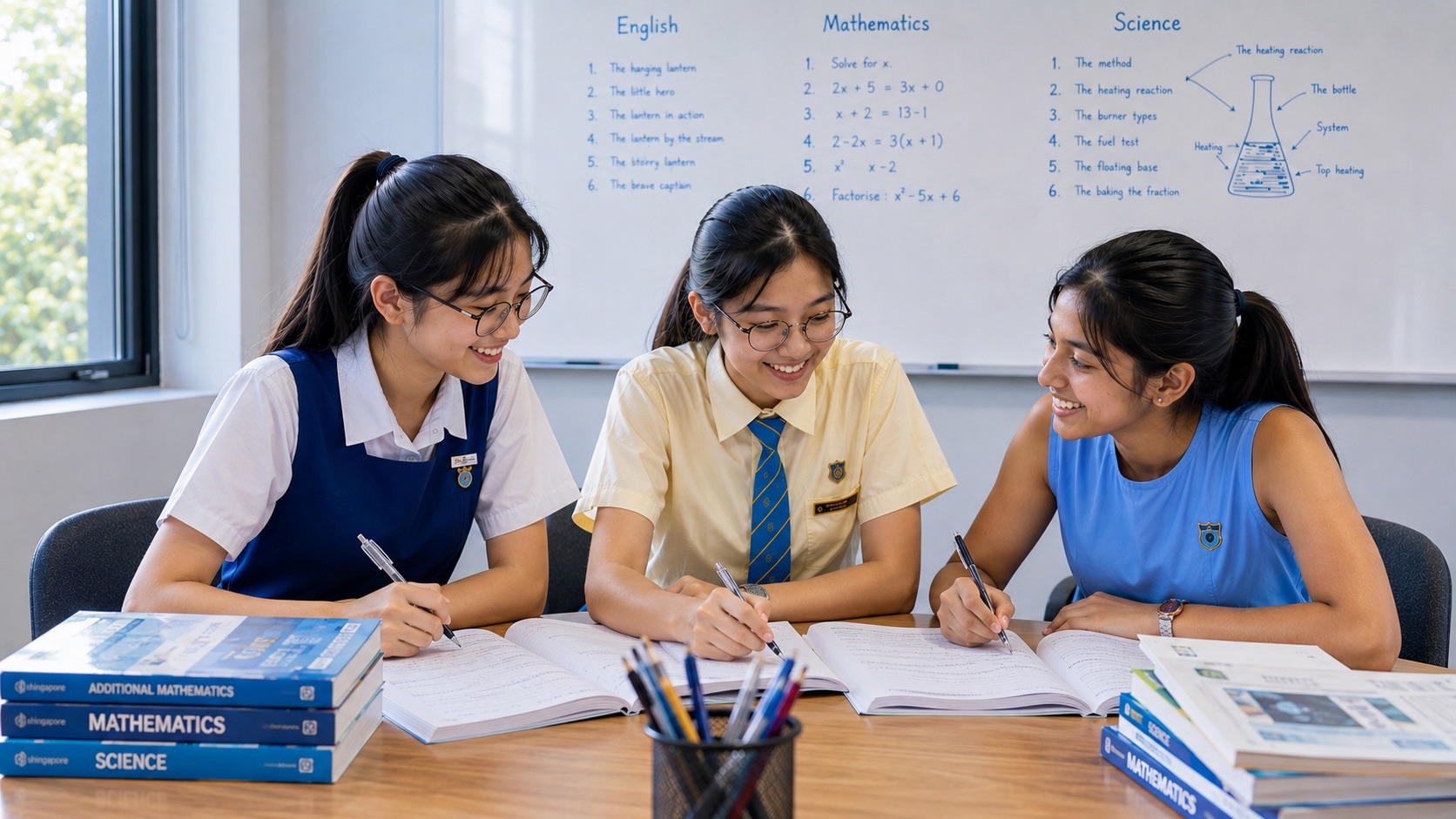
Secondary 1 G3 English small-group tuition in Queenstown can help when a child understands the words on a poster but struggles to explain what the design is doing. A group of three gives each learner time to read quietly, name a feature, hear how somebody else interpreted it and revise an answer. Start with a particular piece of schoolwork. Find out whether your child missed an instruction, chose weak evidence or stopped after naming a feature.
Visual comprehension asks students to read the placement of information as carefully as the words themselves. A picture can supply a detail that the heading leaves open. A caption can limit what a chart appears to show. This guide gives Queenstown families original practice in reading those connections and deciding whether a small group gives their child the feedback and independent practice they need.
- Ask your child to state the intended reader, the message and the action before commenting on individual colours, pictures or type sizes.
- Build an explanation from one identifiable detail and what that detail helps a particular reader understand, feel or do.
- Check the units, period and group shown in a chart. Keep those limits in any written answer.
- Use a group of three for independent first answers, discussion of genuine differences and a second attempt without help.
- Confirm the current subject level and school task instructions. Use the SEC syllabus published for the relevant sitting year when the national exam approaches.
- Try the four original Queenstown practice sets below and compare what your child can do on a fresh example after feedback.
In this guide
Start here
Keep going
What changes when a Queenstown student starts G3 English?
A child who can find the venue, date and time on a Primary 6 notice already has a useful reading foundation. Secondary 1 builds on that skill with questions about how the notice works. Why is one instruction beside the map rather than at the bottom? How does a photo change the meaning of a headline? Which person can act on the information, and who would need another source? Students learn to make those judgments and explain the evidence behind them. Their answers become stronger when they can show the relationship between a design decision and a reader’s needs.
Imagine a hand-painted sign with a large arrow and the words “Return here”. A child could name its feature as “an arrow”. A more informative answer tells us that the arrow directs people holding borrowed equipment to the returns side of a shared counter, helping them join the correct queue. The words “Return here” matter because an arrow on its own could point to an entrance, a collection desk or a lift. The position of the sign matters because a person can use its advice before reaching the point at which the queue divides. The analytical skill is to read all these details together.
The school’s English offer and the national syllabus answer different questions
Full Subject-Based Banding uses Posting Groups for secondary school admission and to guide students’ starting subject levels. G3 describes the level at which a student takes an individual subject. A student can take English Language at one level and other subjects at different levels. Use the school’s confirmed subject information or timetable to check your child’s current English Language level. If you are unsure what a change would involve, ask the school when it considers subject-level changes and how it takes readiness and workload into account. Full Subject-Based Banding overview
The secondary English Language curriculum links reading and viewing to listening, speaking, writing and representing, with grammar and vocabulary helping students communicate across these areas. The same student may read a poster, discuss whether it will help its audience and write an email asking permission to use it. Grammar helps clarify who is responsible for what. Vocabulary helps the student name the effect they have identified. The work depends on understanding the situation as well as knowing the terms.
For the published 2027 SEC school-candidate G3 syllabus, English Language is listed as K300, with 1184 as the previous reference code. Writing and Comprehension each contribute 35 per cent in that published specification, Listening contributes 10 per cent and Oral Communication contributes 20 per cent. The 2027 G3 English Language examination syllabus includes a two-text comprehension section with visual material. Situational writing also uses a visual text, and the oral planned response has a video stimulus. Those examples show how one viewing skill can support different tasks.
The immediate job in Secondary 1 is to understand what the school expects on this term’s work. A school might teach a short advertisement analysis, mark a response to a photograph or use a presentation task. Check the assignment sheet or teacher’s instructions for the current format. When your child approaches the national examination, check the syllabus for the actual sitting year. The practice texts here are original teaching examples with invented events, names and figures. The tasks start small so families can see which decisions a student can already make.
Read the whole visual before choosing evidence
Ask who can use the information and what they are meant to do
Give the text an initial look from the point of view of its likely reader. A school notice about a trial rehearsal goes to people who can attend it. An instruction on an equipment cupboard goes to people who are already using the room. A chart in a report may go to adults deciding whether a trial should be extended. Each reader arrives with a different question. For a pupil who needs to make a booking, the time and instructions need to be easy to find. For a committee deciding whether to change a rule, the sample size and period may deserve more attention.
Audience is most useful when the student can explain why the reader matters. “The poster is for young people” can be broadly correct while leaving out the information that supports it. “It addresses first-time volunteers because it begins with ‘Your first session?’ and puts preparation instructions directly below that heading” makes the group and the evidence clear. The evidence could also be a choice of location, an instruction addressed to a pupil, or a contrast between directions for visitors and directions for helpers. Let the visual itself determine how specific the student can be.
Have your child state the purpose in a verb phrase. Think of actions like inviting new volunteers, helping visitors choose the right route, reminding people when to return books or persuading a committee to continue a trial. Check that the chosen verb fits the actual material. A poster on a wall may advertise an event. The same poster redesigned for the entrance on the day might guide people around the event. The image might be unchanged, with a new location and caption giving it a different job.
Notice placement, scale, relationship and sequence
Ask what a reader is likely to notice first and which features give the text that order. Larger words often gain attention. A contrasting border can separate a warning from other instructions. A repeated symbol can connect two pieces of information on opposite sides of a page. A line, numbered step or directional arrow can guide somebody through a process. Spacing may separate two audiences without using elaborate illustration. These features have effects a student can identify and check against the question.
Next, ask what becomes clear when the reader combines two features. An image of two students at a desk says little about who can attend an activity. A caption saying “First visit? Ask either helper to show you around” gives the image a particular meaning. Now the viewer can connect the people in the picture with the instructions for new visitors. Try reading the picture description alone and then the caption alone. Ask what each leaves unanswered and what the pair allows the reader to infer.
Sequence deserves its own check. In a four-frame storyboard, a close-up of a hand appears different depending on what comes before and after it. If the first frame shows a missing label, the second shows a hand writing one and the third shows someone using that label successfully, the sequence invites us to connect an action and an outcome. A reader should still check what the frames actually show. They might record one helpful action and its immediate result without establishing that every user will find the same solution equally easy.
Write the effect as a consequence for a reader
A student might write, “It uses red to attract attention.” As a first step, this identifies a design choice. Ask what needs the reader’s attention and what the reader will do once they see it. “The red outline surrounds the words ‘Check the size first’, drawing the attention of pupils who are about to add a book to a narrow shelf. That placement helps them choose the right slot before setting a book down.” Here the answer names the outlined words, adds the situation and predicts a practical effect.
Check the question’s scope before adding a second detail. If it asks about an image and its caption, use both. If it asks what a group of readers should do, identify that group and the action the text makes possible. If it asks for a comparison, choose a common criterion and explain both texts against it. A short, precise answer can meet the task. The purpose of practice is to make that decision repeatable across unfamiliar visuals.
Contents · Previous section · Next section
Practice one — A notice for a lunchtime repair clinic
Read this written description of the poster
A fictional secondary school in Queenstown is planning a lunchtime clinic for minor repairs to stationery and pencil cases. A corridor poster is placed along the route to the school’s activity room. Across the top, large curved lettering reads “Give your everyday kit a second chance”. Below this, a two-part drawing shows a pupil holding a pencil case with a loose zip pull, then a helper pointing at a possible replacement pull. A caption directly below the illustration reads “Show us one small item. We’ll check whether we can help.” Lower down, a plain rectangle gives the day, time and room entrance. The event runs on Thursday from 12.45 to 1.15 p.m.
At the foot are two equal boxes. The left box, marked A in a circle, reads “I have something to show. Join the assessment queue.” The right box, marked B in a square, reads “I want to see what the clinic covers. Ask the door helper.” An arrow leaves each box in a different direction. Small print beneath the boxes says “No electrical items”. All procedures in the practice example are invented.
Answer four questions from the text
Question 1. What is the main purpose of the poster, and which part of the description supports your answer?
Worked answer. The poster invites pupils to bring an item to a school repair clinic. The headline “Give your everyday kit a second chance” suggests that familiar things might be usable for longer. The caption asks pupils to show one item so that a helper can decide whether assistance is possible. An answer that only lists the time gives an event detail. To explain the purpose, connect the event with what the school hopes pupils will do.
Question 2. How do the picture and caption work together?
Worked answer. The two-part drawing gives a concrete example of the sort of minor damage a pupil might bring and shows a helper examining a possible fix. The caption gives the general instruction and explains that the helpers will check whether they can assist. The drawing makes the event easier to picture. The caption keeps pupils from treating the suggested replacement pull as a promise of a successful repair.
Question 3. How does the layout help pupils who are still deciding whether to take part?
Worked answer. Two boxes separate pupils who have an item ready from those who want to check whether an item is covered. Box B gives an uncertain pupil a clear action, asking the helper at the door, and the arrow directs them away from the queue for assessments. Saying the boxes make the poster neat would leave out the decision they help people make.
Question 4. A pupil wants to bring a desk lamp. Where should they look to check whether the clinic can help?
Worked answer. They should read the line beneath the boxes. “No electrical items” excludes a desk lamp. The title describes the general idea and the drawing gives one example. The small print supplies a rule that applies to the pupil’s particular item. If the school wanted every pupil to notice the exclusion early, it could move that line beside the instruction to bring one item.
Work through a change of location
Imagine the poster is moved from the corridor to the activity-room door while the clinic is running. Pupils at the door have found the venue. The immediate question is whether to join the assessment queue or talk to a helper. A pupil might enlarge those two instructions and give the title enough space to confirm that the reader has reached the right event. The rule about electrical items can appear before the choice of queue, where someone carrying an excluded item could act on it. Explain the decision by saying who needs the information and when.
Contents · Previous section · Next section
Practice two — A storyboard for a busy equipment table
Read these four frames in order
A fictional Queenstown class is preparing a short video about returning items after a school activity. In the first frame, several tape dispensers, pens and scissors lie in a single shallow tray. A pupil reaches for a pair of scissors and accidentally pulls out a tangled cluster of elastic bands. Other students are visible waiting nearby. The framing lets viewers see the crowded tray and the queue together. There is a small caption at the bottom saying “End of the activity”.
In the second frame, a closer view shows a student cutting and writing three paper labels. Three separate empty boxes are visible in the background. The caption says “Decide where each kind of item should go”. In the third, a pupil who has just approached the table follows the picture of a pair of scissors on a box and returns the scissors to that box. The box also carries the written label “Scissors”. In the fourth, another pupil points at a short label showing what goes back first. At the bottom the final caption reads “Make the next move clear for the next person”.
Explain the sequence, framing and final line
Question 1. What does the first frame establish before the student makes the labels?
Worked answer. It shows both a disorganised tray and the practical effect of that disorganisation. The pupil looking for scissors pulls out tangled bands, while other students wait alongside the table. The opening makes the need for the later change clear. An answer about the scissors alone identifies the object but misses the delay visible around it.
Question 2. Why might the video use a closer view in the second frame?
Worked answer. The closer view lets the audience see the student preparing three separate labels, with three separate boxes visible behind the work. It directs attention to the action that is about to make the return point easier to use. A distant view of the whole activity area would leave the viewer with less information about the labels and the organisation of the boxes. The effect here is tied to what a viewer needs to see at that particular moment.
Question 3. What job does the written label perform alongside the scissors symbol in the third frame?
Worked answer. The symbol gives the pupil a quick visual cue about where the scissors belong. The written label confirms the intended meaning, which is useful if a viewer is unsure what the small picture represents. The pupil’s action shows how those cues can guide a return even without a classmate pointing out the right box. The two features support the same decision in slightly different ways.
Question 4. How does the final caption use the example to make a wider point?
Worked answer. It takes the immediate success at the table and turns it into advice for anyone setting out shared materials. The labels matter because they make the order and destination of the items clear to a person who arrives later. “The next person” shifts attention from the organiser’s intentions to the actual person trying to follow the directions. The sequence gives the reader an example of what that advice looks like in practice.
Compare two possible closing images
One possible last image shows the prepared student smiling at the camera. Another shows a new pupil following the labels without the organiser standing beside them. Which one would you choose to support the final caption? The second gives more direct evidence of the labels guiding somebody’s next move. The first could be suitable if the video ended with a message about student initiative or celebrated the organiser’s contribution. State the purpose that determines your choice.
An independent follow-up is to give your child three sentences about another process, such as returning a borrowed reader or setting out materials for a group project. Ask them to convert those sentences into four written frames. Then ask a sibling or friend to describe the process from the frames alone. If the reader pauses over the order, the student can change one view or add one caption. In that second attempt, the writer sees how a design choice changes another person’s understanding. This is a different form of practice from labelling a ready-made visual and can reveal whether the idea transfers.
Contents · Previous section · Next section
Practice three — An equipment-use chart with a narrow scope
Read the titles, numbers and note
The student committee at an imaginary Queenstown school is looking back at a four-day trial. It prepared a chart titled “Pupils using the equipment table at least once”. The bars show Monday, Tuesday, Wednesday and Thursday in order. The Monday bar reaches 12, Tuesday reaches 20, Wednesday reaches 18 and Thursday reaches 24. The vertical scale starts at zero and is labelled “number of pupils”. A line under the chart says “Count taken in the first 20 minutes of the lunch break. Each pupil counted once per day.” The display uses the same width for each bar, with visible numerals printed at their tops.
Next to the bars is a drawing of a hand holding a newly labelled box. It is captioned “New equipment labels introduced on Tuesday”. The school’s report places the chart beside a paragraph saying the committee wants permission to keep the table for a second week. It does not give information about Friday, other school activities or how many total pupils were passing during the selected period.
Test what the chart allows you to say
Question 1. What is the clearest comparison between Monday and Thursday?
Worked answer. During the measured part of each lunch break, 24 pupils used the table on Thursday compared with 12 on Monday. That is 12 more pupils, and the measured count doubled from the first day to the last. Naming the period helps the reader understand exactly what doubled. A statement that the total number of users doubled across the two days would leave open whether the speaker was including the unmeasured part of the lunch break.
Question 2. Why does the small note matter even though the bar labels already show numbers?
Worked answer. The note establishes the period and how pupils were counted. The figures represent pupils who used the table in the first 20 minutes each day, with repeat use by the same pupil that day counted once. It helps a reader distinguish the number of pupils from the number of transactions. Because one pupil could appear in the count on several days, the four numbers also cannot be added to calculate the number of unique pupils for the whole trial.
Question 3. The report places the box illustration beside the chart. What idea does that combination encourage readers to consider?
Worked answer. The illustration and its caption encourage readers to consider a connection between the new labels and the rise from 12 users on Monday to 20 on Tuesday. The chart supplies the timing of the change in use, and the caption supplies the timing of the label change. The combination makes the possibility worth considering. It does not establish what caused the change, since factors such as attendance, weather or another activity have not been measured here. The chart also shows a drop on Wednesday, so the count did not rise every day.
Question 4. Write a sentence the committee could use accurately in its report.
Worked answer. “During the first 20 minutes of lunch, recorded use rose from 12 pupils on Monday to 24 on Thursday. Labels were introduced on Tuesday, and a second week would give the committee more information about use.” It identifies what increased, gives the reader the figures and explains why the committee is asking for more time. The causal link remains a question the committee could investigate. The sentence makes a useful case without asking the reader to treat the chart as proof of more than it shows.
Explain how the same figures could give a different first impression
Imagine a redrawn version where the scale begins at 10 instead of zero. The bar from 10 to 12 is now very short, while the bar from 10 to 24 is much longer. The gap in number of pupils is still 12. The visual ratio of the two bars now reflects the shortened scale rather than the ratio between the actual counts. Ask your child how the redrawn version might affect a hurried reader and which label they would check. A fair answer identifies the axis start and explains why the heights might appear further apart. A student can analyse that effect without claiming that the person who drew the chart was trying to deceive readers.
If your child is more comfortable with the maths than the writing, ask them to explain the difference in a sentence that starts with the reader’s experience. “A reader who notices bar height before reading the axis might think Thursday’s attendance was several times Monday’s. The numerals show that the measured count doubled.” This helps the pupil turn number skills into an answer about communication. A student who likes writing can try the reverse. Ask them to put the numerical precision back into “The table grew more popular over the week.” Which days, which part of lunch and how much increase?
The same checks help with informational texts at school. Look for the main variable, what was counted, what period was observed and whether the chart represents every day or a selected period. Add a unit to numerical answers when useful. Read any qualifier before deciding what the data supports. In English, those steps lead into how a title, picture or choice of scale can influence the interpretation. In maths and science, they help a student explain which conclusion the evidence can support.
Contents · Previous section · Next section
Practice four — Compare two visuals for different audiences
Read a corridor display and a staff briefing card
The same fictional Queenstown school is running a quiet study room on two afternoons. Version A is a poster on a noticeboard used by pupils. Across the top it reads “Need somewhere quiet to finish?” in large type. A clock symbol sits beside “Tuesday and Thursday, 3.15 to 4.00 p.m.” The next line says “Sign in at the desk. Pick an empty seat.” An image shows one student with an open book and an empty chair across the aisle. A small square in the bottom corner reads “Ask the librarian if the room is full”.
Version B is a one-page briefing card next to the staff sign-in sheet. The heading reads “Study room duty”. A list of three steps appears beside a simple drawing of the desk and two marked aisles. First, ask the pupil to sign in. Second, point out the available rows and attend to any seating questions. Third, indicate the waiting point when all seats are taken. A caption says that staff should check the number of available seats before directing pupils to a row. The card does not list the days of the sessions.
Compare the texts against the same criterion
Question 1. How does each text help its intended reader make a first decision?
Worked answer. The pupil poster uses a question about needing a quiet place and gives the opening hours beside a clock symbol. That helps a pupil decide whether the room suits their purpose and schedule. The briefing card puts the sign-in action first and places the steps beside a diagram of the room, helping a staff member begin the process when the pupil arrives. A good comparison explains the first decision for each audience. A list of features from both texts needs one more sentence saying why the difference matters.
Question 2. A pupil wants to know whether a seat will be available at 3.45 p.m. on Thursday. What does the poster establish?
Worked answer. It establishes that 3.45 p.m. on Thursday is within the advertised hours and that seating depends on an empty place. The image shows how a quiet room can be used and depicts an empty chair. It cannot promise that a chair will be free at a given time. The box advising pupils to ask the librarian if the room is full provides a next step. A careful reader combines the stated opening hours, the practical instruction and the limit of what a picture can show.
Question 3. What part of the original pupil poster could be adapted for the staff card? What would need to change?
Worked answer. Both texts deal with a room that can fill up, so the small box about availability offers useful material for the staff card. For staff, it would be more useful to turn the question into an instruction such as “Show the pupil the waiting point when every seat is taken.” Staff have to act on the room’s capacity. Pupils need to know whom to ask. Keeping the same subject but changing the instruction matches the different responsibilities of the two audiences.
Question 4. Which layout decision would make the poster useful beside the study room itself?
Worked answer. Put “Sign in at the desk” next to a clear arrow pointing to the desk or an unmistakable sketch of where it is. A pupil who has already reached the room mainly needs to know what to do on entry. The hours are still useful if the room is closed or the pupil comes on the wrong day. A learner could choose to highlight the opening hours if the task says the poster will be read mainly before the room opens. A well-supported choice depends on the circumstances supplied in the question.
Try a split audience without adding another paragraph
Suppose the class is asked to put the most useful information for pupils and staff on one notice outside the room. Ask your child to draft two short headings and one action under each. “Students” might be followed by “Sign in before choosing a seat.” “Duty staff” might be followed by “Check available seats before directing a pupil.” The design could place both instructions on different lines with enough space to identify them quickly. That double audience creates a functional reason to use labels and spacing.
A useful group comparison is to have one student read the changed notice as a pupil, another as an adult on duty and a third as somebody who has arrived after closing time. Have each reader describe their next move using only the notice. A learner can see how a choice that is clear to one audience can still leave another audience unsure. If the adult can begin the duty but the late pupil cannot find any hours, the design has revealed which part of the task needs another piece of information.
Contents · Previous section · Next section
Transfer visual comprehension to writing and oral work
Use the visual to write, with a reader’s purpose in mind
Suppose the repair clinic is part of an email to classmates. A writer should give them enough information to decide whether to come. The poster provides a reason to take part, a time, a place and two instructions. Use relevant details in a practical order. Keep the restriction on electrical items, the limit of one item and the first assessment, which leaves the repair itself uncertain.
Here is a possible version. “Have a pencil case with a loose zip pull or another small stationery problem? Bring one item to the activity room on Thursday from 12.45 to 1.15 p.m. The helpers will check whether they can fix it. Leave electrical items at home. If you are unsure what the clinic covers, ask the helper at the door before you queue.” That version gives the reader an example, keeps the limits and avoids promising that every item can be repaired.
Give your child a different reader the next day. A teacher approving the activity may want to know how the two routes will keep the doorway clear. The writer could explain how the queue is reserved for pupils with an item ready, with one helper available for questions. Changing the audience shows whether the child can adapt information from the same visual for a different task.
Pick an aspect of a video prompt to develop aloud
Return to the equipment-table storyboard and ask a pupil to give a short spoken response to this classroom question. “How can students make shared supplies easier for everyone to use?” The pupil can begin with a view, use the detail of a pupil returning scissors to the correct box and say what makes that detail important. They can add a second consideration, such as keeping the words and images visible when several people wait near the table. A direct answer helps the listener follow both the example and the pupil’s own thinking.
A possible response is “I think organisers should show people where to return each item as soon as they arrive at the table. In the video, the small scissors picture and the word beside it help a pupil put the scissors back without asking. Having both is useful when some people notice a picture first and others want to check what they are putting away. You could also keep an empty space by the boxes so that people can see the signs before they reach the table.” This uses one visible detail as evidence, explains a likely effect and develops a practical implication.
As follow-up, ask whether labelling supplies is enough if too many people reach the table at once. A student may decide to add a direction arrow or a temporary waiting area, then explain why that would help. In a group, invite a second pupil to ask which situation calls for a different response. The aim is for the learner to develop the idea through conversation, with the visual giving a shared starting point. This school-age practice can be much shorter than an examination task. The actual format later depends on the syllabus published for the sitting year.
Contents · Previous section · Next section
See what the small group changes for your child
Start with one current piece of work
Bring a marked response, the original visual where possible and the question that was asked. Ask the tutor to have your child explain the text aloud and draft one answer before giving a model. Listen for where the work breaks down. A pupil who misses the date may need an orderly scan of the whole text. A pupil who reads the date correctly and chooses an irrelevant detail may need to practise matching evidence to a question. A pupil who writes “to catch attention” for every effect may need to name the consequence for a particular reader.
Treat these as different teaching choices. More familiarity with visual techniques may help if the student cannot identify an arrow, caption, frame or legend. More annotated examples may help if the student recognises the features but cannot connect two of them. An independent answer to a fresh text is useful when the pupil gives strong answers in discussion then has trouble forming a sentence alone. Diagnostic work should help families understand which sort of help the child is receiving and why.
Use meaningful roles and rotate them
A small group gives the tutor an opportunity to read each pupil’s first attempt and show different ways of getting to a supported answer. The group size works when every student has a job, a chance to reason aloud and a chance to try alone. Start with one prompt for all three pupils, give each quiet thinking time and ask everyone to write their response. Then have a student state their answer without hearing a model. Another student points to the precise evidence in the description and a third asks how that evidence affects the intended reader. Rotate the jobs on later questions so that everyone practises making, checking and explaining claims.
Make disagreement concrete. Two students may agree that the equipment clip is about organisation while disagreeing about the purpose of its final frame. Ask each student to identify the detail that is hardest for their answer to explain. One may notice that the final words focus on the next user. Another may notice that the pupil points at a label giving the order. Both can revise their answer through the same discussion. The tutor can help a student who cannot yet find evidence and challenge a stronger pupil to make their effect more precise.
Ask for a short independent transfer item after the discussion. It can be a small notice or one frame from another fictional video. Check whether the pupil can use a relevant detail while the group stays silent. This tells a parent more than a jointly produced answer copied into each set of notes. A suitable trial should offer enough individual attention to choose a next step while still giving pupils room to hear different readings and learn how to respond to them.
Check progress over four weeks
In week one, have your child answer three questions on a fresh short poster before discussion. Keep one purpose answer, one question about two features and one question about a condition. Keep their first attempt private unless they agree to discuss it. Note the specific change that would help them most. A child who uses an example accurately but provides no link to the reader can work on adding that explanation. A child who overlooks the second text needs a different plan.
In week two, practise the same decision on a different kind of visual. If the first example was a poster, use a storyboard and ask the pupil to explain why a particular frame comes first. If the target was keeping a qualifier in an answer, use a simple chart with a note about time or sample. Discuss two alternative answers that contain similar evidence and differ in their precision. Then use a short task alone to see which version the student can produce without prompts.
In week three, choose a school assignment or a small speaking task that calls for use of information from a visual. Ask the pupil to tell you which detail helped and why. Leave plenty of ownership with the learner. The parent can ask a question about the audience without rewriting a sentence for the child. If an answer goes beyond the evidence, return to the feature that supports the strongest statement the pupil can make.
In week four, use a fresh question and compare it with the first sample. Check whether the pupil identifies a more specific audience, describes an actual visual feature and explains an effect in their own words. A pupil may also ask a useful question about something the text leaves open. Decide what support makes sense in light of their current schoolwork and how independently they approach new material. If the work is now improving with school feedback and brief home practice, that evidence can inform whether any extra tuition is worth keeping.
A family should also think about how a lesson fits into a real Queenstown school week. Ask how often your child can attend consistently, how long the full journey takes and where they will practise between visits. Ask the tutor which example your child will work on next and how the family will see progress. An early review can focus on a written answer, a corrected first attempt and a new independent item. Your child’s willingness to try and revise is worth checking alongside the amount of work covered.
Contents · Previous section · Next section
Frequently asked questions
Is visual comprehension mainly about memorising the names of techniques?
Names are useful because they help a student talk about an exact feature. The answer also has to say what the feature does in the particular text. Challenge a child who writes “contrast makes it stand out” to tell you what stands out, which reader needs to see it and what becomes easier to understand. The words “large heading” or “close-up” provide a starting point. The explanation depends on what the reader can do with that feature.
What if my child struggles to see a small image or read a low-contrast poster?
Check that the material is clear enough to read before interpreting a poor answer. Enlarge the image if that suits the practice task, or use a clear written description such as the examples above. A family can ask the teacher what options are suitable for a particular school assignment. In a lesson, the tutor should be able to discuss what format helps the child read the actual evidence and how to keep that format consistent for an independent check.
Are the practice questions here modelled on a Secondary 1 school paper?
They are original exercises for learning visual reading and may suit a range of lessons during the year. The example texts and questions are invented. Use your child’s assignment sheet or ask the teacher which response lengths and materials apply for the current assessment. The published 2027 SEC syllabus provides a reference for the later qualification, with students checking the applicable version when their own national examination approaches.
Can I practise this with everyday material?
Use one familiar notice at a time, such as the instructions for class equipment, an event flyer or an illustrated guide. Ask an answerable question about who needs a piece of information and how the visual makes it available. A child who says “the bus is here” while studying a map could show which symbol or label confirms the idea. A thirty-second conversation at the right moment can help, with a fresh written answer later if your child is practising for school.
How can I tell whether my child is guessing what the designer intended?
Ask them to test their claim against a feature and say how strong the evidence is. “The central photo makes it likely that the event involves outdoor activities, because the people are shown carrying equipment beside a marked trail” is more defensible than “the designer wants everyone to be excited”. The evidence may show a clear function without revealing what the designer privately intended. Ask your child what a reader could reasonably conclude and whether a caption or instruction makes that conclusion firmer.
Would one-to-one tuition be better for a quiet child?
Ask what helps the child participate. In a well-run three-student group a quiet child can write their first answer privately, hear another view, speak briefly on an agreed turn and try again. Another child may benefit from individual time to work through particular confidence or access needs. You can ask to see how a trial lesson handles thinking time, turns and individual feedback. Base the choice on how your child learns and whether they become more comfortable explaining and checking their own answer.
English learning guides · Full Subject-Based Banding and the SEC · Comparing sources and reading for viewpoint