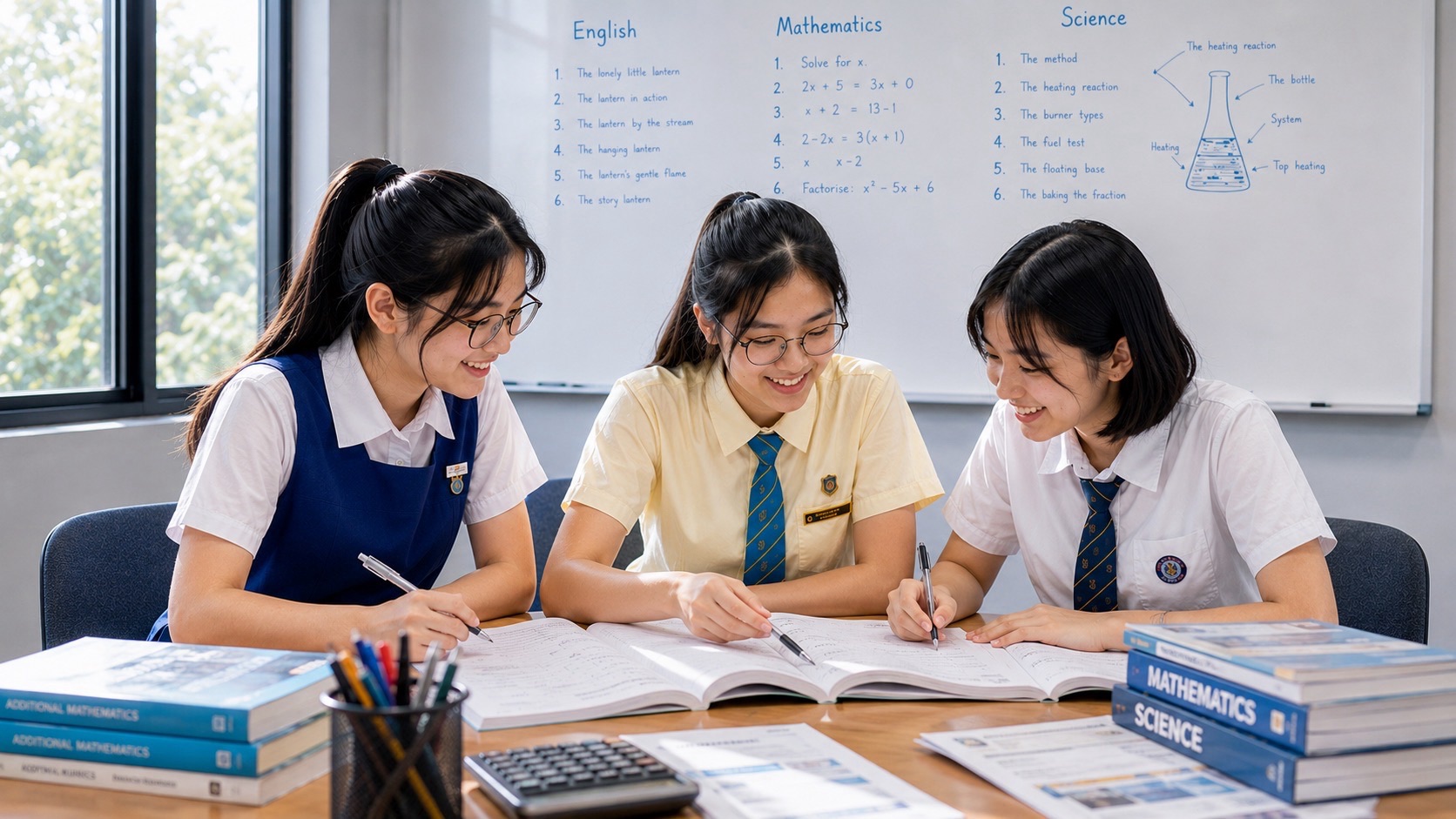
Secondary 1 G2 English small groups tuition can help Punggol students who write fluent sentences but miss something the reader needs. In a group of three, each learner can work from the same notice, plan an individual response and explain why they used particular details. The tutor can then see whether a weak email, report or speech comes from missing a task point, misreading a condition or failing to develop a useful suggestion.
Start with a school task and ask what its reader should be able to do after reading the response. Then check whether your child has answered each requirement with enough detail for that person to act. A precise request to a teacher, a fair account of a trial and a reassuring speech to participants can use the same facts differently. The school’s Secondary 1 instructions set the immediate goal. The later SEC syllabus shows how writing for a purpose, audience and situation continues to matter.
- Read the task before drafting and identify who needs what information and why.
- Turn each requirement into a sentence or paragraph with the necessary evidence, action or reason.
- Keep states such as proposed, available and confirmed distinct when the source describes a change or a possible problem.
- Compare what a teacher, organiser or participant needs from the same facts.
- Look for a three-student lesson where everyone writes independently, receives feedback and tries a fresh version.
- Check progress on an unfamiliar task before adding length or examination timing.
In this guide
Chapters 1–4
Chapters 5–8
Begin with the reader’s next action
A pupil can know the format for a school email and still send the wrong message. They may greet a teacher politely, write a clear opening and finish with a signature, yet never say which decision they want the teacher to make. They may understand what is changing but leave the reader to decide whether the change is approved. When a parent sees a comment such as “develop your points”, it helps to ask what remains uncertain for the person receiving the piece.
Try a practical question. If the email reached the teacher this afternoon, what could the teacher do after reading it? An email that says “Please improve the sharing session” is too broad to answer easily. “Could we announce two arrival times tomorrow so students can enter in groups?” gives the teacher a choice. Add a reason from the source, such as a small waiting area, and specify how late arrivals would receive instructions. The reader now has enough information to consider the proposal.
The same test works with a report. If the teacher needs to decide whether a trial is ready to repeat, the report can help by separating what went well from what still needs attention. A reminder to participants should give the information students need to turn up and take part. School marking instructions may describe task fulfilment, audience and language differently across assignments. Keep the teacher’s comments beside the script so the practice focuses on what the pupil was expected to do in that piece.
Underline the demands rather than counting sentences
When a prompt asks a student to explain a difficulty, suggest an improvement and say what participants should do, underline each action verb. Then put the relevant facts beside it. Explaining a difficulty generally requires its consequence. Suggesting an improvement requires a realistic action. Telling participants what to do requires clear instructions. A sentence such as “We should improve registration because it was difficult” sounds relevant, yet leaves all three demands largely unanswered.
A student who wants to plan quickly can write short notes. “Difficulty: early group blocked entrance. Proposal: wait in classroom until called. Tell participants: check badge table when admitted.” In the final piece, the student must say why the entrance matters, who would call the group and what the participants need to check. A planning note can be rough. The actual response should let a person unfamiliar with the plan understand it in one reading.
Identify where an unsupported promise entered the draft
A common error happens when a pupil writes “The organisers will provide all materials” after reading that spare materials are limited. Both statements contain something about materials, so the child may think the requirement has been met. The change in certainty matters. People might arrive empty-handed if they trust the final draft. Linking a claim back to its source is an editing skill, not just a reading question. Ask which word tells the reader whether help is guaranteed, possible or still to be confirmed.
The fix depends on the source wording. “A limited number of kits will be available at the help table” preserves the condition. “Please bring your own kit if you have one” adds a reasonable instruction if that is consistent with the brief. “The help table can lend you a kit” might imply an assurance that the source did not give. Let the learner explain which draft makes the situation most accurate for the reader.
Use one fictional Punggol project to practise three writing jobs
The setting for these original exercises is a fictional school project inspired by Punggol Waterway Park. The school, workshop, schedules and notices are invented. The three tasks share the same facts so students can see how the reader changes what they write. Families can do one task at a time and compare the pieces after all three have been attempted.
A Secondary 1 team plans a short afternoon photo-and-caption workshop. Students will compare two images, choose one change to document and use a caption to explain why it matters. A short supervised walk is the preferred opening if weather and staff arrangements allow. An indoor activity based on printed images covers the same learning goal. The class trial was held indoors. Sixteen students took part and twelve completed the caption before the session ended. Four spent too long choosing an image. At the start, a queue at the equipment table crossed the entrance to the room. A volunteer moved the queue along the side wall, and pupils could enter more easily.
The draft plan lists Friday at 3.30 pm and names the school project room as the starting point for both the walk and the indoor version. The team has two shared cameras, eight clipboards and a set of printed images. Participants can use a personal device if their school’s rules allow it. Pupils without a device can share equipment under supervision. A teacher needs to approve a longer setup period and confirm whether the school can release pupils at the advertised finish time. The team must give that timing to families after approval. It already knows that the teacher will decide on the outdoor or indoor version at the start of the workshop.
The photograph options in the printed set depict a narrow section of path before and after markings were added, and a viewing point shown from two positions. Students can describe a visible difference and explain how it might matter to a visitor. The plan says the finished caption must state what is visible and avoid claims that the class has not checked, such as saying the path has become safer for everyone. Teaching and writing can share the same principle. The reader needs to know which details the writer has actually seen and which remain an interpretation.
Put the facts into three useful groups
Ask the learner to sort the source into “things that happened”, “things already arranged” and “things someone must decide”. Twelve captions were completed in the trial. The project room is the starting point for both versions. The release time is awaiting confirmation. A pupil who treats all three as the same kind of fact may say the next session has already produced twelve captions and the class is definitely going outdoors. Labelling the status before writing quickly exposes that mistake.
Next ask who needs each fact. The teacher considering a setup request needs to know how the queue affected access. Students attending the workshop need a clear meeting place and an equipment instruction. A report reader may need both the completion data and how the writer collected it. These choices do not give permission to hide a problem. They help the writer give readers the detail that supports their decision without making them search through the whole source.
Contents · Previous chapter · Next chapter
Write an email that makes a decision possible
Imagine you are the student helping to organise the workshop. Your teacher, Ms Tan, can approve extra setup time. Write an email asking for that approval, explaining what happened at the trial, proposing what volunteers would do with the extra time and identifying what remains to be confirmed before telling families. The prompt does not specify a proposed setup time. The pupil may suggest one if it is clearly a request and fits before the session. Keep the Friday starting time clear.
An independent first attempt may read, “Dear Ms Tan, please let us organise the workshop early. The first time was a bit messy. With some preparation, people can finish in time. We will be indoors if it rains. Please reply.” This student sees the decision and attempts a polite register. The teacher still has no clear picture of the issue. “Early” could refer to the whole event instead of setup. “A bit messy” could describe equipment, behaviour or a timetable. The promise about finishing in time goes beyond the trial.
Develop the problem into a reason the reader can assess
Show the pupil how one factual detail supports the request. “At the trial, the line for equipment crossed the entrance. When a volunteer moved it along the side wall, students could get into the room more easily.” The second sentence matters. It shows the proposed setup has a basis in something that worked during the trial. Add who would set up and what they would move. Those details let Ms Tan assess the feasibility of the proposed extra time.
Then address the caption problem separately. Four students ran out of time because they spent too long choosing an image. Setting up earlier could help only if some of that time is used to arrange the pictures and give students a shorter choice after they enter. Avoid saying extra setup automatically solves the writing difficulty. A volunteer can put two images at each station and prepare an example caption the group can see before starting. The suggestion links what the volunteers would do to a problem the trial actually showed.
Read a worked email and test what each paragraph achieves
Subject: Setup time for Friday’s workshop
Dear Ms Tan,
Could the workshop volunteers have 15 minutes to set up the project room before the Friday session starts at 3.30 pm? We would use the time to move the equipment table and lay out the image choices before participants arrive.
During the indoor trial, the equipment queue crossed the entrance. It became easier for students to enter after a volunteer moved the queue along the side wall. We could put the equipment table there from the start and have one helper show students where to queue. We would also place two images at each writing station. Four of the sixteen trial participants ran out of time after spending too long choosing an image, so a smaller selection could give them more time to develop a caption.
Both versions of the workshop would begin in the project room. We can explain the outdoor or indoor plan to students when you have made that decision at the start of the session. Before we send families the timetable, could you also confirm the release time?
Thank you for considering the extra setup time.
Yours sincerely,
The workshop organiser
The opening tells the teacher what decision is requested and what stays at 3.30 pm. The middle describes the queue and caption difficulties separately. Each proposal gives the volunteers a specific job. The end states when the outdoor decision will be made and asks about a timing detail without announcing it as settled. The phrase “both versions would begin” also removes a possible worry that a weather change could alter the meeting place.
Check register through the actions of the reader
The message is polite because it gives a teacher the detail needed for a decision and acknowledges the person who can make it. Extra expressions of formality cannot replace those details. “I humbly ask that you immediately approve the arrangement” sounds ornate while pressing the reader. “Could we have 15 minutes to set up?” gives a clear request and leaves room for a reply. In a school task, use the greeting, ending and format the teacher expects. Keep the main effort on the quality of the communication.
One small-group exercise is to ask three students to write different first paragraphs. One may begin with a request, another with the trial problem and a third with the date and activity. Give a classmate thirty seconds to find the approval needed. Then compare whether the different openings help a busy teacher. All three writers can improve a sentence after the discussion and draft a short request for a new activity on their own.
Contents · Previous chapter · Next chapter
Write a report that keeps observations and recommendations separate
Use the same source and change the assignment. You took notes during the indoor trial and your form teacher wants a report. State what the trial tested, explain what students managed and where they struggled, and recommend two changes for the next session. Identify one thing the indoor trial could not establish. Keep the recommendations tied to what happened. The reader needs enough context to understand why the results matter.
A common first attempt reads like an announcement. “The workshop will be a success because many people liked it. Please arrive at 3.30 pm and bring a phone if you can.” There is no evidence in the brief about whether people liked it. The arrival line would suit a participant reminder, but it contributes little to a report on the trial. Bring the pupil back to the reader’s question. What did we learn from trying the activity? Can you name an outcome a teacher could verify from the notes?
The evidence says that twelve of sixteen participants finished their caption and four spent too long choosing an image. A student can use those numbers without inventing a satisfaction survey. The movement of the queue showed that positioning it along the side wall helped entry during the trial. The two decisions for a future session can be to set up that queue in advance and to give students a shorter selection of images. The trial was indoors, so it gives no direct evidence about how smoothly a supervised walk would run.
Read a worked report and examine its claims
Indoor photo-and-caption workshop trial
The trial tested whether Secondary 1 pupils could choose an image and complete a caption during the scheduled indoor session. It also gave the volunteers a chance to see how participants entered the project room and collected equipment.
Twelve of the sixteen pupils finished their caption. The remaining four spent too long choosing an image and were unable to complete the writing. At the start of the trial, the equipment queue crossed the entrance. Pupils could enter the room more easily after a volunteer moved the line along the side wall.
For the next session, I recommend setting up the equipment queue along the side wall before the room opens. One volunteer could guide arriving students to the end of the line. I also suggest placing a choice of two images at each writing station so pupils can leave more time for the caption itself.
The trial provides useful evidence for the indoor version. Since it did not include a walk, the team should confirm how supervision would work before using the outdoor version.
The report describes results before recommendations. It does not say the new queue arrangement will work for any size of group. It explains what happened when the volunteer changed its position. Mentioning the limits of the trial helps the teacher distinguish an improvement supported by evidence from a plan still to be assessed. The writer also keeps the purpose visible. The queue matters because access affected the start of the activity. The image choice matters because the workshop asks pupils to finish a caption.
Careful numbers give the reader a fair picture
“Most pupils completed the task” is accurate, but the exact numerator and group size are useful to a teacher planning a repeat. “Four pupils failed” gives too little context and describes incomplete work as a broad personal judgement. “Four pupils did not finish the caption after spending too long choosing an image” identifies the observed result and gives the teacher something to change. When a source offers a small exact number, that detail can support a modest recommendation more effectively than a dramatic adjective.
Ask a learner whether twelve captions prove the activity is right for every Secondary 1 group. The source describes a trial with sixteen participants. It does not give earlier scores, comparative results or the quality of every final caption. The report can still say that the indoor version gave most participants time to produce a caption on that occasion. Practising that degree of precision helps when writing about class projects, survey results and reading texts that make claims from limited observations.
Turn a recommendation into a doable instruction
A report can recommend “improve the queue”, but a teacher has to translate that into a job. Instead specify where the line should start and who could guide students. “Give students fewer options” can be developed by naming two images per station before the activity. If a child prefers to impose a fixed selection time, ask them to explain why it fits. A recommendation can be an original idea if the task invites one. The pupil should identify it as a proposal and tie it reasonably to what they observed.
In a group, let each student propose a different solution from the same trial notes. One may shorten the choice. Another may reserve two minutes for choosing before writing starts. A third may provide a sample image pair and a simple contrast question. Ask whether each idea addresses the reported difficulty and whether the available resources support it. Then give a fresh report scenario and see whether the pupils can develop their own recommendation without copying a group example.
Contents · Previous chapter · Next chapter
Give a short speech the participants can follow on first hearing
Now imagine it is Friday and you are welcoming participants in the project room. Your task is to explain why students will compare two images, what to do while they wait for the teacher’s decision about the two possible openings and how to get help if they have no device. Finish by stating what a useful caption should contain. Do not announce a finish time if the source gives you none. The audience needs directions it can act on as well as a reason to participate.
For a speech, a sentence needs to make sense the first time people hear it. “Your preparation is to conform with the faculty’s pending determination” may be grammatically possible but leaves a pupil unsure whether to sit down, pick up a camera or get ready to leave. “Please stay in the project room until Ms Tan tells us which activity we are starting with” is easier to follow and keeps the decision with the teacher. Give the audience the action first. It can then listen to what is coming next.
Read a worked speech and hear what the audience can retain
Good afternoon, everyone. In this workshop, you will compare two images and write a caption that helps someone else notice what has changed. The caption should tell the reader what you can see and explain why that detail might matter to a visitor.
We will start here in the project room. Please wait at your station while Ms Tan decides whether we will begin with the short walk or with the printed images. If we go outside, your group will leave with the supervising staff. If we stay in the room, you can start by comparing the pictures at your station.
If you have permission to use your own device, keep it ready until your group is told to begin. If you do not have a device, tell the volunteer at your station. There are two shared cameras, and the volunteers can help groups take turns using them. You can work from the printed images in the indoor activity.
Before you hand in your caption, check that you have named a visible difference and explained who might find it useful. Give your reader one detail they could point to.
The opening gives an outcome, the middle supplies immediate instructions and the ending tells pupils what to check. Where the source describes a condition, the speech says who makes the decision and what pupils should do while waiting. It also offers a course of action to pupils without a device. It avoids promising that every pupil can have a camera at once. The word “might” in “why that detail might matter” leaves room for a reasoned interpretation.
Say less where the audience needs an instruction
The report’s completion numbers have a clear job for the teacher. The speech can omit them, since participants need the activity goal, starting instructions and a way to ask for help. A report may say “remaining participants”. A speaker might say “if you are still choosing after the first few minutes”. One refers to the people recorded in an account. The other addresses people while they are in the situation. Ask the pupil to rewrite two report sentences as speech lines and decide whether either survives unchanged.
In a group of three, one learner can give the speech, another can act as a pupil without a device and a third can summarise what everyone should do next. Ask the listener to repeat the decision in one sentence. If they say “we are definitely starting outdoors”, the speaker can see where the condition was lost. Give each learner a second speaking turn or a short written speech for a new school event. That shows whether they can apply the feedback to a change of context.
Check how reassuring language can stay exact
The speaker can say, “You can join even if you do not have a device,” because the source gives alternatives. The speaker should be careful about adding “Everyone will receive their own camera.” Shared equipment is limited. A sentence such as “A volunteer will help you work with the available equipment” describes the arrangement more reliably. Ask your child which version a student should be able to trust when deciding what to bring. This is a small but genuine test of writing for another person’s needs.
Contents · Previous chapter · Next chapter
Carry the key facts into a quick handover
Add one final short task after the email, report and speech. A new helper arrives just as pupils are entering. The helper has time to read a few lines. Give your child a piece of paper and ask them to write a handover that gives the starting point, the next decision and what to do if someone has no device. Keep the release time out unless they have been told it has been confirmed. This task checks whether the student can shrink a response without making it less useful.
A workable note would say, “All pupils start in the project room. Keep groups at their stations until Ms Tan announces whether they will begin outside or use the printed images. If a pupil has no device, direct them to the volunteer who is arranging turns with the shared cameras.” The note uses direct instructions because the reader is another helper with a job to do. It can be written without the extended explanation a teacher needs to consider a proposal. The note gives the helper a clear action and identifies the person making the decision.
Rewrite the same opening when the reader changes
Start with “At the beginning of the trial, the equipment queue crossed the entrance.” A report needs to connect the observation to what happened next. A note to the new helper can turn that evidence into an instruction. “Set the equipment queue along the side wall so pupils can enter the room.” An email requesting setup time may include both ideas. “At the trial, the queue crossed the entrance. Could the volunteers set up the table along the side wall before participants arrive?” A pupil can build these variations from the same source without memorising three stock openings.
Give the learner a deliberate mismatch. “At the trial, twelve pupils completed the caption” may be a strong sentence for a report, yet it leaves the newly arrived helper without an instruction. Ask the learner to choose a different fact and turn it into an action. They might pick the first room, the queue location or the two images at each station. The choice should follow the immediate job described in the prompt. In this case the helper is receiving pupils, so the queue or where the pupils should wait is immediately relevant.
Make the next exercise small enough to judge fairly
The pupil may have written a good workshop email after several conversations about the source. Give them a fresh notice with one changed arrangement and one undecided arrangement. Ask for a two-sentence message for the reader who needs both. When you compare the drafts, look for three things. Did the student address that reader directly, did the reader receive a usable action, and did the student preserve the difference between decided and undecided? A short check like this makes the progress easier to see because the task demands are stable even when the setting changes.
Contents · Previous chapter · Next chapter
Revise when two reasonable needs conflict
Situational writing becomes more demanding when a writer has to help two groups at once. The volunteers want to tell families when to collect their children. The teacher has yet to confirm the release time. An eager writer might invent a time because the message feels incomplete without it. A cautious writer might leave out the timetable entirely. A practical response can give the confirmed starting point now and say when the missing detail will be shared, as long as the proposed update respects the source and the role assigned in the task.
Try this extension to the fictional workshop. The teacher confirms that pupils should arrive at 3.30 pm at the school project room. The secretary will send families a message once the release time is confirmed. A parent asks whether their child can participate without a device and needs to know whether the meeting point changes in rain. Draft a three-sentence reply and keep the developing plan separate from the information already confirmed.
A useful reply is, “Yes, pupils without a device can join and the volunteers will help groups share the available equipment. Please ask your child to arrive at the school project room at 3.30 pm, which is the meeting point for both versions of the workshop. The school secretary will send the release time once it has been confirmed.” Each sentence answers a distinct concern. The reply explains who will provide the update. It preserves the uncertainty without making the reader chase the organiser for the details that are already available.
Resolve a misreading of two separate conditions
A student may read that staff arrangements and weather affect the walk and write “We will go outside if the rain stops.” Weather is one condition. Supervision also has to be available. Read the draft aloud and ask whether a pupil would expect the walk to happen in dry weather even with a staffing issue. “The teacher will decide at the start whether the group can go outside” keeps the message accurate without naming every possible outcome.
This decision also comes up when a task asks for an alternative plan. A reader might wonder whether the indoor version has the same goal. The source says pupils can still compare images and write a caption. A clear answer can explain how the printed images support that work. “Do activity indoors” is a heading, while “Pupils can compare the two printed images at their station and use the same caption guide” explains what they would actually do. Encourage the student to add the detail that removes the reader’s next question.
Keep a precise reason when compressing a paragraph
Suppose the pupil’s report has a strict school length limit. They can combine two sentences without losing the cause. “The queue crossed the entrance at first. Pupils entered more easily after a volunteer moved it along the side wall” can become “Moving the equipment queue from the entrance to the side wall made it easier for pupils to enter.” The source supports that observed change. A shorter sentence such as “The queue caused a problem” keeps too little of the evidence to support a recommendation.
Take the same idea into comprehension. Ask the child to identify which parts of a text address a stated purpose and paraphrase them in a shorter way. In the workshop exercise, the twelve completed captions and the decision to move the queue can both be relevant if a reader asks how the trial went. Only one matters if a question asks what improved access to the room. This prepares pupils for the habit of selecting before compressing. It also helps them stop treating every detail from a visual text as equally important.
Contents · Previous chapter · Next chapter
Make feedback visible in a three-student lesson
A useful session might begin with a shared source and three first drafts written without discussion. One pupil writes an early email opening, another plans a report paragraph and a third chooses three speech instructions. Comparing the responses is worthwhile only if everyone has time to explain their choice. With the fictional workshop, one student may include a precise request but leave the evidence too vague. A second may record a result accurately but present it as a guarantee. A third may explain the workshop warmly but omit instructions for pupils without devices. The tutor can give each a different next step.
Then let the group check one requirement at a time. Ask the intended reader to find the next action. Ask a source checker to show where a claim is supported. Ask a writer to revise one phrase that made the audience or certainty unclear. Rotate the roles. End with a different scenario and a short response of the same type for each learner to complete independently. That final attempt provides a record of what each pupil took away from the comparison.
Show the line that changed and why
Specific feedback fits an observable decision. “Your report has a useful number. Include the group size so the teacher can interpret it” acts on a different problem from “Your speech says the walk will happen. Show me where that is confirmed.” Both pupils can make a small repair. Give each one a second example to see whether they would make the same change alone. If the learner depends on a template whenever a condition is involved, move to a simpler fresh task with a known fact and a pending fact before trying a full response.
A child who writes slowly can practise one complete paragraph rather than keep pace with a more fluent classmate. Give a quick written plan and wait while they turn it into connected sentences. A child who writes confidently can be asked to adjust the same facts for two readers and explain which detail they cut. A class of three gives scope for both pupils to work on accurate responses with different amounts of support. The format is valuable when the instructor can track that difference in the resulting work.
Use an unfamiliar task to see whether the feedback survives
After practising the workshop, give this shorter fictional prompt. The class is running a book swap. Participants can browse without bringing a book. Volunteers will accept clean books suitable for teenagers. The organiser asks pupils to confirm whether a spare table can be used, since the current one may be needed for registration. The event starts in the reading room whatever the table decision. Ask the student to write the first two sentences of an email requesting the extra table, then one sentence for students who are unsure whether they can attend.
A workable email opening could be, “Could the book swap volunteers use a spare table for the books? The current table may be needed for registration, so a second one would help us keep those jobs separate.” A participant line might say, “You are welcome to browse in the reading room even if you do not have a book to swap.” Both decisions use the new facts. Neither sentence depends on memorising the workshop response. If a child still writes that a table is confirmed, record that as a specific uncertainty to practise next.
Contents · Previous chapter · Next chapter
Use the published SEC syllabus to plan beyond the next assignment
Under Full Subject-Based Banding, a Posting Group is used for admission and helps determine a pupil’s starting subject levels. English has a subject level of its own. Pupils can take English at G2 while studying other subjects at different levels. If you are considering schools, SchoolFinder provides school profiles. For your child’s own subject arrangement, ask their school.
The 2027 SEC G2 syllabus list for school candidates identifies G2 English Language as K200. The published 2027 K200 syllabus assigns 35% each to writing and comprehension, 10% to listening and 20% to oral communication. Writing and comprehension allow 1 hour 50 minutes each. Listening lasts approximately 45 minutes. Oral takes approximately 20 minutes per person, including 10 minutes of preparation.
Under the 2027 K200 specification, the writing paper includes editing, situational writing of 180 to 250 words and continuous writing of 250 to 400 words. Situational writing draws on a given situation with visual material and asks for language appropriate to the audience, purpose and context. The comprehension paper covers more than one kind of text and includes a summary of about 80 words, excluding the supplied introductory words. Those details belong to the published 2027 examination. Check the specification for your child’s eventual exam year. For current Secondary 1 work, follow the school’s directions, including any different practice lengths or formats.
A younger pupil can build the underlying skills at shorter lengths. Ask for two complete requirements in one email before trying a longer brief with several conditions. Let the student practise editing a claim for accuracy and checking that a report has not turned opinions into observations. The same reading habit applies when listening for an arrangement change or giving an oral response that needs a clear reason. The English article directory gives families related practice when a particular skill needs more time.
Contents · Previous chapter · Next chapter
Decide what support fits your Punggol school week
Begin by looking at what the pupil can already produce independently. If the teacher’s corrections make sense and the child can carry them into another prompt, a short home exercise may be enough. A pupil with the same missing-brief problem across a few assignments may benefit from repeated feedback on that specific decision. A small group can help them compare several sensible approaches and still show their own work. Individual support could allow more time for basic sentence construction when that difficulty prevents the learner from communicating what they already understand.
A family can try a brief sequence over four weeks. In week one, save a recent school response and a new short answer. Choose a recurring difficulty, such as leaving a task point underdeveloped. In week two, ask the pupil to add one supported reason per requirement. In week three, change the audience while keeping similar facts. In week four, use a new setting and see whether they can answer every requirement without help. Record which changes the child made alone and what prompt, if any, they needed.
Think about travel from the child’s actual school or CCA end point when choosing a lesson. A well-timed session gives room for a short independent draft and revision. At home, one weekday task could be writing a two-sentence event update from a fictional notice. Save longer work for a quieter period. If you try a group, ask to see the kinds of first attempts they collect, what they do when pupils are working on different school tasks and how they report progress beyond completion of a worksheet.
Ask the school for the next useful checkpoint
A parent can bring one piece of work that went well and a second showing the repeat error. Ask whether the pupil should focus next on following the task, developing ideas or making the expression more accurate. If you are also discussing a possible change of subject level, ask the school about its process, timing and the work it considers. One stronger email can show improvement in a skill. A decision about subject-level readiness needs a wider view of performance and workload.
Invite the pupil to name one revision they now do without being told. A child might say, “I check whether a plan has been confirmed before I tell people to follow it.” That observation gives the family a way to recognise progress in a current class. Pair it with a new response and follow the work into the next few weeks. Parents can then judge whether school feedback, home practice or additional tuition is giving the learner the right amount of help.
Contents · Previous chapter · Next chapter
Questions Punggol parents ask about G2 situational writing
Does my child need to memorise a different format for every possible task?
Learn the common features the teacher expects, then practise what the form is for. An email opens a conversation or requests a decision. A report gives readers an account and possibly a recommendation. A speech helps people follow an idea when they hear it. A pupil who knows those jobs can decide what to keep when the topic and audience change.
How do we know whether a point is developed enough?
Give the draft to someone who has not seen the source. Ask them to read the point and say what they can do or conclude from it. If they have to ask what caused the problem, who will act, or when a condition applies, add that information where it belongs. The goal is a response the reader can use.
Can my child add their own ideas?
A brief may invite a suggestion, explanation or example. Make it clear that the idea is a proposal and ensure it is compatible with the givens. In the workshop, asking for fifteen extra minutes is a proposal. Claiming the teacher has already agreed is a different statement. A useful idea stays within the writer’s role and gives the reader a reason to consider it.
What can we practise in ten minutes at home?
Choose a simple school notice. Ask your child to write one sentence for a participant and one for the person organising the event. Compare which details each reader needs. Save both sentences and try the same idea with a new notice after a few days. If the child uses a detail for a clear reason and can explain that reason, you have a useful sample to share with their teacher.