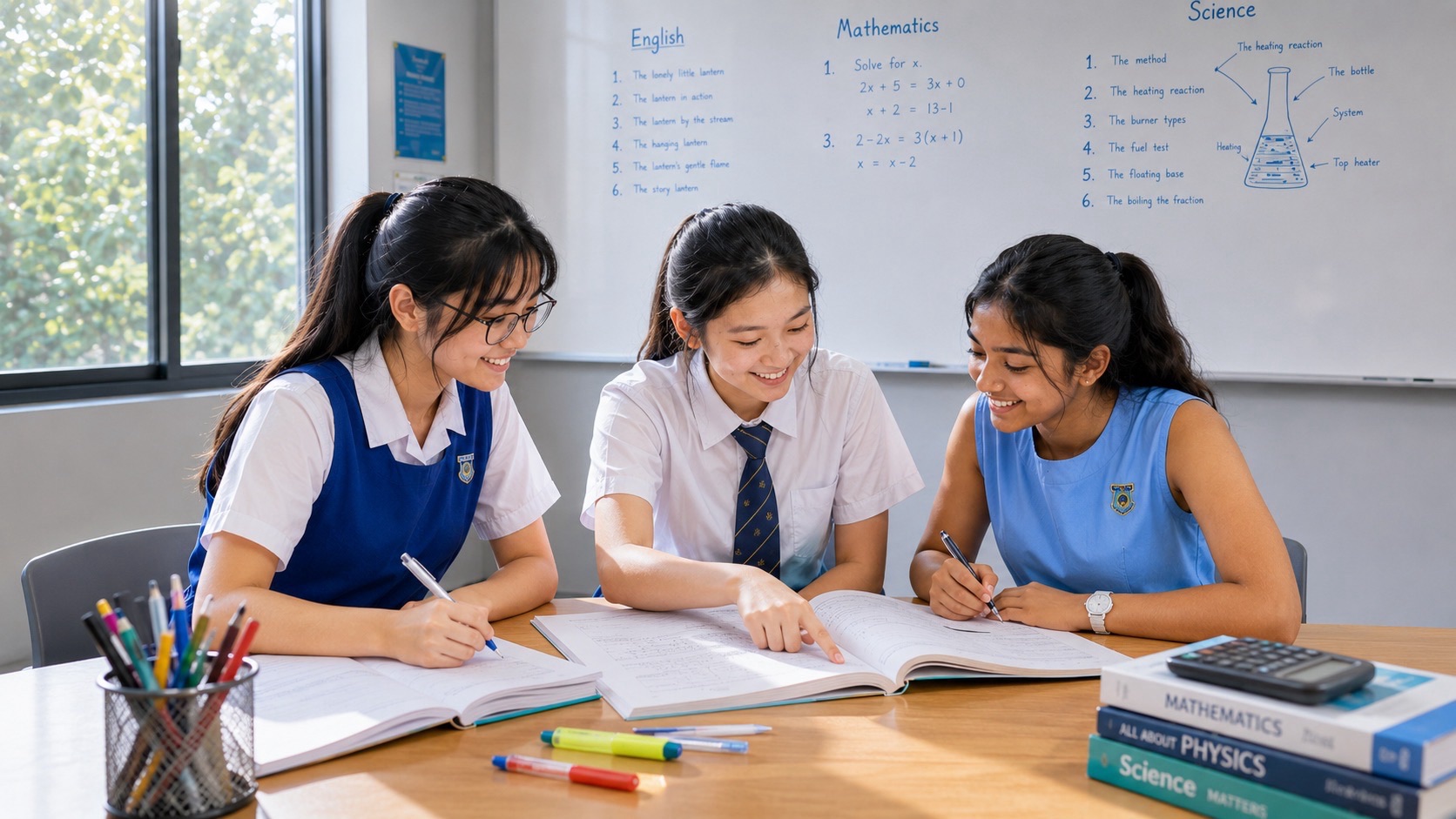
For Yishun families comparing Secondary 1 G1 English small-group tuition, listen to how your child explains one opinion and responds when you ask a slightly different question. A three-student tutorial can help when the tutor hears each answer, gives a specific piece of feedback and lets every student respond to a fresh prompt. The aim is a clear conversation in which your child can make a point, give a reason and adjust when the listener adds a new consideration.
Spoken Interaction in the published 2027 G1 English Language syllabus uses a video clip to begin a discussion. At Secondary 1, start with short, familiar situations. Teach your child to distinguish what the clip shows from what they think it means, then help them choose one detail that supports their answer. Use your school’s current instructions for assessed work and check the SEC syllabus for your child’s examination year when it is available.
- Start with one visible action and one reasonable interpretation. Use words such as “may” when the reason is uncertain.
- Answer the question early, then explain one reason with a detail or a short everyday example.
- Practise follow-ups that add a competing need, a new fact or a limitation.
- When changing an opinion, say what changed your mind and what you would do next.
- In a three-student group, look for individual preparation, distinct speaking turns and fresh prompts.
- Check progress on a different clip with fewer reminders before deciding what your child needs next.
Find your next learning step
Jump to a section or read the guide in order.
What the G1 Spoken Interaction task asks students to do and related sections
Follow the conversation when the question changes direction and related sections
Use a short routine that can survive a school week and related sections
What the G1 Spoken Interaction task asks students to do
The Singapore-Cambridge Secondary Education Certificate begins in 2027. The published school-candidate G1 English Language syllabus for that examination year uses subject code K100. Its Paper 4 is Oral Communication. Reading Aloud and Spoken Interaction are separate parts, and they are not linked by theme in that syllabus. Spoken Interaction is worth 25 of the 40 marks in Paper 4, and the whole oral paper accounts for 20 per cent of the subject assessment. Refer to the applicable year’s syllabus and your school’s instructions for the format your child will meet. SEC overview 2027 G1 English Language syllabus
In the 2027 Spoken Interaction task, the candidate views a video as a starting point for a discussion. The syllabus specifies that candidates are not asked questions about what people say in the clip. For practice with the separate reading task, see the Punggol G1 English reading-aloud guide. At home, a short muted clip can therefore be useful for practising how to read the visual action and form a view. When you have no video, you can draw three frames and let the child look at them in order. A tabletop demonstration can also work. Label these as practice. A parent’s storyboard gives the student a chance to use the skill without claiming to reproduce the exam.
The syllabus assesses how clearly a candidate communicates ideas and how they engage in the discussion. For a younger student, a useful first target is that a listener can identify the student’s opinion. A second target is that the listener can tell why the student holds that opinion. A third target is that the student can address a fresh question without going back to the beginning of a memorised answer. More exact language will help when it makes the reason easier to follow. A familiar word used precisely can do more than a long word with an uncertain meaning.
Two pupils may give different positions on the same question and both communicate well. Ask whether schools should have a voluntary lunchtime book exchange. One student may say yes because it lets people try books without buying them, and another may prefer a once-a-term event because a daily exchange would take too much supervision. Judge how each child develops their own position. If they cannot name a reason, ask who would be affected or what would happen on the first day. The resulting detail often clarifies the idea.
A learner whose secondary school posting information says Posting Group 1 should confirm the actual English subject level with their school before choosing level-specific tutoring. Under Full Subject-Based Banding the posting group guides admission and initial placement for most subjects, and individual subjects can be offered at different levels. A child whose school-confirmed English level is G2 or G3 will need guidance appropriate to that level. The everyday conversation activities in this article can still be adapted, with the school’s tasks setting the current target. English subject choices and progression after PSLE
Separate what the clip shows from what you think happened
Imagine a clip that begins with three pupils at a shared art table. One reaches into an empty tray labelled “Blue”. Another closes a pencil case and moves it towards the far end of the table. The first pupil lifts a hand and points to the empty tray. In the final frame, the second pupil opens the case and places two blue pencils between them. A useful observation names actions that can be seen. The tray was empty, the pupil pointed to it and the other pupil put pencils on the table. The reason they use one tray or the first pupil’s emotion remains open.
Ask your child what the first pupil might have needed. “She may have needed a blue pencil. She reached into the tray marked Blue and pointed to it when she found nothing inside.” The answer uses two details to support a reasonable reading. “She was angry because her teammate stole all the blue pencils” goes well beyond what the clip supports. At home you can ask, “Which part shows she was angry?” If your child says that the pupil pointed quickly, ask whether a quick point could fit another feeling. They may think the pupil was in a hurry or simply asking for help.
If the question asks what the second pupil did, give the action plainly. “He put two blue pencils on the table.” If the question asks what his action suggests, add an interpretation. “He seemed willing to share when she pointed to the empty tray.” If the question asks whether the school should hand out individual pencil packs, make a decision and explain it. “I’d keep a few shared items for each group. Students may need different colours at different times, and the spare pencils helped one person carry on.” The clip stays the same while the type of answer changes.
Let the evidence change the view
Show the child only the first two frames of the art table. Ask them what they expect to happen next and why. A student might say the second pupil is putting the pencils away. Show the last frame and let the child update the interpretation. “At first I thought he was putting them away because he closed his pencil case. When he put two pencils between them, it looked as though he was offering to share.” The update shows the student can hear their own earlier thought and use new evidence.
Now show a different fictional sequence. A boy walks into a waiting area holding a folded umbrella. Two people move their bags off a bench. The boy stops beside a wet patch on the floor and places a cone next to it. Ask why people might have moved the bags. Some students may say they were making space for the boy. That is possible. The wet floor suggests they may have been keeping the bags dry or moving things out of the way. The clip could leave both explanations open. Let the student choose an inference and use a visible detail. If they think a detail could support two readings, that is something they can say aloud.
At the start of practice, an adult may ask, “What did you see? What might it mean?” Once the student can answer both, remove the questions and try a related prompt. Have them describe one concern somebody in the next scene might have and point to the source of the concern. If the child uses the distinction on a new clip without being reminded, note the gain. If they revert to assigning a motive quickly, pause and ask what the camera can show. Adults can model changing their own interpretations, too. That makes it easier for the child to treat an early inference as something they can revise.
Notice where the camera leaves information out
A short clip may cut quickly between locations. In a story about pupils setting up chairs, the first frame may show a pile of chairs near one door. The second shows a student asking another to move one with a gesture. The third shows a clear doorway. Ask whether the scene proves that the chairs had been blocking that doorway before. If the first shot showed chairs near the door, the intended interpretation may be plausible. Unless the passageway itself is visible, the student can say the pile appeared to make the entrance more difficult to use. Teach them to describe what the evidence supports with the degree of certainty it allows.
This matters when a question involves people’s intentions. A child may say “The taller student was lazy” because the clip shows them standing while someone else stacks chairs. The camera may leave out what they did thirty seconds earlier. A careful answer might be, “I could see one student stacking chairs and the other standing nearby. If the second student was free to help, carrying a chair or holding the door would make the job easier.” That answer separates an observable action from a conditional judgement and keeps the discussion fair.
There are times when a child should speak more decisively. If the video clearly shows a bag with a broken zip and books falling out, the observation can be stated as a fact. If the question asks what the pupil should do, the child can give a recommendation. The uncertainty belongs to information outside the clip, such as why the bag broke or whether the pupil already knew about it. Encourage a direct answer with only as much qualification as the evidence needs. A sentence full of “maybe” can confuse the listener even when the child already has a sound view.
Contents · Previous section · Next section
Give a direct answer and develop one reason
Begin with a question that admits a genuine choice. “Would you place a spare equipment box inside the classroom or in the corridor?” An early response might be, “Inside, because it is better.” Ask what becomes better for a person in the scene. “I’d keep it in the classroom. If a pupil notices their ruler is missing during a lesson, they can get one without leaving the room and missing the next instruction.” The child gives a choice, a reason and a circumstance that makes the benefit concrete.
To test the explanation, change one condition. “What if several classes need the same box?” The student can suggest two locations if they distinguish everyday availability and extra demand. “I’d keep one small box in the room for things our class uses often. If several classes need to share a bigger kit, it could be collected from the department office.” The original reason about staying in the classroom has not vanished. The new answer addresses a resource with a wider purpose. A useful follow-up calls for a small change in thinking.
Some students add long lists of similar reasons. “It is useful, convenient, helpful and better for everybody” takes time without telling the listener what changes. Ask for one person and one situation. “It helps the next group because they can check whether the missing ruler will be returned before their activity.” The sentence offers a reason that can be followed, and you can hear what to ask next. It also teaches the student to move from general adjectives to particular actions.
A short response can be enough for a short question. Ask “Who benefits most from a large print sign at the collection table?” A child might answer, “Someone visiting for the first time, because they can see where to queue before joining the wrong line.” Then pause. If the listener asks for another group, the child can think of someone who usually has trouble reading small letters at a distance. Speaking in manageable units gives both people a way to move the discussion forward.
Use a personal example that explains the reason
A personal example works when it lets a listener see why you reached a view. Suppose the question is “Should pupils borrow equipment during breaks?” A child might say, “I once went to school and played with my friends.” The fact may be true and still too broad to help. Ask what equipment they needed and how borrowing it would have made a difference. An answer might become, “I forgot a ball for a class game once. Two friends had already agreed to play and we spent most of the break trying to find a ball. A small equipment loan system would let us use the time we have.” The experience now supports the proposed system.
If the child has no related experience, let them give a plausible example and introduce it as such. “For example, if a group only has ten minutes before class, they could borrow one ball rather than use the whole break looking for one.” They can also use a detail from the clip. How much of the answer should refer to the clip depends on what was asked. If the question concerns a wider issue, a short visual reference can lead into the general reason. If a prompt asks specifically about a person’s action, evidence from the picture stays central.
Avoid repeating the question as the reason. “I think sharing is important because it is important to share” may be easy to say when a child is nervous. Make the circle visible by showing them the two phrases side by side. Ask “What becomes possible when people share?” The child might answer “Someone without the tool can still finish their part on time.” They have given the listener new information. That is a useful test of whether “because” leads anywhere.
Contents · Previous section · Next section
Follow the conversation when the question changes direction
A listener might ask for proof, a different perspective, a solution to a practical problem or a response to a new fact. A pupil who only rehearses complete opening answers can be surprised by these changes. In home practice, ask one new question after the first answer and see whether the child recognises what you added. If they answer the original question again, repeat only the new part. Let them take a moment to choose a response. The goal is a useful exchange in a normal speaking voice.
When the follow-up asks “How do you know?”, the student needs a clue, a reason or the basis of their view. When it asks “Who might disagree?”, the student should consider a person with a different need. When it asks “What if you could only choose one?”, the student needs to prioritise. When it asks “How would you make it work?”, the student needs a practical next step. Practise telling these demands apart. A fifteen-second reply that meets the new demand often carries the discussion further than a longer reply that misses it.
Branching practice with a shared study area
Use this invented clip. The first frame shows one pupil sitting at a table and reading, with a notebook open. The second shows three classmates arriving with a project sheet and standing round a nearby table. The final frame shows the reader moving to the other end of the room while the classmates spread out their papers. The clip does not say why the reader moved. Ask “Should the school set aside different tables for quiet reading and small-group projects?”
A first answer might be, “Yes. Some pupils need to think silently, and groups doing a project need to speak. Setting the tables apart could give each group a place to work. In the clip the reader ended up moving away after a group arrived, although we can’t tell for sure why.” The answer begins with a position and gives both users a place in the reasoning. It refers to the clip without treating the pupil’s motive as certain.
Ask the first possible follow-up. “What if this is the only table the school can provide?” This adds a space constraint. An answer could be, “I’d let people book part of the lunch break for group work and keep another part quiet. I would show both times near the door so pupils can choose when to come.” The child has changed the arrangement in response to limits instead of repeating the two-table solution. If they propose moving a second table into the room, ask them to consider the stated constraint again and decide which part of the idea could still work.
Ask a different follow-up after the same opening. “A student says the room should always be quiet. What might support that view?” Here the listener is asking for a reason another person could hold. An answer could be, “Some students might have no quiet place at home. If the school room is their only chance to read on their own before going home, they would want to be sure it stays quiet.” The student can offer that understanding and still keep their original view about giving space to projects. Explain that addressing the other person’s reason comes before restating your own.
For a third route, ask “How would you know whether your new system is working?” This asks for evidence you could collect after putting the idea into practice. “We could see whether groups still wait outside and ask readers whether they can find a seat during the quiet part of the break.” The student adds sensible checks. A tally of all the pupils using the room would tell you that it is popular. It would give less direct information about whether each group can get what it needs.
Now let the child be the questioner. You give a short opening answer and ask them to choose which complication they would raise. If they ask “Would you give everyone a copy of the room timetable?”, reply with a reason they can consider. Then ask what kind of information their question sought. They may say it was about the practical step of informing users. Swapping roles shows what the listener is doing and helps the child recognise the follow-up in their own speaking turn later.
Keep your view, make an exception or change it
A concession recognises a sound point that qualifies your own. It can be as brief as “I can see why a regular group would want a fixed time.” What comes next is the student’s reason for keeping, changing or limiting the proposal. Suppose a pupil supports booking quiet study seats. A listener says booking every seat in advance could disadvantage a pupil who only decides to study after a consultation. A response could be, “That could happen if every seat were reserved. I’d put half the seats on a booking list and leave the others available when students arrive.” The concession changes the design.
Sometimes a student should keep their original view and explain why. “I agree that marking a space for projects would take another sign. I’d still do it, because it helps new pupils choose a table without interrupting either group.” The existence of an inconvenience does not make the original proposal unreasonable. Ask your child to say why the benefit matters enough to justify the inconvenience. If their reasoning goes in a different direction, let them offer a more balanced proposal. The quality of engagement lies in responding to the issue the listener actually raised.
Sometimes changing the answer is the clearest sign that the child has listened. A student might initially suggest opening a school reading room before lessons. When the listener explains that most pupils reach the room only once morning assembly begins, the student can say, “I suggested opening early because I thought pupils would have time to read then. If most are arriving just before assembly, it would make more sense to open at lunchtime.” The revision explicitly names the information that matters. Practise saying it as an ordinary change of mind so reconsidering does not feel like losing.
If the child agrees with every suggestion the moment it is offered, give them time to choose. Ask whether the new fact changes the goal or simply changes how the goal can be reached. A limited number of chairs changes the arrangement; a room designated for a silent examination changes which activities belong there. This is a helpful distinction when the child must adapt under pressure. It works for ordinary decisions, and it gives an oral answer a more intelligible sequence of ideas.
Contents · Previous section · Next section
Try a second clip with a different topic and a real decision
Set up a three-frame scene inspired by an ordinary park visit. Treat it as fiction. Two walkers enter a path just as a cycle approaches from behind. One walker stops and steps beside the other. Later, a wider view shows the path narrowing round a corner. Nobody falls and the clip gives no clear speed measurement. Ask what people using a shared path could do to make that moment easier for others. Families visiting Yishun Pond Park can also choose a quiet moment to observe how people share space and describe one visible action. Use observations from the visit carefully, and make up the prompt separately if you want a repeatable practice task. Yishun Pond Park information
One answer might be, “Where the path gets narrower, walkers could leave room for people to pass. A cyclist could slow down before the bend so they have more time to see somebody ahead.” The student identifies choices for two users. Ask what detail led them to focus on the bend. “In the wide shot, the path looked narrower where it turned.” That is a relevant visual reason. If the student says the cyclist was riding dangerously fast, ask what in the footage lets them judge that. They might notice the cycle reached the walkers quickly, while exact speed remains uncertain. Their original advice about slowing near a bend can stand without making a claim the picture cannot establish.
Give the child a follow-up about a person they may have missed. “What if someone needs more room to move around the bend?” A possible answer is, “I would wait before passing instead of expecting everyone to move aside straight away. Somebody with a walking aid might need to use more of the path to get round.” The answer considers a specific need and makes a workable suggestion. If the pupil uses a general phrase such as “be considerate”, ask what the other path user would actually see them do.
For a different follow-up, ask “Would putting up more signs solve the problem?” A child might answer, “One clear sign before a blind corner could remind people to slow down. If there are too many signs along the path, someone might miss the one they need.” This response gives a circumstance that helps and a limit. You can then ask what a useful sign would say. A simple message before the narrow section illustrates the proposal. Keep the focus on communication and judgement, since the home task is not a statement of local park regulations.
On another day, use a scenario where several people want to cross a busy station passage to reach a meeting point. Omit bicycles and a bend. Ask why putting a meeting point just beside a busy doorway might cause trouble. The hidden parallel is how people move through a shared space. The child should choose details from the new scene, such as people stopping in the path of those leaving through the doorway. If they automatically repeat advice about riding slower, talk through which action fits. The new setting gives better information about how much of the earlier reasoning transfers.
Contents · Previous section · Next section
Build a discussion from one clip without scripting the replies
For a longer home or tutorial exercise, imagine a clip of a class preparing a seed-swapping event. There are two rows of tables. The first frame shows two pupils setting out blank envelopes on the front table and another pupil labelling three trays beside them. In the second frame, four visitors arrive. One picks up an empty envelope and looks from tray to tray. In the final frame, a pupil places a simple arrow card on the table, and the four visitors form a line beside the trays. The clip gives enough detail to discuss how people find their place. It does not show whether all visitors got a seed or how long they waited.
Ask the student to choose a priority
Start with “Would you put a helper at the entrance or leave clearer instructions on the tables?” Either answer can work. A student who favours a helper might say, “I’d put one helper near the entrance at the start. A visitor may be unsure which tray to choose, and the helper could explain what to do while pointing to the trays. Once people know the order, the helper could move to another job.” The answer gives a specific action and acknowledges that the help may be especially useful early on.
A student who favours clearer instructions could say, “I’d start with a sign on the table showing which tray comes first. In the clip the visitors formed a line after the arrow card was put out. If the sign names the steps as well, the pupils running the event have more time to help people with questions about the seeds.” The sign might contribute to the change in the footage. A careful student can recognise that the clip also leaves open whether the pupil gave another cue. The next question might ask how to check whether a sign alone is enough.
If the child says “Both, because both are good”, ask which action they would do first if they had only a few minutes and one person free. Their priority should match the size of the problem they have identified. A hidden tray label might need a new sign. A visitor who is confused by a long process may need a person who can answer their question. One possible solution is to put in the sign and ask the helper to stand nearby during the busiest part. Help the child explain what made them choose the first action.
Branch to the effect on another person
Ask “Would your plan work for a visitor who has difficulty reading the signs?” A student who recommended signage can acknowledge that directions in words only may leave some readers unsure. They can suggest a simple arrow, a few words and a chance to ask someone. They may also think of having a demonstration envelope at the start of the tray. “I would put one filled envelope beside the empty ones so a visitor can see how the seeds are packed. If they still have a question, a helper can point to the right tray.” This adds an option without requiring the student to speculate about a particular visitor’s ability.
Another branch asks “What if the visitor wants to ask which seeds are suitable for a shaded balcony?” That is a different information need. A sign that shows where to queue cannot answer which item to choose. The student might recommend having one helper who can explain the choices, or labels showing approximate growing conditions when the organisers have accurate information. Ask what the child would say if they did not know the answer. “I’d ask the teacher who prepared the seed list and come back with the right details” is useful. It identifies a way to check a fact rather than promising an answer from memory.
A third branch asks “What evidence would tell you that your directions were clear?” One reply is, “I would watch the next few visitors to see whether they know where to start. If several pick up an envelope and stop at the wrong end, we should make the first step clearer.” The student has proposed a measure tied to the original problem. See whether they can distinguish successful directions from a successful event overall. How many seed envelopes are exchanged may be relevant to the event, while the repeated hesitation tells you more specifically about the signs.
Let the student compare their first turn and their reply
After trying any branch, ask your child which new information changed what they said. In the accessibility branch, the question introduced a visitor who may need another way to understand directions. In the seed question, the visitor needed advice about an item, not a route through the room. In the last branch, the listener asked how to evaluate a proposal. The first turn may still be suitable. Each reply makes progress by identifying what the new question needs.
Give feedback on one of those changes. If the child covered the new question but spoke in circles, ask them to lead with the action and add the reason afterwards. If they described the scene accurately and stayed undecided, have them choose one priority for the stated conditions. If they could answer with an adult nodding and supplying suggestions but now struggle without the cues, let them choose three words at the start to remember their point. The child can make the words mentally or on paper for home practice. Follow school or examination instructions on planning conditions in assessed work.
Give the listener a reason to ask the next question
Try a final short sequence in which the problem is ambiguous. In an invented community games session, two players are already using a board when another person puts a game piece near its edge. One of the seated players slides an empty chair closer. In the next frame the third person is still standing, holding a bag. Ask whether the organisers should put up a sign encouraging people to invite new players. A direct reply could be, “I’d put up a short sign if it is a drop-in session. Someone may want to join and be unsure whether an empty chair is an invitation. The sign could ask a host to explain how to join a game.”
Ask “What if the players are in the middle of a match and adding someone would change the rules?” The child can distinguish between the invitation and when it takes effect. “They could say the newcomer can watch now and join the next match. The person would know they are welcome and the current game can finish.” Ask a different follow-up if the child instead recommends assigning a host. “Would one host be enough when there are many games?” They may answer that each table could have a person to greet newcomers, or that one host could keep a simple waiting list. Ask what evidence the child would look for before deciding.
If the student argues that the third person was already invited, ask what they saw and what they inferred. The empty chair moved closer, which is consistent with an invitation. The listener never sees the reason for moving the chair. A useful spoken answer can say, “It looked as if the player was making room, but I can’t tell whether they asked the person to join.” Then return to the question about organisers. Evidence from the clip can support the proposed solution without settling every detail about the people in it.
For the next session, pick a new setting such as a student workshop where new arrivals wait near an equipment table. See whether your child notices a difference between allowing a person to join and deciding when they can start. Ask them to explain the view in their own way. Give feedback when they have finished. That lets you hear whether the structure makes sense all the way through the answer.
Contents · Previous section · Next section
Use a short routine that can survive a school week
A home session can start with three still frames or a brief video supplied by a parent. Give the child a moment to look, then ask one observation question, one opinion question and one follow-up. Finish by asking your child which answer was easiest to make clear. If the observation caused trouble, focus there next time. If the first opinion was easy and the follow-up was difficult, choose a new listener question that adds only one complication. This can be done in less time than a full paper and gives the family a specific change to measure.
A child who freezes on the first question may need time to look without the pressure of instant speech. Try fifteen or twenty quiet seconds. If they still cannot begin, ask for the easiest detail first, such as where the queue begins or what a person is holding. Once they can say one visible fact, ask what decision the question is inviting. Record the amount of help honestly. The early response shows where to start teaching; a later independent response shows whether the teaching is sticking.
A child who speaks at length may already have plenty to say. Explain how a listener can tell they have reached the point. Ask them to state their position in one sentence and pause. Then invite the main reason. If they tell a story, check which event in the story shows why they hold the view. They can keep an example and shorten the parts that are only background. This keeps the child’s language and personality while giving the listener enough space to ask something useful.
Listen for phrases whose meaning changes depending on stress and grouping. A student who says “only the front table is closed” needs to make “front” clear if the other tables are open. If they say “we should keep one route open”, a slight pause before the reason can help the listener hear the decision. Avoid asking the child to perform a particular accent or imitate a voice from a model. Focus on the intelligibility and meaning of this answer. Children can practise clear speech in a natural Singaporean voice.
A few days later, change the topic and preserve the skill. If the child practised explaining why a sign helped people at a seed exchange, use a short scene at a school concert where the wrong queue forms. Ask how the organisers could check whether a new entrance sign helps. If the child notices that the task concerns evidence of improvement and suggests observing whether visitors use the correct entrance, they have remembered the kind of thinking, even though the details changed. If they describe the old scene, let them start again from one visible action in the new one.
Use simple notes to make progress visible. You might write “Week 1, described queue accurately, said plan was better, needed two questions for a reason. Week 2, gave a reason alone and accepted one new fact.” The specific improvement can be heard in a later conversation. Avoid making each reply into a score. If a school result arrives, consider what it measures and compare it with the task you practised. A note about why a child understood a follow-up is easier to teach from than a percentage attached to a home conversation.
Contents · Previous section · Next section
Decide whether a three-student class offers the right practice
Look for something only a well-run discussion can give the pupil. Each of the three students should have time to notice something in the clip and give an individual answer. They can then hear how different students support different positions. If a tutor sees that one student assumes too much about the scene, that student might need a clue-checking question. Another may need to give a single reason before adding a long example. A third might be ready to respond to a classmate’s different view without the tutor feeding them the language.
Watch what happens when the first confident pupil speaks. If the tutor immediately explains the best possible answer, the remaining two pupils may start copying what they heard. Individual notes first can give everyone a fair starting point. Once each has made a choice, the group can compare. The tutor can ask “What part of the scene supports your idea?” rather than asking who was right. A shy pupil should have time to prepare, followed by a chance to answer a slightly different question in their own words.
Ask a prospective tutor what they would record after a lesson. “We finished an oral practice set” tells you the activity. “Your child gave an independent opinion, then needed the follow-up repeated because it asked about a different person” shows the next teaching move. Ask for an example of a new clip or storyboard the pupil would try later. The examples should be close enough in difficulty to make progress interpretable, while using different people, actions and questions. A parent should be able to recognise the skill from the feedback even without seeing the lesson.
Some families can make progress through school support and short conversations at home. A child who shares a view easily with family but barely speaks during an unfamiliar assessment may need a little practice with another trusted adult and different topics. A child who struggles to identify the question across several tasks may benefit from more direct guidance. If looking for small-group tuition, check that the group is for the child’s current subject level, ask about the actual lesson location and timetable, and find out what progress looks like after a few sessions. A useful enquiry names the repeating difficulty in a single example. Preparing for Secondary 1 G1 English Language Contact eduKate Singapore
Contents · Previous section · Next section
Questions Yishun families ask about Spoken Interaction
Is there a safest opinion to give?
An opinion should answer the prompt and be something your child can explain. If asked whether a school event should accept walk-ins, they can support walk-ins by explaining how pupils who missed the booking could still join. They can also prefer reservations and explain how organisers can plan materials. If space is limited, either position may need a qualification. Choosing a view the child understands gives them something to think with when the listener asks a new question.
What if my child missed part of the clip?
Ask them to work from what they remember accurately and avoid filling gaps with invented events. Practise watching for actions that change a situation, such as a person putting an arrow where others can see it or a group moving to a new table. If the student is distracted by a colourful object or background movement, ask which people or details the question brings into focus. Use a second short clip on a different day to see whether they watch for a relevant action when they have no reminder.
Can we practise with news clips?
A brief, age-appropriate clip with a clear visible action can be useful. Choose something the child can interpret without needing specialist background knowledge. If you use a clip with speech, you can mute it while practising visual observation. A short scene made with objects on a table offers the same starting point when a news story is too complex. Ask one reachable question about what happened, then invite a decision familiar enough for the child to explain.
Should my child memorise an opening or a whole answer?
Remembering a simple action such as “give my view, then say why” can help a hesitant speaker start. A memorised whole answer can be hard to adapt when the listener asks about a different person or condition. Practise more than one way to begin. “I would keep the room quiet” makes a choice. “It depends on how many tables there are” names a relevant condition. Let the child hear how both openings work when the prompt changes.
How can we tell if the answer is clearer?
Listen for what the person wants to do and why. If you can repeat the child’s idea back in one short sentence, you probably heard the main point. Ask one genuine follow-up to check whether the child can extend it. Compare the next attempt with a new prompt that requires similar thinking. A child who can say “I changed my suggestion because you added a fact about room size” is beginning to manage the discussion independently.
How soon should we use full SEC-style timing?
Check the school’s guidance before placing a time limit on a task. Early practice can work on understanding the question and supporting a view without a clock. After your child can use those skills on new prompts, add a modest time limit that still permits thinking. Review whether the child loses evidence, rushes their speech or stops listening when they feel hurried. Only the official syllabus for their examination year and school instructions can tell you which conditions apply in assessment.