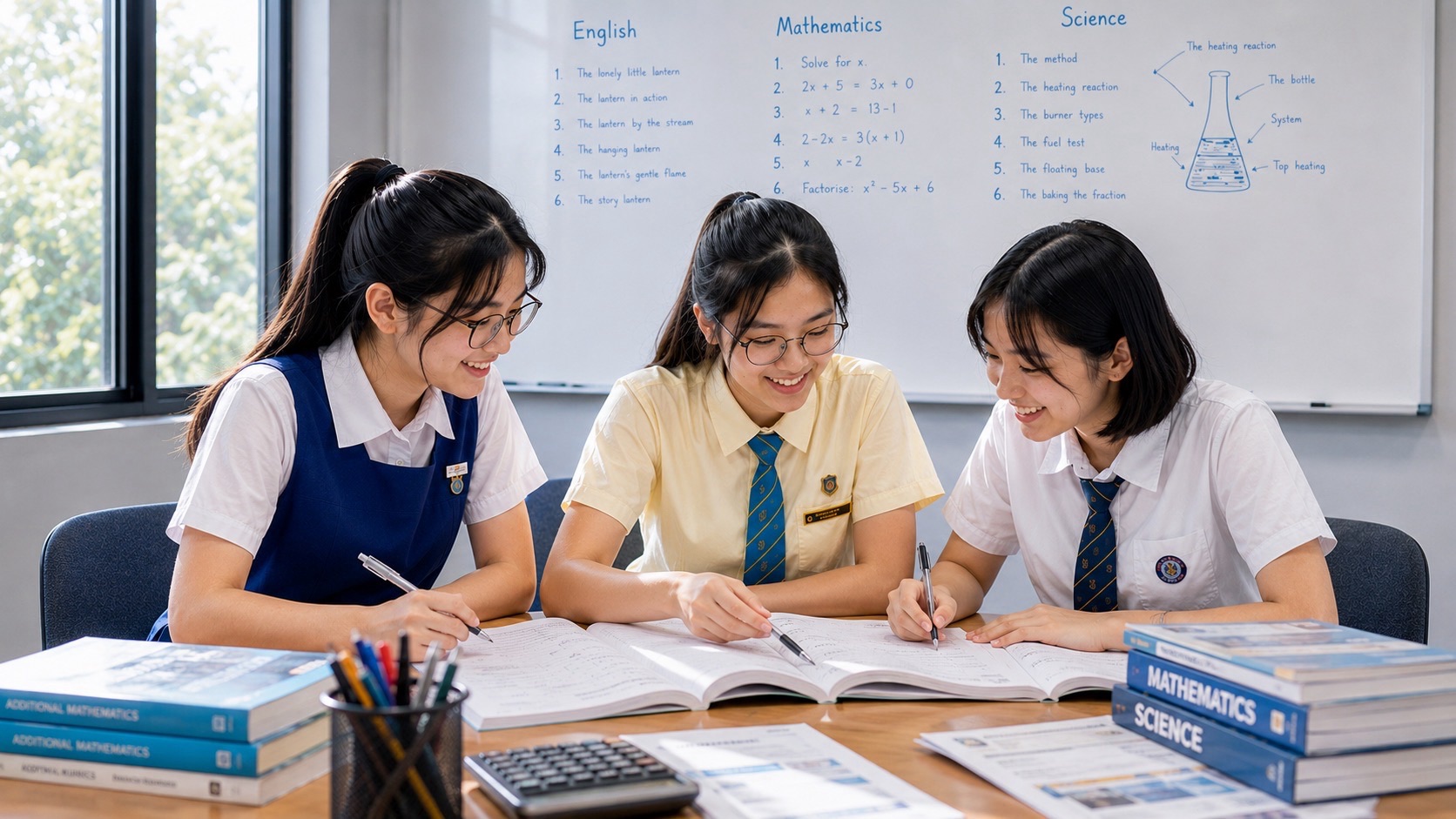
For Sembawang families comparing Secondary 1 G1 English small-group tuition, bring a piece of writing with at least two paragraphs. Ask your child to say what each paragraph does for the reader. A three-student group can help when the tutor sees how each pupil arranges ideas, teaches a specific revision and gives everyone a fresh chance to organise a response independently.
Start with the order of ideas. Put related sentences together, name who or what a pronoun refers to, and use a link such as “because” or “however” only when it describes the real relationship. These habits help readers follow school writing now and support later Singapore-Cambridge Secondary Education Certificate (SEC) work. Use the school’s current tasks, then check the national syllabus for your child’s examination year when it becomes available.
- Give each paragraph one main job and keep the details that help it do that job.
- Arrange those details so a reader can follow the time, reason, comparison or proposed action.
- Use clear names and references when “it”, “they” or “this” could point to more than one thing.
- Choose transition words to show a relationship your sentences actually contain.
- Revise the whole piece for order before changing individual words.
- Ask a tutor to show the first arrangement and a fresh independent attempt when reviewing progress.
Find your next learning step
Jump to a section or read the guide in order.
See what the reader has to keep in mind and related sections
Choose transitions that show the actual link and related sections
Practise revision in the right order and related sections
Questions Sembawang families ask about paragraph writing
See what the reader has to keep in mind
A paragraph groups ideas that belong together. A reader may follow the whole piece more easily when they can tell why those ideas are together, what new information each sentence adds and where the next paragraph takes them. Write three clear sentences on separate slips. “Our group needs a place to display its models. The science corner has two empty shelves. We would only need the lower shelf for one week.” A parent can put them in a sequence and ask the child to say what a listener learns at each step. The three sentences deal with one request and progressively make it more specific.
Now add a fourth sentence. “The duty roster changes every Wednesday.” It could belong if the writer goes on to explain that the display will depend on someone checking the shelves. In the current paragraph it interrupts the request. Before deleting it, ask the student whether they have a reason to keep it. If they say someone on duty could cover the shelf, the detail might fit in a paragraph about responsibility. If they cannot locate a purpose, save it in a separate note. The student learns how to decide what belongs, which helps more than being told to write a shorter paragraph.
A pupil can have good individual sentences and still make a reader work hard. A short draft could begin by discussing a broken cupboard, switch to the colour of a notice and finish by saying an item cannot be borrowed. Each statement might be accurate. The missing work is to show which issue affects borrowing, where the notice fits and what the reader is asked to do. Collect the sentences by job. One paragraph can explain why students cannot borrow. Another can tell students what to do with items due that day. Once the paragraphs have clear roles, the writer can check whether any information has been lost.
Use a small sample to find the current issue. Take two paragraphs of schoolwork and ask the child to mark the sentence they believe matters most in each. Then ask whether the other sentences support it, describe its consequences, give an example or lead to the next topic. A child who gives each paragraph the same job may need help dividing the full response into useful parts. A child who sees two sensible paragraph jobs but places details in the wrong place may practise moving sentences. When an answer sounds logical aloud and confusing on paper, ask whether the reader can identify the same connections without the child explaining them.
Full Subject-Based Banding can mean a pupil takes subjects at different levels. The Posting Group guides admission and the indicative starting level of most subjects. Check the school’s confirmed English Language level when choosing G1 practice and use the current teacher’s instructions to decide how far to extend a task. Students whose school has offered a different English level can use the same basic reading and organisation habits with work suitable for their confirmed level. English subject choices and progression after PSLE
Give each paragraph one main job
A writer can organise a paragraph around a reason, a step in a process, an aspect of a choice or a relevant part of a scene. A paragraph can include several facts if they do work for the same purpose. Suppose a student proposes a quiet corner for reading. One paragraph explains why the corner would help. The details could be that one table is directly beside a busy walkway and a second table is farther from the entrance. They support a point about choosing a location. A sentence about the size of a shelf can wait until the writer discusses equipment and space.
Help your child give each paragraph a label of two to five words. A draft about changing a club activity might contain “reason for change”, “new arrangement” and “what members bring”. Those labels help a reader too. Read the sentences under the label and decide where the answer introduces each detail. If the paragraph labelled “new arrangement” also includes a request for parents to complete a form, consider whether the form belongs with the arrangement or with instructions for parents. The best choice depends on the task and where readers are likely to look.
Some pupils start a new paragraph after every sentence. Give them a set of short related points and ask for a natural group. “The teacher left the spare books at the office. Students can collect one after lunch. They need to sign their name before taking it.” These three sentences perform one job together. They tell someone how to collect a book. If the writer later adds the date by which the books must be returned and what to do if one is damaged, a separate paragraph can make the return process easier to find. The boundary arises from the reader’s needs.
Other pupils keep a whole page in one paragraph. A useful teaching move is to find the place where the reader starts asking a different question. A draft might begin by saying why a group wants permission to hold a rehearsal and continue by asking for a new room, then end with a separate question about access to a cupboard. Ask the child to read and pause at each change of reader need. Some of the details about the room may stay beside the request because the teacher needs them in order to decide. The cupboard may require its own paragraph if it calls for a second decision.
Decide whether a detail explains, illustrates or drifts
A paragraph about fitting a water station beside a play area might begin, “A water station near the entrance would be easier to find.” A useful next sentence says who needs to find it or when. “Pupils joining the activity after class would pass it on the way in.” An example could show a group refilling bottles before starting. A reason could mention that putting the station farther away would require people to leave the activity to look for it. Each gives a reader something new about finding water.
If the next sentence says “The group’s T-shirts were blue last year”, ask whether the colour helps anyone decide where the water station should go. A child might have intended to propose one helper in a blue shirt who points people to water. If so, teach them to bring that reasoning into the sentence so the reader can see why it belongs. If the colour is just an interesting memory, set it aside. Editing for unity can mean developing a detail as well as moving or cutting one.
Students sometimes repeat a topic sentence and believe they have explained it. “The notice is useful because it helps everyone and is especially useful for new students” names a reader but leaves the benefit unclear. Ask what a new student can do after seeing the notice. “The notice lists the room and shows which staircase leads to it. A new pupil can get there without guessing which floor the club uses.” Both statements develop the topic. The writer chooses a detail and shows what it changes.
Use a first sentence that fits the actual task
An opening sentence within a paragraph can name its point, its action or the thing it refers to from the previous paragraph. “The main reason to use the lower shelf is that younger pupils can reach it” offers a point. “After collecting the forms, bring them to the office” gives an action. “The proposed timetable would also affect the helpers” refers to an earlier plan and moves the reader to a different concern. Children can learn more than one opening pattern and still use them consistently.
An opening that tries to advertise every idea can become too long. “This paragraph is going to talk about the library room, its position, the time, the book pile and why people need to go in” gives a list without a direction. Ask which thing a reader should understand first. “The reading club needs a room that stays quiet after lunch” sets a clearer focus. The room position and time can follow as details. The book pile belongs in the same paragraph only if it helps explain where or why the activity will take place.
Contents · Previous section · Next section
Find the order within a paragraph
Chronological order is useful for a procedure, a personal account or anything the reader needs to carry out in sequence. Suppose an instruction says “Return the key after closing the cupboard. Collect the key from the office before class. Check that every set is back before closing the cupboard.” The actions are clear individually, but the reader must reorder them. A student can write “Collect the key before class. Check that every set is back, then close the cupboard. Return the key to the office afterwards.” Most links are made by the order of actions and a few accurate time words.
Cause and effect can run in either direction. A pupil may begin with a problem and give the reason. “Several visitors joined the wrong line because the entrance sign was hidden.” They may instead give the reason and then its effect. “The entrance sign was hidden behind a board, so several visitors joined the wrong line.” Both can work. Ask which information the reader already knows and which information is new. A note to someone who saw the queue might begin with that event, while an explanation of a layout change might begin with the hidden sign.
Grouping by importance helps when the reader is deciding. A student writing to a teacher about moving an activity can give the main timetable problem first, then support it with two details. If the last sentence finally reveals that the current room is unavailable, the reader may have misunderstood why everything before it matters. Ask the writer to imagine the reader has time to read only the first few lines. Which detail is necessary for the reader to understand the request accurately? This is a useful check on sequence when the task calls for practical action.
Try changing the order aloud. Give a child these sentences. “The paper display can be moved to the left. Two tables will be needed for models. The door area should be kept clear. We were asked to plan a layout for eight visitors.” The strongest opening depends on the reader and purpose. A note to the teacher approving the layout can begin with its purpose and mention the clear doorway early. Directions to a class helping to set up might begin “Keep the doorway clear”, then say where to put the display and tables. Organisation responds to the reader, even when the facts remain the same.
Link new information to something the reader knows
A useful way to connect sentences is to carry one subject forward and add something new about it. “Our class will put a suggestion box beside the door. The box will be emptied each Friday. The Friday collection gives the committee time to read suggestions before Monday’s meeting.” Each sentence gives the reader a familiar thing to hold on to before introducing a detail. If the last sentence began with “Monday’s meetings were often short”, the reader might wonder why the point had shifted to meeting length.
Overusing the same noun can sound stiff, and a clear reference can help. Instead of “The suggestion box will be emptied each Friday. The suggestion box will be fixed to a shelf,” the writer can say “The box will be emptied each Friday. It will be fixed to a shelf near the door.” There is only one likely thing that “it” can name. When the sentence introduces several objects, repetition can be clearer. “Put the suggestion box beside the folder, then move the box to the shelf” gives a reader a single instruction. “Then move it” would leave a choice between the box and folder.
Read the following pair. “Ying told Nisha that she should bring the roll of labels. She set them beside the empty trays.” Ask who was supposed to bring the labels and who set them down. The first “she” might refer to Ying or Nisha. The second “she” has the same problem. A clean revision is “Ying asked Nisha to bring the roll of labels. Nisha set the roll beside the empty trays.” The student may then use “she” in a later sentence if Nisha remains clearly the person acting. In a longer piece, introduce a returning character by name if several intervening sentences have focused on someone else.
References can also point to whole events. “The doors will close early and the room will move upstairs. This will be difficult for some pupils.” Which change will create the difficulty? It could be the early closing, the stairs or both. Ask the writer to clarify the point they intend. “The move upstairs could make access difficult for pupils who usually enter from the ground floor” points to one change and gives a relevant reason. “Both changes could affect pupils arriving late, so we will send them the updated directions and opening time” describes a broader consequence. Selecting the right reference helps the reader follow the argument.
Contents · Previous section · Next section
Choose transitions that show the actual link
A transition is useful when it tells the reader how the ideas fit. “Because” gives a reason. “Therefore” or “so” gives a result or conclusion. “However” introduces something that qualifies or contrasts with the preceding idea. “For example” introduces a specific case that illustrates a general point. A plain conjunction may do the job in a short text. A pause or paragraph break may already show the shift. Choose words by meaning and use a register that suits the reader.
A pupil writes, “The gym was booked for a match. However, our class moved the practice to the hall.” The second sentence describes a consequence. “Because the gym was booked for a match, our class moved the practice to the hall” makes that link explicit. Now use “however” in a version that contains a real limitation. “The hall was available at the usual time. However, it was too small for all four groups.” The reader learns what was favourable and what prevented that arrangement from working as hoped.
Consider “Some students prefer to read alone. Furthermore, small groups can discuss a chapter together.” Both statements may be true, and the writer might be trying to compare two preferences. “Other students prefer to discuss a chapter in a small group” makes the second subject explicit. The connective becomes optional. If the paragraph makes an argument for offering both kinds of reading space, a last sentence can make the relevance clear. “A room with separate tables could give each group a suitable place to read.” Now the two facts support one proposal.
A child sometimes adds a formal phrase when an exact noun would help more. “It was difficult. In addition, it took too long.” Ask what was difficult and what took too long. “The sign-up form asked for the same details twice. Filling it in took longer than expected, so the queue grew.” The new version repeats a key idea and shows a cause. It also helps a reader see which action might address the problem. The label “in addition” was doing little work in the first version because the second sentence did not add enough precise information.
Change the opening of a new paragraph to signpost a useful shift
Transitions between paragraphs can be longer than a single word. “The room can fit all three groups. The schedule presents a different problem.” This pair moves from space to time. “Two changes would make the display easier to use. The first is to move the signs. The second is to put the samples beside the relevant signs.” That signposting makes the list navigable. For a family message, the shift can be simpler. “If you can come on Friday, please meet us at the office. If Friday is difficult, use the Saturday slot.” The reader recognises their situation and can choose the relevant instruction.
Carry forward only the information needed to make the shift. A writer might end a paragraph by describing why a school needs new notice boards and begin the next with “The placement of the new boards also matters.” The repeated noun helps the reader recognise the subject. Starting with “Secondly” gives less information if the first point was seldom mentioned and the second has no label. Ask what a reader would gain if they saw only the first sentence of each paragraph. A useful opening gives them a rough sense of the order.
Different readers need different levels of guidance. An organiser who already knows the venue may only need the time and the proposed movement of a table. A visitor needs an opening that identifies the event and venue before explaining why the table has moved. Give your child two readers for the same set of facts and ask them to order the information for each. A note to a friend can be direct and conversational. A written request to an adult responsible for a decision needs enough context to stand alone.
Check whether the link is already visible
Give a child these sentences. “I found the missing pass in the last drawer. I brought it to the office before lunch.” There is a time sequence and a clear object reference. Adding “therefore” may suggest the second sentence is a conclusion when it is simply an action that follows. “Then” is possible, and the order already shows what happened. Ask the child what information another word adds. If it identifies a condition, cause or exception that would otherwise be unclear, keep it. If it merely lengthens a clear passage, read without it and decide which version is easier to follow.
A more demanding pair can require a link. “Six students signed up for the first slot. We need a second slot for everyone.” One missing fact is the capacity of a single slot. An additional sentence gives the reader a reason. “Only four students can use the instruments at a time. We need a second slot for everyone.” Putting “consequently” at the beginning of the gap would make the missing premise less obvious to the writer but leave the reader guessing. Teach the child to supply the idea before selecting the transition.
Contents · Previous section · Next section
Revise a whole request before editing the sentences
The following task is original practice for school writing, rather than a national exam item. A class is considering a lunchtime display of student designs. The tables beside the entrance are often crowded, and two shelves are available at the back of the activity room. The teacher can approve where and when the display will sit. A pupil needs to explain the crowding problem, propose where the display should go, and say how to make it easy to use. Ask the child to organise the response for that teacher.
Read an early draft and identify what each paragraph is trying to do
An early draft might read as follows. “Dear Ms Chua, at lunchtime many students come in at once. There are two empty shelves. Our models are finished and we can ask two people to go there. Visitors might leave their exercise books on the table. I am writing to say we should display them.”
The draft continues. “Also we can put a card each day. It is often crowded. This would help. We can ask the class to set out on Monday. We can move it after Friday. However we still need someone to make sure people know what belongs where. Thank you, Min.”
Ask what the first paragraph accomplishes. It gives facts about crowding, explains that models are ready and finally introduces a proposal. Readers have to guess what “there” is, what the two helpers would do and where the display will go. The second paragraph adds a card, a schedule and a responsibility, while returning to crowding. The points are worth keeping. The revision should bring the proposal forward and group the details so the teacher can see what they are being asked to approve.
Give the writer three short paragraph labels. Start with “request and reason”, move to “place and layout”, then finish with “running and removal”. Place each useful fact under one label. Crowding near the entrance supports the first paragraph. Empty shelves, model names and the need to find the display belong with layout. Helpers, the Monday setup and the Friday removal belong with running the display. The exercise book detail can explain why entrance tables should remain free if that is the point the writer intends.
Build a revised complete response
A revised opening might be, “Dear Ms Chua, may our class display its design models in the activity room from Monday to Friday? The tables by the entrance get crowded at lunchtime. Pupils also use them for their exercise books, so I suggest keeping the entrance tables clear.”
A second paragraph might read, “We could place the models on the two empty shelves at the back of the room. Each model would have a card with its name and the group that made it. We could put a small sign near the entrance so visitors know where to look without having to stop at the door.”
A closing paragraph might read, “Two volunteers could set up the shelves on Monday and check the labels each lunchtime. Our group would remove the models after the display on Friday. Please let us know whether we can use the shelves and when we may set up. Thank you, Min.”
Now read the first sentence of each paragraph. The first asks permission, the second locates the display and the third deals with responsibility. The phrase “at the back of the room” is more useful than “there”. “Each model” and “the labels” give clear points of reference. “So” introduces the result of keeping information available near the entrance. The day and removal plan are specific enough for the teacher to respond, and the student asks for an agreement rather than claiming it already exists.
Notice that each paragraph could be developed differently if the teacher needed more information. The first might explain how long visitors usually stand near the entrance. The second might describe how the models can fit without blocking someone’s view. The third might add whether any equipment is needed during setup. Develop the point that matters most to the current task. A school assessment establishes its own requirements. This shorter sample shows how paragraphs work together. When a longer task asks for more detail, use the extra space to explain the situation and reasoning clearly.
Try one more change before moving on. Make the reader a classmate who has agreed to help, and write a brief message with the agreed details. The pupil might place Monday’s setup action first, then explain where the display will go, and end by asking whether the classmate can check it at lunch. The crowding explanation can be shortened if the classmate already knows it. This shows that paragraph unity depends on what the reader needs to do. It also shows why an effective response to a teacher cannot be copied word for word into a peer message.
Contents · Previous section · Next section
Compare another pair of full drafts with different readers
Consider an invented Saturday school reading event. The organisers can use two parts of a hall. Families arriving for a shared reading activity should collect an activity card at the welcome desk. People who prefer silent reading can go straight to the marked tables at the back. A volunteer has to help anyone who is unsure where to go. The organiser needs both a reminder to volunteers and a short note for visiting families. Ask the pupil to keep the facts stable and make the two responses work for different people.
Give the people running the event a sequence of actions
A first volunteer note might read, “We need to make the card easy to find. Give them one when they come in. It should say what to do. We also have quiet reading and they are at the back.”
The next paragraph reads, “Please tell them to go there if they ask. Some people may have questions. Do not send everyone to the first place. Also put down the cards before the doors open. Thank you.”
There are useful instructions in the draft. A volunteer could still have trouble identifying who gets a card and what “there” means. The setup instruction appears near the end, even though it needs doing first. Ask the student to make an action list in order. Put the cards on the desk before the doors open. When visitors arrive, find out what they want to do. Give an activity card to families who join shared reading. Show silent readers the marked tables. Stay available for visitors who ask where to go.
The revised note could begin, “Before opening the hall, place the activity cards at the welcome desk. Put them where a volunteer can reach them without leaving the entrance.”
The second paragraph can say, “When visitors arrive, ask which activity they want to join. Hand one activity card to each family joining shared reading and direct them to the group area. People who choose silent reading can go straight to the marked tables at the back.”
A third paragraph can resolve uncertainty. “If visitors are unsure, briefly explain the two options and show them where each area begins. Stay near the desk so the next arrivals can ask a question as well.”
The sequence goes from preparation to arrival to help. It uses “when” and “if” because procedure depends on time and condition. The readers know who they are and what they are expected to do. The language keeps the two groups distinct so the volunteer can direct them correctly. “Activity cards” becomes “them” within the first paragraph where the reference is clear. Later the full phrase returns beside a particular action.
Give visitors the information they need to choose
A note for families begins with the purpose of the event and may help the reader choose. One version could read, “Welcome to Saturday’s school reading event. You can join a shared reading activity or read quietly on your own. Both areas are inside the hall.”
The next paragraph could say, “If your family would like to join shared reading, please pick up an activity card at the welcome desk. A volunteer will show you where the group meets.”
A final paragraph might read, “For silent reading, go straight to the marked tables at the back of the hall. Ask the volunteer at the welcome desk if you would like help finding either area.”
Nothing in the brief says silent readers need an activity card. The paragraph openings divide the options by visitor need, so someone can select the information relevant to them. The note leaves out the instructions about when to put out the cards. Those matter to the volunteers and would make the visitors’ note longer without making their next action clearer. In a different task about planning access, some logistical information would belong. Ask the child to name who uses each fact and why.
To test the two versions, read each aloud with a different person playing each reader. The volunteer can say what they are going to do before the event. A visiting family can explain where they will go. If both hear the same directions although they have different roles, look for a missing subject or an instruction placed in the wrong paragraph. Give the child one new fact, such as a second desk for returning borrowed books, and invite them to decide where it belongs for each reader.
Contents · Previous section · Next section
Practise revision in the right order
Start by reading the task and the draft. Write two or three words beside each paragraph to explain what the paragraph currently does. This is often enough to spot issues. A paragraph may start with a request and end with directions to people who have already booked. Another may contain a reason that would be clearer near the opening. Move sentences or paragraphs before finding new words for them. After each move, reread the first and last sentences to see whether the connection still works.
Next, check what each pronoun or reference means. Some will be secure. Circle only the ones that could point to different nouns or events. Replace one with a name, a precise noun or a short phrase that identifies the action. Check whether a long transition could be expressed by one logical link. For example, “Due to these various points which were just described above, it is therefore important” might be clearer as “The narrow entrance means we need a second queue.” The exact link matters more than the number of words.
Then check a sentence or two for language the child has been learning. If the active goal is clear sentence endings, let them look for that feature in the whole draft. If the goal is agreement, start with sentences they changed during revision. Moving ideas can produce accidental repetition or an incomplete sentence. Read the changed parts with the sentence before and after. This helps maintain meaning across the boundary. Save the first and revised drafts so the child can see what moved and what stayed in place.
Try a new task a few days later. Give three short points about another school activity and ask for two paragraphs without demonstrating the plan again. See whether the child separates what happened from what the reader needs to do next, or gives distinct reasons separate space. Keep the length and demand close enough to compare the attempts. If all the writing still runs together, ask what each paragraph should help the reader work out. If the child chooses useful paragraphs independently but drifts halfway through one, practise checking one paragraph after drafting it.
A nearby library can supply low-pressure reading examples. At Sembawang Library in Sun Plaza, let your child choose a book or short text they want to browse. Ask them to find two paragraphs and tell you what each one adds. They might notice how one introduces a person and the next tells what the person did, or how one describes a problem and the next explains the response. Leave the reading choice to the child and keep the activity short. Sembawang Library
Check a paragraph break after changing the ending
An edit to the final paragraph can change what the previous paragraph needs to lead into. Imagine that the note about the reading event originally ended by asking families to arrive early. In the updated situation, the organiser wants people to stagger their arrivals. A writer might edit the last line to “Arrive at the time on your confirmation” but leave the previous paragraph saying “We hope everyone will be ready outside the hall when the doors open.” The directions now compete. Read one paragraph before the change and one after it. That makes it easier to find inaccurate advice left over from an earlier draft.
Pupils can also practise choosing a useful ending. A request can end with the decision the reader needs to make. A note inviting someone to choose can end by explaining how to ask for help. A piece describing a problem can end by showing what changed after the response. Ask the child to choose the ending that serves the task and check whether an earlier paragraph prepares for it. If the ending suddenly introduces a new plan, add a clear reason earlier or develop it in the final section.
Give the child a fresh note with a short contradiction between two paragraphs. One says the last group will return the borrowed materials on Friday, and the ending says to keep them for a second week. Ask them to use one fixed instruction from the task to decide which paragraph to revise. This connects proofreading to meaning. A reader is more likely to notice the two directions than a perfectly placed comma.
Contents · Previous section · Next section
Use the SEC writing syllabus as a longer-term reference
SEAB lists K100 as the published G1 English Language school-candidate syllabus for the inaugural 2027 Secondary Education Certificate. Its Writing paper includes editing, situational writing and continuous writing. For both extended writing sections, the published language criteria concern how ideas are organised, how clearly the writer expresses them and how accurately the language is used. The descriptors show why sequencing matters within paragraphs and between paragraphs. They also give a reason to practise using links to make real relationships clear. 2027 SEC G1 syllabus list G1 English Language K100 syllabus
The 2027 Writing paper is computer-delivered. A child who is already drafting by keyboard for some school work can practise reading what they have moved and correcting references after an edit. Pressing Enter between ideas is easy. Deciding where the reader’s question changes requires the same thinking as on paper. As practice length grows, ask your child to reread the first and last sentence of the paragraphs they have rearranged and fix a broken connection. Use the school’s instructions for allowed materials and conditions on assessed tasks.
SEC eligibility, paper details and school assignments affect different decisions. The national syllabus for the correct year describes the later exam. The school gives the directions for the work a Secondary 1 pupil is doing now. A short school task may legitimately ask for two well-developed paragraphs. As a child develops, longer tasks give them more opportunity to organise several points for a given audience. Ask the teacher what a well-organised response should accomplish for the current task. The child can build that understanding one piece of work at a time.
Contents · Previous section · Next section
Look for individual writing in a three-student class
Three pupils can write to the same brief and need different help. One may need to decide where the request appears. A second may choose good paragraphs and use “however” for every change. A third may sequence the ideas well but assume that “they” makes sense when the draft mentions two groups. A tutor can ask each writer what they think the reader needs next. The answer informs a short correction and gives the student an action they can use on a later task.
Check that each pupil has time to plan and draft individually before the group discusses a sample. The tutor can put two paragraph openings side by side and ask which one suits a visitor or an organiser. Students can learn from a reasonable choice another pupil made. They still need a fresh instruction and time to make their own choice. Look for feedback such as “She moved the approval request to the opening and independently brought the next steps into their own paragraph on a new task.”
At home, you can do part of this work with two short samples. Ask a child to explain the reason for one paragraph break and show which words connect the next idea. With a tutor, ask how the teacher would judge progress if the child already gives good answers in discussion and finds it hard to organise the writing independently. Check any class location, available lesson time and suitability for the child’s subject level directly. Share one example of where the reader got lost and one place where the child explained their idea well. Contact eduKate Singapore
For shorter practice on sentence accuracy and editing, see the Bedok guide to G1 English writing.
Contents · Previous section · Next section
Questions Sembawang families ask about paragraph writing
How many sentences should a paragraph have?
Use enough sentences to do the job the paragraph has. Two may be enough for a brief explanation when the relationship is clear. A developed reason may need a statement, an example and an explanation of how the example supports the point. School instructions may set particular expectations for an assignment. To help a child decide what to add, ask what important detail a reader would still need. Add a paragraph when a different part of the task starts to require attention.
Can my child repeat a word instead of using a pronoun?
Yes, when a repeated word tells the reader exactly what the sentence means. “They gave the club a spare table” can confuse a reader after a sentence about two different teams. Naming the team once removes the uncertainty. Use the pronoun in a later sentence when the person or object remains obvious. Ask your child to read the version without explaining it aloud and see whether the reader can follow the references unaided.
Should we give our child a list of useful transitions?
A short list can help if it groups words by the relationships they express. Then practise choosing between a reason, a contrast, a result and an example. Ask which relationship the writer intends before selecting the word. If the draft needs an extra fact, add the fact so the connection is clear. A simpler word is often enough when it expresses exactly what the reader needs to understand.
Should we work on paragraph order or grammar first?
In a full response, make sure the reader can find the point and follow the order. Then repair language that makes the meaning unclear. A serious sentence error may need immediate attention if you cannot tell what the child meant. If the sentence is clear enough to move, position it before polishing. The first useful check is the one that helps the reader make sense of the work. Use the teacher’s feedback to decide which part merits the next short practice.
What would real improvement look like?
Look for a fresh piece in which the child puts related ideas together, makes necessary references clear and can say why the order fits the reader. A shorter paragraph can show improvement if it now develops one point accurately. Ask the child to mark one useful link themselves. Then see if the same habit appears in school writing. It is possible to notice these gains before an assessment sums up several different writing skills. Preparing for Secondary 1 G1 English Language