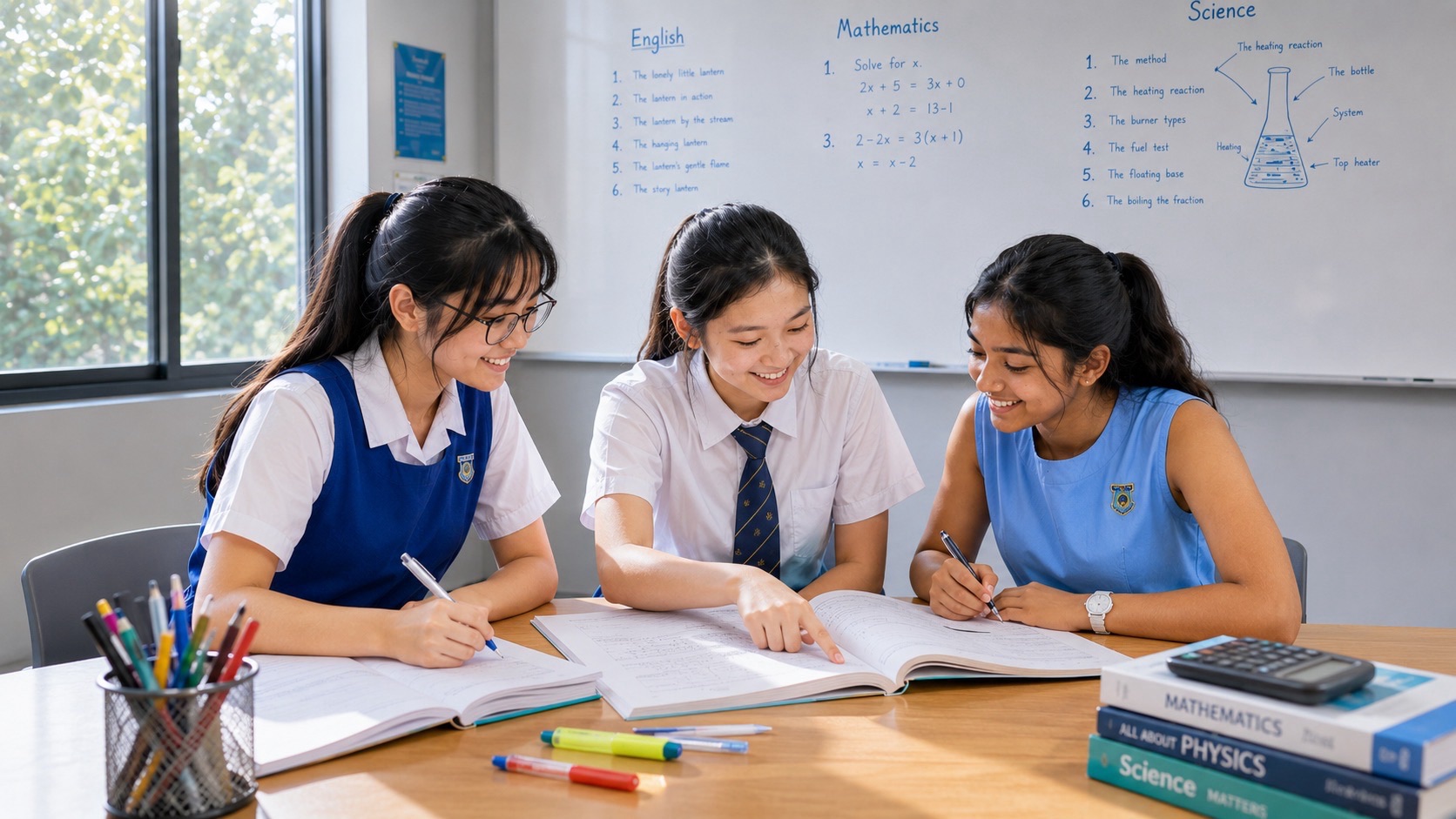
Secondary 1 G1 English small-group tuition can help Bukit Panjang students write explanations a reader can follow from the first sentence to the last. A student may know why an activity moved indoors or how a group uses a sign-up sheet, yet leave out the detail that connects the answer. In a three-student group, one learner can read the explanation, another can describe what it helped them understand and the tutor can help the writer repair the missing step.
The move from Primary 6 to Secondary 1 brings more tasks that ask students to do something with information. They might explain why a school routine changed, describe how a system works or use a short source to answer a reader’s question. For a Bukit Panjang family, a useful lesson makes those jobs explicit, gives the student time to write in their own words and checks whether they can explain a new idea without a tutor filling in the connection.
- Confirm your child’s English Language subject level and check which explanation tasks the school is using this term.
- Ask what the reader needs to understand before choosing the details and writing the opening.
- Practise defining an unfamiliar term, putting a process in order and explaining a cause through its consequences.
- Use the worked examples to see how a writer builds a connection from a fact or source detail, then test the same skill with fresh material.
- Treat the 2027 SEC G1 English syllabus as a reference. It lists an explanation as one possible Situational Writing form. Check the syllabus for your child’s own examination year.
- Look for individual drafting and revision in a three-student class, and choose a schedule your child can manage alongside school.
Find your next learning step
Jump to a section or read the guide in order.
What makes an explanation clear? and related sections
Connect a cause to the result it produces and related sections
What an active three-student lesson looks like and related sections
What makes an explanation clear?
An explanation helps somebody understand how something works, why something happened or what an idea means. Suppose a classmate asks why the class moved closer to the door. “Because the teacher said so” may identify the immediate instruction. If the class moved because the display team needed room to carry a large model, the more useful explanation includes the constraint and how the seating change solved it. “The display team needed a clear path wide enough for its model, so we moved the nearest desks back and sat along the side of the room.” The reader can now see the practical connection.
A clear explanation usually starts with the subject and the question being answered. It then selects the facts the reader needs in order to follow the connection. End where the question has been answered or the reader has enough information for their next step. If a child has been asked how a signup sheet prevents double bookings, their answer can explain what people write and what later users see. An account of everything the class did that day would use space without improving the explanation.
One useful first check is to imagine a reader who was absent. What would they need to be told even though everyone in the classroom already knows it? Consider “Everyone put it there before recess.” Those five familiar words work among people who know what “it” and “there” refer to. The absent reader needs an object and a place. “Before recess, each group put its borrowed markers in the tray beside the whiteboard.” The writer is doing the reader’s part of the work at the right time.
Decide which question the writer is answering
Ask the learner to circle the main instruction. “What is a waiting list?” calls for a definition and possibly a simple example. “How does the waiting list work?” calls for a process the reader can picture. “Why does the class use one?” calls for an explanation of the problem it solves. All three involve the same subject. An answer that says “It is a list of names” could begin to address the first question and leave most of the other two unanswered.
Have the child try one opening sentence for each question. For the definition, “A waiting list records people who want a place after all the current places have been filled.” For the process, “When a space becomes free, the organiser contacts the first person on the waiting list.” For the reason, “The list gives the organiser a fair way to offer a new space when somebody cancels.” These are short starting points. A student can extend them by adding what the particular reader needs next.
Choose one topic the child knows well, such as bringing materials back to a classroom box, and swap the questions. Ask what the return box is, how it is used, and why it helps. If the child gives the same answer each time, listen for the part of the task they missed. The same activity supports oral language too. A student who can explain an idea aloud before writing may have enough content. They may need help arranging it so a reader can follow it without hearing their spoken clarifications.
Write for a reader with a reason to care
A class member taking over a job tomorrow needs different details from a parent hearing how the job is organised. The class member might need the order of operations and a warning about a common mistake. The parent might mainly need to know why the process helps and whether the student needs to bring anything. Give the learner a clear audience when practising. If no audience is given, picture somebody who is genuinely interested and unfamiliar with the topic.
Try “Explain how the group returns items it has borrowed” and assign two readers. One is a classmate who will carry out the routine. The other is a teacher deciding whether to use it next term. The classmate needs exact places, labels and deadlines. The teacher needs to understand how the routine makes it easier to recognise which items are still out. In both drafts, the process itself must be accurate. The amount of detail and the order can change with the reader’s purpose.
Define an idea so the next sentence can do more
A definition tells the reader what something is and what makes it useful or distinctive in the present context. Definitions are often strongest when a general category comes first. “A return register is a list that records what people bring back after borrowing it.” The reader knows what kind of thing it is and what it records. A second sentence can show how it differs from another list. “The class timetable says when activities happen. The register shows which borrowing records are still open.” The distinction gives the reader a foothold.
One common trouble spot is the definition that returns to the same word. “A booking system is a system for bookings.” The words sound familiar, but the reader still needs to know the system’s job. Try “A booking system reserves a room or item for one person or group during an agreed period.” Follow with an example that uses the term correctly. “If Lina reserves the shared tablet from two to half past two, another group can see that it is unavailable during that time.” The reader can now understand both the term and a real situation it applies to.
Look for examples that make the boundary clear. A reservation and a request can seem similar to a child. In the context of a classroom tablet, a request asks for a turn. A reservation is the turn already agreed. A useful example shows the difference through an action. “A learner who writes their name on the request form is still waiting. When the teacher confirms a time, a group can plan to collect the tablet then.” The explanation protects against confusing the wish with the confirmed arrangement.
Work through a definition of a resource station
Here is an invented source for practice.
In Class 1, the resource station is a low shelf near the door. One tray contains clean paper. One tray contains usable offcuts. The other tray takes paper that is too small or worn for class use. A student who needs a label can choose a clean offcut. Students place paper in the last tray when it cannot be used again.
Try this prompt. “Explain what the resource station is and how it helps someone preparing labels.”
A first response might say, “It is where things go. It helps because there are trays and paper.” The answer includes some factual words, but readers still have to guess which paper to use and why the station is helpful. Look for a general category and a distinction. The general category is a shelf for class paper. What makes it useful is that the paper is sorted into different trays, including a tray with offcuts large enough to use.
A developed response could read, “The resource station is a shelf where the class sorts paper by how it can be used. A student making a small label can take a clean piece from the offcuts tray. This saves a whole sheet and makes it easy to find paper that is large enough for the job.” The categorisation answers what it is. The example links the label to one tray and explains the benefit. The writer avoids guessing how much money or paper the class saves over a year, because the source gives no figures.
Ask a student to explain the term “offcut” in their own words. “A piece left after a larger sheet has been cut” is clear. Then ask the child to describe the resource station to a new learner who will have to return paper after an activity. The new reader needs to know where to place paper they can use again and where to put damaged pieces. The earlier answer can supply the definition. The writer must now select different details.
Keep a usable term and explain it once
Students sometimes avoid a helpful word because they think every term must be replaced with a simpler one. A term such as “deadline” is useful if the reader has a clear meaning for it. “A deadline is the latest time at which the work can be submitted.” The next sentence can use “deadline” without repeating the definition. Try substituting “finish time” and see whether anything important changes. A group may finish an item before the submission deadline. The two times can differ.
For a word such as “collection point”, check which parts are clear. A student can see “point” means a place in this case. A useful definition adds what happens there. “The collection point is where students pick up their finished display boards.” If the same phrase appears later, use it consistently. Calling it “the station”, then “the box” and later “the area” can make a reader wonder whether the writer has moved to a different place. Accurate repetition of a term can help a reader keep track.
Contents · Previous section · Next section
Explain a process in the order somebody can follow
When the question is “How does it work?”, begin by deciding where the process starts and what counts as completion. A process for borrowing a class item might start by checking whether the item is free and finish when its return is recorded. A process for putting up an exhibition might start when the room is available and finish when somebody confirms who has each job. The start and finish provide a frame for choosing the steps between them.
Use connecting language because it does real work. “Before opening the cupboard” tells the reader which action is a prerequisite. “While the first group is setting up” tells the reader two activities can happen at once. “Once the label has been checked” tells them what needs to happen before they proceed. A row of sentences starting with “then” can name the steps in time and still leave doubts about which ones depend on each other. Ask where applying the instructions out of order would matter. Explain that dependency.
Give a reader a small example when the process is difficult to picture. A child might write “Record cancellations, then adjust the allocation.” An ordinary sentence makes each action visible. “If the first group cancels its slot, cross out its name and offer the time to the first group on the waiting list.” The reader sees who loses a reservation and who receives it. If the process is merely being explained to someone who reads about it, third-person wording such as “the organiser crosses out the name” can help retain a natural explanatory voice.
An original process that prevents double use
Suppose a class has two audio recorders. Students use them to practise an oral presentation. Here is the information they are given.
The sign-up sheet shows the name of each recorder in a separate column. Each row is a twenty-minute slot. A group writes its name in an empty box before borrowing a recorder. It collects the device from its labelled tray at the beginning of its slot. The group returns it to the same tray at the end. If a group gives up its slot before using the recorder, it removes its name from the sheet so classmates can see the time is free.
Try this prompt. “Explain how the sign-up system allows groups to share two recorders without expecting the same one at the same time.”
A short first draft might say, “Everyone writes their name and returns the recorder. The sheet and labelled trays help them share.” This identifies the main tools and leaves the mechanism mostly implicit. The tutor can ask what the grid tells the second group when the first has already signed up. The writer needs to explain the relationship between the row, the column and the entry. It may help to draw a sample row and show one filled box and one empty box.
A fuller answer could read, “A group checks the sign-up sheet to see which recorder is free for the time it needs. Each column represents one recorder, so an occupied box reserves that particular device for the twenty minutes in the row. Another group can choose the other recorder if that box is free, or select a different time. The group collects the device from its labelled tray when its slot begins and puts it back when the slot ends. If it cancels before borrowing the device, removing its name frees the recorded slot for someone else. The sheet tells groups to expect different devices or different times.”
A student can test this explanation with a classmate. “Group Cedar writes its name under Recorder A for 2.20. Which choices could Group Willow have?” The answer depends on what other boxes are filled. Group Willow could use Recorder B at 2.20 if free or look for another time. That follow-up shows whether the explanation refers to an actual decision a reader can now make.
For a transfer exercise, replace the recorders with two separate rehearsal spaces and make each group’s need different. One room has a table for models. One has space to practise a presentation standing up. Ask the child to explain what a booking list would need to show so groups can choose a room that suits them. The principle of a slot remains. The letter or number of the room becomes a decision because the rooms do different jobs.
Explain an exception without losing the main process
A pupil may understand the usual steps and need help remembering when one of them changes. A school notice could say that students normally mark collections before taking equipment, but that a teacher handles collections when supplies come in late. Put the main process first, then write a sentence that identifies the exception. “Students usually write their names before collecting supplies. If the order arrives after the lesson has started, the teacher records which items each group receives.” The “if” sentence tells a reader when the change applies.
Test the two cases with a question. What happens if supplies arrive before class? What happens if they arrive once the class is already under way? A student who gives the same answer both times should revisit the words “if” and “usually”. A child who knows the difference orally can write one example of each. Asking them to put both examples into one long sentence may produce new confusion. Keep the cases in separate sentences until the connection feels natural.
In a longer explanation, mention unusual cases only when they matter to the reader. A group member covering the organiser’s role may need the exception because a wrong decision can interrupt a lesson. A parent reading a brief note about what the class does may only need the usual process. A writer can show judgement by including the right condition for the audience and leaving detail about a rare case for readers who need it.
Contents · Previous section · Next section
Connect a cause to the result it produces
Students often say “it helps” and stop. A useful causal explanation shows what happens between the cause and the result. Suppose the class puts numbered cards beside the materials for a practical task. “The cards help everyone get ready faster” says what might improve. “The cards show which group uses each set of materials, so groups can go straight to their own table instead of asking where their materials are.” The added step tells the reader why the effect makes sense.
Work through three questions before writing. What changed? What did that change allow someone to do? What result followed or could follow? If a group put a list of jobs where everyone could see it, the next event may be that someone could start a needed task while others were busy. The result may be that tasks were less likely to be repeated. The document itself does little until someone reads and acts on it. Explaining that human action makes the cause easier to understand.
When an outcome is likely rather than certain, use wording that matches the evidence. “This can reduce waiting” suggests a plausible benefit. “This stopped all waiting” requires something to show waiting disappeared. A pupil can still give a clear answer while acknowledging a condition. “The return labels help classmates find the right box when they can read the labels from the entrance.” The condition tells the reader when the proposed benefit works.
A numbered basket shows what is still missing
Imagine a classroom where groups use small bags of measuring equipment. The teacher puts a numbered basket on each table. The class has the following information.
Each bag and basket has a group number. At the end of the activity, each group returns its bag to the basket with the same number. The teacher checks the baskets before dismissing the class. Each number is large enough to see at a glance. When an empty basket remains, the teacher can ask the group assigned to that number to check its table.
The question is “Explain why the numbered baskets help the teacher find out which groups still have equipment.” A first draft might read, “The baskets are organised, so the teacher knows everything and can find the equipment.” The word “organised” hints at the mechanism and the answer overstates what the teacher knows. Point to the visible clue instead. The teacher can tell which group has yet to return its bag by seeing which basket is empty. The basket alone does not reveal the bag’s exact location.
A stronger version could read, “The number on a group’s bag matches the number on its return basket. When a bag comes back, it fills the basket for that group. An empty basket tells the teacher which group still needs to check for its bag. The teacher can ask that group directly rather than sending the entire class to search.” The first two sentences build the mechanism. The last two explain the consequence without claiming the teacher can recover anything immediately.
Have a classmate test the explanation. “What does an empty basket marked 4 tell the teacher?” If the reader replies “Group 4 may still have the bag or should check its table,” they have followed the reasoning. Ask what would happen if the bags were swapped by accident. The writer could add a condition that the teacher checks that each bag number matches its basket or narrow the claim to what the method usually shows. This extension trains a child to see what evidence can support.
Tell a likely cause apart from an event that came first
People often say one thing caused another because it happened earlier. It may have played a part, but the sequence alone can leave other explanations open. Consider an invented situation. A class puts a “remember your water bottle” card by the door on Monday. That week, fewer bottles are left in the classroom. On Thursday and Friday, the monitors also remind everyone to check the tables before leaving. Can the class say the card alone caused the change? The new sign is a plausible reason. The spoken reminders could also have helped.
A student can give a measured explanation. “The sign may have helped because learners would see the reminder when leaving. The monitors’ reminders could also have made pupils check their tables. We would need more information about what happened on days with only the sign to tell how much it contributed.” This answer uses the order of events and adds a possible mechanism. It notices another relevant fact and shows what further information would make the cause clearer.
A younger learner can start with one careful sentence. “Fewer bottles were left after the sign went up, but there were other reminders as well.” Then ask which extra detail would make the suggestion more convincing. It could be a student reporting that they saw the sign and went back for their bottle. That example supports a mechanism for one person. It cannot establish what every student did. A writer can describe what the evidence supports without treating uncertainty as a reason to avoid answering.
Try a second example around a reading corner. After the library adds a larger label to a book box, returns go up for two weeks. The school also held a class competition during that period. Ask the student to explain how either change might affect returns. Then ask which piece of evidence would support their best explanation. Did students say they could find the box more easily? Did returns rise only among the groups taking part in the competition? Different observations point to different explanations.
Contents · Previous section · Next section
Use a source detail where it answers a real question
When a task provides a poster, notice, source paragraph or table, start by reading the question. Then read the source for facts that do a job in the answer. A detail may identify who is included, explain why a change happened or show how a reader should act. The learner should be able to tell you why they chose each detail. “It was on the page” is a starting observation. “It tells the reader which group the new rule applies to” is a reason.
Read the original notice below. Imagine the class needs to explain a new display arrangement to parents who plan to visit after school.
The display was planned for the activity room. A rehearsal now uses that room at the original time. The display will take place in the hall between 3.30 and 4.30 p.m. The hall has two doors, so visitors will enter through the door beside the staircase and leave through the door closer to the courtyard. This gives students room to carry models into the hall before the start. Families who need help locating the hall can ask a teacher at the entrance to the main block.
Try this prompt. “Explain why the display arrangement changed and how the entrance plan will help people move around.”
The reader needs the reason for the move and the effect of the entrance plan. The original time window may be helpful if this appears in a practical message, but it cannot replace an explanation. A student who copies “The hall has two doors” has mentioned a relevant fact. They still need the connection. What do the separate doors allow arriving and leaving visitors to do? Why is it useful to let students finish bringing in models without blocking the entrance?
A possible answer reads, “The display has moved to the hall because the activity room will be used for a rehearsal. The hall has two doors. Visitors will enter beside the staircase and leave by the courtyard door. The separate doors make it easier for people arriving and leaving to pass through different places. The hall arrangement also gives students room to move their models in before the display starts.” Each sentence plays a role. The response keeps the change tied to a fact and makes a reasonable practical connection without adding facts about staffing, capacity or supervision.
A short weaker answer might say, “The hall is bigger and safer so everyone can come. The activity room was busy.” The source does say the activity room is needed for a rehearsal. It gives no comparison of room sizes and no statement that everyone can attend. Rather than penalising the student for trying to explain, ask which parts can be matched to a detail in the note. A repair could replace the claim that the hall is bigger with a fact about having two doors, then explain what they allow people to do.
Decide when the source can support an inference
Some questions need a reader to go beyond repeating the source. A child may worry that an inference is a guess. Show them how to connect it to a detail. If a notice asks visitors to arrive at different entrances for two activities held at the same time, a reasonable explanation is that the arrangement keeps both groups from going to the same place. The notice may make that benefit likely even if it does not use those words.
A less supported claim would be that the entrances were chosen because one stairway is under repair, when the note gives no evidence about repairs. Ask the writer to underline the words that support their idea and explain the gap between that text and their sentence. A test question is “Could I show a reader why I wrote that?” If they can point to the source and give a short explanation, the inference probably has a basis. If they can only say that it sometimes happens, choose a more cautious claim.
Visual sources can carry conditions too. Draw two arrows on a simple diagram, one from the staircase door into the hall and one out through the courtyard door. The arrows convey direction. They do not supply opening times or reasons. Combine the diagram with a short notice to practise finding one fact in each source. The student can then answer a question about where an arriving visitor goes and why there are two directions. This makes reading the visual part of the explanation instead of an extra decoration.
Combine two sources without confusing their jobs
Consider a source notice about a change to a collection routine.
From Tuesday, students collect spare exercise books in the room beside the office. Each class sends one representative. The representative brings a list with the number of books the class needs. A teacher places the requested books into a bag for each class.
Imagine a small table supplied with the notice. It shows that the room opens at 1.20 p.m. on Tuesday and 1.40 p.m. on Wednesday, and that it closes at 2 p.m. on both days. Ask the learner to explain how sending one person helps the collection run smoothly, then add the one timing detail needed by a representative collecting on Wednesday. The notice supplies the process. The table supplies the time. A clear answer should keep those jobs distinct.
A first version might read, “Each class has a representative who collects the books and it is 1.20 or 1.40, so it is easier.” The writer has seen both time entries and needs to connect the chosen entry to Wednesday. They also need to say why one person and one list help. Ask them what the teacher can do when a representative supplies a single number. That question may prompt a sentence about preparing the full class order together.
A clearer answer could read, “Each class sends one person with a list of how many books it needs. The teacher can use this list to pack one bag for that class instead of sorting separate requests from individual students. For a Wednesday collection, the representative can arrive from 1.40 p.m. and needs to finish before the room closes at 2 p.m.” The causal connection comes first because the question asks how the arrangement helps. The final sentence supplies what the representative needs on the stated day.
For a follow-up, add a row showing a different time on Friday and ask the child to prepare a two-sentence explanation for the teacher taking over the collection. It may begin with how the school prevents mixed orders and include Friday’s opening time only if the teacher needs it. The student has to use a fresh audience and a new timing detail. That shows whether they can continue to choose evidence with a purpose.
Contents · Previous section · Next section
Revise an explanation in three passes
Read the whole response once to check scope. If the prompt asks why and how, point to the sentence where the cause first becomes clear and the sentence where the process is explained. Give each part enough development for a reader to follow. If most of the answer describes the setting, see which one sentence can establish it efficiently. Use the space saved to develop a connection.
Read a second time to check the job of each paragraph. A longer explanation might first define an arrangement, then describe the important steps and finish with why the arrangement matters to the audience. A short response may do all of that across a few sentences. Let the reader’s needs determine the structure. Start a new paragraph where you turn to a distinct part of the question, such as shifting from why materials are stored separately to how students should collect them.
Read a third time to find any wording that obscures a relationship. If two different people appear just before “they”, name the person or group who acts. Look at connecting words. “Because” introduces a reason. “After” shows order in time. “As a result” signals a consequence. If the connector promises cause and the writer has merely placed two events next to each other, change the wording or add the missing connection. Read the revised passage aloud to see if the relationship became clearer.
Repair an explanation of a class routine
Try this short first draft.
We have two copies, and they put it outside. People come when it is time. This is why it works better. Our teacher made this after some groups had the same time.
The material suggests a scheduling problem. The learner may know whose copies these are or what “it” refers to. Ask the child to name the copies, the organiser and the object. Then ask what each reader sees in the record and why that prevents confusion. A workable scenario is that the teacher keeps one copy of the room schedule and posts a second copy outside the room.
A revision could read, “The teacher keeps one copy of the room schedule and posts another copy outside the door. The schedule shows the time set aside for each group. A group can check its turn before entering and wait if the room is still booked. The teacher started using the schedule after two groups expected to use the room at the same time.” The repair names who does what. It also explains what makes the schedule useful. A person outside the room can check the current booking before acting.
The reader could still ask what happens if the two copies disagree. That question may warrant another sentence if the audience needs to follow the process. The student could write “The teacher updates both copies when a booking changes.” In a source-based task, check whether the materials say who updates the copies. If the detail is unavailable, a phrasing such as “The copies need to show the same bookings for the system to work” explains the condition without adding an unsupported procedure.
Try a two-sentence explanation from another subject
In a Mathematics activity, three groups are asked to compare how far the same model rolls down a ramp from different starting points. The worksheet tells them to measure from the same line at the bottom. Ask the learner why the shared line matters. The short answer “so that it is fair” gives the aim. Add the mechanism. “All groups measure from the same line, so a larger number represents more distance beyond that line. If one group starts measuring closer to the ramp, their number could be larger partly because they used a different starting point.” The answer says exactly what the shared rule allows the students to compare.
For transfer, ask why a class measuring the size of different leaves might use the same unit. The student has to identify what remains fixed, explain what goes wrong if it changes and relate the answer to a comparison. The activity is short enough for the learner to try before seeing a model.
Contents · Previous section · Next section
What an active three-student lesson looks like
Give three students the same short source, but ask each to draft independently. One may answer the main question in the first sentence and skip the evidence. Another may copy too much detail and make the reader search for the point. A third may give the claim and one reason but mix up the class and teacher’s jobs. The tutor can give different directions within the same task and gain evidence of how each student makes sense of the source.
After each draft, give the other two pupils clear responses to make. The first reader reports the main idea in their own words. The second points to the line that explains how or why it works. If they can both describe the subject and find the connection, the learner has evidence the writing reaches readers. If the main idea is clear and the relationship is missing, the tutor can ask, “What does the reader do with this information?” or “What would happen without this step?” The writer then chooses a revision.
When a child is quiet, allow a short planning note before discussion. A pupil who rarely speaks first might be good at seeing which detail from a source belongs. They can state that detail and explain its role before another student offers a complete model. The adult can also separate the spoken task from the writing task. Sometimes a learner can explain a process well out loud and needs to see how the listener’s question becomes part of the written answer. Having another student ask where the information came from can teach them what a reader will need.
Ask a prospective tutor how they will check independent progress. A lesson should give the child a chance to attempt an explanation before seeing a complete model and time to apply feedback after it. After practice with a resource station, a fresh task about a booking sheet can show whether the learner now includes the missing intermediate step. A copied model may tell you what the child saw. A fresh attempt can show which decisions the student could make on their own.
Contents · Previous section · Next section
Where explanation fits in the SEC and in school
Under Full Subject-Based Banding, a Posting Group helps determine initial subject levels and is used in secondary school admission. English Language has its own subject level. Check your child’s school allocation, especially if your family has discussed options for a more demanding level. Ask the school about the class’s current writing tasks and how progress is assessed. English subject choices and progression after PSLE.
The Singapore–Cambridge Secondary Education Certificate starts in 2027. In the published 2027 G1 English Language syllabus, K100, Situational Writing makes up one section of Paper 1. The task is based on a given situation and includes a visual text. Candidates write at least 180 words, and the syllabus lists an explanation among the possible forms. The task calls for the student to use given information and write for the stated purpose, audience and context. The shorter teaching examples above isolate specific skills. A full response follows its actual task and develops the required points. Check the published syllabus for your child’s exam year as it becomes available. 2027 G1 English Language examination syllabus.
For practice turning a brief into different messages, see the Bishan guide to G1 situational writing. An explanation is useful well before a national assessment. Your child might explain a change to a classroom activity, use evidence to answer a comprehension question or prepare a short description of a process in another subject. The audience and conventions can vary. Ask your child’s teacher for one sample that is appropriate to their current level. Have the child read the prompt and explain what the reader needs before copying any layout or opening. That conversation gives purpose to the form. Parent guide to Secondary 1 G1 English Language.
Contents · Previous section · Next section
Decide what progress would look like for your family
Pick one exercise for each week. Begin with a short definition for somebody who is new to a familiar routine. Move to a process with an exception, then a cause that needs an intermediate step, and finally an unfamiliar source task. Keep short notes about what the child did independently. “Used the time correctly but needed a question to connect the list to one class order” helps you locate the next lesson. “Did well” gives less direction.
If school feedback and home practice are helping the student apply the same skill on new topics, you have a route you can keep using. If progress is harder to see, bring one marked assignment and one fresh attempt to a teacher or tutor and discuss the same specific concern in both. A family can use the first few lessons to see if writing becomes more direct and better supported. Ask for a comparable example the child completes with fewer prompts. Consider the journey from Bukit Panjang, lesson timing and demands around the child’s school week before committing. Contact eduKate Singapore.
How much help should I give with a first answer?
Give the child the question and any materials, then wait for a first attempt. If needed, read the question aloud and ask the child to tell you what the reader wants to find out. After the first answer, point to one place that needs help. Give a question rather than the missing sentence if the learner can work it out. That allows you to see whether they can independently make the same connection the next time.
Does my child need more advanced vocabulary to explain an idea?
Choose words that carry useful meaning. “Allocate” may be helpful if the child knows that it means to set something aside for a person or purpose. “Give each group a time” may fit the same explanation and be easier to read. Spend part of the session finding a specific verb or noun that removes doubt. Spend the rest checking the order of facts and the relationship between them. Clear language and clear thinking grow through the same exercise.