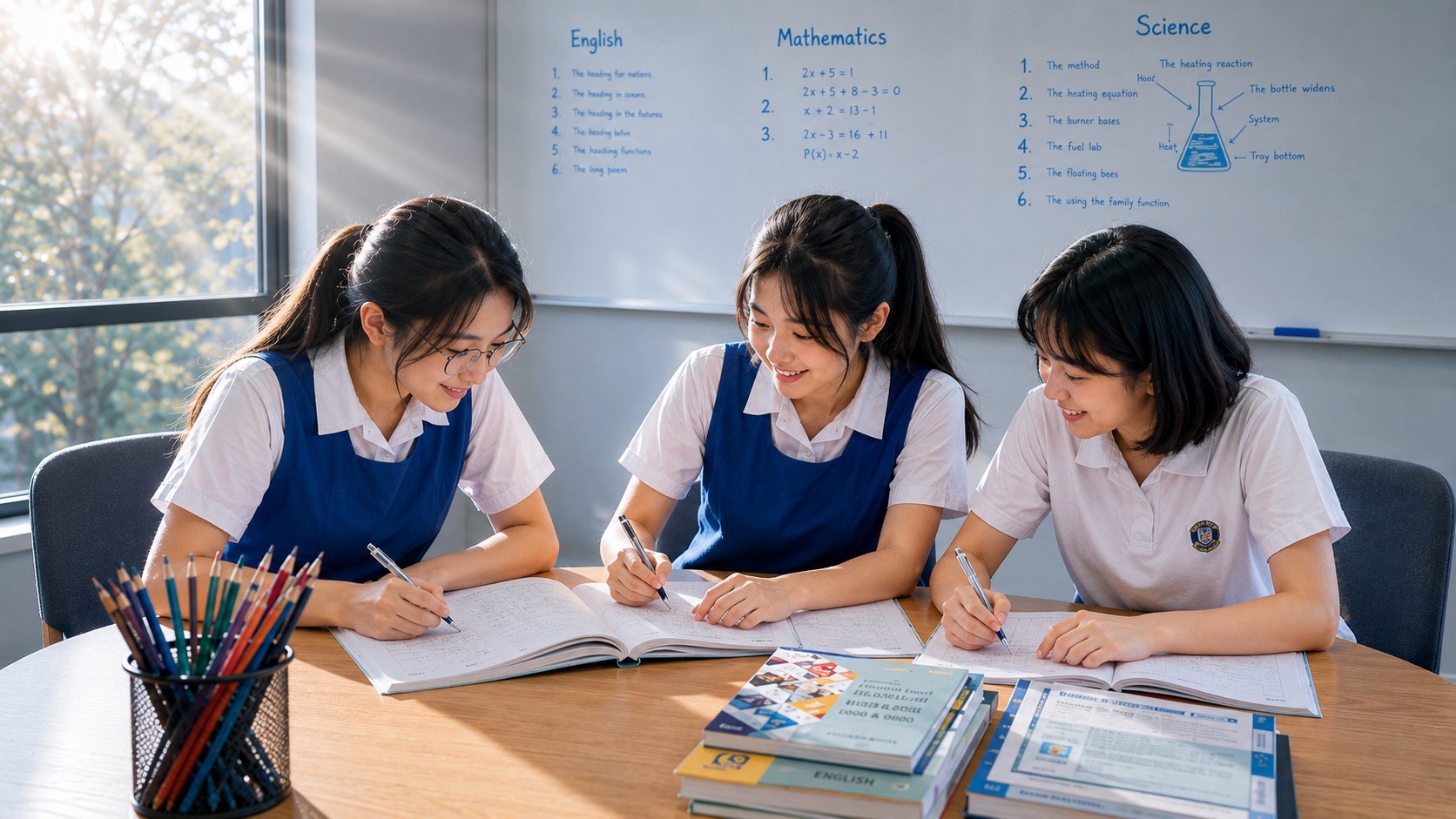
Primary 5 Science water and changes of state tuition should help a child explain where water goes, where droplets come from and how heat affects the change. For Bukit Timah parents considering small groups tuition, this means looking beyond whether a pupil can recite “evaporation” or “condensation”. The child needs to identify the starting state, the final state, the direction of heat transfer and the evidence in the question. Water is explicitly a Primary 5 topic in the current MOE Science syllabus.
In a three-pupil tutorial, each child can make a prediction, explain an observation and improve an answer independently. This guide develops those skills through original examples involving cold cups, drying water, temperature readings and fair comparisons. It concentrates on Standard Science while identifying the Foundation scope carefully. Primary 5 assessments follow the school’s announced arrangements; the PSLE comes at the end of primary education. A useful tuition plan connects the current chapter to clear thinking now, rather than turning every lesson into an early full examination.
- Know the states: ice is solid water, liquid water flows, and water vapour is an invisible gas.
- Name the change accurately: distinguish melting, freezing, evaporation, boiling and condensation.
- Explain the heat transfer: say which substance gains or loses heat and identify the relevant surroundings.
- Check the source: droplets outside an intact cold cup can come from water vapour in the air.
- Compare fairly: change one intended factor and keep other relevant conditions comparable.
- Read data carefully: distinguish water remaining, water lost and the time over which a change occurred.
- Match the level: use the appropriate Standard or Foundation learning outcomes and the school’s current instructions.
- Practise safely: home observations can use unheated water and a chilled, intact container; leave heated demonstrations to appropriately supervised school settings.
Contents
Chapters 1–4 · Understand states and heat
Chapters 5–8 · Explain the changes
Chapters 9–12 · Investigate data and the cycle
Chapters 13–16 · Teach and check understanding
Chapters 17–20 · Plan the next learning step
CHAPTER 1 OF 20 · Understand states and heat
1. Understand the current Primary 5 scope
Back to contentsThe MOE Primary Science syllabus places water and its changes of state in Primary 5. Standard outcomes cover the changes, relevant temperatures, water-cycle understanding and investigations involving heat and evaporation factors: air movement, temperature and exposed surface area. Foundation outcomes include naming changes, stating reference temperatures, recognising water-cycle changes and comparing the states; its topic-specific practices do not list the same evaporation investigations. Check the child’s subject level before choosing practice.
This is more precise than relying on an older guide that groups all upper-primary topics together. The subject has a national curriculum, while the school organises lessons and announces assessment coverage. A topic’s place in Primary 5 does not establish the exact week when every school teaches it.
The practical examples below are teaching proposals, not official examination questions. Their purpose is to make explanations and decisions visible. A Foundation learner may benefit from a simpler version of an example, but an enrichment activity should not be presented as a compulsory requirement merely because it appears in a Standard guide.
For the wider subject picture, the Bukit Timah Primary 5 Science syllabus guide provides a companion route. Here, the focus stays on understanding water, interpreting evidence and choosing useful practice for this chapter.
CHAPTER 2 OF 20 · Understand states and heat
2. Keep the substance and its state separate
Back to contentsWhen ice melts, the substance is still water. What changes is its state. That distinction helps a child avoid descriptions such as “the ice disappeared”, which may overlook the liquid left behind. Ask what was present before, what is present afterwards and how the child knows.
Solid ice retains its own shape under ordinary classroom conditions. Liquid water takes the shape of the part of a container that it occupies. Water vapour is gaseous water and is invisible. A child cannot identify vapour merely by pointing to something white floating above a warm drink.
The visible mist is made of tiny liquid droplets. NASA’s explanation of cloud formation makes the distinction between invisible water vapour and the droplets that become visible especially clear. The same distinction helps children interpret pictures of clouds, mist and a cooled surface.
Use three labels in an original sorting task: ice cube, a puddle and water vapour mixed with air. Then add a fourth item, visible mist. The challenge is to recognise that four examples do not require four states. Mist consists of small liquid droplets, so it belongs with liquid water even though those droplets are suspended in air.
A pupil who sorts correctly should explain one choice. “Mist is gas because it floats” uses appearance as the deciding rule. “Mist contains tiny liquid droplets; water vapour itself is invisible” identifies the substance and state more accurately.
CHAPTER 3 OF 20 · Understand states and heat
3. Explain which substance gains or loses heat
Back to contents
“It becomes colder” describes an outcome but may leave the scientific explanation incomplete. Heat transfers from a hotter region or object to a colder one. In a changes-of-state question, the child should identify the water involved and whether it gains or loses heat.
Imagine an ice cube on a clean dish in a room warmer than the ice. Heat transfers from the warmer surroundings to the ice. As melting takes place, solid water changes to liquid water. The liquid does not come from inside a hidden container; it is the same water in a different state.
Now consider liquid water cooling in a freezer. Water loses heat to the colder surroundings, and freezing can occur under suitable conditions. Saying that the water “gains cold” obscures the direction of energy transfer. The useful explanation is about heat leaving the water.
Ask the child to complete a sentence with actual names rather than repeated pronouns: “The water vapour loses heat to the cold outer surface of the container.” Compare that with “It loses heat to it.” The first sentence lets the reader check whether the child has identified the relevant substances.
Heat and temperature should also remain distinct. Temperature tells us how hot or cold something is; it is not the same thing as the energy transferred. This distinction becomes particularly useful when a table shows that temperature remains steady during a change of state.
CHAPTER 4 OF 20 · Understand states and heat
4. Teach melting and freezing as opposite changes
Back to contentsMelting changes a solid into a liquid. Freezing changes a liquid into a solid. For the usual primary-school model of pure water at ordinary atmospheric pressure, the melting/freezing point is 0°C and the boiling point is 100°C. These are reference conditions, not a claim that every mixture or environment behaves identically.
An original question might show ice cubes in a closed, dry container. After some time in a warmer room, liquid water surrounds the remaining ice. Ask the child to explain the liquid’s source. The ice gained heat and some melted. The useful answer names the original solid and the resulting liquid, rather than saying only that “water formed”.
Change the question: the outside of the same cold container becomes wet. The answer now concerns a different location and potentially a different source. Liquid inside can come from melting ice, while droplets outside can come from condensation. A child who sees the word “ice” and answers “melting” for every part of the diagram misses that distinction.
Freezing questions benefit from equally careful reading. A picture of a cold bottle does not prove that its contents have frozen. Look for evidence of a solid state or the conditions stated in the task. Teach the pupil to use the observation provided, rather than supplying an expected event simply because a freezer appears in the story.
At home, an adult can use an existing ice cube in a stable dish for observation. There is no need to apply heat, handle boiling water or improvise equipment to see that solid water can become liquid.
Both evaporation and boiling change liquid water into water vapour, but a child should not treat them as interchangeable descriptions of every drying event. A wet cloth can dry in an ordinary room without reaching water’s boiling point.
Evaporation occurs at the exposed surface of liquid water and can occur below boiling temperature. Boiling occurs throughout the liquid when conditions reach its boiling point, with vapour bubbles forming within it. The US Geological Survey’s water-cycle explanation describes the liquid-to-gas change and its connection with heat.
| Comparison | Evaporation | Boiling |
|---|---|---|
| Starting and final states | Liquid water to water vapour | Liquid water to water vapour |
| Where the process occurs | At the exposed liquid surface | Throughout the liquid |
| Temperature condition | Can occur below boiling temperature | Occurs at the boiling point under the stated conditions |
| Original example | A small water patch gradually dries from a tray | A teacher’s controlled demonstration shows sustained boiling |
Ask why “the water evaporated because it reached 100°C” is an unsuitable explanation for a damp classroom floor. The observation does not require boiling. The water can gain energy from its surroundings while evaporation takes place at the surface.
The terminology around “steam” needs care. Everyday speech sometimes calls the visible white plume steam. When explaining states scientifically, identify the invisible gaseous water and distinguish it from the visible droplets formed after vapour cools and condenses. A printed picture is enough for this discussion; children do not need to approach a kettle or hot plume.
CHAPTER 6 OF 20 · Explain the changes
6. Solve the cold-cup question by locating the water
Back to contentsConsider this original situation. Amira fills an intact cup with chilled water. She wipes the outside dry and places the cup on a dry tray in humid room air. Later, small droplets appear on the outside. There has been no spill, and the cup has no crack. Where did the outside droplets come from?
The relevant source is water vapour in the surrounding air. Near the sufficiently cold surface, water vapour can lose heat and condense into liquid droplets. The US Geological Survey’s condensation guide uses the outside of a cold glass as an everyday example. The liquid inside an intact cup has not passed through its wall.
A complete sample answer is: “Water vapour in the surrounding air lost heat to the cold outer surface of the cup and condensed into liquid water droplets.” The answer identifies the source, heat transfer, process and result. These are useful checks, not a compulsory sentence that fits every question.
Now remove one condition: the problem no longer says whether the cup is cracked or whether water was spilled. A wet surface alone cannot establish the source with the same confidence. The pupil should consider what evidence distinguishes condensation from leakage or a spill. Science questions sometimes supply those conditions precisely so that an explanation can be chosen.
For a safe observation, use a chilled, closed, intact drinking-water container and wipe its exterior dry first. Compare it with an unchilled container nearby. An adult should handle the setup and keep it away from electrical items. The point is to notice where droplets appear, not to guarantee identical results in every room.
CHAPTER 7 OF 20 · Explain the changes
7. Explain condensation without saying that air becomes water
Back to contentsAir is a mixture. Water vapour can be one component of it. When droplets form on a cooled surface, it is misleading to say that all the surrounding air has turned into liquid water. Name the water vapour specifically.
Use an original diagram showing moist air near a cool metal surface. Ask the child to label the water before and after the change. Before condensation, the relevant water is gaseous. Afterwards, it appears as liquid droplets on the surface. The surface provides a location for the droplets; it does not manufacture the water.
The direction of heat transfer is another useful check. A pupil may write that the cold surface loses heat to the warm vapour. That reverses the relevant direction. Under the stated conditions, the water vapour transfers heat to the colder surface as condensation occurs.
Not every cool object immediately becomes visibly wet. The conditions must allow condensation, and the amount of moisture in the air matters. For Primary 5 explanations, a task often supplies an observation or a clear statement that droplets form. Use that information rather than adding an unsupported rule that every temperature decrease always creates visible water.
Then change the final state. If the question describes a puddle drying, condensation is no longer the appropriate process. Naming the initial and final states gives the child a dependable way to choose between similar-looking words.
CHAPTER 8 OF 20 · Explain the changes
8. Explain why drying can happen at different speeds
Back to contentsA child may know that warmer conditions, moving air and a larger exposed surface can increase evaporation, yet struggle to apply those ideas to a particular arrangement. Begin with the factor actually changed in the question.
For exposed area, compare the same amount of water spread across a broad shallow surface with water held in a narrower opening, under otherwise comparable conditions. More liquid surface is available for evaporation in the broader arrangement. The explanation concerns exposed water surface, not simply the outside size of the container.
For moving air, consider identical wet cloths in comparable conditions. Moving air can carry water vapour away from the region near a wet surface, allowing evaporation to continue more readily. A question about air movement should not automatically receive an explanation about higher temperature unless temperature also changes and the evidence supports it.
For temperature, compare arrangements whose other relevant conditions are controlled. A warmer environment can supply energy for evaporation more readily. However, “sunny” and “shady” locations may also differ in wind, shelter and other conditions. A real-world observation is not automatically a clean test of temperature alone.
Teach the child to attach a conclusion to its conditions: “Under the stated conditions, dish B loses more water through evaporation over the same time.” That is more careful than claiming that one named container always dries fastest wherever it is placed.
CHAPTER 9 OF 20 · Investigate data and the cycle
9. Design a fair comparison before reading the result
Back to contentsSuppose a fictional investigation asks how air movement affects evaporation. Two identical dishes contain equal volumes of water and are observed for the same duration. The intended change is still air versus moving air. The question states that the air temperature and other relevant conditions are comparable, with no spills or leaks.
Before predicting, identify the changed factor, what will be measured and what must remain comparable. The outcome could be the volume of water remaining after a fixed time. The initial quantity, container shape and material, exposure period and starting water temperature should be matched.
| Part of the plan | Purpose in this original investigation |
|---|---|
| Still air or moving air | The intended factor being compared |
| Water volume remaining after three hours | The measured outcome |
| Identical dishes and equal starting volumes | Reduce alternative explanations involving container or quantity |
| Same observation duration | Make the amounts lost meaningfully comparable |
| Repeated trials and careful readings | Check consistency and reduce reliance on one result |
Now introduce an error: dish B begins with half as much water. If it becomes empty first, does that alone establish a faster evaporation rate? No. There was less water to lose. The pupil must separate the amount available from the speed of the process.
This example can remain on paper. It teaches experimental reasoning without requiring a child to arrange electrical fans around water. A tutor can ask pupils to improve the proposed method, then explain exactly which alternative explanation each improvement addresses.
CHAPTER 10 OF 20 · Investigate data and the cycle
10. Read water remaining and water lost correctly
Back to contentsThe table below contains invented figures for the fictional investigation. They are teaching data, not measurements from an actual experiment. Dish A is in still air; dish B is in moving air. Assume the other stated conditions are comparable and evaporation is the only cause of water loss.
| Elapsed time | Dish A: water remaining | Dish B: water remaining |
|---|---|---|
| 0 hours | 30 mL | 30 mL |
| 1 hour | 29 mL | 28 mL |
| 2 hours | 28 mL | 26 mL |
| 3 hours | 27 mL | 24 mL |
After three hours, A has lost 30 − 27 = 3 mL, while B has lost 30 − 24 = 6 mL. B has less water remaining because more has evaporated. The pupil should not say A evaporated faster merely because its final number is larger.
Over this three-hour interval, the average losses are 1 mL per hour for A and 2 mL per hour for B. Those calculations describe the supplied data. They do not prove that the rates will remain unchanged indefinitely. Conditions can change, and a dish cannot keep losing water once none remains.
A clear conclusion is: “Under these conditions, more water evaporated from B over the same three hours, supporting a higher evaporation rate in moving air.” The response uses evidence and keeps the conclusion within the comparison.
If the figures are plotted, time belongs on the horizontal axis and water remaining on the vertical axis. B’s line falls more steeply in this example. If the vertical axis instead showed cumulative water lost, its line would rise. Always read the label before interpreting a line’s direction.
CHAPTER 11 OF 20 · Investigate data and the cycle
11. Recognise a change of state when temperature stays steady
Back to contentsAnother original exercise provides observations from a fictional teacher-controlled warming demonstration. It concerns pure ice and water under ordinary atmospheric conditions. Heating continues during the listed interval. Children interpret the record; this is not an instruction to reproduce a heated experiment at home.
| Time | Temperature | Recorded observation |
|---|---|---|
| 0 minutes | −4°C | Solid ice |
| 2 minutes | 0°C | Ice and liquid water present |
| 4 minutes | 0°C | Ice and liquid water still present |
| 6 minutes | 8°C | Liquid water; no ice observed |
Between minutes two and four, the temperature reading remains at 0°C while melting continues. It would be incorrect to conclude that no heat is gained simply because the temperature does not rise. Energy is involved in the change from solid to liquid during this interval.
The observation column matters. It supports the interpretation that both states are present while the change occurs. Temperature alone should not be used carelessly to describe every detail of the sample.
By minute six, the record describes liquid water above 0°C. The child can compare the earlier change of state with the later rise in liquid temperature. This develops a more accurate account than saying that all heat gain always raises temperature.
Do not infer an exact moment when the last piece of ice melted from these four readings. The observations place it after minute four and by minute six, but do not record precisely when. Recognising what the evidence cannot tell us is part of interpreting it well.
CHAPTER 12 OF 20 · Investigate data and the cycle
12. Connect the changes to the water cycle
Back to contentsA water-cycle diagram becomes more useful when each arrow explains a process. Water can evaporate from exposed surfaces as it gains energy, including energy supplied by the Sun. Water vapour moves in the atmosphere and can condense when conditions allow it to cool sufficiently.
Clouds contain tiny liquid droplets, ice crystals or both; they are not simply visible piles of gaseous water. The US National Weather Service’s weather education material explains how cooling, condensation and cloud composition relate. At Primary 5, the useful distinction is between invisible vapour and the visible water or ice in clouds.
As droplets grow, water can return to the surface as rain. The US Geological Survey’s precipitation explanation distinguishes small cloud droplets from the larger drops that fall as rain. A simplified classroom diagram captures major processes; it does not mean every droplet follows one fixed route.
Ask the child to connect a small observation to the larger picture. A water patch drying illustrates a liquid-to-gas change. Droplets appearing on a cool surface illustrate a gas-to-liquid change. These familiar events help explain the processes represented in the diagram, although a cup and the atmosphere are different settings.
Then ask what a label does not establish. A cloud symbol alone does not prove it is raining at that moment. An evaporation arrow does not mean all the water below it disappears immediately. Reading diagrams with these limits prevents a useful simplified model from becoming a misleading story.
CHAPTER 13 OF 20 · Teach and check understanding
13. Repair explanations through the missing connection
Back to contentsConsider the answer, “The cup is cold, so water appears.” It identifies a relevant condition but leaves the water’s source and the process unstated. A tutor can ask: “Which water? Where was it before? What changed?” Those questions guide the pupil towards an explanation without writing it for them.
A second answer says, “Water vapour evaporates on the outside.” The pupil has identified vapour but selected the wrong process. Compare the starting gas with the resulting liquid droplets. That change is condensation. Teaching the states first makes the correction more transferable than asking the child to memorise a replacement sentence.
A third answer says, “The ice loses heat and melts.” Here the process is named correctly but the direction is reversed. The correction should explain that the ice gains heat during melting. A child who merely swaps “loses” for “gains” may still need to identify the warmer surroundings.
Keep a brief correction record containing the mistaken idea, its repair and a fresh question. After correcting a cold-cup explanation, try a cool surface in moist air with different labels. After correcting a drying explanation, use a wet cloth instead of a dish. The pupil should make the decision again without copying.
The aim is a response that answers the actual question. Some tasks ask only for a process name; others require an explanation, comparison or use of data. A long paragraph is unnecessary when the question needs a short answer, and an isolated keyword is insufficient when the question asks why.
CHAPTER 14 OF 20 · Teach and check understanding
14. Make three-pupil teaching reveal three sets of thinking
Back to contentsA small class creates an opportunity for close attention, but a tutor still needs to organise participation deliberately. If one child names every process first, the other two may follow without making their own decisions.
Start with three short independent responses: identify a melting event, explain outside droplets and compare two rows of evaporation data. The tutor can see whether the difficulty concerns vocabulary, heat direction, locating the water or interpreting quantities. Similar overall scores can conceal very different needs.
For a shared task, one pupil identifies the starting and final states, another checks the heat transfer, and the third checks the evidence. Rotate these roles. Each pupil then writes a complete answer separately. Discussion should prepare the child for independent explanation rather than replace it.
Different levels of support can use the same situation. One pupil labels a diagram before writing. Another explains a change without prompts. A more confident pupil identifies an unfair comparison or explains why the data do not justify an exact prediction. The goal is an appropriate next decision for each child, not identical worksheet volume.
End with a changed example. A useful lesson note might say, “He identifies condensation accurately but still says the liquid inside crossed the cup wall.” That tells a parent what needs attention. “We finished the water chapter” describes coverage without revealing whether the important idea is secure.
CHAPTER 15 OF 20 · Teach and check understanding
15. Use safe home observations with a clear question
Back to contentsHome practice can remain simple. Put a small amount of unheated water in a stable, non-absorbent tray and observe it at agreed times. Keep it away from electrical items and places where someone might slip. An adult should manage the setup and empty it after the observation.
Before starting, ask what will count as evidence. A lower water level may be consistent with evaporation, but a spill, leak or absorbent container would offer other explanations. The child can write the original amount or mark the level, then record what actually happened rather than what was expected.
A chilled, closed container offers a second observation. Wipe it dry, place it on a dry surface and notice whether droplets form outside. Discuss the surrounding air as a possible water source. Conditions vary, so the activity should invite observation rather than promise a particular number of droplets after a fixed number of minutes.
For a third activity, use only drawings. Give the child four arrows: solid to liquid, liquid to solid, liquid to gas and gas to liquid. Ask for process names and everyday examples. Include evaporation and boiling as two ways of making the liquid-to-gas change.
No boiling water, heated container or steam exposure is needed for these home tasks. School demonstrations can provide appropriately controlled observations of heating. At home, the parent’s most useful contribution is often a precise question followed by time for the child to think.
CHAPTER 16 OF 20 · Teach and check understanding
16. Check progress with a new situation
Back to contentsA corrected answer is useful, but it does not by itself show that the child can make the decision independently. Change the object or presentation while keeping the underlying idea. Replace a cup with an intact cold bottle, a table with a graph, or a puddle with water in a tray.
Look for four changes: the child identifies the relevant water source, names the initial and final states, explains the heat transfer appropriately, and uses the supplied evidence. Not every question requires all four in its written answer, but these checks help locate a misunderstanding.
Record the help provided. “Explained without prompting” means something different from “completed after being reminded that the outside water came from air”. Both attempts can be useful, but they should not be treated as the same level of independence.
Progress can also mean rejecting an unsupported conclusion. A pupil who says “The table does not tell us the exact melting time” is reading evidence carefully. A pupil who notices unequal starting quantities before comparing drying times is improving the investigation, even before writing a final explanation.
Keep two or three dated samples rather than a large collection of copied corrections. They give the teacher, tutor and parent something concrete to discuss. If the same error persists, change the explanation or task sequence instead of assuming that more repetitions of the same worksheet will resolve it.
CHAPTER 17 OF 20 · Plan the next learning step
17. Choose support that addresses the actual difficulty
Back to contentsBring the question, the child’s answer and the school’s feedback when discussing tuition. An answer alone may appear incomplete because the original task is missing. Together, the documents reveal what was asked and how the pupil interpreted it.
Ask a potential tutor to identify the first teaching priority. Does the pupil confuse state names, reverse heat transfer, overlook the source of droplets or misread data? A useful explanation should connect that finding to a specific practice task and a way to check improvement.
For a three-pupil group, ask how the tutor gathers independent responses and handles different needs. A lively discussion can be valuable, but every child should eventually explain a fresh example without borrowing another pupil’s reasoning.
A Bukit Timah family also needs arrangements that fit school, CCA, travel and the child’s remaining capacity for homework. Confirm the actual venue, timetable, availability and fees directly. This article describes educational decisions; it does not announce places or pricing.
The same emphasis on tracing causes applies in the Primary 5 electrical systems and circuits guide. In one topic, pupils trace a conducting path; here, they trace the water and the change. The shared habit is to explain the particular system instead of matching a memorised keyword.
CHAPTER 18 OF 20 · Plan the next learning step
18. Keep examination preparation in proportion
Back to contentsThe SEAB PSLE overview places the national examination at the end of primary education. Its Science document for examination from 2026 includes understanding, application, inquiry and communicating reasoning. Those aims support practising explanations and interpreting evidence; they do not turn every Primary 5 task into a full PSLE paper.
Use the child’s school scope and subject level to plan immediate work. When the examination year approaches, check the appropriate official document, including the separate Foundation Science format where relevant. School assessments can have their own arrangements.
For this chapter, the next useful step is often modest: explain one cold-surface observation accurately, correct one reversed heat-transfer statement or interpret one data table. Secure understanding provides a foundation for later timing and examination practice.
Why does my child know the definitions but answer incorrectly?
The difficulty may be selecting the relevant process. Ask the child to locate the water and state what it was before and after the change. Definitions become more useful when connected to a particular observation.
Should every answer mention heat gain or heat loss?
Follow the question. A request to name a process may need only its name. An explanation of how a change occurs may require heat transfer and the relevant source or surroundings. Avoid turning a useful checking idea into a compulsory sentence for every task.
Can water evaporate when the day is cool?
Yes. Evaporation does not require boiling. Its rate depends on conditions, so a cool day can still allow a wet surface to dry. Compare the actual circumstances rather than using the weather description as the entire explanation.
Must we buy equipment?
No elaborate kit is needed to discuss drawings, interpret a printed table or observe unheated water safely. Use school-provided resources and simple questions first. Practical activity should serve a clear learning purpose.
What should we try this week?
Choose one recent question and ask the child to explain the water’s starting location and state. Find the first unclear decision, repair it and later try a different example using the same concept. That gives the family a manageable next step and useful evidence of progress.
Curriculum and examination information checked on 16 November 2026. Worked situations, numerical tables and teaching routines are original examples, not official questions, experimental findings or marking schemes.
- MOE: Primary Science Teaching and Learning Syllabus.
- SEAB: PSLE overview and current resources.
- SEAB: Standard Science 0009, for examination from 2026.
- SEAB: Foundation Science 0039, for examination from 2026.
- NASA: How do clouds form?
- USGS: Evaporation and the water cycle.
- USGS: Condensation and the water cycle.
- USGS: Precipitation and the water cycle.
- US National Weather Service: Weather education.