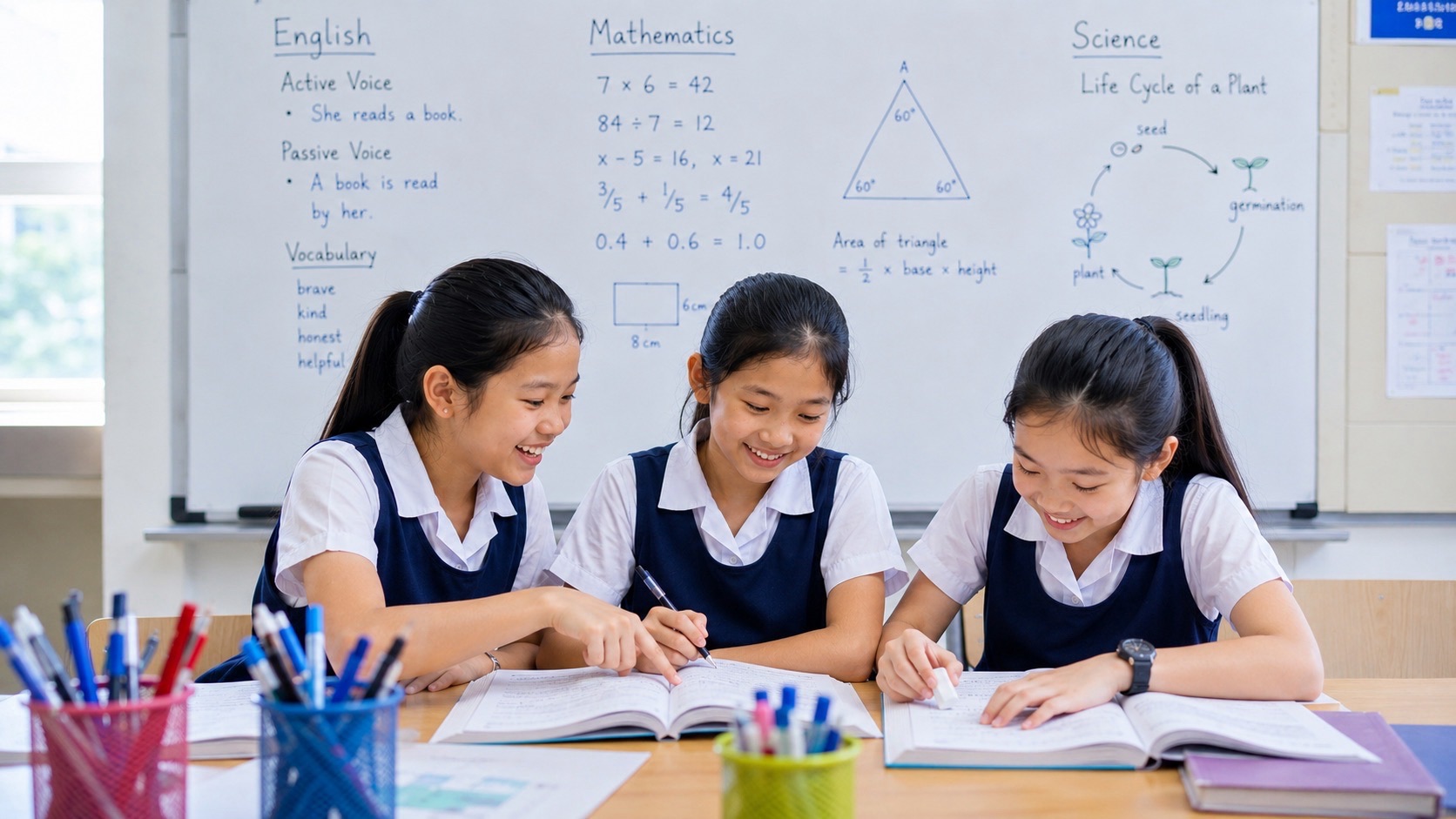
Primary 3 Science materials questions become easier when a child can identify what was tested, compare the right results and explain what the evidence supports. In a fair test, the samples must be given a comparable task. In a data question, the child must read the headings, units and conditions before choosing an answer. For Bukit Timah parents considering small groups tuition, this guide shows how those skills can be taught through original materials investigations. It includes worked questions, flawed comparisons, corrected explanations and decisions that cannot yet be made from the available information.
The MOE Primary Science syllabus, updated May 2024, places Diversity of Materials at Primary 3. Its focus includes comparing material properties and relating them to uses. This workshop concentrates on applying that knowledge to fair tests and results; use our Primary 3 Science materials background guide when a child first needs the underlying concepts. All investigations and data below are original teaching examples. They can be discussed on paper; practical suggestions use simple, suitable objects under adult supervision and do not require heating, breaking glass or testing materials to destruction.
- Name the question: decide which material property the investigation is trying to compare.
- Make the task comparable: notice differences in sample size, thickness, testing time and the way a result is observed.
- Read the whole table: a number means little without its heading and unit.
- Separate evidence from claims: one result does not describe every object made from that material.
- Choose for a purpose: the most suitable sample depends on the job it must perform.
- Explain the connection: state the relevant result, property and reason that property matters.
- Recognise missing information: identify the next useful comparison instead of guessing.
- Check independence: a child should be able to apply a correction to a fresh table or investigation.
BUKIT TIMAH · PRIMARY 3 · PARENT GUIDE
Choose your reading route
Start with the question closest to your child’s needs, or read the chapters in order.
Chapter index
Set up the question · chapters 1–2
Read controlled tests · chapters 3–5
Choose from evidence · chapters 6–8
Examine the conclusion · chapters 9–12
CHAPTER 1 OF 15 · Set up the question
1. Bring the right background knowledge to the investigation
An object is the thing being considered; a material is what it is made from. A ruler is an object. Plastic or metal may be its material. If two rulers behave differently, the material may be relevant, but their thickness, shape and construction may also differ. A useful investigation needs to notice those differences.
The syllabus’s materials section, printed pages 39–40, includes wood, metal, ceramic, rubber, glass, plastic and fabric. The comparison properties are strength, flexibility, floating or sinking in water, waterproofness and transparency. It treats waterproof materials as those that do not absorb water. Density is not required, and children need not use the labels transparent, translucent and opaque; they can describe whether most, some or no light passes through.
That background does not produce an answer automatically. Suppose a question asks which sample is suitable for wiping up a spill. A table showing light transmission cannot settle the choice. The child needs evidence about water absorption. The first task is connecting the question with the property that matters.
Try a quick prerequisite check. Ask what information would help choose a clear viewing panel, a bendable cover and a strip that supports a load. Accept ordinary language first, then connect it to the relevant scientific term. If the child cannot explain the job, pause before introducing a complicated table.
Also separate observations from material names. A sample labelled “plastic” does not tell a learner everything about its behaviour. Different objects and samples can have different properties. In the questions below, use the stated observations rather than replacing them with an assumption about what a material should always do.
The aim is to use knowledge carefully. A child should recognise a familiar property while remaining attentive to the particular sample, test and purpose described.
CHAPTER 2 OF 15 · Set up the question
2. Turn a broad question into something that can be compared
“Which material is best?” is incomplete. Best for a viewing panel, a cleaning cloth or a bag handle? Those jobs require different information. Before discussing equipment, ask the child to finish the sentence: “We want to find out which sample…”
Here are three useful endings: absorbs more water in the same testing time; bends farther under the same test conditions without breaking; or allows more light through in the same arrangement. Each ending points to an observation that could answer the question.
Consider this original scenario. A class wants a material for a small cover that can bend around a curved model. One pupil proposes comparing the samples’ colours. Another proposes comparing how easily the samples bend. The second proposal addresses a relevant property. Colour might matter to appearance, but it does not answer the stated question about bending.
Worked question
Question: A pupil says, “I will find the strongest sample by seeing which one floats.” What is wrong with this plan? Answer: The proposed observation concerns floating, while the question concerns strength. The investigation needs evidence about the samples supporting a load without breaking under comparable conditions.
This correction is more helpful than saying the plan is “not fair”. A plan can be carefully controlled and still measure something irrelevant. First ask whether the observation answers the question. Then ask whether the comparison gives the samples a comparable task.
For practice, write a purpose on one card and an observation on another. Let the child decide whether they match and explain why. Include one mismatched pair. The explanation reveals whether the child understands the relationship, rather than merely recognising familiar words.
End by recording the investigation question at the top of the page. Return to it when drawing the conclusion. This keeps an interesting result from pulling the child towards a different, unsupported claim.
CHAPTER 3 OF 15 · Read controlled tests
3. Read a water-absorption table without changing its meaning
The following invented results describe initially dry samples with comparable length, width and thickness, tested for the same length of time using the same method. Each trial uses a fresh comparable dry sample and the same sufficient quantity of water. The table reports the amount of water absorbed. It does not describe the colour, price or durability of the samples.
| Sample | First trial | Second trial |
|---|---|---|
| A | 0 mL | 0 mL |
| B | 4 mL | 4 mL |
| C | 2 mL | 2 mL |
Question: Which sample absorbed the most water in these trials? Answer: B. It absorbed 4 mL in each trial, compared with 0 mL for A and 2 mL for C. The answer refers to the measurement in the heading, not to an imagined description of the materials.
Follow-up: Which sample would be the better candidate for a wipe if water absorption were the only requirement? B is supported by the given results. If the wipe must also remain intact during use, the table does not supply that additional information.
A common mistake is treating “absorbed the most” as meaning “kept something underneath the driest”. These are different questions. A sample can take water into itself, while a cover is intended to prevent water reaching an object. The purpose changes which observation matters.
Distinguish a material test from a finished-object test
Suppose a sheet does not absorb water but a cover made from it has a large opening. Water can pass through that opening. The material result alone does not prove that the finished cover protects everything underneath. Ask what the test actually examined: the material’s absorption or the completed object’s performance.
For another question, replace the sample letters with new ones and change the readings. Keep the purpose explicit. The child should choose from the new evidence instead of remembering that B was the answer previously. That small change checks whether the reasoning transfers.
CHAPTER 4 OF 15 · Read controlled tests
4. Recognise a strength conclusion that goes too far
Strength questions concern supporting a load without breaking. They do not require a child to break household objects. Use prepared illustrations or invented results to practise the reasoning, leaving any practical load testing to a teacher with suitable equipment and controls.
Imagine two prepared strips with the same dimensions tested in the same arrangement. Both support four identical blocks without breaking. A pupil concludes that the strips are equally strong. What has the result actually shown?
It shows that both strips supported that particular load in the stated test. It has not established their limits. One might support a greater load than the other, but the experiment stopped before revealing a difference. A careful answer is: “Both supported four blocks without breaking; this result does not tell us which can support a greater load.”
Worked question with a supported comparison
A separate invented report states that, under the same controlled method, strip P first tore when the eighth identical block was added, while strip Q first tore when the twelfth was added. Which strip withstood the greater load before tearing? Q did. The report supports that comparison between the tested strips in that arrangement.
It does not establish that every object made from Q’s material is stronger than every object made from P’s material. A much thinner piece, a damaged section or a different construction could change the task. Keep the wording attached to the samples and conditions actually compared.
Another common error is replacing “strong” with “heavy”. A sample’s weight alone does not give the result of a load-support test. Ask the child to identify the evidence the question provides. If only weights are given, explain why the requested strength comparison remains unanswered.
The useful habit is asking whether the test found a difference or merely showed that both samples met one requirement. Those are different conclusions, and both can be stated clearly.
CHAPTER 5 OF 15 · Read controlled tests
5. Compare bending results under the same conditions
A flexibility comparison needs more than noticing that one object bent. A thin strip and a thick block have been given very different tasks. When a question aims to compare prepared materials fairly, examine the samples’ dimensions and how the bending force was applied.
In this original paper investigation, equal-sized strips are supported in the same way. The same small load is applied at the same position. The table records how far each strip bends downward; none breaks during the test.
| Strip | Downward movement at the measured point | Did it break? |
|---|---|---|
| D | 1 cm | No |
| E | 3 cm | No |
| F | 2 cm | No |
Question: Which strip bent the most in this test? E, because its measured point moved downward by 3 cm, more than D or F. If the question asks for a reason, the numerical comparison supplies it.
Follow-up: Does this prove that E is the strongest strip? No. The table reports bending under one load, and all strips remained unbroken. It does not compare the greatest loads they could support without breaking.
Now change the setup: E receives a larger load than D and F. The original comparison is no longer a fair basis for attributing the different bending amounts to the samples. A child should identify the changed load and explain why it could affect the result.
For a gentle home observation, an adult can offer a suitable flexible object and a suitable rigid one for discussion without forcing either. Stop before damage or sharp edges occur. The controlled data question can remain a paper exercise. The learning objective is to distinguish what was changed, what was observed and what can reasonably be concluded.
CHAPTER 6 OF 15 · Choose from evidence
6. Read a light comparison as evidence about a particular sample
A materials question about a viewing panel may provide observations of light passing through different samples. The child must connect those observations to the stated purpose. Memorising a list of material names is less useful than reading what the particular samples did.
Consider a teacher-prepared comparison in which the light source, sample position and observation method remain the same. Sample G allows most of the light through, H allows some, and J blocks the light in the arrangement. These observations can be described in ordinary words.
Question: Which sample should be investigated first for a panel intended to let as much light as possible enter a model room? G is supported by the stated requirement because it allows most light through. The answer should identify the property and explain how it helps the job.
Different question: Which sample is suitable for a panel intended to block light? J now fits the stated requirement. Nothing in the table changed; the purpose changed. This is a useful way to teach that “most” is not automatically the best result.
Spot the unfair arrangement
A pupil tests G using a bright lamp and H using a dimmer lamp. G appears to let through more light. Why is the comparison uncertain? The light supplied to the samples differed. Use the same light source in the same arrangement when comparing their effects.
Also check layers. One sheet and several stacked sheets do not represent the same thickness. If the investigation is about the effect of adding layers, that difference may be intentional. If it is about comparing two prepared samples, the difference may prevent a fair comparison.
Use ordinary room lighting or a suitable teacher-managed source for demonstrations. Never look at the Sun or direct a bright beam into anyone’s eyes. Pictures and written observations are sufficient for practising the decision and explanation.
CHAPTER 7 OF 15 · Choose from evidence
7. Keep floating observations separate from sweeping material claims
Floating and sinking questions are especially useful for teaching the boundary between an observation and a claim. “This object floated” describes what happened. “Every object made from this material floats” is a much broader statement that one observation does not establish.
In an original scenario, a child places an empty, closed plastic container on water. It floats. The child then declares that all plastic objects float. Ask what was tested: a particular hollow container in that condition, or every possible plastic object?
The observation concerns the container. Its construction and the enclosed space are part of the object being tested. A simple P3 response can identify that limitation without introducing density calculations. The child can say, “We tested this container; we need a more suitable comparison before making a claim about other samples.”
Worked question
A table states that solid sample K sank while solid sample L floated in the same water setup. Which sample stayed at the water’s surface? L. Which would be a candidate for an object whose material sample must float? L is supported by this particular test, subject to the stated design requirements.
Does the result show which sample absorbs more water? No. That is a different property requiring relevant observations. A sample’s position in the water does not by itself supply a measurement of water absorption.
When discussing fairness, notice whether the samples have comparable forms or whether one is a sealed hollow object while the other is a solid piece. If the purpose is to compare finished designs, different shapes may be part of the designs. If the purpose is to compare material samples, those differences need attention.
Any home observation should use a shallow tray, suitable large objects and adult oversight. Keep water away from electrical items, clear spills and empty the tray afterwards. The written scenario is enough when practical testing would add inconvenience without resolving a learning question.
CHAPTER 8 OF 15 · Choose from evidence
8. Choose a material from more than one column of data
Real selection questions often require two properties together. A child who chooses from only the largest number may miss a second condition. Teach the child to list the essential requirements before inspecting the samples.
In this original design question, a class needs a small panel that allows light through and does not absorb water. It does not need to bend. The following results are invented for the exercise.
| Sample | Water absorption in the stated test | Light passing through | Can bend without breaking in the stated test? |
|---|---|---|---|
| M | None observed | Most | No |
| N | Water absorbed | Some | Yes |
| P | None observed | No light observed through it | Yes |
Answer: M meets the two stated requirements. It did not absorb water in the test and allowed most light through. Its inability to bend in the given test does not rule it out because bending is not a requirement for this panel.
Why not P? P meets the water-absorption requirement but blocks light in the stated arrangement. Naming one favourable property is not enough when the job requires two.
Changed task: The class now needs a bendable cover that blocks light and does not absorb water. P meets those stated conditions. M is no longer the supported choice because the new task includes bending.
Ask the child to explain both selections using the same table. This is a stronger check of understanding than giving two nearly identical questions with the same answer. The child must change the decision when the requirements change.
Finally, ask whether the table proves the finished object will be safe and durable in every situation. It does not. It addresses a limited set of classroom properties. A good science answer can solve the stated question while recognising that a real product would need further information.
CHAPTER 9 OF 15 · Examine the conclusion
9. Find the flaw before rewriting the test
A question asking why an investigation is unfair requires a specific difference and its relevance. “It is not accurate” gives little information. Name what changed besides the intended factor, then explain how that difference could affect the observation.
Flaw one: different amounts of material
A pupil compares water absorption using a large piece of fabric A and a much smaller piece of fabric B. A absorbs more water. The child concludes that A is always the more absorbent material. The amount of material differed, so the result is not a clean comparison of the prepared materials. Use comparable sample dimensions and a consistent method.
Flaw two: different testing times
Two equal samples receive the same water treatment, but one is observed after a short interval and the other much later. If time can affect the result, the samples have not been given the same task. Specify the same interval and observe both using the same procedure.
Flaw three: changing the support arrangement
One strip spans a short gap while another spans a much wider gap during a load comparison. The support arrangement changed along with the strip. A corrected plan should use the same gap, loading position and type of load when the aim is to compare the prepared strips.
Do not teach a list of things that must always stay unchanged regardless of the question. If a class is investigating how testing time affects one sample, time is precisely what it intends to change. Fairness depends on the question being asked.
A useful response therefore has two parts: identify the unwanted difference, then state how to control it for this investigation. Ask the child to draw or describe the corrected setup. A correction becomes meaningful when another person can understand what to do differently and why that change makes the comparison more informative.
CHAPTER 10 OF 15 · Examine the conclusion
10. Handle an unexpected result without hiding it
Repeated observations sometimes differ. A child should learn to preserve the result and inspect the method, rather than changing a number to make the table look tidy. An unexpected reading is information about either the sample, the method or something that needs further investigation.
Suppose three invented trials report that sample R absorbs 3 mL, 3 mL and 1 mL of water. The child predicts that the last number must be wrong. That is a possibility to investigate, not a conclusion already proved by the table.
Ask what should be checked. Were comparable fresh samples used? Was the testing time the same? Was the same method used to determine absorption? Was any water spilled? A previous wetting could also make a reused sample different from a dry starting sample. The next step should address a plausible cause of the variation.
Worked response
Question: Should the pupil erase the 1 mL reading and replace it with 3 mL? Answer: No. Keep the recorded observation, check the procedure and repeat the comparison appropriately. Replacing an observation with the expected value would conceal what happened.
If a clear procedural mistake is found, record it. For example, “This trial used a smaller sample” explains why the comparison needs to be repeated. The child can distinguish a documented problem from a guess based only on disliking the number.
Repetition also does not remove an unfair setup automatically. If every trial compares a thick sample with a thin one unintentionally, repeating it three times repeats the same problem. The conditions must first answer the intended question.
For parent practice, provide one inconsistent table and ask for two useful checks. Avoid requiring a long list of imagined disasters. The strongest response identifies a realistic uncertainty and proposes a change that could resolve it.
CHAPTER 11 OF 15 · Examine the conclusion
11. Recognise when the data cannot decide between two choices
Some tables leave a genuine tie. Learning to say what remains unknown is part of reading evidence accurately. A child should not invent a difference merely because a question appears to invite one winner.
Consider two candidate samples for a cover. Both show no water absorption in the given test, and both bend without breaking. The design requires those two properties. On the available information, both meet the stated requirements.
If the question then asks which sample lasts longer, the answer needs another kind of evidence. Nothing in the table compares durability over time. “Sample S is better because its letter comes first” is clearly unsupported, but “S looks stronger” may be equally unsupported if no relevant observation has been provided.
A useful next-test question
Ask the child to propose one further comparison that would help if the cover also had to support a small load. A controlled load-support comparison would address that extra requirement. Repeating the same water test would not answer the new question.
Alternatively, the class might need the cover to allow most light through. A light-transmission comparison would then be relevant. The next investigation depends on the missing information, not on which activity happens to be easiest or most entertaining.
Teach a clear uncertainty statement: “Both samples meet the requirements shown. We need evidence about the additional property before choosing between them.” This is a complete answer when the information is insufficient. It is more useful than “I do not know” because it identifies exactly what would help.
At home, ask whether an advertisement or familiar object supplies enough information to make a particular materials claim. Keep the discussion modest: identify what is shown and what is missing. The same habit helps children avoid turning a single attractive feature into a conclusion about every aspect of an object.
CHAPTER 12 OF 15 · Examine the conclusion
12. Write an explanation that connects the evidence to the job
A useful materials explanation identifies the choice, the relevant evidence, the property and the purpose. This is a thinking aid, not a fixed national marking formula. The answer should be only as long as necessary to make the connection clear.
Worked example: a wipe
Question: Samples A and B absorb 1 mL and 5 mL of water respectively under the same conditions. Which is the better candidate for wiping up a small spill if absorption is the only stated requirement?
Answer: Choose B. It absorbed 5 mL, more than A’s 1 mL, so it can take up more water in the stated test. That property is useful for removing the spill. The explanation uses the given numbers and the particular job.
Worked example: a light-blocking panel
Question: Sample C allows most light through, while sample D blocks the light in the test arrangement. Which fits a panel intended to block light? Answer: D, because the observation shows it blocks light, which is the required function.
Correct an incomplete answer
“Choose D because it is suitable” repeats the decision without explaining it. Ask, “Which result makes it suitable?” Then ask, “Why does that result matter for this job?” These two prompts lead the child back to evidence and purpose.
A different weak answer lists every known property. That can introduce irrelevant or unsupported claims. If the task concerns absorbing a spill, the sample’s colour does not help unless the question makes colour relevant. Select the evidence that actually answers the question.
When checking work, underline the result cited and circle the explanation of its usefulness. If one part is missing, revise that part. Let the child produce the correction rather than replacing the whole answer with an adult’s polished paragraph. Then try a fresh question with a different purpose.
CHAPTER 13 OF 15 · Teach and review
13. Give every pupil a separate reasoning task in a small group
A three-pupil lesson can create useful opportunities for discussion, but the number of pupils does not show who is thinking. The lesson needs individual predictions and explanations. The following structure illustrates teaching choices; it is not a statement about a particular provider’s current classes.
Begin with one shared table and three private answers. Each pupil identifies the question, selects the relevant column and writes a brief conclusion before anyone speaks. This makes it harder for a confident child’s answer to substitute for the other pupils’ reasoning.
Next, give the pupils three roles. One explains the selection, another checks the evidence cited, and the third looks for a limitation in the conclusion. Rotate the roles. The teacher can observe whether a child struggles with reading the heading, making the comparison or explaining the purpose.
Use a second round with a changed requirement. A sample previously chosen for a viewing panel may be unsuitable when the task changes to blocking light. Each pupil must reconsider the decision rather than repeating the group’s earlier answer.
For an adult-managed demonstration, the pupils can predict, record and check while the adult handles the equipment. A paper investigation works equally well when the purpose is interpreting data or detecting an unfair comparison. More equipment is not automatically a better lesson.
End with different short questions built around the same idea. One pupil might receive a water-absorption table, another a bending comparison and another a flawed load test. The teacher should check each response independently and identify the next teaching step.
Useful feedback might say, “Your child now reads the units correctly but still assumes the largest number is always best.” That gives the parent and child a specific task: compare questions with different purposes. “Needs more practice” is less useful because it leaves the actual difficulty unnamed.
CHAPTER 14 OF 15 · Teach and review
14. Use a brief home workshop and keep a meaningful record
Choose one question family at a time. If the child confuses the measured property, use short matching tasks. If the child reads tables accurately but overstates conclusions, practise deciding which claims the data support. If the difficulty is explaining, ask for an oral answer before writing.
A manageable home workshop can contain one example discussed together, one changed example completed independently and one correction. Adapt the length to the child’s attention and other commitments. The purpose is to reveal understanding, not to complete a predetermined pile of worksheets.
Keep a three-part note: what the child did independently, where a prompt was needed and what the next question should check. For example: “Compared the water amounts correctly; needed help connecting absorption to the wipe; next task changes the purpose to a cover.” This record leads directly to a useful follow-up.
Use safe observations selectively
An adult may show a familiar intact object and ask what it is made from, or compare suitable large samples gently. Avoid forcing rigid objects, snapping bands, using sharp fragments or putting unfamiliar materials near food. Do not heat samples, mix chemicals or break glass and ceramics for this topic.
Keep water activities small and supervised, protect electrical equipment and clear the area afterwards. There is no need to reproduce a load test that continues until a sample tears. The invented tables already provide the evidence required for the reasoning exercise.
If the adult is unsure of an explanation, write the question down for the school teacher. Guessing confidently can create a misconception that later needs repair. A parent can still ask the child to point to the relevant table cell and describe what it says.
Look for independence after a gap. Can the child explain a different table without the previous answer visible? That is more informative than immediately repeating a sentence an adult has just supplied.
CHAPTER 15 OF 15 · Teach and review
15. Choose the next teaching step from the child’s actual work
For Bukit Timah parents comparing Primary 3 Science support, bring a recent materials question and the child’s original response. Ask the teacher to identify the first point where the reasoning became uncertain. That point may involve reading, a concept, a comparison or the link between property and purpose.
Ask how the teacher will check the repair. A useful answer describes another question with a meaningful change: a new table, a different purpose or a corrected setup. Repeating the exact same answer does not show whether the child can use the idea elsewhere.
Also ask how pupils discuss insufficient information. A class that rewards only immediate confident choices may miss an important part of scientific reasoning. Children need opportunities to explain that a table does not yet compare the property being asked about.
School sequence and assessment arrangements should be checked directly. For example, Valour Primary’s published 2026 plan places Diversity of Materials in its P3 second-term sequence. That is an example of a school plan, not a timetable for every primary school. Use your child’s current notices to choose what to practise next.
The PSLE is taken at the end of primary education. These P3 workshop questions are teaching examples rather than a separate national examination format. Their value is the reasoning they make visible: a child states the question, reads the evidence, notices an unfair comparison and explains a justified choice.
If the background concepts remain uncertain, return to the materials background guide before increasing the complexity of the data. If the concepts are secure, change the situation and ask the child to explain the limits of the result. The next step should follow what the child can demonstrate, with enough support to make the new task achievable.
Curriculum and source information checked on 16 November 2026. Practice questions and lesson routines are original teaching suggestions; use current school notices for your child’s arrangements.