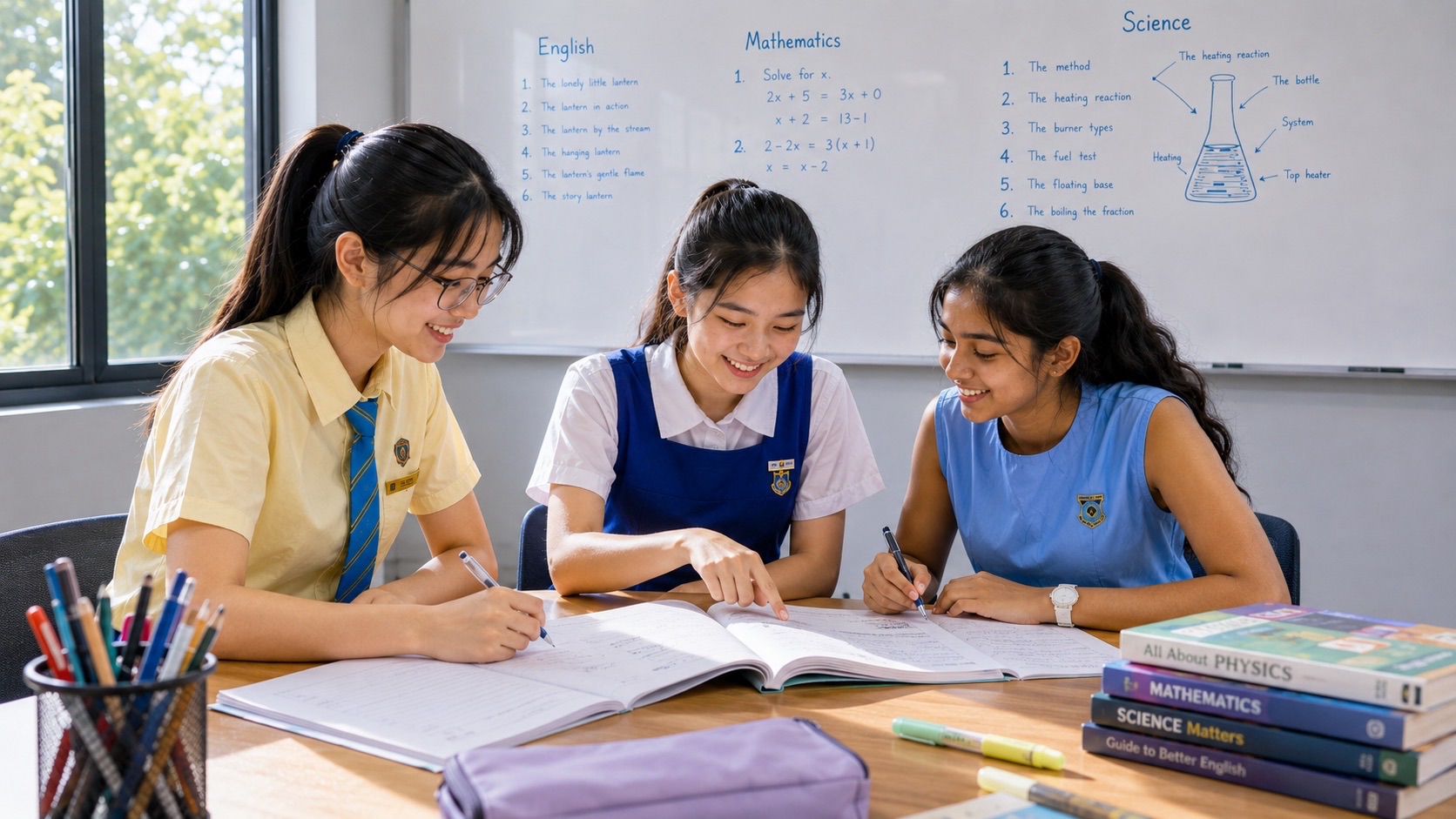
JC2 H2 Art small-group tuition in Bukit Timah should help a student look more carefully, explain visual decisions clearly, and develop an independent artistic practice. For the 2027 Singapore–Cambridge A-Level examination, the relevant H2 Art syllabus is 9357, as listed by SEAB for school candidates. Parents comparing support should therefore ask which syllabus the tutor teaches and what the student actually needs: closer visual analysis, stronger arguments about art, purposeful experimentation, or better organisation of existing work.
A three-student tutorial can create room for each learner to speak, defend an interpretation, and practise a skill independently. Its value depends on the tutor’s subject knowledge, the group’s suitability, and the quality of feedback. This guide explains what useful support could look like; families should confirm current specialist provision, arrangements and availability before enrolling. The aim is a student who can make and explain decisions without someone taking over the work.
- Start with the correct course: confirm the examination year, syllabus code and school instructions.
- Diagnose the difficulty: observing an image, explaining it, comparing works and developing ideas require different kinds of practice.
- Use three students actively: everyone should produce an individual response before group discussion.
- Keep practice concrete: connect an exact visual detail to an effect, interpretation or artistic decision.
- Protect ownership: clarify permitted feedback with the school; the student remains responsible for assessed work.
- Review progress: look for clearer reasoning, useful experimentation and increasingly independent correction.
CHAPTER 1 OF 16 · Understand and diagnose
1. Understand the current H2 Art course before choosing support
The 2027 H2 Art examination syllabus sets out two compulsory components:
| Component | Allocation | Weight |
|---|---|---|
| Paper 1: Art Discourse | 3 hours; 80 marks | 40% |
| Paper 2: Portfolio | 30 hours within 10 weeks; 60 marks | 60% |
The Portfolio permits up to 20 screens of visual materials and a commentary of no more than 1,500 words based on no more than seven works. Its selection includes at least three art forms and media, including Fine Art and either Design or Time-based work. The school assesses it, with external moderation.
The six syllabus topics are Representation in Art, Abstraction in Art, Materials in Art, Technology in Art, People in Art, and Art in Society. Use them as ways to connect practice and discussion, rather than treating each as a separate collection of facts to recite.
For Paper 1, the official specimen paper directs candidates to complete the compulsory visual-analysis question, one comparative-study question, and one discursive essay. Its essay instruction requires reference to at least two different artists. Students should read the instructions on their actual paper carefully.
The school’s teaching calendar and assessment briefing should guide day-to-day planning. A national syllabus does not tell a family exactly which lesson a particular college will teach next Tuesday. Bring the current school brief, recent marked writing and a few practice studies to a consultation. Those materials reveal considerably more than the subject name alone.
The portfolio allocation is also not a reason to assume that all artistic learning happens inside one short period. Students need an organised record of their development. Ask the school to explain how its assessed window operates before scheduling outside help around it.
CHAPTER 2 OF 16 · Understand and diagnose
2. Find the exact difficulty behind “I am weak at Art”
A student may draw confidently but struggle to explain an unfamiliar image. Another may discuss artworks intelligently yet repeat the same visual idea because experimenting feels risky. A third may have thoughtful studies scattered across folders, with no reliable way to locate the relevant version. These are different problems. Giving each student another finished picture to copy would leave the underlying difficulty largely untouched.
A useful diagnostic begins with a modest task. Show the student an appropriate image and ask for five observations. Then ask which observation matters most and why. Listen for the movement from naming to reasoning. “There is a large empty area” identifies a feature. “The empty area separates the figure from the objects around it” begins to explain a relationship. “That separation makes the figure appear isolated” offers an interpretation that can be tested against the image.
Next, ask the student to compare two versions of their own unassessed practice exercise. What changed? What became clearer? What became less effective? If the answer is only “this one looks nicer”, the next teaching step is to develop usable criteria. If the student can identify the intended effect but cannot produce it, the need may be technical. If the student cannot state an intention, begin with inquiry and selection.
Finally, ask the learner to repeat a small part of the task without prompts. Supported performance and independent performance should be recorded separately. A sensible first target might be “write one paragraph with a precise observation and a justified interpretation”, or “test two arrangements before selecting one”. Such targets make progress visible without turning every lesson into a judgement about talent.
CHAPTER 3 OF 16 · Understand and diagnose
3. What a three-student Art tutorial should make possible
Three students can look at the same image and notice different things. One follows the direction of the figures’ gazes; another notices the dominant colour; another sees a small object that changes the apparent situation. A tutor can use those differences to teach careful attention. However, discussion only becomes learning when students explain their evidence and reconsider their own first response.
Begin with individual looking and writing. This prevents the first confident speaker from supplying everyone’s interpretation. During discussion, a useful rotation is observer, questioner and evaluator. The observer offers a claim with a visible detail. The questioner asks how that detail supports the claim. The evaluator identifies what is persuasive and what remains uncertain. Rotate the roles so that every student practises all three responsibilities.
The tutor should correct inaccurate vocabulary without making the conversation intimidating. If a learner says “the colour is bright” when the important contrast is actually light against dark, demonstrate the distinction on a separate example. Then return responsibility to the learner: which word now describes the image more precisely? A correction is more useful when the student applies it immediately.
A small group also needs sensible matching. Students can benefit from different artistic interests, but their support needs must be manageable within one lesson. Someone needing sustained help with basic observation should still receive that help when peers are ready for extended argument. Ask how individual tasks, feedback and follow-up work are allocated. A three-student limit creates an opportunity for attention; it does not by itself establish the quality of teaching.
CHAPTER 4 OF 16 · Explore the worked examples
4. Worked example: move from description to interpretation
The following image is an invented teaching example, not a reproduction of an artwork or an examination question. Imagine a horizontal painting of a bus shelter at dusk. A single seated figure occupies the far left. Most of the right side is an unoccupied pavement. A red umbrella rests beside the figure. The shelter roof forms a long dark band above a pale sky.
Begin with description: the figure sits near the left edge; the pavement occupies a large part of the composition; the umbrella introduces a concentrated area of red. These statements can be checked against the imagined picture. They establish what is present before deciding what it means.
Next, explain relationships. The broad empty pavement makes the occupied part of the shelter appear small. The dark roof presses visually across the upper area, while the lighter sky gives that shape a clear outline. The umbrella may attract attention because its colour differs from the quieter surrounding colours. Each sentence connects more than one feature.
An interpretation can now follow: the imbalance between the small occupied area and the larger empty space may make waiting feel prolonged or solitary. This is stronger than announcing that “the artist is sad”. It describes a possible experience created by the image without inventing the maker’s personal feelings.
A useful practice paragraph would be: “The seated figure is pushed towards the left edge, while the pavement extends across the right side with little visual interruption. This unequal distribution gives the empty space unusual prominence. The arrangement may suggest a quiet interval in which waiting becomes more noticeable than movement. However, the red umbrella introduces a point of warmth, so the scene need not be read as entirely bleak.”
Notice the qualification. The writer has not weakened the answer by considering another detail. They have made the reading more accountable to the whole image. Art discussion does not require every student to feel the same emotion; it requires a relationship between the claim and the available evidence.
For a quick check, change the example: imagine three figures filling the centre and several bright umbrellas scattered across the pavement. Would the original paragraph still work? Much of it would not. That is a useful test. If an answer survives major changes to the image without revision, it may be too general to demonstrate close looking.
CHAPTER 5 OF 16 · Explore the worked examples
5. Worked example: compare two works through one useful question
Comparison becomes difficult when a student writes everything they can think of about the first image, then repeats the process for the second. The reader receives two descriptions but little explanation of the relationship between them. A better starting question is narrow: how does each work make the viewer notice an ordinary object?
Imagine two original practice works about a worn shoe. Work A is a tightly cropped photograph. Side lighting reveals folds and scuffs, and the background is plain. Work B is a small installation of ten clean paper shoes arranged in a neat row; one is crumpled and turned away. These are fictional examples created for this guide.
The shared subject gives the comparison a starting point. The different treatment gives it substance. In Work A, close framing and visible wear direct attention to the particular object. In Work B, repetition establishes an orderly pattern before the crumpled shoe interrupts it. The first work invites inspection of accumulated traces; the second makes difference visible through a break in a sequence.
A comparative sentence could say: “Both works give an everyday shoe unusual attention, but they do so through different relationships. The photograph enlarges evidence of use on one object, whereas the installation makes a single disrupted form stand out against repeated intact forms.” This sentence keeps both works in view and explains the basis of the comparison.
Now test interpretation. The photograph could suggest a particular history of use, but the viewer should not invent its owner’s occupation. The installation could invite discussion of conformity or exclusion, but those possibilities require explanation. The crumpled form’s position, material and relationship to the repeated forms support the reading; the mere presence of ten objects does not automatically establish a political message.
In a tutorial, ask one student to propose a similarity, another to explain a difference and the third to identify an unsupported leap. Then everyone writes a fresh paragraph. The written response matters because a learner can agree with a persuasive discussion without being able to construct the reasoning independently. The final check is whether each student can select a comparison that answers the question, rather than collecting unrelated similarities.
CHAPTER 6 OF 16 · Explore the worked examples
6. Build an argument about art without relying on impressive language
Consider this original practice prompt: “How much does the choice of material affect the meaning of an artwork?” A weak response may list materials and attach an adjective to each: metal is strong, paper is fragile, stone is permanent. Those associations can begin a discussion, but they become shallow when treated as universal meanings.
Start by clarifying the claim. Material can affect what a work looks like, how it behaves, how viewers encounter it and what associations it carries. Yet its effect also depends on what the artist does with it and the context in which it appears. A sheet of paper might be carefully preserved, deliberately torn, repeatedly folded or allowed to dissolve. The same material can support very different decisions.
Build a paragraph around a specific work the student has researched accurately. Identify the material, a relevant process and a consequence. Then connect that consequence to the question. The artist’s name should lead to analysis, not substitute for it. Two accurate examples discussed carefully can support more convincing reasoning than a crowded list of names with little explanation.
For planning practice, use the fictional paper-shoe installation from the previous section. The crumpled paper makes a change in form visible and invites a reading of vulnerability. Now imagine the same arrangement cast in heavy bronze. The relationship between damage, weight and durability would change. This thought experiment helps a student explain why material matters, though it cannot replace real artists and artworks when a task requires them.
A conclusion should state what the discussion has established and under which conditions. “Material matters most when its physical properties or associations contribute directly to the work’s purpose” is a defensible position to investigate. “All materials are equally important” needs further explanation. The tutor’s task is to help the student make a supportable judgement, including relevant limits, in language they understand well enough to use independently.
CHAPTER 7 OF 16 · Explore the worked examples
7. Worked example: turn an artistic intention into an experiment
Studio practice can stall when the intention is broad and the next action is unclear. “I want to explore memory” may be personally meaningful, but it does not yet identify what to try. Narrow the question for an unassessed exercise: how could overlapping images make one familiar place appear difficult to remember clearly?
Imagine a student using their own simple drawing of a doorway. In the first trial, they place two copies directly on top of each other. In the second, they shift one copy slightly sideways. In the third, they combine a clear doorway with a faint partial outline. The student has changed one main relationship while keeping the subject stable.
Now evaluate the results. Direct alignment may leave the original image largely unchanged. The shifted outlines may suggest vibration or movement. The incomplete faint outline may create a more uncertain sense of recall. None of those effects should be declared successful merely because the student intended it. Ask what a viewer can actually see and whether that experience supports the inquiry.
A useful practice reflection might read: “The displaced copies created movement more strongly than memory. I therefore reduced the second outline and left part of it unfinished. This made the familiar structure less certain without making every edge equally blurred. My next test is whether removing one recognisable detail changes the effect.” This is an invented example of reasoning, not wording for a student to submit as personal commentary.
The tutor can help design such an exercise without supplying a student’s assessed artistic concept. The important teaching move is to connect question, variation, observation and decision. “Try something different” is vague. “Change the spacing while retaining the same scale, then compare the result” creates an action whose consequences the learner can inspect.
Experimentation also needs a stopping point. Once the student has enough evidence to choose the next direction, more versions may simply consume time. A parent can ask, “What did this test help you decide?” The answer reveals more about progress than the number of pages filled or the apparent polish of every study.
CHAPTER 8 OF 16 · Protect and develop practice
8. Support the learner while preserving ownership of assessed work
The syllabus’s academic-integrity guidance requires authentic individual work and acknowledgement of sources, external consultations, applications and tools. Families should obtain the school’s specific instructions about permitted support before sharing active assessment materials with an outside tutor.
A productive arrangement can distinguish general skill practice from decisions that belong to the candidate. For example, a tutor can teach how to describe tonal contrast using a separate practice image. The student can then use that understanding independently. The tutor should not repaint an assessed image, invent the student’s artistic intention or rewrite a commentary so that another person’s reasoning appears to be the candidate’s.
Ask a concrete question when the boundary is uncertain: “May the tutor discuss general principles using separate examples while this assessment is running?” This is more useful than assuming that anything called feedback is automatically allowed. The school is the appropriate place to clarify the applicable assessment arrangements.
In ordinary practice, keep a simple record of what was discussed. It might identify a technical demonstration, a source consulted or a general question explored. Retaining stages of work also helps the student explain how an idea developed. The purpose is accurate ownership and recall, not creating a complicated administrative burden.
Parents can support practical conditions: a suitable place to work, a manageable materials budget, organised files and time to discuss a difficulty with the teacher. They can listen to an explanation and ask where an idea came from. Choosing the artistic direction, constructing the interpretation and completing the candidate’s response remain the student’s responsibilities. Good support leaves the learner more capable of those responsibilities over time.
CHAPTER 9 OF 16 · Protect and develop practice
9. Research context without turning the answer into a biography
Research should answer a question raised by the work. A student might need to understand an unfamiliar material, the setting in which a work was shown or the issue an artist addresses. Begin with that need. Collecting pages of biographical information before looking closely can make it difficult to identify which facts help explain the artwork.
Keep three kinds of statement distinct: an observed feature, a sourced contextual fact and the student’s interpretation. “The figure is much larger than the surrounding figures” is an observation. A museum’s account of how a work was commissioned is contextual information. “The scale may emphasise authority” is an interpretation. Combining them thoughtfully is useful; presenting all three as equally certain is not.
For accessible Singapore resources, National Gallery Singapore’s Articulation resources provide material for developing visual literacy and research, while As We See It introduces ways of looking at visual qualities. These are starting points for learning, not a substitute for the school’s course materials.
A useful independent task is to record one artwork accurately, write two observations before reading its interpretation, and identify one question that the source helps answer. Save the source details immediately. Later, the student can distinguish what they noticed themselves from what they learnt through reading.
CHAPTER 10 OF 16 · Protect and develop practice
10. Choose a repair, stabilisation or extension route
Repair: establish a dependable starting point
For a learner who freezes in front of an unfamiliar image, begin with visible features and short explanations. Work with one question at a time: where does attention go, and which detail helps explain that? Use a small vocabulary accurately before adding more terms. Success means the student can begin alone and support one interpretation with evidence.
Stabilisation: make good thinking more consistent
A student may produce thoughtful work in discussion but vague writing under time pressure. Practise a short plan, a complete paragraph and a review. Compare the written answer with the original intention. Does the reasoning actually reach the reader? Revisit the same weakness across different images so that improvement transfers beyond one familiar example.
Extension: examine complexity and alternative readings
A confident learner can investigate ambiguity, competing interpretations and the effects of display context. Ask what changes when the same work is seen as a small photograph, a large physical object or part of a sequence. The student should identify which conclusions remain secure and which depend on information they do not have.
These routes describe present learning needs, not permanent labels. A student may need extension in discussion and repair in organising research. Review the route after several lessons using fresh work. Continuing with the same worksheet pattern because it is familiar can hide the fact that the student now needs a different challenge.
CHAPTER 11 OF 16 · Protect and develop practice
11. An illustrative 90-minute small-group lesson
The following is an example of how a tutorial could work, not a published class timetable. Its purpose is to show parents what the minutes should produce.
- First 10 minutes: each student completes a short observation task independently. The tutor identifies one shared misunderstanding and any individual needs.
- Next 15 minutes: the tutor models one skill on a separate example, such as linking composition to the viewer’s attention.
- Next 20 minutes: students discuss another image with rotating roles. Each claim must refer to an identifiable detail.
- Next 20 minutes: everyone writes an individual response. The tutor observes decisions and gives targeted prompts where needed.
- Next 15 minutes: students revise one passage after feedback, explaining what they changed and why.
- Final 10 minutes: a new short task checks independent transfer, followed by a manageable practice assignment.
A studio-focused lesson would use a different balance, with time for demonstrations and controlled experiments. It should still include a clear purpose, independent decision-making and review. Parents can ask to see the difference between the initial and final attempt. An attractive worksheet or a long verbal explanation is less informative than evidence of what the learner can now do.
CHAPTER 12 OF 16 · Protect and develop practice
12. A four-week plan for making support useful
This example is a learning plan to adapt around the school’s requirements. It does not prescribe an assessment schedule or promise a grade.
Week 1: establish a baseline
Bring recent marked work and complete one fresh diagnostic. Agree on two priorities at most. One could concern writing, such as supporting interpretations with details; the other could concern practice habits, such as locating and labelling the relevant versions of an exercise. Keep the initial work so that later improvement can be compared honestly.
Week 2: practise the missing connection
Choose short tasks that directly address the priorities. A learner whose writing jumps to meaning can practise observation and explanation before interpretation. A learner who produces repeated versions without evaluating them can compare two controlled variations. Home practice should be small enough to complete carefully and specific enough for the next lesson to review.
Week 3: transfer the skill
Change the image, question or medium while keeping the central thinking demand. Reduce prompts. Ask the student to explain when the method helps and when it needs adjustment. If performance collapses outside the original example, return to the connection that remains uncertain rather than immediately increasing the workload.
Week 4: review and choose the next step
Complete a fresh task comparable in difficulty to the baseline. Discuss what improved, what still requires help and what the student can now manage alone. The next decision could be continued support, a narrower focus, a different grouping or more school-based consultation. A review should inform that decision rather than merely confirm attendance.
CHAPTER 13 OF 16 · Protect and develop practice
13. Read feedback as instructions for the next attempt
Comments such as “develop analysis” can feel discouraging because they identify a need without showing the student where to act. Translate the comment into a specific question. Which sentence names a feature but does not explain its effect? Which interpretation has no visible support? Which comparison discusses only one work?
A practical revision sequence is to underline the claim, identify the evidence and check the connection between them. If the evidence is absent, return to the image. If the evidence is present but its relevance is unclear, explain the relationship. If the paragraph is convincing but does not answer the question, reconsider the selection rather than adding another sentence.
The student should make the revision. A tutor who replaces the whole paragraph with polished prose may demonstrate expertise while leaving the learner unsure how to repeat the improvement. A shorter correction that the student understands and applies to a new task provides clearer evidence of learning.
Keep progress notes simple: “identified a precise detail without prompting”, “compared both works in the same paragraph”, or “changed a trial after explaining its weakness”. These observations do not predict an examination grade. They show which parts of the learning process are becoming more dependable and which still need attention.
Start with subject fit. Ask whether the tutor has current familiarity with H2 Art 9357 and experience teaching the particular difficulty your child faces. A person who teaches enjoyable general art lessons may offer a different service from someone supporting analytical writing at pre-university level. Both can be valuable, but the match matters.
Ask how the three students are grouped, how individual written work is reviewed, and how the tutor handles different needs within one session. Request an explanation of the intended first month. The answer should identify a teaching process and review point, rather than rely entirely on the amount of material supplied.
Clarify the limits of the service. Which forms of studio practice can the setting support? Which work should remain with the school or an appropriate specialist facility? What materials are included? What are the actual fees, attendance arrangements and cancellation terms? Obtain current answers directly; this article does not establish a timetable or fee schedule.
Finally, consider the whole week. Travel from school, meals, other subjects and independent art practice all use time. A convenient Bukit Timah location is useful only if the arrangement leaves enough capacity to apply the learning. The student should understand the purpose of the support and be able to describe the problem they want help solving.
Does an Art student mainly need more drawing practice?
That depends on the difficulty. Practice may be useful when technique prevents the student from expressing an intention. It will not by itself resolve an unsupported interpretation or an argument that misses the question. Diagnose the task before increasing the quantity of work.
Should every student in a small group produce a similar answer?
No. Different interpretations can be valuable when they are grounded in evidence. A useful tutorial helps students make their own reasoning clear and examine alternatives. Identical polished paragraphs are a poor sign if learners cannot explain the decisions behind them.
Can a parent judge progress without knowing much about Art?
Yes. Ask the student to show a decision and explain it: what they noticed, what they tried, what changed and why. You do not need to supply the interpretation. Listen for increasing specificity and independence, and use teacher feedback to understand the remaining priorities.
What should we bring to an initial consultation?
Bring the examination year and code, the school’s current instructions, marked writing, relevant unassessed practice and the student’s own questions. Check before sharing active assessed materials. A focused sample of work is usually more useful for discussion than an unsorted folder containing everything.
A useful Art lesson ends with a clearer decision. The student may know how to support one interpretation, compare two visual strategies, test a material choice or ask a better research question. Those gains are modest enough to observe and meaningful enough to carry into new work.
For a Bukit Timah family considering JC2 support, begin with the student’s actual work and the school’s requirements. Choose one difficulty to examine, confirm suitable provision and agree on how progress will be reviewed. The purpose of a three-student tutorial is to create enough attention for each learner to think, practise and improve while remaining the author of their own work.
Official sources and further reading
For the broader revision timetable, continue with the JC2 H2 Art examination-preparation guide.
Sources checked for the 2027 examination cohort on 16 November 2026.
More JC2 small-group guides: JC2 H2 English Language and Linguistics · JC2 H2 Knowledge and Inquiry · JC2 H2 Music.