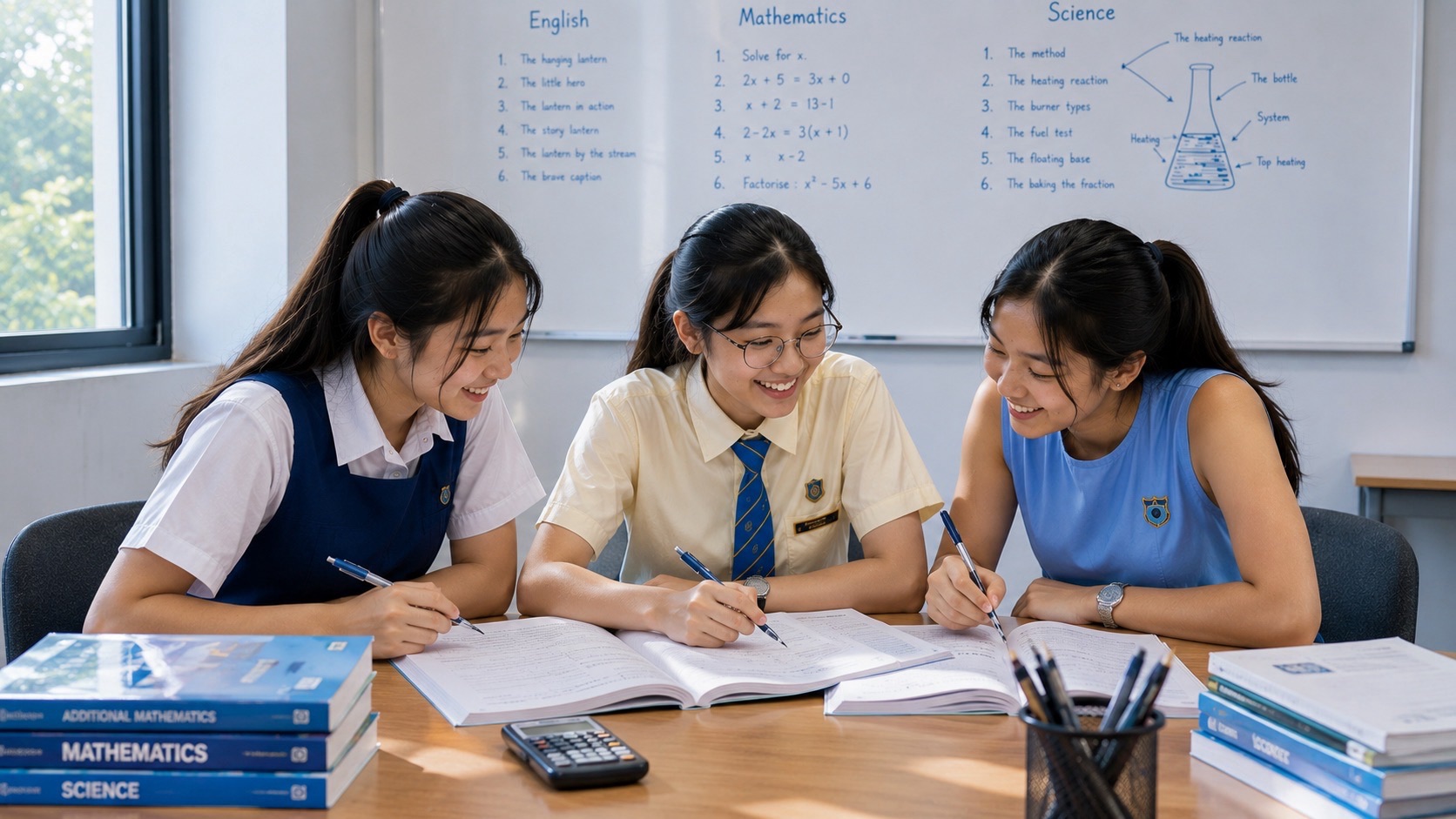
The Anglo-Chinese Free School was the name of the school established by philanthropist Gan Eng Seng in 1885. It is not a separate school in the 2027 Secondary 1 posting exercise. Its present institution is Gan Eng Seng School, a co-educational government secondary school at 1 Henderson Road, Singapore 159561. It is also not the same institution as the Anglo-Chinese School (ACS) family. Parents must use Gan Eng Seng’s modern MOE school code and actual programmes when choosing schools after PSLE.
For the 2026 Secondary 1 intake based on the 2025 PSLE, Gan Eng Seng School’s historical posting score ranges were PG3 9–15, PG2 21–24 and PG1 25–27. They do not guarantee the cut-offs for entry in 2027. Today’s school teaches through Probes* Applied Learning in sustainability, digitalisation and coding, together with community leadership and selected Capstone enrichment. Parents should check their child’s eligible Posting Group, daily Henderson Road route, academic support, CCA access and actual interests rather than assume the word ‘Free’ or the historic Anglo-Chinese name creates a special admission route.
Quick parent summary: • Historic name: Anglo-Chinese Free School, founded 1885; • Current name: Gan Eng Seng School, government co-educational; • Not part of the separate Anglo-Chinese School (ACS) family; • Current address: 1 Henderson Road, Singapore 159561; • Historic sites included Tanjong Pagar, Telok Ayer, Waterloo Street, Anson Road and Raeburn Park; • Completed 2026 intake PG3 9–15, PG2 21–24, PG1 25–27; • ALP: Probes* Sustainability and Digitalisation/Coding; • LLP: Community Youth Leadership; • Capstone+ is selective; • Confirm six distinct live S1 school choices.
1. The current school is Gan Eng Seng School, not a separate free school
The Anglo-Chinese Free School is a historic name at the beginning of Gan Eng Seng School’s institutional history. It does not operate as a separate modern Secondary 1 admissions option. A family choosing a secondary school after the 2026 PSLE must use the current name Gan Eng Seng School, a government co-educational secondary school at 1 Henderson Road, Singapore 159561. A historic photograph from the nineteenth century or a heritage account that describes a free school should not be mistaken for an open application pathway.
The present school has a contemporary curriculum, Full Subject-Based Banding and current distinctive programmes. Its heritage is important for understanding values, but admission is determined by the actual MOE posting framework, the child’s eligible Posting Group and the decisions made during the current exercise. Do not count an old school name as a second school or substitute a pre-PSLE AL result from a century-old context.
2. Anglo-Chinese Free School is not the same as Anglo-Chinese School
The resemblance of the names can cause confusion. Gan Eng Seng’s Anglo-Chinese Free School and today’s Anglo-Chinese School (Independent) or Anglo-Chinese School (Barker Road) are not the same institution. Both names include ‘Anglo-Chinese’ because the words describe a particular educational and language context, not because they necessarily belong to the same school family. A parent should not copy ACS affiliation, school fees, IB options or historic cut-offs into a Gan Eng Seng School comparison.
Gan Eng Seng’s school has a separate founder, history, present campus and MOE SchoolFinder entry. It operates at Henderson Road, while the different ACS institutions have their own locations and admission categories. The word ‘Free’ in the old name referred to the early charitable purpose, not a guarantee that modern secondary education at Gan Eng Seng has no applicable fees, materials or family costs. Clarifying the two names is a practical way to prevent errors in a school-choice list.
3. The original school was founded in 1885 for children who could not easily afford education
Gan Eng Seng School’s 2026 official history traces its founding to 1885, when the philanthropist Gan Eng Seng started a school in shophouses in the Tanjong Pagar area. It was intended to offer free education to children from poorer families nearby. That founding purpose matters because access to learning was a real problem in the late nineteenth century. The institution helped establish a tradition of education linked to personal opportunity and civic contribution.
Parents should understand this history without romanticising the conditions of the period. The curriculum, social rules and financial arrangements were very different from modern government schooling. The useful question for a present-day family is whether the school still shows practical commitment to helping pupils with different backgrounds develop knowledge, confidence and character. The past provides a reason to ask about current support, not an assurance that every old arrangement remains in force.
4. English and Chinese instruction was an early distinctive feature
The school began with instruction in both English and Chinese, an unusual feature in its founding context. The Gan Eng Seng story is therefore also about bilingual educational aspirations in a period when access to different languages could open opportunities. The National Heritage Board’s accounts highlight Gan’s support for bilingual learning, and the school’s official history explains that its early teaching in both languages changed in later years.
A parent should not infer that modern Gan Eng Seng School offers separate English-medium and Chinese-medium streams in the nineteenth-century sense. Today’s pupils follow contemporary MOE subject requirements and Mother Tongue options. If a family values bilingualism, investigate the current language programmes and Higher Mother Tongue arrangements directly. A historic educational principle can inspire a present choice, but current classroom teaching and eligibility are the relevant evidence.
5. The Telok Ayer Street school building marked a new stage
Gan Eng Seng School’s account records that the government offered a site at Telok Ayer Street in 1889, and that Gan financed the school building. It was formally opened in 1893 by the colonial Governor Sir Cecil Clementi Smith. Those milestones helped transform a small charitable school in shophouses into a more established institution. A historical visitor might therefore encounter accounts of both the initial Tanjong Pagar rooms and the later Telok Ayer building.
Neither address is the current Secondary 1 school campus. A family should not follow a historic Telok Ayer marker when planning a daily 2027 commute. The correct present address is 1 Henderson Road, and official transport and security instructions may change between school years. Heritage sites can be visited for learning about Singapore’s history, but they are not destinations for present-day student registration.
6. The founder’s death changed the school’s education and financing
The school’s official history explains that English and Chinese were taught together until Gan Eng Seng’s death, after which the institution became a purely English school. Financial difficulties also meant that the original free-school arrangements could not continue unchanged and fees were charged for a time. This is a valuable example of how an educational institution can face difficult resource decisions while trying to maintain its mission.
Parents should resist describing the historical name as a perpetual guarantee of free secondary education. The modern government school operates under current MOE funding, school-fee and assistance arrangements. If the family needs financial support, ask the present school about available schemes, uniforms, textbooks, devices and other costs. A real discussion of access is more useful than invoking the word ‘Free’ from a nineteenth-century title.
7. Gan Eng Seng became a government school in 1938
The Board of Trustees faced serious building and financial challenges in the 1930s. According to the official school history, Gan Eng Seng School became a government school in 1938. The change mattered because the administration, resources and accountability of the school moved into a different framework. It is not evidence that Gan Eng Seng today shares an admission process with the private or independent schools that happen to contain similar words in their names.
A present-day parent should distinguish a government school from a government-aided or independent institution when comparing school costs and pathways. The school’s current status can be checked in MOE SchoolFinder. Its educational fit still depends on teaching quality, programmes, academic support and the child’s personal needs. Administrative history can provide context, but it cannot tell a family which school their child will enjoy on an ordinary Tuesday.
8. The war disrupted the school’s operations
Gan Eng Seng’s heritage account records that the school occupied temporary facilities before the Japanese Occupation and that teaching was interrupted as war approached. It describes the move to the Sepoy Lines Malay School premises in 1941, the disruption caused by the outbreak of war, and the difficulties in reopening immediately after the Japanese Occupation ended in 1945. The school eventually resumed classes in May 1946.
This history can help pupils understand that schools are social institutions affected by national events, not isolated examination centres. Parents may discuss how staff, families and students dealt with disruption and uncertainty, while avoiding the claim that current students experience the same conditions. A school with a long history can offer valuable heritage education, but its current ability to support students should be judged by present-day practices and communication.
9. The Waterloo Street and Anson Road years were intermediate locations
The official history notes that Gan Eng Seng used a building in Waterloo Street after the war and moved to Anson Road in 1951. It later relocated again as the city and schooling needs changed. A parent might see a school address in an old photograph or commemorative magazine and assume the institution has moved little since its founding, but Gan Eng Seng’s history involved several distinct locations.
For families choosing schools now, this is chiefly a reminder to verify the current campus and school gate before estimating transport. The new Secondary 1 pupil will not be travelling to Waterloo Street or Anson Road. The educational quality of a present school is not determined by the prestige of an old building. Ask how the modern campus supports ordinary science, mathematics, language and co-curricular learning.
10. Raeburn Park was not the final school campus
Gan Eng Seng relocated to Raeburn Park in 1986, according to its school history. Alumni from the late twentieth century may therefore associate the school with Raeburn Park rather than its present Henderson Road site. That memory can be authentic without being useful for the child’s 2027 journey. Schools sometimes move to make use of new facilities or respond to broader planning changes.
Ask relatives who attended Gan Eng Seng which years and campus their stories concern. A teenager may enjoy hearing about an older generation’s school life, but should understand that the current facilities, class environment and teacher practices belong to a different period. This can become a lesson in how Singapore’s infrastructure and educational system developed, without becoming an assumption about current admissions.
11. Since 2001, the modern address has been Henderson Road
Gan Eng Seng School moved to 1 Henderson Road, Singapore 159561, in 2001. That is the address parents should use for current school-choice planning. A child travelling from Queenstown, Bukit Merah or another estate may have a different route and travel burden. Do not assume a family member’s journey to an earlier campus is evidence that the new pupil can reach school quickly.
Test the weekday morning commute, including a realistic buffer before lessons, and consider how late the child might return after a CCA. Check public transport changes, walking routes and safe crossings. A school with a strong sense of history may still be a poor practical choice if the journey causes persistent fatigue. The family should balance educational strengths and the child’s energy with the daily transport commitment.
12. The 141-year history can be meaningful without controlling the choice
Gan Eng Seng School has passed through colonial Singapore, war, independence, changes in school ownership and campus moves. Its long history may be a source of pride for alumni and students. In 2026, the institution describes a goal of developing Gessians of Excellence, Standing and Significance. Parents can use this as a starting point for asking what excellent character and meaningful contribution look like for ordinary pupils.
A child whose parent attended Gan Eng Seng should have room to decide whether the present-day school culture suits them. An ancestral connection can make a school visit more personal, but it cannot establish educational fit or admission eligibility. Ask what the child thinks of lessons, classmates, extracurricular activities and the school environment as it exists now. School history should inform rather than dictate the family decision.
13. Today’s Probes* ALP has two main educational domains
Gan Eng Seng’s current Probes* STEM Applied Learning Programme focuses on Sustainability and Digitalisation and Coding. The official 2026 school page describes encouraging pupils to explore ideas further, apply them more deeply and challenge assumptions. These are habits of inquiry rather than simply owning more technology or repeating an impressive experiment. The programme can be relevant to pupils who enjoy asking how everyday problems work.
Parents should ask what all Secondary 1 students experience and which further tasks are selected enrichment. A pupil might develop practical skills through environmental problems or basic coding, while another needs more help linking the activity to underlying Mathematics and Science. A good ALP gives children tools for understanding problems and evaluating solutions rather than only producing a display to be photographed.
14. Sustainability work connects data to real community questions
The 2026 Probes* materials give examples of water purification, food security and edible gardens. These contexts allow students to ask how a proposed solution affects the people who use it, what resources it consumes and how its effectiveness could be measured. The point is not that every pupil will become an environmental engineer. It is that they practise careful observation and the ability to revise an initial idea when evidence does not support it.
Parents can ask teachers how they prevent project work from becoming a race to assemble the most attractive prototype. Does the class discuss trade-offs and limitations? Do students learn to report an unsuccessful test fairly? A child who enjoys Humanities may contribute to understanding community needs, while one who enjoys Science may focus on measurements. The school should help both make meaningful progress.
15. Code for Fun introduces computational reasoning in Secondary 1
Gan Eng Seng’s Probes* page describes a Code for Fun experience for Secondary 1 pupils, linked to the Infocomm Media Development Authority. It introduces coding with Micro:bit controllers and concepts associated with artificial intelligence, then asks learners to apply their understanding to a practical problem. This is a starting point for logical thinking, not a promise of advanced computing certification or a place in every coding competition.
Ask how beginners learn to identify a variable, test an instruction and diagnose a mistake. A pupil who likes technology may still need support with number sense or written explanation. A strong curriculum should help students understand why something works before expecting them to perform it quickly. Teachers should distinguish ordinary learning from extra talent development, with clear expectations for each.
16. Design Thinking has an explicit sequence
Gan Eng Seng explains its design-thinking framework as Empathise, Define, Ideate, Prototype and Test. That sequence makes creativity more disciplined. Before making something, pupils are encouraged to understand a problem and the people affected by it. They then frame an issue, generate possible approaches and examine how well a prototype works. This can help a teenager learn that an elegant idea is not automatically useful without evidence.
A parent can ask the child to propose a simple improvement to homework organisation or a shared household space. Who experiences the problem, what has already been tried and how would an improvement be tested? This is an illustrative home discussion, not a claim about an assigned school project. The important skills are careful questioning, collaboration and revision.
17. Capstone and Capstone+ are selected enrichment, not automatic admission benefits
Gan Eng Seng’s current Capstone programme has two tiers. Its first tier provides department-based stretch opportunities for pupils with identified interests and strengths, including writing, humanities, mathematics and sciences. Capstone+ targets approximately the top ten per cent of the school cohort for broader multi-year development. Parents should not assume that a child posted to the school automatically receives those selective opportunities, just as a historic Free School connection does not create an admissions preference.
A student who does not enter Capstone+ can still participate in meaningful ordinary classes, Applied Learning, CCAs and leadership experiences. A parent can ask how pupils are selected, what further opportunities exist for interested learners and what happens if a strong pupil needs academic help in a different subject. The overall school experience should remain valuable even without a prestigious enrichment label.
18. The school’s community leadership direction concerns everyday contribution
Gan Eng Seng’s Learning for Life Programme develops community and youth leadership through class roles, CCAs, camps and service learning. Its current materials emphasise leadership as something pupils can practise through actions and reflection. A child who has never held a formal school office may still learn to work reliably in a group, help classmates and consider the people affected by a project.
Parents can ask whether selected council roles are the only visible leadership route or whether ordinary pupils can demonstrate growth through smaller responsibilities. When a service activity goes wrong, how does the school help students listen to feedback and improve? These questions allow families to judge character education by practical outcomes rather than slogans.
19. The completed 2026 score ranges belong only to Gan Eng Seng School
For the PSLE 2025 cohort entering Secondary 1 in 2026, Gan Eng Seng School recorded PG3 9–15, PG2 21–24 and PG1 25–27. These ranges describe a completed posting exercise, not the guaranteed thresholds for children entering in 2027. A lower PSLE total is stronger. A parent should use the child’s actual Posting Group when interpreting a past range and should not copy an independent school’s IP cut-off simply because its historical name sounds similar.
The school does not have a separate Anglo-Chinese Free School admissions pool. A child cannot apply twice by using the current name and the former name. There is one present government school with current choices and subject arrangements. If the family wants to consider ACS instead, it must investigate that separate school using its own requirements and historical data.
20. A PG3 family example: why Score 14 merits investigation, not certainty
Suppose a pupil is eligible for PG3 and has a PSLE Score of 14. Gan Eng Seng’s previous endpoint of 15 makes it reasonable for the family to investigate if the child is attracted to the school’s sustainability, digital learning and culture. That does not make an offer certain. A pupil at Score 16 should understand that it was numerically beyond the old endpoint and needs other credible options.
Parents should not describe the earlier score range as a universal measure of academic achievement. Applicant demand and vacancies may change each year. The useful way to compare is to record the child’s group, the school’s completed range, the commute, relevant programmes and one genuine reason the child would like the institution.
21. PG2 and PG1 pupils must use their own historical lines
The previous PG2 range was 21–24 and the PG1 range was 25–27. A PG2 pupil scoring 23 should compare against the PG2 endpoint of 24, not the PG3 endpoint of 15. A child entering through PG1 with Score 26 should use the correct category. Each has legitimate learning and co-curricular needs that cannot be reduced to a ranking.
Some total scores can offer a choice between Posting Groups under Full Subject-Based Banding. Families should refer to the child’s actual option form and current rules before assuming a route. The school can explain its initial subject-level arrangements and support. Do not blend the most favourable numbers from several categories to create an unrealistic promise.
22. A school cut-off is not a ranking of the teachers
Past cut-offs measure the demand for places under a particular set of applications, not the effectiveness of every teacher or the future prospects of each student. A child may do well at a school with a less competitive historical range because the teaching, support, environment and daily routine fit them. Another may find a more competitive school a poor fit if the journey or learning culture is unsuitable.
Gan Eng Seng’s history may add a sense of identity, but it does not prove that it is automatically the right choice for every child. Ask to understand daily classroom practices, academic feedback and student support. Parents should prefer evidence over broad online prestige claims. The school matters because of the learning and relationships it can provide now.
23. Full SBB is a more flexible system than the school’s historical streams
Historical records of Gan Eng Seng may discuss earlier English and Chinese mediums, technical subjects or academic streams. Those descriptions belong to particular periods. Under the modern Full Subject-Based Banding system, pupils enter through Posting Groups and may offer subjects at different G-levels as allowed by MOE criteria. The initial group should not be used to define a child’s ability permanently.
Ask how Gan Eng Seng informs families about available subject levels, reviews progress and supports pupils who have uneven strengths. A student may have excellent mathematical reasoning while needing more help with essay writing, or vice versa. The school choice should help the child build a stable foundation and prepare for later subject decisions, rather than treat PSLE as a final verdict.
24. The new SEC examinations belong to current cohorts, not the old Free School
Singapore’s Singapore-Cambridge Secondary Education Certificate begins from 2027 for the relevant graduating pupils. Older N- and O-Level structures and historical school records cannot be used as a direct guide to the precise subjects a new Secondary 1 child will sit years later. A pupil entering Secondary 1 in 2027 does not take the national SEC examination that year.
Families should ask about the school’s current SEAB subject codes, how later subject combinations are determined and which support arrangements help pupils make appropriate choices. A historical account of Anglo-Chinese Free School is not an examination guide. The practical job is to choose a school where today’s child can learn independently, receive feedback and gradually discover strengths.
25. The actual school gate and route need a weekday trial
Gan Eng Seng is at 1 Henderson Road, Singapore 159561. A parent in Bukit Merah or Queenstown may find the school practically accessible; another family may have a longer bus or rail connection. The actual experience depends on the home’s position, transfers, walking and the child’s CCA commitments. Test the journey during a school-morning period rather than relying solely on an afternoon map estimate.
Consider the late return after a CCA. Does the child have time to eat, rest and complete homework? What happens when a connection is missed? A school with attractive programmes may still impose an excessive transport burden on one family while being an excellent choice for another. There is no universally best travel distance, but families should be explicit about the practical cost.
26. A six-choice list should not contain duplicate historic names
The regular Secondary 1 Posting exercise allows six schools in genuine preference order. List Gan Eng Seng School only once under its current name and official school code. Do not treat the old Anglo-Chinese Free School label as a seventh route, and do not confuse it with a separate ACS institution. An inaccurate school identity undermines a careful plan even if all the other choices are thoughtful.
Include schools with a sensible range of historical cut-offs and make sure every school is one the family could accept. Parents should rank choices by actual preference because choice order matters under some tie-breaking rules. A school that the child genuinely likes may deserve a high rank even when admission is uncertain, provided the other options are realistic and desirable.
27. Tie-breakers matter when applicants share a score
In the ordinary S1 Posting process, academic merit comes first, followed by citizenship, choice order and potentially computerised balloting when pupils remain tied for the last places. The rules should be checked against MOE’s latest instructions before submitting. A previous score at the cut-off does not mean every applicant at that score got in, and parents should not promise an exact outcome based on last year’s numbers.
A family should use Gan Eng Seng’s historical PG3 15, PG2 24 and PG1 27 endpoints as references only. They are not a statement about next year’s available places. The correct response to uncertainty is to prepare all six school choices carefully and discuss the possible outcomes calmly with the child, rather than invent probabilities or manipulating the order through rumour.
28. Academic support and first-month adjustment are important
New Secondary 1 pupils often need help adjusting to formal algebra, longer written responses, more subjects and CCA commitments. A child who performed strongly at PSLE may still require support with organisation or confidence. Gan Eng Seng’s school information describes a range of learning programmes and school-home collaboration, but a particular intervention’s availability should be confirmed rather than assumed.
Ask form teachers how they identify gaps, provide feedback and communicate concerns with parents. A pupil who is anxious or socially isolated may need a different response from one who simply has an unstable mathematics foundation. The school choice should consider how the child will seek help during the ordinary week, not only the achievements on the school’s homepage.
29. Financial assistance follows current policies, not the historic word ‘Free’
The word ‘Free’ in Anglo-Chinese Free School described the original charitable model. It cannot be used as evidence that there are no modern fees, textbook costs, uniforms, devices, transport or extracurricular expenses. Gan Eng Seng is a government secondary school operating in today’s MOE system. Families should consult current fee and financial assistance policies and ask the school for clear instructions relevant to their citizenship and household circumstances.
Do not buy materials from an old supplier associated with the Telok Ayer, Anson Road or Raeburn Park periods. After the child is actually posted and their subject levels are known, follow the correct booklist and uniform instructions. If the household needs assistance, seek information early instead of letting cost assumptions drive the child away from an otherwise suitable school.
30. The child should have a genuine voice in the final ranking
Parents can research school status, scores, programmes and transport, but only the child can describe what motivates or worries them. Ask the teenager whether they like Gan Eng Seng’s Probes* approach, its service culture or its proximity, and whether they can imagine seeking help from a teacher there. A parent’s pride in Gan Eng Seng’s heritage can be shared without requiring the child to repeat a family tradition.
If the family attends an open house, ask the child to describe one ordinary school activity they would enjoy and one practical concern. Compare that with similar questions at other schools. The best choice is an environment where the pupil can sustain learning, friendship and independent growth, not a historic name that impresses relatives.
31. What to do after actual S1 posting
Once the child is posted, use the current Gan Eng Seng School website and school-issued registration instructions to check orientation, textbooks, uniforms, school devices, subject levels, CCA selection, transport and financial assistance. These procedures may change between years and should not be inferred from a historical school brochure or an old alumni social-media group.
The first term should include a predictable bedtime, a method for organising tasks and a safe transport plan. Encourage the child to identify teachers and peers they can approach when confused. PSLE is an important examination milestone, but it does not decide every opportunity that follows. The parent’s response to school posting can help the teenager build confidence in the next stage of education.
32. The final decision rests on the present school’s value to the child
Anglo-Chinese Free School belongs to the roots of Gan Eng Seng School, and its founding purpose of access to education is worth understanding. Yet the relevant modern school is Gan Eng Seng at Henderson Road, with current programmes, school staff, academic support and a particular mix of pupils. The school should not be confused with the separate Anglo-Chinese School family.
A sensible family can explain the child’s correct admission route, historical cut-off reference, reasons for liking Gan Eng Seng and actual journey. If those details are verified and every other listed school is acceptable, the decision is well founded. If the preference depends only on the word ‘Free’ or a mistaken connection to ACS, investigate further. The goal is to help the child learn well and belong.
Frequently asked questions about Anglo-Chinese Free School and Gan Eng Seng
Is Anglo-Chinese Free School still accepting Secondary 1 pupils?
No. That is the original name of today’s Gan Eng Seng School, not a separate 2027 intake.
Is it part of Anglo-Chinese School (Independent)?
No. Gan Eng Seng School and the Anglo-Chinese School family are separate institutions.
Where is Gan Eng Seng School now?
1 Henderson Road, Singapore 159561.
Was Anglo-Chinese Free School really free?
It was founded in 1885 to provide free education to children from poor families; later financing arrangements changed.
What were Gan Eng Seng’s previous 2026 intake score ranges?
PG3 9–15, PG2 21–24 and PG1 25–27, based on the 2025 PSLE.
Do those score ranges guarantee 2027 entry?
No. They describe the previous completed S1 posting exercise; admission demand and places change.
What are Gan Eng Seng’s distinctive programmes?
Probes* STEM ALP, Community Youth Leadership LLP and selected Capstone enrichment, among others.
Does every student get Capstone+?
No. The school says Capstone+ targets approximately the top ten per cent of each cohort.
Is the school co-educational?
Yes. The present Gan Eng Seng School is a co-educational government secondary school.
Does the school share ACS affiliation rules?
No. Do not transfer affiliation or admission details from a different school family.
How many schools may parents list?
The ordinary MOE S1 Posting process allows six ranked choices; choose six genuine schools where the child is eligible.
Where should parents verify information?
MOE SchoolFinder, the school’s official website and the current S1 Posting instructions.
Official and historical references for parents
This independent guide was researched on 14 November 2026. School history refers to former names and former sites, not separate current admission routes. The school score ranges are completed 2026-entry results based on PSLE 2025; they cannot forecast 2027 cut-offs. Families should verify current admission, programmes, school-fee arrangements and eligibility with Gan Eng Seng School and MOE.
- Gan Eng Seng School official 1885–2026 history
- Gan Eng Seng School’s 2026 Probes* ALP
- Gan Eng Seng School’s Capstone programme
- Gan Eng Seng School’s Learning for Life Programme
- Gan Eng Seng School’s Home Based and Student Initiated Learning
- National Heritage Board Gan Eng Seng history reference
- 2026 intake PSLE ranges from completed 2025 PSLE exercise
- MOE SchoolFinder
- MOE Secondary 1 Posting instructions
- Current Gan Eng Seng parent guide at eduKate
Continue with the present school guide
For school-specific choices and further programme detail, read the current Gan Eng Seng School PSLE parent guide. The concise opening structure follows eduKate’s immutable Clementi teaching reference; no formal affiliation with Gan Eng Seng School or ACS is implied.