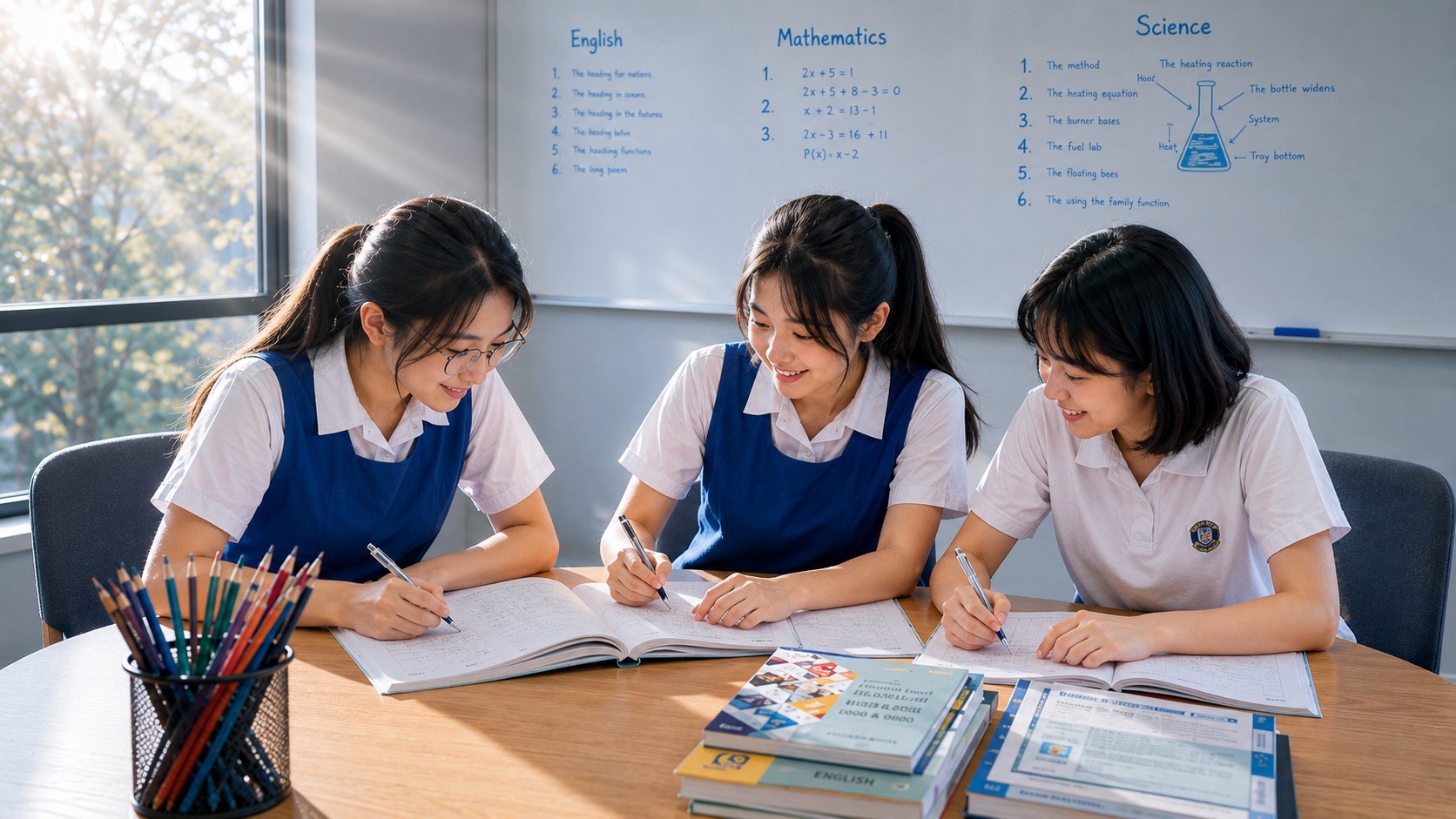
Secondary 2 G2 Art EOY preparation is not simply drawing more pictures before the examination. Begin with the school’s actual art themes, media, visual references, practical tasks and reflection requirements. Students need to observe closely, develop an idea, make purposeful choices, use materials safely, revise work and explain what they intended. A useful session might analyse one artwork, sketch several alternatives and refine one composition using teacher feedback. Parents should value the thinking and process as well as the finished piece; an attractive drawing does not automatically show that the student understood the task.
SEAB lists G2 Art as K236 in the 2027 national SEC syllabus, but Secondary 2 EOY assessment is set by the school and may assess only the learning and media taught during the year. Do not assume that a Sec 2 paper follows the national portfolio, practical or written requirements exactly. Ask the teacher what evidence of process, experimentation and final work is expected. If the child is anxious, help them start with observation and an achievable idea. Avoid comparing a teenager’s work with professional artists or saying they lack talent because one drawing did not turn out as planned.
- Confirm the school’s exact Sec 2 G2 Art EOY scope, date, duration and assessment format.
- Gather class notes, marked tasks, project records and teacher feedback.
- Complete a small diagnostic: Respond to a short school-taught visual prompt with observation notes, several thumbnail sketches, one developed study and a short reflection.
- Repair the earliest missing skill before adding more timed or elaborate tasks.
- Record each error, its correction and a fresh independent check.
- Use short practice sessions and protect sleep, meals, CCA and family time.
- Treat the later SEC subject code as national context, not as the Sec 2 school paper blueprint.
The important distinction: the school EOY is not the national SEC
The Singapore-Cambridge Secondary Education Certificate begins for graduating cohorts in 2027. SEAB lists G2 Art as subject code K236 in its 2027 G2 syllabus information. A Secondary 2 end-of-year examination is an internal school assessment taken earlier. The school decides what has been taught, what practical or written work is assessed, the timing, the permitted tools and the criteria used. A national subject code tells parents that an upper-secondary SEC subject exists; it does not prescribe a universal Sec 2 paper.
Full Subject-Based Banding means that G1, G2 and G3 refer to the level at which an individual subject is studied. Students can have different subject levels in their profile. It is more accurate to check whether the child is offering this particular subject at G2 than to treat ‘G2 student’ as a complete description of every lesson or assessment. School subject options, facilities and the timing of level decisions depend on school arrangements. Ask the school rather than relying on another family’s experience.
The immediate goal is to develop visual ideas, use materials purposefully and explain artistic choices and revisions. Start with actual classroom work and help the learner become independent at a small task. A child who can explain a design decision, use a spreadsheet formula correctly, interpret a food label or refine an artwork from feedback has demonstrated a real skill. A teenager who merely recognises a model answer or copies a finished product has not yet shown the same understanding. Parents can make revision more effective by looking at what the child can do, not by counting completed pages or hours.
What parents should collect before beginning revision
Find the latest assessment notice, class learning platform announcement, scheme of work and teacher instructions. Check which topics, software tools, media, techniques or practical processes have actually been taught. Ask which work will be examined in the EOY and whether project, portfolio or practical elements are assessed separately. Some schools use internal tasks that do not resemble the later national SEC examination. Confirm what file formats, materials or equipment students may use and whether there are school-specific safety requirements.
Gather a small sample of recent work: one task that went well and one with teacher comments showing a recurring weakness. Read feedback before selecting practice. Is the child struggling to understand a concept, follow instructions, organise ideas, operate a tool, manage time, test a result or explain a decision? These are different problems. A student who has good practical ability but weak written explanation may not benefit from another practical activity alone. A student who understands a concept but cannot locate a software function will not solve the problem by memorising definitions.
Ask the teacher one clear question: ‘Which first skill should my child repair before EOY, and what fresh task would show improvement?’ This is usually more helpful than asking whether the child needs more workbooks. Parents may not know the content in detail. They can still help the teenager organise materials, plan short sessions and explain teacher comments. Use school feedback as the standard for the current assessment; do not guess what a national examination might require several years later.
What a prepared student should be able to demonstrate
- Understand the purpose of the task and identify its required outcome.
- Use the knowledge, tool, material or process that has actually been taught.
- Explain why a particular method or choice is suitable.
- Check the result against a clear requirement rather than relying on appearance alone.
- Recognise a mistake and make a sensible correction.
- Present work clearly and follow school instructions on safety, file handling or documentation.
- Apply feedback to a new task without depending on a copied example.
These are signs of useful readiness, not a promise of a particular grade. Ask the child to demonstrate one capability each week. Keep an original attempt and an improved attempt so the family can see the difference. An independent solution to a changed task is better evidence of learning than a neat copy of the teacher’s model. Where a rubric exists, use it to understand what the school values and avoid adding expectations that the assessment does not require.
Twelve essential skills for Sec 2 G2 Art
Understand the visual brief
Identify theme, purpose, audience, media and constraints. Ask what the learner is being asked to explore rather than rushing into a favourite subject. A drawing can be attractive yet unrelated to the brief. Write a one-sentence intention and list visual elements that could communicate it. Revisit the intention at the end.
Observe before drawing from memory
Look at shape, proportion, edge, texture, light, shadow, pattern and spatial relationships where relevant. Begin with a few measured observations rather than trying to complete the entire image. Use school-taught techniques and materials. Ask what changed between the first quick study and a more careful drawing.
Use composition to guide the viewer
Consider where the main subject sits, how the viewer’s eye moves and whether important areas are clear. Explore thumbnail sketches before committing to a large piece. Change scale, cropping, balance or viewpoint and compare effects. A purposeful arrangement supports the idea the student wants to communicate.
Understand colour and value relationships
Where colour work is taught, explore hue, saturation, temperature and value. Use small test areas before applying colour to the main piece. Ask whether contrast separates forms or draws attention to a central element. For monochrome work, consider light and dark relationships. Each choice should support the intention.
Choose media for their properties
Different materials support different effects and working methods. Pencil may allow precise line and tonal study, while paint, collage or digital tools may encourage another kind of mark. Use media introduced by the school. Practise control through small tests and select what best suits the idea.
Develop ideas through experimentation
Make alternatives and test a small change in viewpoint, material, scale, mark or colour. Record what was learned from each attempt. Experimentation is purposeful when it helps decide what to keep, change or reject; it is not random decoration.
Study visual references critically
When analysing an artwork or visual source, identify what is visible before making an interpretation. Notice subject, composition, media, technique and context where taught. Ask what the artist may be exploring and which details support the response. Use references to learn, then develop a personal response and follow acknowledgement rules.
Use art vocabulary accurately
Words such as line, tone, texture, shape, form, space, pattern, contrast and emphasis should describe actual visual features. Point to the relevant area and explain its effect. Short precise observations are better than a long list of labels.
Reflect on process, not only the final work
A useful reflection describes intention, what was attempted, what changed, what worked and what could improve. Avoid statements such as ‘it is nice’ or ‘I am bad at drawing’. Point to evidence: a composition choice, a media test or a change in proportion.
Document artwork and process clearly
If the school requests a process journal or portfolio, follow its format and deadlines. Photograph work clearly when permitted, label experiments and keep notes concise. Show development from idea to test to outcome. Do not fabricate a process after the work is completed.
Manage time across planning, making and review
Allocate time for understanding the prompt, thumbnail sketches, main development and final checks. Do not spend most of the session perfecting a small area while leaving the overall composition unfinished. Practise realistically after understanding the process.
Care for tools and the workspace
Use teacher safety instructions for blades, paints, solvents, electrical equipment or digital devices. Clean tools as directed and protect surfaces. Do not experiment with hazardous materials at home without supervision.
A short diagnostic: locate the first weak link
Use the baseline task: Respond to a short school-taught visual prompt with observation notes, several thumbnail sketches, one developed study and a short reflection. Give the learner a realistic quiet period and observe how they approach it. Do not interrupt every hesitation. Ask afterwards what the student was trying to achieve, which step was difficult and how they decided what to do next. Sort the difficulty into missing knowledge, unclear instructions, weak planning, tool or technique control, incomplete testing, written explanation or time management. A useful diagnosis identifies where the process first stopped working; it does not label the entire subject as weak.
Mark the task against teacher instructions and the student’s own stated aim. Ask the child to explain one lost mark or incomplete feature. Choose a small correction that can be attempted independently. If the student cannot explain the concept, provide a simpler demonstration. If the student understands but executes poorly, practise the relevant step. If the output is complete but the reflection is vague, model a short evidence-based explanation. A different problem needs a different lesson.
After explaining the missing step, give a changed task that uses the same underlying skill. Repeating the same worksheet or copying the same product can test memory rather than transfer. If the learner can complete the new task and explain why the method works, record the progress. If not, reduce the task to a simpler prerequisite. This cycle makes learning visible and gives the parent a clear next action.
An eight-week EOY preparation plan
Eight weeks before the examination, collect the scope, organise resources and conduct the short diagnostic. In week seven, select the first recurring weakness and practise it through a worked example followed by a fresh attempt. In week six, add another important skill while revisiting the first one from memory. Do not try to cover every topic in a single weekend. If school assignments and CCA already take much of the week, choose the most useful practice rather than designing a timetable that the child cannot maintain.
Week five is for connecting skills: the learner should combine planning with execution, interpretation with explanation or a practical method with a short reflection. Week four introduces moderate time limits only after the student can perform the basic process accurately. Observe whether time is lost through setup, indecision, missing knowledge, tool use or overworking one section. Timing helps diagnose work habits. It should not punish a child who has not yet understood the method.
In week three, complete a representative task using the school’s current expectations and review the result carefully. In week two, attempt one longer practice or project segment if the child is ready. Spend the next session correcting the underlying problems instead of immediately assigning another large task. In the final week, revisit core requirements, safety or software routines, key concepts and a few confidence-building examples. Avoid introducing unrelated advanced material that the school has not taught.
If only four weeks remain, combine scope collection and diagnosis, then repair two significant weaknesses and practise the real task format. If only a few days remain, focus on the teacher’s explicit priorities, essential steps and safe, orderly preparation. No responsible plan can guarantee a grade from a short schedule. It can help the student use the remaining time wisely, understand the task and reduce unnecessary anxiety.
A realistic weekly study routine
A busy Secondary 2 learner may manage four focused sessions of twenty to thirty minutes in an ordinary week, adjusted for homework and CCA. One session can revisit a key concept, another can practise a weak skill, a third can complete an independent variation and a fourth can review feedback or a project record. Practical work may need a different arrangement because tools and facilities are available only at school. Follow teacher instructions and use home time for planning, observation or written reflection where appropriate.
A short session can begin with five minutes of recall, continue with ten to fifteen minutes of focused practice and end with an independent check and a short reflection. These timings are examples rather than official requirements. Ask the child to choose a workable time and name the exact task. The learner should increasingly manage the file, notebook, sketchbook or record independently. Parents can provide structure without becoming a supervisor who checks every click, line or mark.
Build in genuine breaks. A child who returns from school hungry or exhausted may need food, movement and quiet before concentration is possible. If several subjects have assessments, coordinate the work and avoid forcing long practical sessions late at night. Protect sleep. Creative and technical tasks often benefit from a fresh mind because the learner needs to make decisions, notice mistakes and reflect on a result. More hours do not automatically produce more learning.
An error log that leads to better work
Use five headings: task, original attempt, problem, correction and next independent check. Write observable issues rather than personal labels. ‘The chart axis was not labelled’, ‘I selected a formula range that missed the last row’, ‘the sketch did not show how the part joins’ or ‘the reflection did not use evidence’ are useful entries. ‘Careless’ and ‘not creative’ are not. The student should understand that the log exists to improve a process, not collect evidence for criticism.
Once a week, select one old issue and test it on a new task. If the child can now complete the step independently, mark it as more secure. If the difficulty returns, teach an earlier prerequisite and try again. Keep a small record of successful decisions as well as mistakes. A teenager who can explain why a method worked and when it might not work is developing sound judgement, even if the final output is not perfect.
Common mistakes that reduce EOY preparation effectiveness
Starting final artwork too quickly
Understand the brief and test thumbnail ideas before committing to the main piece.
Copying a reference without transformation
Analyse what works, then develop a new composition or personal idea while following school acknowledgement rules.
Using colour without considering value
Test light and dark relationships so important forms remain readable.
Treating every sketch as a failed final
Use sketches to test possibilities and record what each experiment teaches.
Writing vague reflections
Name one decision, point to evidence in the work and explain the next improvement.
Ignoring the theme
Return to the brief and explain how visual choices communicate the topic.
Leaving documentation to the last minute
Record process as it happens and follow school deadlines.
Assuming professional-looking work is the only success
The school may assess idea development, observation and process as well as final work.
Five family situations and practical next steps
The child says they have no artistic talent
Start with observation, small studies and a clear technique. Show progress between attempts instead of comparing with professional art.
Portfolio looks beautiful but lacks process
Add honest notes and evidence of development where requested. Do not invent experiments.
Student is stuck for ideas
Generate several subject, viewpoint or material choices from the brief. Test one in a thumbnail.
Parent does not know how to critique art
Ask what the student intended, which part communicates it and what they would change. Avoid imposing personal taste as marking standard.
Student runs out of time
Practise a short planning phase and realistic making sequence. Identify whether time is lost through setup, indecision or overworking details.
Exam anxiety and practical confidence
Anxiety in a practical, creative or digital subject may look different from anxiety about a written paper. A child may avoid starting, fear damaging materials, worry that the work is not attractive enough, or become frustrated when a program or prototype fails. Ask which stage feels uncertain: understanding the brief, choosing an idea, using a tool, testing the result or explaining the work. Offer one manageable starting action and allow the student to finish it before adding further demands.
Make the family message clear: the EOY matters as feedback, but it does not measure the teenager’s personal worth or determine every future opportunity. Praise preparation, safe habits, persistence, careful testing and willingness to revise. Avoid comparisons with professional work or classmates who have different experience, equipment or support. A learner’s first attempt may look ordinary and still contain excellent thinking. Ask what was learned and what the next iteration could improve.
If anxiety is persistent and affects sleep, appetite, school attendance, relationships or everyday functioning, speak with school staff or a school counsellor. Persistent or severe distress may also need appropriate professional healthcare support. More practice papers or extra tuition are not automatically the answer. Before an assessment, check the required materials, file location or practical setup, allow a sensible stop time and encourage the child to read instructions carefully. After the paper, give the student time to rest before discussing the outcome.
Falling behind, maintaining and progressing: three different responses
A learner falling behind may need a basic process or concept rebuilt before attempting a larger product. Break the task into steps and provide a clear example. A student maintaining a satisfactory standard may need regular practice, careful checking and more independent decision-making rather than many additional sessions. A student progressing strongly can be challenged with unfamiliar constraints, alternative methods or deeper reflection within the school’s taught level. The same worksheet or project is not right for every learner.
For a student who is doing well, a later subject-level discussion may be appropriate if the school offers it and the learner’s sustained performance, interest and readiness support the conversation. Do not promise G2-to-G3 movement on one EOY result. For a student who is struggling, do not assume a single practical failure closes future options. Check school criteria, subject offerings and the student’s overall evidence with the appropriate teachers.
Tuition, school help or independent practice
Start with classroom feedback, teacher consultation and the materials already supplied. Some students need a more reliable routine; others need a demonstration of a missing concept or individual feedback on a project. Outside support can help when it addresses a specific learning gap, but it should not duplicate the child’s workload without purpose. Ask a tutor or programme provider what the student will learn to do independently and how progress will be checked using a new task.
A small class may allow individual discussion, but size alone does not prove quality. Check whether the teacher understands the subject’s actual G2 level, the school’s tools and safety expectations, and whether the learner receives constructive feedback. Consider travel time, fees, rest, CCA and the child’s willingness to attend. Some families may choose a short targeted period of support; others may reasonably use school consultation and independent work. Review evidence before extending support.
The eduKate learning crosswalk: reference, explanation and action
MOE explains Full Subject-Based Banding. SEAB publishes the national SEC syllabus and subject code. The school confirms what is taught and assessed in the Secondary 2 EOY. A learning resource should then help the child understand the concept, practise the actual skill, check a fresh attempt and revisit it later. Do not treat a national subject listing as if it were the child’s classroom assessment notice.
Use active recall for knowledge, explicit modelling for a process not yet understood, a checklist for multi-step tasks and reflection after a practical or creative attempt. If the student makes a mistake, identify its cause before repeating the task. For Art, the most useful final check is a process page, a developed visual study and a short explanation of choices and next improvements. The learner should explain the decisions and evidence, not only show a finished output.
Understanding the national SEC code and later options
SEAB lists Art at G2 under code K236 for its 2027 SEC school-candidate syllabus. This is the national subject entry for graduating candidates, not a universal Secondary 2 test format. Some subjects may be offered only by certain schools or have different lower-secondary preparation arrangements. Confirm whether the child is currently taking a recognised G2 subject, a school programme or an introductory module. The timetable and teacher’s information are the correct starting point for EOY preparation.
A Secondary 2 EOY result by itself does not decide entry to Junior College, Polytechnic or ITE. Future pathways depend on qualifications, subject combinations, grades and admission rules applicable at the time. PSLE took place in Primary 6 and is not the examination the student is preparing for now. A teenager’s strengths and interests may develop during secondary school. Use current school evidence and official guidance when later choices arise; do not project a single subject mark into the child’s future.
Frequently asked questions about Sec 2 G2 Art
Is K236 a Secondary 2 EOY code?
No. K236 is the national G2 SEC Art code for 2027. The school determines Sec 2 EOY tasks and criteria.
Do students need a portfolio?
Lower-secondary documentation requirements depend on the school. Follow teacher instructions rather than assuming the SEC submission format applies.
Should parents buy expensive materials?
Use what the school requires and what the student can handle safely. Expensive materials do not automatically improve learning.
Is drawing the only thing assessed?
Art learning can include observation, idea development, visual decisions, media and reflection. The school rubric sets the emphasis.
Can the student use online images?
Follow school instructions on references, copyright and attribution. Use sources for learning and develop an original response.
What if the final artwork is incomplete?
Review the brief, process evidence and teacher feedback. Identify the planning or time-management step to improve.
Should the child copy model artwork?
Copying may help study techniques if permitted, but distinguish study from original work and follow task rules.
How can the child improve before EOY?
Practise observation, thumbnail planning, one taught medium and a short reflection using the actual school scope.
A parent–student planning checklist
- Confirm the school’s exact G2 Art EOY scope, format and date.
- Select one successful task and one marked example that shows a repeated weakness.
- Complete a small diagnostic: Respond to a short school-taught visual prompt with observation notes, several thumbnail sketches, one developed study and a short reflection.
- Schedule realistic practice for explanation, execution and independent checking.
- Record corrections and test them later on a changed task.
- Ask the teacher about subject requirements, available help and practical arrangements.
- Agree on a sensible stop time, rest and examination-day preparation.
End the planning conversation with one student-owned next action. The child might agree to revise one key process on Tuesday and complete a fresh task or explanation on Thursday. Ask what would make the task easier to start and what equipment or materials are actually needed. Parents can protect time and obtain resources, while the teenager increasingly owns the work and explains decisions. Review progress at the end of the week instead of turning every evening into a negotiation.
After EOY: turn feedback into a bridge toward the next year
When results return, look at the actual task, component feedback and teacher comments. Identify whether the main gap was knowledge, planning, technique, tool use, safety, testing, communication or time management. Ask the teacher which skill will matter most in the next year. A modest bridging plan can strengthen the foundation without taking away all holiday rest. If the child enjoyed the subject, consider appropriate ways to continue exploring it without treating every activity as an examination.
A disappointing result is not proof that a teenager lacks creativity, practical ability or technical potential. It is information about how the student performed on a particular task under particular conditions. A strong result is also not a reason to stop learning; the student can continue to improve accuracy, judgement and independence. Start with a process page, a developed visual study and a short explanation of choices and next improvements, correct one weakness and test that improvement on a fresh task.
Official information and eduKate learning resources
SEAB: 2027 G2 Syllabuses for School Candidates
SEAB: Singapore-Cambridge Secondary Education Certificate
MOE: Full Subject-Based Banding
eduKate: Active Recall and Spaced Repetition
eduKate: Exam Timing and Mock Papers
eduKate: Tuition or Self-Study
The official links explain the national framework and later subject options; they do not prescribe one common Secondary 2 EOY paper for every school. The school’s own notice, learning scope, task instructions and marking criteria remain the reliable reference for this student. This guide does not guarantee a grade or replace teacher feedback. It offers a practical process: understand the brief, practise the taught skill, check the result, learn from the correction and protect the learner’s wellbeing.