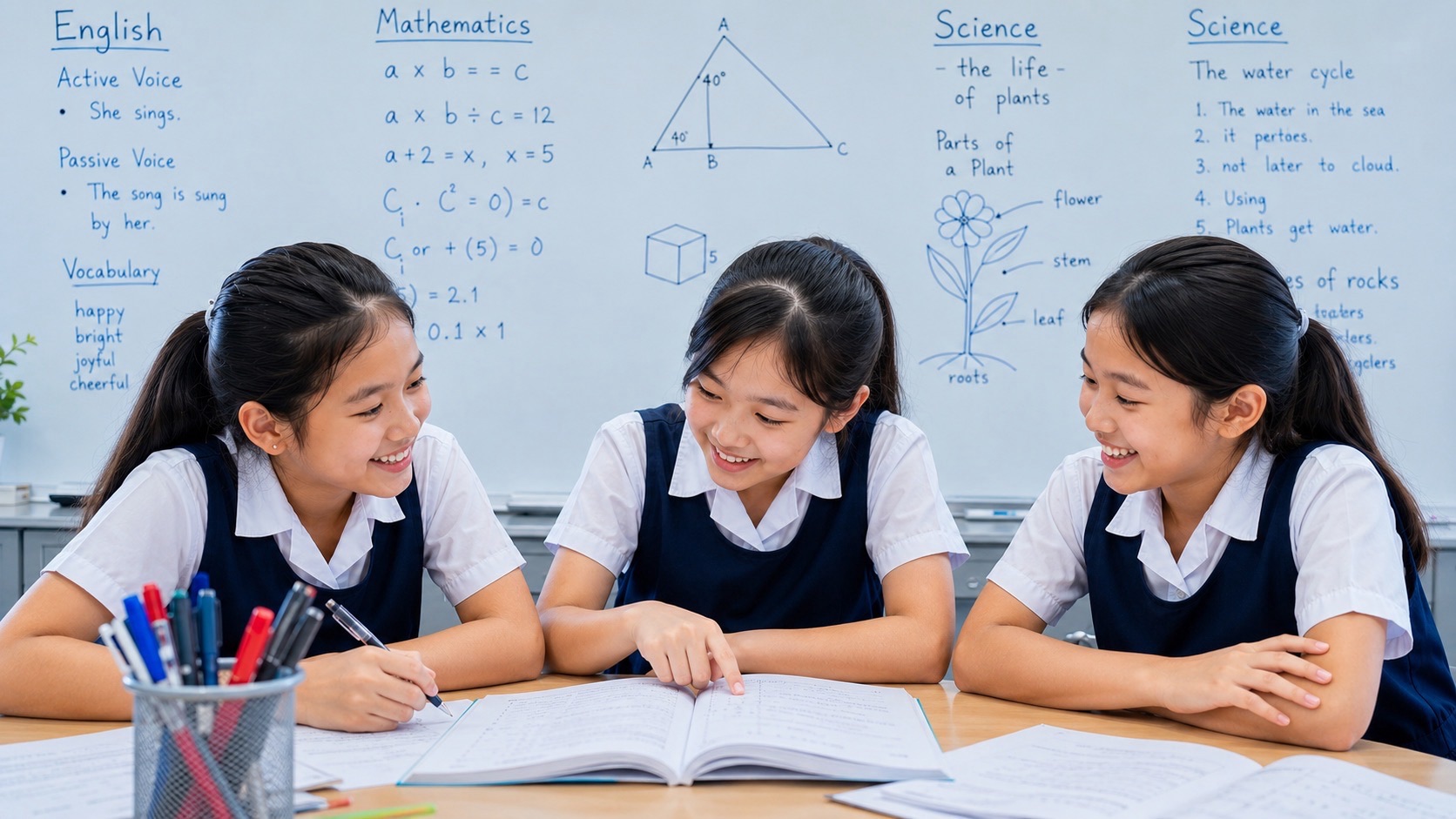
Quick answer for parents: Primary 1 is not only an academic transition. A child enters a new social environment, meets classmates with different personalities and learns how to join games, share materials, wait for a turn, manage disagreements and ask adults for help. Friendships may form quickly or take time. A child who has not found a close friend in the first few weeks is not automatically unhappy or socially behind. Parents can support belonging by listening carefully, teaching simple social language and working with the school when concerns persist.
A young pupil may describe a small disagreement as a major problem, or may not have the words to explain repeated exclusion. Parents should take the child’s feelings seriously without immediately assuming the worst. Ask what happened, when and where, who was present and whether the same issue repeats. This guide explains how to build social confidence, recognise when adult intervention is needed and keep friendship worries in proportion alongside the child’s learning and wellbeing.
- Friendship development differs from child to child; there is no required number of friends.
- Practise greetings, joining a game, turn-taking and asking for help.
- Listen to the child’s account without immediately blaming another child.
- Distinguish an occasional disagreement from repeated targeted behaviour.
- Contact the teacher when a concern repeats, affects safety or makes the child afraid to attend school.
- Teach assertive, respectful language without encouraging retaliation.
- Do not compare social popularity or pressure a child to become outgoing.
- Protect sleep, play and emotional wellbeing during the school transition.

Find the answer you need
P1 context · Main guide · Parent examples · Parent principles · Action plan · FAQs · Official resources
What P1 preparation actually means
The PSLE is held at the end of Primary 6. MOE removed weighted assessments and examinations in P1 and P2, but teachers continue to use classroom work, observations and formative feedback to understand pupils’ progress. A P1 child is not sitting a PSLE trial, and a P1 mark is not a reliable forecast of the eventual examination result.
This guide focuses on a practical P1 concern that parents can address now. It should complement current school communication rather than replace it. The child should be supported according to what has been taught and observed at this stage, not a future score or label.
Main guide: P1 friendships and classroom belonging
1. Why friendship is part of the P1 transition
For p1 friendships and classroom belonging, parents should first understand what the school is trying to help the child learn. Why friendship is part of the P1 transition is not an isolated test of the child’s worth or ability. It is one part of a wider learning experience in which children are still developing language, attention, confidence, independence and social understanding. Ask what the child can currently do without help, what changes when an adult provides a model and which step remains difficult. A clear description makes it easier to choose the next useful action.
A practical way to support why friendship is part of the p1 transition is to begin with a familiar example and use the language the child hears at school. Demonstrate once, invite the child to try and wait before giving another prompt. If the task is unfamiliar, reduce the number of steps. A child may need extra thinking time, a concrete object, a picture, a repeated instruction or a reassuring conversation. These are different forms of support. The parent should notice which one helps rather than simply adding more practice.
After a short period, change one feature of the activity and observe whether the child can transfer the learning. This may involve a different word, object, classroom situation, family routine or peer interaction. Independent transfer is more informative than repeating the same example immediately. If the child remains unsure, record what happened and ask the teacher whether the same pattern appears in class. Do not turn one difficult attempt into a prediction about the child’s future PSLE performance.
2. There is no correct number of friends
For p1 friendships and classroom belonging, parents should first understand what the school is trying to help the child learn. There is no correct number of friends is not an isolated test of the child’s worth or ability. It is one part of a wider learning experience in which children are still developing language, attention, confidence, independence and social understanding. Ask what the child can currently do without help, what changes when an adult provides a model and which step remains difficult. A clear description makes it easier to choose the next useful action.
A practical way to support there is no correct number of friends is to begin with a familiar example and use the language the child hears at school. Demonstrate once, invite the child to try and wait before giving another prompt. If the task is unfamiliar, reduce the number of steps. A child may need extra thinking time, a concrete object, a picture, a repeated instruction or a reassuring conversation. These are different forms of support. The parent should notice which one helps rather than simply adding more practice.
After a short period, change one feature of the activity and observe whether the child can transfer the learning. This may involve a different word, object, classroom situation, family routine or peer interaction. Independent transfer is more informative than repeating the same example immediately. If the child remains unsure, record what happened and ask the teacher whether the same pattern appears in class. Do not turn one difficult attempt into a prediction about the child’s future PSLE performance.
3. Teach a simple way to join a game
For p1 friendships and classroom belonging, parents should first understand what the school is trying to help the child learn. Teach a simple way to join a game is not an isolated test of the child’s worth or ability. It is one part of a wider learning experience in which children are still developing language, attention, confidence, independence and social understanding. Ask what the child can currently do without help, what changes when an adult provides a model and which step remains difficult. A clear description makes it easier to choose the next useful action.
A practical way to support teach a simple way to join a game is to begin with a familiar example and use the language the child hears at school. Demonstrate once, invite the child to try and wait before giving another prompt. If the task is unfamiliar, reduce the number of steps. A child may need extra thinking time, a concrete object, a picture, a repeated instruction or a reassuring conversation. These are different forms of support. The parent should notice which one helps rather than simply adding more practice.
After a short period, change one feature of the activity and observe whether the child can transfer the learning. This may involve a different word, object, classroom situation, family routine or peer interaction. Independent transfer is more informative than repeating the same example immediately. If the child remains unsure, record what happened and ask the teacher whether the same pattern appears in class. Do not turn one difficult attempt into a prediction about the child’s future PSLE performance.
4. Practise turn-taking and sharing without demanding passivity
For p1 friendships and classroom belonging, parents should first understand what the school is trying to help the child learn. Practise turn-taking and sharing without demanding passivity is not an isolated test of the child’s worth or ability. It is one part of a wider learning experience in which children are still developing language, attention, confidence, independence and social understanding. Ask what the child can currently do without help, what changes when an adult provides a model and which step remains difficult. A clear description makes it easier to choose the next useful action.
A practical way to support practise turn-taking and sharing without demanding passivity is to begin with a familiar example and use the language the child hears at school. Demonstrate once, invite the child to try and wait before giving another prompt. If the task is unfamiliar, reduce the number of steps. A child may need extra thinking time, a concrete object, a picture, a repeated instruction or a reassuring conversation. These are different forms of support. The parent should notice which one helps rather than simply adding more practice.
After a short period, change one feature of the activity and observe whether the child can transfer the learning. This may involve a different word, object, classroom situation, family routine or peer interaction. Independent transfer is more informative than repeating the same example immediately. If the child remains unsure, record what happened and ask the teacher whether the same pattern appears in class. Do not turn one difficult attempt into a prediction about the child’s future PSLE performance.
5. Help the child describe feelings and events
For p1 friendships and classroom belonging, parents should first understand what the school is trying to help the child learn. Help the child describe feelings and events is not an isolated test of the child’s worth or ability. It is one part of a wider learning experience in which children are still developing language, attention, confidence, independence and social understanding. Ask what the child can currently do without help, what changes when an adult provides a model and which step remains difficult. A clear description makes it easier to choose the next useful action.
A practical way to support help the child describe feelings and events is to begin with a familiar example and use the language the child hears at school. Demonstrate once, invite the child to try and wait before giving another prompt. If the task is unfamiliar, reduce the number of steps. A child may need extra thinking time, a concrete object, a picture, a repeated instruction or a reassuring conversation. These are different forms of support. The parent should notice which one helps rather than simply adding more practice.
After a short period, change one feature of the activity and observe whether the child can transfer the learning. This may involve a different word, object, classroom situation, family routine or peer interaction. Independent transfer is more informative than repeating the same example immediately. If the child remains unsure, record what happened and ask the teacher whether the same pattern appears in class. Do not turn one difficult attempt into a prediction about the child’s future PSLE performance.
6. Teach respectful disagreement
For p1 friendships and classroom belonging, parents should first understand what the school is trying to help the child learn. Teach respectful disagreement is not an isolated test of the child’s worth or ability. It is one part of a wider learning experience in which children are still developing language, attention, confidence, independence and social understanding. Ask what the child can currently do without help, what changes when an adult provides a model and which step remains difficult. A clear description makes it easier to choose the next useful action.
A practical way to support teach respectful disagreement is to begin with a familiar example and use the language the child hears at school. Demonstrate once, invite the child to try and wait before giving another prompt. If the task is unfamiliar, reduce the number of steps. A child may need extra thinking time, a concrete object, a picture, a repeated instruction or a reassuring conversation. These are different forms of support. The parent should notice which one helps rather than simply adding more practice.
After a short period, change one feature of the activity and observe whether the child can transfer the learning. This may involve a different word, object, classroom situation, family routine or peer interaction. Independent transfer is more informative than repeating the same example immediately. If the child remains unsure, record what happened and ask the teacher whether the same pattern appears in class. Do not turn one difficult attempt into a prediction about the child’s future PSLE performance.
7. Distinguish ordinary conflict from repeated harmful behaviour
For p1 friendships and classroom belonging, parents should first understand what the school is trying to help the child learn. Distinguish ordinary conflict from repeated harmful behaviour is not an isolated test of the child’s worth or ability. It is one part of a wider learning experience in which children are still developing language, attention, confidence, independence and social understanding. Ask what the child can currently do without help, what changes when an adult provides a model and which step remains difficult. A clear description makes it easier to choose the next useful action.
A practical way to support distinguish ordinary conflict from repeated harmful behaviour is to begin with a familiar example and use the language the child hears at school. Demonstrate once, invite the child to try and wait before giving another prompt. If the task is unfamiliar, reduce the number of steps. A child may need extra thinking time, a concrete object, a picture, a repeated instruction or a reassuring conversation. These are different forms of support. The parent should notice which one helps rather than simply adding more practice.
After a short period, change one feature of the activity and observe whether the child can transfer the learning. This may involve a different word, object, classroom situation, family routine or peer interaction. Independent transfer is more informative than repeating the same example immediately. If the child remains unsure, record what happened and ask the teacher whether the same pattern appears in class. Do not turn one difficult attempt into a prediction about the child’s future PSLE performance.
8. Work with teachers on social concerns
For p1 friendships and classroom belonging, parents should first understand what the school is trying to help the child learn. Work with teachers on social concerns is not an isolated test of the child’s worth or ability. It is one part of a wider learning experience in which children are still developing language, attention, confidence, independence and social understanding. Ask what the child can currently do without help, what changes when an adult provides a model and which step remains difficult. A clear description makes it easier to choose the next useful action.
A practical way to support work with teachers on social concerns is to begin with a familiar example and use the language the child hears at school. Demonstrate once, invite the child to try and wait before giving another prompt. If the task is unfamiliar, reduce the number of steps. A child may need extra thinking time, a concrete object, a picture, a repeated instruction or a reassuring conversation. These are different forms of support. The parent should notice which one helps rather than simply adding more practice.
After a short period, change one feature of the activity and observe whether the child can transfer the learning. This may involve a different word, object, classroom situation, family routine or peer interaction. Independent transfer is more informative than repeating the same example immediately. If the child remains unsure, record what happened and ask the teacher whether the same pattern appears in class. Do not turn one difficult attempt into a prediction about the child’s future PSLE performance.
9. When a child does not want to go to school
For p1 friendships and classroom belonging, parents should first understand what the school is trying to help the child learn. When a child does not want to go to school is not an isolated test of the child’s worth or ability. It is one part of a wider learning experience in which children are still developing language, attention, confidence, independence and social understanding. Ask what the child can currently do without help, what changes when an adult provides a model and which step remains difficult. A clear description makes it easier to choose the next useful action.
A practical way to support when a child does not want to go to school is to begin with a familiar example and use the language the child hears at school. Demonstrate once, invite the child to try and wait before giving another prompt. If the task is unfamiliar, reduce the number of steps. A child may need extra thinking time, a concrete object, a picture, a repeated instruction or a reassuring conversation. These are different forms of support. The parent should notice which one helps rather than simply adding more practice.
After a short period, change one feature of the activity and observe whether the child can transfer the learning. This may involve a different word, object, classroom situation, family routine or peer interaction. Independent transfer is more informative than repeating the same example immediately. If the child remains unsure, record what happened and ask the teacher whether the same pattern appears in class. Do not turn one difficult attempt into a prediction about the child’s future PSLE performance.
10. Support a child who is quiet or slow to warm up
For p1 friendships and classroom belonging, parents should first understand what the school is trying to help the child learn. Support a child who is quiet or slow to warm up is not an isolated test of the child’s worth or ability. It is one part of a wider learning experience in which children are still developing language, attention, confidence, independence and social understanding. Ask what the child can currently do without help, what changes when an adult provides a model and which step remains difficult. A clear description makes it easier to choose the next useful action.
A practical way to support support a child who is quiet or slow to warm up is to begin with a familiar example and use the language the child hears at school. Demonstrate once, invite the child to try and wait before giving another prompt. If the task is unfamiliar, reduce the number of steps. A child may need extra thinking time, a concrete object, a picture, a repeated instruction or a reassuring conversation. These are different forms of support. The parent should notice which one helps rather than simply adding more practice.
After a short period, change one feature of the activity and observe whether the child can transfer the learning. This may involve a different word, object, classroom situation, family routine or peer interaction. Independent transfer is more informative than repeating the same example immediately. If the child remains unsure, record what happened and ask the teacher whether the same pattern appears in class. Do not turn one difficult attempt into a prediction about the child’s future PSLE performance.
11. Build social confidence through ordinary activities
For p1 friendships and classroom belonging, parents should first understand what the school is trying to help the child learn. Build social confidence through ordinary activities is not an isolated test of the child’s worth or ability. It is one part of a wider learning experience in which children are still developing language, attention, confidence, independence and social understanding. Ask what the child can currently do without help, what changes when an adult provides a model and which step remains difficult. A clear description makes it easier to choose the next useful action.
A practical way to support build social confidence through ordinary activities is to begin with a familiar example and use the language the child hears at school. Demonstrate once, invite the child to try and wait before giving another prompt. If the task is unfamiliar, reduce the number of steps. A child may need extra thinking time, a concrete object, a picture, a repeated instruction or a reassuring conversation. These are different forms of support. The parent should notice which one helps rather than simply adding more practice.
After a short period, change one feature of the activity and observe whether the child can transfer the learning. This may involve a different word, object, classroom situation, family routine or peer interaction. Independent transfer is more informative than repeating the same example immediately. If the child remains unsure, record what happened and ask the teacher whether the same pattern appears in class. Do not turn one difficult attempt into a prediction about the child’s future PSLE performance.
12. Protect belonging, confidence and learning together
For p1 friendships and classroom belonging, parents should first understand what the school is trying to help the child learn. Protect belonging, confidence and learning together is not an isolated test of the child’s worth or ability. It is one part of a wider learning experience in which children are still developing language, attention, confidence, independence and social understanding. Ask what the child can currently do without help, what changes when an adult provides a model and which step remains difficult. A clear description makes it easier to choose the next useful action.
A practical way to support protect belonging, confidence and learning together is to begin with a familiar example and use the language the child hears at school. Demonstrate once, invite the child to try and wait before giving another prompt. If the task is unfamiliar, reduce the number of steps. A child may need extra thinking time, a concrete object, a picture, a repeated instruction or a reassuring conversation. These are different forms of support. The parent should notice which one helps rather than simply adding more practice.
After a short period, change one feature of the activity and observe whether the child can transfer the learning. This may involve a different word, object, classroom situation, family routine or peer interaction. Independent transfer is more informative than repeating the same example immediately. If the child remains unsure, record what happened and ask the teacher whether the same pattern appears in class. Do not turn one difficult attempt into a prediction about the child’s future PSLE performance.
Further parent examples and questions
What if the child succeeds at home but not at school?
Home and school are different learning environments. A child may be relaxed with a parent but less confident in a group, or may need more time to process an instruction in a busy classroom. A home activity may also contain adult prompts that are not available in class. Neither setting alone gives the whole picture.
Share the conditions under which the child succeeds at home. Ask the teacher what the pupil can do independently in class and what support is needed. The goal is to understand how the child transfers learning between settings, not to argue that one observation must be correct.
What if the child struggles even after repeated practice?
Repeated difficulty can mean that the teaching approach, task level or underlying skill needs to be reviewed. More practice of the same type may not address the missing connection. Parents should identify exactly where the child becomes uncertain and ask the teacher whether a different explanation or support pathway is appropriate.
Keep one or two examples and record what prompts helped. If the concern involves speech, hearing, vision, motor development or wider wellbeing, ask the school about the appropriate next step. A tuition provider can teach academic content but should not diagnose a condition.
What if another parent gives conflicting advice?
Parents may share useful experiences, but one pupil’s programme, report or school routine is not automatically the same as another child’s. Schools can differ in delivery arrangements, and cohort information may change. Online discussions may also be based on older policy or a different school.
Use other parents’ experiences as questions to ask, not as official instructions. Check the school’s current communication and MOE guidance. When a decision affects the child’s support or curriculum pathway, ask the school directly and keep a note of the answer.
How to know whether support is helping
Look for a change in the target skill: the child can complete a task with fewer prompts, explain an idea more clearly, use a taught strategy or participate with greater confidence. Do not measure success only by marks or the amount of work completed. A small but meaningful gain may be important at this stage.
Ask the teacher how progress is monitored and when the school will review the support. At home, use a changed but familiar example to see whether the learning transfers. If there is no improvement or the child becomes distressed, discuss whether the plan should be adjusted.
What a balanced weekly routine can look like
A P1 week should include school learning, required homework, rest, sleep, movement, play and family interaction. One short practice activity may be enough when it is purposeful. Some weeks may need less optional work because the child is tired or school activities are demanding.
Do not treat every available hour as tuition time. Review whether the routine is sustainable and whether the child still has opportunities to enjoy reading, play and friendships. If extra lessons create fatigue, reconsider the number and format rather than assuming the child needs to become more disciplined.
How to keep a useful parent note
A short note can record the date, the activity, what the child completed independently, the prompt that helped and any question for the teacher. It does not need to become a formal assessment chart. The purpose is to remember a pattern accurately instead of relying on a stressful moment or a vague impression.
Keep the note factual and private. Do not record every error or rank the child against classmates. Review it after a few weeks and remove items that are no longer relevant. Share only examples that help the teacher understand the concern or recognise progress.
Parent principles that apply across P1 learning
P1 and P2 have no weighted examinations
MOE removed weighted assessments and examinations in P1 and P2. Teachers still gather evidence through classroom work, discussion, observation, short tasks and formative feedback. Schools may use qualitative descriptors to report learning progress. The exact reporting format, timing and learning outcomes should be checked in the current information sent by the pupil’s own school.
A task may still be marked or commented on because a teacher needs to identify what the child has understood. That does not make the task a weighted examination or a PSLE result. Ask what was being observed and what the next learning step should be. Do not convert a P1 class activity into a predicted Achievement Level.
Use specific observations rather than labels
Parents often describe a child as weak, careless, shy or not interested. These labels do not tell the teacher what actually happened. A useful description identifies the task, the situation, the support given and the point where the child became unsure. For example, ‘She can read familiar words but guesses when the sentence contains an unfamiliar word’ is more informative than ‘She is bad at English’.
Keep one or two examples and ask whether the same pattern appears in class. A teacher may see strengths or difficulties that are not visible at home. Combine both perspectives before choosing extra practice. The purpose is to understand the learning need, not to prove that one adult is right.
Follow the school’s current teaching sequence
A workbook or online course labelled Primary 1 may introduce content in a different order from the school. If the child learns one skill in class and hears an incompatible explanation at home, the extra practice may create confusion. Parents should begin with class materials, current messages and the teacher’s stated learning objectives.
Choose one recently taught skill and practise it with a clear example. If a resource appears to contradict the classroom method, pause and ask the teacher before using it. Consistency helps a young learner connect an explanation with independent practice. More materials are not automatically better materials.
Correct one important point at a time
A P1 learner is still developing attention, language, motor control and confidence. Correcting every error at once can overwhelm the child and obscure the skill being taught. Identify the first missing connection, explain it clearly and let the child try again. A correction should tell the learner what to do next, not simply signal that the answer is wrong.
Use calm language such as ‘Let’s look at the instruction again’ or ‘Show me how you worked that out’. Avoid calling the child careless or lazy. If several errors appear, focus on the earliest one that prevents the rest of the task. A clear next step is more useful than a long list of corrections.
Keep practice proportionate and protect wellbeing
Extra practice is helpful when it addresses a genuine need and allows the child to use a skill again. It is less helpful when it repeats the same error without teaching, adds unfamiliar material or removes time for sleep and play. There is no universal MOE daily quota for extra tuition or worksheets in P1. Follow school requirements and the child’s energy.
If homework regularly causes distress or takes the evening, review the task and discuss the pattern with the teacher. Keep time for movement, friendships, family conversation and reading for enjoyment. Persistent worry that affects sleep, eating, attendance, play or ordinary functioning deserves a conversation with the school and, where appropriate, a qualified professional.
Tuition is one option, not the first automatic response
A private tutor can provide another explanation and structured practice, but the tutor does not replace the class teacher, school support or professional assessment where needed. Parents should identify the specific skill that needs help before paying for a broad package. A useful programme has a clear target, age-appropriate methods and a way to check whether the child can apply learning independently.
Ask what the tutor will teach, how the lesson relates to current school learning and how progress will be reviewed. Be cautious about guarantees of future PSLE grades, school placement or fixed learning outcomes. If the child becomes more tired but cannot use the skill independently, reconsider the format.
A practical parent action plan
Step 1 — clarify: identify the current school observation or learning need. Ask what the child can do independently and where support is required.
Step 2 — agree: speak with the teacher about the purpose of any school support or feedback. Confirm the programme’s current format, target skills and review process.
Step 3 — reinforce: use short home activities that follow the school’s approach. Demonstrate one example and allow the child to try independently.
Step 4 — observe: note whether the child needs fewer prompts, understands more clearly or can use the skill in a changed example.
Step 5 — review: share progress or continuing difficulty with the teacher. Adjust the support if the original approach is not helping.
This is a family framework, not an official MOE timetable or eligibility process. The child’s school determines its programme arrangements and communicates the support available. Follow those instructions and ask for clarification whenever a decision is unclear.
Frequently asked questions
Does my child need a best friend in P1?
No. Children form relationships at different rates and may enjoy different kinds of social interaction.
What if my child plays alone during recess?
Ask whether the child is comfortable and whether this is a preference or a source of distress. Speak with the teacher if the pattern worries the child.
Is every disagreement bullying?
No. Ordinary disagreements occur, but repeated targeted behaviour, threats or harm should be raised with the school.
Should I teach my child to fight back?
No. Teach clear boundaries and help-seeking; unsafe behaviour should be handled by adults.
When should I contact the teacher?
Contact the teacher when a concern repeats, involves harm, affects safety or makes the child afraid to attend school.
Official information and related eduKate guides
MOE primary curriculum provides the curriculum context. For a school-specific concern, use the class teacher and the school’s stated student-wellbeing or reporting channels. This guide is general parent support and is not a substitute for the school’s procedures for safety incidents.
Related eduKate reading: P1 to P6 Parent Roadmap · P1 Anxiety, Confidence and Wellbeing · P1 Home Study Routine · P1 Tuition and Extra Help. These articles supplement school and official guidance; they do not replace it.
The parent’s decision
P1 is a year for building foundations, confidence and a positive relationship with school. Use the teacher’s observations to understand what the child needs now, ask specific questions and choose proportionate support. Do not turn an early difficulty into a prediction about PSLE performance. The most useful preparation is to help the child make steady progress at the stage they are actually in.