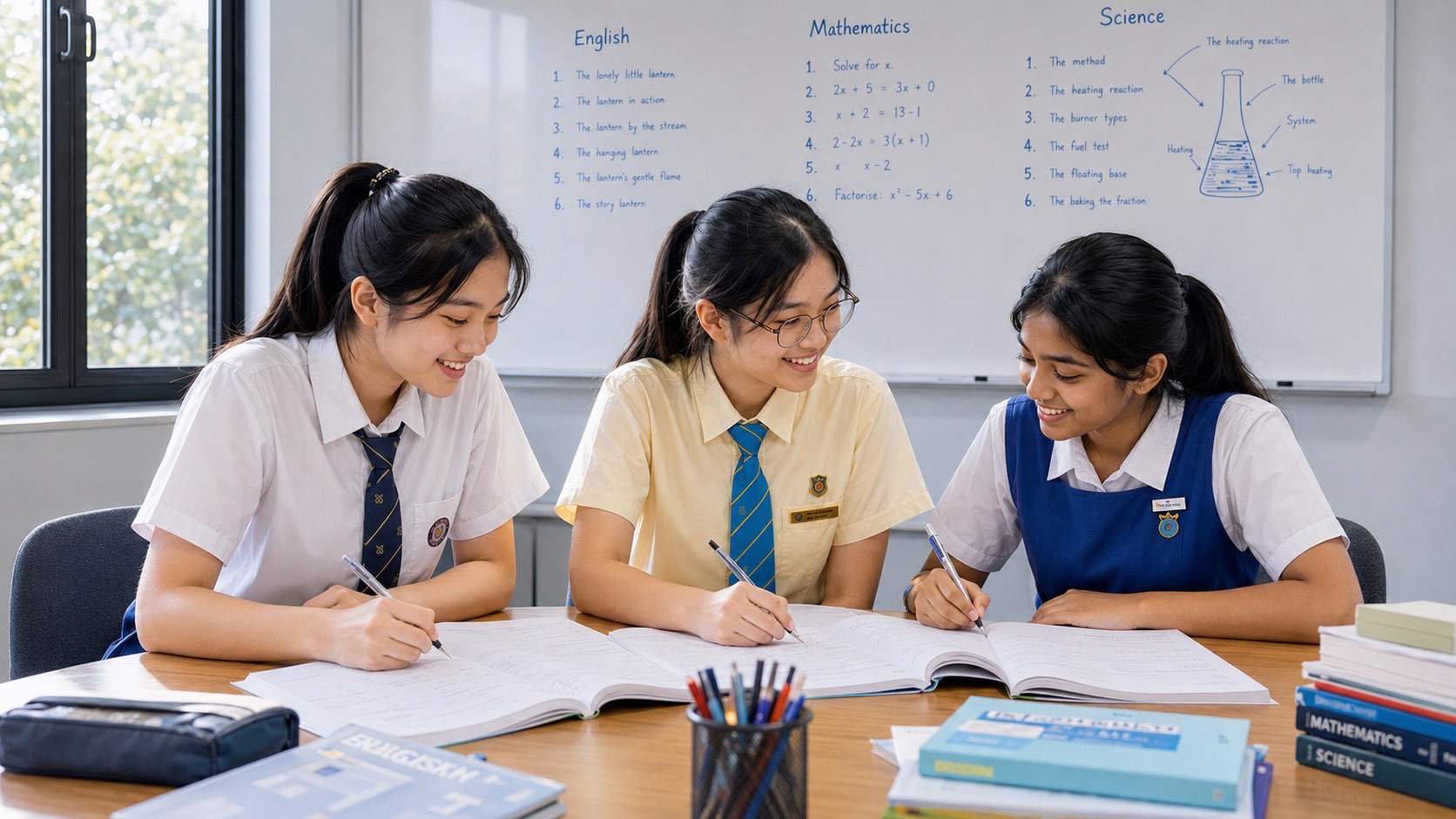
Fairfield Methodist School (Secondary) is worth considering after PSLE results if your child would thrive in a co-educational Methodist school in Dover that emphasises character, thoughtful communication and leadership through service. For the 2026 Secondary 1 intake, based on PSLE 2025, the historical non-affiliated score ranges were Posting Group 3 (PG3) 6–11, PG2 21–21 and PG1 25–27; affiliated ranges were PG3 6–20, PG2 21–25 and PG1 25–28. These are separate reference categories, not guarantees of 2027 places.
The school is at 102 Dover Road, Singapore 139649, with One-North and Buona Vista MRT among the transport choices. Fairfield’s Voice of a Fairsian Programme develops values-informed speaking and expression, and its Sophia Blackmore Leadership Programme seeks to develop students who lead with integrity and service. Parents should check the child’s actual affiliation eligibility, the school’s Christian ethos, subject access and daily journey before choosing among six schools. A historical cut-off alone cannot determine the best fit.
Quick parent summary: • Government-aided, autonomous, co-educational school; • Address: 102 Dover Road; • 2026 non-affiliated PG3 6–11, PG2 21–21, PG1 25–27; • 2026 affiliated PG3 6–20, PG2 21–25, PG1 25–28; • Affiliated primary school: Fairfield Methodist School (Primary), subject to official MOE rules; • Key programmes: Voice of a Fairsian, Sophia Blackmore Leadership; • Telephone: 6778 8702; • Compare the correct admission category and prepare six distinct options.
1. First check affiliation: two different historical score ranges
The first potential mistake is quoting Fairfield’s affiliated cut-off to a non-affiliated family. The school has an affiliated pathway associated with Fairfield Methodist School (Primary), but this is not something a parent acquires by attending a Methodist church, living nearby or having a relative who attended Fairfield decades ago. Affiliation and its conditions are defined by the current school and MOE process.
For the 2026 intake, the historical PG3 non-affiliated last admitted score was 11, while the affiliated range ended at 20. That difference matters enormously for a family calculating how realistic a choice may be. Similarly, the PG2 non-affiliated range was 21–21, while the affiliated range was 21–25. The PG1 corresponding last scores were 27 and 28. Check your own child’s official eligibility and do not borrow another family’s column.
2. Understand the score table without inventing predictions
The historical 2026 Secondary 1 ranges based on PSLE 2025 were as follows: PG3 non-affiliated 6–11, affiliated 6–20; PG2 non-affiliated 21–21, affiliated 21–25; PG1 non-affiliated 25–27, affiliated 25–28. The first number in each row records the best score of pupils posted in that category; the second records the last. The lower the overall PSLE Score, the stronger the result.
An identical beginning and ending range, such as 21–21, does not mean there was only one admitted student. It simply means pupils posted in that category were recorded at that PSLE score. Each cut-off belongs to an actual cohort with particular choices and available places. The score needed for entry in 2027 is not yet known. Use MOE SchoolFinder as the official reference during the current exercise.
3. A non-affiliated child’s application
Imagine a non-affiliated child eligible for PG3 and holding Score 10. Fairfield’s historical non-affiliated PG3 range ended at 11. This gives the family a sensible reason to investigate, but it cannot guarantee a place. They should examine the school because the child may enjoy its culture, subjects, communication activities or convenient route, not simply because an earlier score seems favourable.
Now consider a non-affiliated child with Score 13. That is numerically higher than the previous non-affiliated PG3 cut-off of 11. It would be misleading to say that an affiliated range ending at 20 makes Score 13 a straightforward choice for this child. If Fairfield is strongly preferred, the family can discuss it as an uncertain aspiration and still prepare other realistic, desirable options.
4. An affiliated child’s application
Imagine a pupil from Fairfield Methodist School (Primary) with Score 18 and PG3 eligibility. The previous affiliated PG3 range ending at 20 makes the secondary school worth examining, provided the pupil meets the actual affiliation conditions for the new exercise. It is still not an automatic continuation into the secondary campus: current vacancies, applications and admission rules determine the outcome.
Affiliation can offer continuity in values, community and friendships, but continuity is not always the child’s greatest wish. Some pupils welcome a familiar culture; others want to meet new people and experience a different school environment. Parents should ask the child whether they genuinely want Fairfield, rather than treating the affiliated path as an instruction or a family obligation.
5. Fairfield’s Methodist ethos: ask what it looks like daily
The school describes its mission as providing a holistic education in a Christian environment while developing students of good character to serve others. For families who value such an ethos, this may be an important reason to shortlist Fairfield. For others, the right step is to understand what it means in actual assemblies, class routines, values lessons, community activities and relationships.
Ask staff how pupils from different religious and family backgrounds experience the school, what participation is expected, and how questions and differences of belief are handled respectfully. A useful conversation is about everyday practice rather than stereotypes. A family should feel free to ask difficult questions courteously and to choose another school if a different environment is a better fit.
6. The Voice of a Fairsian Programme
Fairfield’s Voice of a Fairsian Programme develops communication grounded in the values Purity, Unity, Resilience and Excellence, which the school groups under PURE. Its published materials show oracy tasks connected to English and Literature and differentiated enrichment opportunities, including narrative, investigative and broadcast journalism. The programme invites a useful question: can the school help the child communicate with clarity, evidence and consideration for others?
For a student already comfortable speaking, the programme could provide more demanding tasks. For a shy pupil, its value may depend on how teachers structure initial practice in pairs, small groups and later presentations. Ask what every Secondary 1 pupil receives, what enrichment requires selection and how feedback on speaking and writing is delivered. These details determine whether the programme is accessible and helpful for your child.
7. Why speaking and writing are more than examination subjects
Being able to explain an idea clearly helps a teenager in science discussions, project work, disagreements with friends and decisions about the world outside school. Journalism-like tasks can teach students to distinguish an allegation from evidence, interview with care, recognise that different people experience an event differently and revise an argument. Those are lifelong habits, not just training for a media career.
Ask Fairfield to show an ordinary task rather than only the most polished student performance. Does a beginner learn to ask an open-ended question? How do students substantiate a claim? How are mistakes discussed? A parent interested in the programme should look for improvement over time, not only confidence on stage. Quiet reflection and careful listening matter as much as speaking fluently.
8. Sophia Blackmore Leadership Programme
The school’s Sophia Blackmore Leadership Programme, named after its founder, describes leadership as influence based on values rather than title alone. Its published framework provides broad experiences through character education, Fairfield Learning Experience activities, values-in-action and CCAs, with additional training for selected class leaders, student councillors and CCA leaders. This layered structure is more useful to parents than simply asking how many leadership badges are awarded.
A Secondary 1 pupil can lead by being reliable, listening to classmates and offering help. An older student might have a more formal responsibility to coordinate teams and mentor others. Ask how quieter children are included in early leadership experiences, how formal roles are selected and how unsuccessful applicants continue to grow. Good leadership teaching gives every child useful responsibility without requiring all children to become public speakers.
9. Why Fairfield’s history should not replace current evidence
Fairfield traces its founding to 1888 and has a long tradition associated with Sophia Blackmore. History can create continuity and a strong sense of school identity. It may mean that parents recognise the name and that families have multi-generational connections to the community. These are meaningful social facts, but they do not tell a family everything about the Secondary 1 experience in 2027.
Today’s pupil needs current teachers, subject options, support arrangements, a workable commute and modern academic skills. Ask how the school combines its values with present-day communication, digital literacy and student wellbeing. A school with a proud history should still be judged on how well the actual child can learn there now.
10. Is Fairfield suitable for a child who is not naturally outspoken?
A child who worries about presenting in front of classmates should not be automatically excluded from a school that emphasises voice. A carefully designed communication curriculum can help that pupil build confidence through small steps. Ask how nervous beginners are supported, whether teachers assess effort and progress, and what adjustments may be appropriate for an individual learner.
At the same time, do not choose a school solely in the hope that a named programme will fix a child’s shyness. That is too much pressure on a teenager. Let the child describe their fear: is it public speaking, unfamiliar classmates, fear of criticism or a specific previous experience? The practical support the school offers should influence the decision more than an attractive slogan.
11. Full Subject-Based Banding and subject combinations
Under Full Subject-Based Banding, pupils are admitted by Posting Group and may take subjects at G1, G2 and G3 levels depending on eligibility and subsequent progression. The Posting Group is not a permanent description of a child’s intelligence. If a child is especially ready for a more demanding Mathematics or Mother Tongue subject, ask the school how subject-specific eligibility and offers are handled.
Parents should verify current subject combinations, assessment formats, pathways and extra requirements. A subject advertised on a website may not be available to every student or in every combination. Changes to the national examination system also mean that a handbook using old Express and Normal labels may not accurately describe the route for a child entering in 2027. Ask for the current cohort’s information, especially for future upper-secondary choices.
12. The actual Dover Road commute
Fairfield’s contact page states that the visitor entrance is along Dover Road. It describes One-North MRT Exit A as roughly a six-minute walk and Buona Vista MRT Exit D as approximately a fifteen-minute walk, and lists bus routes 33, 74, 166 and 196. These are useful landmarks, but they are not measurements from your home’s front door.
Test the school journey on a realistic weekday morning and after CCA. Include the transfer, the uncovered walk, the time waiting to cross roads and how the pupil feels about the trip independently. A route that looks efficient on a map may be stressful in heavy rain. A longer journey may still be worthwhile when the school’s culture is a distinctive fit, but the family should make that trade-off deliberately.
13. Autonomous school does not mean automatic access to enrichment
Fairfield is described as a government-aided autonomous school. Parents should not convert that description into assumptions about extra lessons, specialist subjects or guaranteed places in programmes. Ask what is included for every pupil, whether particular opportunities have fees, and what eligibility or selection is involved. A school can have excellent enrichment without enrolling every Secondary 1 student in every activity.
Start with the main curriculum. Can the child keep pace and receive help when necessary? Does the schedule leave enough time for sleep, family responsibilities and a fulfilling CCA? A programme is genuinely beneficial when it deepens learning without becoming an unsustainable collection of commitments.
14. CCAs and DSA talent areas are not the same list
Fairfield has published DSA-Sec opportunities for sports and performing arts, including badminton, basketball, football, volleyball, choir, concert band and modern dance for its 2026 exercise. But a DSA talent area is not a guaranteed CCA placement for an ordinary posted student, and the entire CCA roster can be broader than those DSA areas.
Ask for the latest CCA information, trial arrangements, participation expectations and costs. Encourage your child to name three activities they would honestly enjoy. A beginner-friendly club may offer more confidence and friendships than a prestigious team for which they have little interest or realistic access. The child’s CCA should become a sustainable part of school life.
15. What about students needing extra help?
Fairfield’s published co-curriculum includes guidance, counselling and student wellbeing resources. Parents should ask how a new Secondary 1 pupil actually accesses those resources and who coordinates support with teachers. What happens if the child falls behind academically? How does a parent report emerging bullying, loneliness or anxiety? A named programme is valuable only when the process works in ordinary cases.
Where there is a medical, developmental, learning or accessibility need, discuss the child’s practical requirements confidentially with the school. Ask about lessons, school movement, activities and assessments. Do not infer that all adjustments are possible from one general support statement. A clear and respectful discussion provides stronger evidence than an anonymous review.
16. A realistic PG3 family scenario
Imagine a PG3-eligible student with a non-affiliated Score 10 who enjoys reading and constructing careful arguments. The historical non-affiliated cutoff of 11 gives the family a reason to explore Fairfield, but they still need to examine transport, ethos and other schools. After a visit, the child likes the speaking activities but worries about not knowing anyone.
The family can talk to staff about how newcomers settle in, then compare other appropriate schools. They should list Fairfield according to real preference and include alternatives with different historical cut-offs. A close fit is a better argument than ‘it was our first choice because it sounds famous’. The family gains nothing by pretending uncertainty has disappeared.
17. A realistic affiliated-family scenario
Consider an eligible affiliated child with PG3 Score 18. The old affiliated range extended to 20. The parent might reasonably consider Fairfield a strong option, but must check current affiliation rules and keep other genuine preferences on the list. The child may appreciate the continuity of familiar classmates and values, yet also be interested in a fresh school community.
Ask what the pupil wants from the next four years. Does Fairfield offer the subject route and CCA they prefer? Is its commute comfortable? Are the communication and leadership opportunities motivating? Affiliation should help a family understand the admissions route; it should not silence the child’s view of their own future.
18. How to build six choices fairly
MOE’s Secondary 1 posting process considers PSLE Score first. At a tie, citizenship, school choice order and computerised balloting apply in that order. Use six distinct school choices and order them by genuine preference. If your child is offered a choice of Posting Groups, the chosen group applies across all six schools; you do not apply to one school under PG3 and the next under PG2.
MOE recommends including at least two or three schools where the child’s score is numerically better than the school’s previous cut-off. Such schools must still be places the child would accept. A list made only from similarly competitive schools can create avoidable stress. A family should be ambitious about fit and careful about admissions realities at the same time.
19. Open house and school questions
Fairfield’s October 2026 school updates indicate that its school website is the source for current open-house details. Avoid copying a date from an older event flyer without checking. A visit is most useful when the family asks how Voice of a Fairsian is taught to the ordinary cohort, how leadership roles are developed, what the Christian school environment means day to day and how newcomers are included.
Ask for a typical Secondary 1 timetable. Confirm the latest subject offerings, CCA trial arrangements and support contacts. Let your child ask how friendships form and what pupils enjoy most during the first term. Listen for specific examples, not only large words about excellence. A child should be able to imagine attending lessons there when the open-house banners have been taken down.
20. When Fairfield may not be the best choice
The school may not be a suitable top choice if its daily route exhausts the child, the family and pupil prefer a different ethos, the required subject or support arrangements are unavailable, or the historical non-affiliated boundary makes it too uncertain to dominate the school list. These are not criticisms of the school. They are legitimate facts about individual fit.
Another school with a less selective score range may offer exactly the teaching, activities and care the child needs. Parents are not required to choose the most recognised school name. They are required to make a responsible choice with the information available, recognising that adolescence involves growth and changing interests.
21. What happens after Secondary 1 posting results?
If the child is posted to Fairfield, consult the latest intake instructions and Parents Gateway messages. Its website already refers to 2027 textbook, stationery and school-attire arrangements, but a family should confirm the exact booklist and the child’s subject-level requirements before purchasing. Check reporting instructions, orientation, CCA introduction and any device or financial-assistance procedures.
A successful first term depends on practical confidence. Help the child practise the route, organise a timetable, manage homework without constant supervision and learn how to ask a teacher for help. PSLE results matter for entry; they do not decide the quality of the next four years on their own.
14 November 2026 expanded school-specific verification
This editorial update adds school-specific, dated 2026 material to the existing independent eduKate parent guide. It preserves the original immediate-answer first two paragraphs and third-paragraph bullet summary. The PSLE 2025 score ranges are historical outcomes for 2026 Secondary 1 entry; they are not forecasts of 2027 admission. Use the official school and MOE guidance to confirm any changing eligibility, programme or event.
The 2026 Fairfield Open House and what parents should verify
Fairfield’s official school website lists its 2026 Open House for Friday, 20 November 2026. Families looking at the school during the 2026 PSLE choice period can use the event to investigate the ordinary student experience, but they should check the latest registration details and programme before visiting. The school also lists 2027 textbooks, stationery and school attire arrangements, a useful sign that the incoming cohort’s administrative preparation is already under way. A date from the 2026 event is not a promise that the school will hold its next open house on the same day in 2027.
Ask to see how a form teacher manages a typical Secondary 1 class, not just the most polished performance. Speak with pupils about what happens when someone struggles with algebra, disagreements, writing or time management. A parent may admire the Voice of a Fairsian programme, but should also ask how quieter children participate, how reading and speaking are assessed and how beginners receive feedback. Good school-choice evidence concerns the lessons and relationships that repeat every week, not only one afternoon of displays.
The official Voice of a Fairsian programme has three levels of access
Fairfield’s Voice of a Fairsian page, updated 22 May 2026, places communication within its PURE values: Purity, Unity, Resilience and Excellence. It shows a three-tier design. The foundation is built into the English and Literature learning experienced by the wider school population. A further tier provides selected enrichment such as leadership communication and different journalism experiences. The most advanced tier involves more specialised opportunities, including industry-related attachments for selected students. That structure is easily misread if a visitor sees a media-studio photo and assumes every pupil receives an external internship.
Parents should ask the school to distinguish what all Secondary 1 pupils do from what requires selection, application or evidence of progress. For example, developing an empathetic voice may be a classroom goal for every child, whereas representing the school in a journalism event may involve fewer students. The breadth of a programme can be genuinely attractive while its specialised outcomes remain selective. This is an important distinction for a pupil who loves writing but has never produced a professional-looking video or competed in public speaking.
What an empathetic, creative and insightful voice looks like at age thirteen
A young teenager may think speaking confidently means talking quickly and never hesitating. Fairfield’s approach gives families a more useful standard: communicating thoughtfully, creating an original explanation and supporting an opinion with careful evidence. A student might need to interview someone who disagrees with them, revise an unclear paragraph or explain a school issue fairly. These are illustrative applications of the programme’s learning goals, not promises of a particular 2027 worksheet. The real test is whether the child learns to communicate responsibly when an audience cannot see the idea the same way.
Parents can practise this at home by asking the child to explain why they prefer one school, then to restate a family member’s differing view without caricaturing it. This combines listening, perspective-taking and clear argument. A strong academic pupil who is less confident speaking may need graduated practice. A child who enjoys public speaking may need more challenge in research and accuracy. Fairfield’s communication direction is most useful when it helps both kinds of learners make progress rather than rewarding only existing confidence.
Sophia Blackmore leadership: leadership does not begin with a badge
Fairfield’s Sophia Blackmore Leadership Programme, updated May 2026, explains four leadership practices linked to values: modelling honesty, encouraging unity, strengthening resilience and inspiring excellence. The school makes a point of teaching leadership as influence rather than formal rank. Its three-tier structure starts with experiences across CCE, FLEX week, assembly discussions, Values in Action and CCA training. Selected class leaders, councillors and CCA leaders then receive greater responsibility, with additional mentoring for executive leadership roles.
That division is practical for a parent with a shy child. The pupil does not need to compete immediately for a badge in order to practise supporting teammates, communicating honestly or handling setbacks. Equally, a pupil seeking formal leadership should understand that appointments bring commitments to planning, mentoring and service. Ask how the school identifies potential beyond popularity, what a student can do after not being selected, and how teachers guide leaders who make mistakes. A good programme gives ordinary pupils a pathway into responsibility rather than treating leadership as a permanent label.
Fairfield Make Someone Smile and the value of measurable service
The school leadership page identifies the Fairfield Make Someone Smile projects and opportunities to serve the school and wider community. At the parent level, the strongest question is not how many service photographs a class produces. It is whether pupils identify real needs, listen to the people affected, act respectfully and evaluate whether their action helped. A thoughtful community project can teach organisation, communication and accountability even if it has a small scale. A charity-themed presentation alone is not proof that pupils have learned those habits.
Parents can ask for one example where pupils changed a plan after feedback. Did they listen when a community partner said a proposed activity was impractical? Were quiet students able to contribute? Did the class reflect on what it had learned beyond the number of hours recorded? These discussions reveal whether school values are experienced as real responsibilities. The student should be able to describe both a positive outcome and something that could have been improved without fearing that reflection means failure.
Affiliation is an admissions category, not a measure of worth
The previously published 2026 Secondary 1 intake ranges for Fairfield, based on the 2025 PSLE, show distinct categories. In the non-affiliated column, the historical endpoints were PG3 11, PG2 21 and PG1 27; in the affiliated column, they were PG3 20, PG2 25 and PG1 28. The affiliated route is associated with Fairfield Methodist School (Primary) under the current MOE rules. A parent must not use the affiliated endpoint for a child who does not qualify. Nor does having affiliation make a student academically weaker or stronger; it simply means a different set of posting conditions applies.
Consider two families with a PG3-eligible child scoring 18. A qualifying affiliated family has a historical reference with an endpoint of 20, while a non-affiliated family faces a previous endpoint of 11. They should not describe their prospects in the same way. Neither family has a guaranteed place, because demand, vacancies and tie-breaking differ in a new cohort. Good planning starts with the child’s official eligibility and a list of six genuinely acceptable schools, not an anxious debate about whose route is more prestigious.
The school’s autonomous status and upper-secondary choices require precise questions
Fairfield is a government-aided autonomous co-educational school. Autonomous status allows scope for particular programmes, but it does not mean every pupil can select any enhancement, CCA or subject without conditions. Parents should look at the school’s current subject offerings and ask how Full Subject-Based Banding is managed for pupils entering through different Posting Groups. A school may teach a subject without offering it in every combination, at every G-level or to every pupil who wants it.
A child attracted to English, journalism or leadership still needs a workable Mathematics, Science and Mother Tongue pathway. Ask how the school identifies learning gaps, how subject-level offers are explained to parents and how eligibility for upper-secondary combinations is determined. The child’s interests at twelve may change substantially by fifteen. Choose a school that can support ordinary academic foundations as well as the enrichment that first caught the family’s attention.
A Dover Road morning can be harder than the map suggests
Fairfield is at 102 Dover Road, Singapore 139649. One-North and Buona Vista MRT can be useful transport reference points, but families need to confirm the actual onward walk or bus service, the school gate and the peak-hour journey from their own home. A school that looks conveniently central may still require a transfer or a long journey for a child in Punggol or the east. Conversely, a nearby family may gain substantial time for rest and CCA participation.
Test the journey twice: once for a morning arrival that provides a calm buffer, and once for a late return after a school activity. Ask whether the student can handle a missed connection and whom they should call if delayed. A child who enjoys the school’s values should not routinely lose essential sleep to get there. The right school choice takes both the quality of the educational experience and the practical cost of reaching it seriously.
Fairfield’s 2027 booklist: plan spending only after an actual posting
The school’s November 2026 updates point families to year-end purchasing instructions for 2027 books, stationery and attire. These can help with household planning, but a parent should not buy a specific set of textbooks before the child is actually posted and subject-level arrangements are confirmed. Book requirements may differ by class, mother tongue and other choices. If family finances are tight, ask about available assistance before assuming every item must be purchased in one expensive trip.
After the S1 result, follow the current school’s official instructions rather than a screenshot from last year. Confirm the actual orientation, reporting date, administrative forms, CCA selection process and any device arrangements. A thoughtful six-school shortlist is important, but the transition into the school day matters too. Parents can help most by establishing sleep, organisation and a calm way for the child to raise questions during the first term.
Official sources for the November 2026 school update
The following school sources explain current or historically dated programme details. Some activities are illustrative or selective and can change between cohorts. Confirm any decisive item directly with Fairfield Methodist School (Secondary).
- Fairfield 2026 Voice of a Fairsian programme
- Fairfield 2026 Sophia Blackmore leadership framework
- Fairfield 2026 Open House and 2027 booklists
- Fairfield November 2026 school updates
- MOE Secondary 1 Posting procedures
- MOE SchoolFinder
- MOE Secondary 1 Posting
22. Official links and further parent reading
Use Fairfield Methodist School (Secondary), the Voice of a Fairsian Programme, the Sophia Blackmore Leadership Programme, MOE SchoolFinder and MOE Secondary 1 Posting. See eduKateSingapore’s school-choice submission guide for help checking the official process.
Last fact checked: 14 November 2026. The score ranges refer to the 2025 PSLE cohort entering Secondary 1 in 2026, and should not be mistaken for the still-undetermined 2027 intake. This is an independent guide, not an MOE announcement, affiliated admission ruling or guarantee of a place.