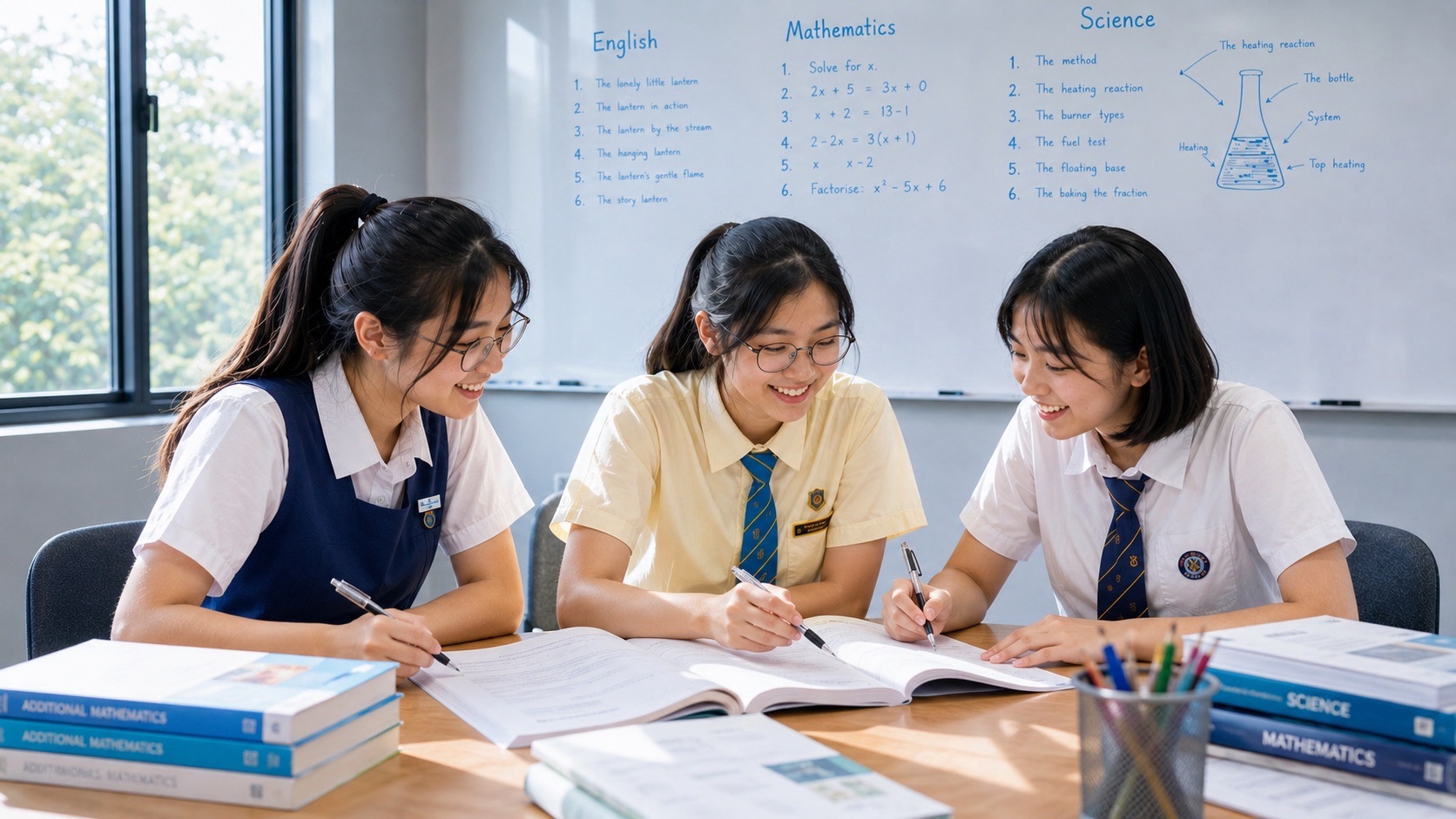
Why do students need background knowledge? Because almost every act of learning depends on what the learner already knows. Reading comprehension, problem-solving, vocabulary, inference, memory and even curiosity become easier when new information has somewhere sensible to attach. A student can read every word in a paragraph correctly and still understand very little if the topic, concepts and references are unfamiliar. Prior knowledge is not an optional extra placed around learning. It is part of the machinery that makes learning possible.
This is why background knowledge matters in school, examinations and everyday thinking. When students know the people, places, concepts, systems and vocabulary surrounding a topic, they can recognise patterns, fill reasonable gaps, interpret technical terms, judge what matters and remember more of what they read. When that knowledge is missing, the same text or lesson places far more pressure on working memory. The student is forced to decode the words, construct the context and understand the new idea at the same time.
The important conclusion is not that students should memorise endless disconnected facts. Background knowledge becomes powerful when facts are organised into usable networks. A learner who knows how rivers, erosion, sediment, rainfall and landforms connect is better prepared to understand a new article about deltas than a learner who has memorised five isolated definitions. Good education therefore builds knowledge deliberately: broad enough to open new doors, structured enough to support reasoning, and revisited often enough to remain available when the student needs it.
The short answer: new learning is built on old learning
Students need background knowledge because the brain does not process every new experience from zero. It interprets new information through existing mental structures. A familiar idea can be recognised quickly. An unfamiliar idea requires much more construction.
Background knowledge helps students:
- understand what a text is talking about;
- recognise the meaning of unfamiliar words from context;
- make inferences without guessing;
- connect causes and effects;
- notice when information is surprising or inconsistent;
- remember new material more efficiently;
- solve problems by identifying familiar structures;
- ask better questions;
- learn more quickly from explanations;
- transfer knowledge into new situations.
The more organised the existing knowledge, the more efficiently the learner can use it. This is one reason experienced readers, scientists, historians, musicians, programmers and mathematicians often seem to understand new material rapidly. They are not receiving less information. They are processing it through richer internal maps.
Background knowledge is more than knowing facts
A fact is a piece of information. Background knowledge is the larger network in which many pieces become meaningful.
Knowing that photosynthesis uses light is useful. Knowing that plants contain chlorophyll, absorb carbon dioxide, take in water, store chemical energy in sugars and release oxygen creates a system. That system helps a student understand later questions about plant growth, food chains, carbon cycles and ecosystems.
The difference matters because learning rarely asks us only to recall one sentence. Students must interpret diagrams, compare explanations, predict outcomes and connect ideas across chapters. That requires organised knowledge.
Strong background knowledge therefore includes several layers:
- facts: names, dates, terms, quantities and definitions;
- concepts: categories and big ideas;
- relationships: how ideas connect;
- procedures: how something is done;
- causal models: why something happens;
- examples: what the concept looks like in real cases;
- exceptions: where a simple rule stops working;
- language: the vocabulary used to express the domain.
A learner with only fragments may know several correct statements but still struggle to use them. A learner with a connected model can move through the subject more confidently because each new idea has multiple points of connection.
Why prior knowledge changes reading comprehension
Reading comprehension is often treated as if it were a single general skill. It is partly a set of reading skills, but it is also deeply dependent on knowledge.
Consider a short article about a parliamentary debate, a cricket match, a volcano, a computer processor or a classical myth. A fluent reader may pronounce every word accurately. Yet if the reader does not understand the underlying domain, many sentences remain thin or ambiguous.
Background knowledge helps the reader know what can be left unstated. Writers do not explain everything. They assume the reader can fill some gaps.
A sentence such as “the team declared before tea” is easy for someone who understands cricket and confusing for someone who interprets each word only through everyday meanings. The difficulty is not decoding. It is domain knowledge.
This is why reading ability can appear to change dramatically across topics. A student may comprehend a familiar sports article well and struggle with a passage about monetary policy, not because the student suddenly forgot how to read, but because the second passage demands unfamiliar concepts and vocabulary.
The hidden role of inference
Texts rarely state every connection explicitly. Readers have to infer.
If a story says that dark clouds gathered, people rushed to bring laundry indoors and the first drops struck the pavement, the reader easily infers that rain is beginning. That inference is possible because the reader already understands clouds, weather, laundry and rain.
More advanced texts require more advanced inference. A history passage may assume that the reader understands taxation, trade routes and political alliances. A science passage may assume familiarity with energy transfer. A mathematics question may assume an understanding of ratio before introducing a new application.
Without relevant knowledge, inference becomes guesswork. The student may search the text repeatedly for a sentence that is not there because the author expected the reader to connect the clues.
This is one reason “use context clues” is incomplete advice. Context clues work better when the student already knows enough about the context to interpret them.
Why vocabulary grows faster when knowledge grows
Vocabulary and background knowledge reinforce each other.
When students learn about a domain, they repeatedly encounter its words. A unit on ecosystems may naturally introduce habitat, population, producer, consumer, decomposition, biodiversity and adaptation. These words are easier to learn because they belong to a connected conceptual system.
The reverse is also true. Knowing the vocabulary of a domain makes it easier to acquire more knowledge because texts become more accessible.
This creates a compounding effect.
A student who knows more words can understand more texts. By understanding more texts, the student acquires more knowledge. With more knowledge, the student can infer more new vocabulary. The cycle continues.
A student with weak vocabulary and limited world knowledge can experience the opposite cycle. Reading is harder, so less is learned from reading. Because less is learned, later texts remain difficult.
This is why vocabulary teaching is strongest when it is connected to rich content rather than presented only as isolated weekly lists.
Background knowledge reduces pressure on working memory
Working memory is limited. It can hold and manipulate only a modest amount of unfamiliar information at one time.
Prior knowledge helps because familiar information can be grouped into larger meaningful units.
A chess expert looking at a realistic board position does not necessarily memorise thirty-two separate pieces as isolated objects. The expert recognises patterns, threats and structures. A beginner sees far more separate information.
The same principle applies in school.
A mathematics student who automatically recognises common fraction relationships has more mental capacity available for the algebraic structure of a problem. A science student who already understands cells can focus on the new mechanism being introduced. A history student who knows the broad sequence of events can concentrate on interpreting a source rather than reconstructing the entire timeline.
Knowledge creates compression.
It turns many separate details into meaningful chunks, freeing attention for higher-level reasoning.
Why experts seem to see more
Expertise changes perception.
A doctor, mechanic, musician, programmer or experienced teacher can notice features that a novice misses. The information was visible to both people, but the expert had categories for interpreting it.
In a mathematics solution, an experienced teacher may immediately recognise that a student’s error came from misunderstanding equivalence rather than from arithmetic. A novice may see only a wrong answer.
In a piece of writing, an experienced reader may notice that the problem is not grammar but weak logical progression. In a science experiment, an expert may see an uncontrolled variable that a beginner does not even know to look for.
Background knowledge directs attention.
It tells the learner what is likely to matter.
Why knowledge helps memory
New information is easier to remember when it connects to existing knowledge.
Imagine being given twenty unrelated words. Remembering them may be difficult. Now imagine that all twenty words belong to a familiar topic such as cooking. The words become easier to organise because they fit known categories: ingredients, tools, methods and outcomes.
Meaning supports memory.
This is why a student can sometimes remember a complicated explanation in a favourite subject while forgetting a short paragraph in an unfamiliar one. The first explanation had many attachment points.
Prior knowledge does not guarantee memory. Students still need retrieval, spacing and review. But knowledge makes encoding richer because the new idea can be connected to causes, examples, contrasts and earlier concepts.
Why facts are not the enemy of critical thinking
Education debates sometimes place factual knowledge and critical thinking on opposite sides.
That opposition is misleading.
Critical thinking requires something to think about. To compare claims, evaluate evidence or detect misinformation, a person needs relevant concepts and facts.
A student evaluating a claim about climate needs some understanding of atmosphere, greenhouse gases, measurement and variation. A student evaluating a historical argument needs chronology, source knowledge and context. A student assessing a financial claim needs to understand percentages, interest, inflation or risk.
Without background knowledge, a learner may know generic instructions such as “check the source” or “look for bias” but still be unable to judge whether the content is plausible.
Knowledge and thinking are partners.
Facts become useful when they support reasoning. Reasoning becomes stronger when it has accurate facts to work with.
Why Google does not remove the need to know things
Search engines make information easy to retrieve. AI systems can summarise, explain and generate material quickly. This changes how people work, but it does not remove the value of internal knowledge.
To search well, a person needs to know what to ask.
To judge an answer, a person needs enough knowledge to notice errors, missing context or implausible claims.
To connect ideas across sources, a person needs concepts in memory while reading.
External tools are strongest when they extend internal knowledge rather than replace it.
A person with no knowledge of a topic can retrieve information but may struggle to rank its importance. A knowledgeable person can ask narrower questions, verify more effectively and integrate the result into a broader model.
The internet made access easier. It did not make understanding automatic.
Why background knowledge matters in mathematics
Mathematics is often presented as a subject where pure reasoning matters more than knowledge. In reality, mathematical reasoning depends heavily on stored knowledge.
Students need number facts, definitions, properties, notational conventions, procedures and familiar structures.
Consider an algebra problem involving fractions. A student who has to reconstruct basic fraction operations while also manipulating algebraic expressions faces a double burden. The higher-level problem feels much harder because the prerequisite knowledge is unstable.
Likewise, a student may know the formula for area but fail to recognise that a complicated shape can be decomposed into familiar parts. Recognition depends on a library of known examples.
Mathematical creativity is not thinking without knowledge. It is recombining well-understood knowledge in new ways.
Why background knowledge matters in science
Science is cumulative.
New explanations often depend on earlier models.
A student studying respiration benefits from understanding cells, gases, diffusion, energy and chemical reactions. A learner studying electricity needs concepts such as charge, current, potential difference, resistance and circuits.
If those foundations are weak, advanced topics can become lists of sentences to memorise rather than systems to understand.
Background knowledge also helps students interpret experiments. A graph is not meaningful by itself. The learner needs enough conceptual knowledge to know which variables should relate, what a plausible trend looks like and what alternative explanations might exist.
Science education works best when facts, models and evidence are repeatedly connected.
Why background knowledge matters in history and society
Historical texts are dense with assumed context.
A source may mention a treaty, empire, religious movement, economic crisis or political institution without explaining it fully. Students who know the surrounding history can interpret what the source implies.
Chronology also matters. Events have different meanings depending on what came before and what people at the time could reasonably know.
Without background knowledge, students can commit hindsight errors. They judge earlier decisions using information that only became available later.
Social understanding works similarly. Concepts such as markets, institutions, law, culture, migration, inequality and governance are easier to reason about when students know concrete cases.
Abstract discussion becomes stronger when grounded in examples.
Why background knowledge matters in writing
Students cannot write deeply about what they barely know.
A writer needs content to select, organise and explain.
This is why a student may produce fluent but shallow writing on an unfamiliar topic. The sentences are grammatically correct, but the ideas remain generic because the writer has few details, examples, mechanisms or distinctions available.
Background knowledge gives writing substance.
It enables the student to:
- choose precise examples;
- explain causes rather than merely state opinions;
- anticipate counterarguments;
- use accurate domain vocabulary;
- compare cases;
- avoid vague generalisations;
- develop paragraphs with evidence.
Writing instruction therefore cannot be separated completely from knowledge building. Students need both composition techniques and something worth saying.
The knowledge gap can look like an ability gap
One of the most important educational consequences of background knowledge is that differences in knowledge can be mistaken for fixed differences in intelligence.
A student who knows a topic can appear faster, more articulate and more analytical.
Another student may appear hesitant simply because every term is unfamiliar.
This does not mean all performance differences are caused by knowledge. But it means teachers should ask what prerequisite knowledge the task assumes before concluding that a learner “cannot think.”
Sometimes the most effective intervention is not another generic reasoning exercise. It is to teach the missing domain knowledge explicitly.
Why some students learn more from the same lesson
Two students can sit in the same classroom, hear the same explanation and leave with different amounts of learning.
Prior knowledge is one reason.
The student with a stronger foundation recognises more references, asks more precise questions and integrates the explanation with existing ideas. The student with weaker background knowledge must first understand the vocabulary and reconstruct earlier concepts.
This can create a compounding advantage sometimes described informally as knowledge begetting knowledge.
The solution is not to slow all learning indefinitely. It is to design instruction that gives students the prerequisite knowledge needed to access the next layer.
Good teaching makes hidden prerequisites visible.
Why broad knowledge matters as well as specialised knowledge
Specialised knowledge gives depth. Broad knowledge gives reach.
Students encounter texts and conversations that cross domains. An article about renewable energy may involve physics, economics, geography and public policy. A story may contain historical references. A science question may depend on interpreting a graph. A mathematics problem may use a financial context.
Broad general knowledge helps learners enter unfamiliar territory.
It also supports analogies. A student who understands feedback loops in one system may recognise a similar pattern elsewhere. A learner who knows several historical examples can compare institutions rather than treating each case as isolated.
Education should therefore not force a false choice between breadth and depth. Learners need broad foundations and opportunities to build deep expertise.
Why knowledge should be sequenced
Knowledge is easier to learn when teaching follows a coherent sequence.
A curriculum should not be a random collection of interesting activities. Each stage should prepare students for what comes next.
In mathematics, whole-number relationships support fractions, which support ratio, algebra and proportional reasoning.
In science, particles support chemical reactions; cells support body systems; forces support mechanics.
In history, chronology and geography help later interpretation.
Sequencing reduces unnecessary difficulty because students meet new material with the right prerequisites already available.
This does not require teaching everything in a rigid line. Learning can revisit ideas at increasing depth. The important point is that later complexity should grow from earlier foundations rather than assume them magically.
Why retrieval matters after knowledge is taught
Background knowledge only helps if it can be accessed.
A student may once have learned a topic but be unable to retrieve it when reading a later text. This creates the appearance that the topic was never taught.
Retrieval practice helps keep important knowledge available.
Useful classroom routines include:
- short cumulative quizzes;
- low-stakes recall at the start of lessons;
- asking students to explain earlier ideas from memory;
- mixing old and new questions;
- revisiting vocabulary in new contexts;
- using concept maps from memory before checking notes;
- returning to key examples weeks later.
The aim is not endless testing. It is maintenance.
If important knowledge disappears as soon as a unit ends, it cannot support future learning.
Why knowledge should be connected, not merely accumulated
A student can know many isolated facts and still struggle to reason.
The goal is to build networks.
Teachers can strengthen connections by asking:
- How is this similar to what we learned before?
- What changed?
- What caused this?
- What would happen if one condition were removed?
- Which example does not fit the rule?
- Where else does this pattern appear?
- What earlier concept does this new term depend on?
These questions turn memory into structure.
A connected knowledge base is more flexible because the learner has several routes to retrieve an idea.
Why examples matter
Definitions are useful, but examples make concepts concrete.
A student who learns the definition of a monopoly benefits from seeing several real and hypothetical market structures. A learner studying adaptation benefits from examining different organisms and environments. A student learning irony benefits from encountering it in several texts.
Examples reveal what stays the same when surface details change.
They also help students learn category boundaries.
Without varied examples, students may attach a concept too narrowly to the first case they saw. They can recite the definition but fail to recognise the idea elsewhere.
Rich background knowledge therefore contains both rules and cases.
Why misconceptions count as background knowledge too
Prior knowledge is not always correct.
Students arrive with intuitive models formed from everyday experience. Some are useful. Others conflict with scientific, mathematical or historical explanations.
A learner may believe heavier objects always fall faster, that seasons are caused by Earth being closer to the Sun, or that an equals sign simply means “write the answer next.”
These ideas shape how new teaching is interpreted.
Good instruction therefore activates prior knowledge but also checks it.
Teachers can ask students to predict, explain or draw a model before instruction. This reveals the mental structure already present.
Learning sometimes means adding knowledge. At other times, it means reorganising or replacing an existing model.
Why students should read widely
Wide reading is one of the most powerful long-term ways to build background knowledge.
Books, essays, quality journalism, biographies, science writing, history, geography, literature and carefully chosen reference material expose students to worlds beyond their immediate experience.
Reading widely also creates repeated encounters with important concepts.
A child may first meet the idea of migration in a story, later in geography, then in history, then in a news article. Each encounter adds detail and makes the concept more flexible.
The effect is cumulative and difficult to compress into a last-minute revision programme.
This is why general reading should not be seen only as entertainment or language practice. It is knowledge construction.
Why conversation and experience also matter
Students learn from more than books.
Conversations, museums, travel, documentaries, hobbies, games, household tasks, nature, community events and practical projects all build knowledge.
A child who cooks learns measurement, heat, texture, sequence and materials. A child who gardens encounters soil, insects, growth, weather and time. A student who builds a computer gains practical understanding of components and interfaces.
These experiences provide concrete reference points.
Later, when abstract ideas appear in school, the learner has something real to connect them to.
Why unequal access to knowledge matters
Students do not enter school with identical background knowledge.
Families differ in language exposure, books, travel, conversation, hobbies, cultural experiences and access to resources. Communities differ too.
Schools cannot assume every child already knows the context required by a lesson.
This is an important equity issue.
If teaching constantly relies on knowledge that some students were expected to acquire elsewhere, existing differences can widen.
A strong curriculum therefore brings valuable knowledge into the classroom deliberately. It does not lower expectations. It expands access to the knowledge that makes high expectations reachable.
How teachers can build background knowledge before a difficult text
Pre-teaching does not mean explaining every sentence before students read it.
The goal is to remove unnecessary barriers while preserving the intellectual work of reading.
A teacher might:
- teach a small set of essential terms;
- show a map, diagram or timeline;
- give a short factual overview;
- connect the topic to earlier learning;
- explain one unfamiliar institution or process;
- ask students what they already know;
- correct major misconceptions;
- provide a purpose for reading.
This preparation can make a challenging text accessible without making it easy.
The student still has to interpret, infer and reason. The difference is that the basic context no longer consumes all available attention.
How students can deliberately build background knowledge
Students do not have to wait passively for knowledge to accumulate.
A practical method is to build a small knowledge frame before starting a difficult topic.
Step 1: identify the domain
Ask what the topic is really about. Is it genetics, banking, electricity, colonial history, probability, ecosystems or something else?
Step 2: learn the essential vocabulary
Choose the small set of terms that appear repeatedly and define the system.
Step 3: learn the big relationships
What causes what? What are the main parts? What is the sequence? Which quantities depend on each other?
Step 4: collect a few examples
Examples make abstract ideas easier to recognise later.
Step 5: retrieve the frame from memory
Close the book and explain the topic aloud or on paper. Retrieval reveals what is actually available.
What background knowledge should not become
The idea can be misused if it becomes an excuse for endless fact memorisation.
Students do not need to memorise every possible detail before they are allowed to think.
Knowledge building should remain purposeful.
Good selection asks:
- Will this knowledge unlock many later ideas?
- Does it help explain a system?
- Will students encounter it repeatedly?
- Does it support reading or problem-solving?
- Can it connect to important questions?
- Is it better learned as a concept than as an isolated fact?
The goal is not trivia accumulation.
The goal is intellectual infrastructure.
Common questions about background knowledge
Is background knowledge the same as prior knowledge?
The terms overlap. Prior knowledge usually means what a learner already knows before a new task. Background knowledge often refers to the broader factual and conceptual context that helps the learner understand that task.
Can a student be a strong reader without broad knowledge?
A student can have strong decoding and general comprehension strategies, but understanding still depends on topic knowledge. Broad knowledge makes strong reading more transferable across domains.
Should students memorise facts?
Some facts deserve secure memory because they support many later ideas. The key is to organise them within concepts and use them in explanation, reasoning and application.
Does background knowledge help weak readers?
It can make texts more comprehensible, but it does not replace instruction in decoding, fluency or language where those skills are weak. Reading development requires both language skills and knowledge.
How quickly can background knowledge be built?
Some useful context can be built in minutes before a lesson. Deep, flexible knowledge grows over months and years through repeated study, reading, discussion and experience.
Is general knowledge still important in the age of AI?
Yes. AI can retrieve or generate information, but users still need knowledge to ask precise questions, detect errors, compare claims and integrate answers into a coherent understanding.
The deeper answer: knowledge changes what the learner can see
The deepest reason students need background knowledge is that knowledge changes perception.
It changes what a sentence means.
It changes which details stand out.
It changes which questions can be asked.
It changes how much working memory is available for a new problem.
It changes how easily new information can be remembered.
And it changes how confidently a learner can move from one idea to another.
A student with strong background knowledge does not merely possess more answers. The student has more ways to make sense of unfamiliar questions.
That is why good education builds knowledge patiently and cumulatively. It teaches important facts, but it also connects them. It revisits them. It gives students examples. It asks them to explain. It exposes them to wide reading and real-world experience. It ensures that essential ideas remain retrievable long after the original lesson.
Background knowledge is not the opposite of creativity, critical thinking or problem-solving.
It is part of the foundation beneath all three.
Why background knowledge becomes especially important in examinations
Examinations compress several demands into a short period. Students must understand the question, recognise the relevant concept, retrieve supporting knowledge, select a method and produce an answer under time pressure. Background knowledge shortens several of those steps.
A well-prepared student does not have to rediscover the entire topic while reading the question. Familiar terminology activates an existing model. The learner can move quickly from recognition to application. This is one reason secure knowledge often looks like speed. The student is not necessarily thinking less carefully. The student is spending less time rebuilding foundations.
This also explains why last-minute memorisation can produce fragile exam performance. A fact remembered in isolation may disappear when the question changes its wording or combines two topics. A connected knowledge network is more resilient because there are several routes into the same idea.
In comprehension, background knowledge helps the student interpret implied meaning. In mathematics, it helps with method selection. In science, it helps distinguish evidence from explanation. In humanities subjects, it provides context for evaluation. In writing, it supplies examples and mechanisms. Examinations differ, but the advantage is the same: knowledge reduces the number of things that must be invented on the spot.
Why knowledge improves the quality of questions students ask
Beginners often ask broad questions because they do not yet know the structure of the subject. “I don’t understand electricity” may be the most precise question available to a learner who cannot distinguish current, voltage, resistance and power.
As knowledge grows, questions become sharper. The student can ask whether increasing resistance changes current when voltage is held constant, why a parallel circuit behaves differently from a series circuit, or what a particular graph implies. The learner has gained not only answers but a vocabulary for locating uncertainty.
This matters far beyond school. Skilled professionals often solve problems by asking better questions. Their expertise lets them divide a vague problem into meaningful parts. Background knowledge creates that ability because the person knows which distinctions matter.
Why knowledge supports curiosity rather than replacing it
Curiosity is sometimes imagined as a completely spontaneous trait: either a child is curious or is not. In practice, knowledge can create curiosity.
A person is more likely to ask an interesting question when enough of the topic is familiar to reveal a gap. Someone who knows nothing about astronomy may look at the night sky and see stars. Someone who knows that stars have different temperatures, masses and life cycles can wonder why one star becomes a white dwarf while another ends in a supernova.
Knowledge makes the unknown visible.
This is why teaching rich content can stimulate inquiry. Students do not need to choose between being told things and discovering things. Direct instruction can supply the concepts that make later exploration more intelligent.
Why analogies work better when students know both sides
Teachers frequently use analogies: electric current is compared with flowing water, the cell membrane with a controlled boundary, an equation with a balance, memory with a network, or a computer processor with a coordinated workplace.
An analogy is useful only if the learner understands the familiar side well enough to map it onto the new side. If both domains are unfamiliar, the comparison adds another layer of confusion.
Background knowledge therefore makes analogy a powerful learning tool. It provides stable reference structures. It also helps students notice where the analogy breaks. Water flow can illuminate some features of electricity, but electrons and water are not identical systems. A knowledgeable learner can use the comparison without mistaking it for a complete explanation.
Why knowledge helps students detect nonsense
One practical benefit of knowledge is the ability to notice when something does not fit.
A student who knows roughly how large Earth is will question a claim that a country is ten million kilometres wide. A learner who understands percentages may notice that a supposed discount is mathematically impossible. A student who knows the sequence of a historical conflict can recognise a date placed in the wrong century.
This is not perfect fact-checking. Experts can be fooled and novices can be sceptical. But knowledge creates plausibility checks.
In an environment full of search results, social media posts, generated text and confident claims, those checks are increasingly valuable. Verification begins with the ability to notice that verification may be needed.
Why teachers should distinguish missing knowledge from weak effort
A student staring at a page may look unmotivated when the deeper problem is that the task contains too many unknowns. If every sentence includes unfamiliar vocabulary and every question depends on concepts the student has not secured, simply demanding more concentration may not solve the problem.
Diagnosis matters.
A useful teacher asks: What does this task assume the student already knows? Which of those prerequisites are missing? Is the student struggling with the new idea, or with an older idea hidden inside it?
That question changes intervention. A learner who lacks multiplication fluency may need a different repair from a learner who misunderstands algebraic notation. A reader who cannot decode words needs different support from a fluent reader who lacks topic knowledge.
Effort matters, but effort works best when directed at the real bottleneck.
Why parents can build knowledge without turning home into school
Families can support background knowledge in ordinary ways. The goal is not to reproduce a classroom every evening.
Conversation is powerful. Adults can explain how a bill works, why a bridge uses certain shapes, what a news map shows, how a recipe changes when quantities double, why a plant bends toward light, or where a family story fits into a wider historical period.
Shared reading helps. So do documentaries, museums, walks, cooking, fixing things, maps, public transport, travel planning and hobbies. The important feature is not expense. It is attention to the world.
Parents can also ask children to explain what they learned. Explanation strengthens retrieval and reveals gaps without requiring a formal test.
A home that treats questions seriously can become a knowledge-rich environment without becoming an exam centre.
Why teachers should revisit old knowledge inside new topics
Students often experience subjects as separate chapters: learn one unit, sit the test, move on. Real knowledge does not work that way.
Later learning should reactivate earlier ideas. A new science topic can ask students to retrieve particle theory. A new mathematics unit can reuse ratio. A literature lesson can revisit historical context. A geography topic can return to earlier ideas about climate and water.
This repeated use strengthens memory and shows students that knowledge is a connected system rather than a pile of expired chapters.
It also improves transfer. Students learn that an idea can appear in more than one setting. The concept becomes portable.
A practical background-knowledge routine for any new topic
Before beginning a demanding unit, students can use a simple six-part routine.
- Locate it: identify where the topic sits in the larger subject.
- Name it: learn the small set of essential terms.
- Map it: identify the main parts and relationships.
- Example it: collect two or three concrete cases.
- Connect it: link the topic to earlier learning.
- Retrieve it: explain the map without looking.
This routine is deliberately compact. Background knowledge should make the next stage easier, not become an endless preparation phase that prevents the learner from starting.
The student can then read the textbook, listen to the lesson or attempt the problems with a clearer mental framework. New details have a place to go.
How to know whether background knowledge is becoming usable
Knowledge is useful when it changes performance.
A student should gradually be able to:
- explain the topic without copying notes;
- recognise the concept in an unfamiliar example;
- use the vocabulary accurately;
- connect new information to earlier ideas;
- notice when a claim contradicts the model;
- ask more precise questions;
- remember the main structure after time has passed;
- apply the knowledge in writing or problem-solving.
If the learner can only recite a definition, the knowledge may still be too narrow. If the learner can explain, compare, predict and apply, the knowledge has become more flexible.
The long-term payoff: each new thing becomes easier to learn
The greatest benefit of background knowledge is cumulative.
Learning one topic well does more than produce one successful test result. It increases the learner’s capacity to understand related topics later. Knowledge about fractions supports percentages. Knowledge about energy supports ecosystems. Knowledge about geography supports history. Knowledge about language supports reading across every subject.
Over years, these connections form an increasingly dense network.
That network is one reason education can accelerate. A knowledgeable student encounters a new idea and immediately finds several hooks for it. The learner can compare, question and remember more quickly because the mind is not empty space waiting to be filled. It is an organised structure ready to be extended.
This is the practical answer to why students need background knowledge. Knowledge is not merely content that schools ask students to store. It is the infrastructure that allows future learning to move faster, reach deeper and survive beyond the lesson in which it first appeared.