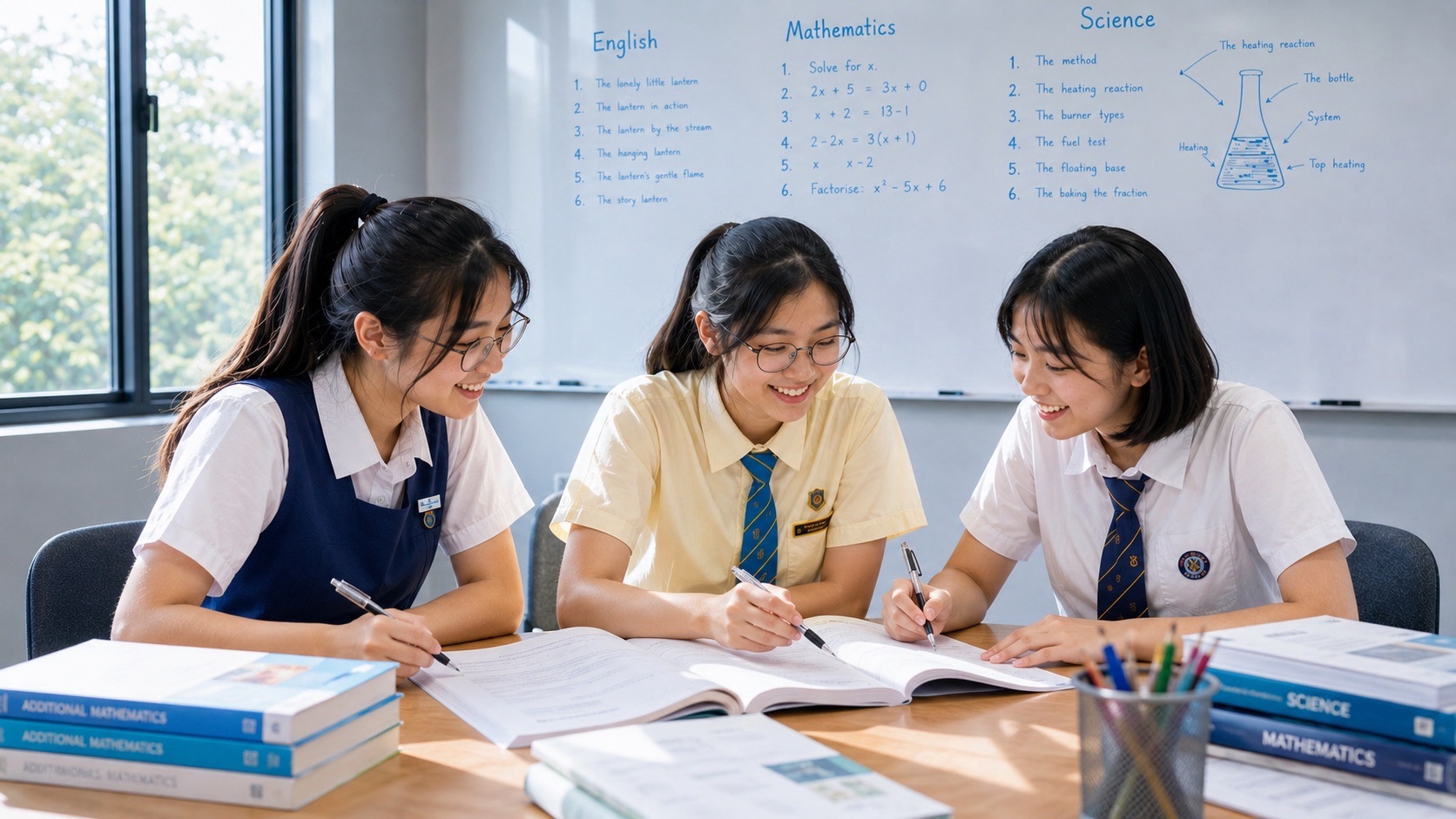
Homework is one of the most familiar parts of school and one of the least carefully defined. Students carry it home, parents organise evenings around it, teachers spend time setting and marking it, and schools often debate how much is enough. So why do schools give homework at all? The useful answer is not simply “to practise” or “because learning must continue after class.” Homework can serve several different purposes, and it only earns its place when the task is matched to one of those purposes.
At its best, homework helps a learner retrieve something that was taught, practise a skill until it becomes easier to use, prepare for a coming lesson, apply an idea in a new setting, notice what is still unclear, or learn how to manage work without a teacher standing nearby. Those functions matter because learning is not completed at the instant something is explained. Understanding has to survive time, distraction and changes in context. A student who can follow an example in class but cannot reconstruct the method later does not yet own the learning.
At its worst, homework is merely more work. It can become repetitive, excessively long, poorly timed, badly explained, impossible without adult help, or disconnected from what students have actually learned. The important question is therefore not whether homework is always good or always bad. It is why a particular task exists, what learning mechanism it is supposed to activate, and whether the cost in time and attention is justified by the benefit.
The short answer: schools give homework to extend learning beyond the lesson
A classroom lesson has limited time. Even excellent teaching cannot make every new idea durable in one sitting. Students need later opportunities to bring information back from memory, use procedures again, connect ideas, and discover whether they can work independently.
Good homework commonly has one or more of these aims:
- strengthen recall through retrieval;
- build fluency through carefully chosen practice;
- spread learning across time instead of concentrating it in one lesson;
- reveal misconceptions before they become permanent;
- prepare background knowledge for a future lesson;
- ask students to apply a concept in a new situation;
- develop planning, persistence and independent work habits;
- create evidence that helps a teacher decide what to reteach;
- give students time for reading, drafting or problem-solving that cannot fit comfortably inside class.
These are different jobs. A ten-minute retrieval task is not the same kind of homework as a research project. A set of arithmetic questions designed to build automaticity is not the same as a reflective reading response. Treating every assignment as if it has the same purpose creates confusion.
The most important principle is simple: homework should have a reason that can be stated clearly.
Homework exists because learning needs more than exposure
Seeing an idea once is not the same as learning it. A student may understand a teacher’s explanation while it is happening because the example, prompts and surrounding context make the reasoning easy to follow. Later, when those supports are gone, the student may discover that the knowledge cannot yet be retrieved or used.
This gap between recognition and independent recall is one reason homework exists.
Suppose a class learns how to solve a linear equation. During the lesson, the teacher models each step. Students then complete two examples with guidance. Many will feel that the method is clear. The following evening, however, a short homework set asks them to solve similar equations without the teacher’s cues. Some students reconstruct the process successfully. Others discover that they cannot remember when to change signs, how to handle brackets, or why the same operation must be applied to both sides.
That discovery is useful. It tells the learner and the teacher where the learning is not yet stable.
The same pattern appears in languages, science, history and almost every other subject. A student may recognise a vocabulary word while reading but fail to produce it while writing. A science explanation may make sense in a diagram but become difficult when the variables change. A historical argument may sound persuasive in class but be hard to reconstruct from evidence later.
Homework creates a second encounter with the idea under different conditions. That second encounter is valuable precisely because it is not identical to the first.
Why retrieval matters
One of the strongest reasons for giving some forms of homework is retrieval. Retrieval means trying to bring information back from memory rather than simply looking at it again.
Reading notes can create familiarity. Familiarity feels fluent because the words are visible. Retrieval is more demanding. The student must produce the answer, explanation, formula, definition or method without having it directly in front of them.
That effort can strengthen learning when the material is at an appropriate level.
A short homework task might therefore ask students to:
- recall key terms from a lesson;
- answer a few questions without notes;
- explain a process from memory;
- reconstruct a diagram;
- solve one problem using a recently taught method;
- write what they remember before checking the textbook.
The point is not to make students struggle for its own sake. The point is to make memory do the work that future learning will require.
If a student always studies with the answer visible, the student can become skilled at recognising information without becoming skilled at producing it. Homework can interrupt that illusion by asking, “What can you do now, on your own?”
Why practice matters, but not all practice is equal
Another reason schools give homework is to increase practice. Certain skills become easier when they are used repeatedly with feedback. Reading fluency, spelling patterns, number facts, algebraic manipulation, musical technique, sentence construction and many other skills benefit from repeated correct performance.
But repetition alone is not enough.
Practice is useful when it is:
- connected to a clear skill;
- short enough that attention remains reasonably high;
- difficult enough to require thought;
- not so difficult that students practise errors;
- varied enough to prevent mindless pattern matching;
- checked soon enough that misconceptions can be corrected;
- gradually made more independent.
Twenty carefully selected questions can be more useful than sixty nearly identical ones. Five minutes of deliberate vocabulary retrieval can be more useful than copying definitions three times. One well-designed extended problem can reveal more about mathematical understanding than a page of routine substitutions.
This is why the phrase “more practice” can be misleading. Schools do not need homework because quantity is automatically beneficial. They need well-designed opportunities for the learner to perform the thinking again.
Fluency frees attention
Practice also matters because some processes should eventually require less conscious effort.
When a learner must think intensely about every low-level step, there is less mental capacity available for a more complex task. A writer who is still struggling with basic sentence boundaries has less attention available for argument structure. A mathematics student who cannot reliably manipulate simple fractions may be overwhelmed by an algebra problem that uses fractions inside a larger chain of reasoning.
Homework can help make foundational processes more fluent.
Fluency does not mean thoughtlessness. It means that basic operations become stable enough that attention can move to the harder part of the problem.
Homework spreads learning across time
Learning is usually stronger when practice is distributed rather than compressed into one long session. This is another reason homework can be useful.
Imagine two students who each spend forty minutes reviewing a topic. One studies for forty minutes immediately after the lesson and never returns to it. The other studies for ten minutes on four different days. The total time is identical, but the second pattern repeatedly requires the brain to reconstruct the learning after some forgetting has occurred.
That reconstruction can make memory more durable.
Homework naturally creates spacing because it moves some learning away from the original lesson. A small task tonight, another brief retrieval later in the week, and a mixed review the following week can create several contacts with the same idea.
The spacing has to be planned. If every homework task only covers today’s material, older knowledge can still disappear. Strong homework systems often mix recent content with selected earlier content so students must distinguish between methods rather than merely repeat the latest procedure.
This is particularly important in cumulative subjects. Mathematics, languages and sciences often depend on earlier knowledge. Forgetting a prerequisite can make a later topic appear far more difficult than it really is.
Homework can reveal the difference between supported and independent performance
In class, students receive many forms of support that they may not notice.
The teacher chooses the examples. A peer asks a useful question. The board displays the key formula. A worksheet places similar questions together. The teacher gives a hint when the class hesitates. The lesson itself signals which method is relevant.
At home, some of those supports disappear.
That change can reveal whether the student has actually learned to select and use the method independently.
This is not a reason to abandon students. Homework should not become a nightly test of survival. It is a reason to recognise that independent performance is a different stage of learning.
A student who can complete a task only while receiving prompts is still progressing, but has not yet reached the same level as a student who can begin, persist, check and finish without those prompts.
Well-designed homework lets teachers see that distinction.
Homework can provide feedback to the teacher
Homework is often described as work for the student, but it can also be information for the teacher.
A good assignment produces evidence.
If half a class makes the same error, the problem may not be individual carelessness. It may show that a concept was misunderstood or that an explanation needs to be taught differently. If students can answer routine questions but fail on a transfer problem, the teacher learns that procedural fluency is ahead of conceptual flexibility. If students omit the same part of a written response, the marking criteria may need to be made more explicit.
This only works when the homework is reviewed intelligently.
If a teacher merely records whether it was completed, much of the diagnostic value is lost. Completion tells us that something was submitted. It does not necessarily tell us what students understand.
More useful questions include:
- Which errors are common?
- Which questions took too long?
- Where did students stop?
- Which answers were correct for the wrong reason?
- Which students need reteaching?
- Which students are ready to extend the idea?
- Did the assignment itself create confusion?
Homework becomes part of teaching when its evidence changes what happens next.
Why schools use homework for preparation
Not all homework looks backwards.
Some assignments prepare students for a future lesson. A teacher may ask students to read a short text, watch a demonstration, learn a few essential terms, gather data, bring an example from everyday life, or answer a prediction question before class.
Preparation can make classroom time more productive because students arrive with some initial knowledge.
However, preparatory homework has a design challenge: it cannot assume that every student will understand new content perfectly without instruction. If the pre-class task contains the hardest conceptual work, students who need teaching most may arrive already confused.
Good preparation usually gives students access to manageable background material and reserves the most demanding reasoning for the classroom, where questions can be answered.
Preparation is useful when it lowers the entry barrier to the next lesson rather than outsourcing the lesson itself.
Homework can create time for slow thinking
Classrooms move on a schedule. Some tasks benefit from more time than a lesson can provide.
Reading a chapter carefully, drafting an essay, revising a paragraph, completing a design, collecting observations, conducting safe household measurements, practising an instrument, or solving a complex problem may require sustained attention that does not fit neatly into a forty- or sixty-minute period.
Homework can create space for that slower work.
This is different from routine practice. The value lies not in repetition but in duration and reflection.
A student writing an essay may need time to:
- decide what the question is really asking;
- gather evidence;
- form a position;
- plan the sequence;
- draft;
- notice weaknesses;
- revise for clarity;
- edit language.
Compressing all of that into a single lesson may encourage speed rather than quality.
When homework provides time for meaningful extended work, its purpose should be visible. Students should know whether they are expected to explore, draft, revise, practise or finish.
Homework can help students learn to manage themselves
Schools do not only teach subject content. Students also have to learn how to organise work.
Homework can create opportunities to practise planning, starting, sustaining attention, estimating time, preparing materials, meeting deadlines and recovering after distraction.
These are not automatic skills.
A student can understand mathematics and still lose marks because assignments are forgotten. Another can read well but postpone every long-term task until the final evening. Another may spend far too long trying to make the first answer perfect and then rush the rest.
Homework makes these patterns visible.
However, independence should be developed gradually. Giving a young learner a large, open-ended assignment and calling it “responsibility” does not automatically teach responsibility. Students often need explicit structures: a checklist, intermediate deadlines, examples of how to break a project into stages, guidance on how long a task should take, and permission to stop when the agreed time has been reached.
Independence grows through supported practice, not abandonment.
Why homework can become ineffective
Homework has legitimate purposes, but it can fail in predictable ways.
Too much work
When the volume is excessive, the assignment may consume time needed for sleep, family life, exercise, reading, hobbies or recovery. Longer is not automatically better. Beyond a point, tired students work more slowly, make more errors and retain less.
Work that was never taught
Practice should normally follow enough instruction for students to understand what they are practising. If a learner has no entry point, homework can become a test of access to parents, tutors, answer sites or private help.
Repetition without thought
Copying large quantities of material may create the appearance of diligence while producing little learning. Repetition is most useful when the learner must retrieve, decide, apply or check.
Tasks without feedback
If misconceptions are never corrected, students can rehearse them. A homework system needs some route back into feedback: teacher review, self-checking with explanation, peer discussion, model comparison, or targeted correction.
Unclear instructions
Ambiguous tasks waste time. Students should know what to do, what a finished response should look like, which resources are allowed, and approximately how long the task is expected to take.
Assignments that assume unequal resources
A project that quietly requires printers, specialist materials, reliable internet, a quiet room, adult assistance or paid software can turn resource differences into academic differences.
Homework used as punishment
When extra academic work is used primarily as a penalty, students can learn to associate practice with wrongdoing. Consequences for behaviour and learning tasks serve different purposes and are usually clearer when kept separate.
The amount of homework matters less than the learning value per minute
People often ask, “How much homework should students get?”
There is no single number that fits every age, subject, school system and learner. A useful way to think about the question is not only in minutes but in learning value per minute.
Ten focused minutes that successfully retrieve important knowledge may be highly productive. Forty minutes spent copying, searching for unclear instructions or repeating mastered work may have little value.
The right amount depends on factors such as:
- the learner’s age and developmental stage;
- the difficulty of the task;
- how much support is required;
- whether the task replaces or adds to class practice;
- how many subjects are assigning work on the same day;
- the student’s reading and processing speed;
- the need for sleep and recovery;
- whether the work is routine practice or a long-term project.
Schools therefore need coordination as well as individual subject planning. Each teacher can set a reasonable assignment, yet the combined load across several subjects can still become unreasonable.
The relevant unit is the student’s whole evening, not one teacher’s worksheet.
Why homework changes with age
The purpose and design of homework should evolve as students grow.
For younger children, short tasks may focus on reading, basic fluency, family conversation, observation and routines. The aim is often to create positive habits without turning the home into a second classroom.
As students become older, assignments can become more independent and more complex. Secondary students may need extended reading, multi-step problem-solving, revision planning and project work. Older learners also need practice managing competing deadlines.
The shift should not simply be “older students get more.”
It should be “older students take on more sophisticated forms of independent learning.”
A twenty-minute task that requires an older student to compare sources, evaluate evidence and formulate a response may be more educationally demanding than an hour of repetitive exercises.
Why homework should not require a parent to become the teacher
Families often want to help, but homework is usually most informative when it shows what the student can do.
If an adult explains every difficult step, rewrites sentences, corrects all errors before submission or manages the entire project, the finished work may look stronger while providing less information about the learner.
A healthier role for parents and caregivers is often to support conditions rather than supply answers.
Useful support can include:
- helping establish a regular work time;
- providing a reasonably quiet place where possible;
- asking the child to explain the task;
- encouraging a short break after sustained effort;
- helping the child locate instructions;
- reminding the child to check completed work;
- writing a note when a task was genuinely impossible or excessively long.
The parent can ask, “What have you tried?” or “Show me where you became stuck.”
That keeps the thinking with the learner.
If homework consistently requires adult reteaching, the problem should return to the school. The assignment may be too difficult, earlier knowledge may be missing, or the student may need additional instruction.
Why “productive struggle” is useful only within limits
Some homework should feel effortful. Learning often requires students to think beyond immediate comfort.
But difficulty is not automatically productive.
A useful struggle occurs when the learner has enough knowledge to make progress, can test ideas, receives feedback, and has a realistic chance of success. Unproductive struggle occurs when the learner does not know what the task means, lacks required prerequisite knowledge, or repeats failed attempts without new information.
This distinction matters because adults sometimes praise perseverance without examining the task.
If a student spends an hour on work intended to take fifteen minutes, the answer is not always “try harder.” The mismatch itself is evidence.
The student may need:
- a missing concept retaught;
- a worked example;
- a smaller first step;
- clearer instructions;
- fewer questions;
- more time in class;
- a conversation with the teacher.
Good homework stretches learning. It should not routinely overwhelm it.
Why homework can support transfer
A powerful sign of learning is the ability to use knowledge in a new situation.
Homework can support this when it changes the surface features of a task.
For example, after learning percentage increase in class, students might compare two discounts, interpret a price change, or explain why two successive percentage changes do not cancel each other perfectly. After learning a scientific principle, they might predict what would happen in a household example. After studying persuasive techniques, they might analyse an advertisement they encounter outside school.
These tasks ask more than repetition.
They ask students to recognise when an idea applies.
Transfer is difficult because real situations do not arrive labelled by chapter. A problem does not announce, “Use the method from Tuesday.”
Good homework can gradually remove those labels.
It can mix question types, vary contexts, and ask students to explain why a method fits.
Why homework can make misconceptions visible
Wrong answers are not all the same.
One error may come from forgetting a fact. Another may come from a stable misconception. Another may be a reading mistake. Another may be caused by rushing. Another may arise because the student knows the rule but not when to use it.
Homework gives teachers material for distinguishing these possibilities.
Consider a science question about evaporation. If a student repeatedly writes that water must boil before it can evaporate, that is not random carelessness. It reveals a conceptual model that needs correction.
In mathematics, if a student repeatedly treats the equals sign as a command to calculate rather than a statement of equivalence, several later topics may be affected.
In language work, a student who can identify a grammar structure but cannot use it in original writing may need application rather than more identification exercises.
The value of the homework lies in what the error tells us.
Why checking homework matters
If homework is part of learning, checking cannot be an afterthought.
Checking does not always require a teacher to mark every line. Different tasks can use different feedback systems.
A short factual quiz may be self-checked, provided students are expected to correct errors and explain them. A mathematics set may be reviewed by looking at selected questions where common mistakes are likely. A draft may receive feedback on one or two high-value features rather than every sentence. A teacher may begin the next lesson by discussing patterns found across the class.
Effective checking answers two questions:
1. What did the student learn from doing the task? 2. What should happen because of the evidence the task produced?
When neither question is answered, homework can become ceremonial: work is assigned because homework is expected, completed because completion is expected, and then forgotten.
That is not a learning system.
Homework and motivation
Homework affects motivation because it occupies a part of life that students often perceive as their own time.
Students are more likely to engage seriously when they can see the purpose, estimate the workload, understand the standard and experience a reasonable chance of success.
Motivation is weakened when tasks feel endless, arbitrary or impossible.
Choice can sometimes help. A teacher might allow students to select one of several examples, choose the context for an application task, or decide the order in which components are completed. Choice does not remove rigour. It can increase ownership.
Visible progress also matters.
A student who can see that a five-minute retrieval routine has made key vocabulary easier to recall may understand why the routine is worth doing. A learner who repeatedly completes long worksheets without feeling more capable may reasonably question the value.
Homework should help students notice learning, not merely notice workload.
Homework in a world of search engines and AI
Modern students can obtain answers quickly. That changes homework design.
If a task can be completed by copying a definition, pasting a question into a search engine or asking an AI system for a finished response, the teacher has to think carefully about what the assignment is actually measuring.
The answer is not always to ban tools. It is often to design tasks in which thinking remains visible.
A student can be asked to:
- explain a solution in their own sequence;
- compare two possible answers and identify the stronger one;
- show intermediate reasoning;
- connect the task to a class example;
- critique an AI-generated response;
- provide evidence for a claim;
- revise a first draft and explain the changes;
- complete part of the work from memory before using resources.
The educational question is not whether information tools exist. They do. The question is whether homework still creates a reason for the student to retrieve, judge, apply, construct or reflect.
Schools need assignments that survive easy answer generation because the intellectual work cannot be reduced to copying a final product.
What good homework looks like from the student’s side
A student should ideally be able to answer five questions before beginning:
What am I practising or producing?
The task should be identifiable. “Do page 37” is less informative than “practise converting fractions, decimals and percentages so you can move between representations accurately.”
Why am I doing it?
The student does not need a lecture on learning science every night, but the purpose should make sense.
How long should this take?
An expected time protects both focus and well-being. If the task takes dramatically longer, that is useful information.
What should I do if I get stuck?
Students need a stopping rule: review an example, consult notes, mark the question, attempt the next one, or bring the difficulty back to class.
How will I know whether I did it well?
A checklist, model, rubric, answer key, success criteria or short example can make standards visible.
When these questions are answered, homework becomes easier to manage independently.
What good homework looks like from the teacher’s side
Before assigning work, a teacher can ask:
- What exact learning goal does this serve?
- Is the task practice, retrieval, preparation, application, extension or assessment?
- Have students been taught enough to attempt it?
- How long should it take an appropriately prepared student?
- What will I do with the results?
- What misconceptions might appear?
- Can students complete it without special household resources?
- Is every question necessary?
- Does this duplicate work already done in class?
- What happens if a student cannot finish?
These questions move homework from habit to design.
The strongest assignment is not the one that looks busiest. It is the one that earns its time.
A practical example: turning weak homework into stronger homework
Imagine a class has learned ten new scientific terms.
A weak assignment might say: “Copy each definition three times.”
The student can complete thirty lines while barely thinking about meaning.
A stronger version could ask the student to cover the definitions and retrieve as many meanings as possible, check the answers, correct mistakes, then use five terms to explain a process.
The workload may actually be shorter.
But the learner has done more useful mental work:
- retrieval;
- checking;
- correction;
- application;
- explanation.
Now imagine a mathematics class has learned a new procedure.
A weak assignment gives forty identical questions.
A stronger assignment might include:
- six routine questions for fluency;
- four mixed questions requiring method selection;
- one error-analysis question;
- one transfer problem;
- one short reflection: “Which step is easiest to forget, and how will you check it?”
Again, the point is not cleverness for its own sake. The point is to align the homework with learning.
When homework should be reduced, changed or stopped
Homework is not sacred. If a task is not serving its intended purpose, it should be changed.
Warning signs include:
- many students require adult teaching every night;
- completion takes far longer than planned;
- students routinely copy answers because they have no entry point;
- the same assignment is given regardless of mastery;
- students complete large volumes but still cannot explain the concept;
- homework errors are never discussed;
- workload interferes consistently with sleep;
- projects depend heavily on household money or adult availability;
- students are punished for not understanding work they were never taught.
The response may be to reduce quantity, provide better examples, move more practice into class, differentiate the task, redesign feedback or remove the assignment entirely.
The question is always: what learning would be lost if we did not assign this?
If the answer is “none,” the homework is difficult to justify.
What students can do to make homework more useful
Students cannot control every assignment, but they can improve the way they approach it.
A practical routine is:
- read the instructions before opening every resource;
- identify the goal;
- begin with the hardest reasonable part while attention is fresh;
- attempt retrieval before checking notes;
- mark genuine sticking points instead of hiding them;
- check completed work;
- correct errors actively;
- stop and seek help if the task becomes unproductive;
- record what needs to be asked in the next lesson.
For longer projects, students should break the work into stages and create earlier personal deadlines.
The aim is not to spend the maximum possible time.
The aim is to convert the assigned time into learning.
What parents can do without taking over
Parents often face a difficult balance. They want to support learning, but too much help can make homework stop measuring the student’s understanding.
A useful approach is to support process.
Parents can ask:
- What is the task asking you to do?
- What did your teacher show you?
- Which part can you begin without help?
- What have you already tried?
- Is there an example in your notes?
- How long is this supposed to take?
- What will you ask the teacher tomorrow?
If the child is becoming distressed or the task is consuming unreasonable time, it is legitimate to stop and communicate that information.
A truthful unfinished assignment can be more educationally useful than a perfect assignment completed by an adult.
What homework is not
Homework is not proof that a school is rigorous.
Homework is not a substitute for teaching.
Homework is not automatically valuable because it takes a long time.
Homework is not a reliable measure of effort when students have very different resources, processing speeds and levels of support.
Homework is not successful simply because every blank has been filled.
Its value comes from the learning process it creates.
Common questions about why schools give homework
Is homework necessary for every subject every day?
No. The need depends on the learning goal. Some lessons already contain enough practice. Some subjects require extended work outside class. Some days students benefit more from rest, reading or preparation for a major assessment.
Does more homework produce better results?
Not automatically. The quality, purpose, difficulty and age-appropriateness of the work matter. Excessive quantity can reduce attention and compete with sleep and recovery.
Should homework always be marked?
It should receive some meaningful form of feedback or use. That does not require detailed teacher marking of every task. Self-checking, selected review, discussion and error correction can all be useful when designed carefully.
What if a student cannot do the homework independently?
That is information. The student may need reteaching, a worked example, prerequisite knowledge or a better-matched task. Repeated dependence on outside help should not be treated as a normal homework system.
Is reading homework?
Yes, when reading is part of the intended learning. Sustained reading can build knowledge, vocabulary, comprehension and familiarity with complex texts.
Can homework teach responsibility?
It can create situations in which planning and follow-through are practised, but responsibility is not taught merely by assigning large amounts of work. Students need routines, expectations, feedback and progressively greater independence.
Should students use AI for homework?
The answer depends on the assignment and school rules. If AI is permitted, it should not replace the thinking the task is designed to develop. Students can use tools more responsibly when they must show reasoning, verify claims, compare answers, revise drafts or explain decisions.
Why do some students finish homework much faster than others?
Differences can come from prior knowledge, reading speed, processing speed, attention, confidence, task interpretation and the amount of help available. Time taken is therefore a useful diagnostic signal, not simply a measure of effort.
The deeper reason schools give homework
The deepest reason for homework is that learning has to travel.
It has to travel from the classroom into memory.
It has to travel from an explained example into independent performance.
It has to travel from one day to another.
It has to travel from a familiar problem into an unfamiliar one.
It has to travel from teacher guidance into self-management.
Homework can help with that movement when it is deliberately designed.
The assignment should not exist because “schools have always given homework.” It should exist because there is a specific piece of learning that benefits from another encounter outside the lesson.
That standard is demanding, but it is useful.
When homework has a clear purpose, reasonable scope, accessible instructions and meaningful feedback, it can strengthen learning without taking over a student’s life.
When it has no clear purpose, more of it is not the answer.
The best homework is not the heaviest bag or the longest evening.
It is the smallest amount of well-chosen work that helps learning become more durable, more independent and more transferable.