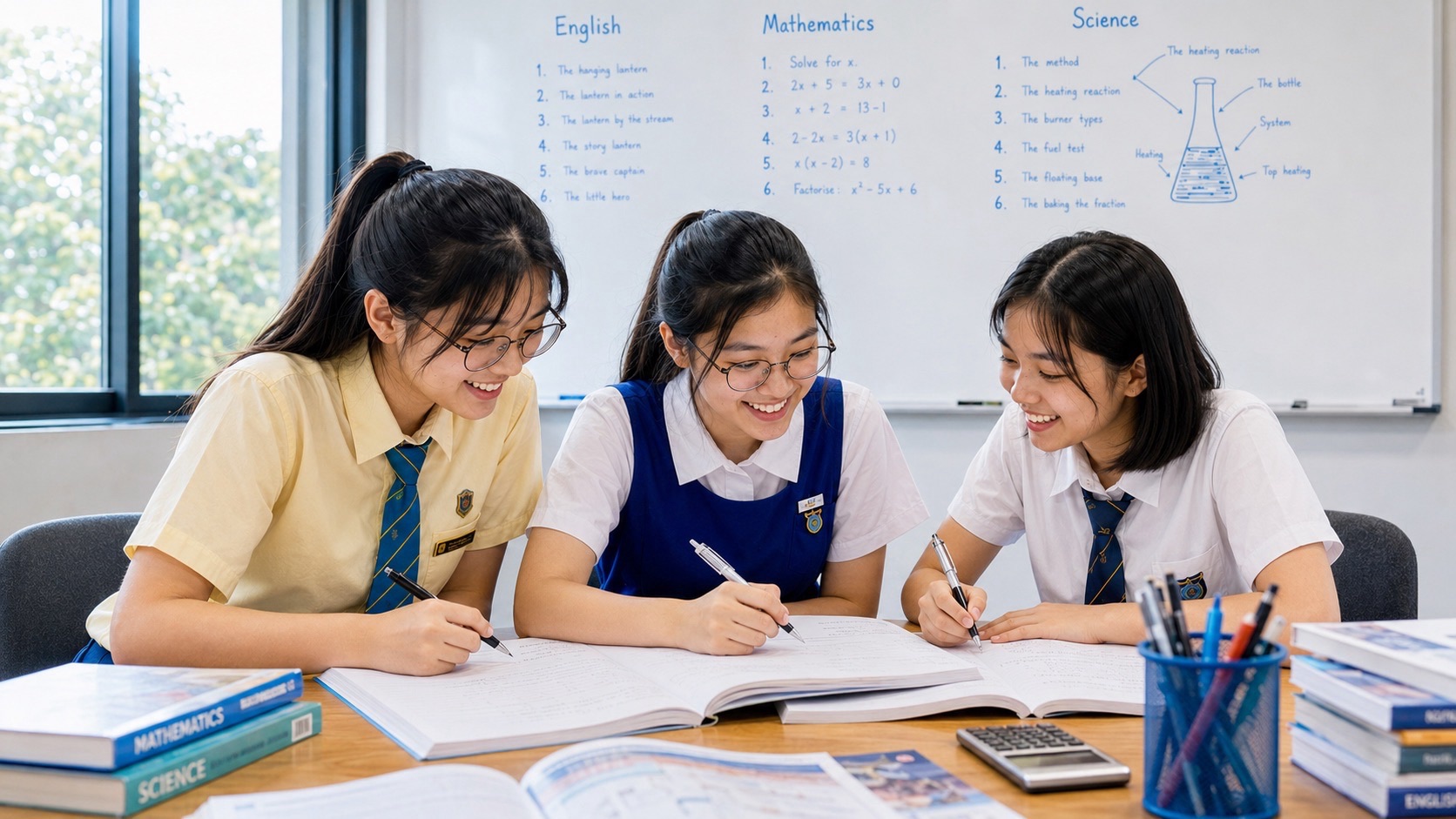
Why Students Cannot Improve by Revising Only Before Tests | When Learning Has No Maintenance Cycle

Test-driven revision creates a predictable rhythm: knowledge receives intense attention before an assessment and little attention afterwards. This can produce acceptable short-term performance while leaving foundations fragile for the next stage of learning.

Assessment urgency is not a learning architecture

A deadline is good at concentrating attention. It is less good at deciding which knowledge deserves to remain accessible months later. When every revision cycle begins only because a test is approaching, students repeatedly rebuild knowledge that could have been maintained more cheaply.

Important knowledge has downstream jobs

Fractions support later Mathematics. Vocabulary supports reading and writing. Scientific concepts become prerequisites for more complex mechanisms. Grammar and sentence control continue to matter long after the worksheet on them has ended. Foundational knowledge should therefore survive beyond the assessment that first measured it.

Maintenance can be small

Long-term retention does not require repeating full revision programmes every week. Short cumulative retrieval, mixed questions and periodic application can keep high-utility knowledge accessible while most study time moves forward.

Let new learning retrieve old learning

The most efficient maintenance often occurs when previous knowledge is deliberately reused in a new context. Ask which earlier idea this topic depends on, retrieve it briefly, then use it to construct the new model.

Use tests diagnostically

An assessment should not merely close a topic. Its errors identify knowledge that needs repair, while successful but foundational knowledge can enter a maintenance schedule. The result becomes input into the next learning cycle.

The repair

Keep examination revision, but place it inside a larger system: learn, retrieve, assess, repair, maintain and reconnect. Students progress faster when each test is not followed by forgetting everything that will soon be needed again.

Explore the connected learning guides

Choose the question that brought you here. Open one useful guide, try a small task, and stop when you have what you need.

Take one question further

The same learning habit can travel across subjects, while each subject keeps its own methods. These routes help you notice a difficulty, understand one part of it, and return to something you can do.

A word is familiar, but using it is difficult.

Move from recognising a word to retrieving it in a new context. Understand vocabulary plateaus.

Try it without the guide: Choose one word you already know. Close the guide and use it in a new sentence. Explain why it fits; try another context tomorrow.

A piece of writing has ideas, but the reader loses the thread.

Make the order of events and the links between sentences clear. Explore composition writing.

Try it without the guide: Choose one short paragraph. Read the relevant explanation, close it, and revise the paragraph. Ask someone to tell you what happened and why.

The Mathematics seems familiar, but marks still disappear.

Find the first point where the working stops being reliable. Find Secondary 4 A-Math mark leakage.

Try it without the guide: For a Secondary 4 A-Math question you have attempted, locate the first uncertain line. Repair that step, then try a comparable question without the worked answer.

A Science fact is remembered, but the explanation is incomplete.

Connect the evidence to a scientific idea and the resulting change. Follow the Primary Science learning route.

Try it without the guide: Choose a familiar Primary Science example. Explain the evidence, the idea and the result without notes. Then change one condition and explain your prediction.

Two accounts of the world seem to disagree.

Check the question, source, date and evidence before combining claims. Explore the World Knowledge research library.

Try it without the guide: Take one claim. Find the source best placed to support it, note its date, and state what remains uncertain. Return to your original question.

There is plenty of help, but independence is hard to see.

Check what the learner can understand and do after support is removed. Understand how education works.

Try it without the guide: Choose one small task the child has practised. Agree on a calm, brief attempt without prompts. Use what happens to choose one next step, then stop.

For the structure behind these connections, read the eduKateSingapore runtime manifest and the eduKate ecosystem boot contract. The reader map describes public navigation; those manifests preserve the wider ownership and return rules.

Discover more from eduKate Singapore

Subscribe now to keep reading and get access to the full archive.

Continue reading