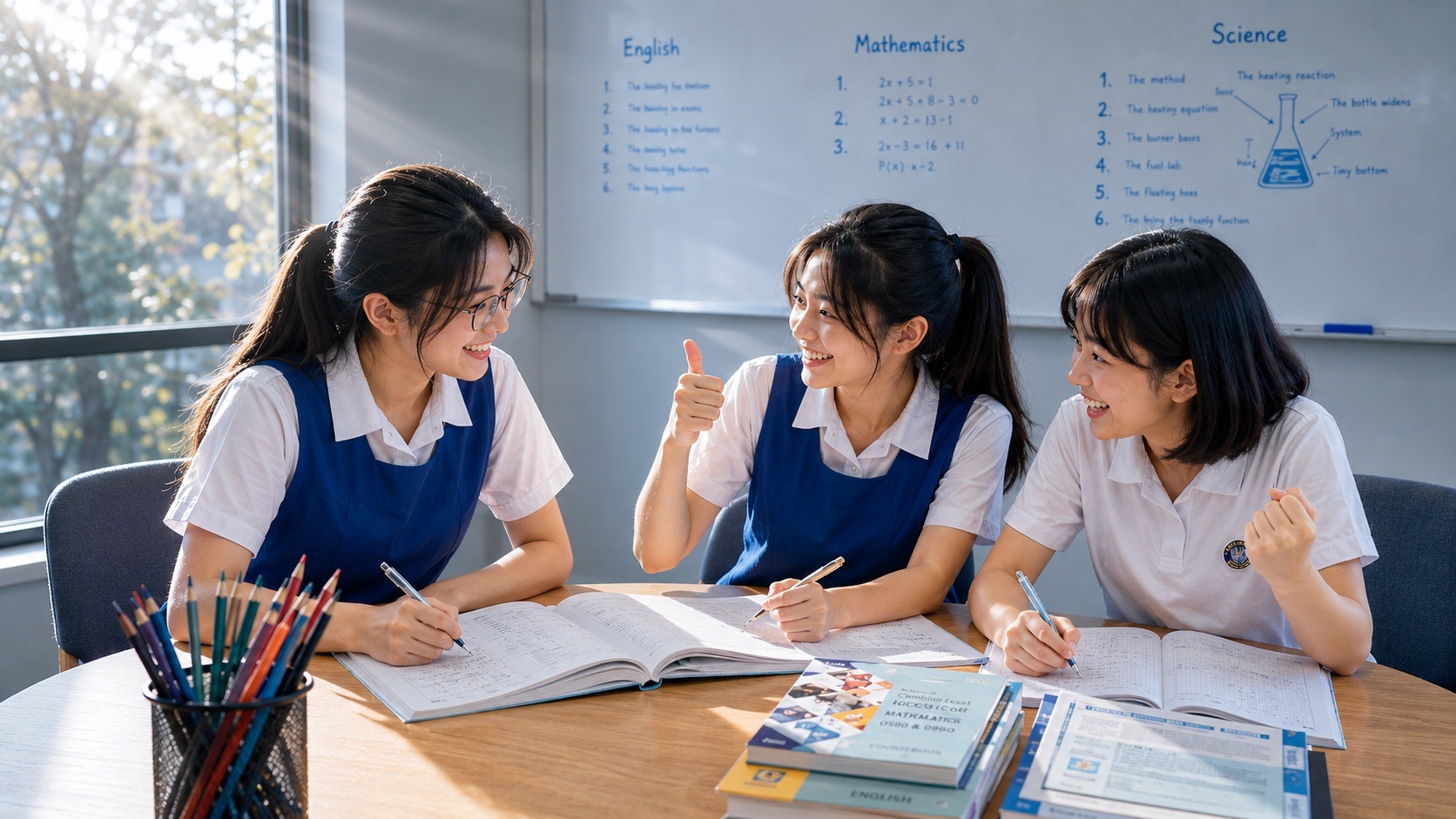
Quick answer: Primary 5 Science tuition should not simply add more worksheets. Its job is to make the child’s scientific thinking visible: what concept was selected, what evidence was used, what was inferred, where the reasoning changed, and how clearly the answer communicates the mechanism. In eduKate’s current model, three students work in a small group, typically for 1.5 hours, so the tutor can observe those differences closely while keeping the lesson social and discussion-rich.
This page is the commercial Primary 5 Science small-group mechanics owner. It is deliberately different from our broader Primary 5 Science Preparation guide, which explains the P5→P6 learning architecture. Here the question is narrower: what actually happens inside a three-pax Primary 5 Science tutorial when three students produce three different answers to the same scientific problem?
For current placement and availability, use the eduKate contact page.
Current Science Boundary: 2026 PSLE Uses the 2023 Primary Science Syllabus
SEAB states that the 2026 PSLE Science examination assesses attainment in Science as described in the 2023 Primary Science syllabus. The assessment objectives include both Knowledge with Understanding and Application of Knowledge and Scientific Inquiry.
That matters for Primary 5 tuition because the child is not preparing only to remember facts. The national destination also requires learners to apply scientific facts, concepts and principles; make predictions; formulate hypotheses; interpret and analyse information; evaluate observations, information and methods; and communicate explanations and reasoning.
Official references: SEAB 2026 PSLE Science syllabus and MOE 2023 Primary Science syllabus.
Primary 5 Is Not the PSLE Year
The old version of this page contained a serious error: it referred to an “end-of-year PSLE” in Primary 5. The PSLE is taken at the end of Primary 6. Primary 5 is therefore best treated as an integration and foundation year—a year to build the scientific system that Primary 6 will later retrieve, mix and condition under exam constraints.
That gives us a healthier operating rule:
Primary 5 should build the Science machine. Primary 6 should increasingly test whether the machine runs under mixed and timed conditions.
Why Primary 5 Science Becomes Difficult
The challenge is rarely one thing. Several demands increase together:
- more concepts are active at the same time;
- questions combine topics and representations;
- diagrams and tables carry more of the evidence;
- students must distinguish what is observed from what is inferred;
- open-ended answers need causal explanation;
- experiments require variable and fair-test reasoning;
- familiar textbook language becomes less available in unfamiliar contexts;
- students are expected to become more independent at checking and correcting.
A child may therefore know the chapter but still struggle to use it.
The Three-Pax Science Advantage
Suppose three students answer the same question about an investigation.
- Student A knows the concept but ignores the graph.
- Student B reads the graph correctly but chooses the wrong scientific relationship.
- Student C understands both but writes a vague answer that does not connect mechanism to result.
The final marks may look similar, but the repairs are not. Three students is small enough for the tutor to inspect the working and explanation of each learner while still allowing comparison, discussion and peer explanation.
That is the educational value of the small group: higher diagnostic resolution, not merely “personalised attention” as a marketing phrase.
The Primary 5 Science Diagnostic Loop
- Cold attempt: let the student answer before teaching the solution.
- Locate the first break: concept, evidence, inference, inquiry, language or checking?
- Repair the smallest useful relationship: do not reteach the whole chapter if one link is weak.
- Represent differently: diagram, table, model, physical demonstration or verbal explanation.
- Near transfer: change the surface while keeping the same relationship.
- Mixed transfer: combine with an older topic or neighbouring concept.
- Delayed return: test again after several days.
- Record the result: did the correction survive?
One wrong answer becomes a map of what the learner currently cannot yet do reliably.
Science Knowledge: Facts Need Relationships
Students often memorise facts as isolated statements:
- plants need light;
- water evaporates;
- friction opposes motion;
- blood transports substances;
- reproductive cells are involved in reproduction.
But examination questions change the surface. The child must know the relationship well enough to recognise it in a new setup.
For every core concept, we ask:
- What changes?
- What causes the change?
- What evidence would show it?
- What condition matters?
- When would this relationship not apply?
- How would the question look if the context changed?
This turns factual recall into usable scientific structure.
Scientific Inquiry: The Question Is Often About the Investigation
Primary Science questions often show a setup, table or experimental method. Students who rush directly to topic memory can miss the actual job.
Use an inquiry checklist:
- What is being changed?
- What is being measured or observed?
- What relevant factors need to be kept similar?
- What pattern does the data show?
- What conclusion is supported?
- What conclusion is not supported?
- What change would improve the investigation?
Inquiry is causal reasoning made visible.
Variables: Definitions Are Not Enough
Children can memorise “changed variable, measured variable, controlled variable” and still design a poor fair test. The deeper question is:
If two relevant things changed at the same time, how would we know which one caused the result?
This makes the purpose of control variables clear. We do not control things because a worksheet demands a category. We control relevant alternative causes so the comparison becomes interpretable.
Open-Ended Answers: Condition → Mechanism → Outcome
One of the most useful Primary 5 answer structures is:
given condition → scientific mechanism/relationship → observed outcome.
Example:
Because the water received more heat, more water changed from liquid to gas over the same period, so the water level decreased faster.
The exact wording must fit syllabus level and evidence. The structure simply reminds the child that an explanation needs the link between cause and outcome.
Keywords Help Only When the Relationship Is Correct
A common Primary Science strategy is to memorise marking keywords. Keywords are useful because scientific terms reduce ambiguity. But a keyword cannot rescue the wrong mechanism.
For each scientific term, the learner should be able to:
- explain it simply;
- recognise an example;
- recognise a non-example;
- use it in a causal sentence;
- distinguish it from a nearby concept;
- retrieve it after a delay.
That is stronger than keyword spotting.
MCQ: Every Wrong Option Teaches Something
MCQs are not merely quick marks. Good distractors often represent plausible misconceptions. After a wrong answer, ask:
- Why did my chosen option look right?
- Which condition in the question rules it out?
- What exact relationship makes the correct option fit?
- Could one of the wrong options become correct if the setup changed?
This converts one MCQ into a discrimination lesson.
Graphs and Tables: Evidence Is Not Decoration
Before answering, require a data reading pass:
- What is measured?
- What are the units?
- What increases, decreases or stays stable?
- Are we comparing rate, amount or final value?
- Is there an unusual point?
- What can we conclude?
- What remains unknown?
Strong students often lose marks by jumping to a remembered scientific story before reading the actual data.
Diagrams: Read Arrows, Labels and Missing Information
A diagram can encode:
- direction;
- relative position;
- connection;
- sequence;
- movement;
- energy transfer;
- material flow;
- experimental arrangement.
We train students to translate the diagram into words before solving difficult questions. Representation switching is itself a Science skill.
Describe, Explain, Compare, Predict
| Command | Job | Common mistake |
|---|---|---|
| describe | state what is observed or how it changes | adds unsupported cause |
| explain | give scientific reason/mechanism | repeats the observation |
| compare | address the same dimension on both sides | describes only one item |
| predict | use relationship + condition to state likely outcome | guesses without evidence |
Question-command discrimination is one of the easiest places to improve answer precision.
Primary 5 Science Error Taxonomy
| Error | Visible symptom | Repair |
|---|---|---|
| fact gap | basic knowledge genuinely absent | relearn + retrieve |
| concept gap | term known but relationship misunderstood | model + contrasting cases |
| application gap | works only in familiar examples | vary surface context |
| evidence gap | ignores data/diagram | extract evidence before concept selection |
| inquiry gap | variables or method logic confused | causal experiment-design work |
| language gap | idea correct but answer incomplete | condition→mechanism→outcome scaffold |
| demand gap | describes when asked to explain | command-word practice |
| overclaim | conclusion stronger than evidence | claim-evidence boundary |
Once the error is classified, the next worksheet can be chosen intelligently.
A Typical 90-Minute Three-Pax Lesson
| Phase | Shared job | Tutor watches for |
|---|---|---|
| 10–15 min | delayed retrieval | what survived from last week? |
| 20–25 min | concept/inquiry focus | who needs another representation? |
| 20 min | independent question set | first wrong turn |
| 20 min | open-ended explanation | evidence, mechanism and language |
| 10–15 min | mixed transfer | does the repair survive a new surface? |
The exact distribution changes by learner state. The feedback loop is the stable part.
Repair, Stabilise, Extend
Repair
Return to the earliest weak relationship. If a transport-system answer fails because the child does not understand what is being transported and why, repair the concept before demanding harder papers.
Stabilise
Use changed diagrams, different contexts, mixed retrieval and delayed return. The concept should survive after the original explanation disappears.
Extend
Strong students can evaluate methods, compare alternative explanations, reason about limitations and tackle more unfamiliar combinations without prematurely importing Secondary Biology or Physics content.
Depth before curriculum distance.
Hands-On Science: Observation Must Return to Reasoning
Experiments and demonstrations are useful when they generate evidence the child must explain.
- predict first;
- observe carefully;
- record data;
- compare with prediction;
- explain using the target concept;
- identify one limitation;
- change one condition and predict again.
A memorable demonstration without a reasoning return path is entertainment, not enough Science learning.
Science Language: Precision without Keyword Dumping
Words such as absorb, reflect, conductor, adaptation, force, energy, variable have school-science meanings that need precise use.
For every technical term, ask the student for:
- a simple definition;
- an example;
- a non-example;
- one natural Science sentence;
- one nearby term that can be confused;
- one retrieval prompt a week later.
This links vocabulary to concept control.
What Strong Primary 5 Science Students Need
- ambiguous data that requires careful interpretation;
- alternative explanations;
- method evaluation;
- questions combining several Primary Science relationships;
- counterexamples;
- claim-evidence discipline;
- clearer scientific writing;
- self-checking before answer submission.
They do not automatically need later-level Biology content. Advanced reasoning inside the Primary curriculum often produces more useful growth.
What Struggling Primary 5 Science Students Need
- smaller concept units;
- diagram-first explanation;
- essential scientific vocabulary;
- one command word at a time;
- short retrieval cycles;
- fewer simultaneous topics;
- open-ended answer scaffolds;
- visible evidence of successful correction.
Repeated full papers can become demoralising when the underlying system is not yet ready.
The Parent Progress Dashboard
| Signal | Question |
|---|---|
| Concept | Can the child explain without notes? |
| Application | Can the idea survive a changed example? |
| Evidence | Does the child use the actual graph/diagram/data? |
| Inquiry | Can variables and method be reasoned through? |
| Communication | Is mechanism stated clearly enough? |
| Retrieval | Does the concept remain available two weeks later? |
| Independence | Can the child identify and repair some errors without prompts? |
These signals often improve before school marks move dramatically.
Past Papers: Use Them as Sensors
Past papers become more useful as syllabus coverage increases. At Primary 5, selected questions and mixed clusters often produce cleaner information than constant full papers.
Use a paper to ask:
- Which topics remain cue-dependent?
- Which questions fail because of evidence reading?
- Which answer types are incomplete?
- Which misconceptions repeat?
- Does time pressure create a new error?
Then leave the paper and repair the mechanism.
Home Science without Turning Home into Tuition
Parents can support Science through curiosity and explanation rather than nightly drilling.
- Ask what evidence supports an answer.
- Ask what would change the prediction.
- Notice heat, light, forces, plants, water and materials in daily life.
- Let the child explain a diagram from memory.
- Review one old error each weekend.
- Use official or reputable Science sources when facts become uncertain.
The home job is to keep the child thinking, not to duplicate school and tuition.
Frequently Asked Questions
Is Primary 5 the PSLE year?
No. PSLE is taken at the end of Primary 6. Primary 5 is a critical foundation and integration year.
What syllabus does the 2026 PSLE Science examination assess?
SEAB states that the 2026 examination assesses attainment in Science as stated in the 2023 Primary Science syllabus.
How many students are in eduKate’s Primary 5 Science small group?
The current model is typically three students, subject to placement and availability.
How long is a lesson?
Lessons are typically 1.5 hours, subject to current programme arrangements.
Should my child memorise model answers?
Use model answers to identify the necessary relationship and scientific language, then close the model and reconstruct the reasoning on a changed question.
What should we bring for diagnosis?
Recent school papers, open-ended answers, worksheets with working, teacher comments and examples of repeated misconceptions.
Current Programme Route
Use the Primary Science Specialist Library for free Science learning resources. For current small-group tuition placement, use the eduKate contact page.
The Main Principle
The best Primary 5 Science tuition does not make the child dependent on more worksheets. It makes the learner better at seeing the scientific problem, selecting evidence, applying the right concept, communicating the mechanism and checking whether the conclusion is justified.
Three students can answer one question three different ways. The value of the small group is that we can see why—and make the next lesson respond to the reason.