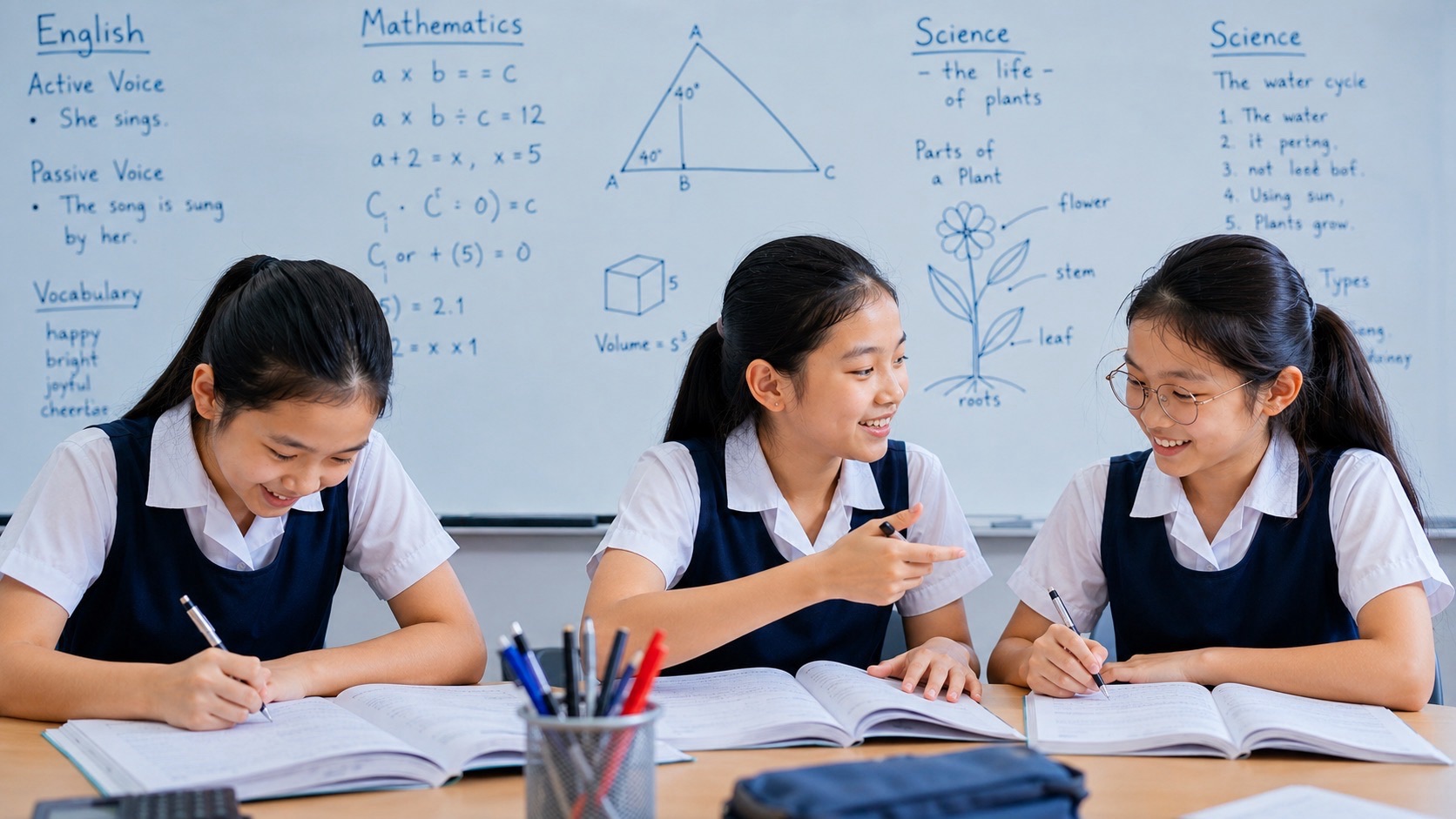
Sengkang Science Tuition Centre Primary 3 Science Tutor is this long-standing eduKateSingapore page’s protected local search intent: a practical guide for families looking for Primary 3 Science tuition in Sengkang and a complete explanation of how a child should begin learning Science well. Primary 3 is the first formal Primary Science year for most Singapore students. The right start is not to memorise model answers for a distant PSLE. It is to learn how scientists look at the world: observe carefully, classify by evidence, compare fairly, identify variables, explain cause and effect, represent information, ask testable questions and change an idea when evidence disagrees.
For parents comparing Primary 3 Science tuition in Sengkang, the useful question is not whether a centre can give a child a thicker stack of notes. It is whether teaching can turn facts into scientific reasoning. A P3 learner may remember that living things need air, water and food yet still classify an unfamiliar example poorly. Another may know the stages of a life cycle but cannot explain what changed. Another may recognise that a magnet attracts iron yet make a weak prediction because the child has not learned to isolate what is being tested. These are not the same problem, so they should not receive the same worksheet.
eduKate’s approach to P3 Science tuition for Sengkang families therefore begins with a learning system rather than premature exam pressure: Observe → Describe → Compare → Classify → Predict → Test → Explain → Check → Transfer. The current MOE Primary Science Syllabus introduced from the 2023 Primary 3 cohort is designed around scientific ideas, practices and values, with students learning Science through inquiry and real-world contexts. For P3, that means building dependable foundations in areas such as diversity, materials, life cycles and magnets while developing the habits that later make P4–P6 Science and PSLE reasoning possible.
Quick Read for Parents
- Primary 3 is the beginning of formal Primary Science, so method matters as much as factual knowledge.
- Current P3 learning under the 2023 Primary Science Syllabus includes foundations such as diversity of living and non-living things, diversity of materials, life cycles and magnets.
- Good Science teaching links every fact to evidence, comparison, prediction, explanation or application.
- Vocabulary must be precise: everyday words and scientific words are not always interchangeable.
- Students should learn to read tables, diagrams, pictures and simple experimental setups as information, not decoration.
- Structured answers should grow from claim + evidence + scientific reason rather than memorised phrases.
- Hands-on investigations are useful when the child can explain what was changed, observed and concluded.
- Wrong predictions are useful if the learner compares them with evidence and updates the model.
- Small-group teaching is valuable when the tutor can hear each child’s reasoning rather than only mark final answers.
- The P3 goal is P4 readiness: stronger concepts, better scientific language and increasing independence.
1. What This Legacy Page Now Owns
This article upgrades eduKateSingapore.com’s original 7 February 2020 page in place. The existing title, canonical URL, publication history, author, categories, tags and featured image remain because the legacy page already has search history and a clear Sengkang Primary 3 Science intent. The old body mixed P3–P6 sales copy, PSLE and A1 language, unrelated Mathematics and Secondary captions, travel photographs and statements about “encyclopaedic knowledge” that no longer described a focused modern P3 Science programme.
The rebuilt page has one job: explain how Primary 3 Science should be taught to a young learner in Sengkang. It focuses on the first-year transition into scientific thinking, the current syllabus direction, concept formation, inquiry practices, vocabulary, diagrams, experiment reasoning, question answering, home support and the bridge into Primary 4. It does not claim that every child needs tuition, and it does not treat a P3 learner as a miniature PSLE candidate.
Nearby legacy Science pages on eduKateSingapore cover “small group tutor”, “tutorials” and other historical keyword variants. This page remains the Science Tuition Centre + Primary 3 Science Tutor owner. It will route outward to broader Science resources rather than duplicate every future P3 Science article.
2. Current Singapore Primary Science Direction
The current MOE Primary Science Syllabus 2023 is the reference point for cohorts that began Primary 3 from 2023 onward. SEAB’s current 2026 PSLE Science syllabus states that the examination assesses attainment in Science as set out in that 2023 syllabus and includes both Knowledge with Understanding and Application of Knowledge and Scientific Inquiry. That later examination destination is useful to understand, but P3 teaching should build the habits underneath it rather than drill an eleven-year-old with upper-primary examination routines.
Current school briefings based on the 2023 syllabus commonly identify P3 content such as diversity of living and non-living things, diversity of materials, life cycles of plants and animals, and interaction of forces through magnets. Schools may organise classroom sequences differently, so a tuition programme should stay aligned with the child’s school while preserving the conceptual relationships among topics.
The syllabus direction is broader than “know facts”. Students should develop core scientific ideas, practices of Science and values or attitudes that support inquiry. In classroom language, that means a child should increasingly be able to say what was observed, what evidence supports a classification, what changed in a life cycle, what variable was tested, why a conclusion follows and what new evidence would change the conclusion.
3. Primary 3 Is a Language Transition as Well as a Science Transition
Science introduces children to a new way of using ordinary language. A student may say a material is “strong” when the scientific observation is that it does not tear easily under a particular force. A child may say an animal “likes” a habitat when the task asks what features help it survive. A student may call every change a “reaction” even when the topic is simply a physical change in state. Precision grows gradually.
This is why P3 Science and English are connected without being the same subject. The child must read conditions, understand comparative words, distinguish cause from description and turn observations into complete explanations. A learner with the right idea can still lose clarity if the sentence does not show the relationship. Tuition should therefore teach scientific vocabulary inside scientific reasoning.
One useful habit is to separate what I see from what I think it means. “The paper clip moved towards the magnet” is an observation. “The magnet exerted an attractive force on the paper clip” is an explanation using a scientific idea. Both matter, and P3 is a good year to learn the difference.
4. Observation Is Not Guessing
An observation should be grounded in available senses, measurements, diagrams or recorded information. If a picture shows a leaf with holes, the child may observe that holes are present. Saying “a caterpillar ate it” is an inference unless the evidence includes the caterpillar or another clue. This distinction is foundational because later Science requires students to infer responsibly from evidence.
Tutors can train this with simple objects. Place two materials on the table. Ask students for observations only. Then ask what those observations might suggest. Label the two columns Observed and Inferred. Over time, the learner stops treating a plausible story as a measured fact.
5. Compare Before You Classify
Classification is central to early Science. But classification is not memorising which box an object belongs in. It is choosing or applying a criterion and using evidence consistently. Before classifying animals, plants or materials, students should compare relevant properties.
Suppose three objects are made from metal, plastic and rubber. If the question asks which is attracted by a magnet, material type alone is not enough: not every metal behaves identically in every context, and attraction should be tested or given by evidence. If the question asks which bends easily, that is a different property. The criterion determines what information matters.
A strong P3 habit is: Name the criterion → compare evidence → place each item → check for consistency. This habit later supports classification keys, data tables and more complex scientific organisation.
6. Diversity: Similar Does Not Mean the Same
Diversity teaches children that the natural and material worlds contain both patterns and variation. Two animals may both move, grow and reproduce but differ in body covering, method of movement or habitat. Two materials may both look shiny but differ in flexibility, transparency or interaction with magnets. Scientific thinking notices the relevant similarity without erasing difference.
Ask a child to create two valid ways to group the same set of objects. A collection of spoons, rulers, cups and clips can be grouped by material, transparency, flexibility or magnetism if those properties are known. The exercise shows that a classification is built for a purpose.
7. Living and Non-Living: Use Characteristics, Not Surface Appearance
Young learners can be fooled by movement. A toy car moves, but movement alone does not make it living. A plant may appear still, yet it grows, responds and carries out life processes. P3 teaching should therefore use a collection of characteristics rather than one visual clue.
Give borderline-looking examples: a seed, fire, a robot, a dried leaf and a sleeping animal. Ask what evidence would be needed before deciding. Some examples are intentionally useful for discussion because they reveal which rule the child is using. The tutor should value the reasoning even when the first answer is wrong.
8. Materials: Properties Are Useful Because They Affect Function
Material properties become meaningful when connected to use. A transparent material may be useful for a window because light can pass through. A waterproof material is useful for a raincoat because water does not pass through easily. A rigid material may support a structure, while a flexible one can bend around a shape.
Teach the relationship as Property → Function → Evidence. “Plastic is good” is weak. “This transparent plastic is suitable for the cover because we can see the display through it while the cover protects the object” is stronger. The child learns to justify material choice rather than name a property in isolation.
9. Life Cycles: Learn Change Through Sequence
A life cycle is not merely a list of stages. It is a repeating sequence showing growth and reproduction across a living organism’s life. P3 students should be able to order stages, compare young and adult forms and explain what changes or remains recognisable.
Use cards, diagrams and unfamiliar examples. If a child only memorises one textbook butterfly diagram, transfer is weak. Ask the learner to interpret a life-cycle representation with arrows arranged differently or with one missing stage. The child should use sequence and biological meaning rather than visual memory.
10. Magnets: Start with Interaction, Not Magic
Magnets are ideal for teaching interaction because children can observe attraction and repulsion directly. But the lesson should move beyond “magnets stick to things”. Ask what materials are attracted, what happens when poles approach and how distance changes an observable effect in a simple setup.
Students should distinguish magnetic material from magnet. A paper clip can be attracted to a magnet without itself behaving like a permanent bar magnet. The distinction sounds small but prevents later conceptual confusion.
11. P3 Science Is the Beginning of Evidence-Based Explanation
A useful early answer structure is Claim → Evidence → Scientific Idea. Claim: Object A is more suitable. Evidence: it lets light pass through while Object B does not. Scientific idea: transparent materials allow light to pass through, which is needed for the stated use. The exact wording should remain age-appropriate, but the logic is powerful.
The child should not memorise the structure as three sentence starters forever. The tutor uses it to expose the reasoning. Once the relationship becomes natural, the answer can become shorter and more fluent.
12. Scientific Questions: Ask What Can Be Investigated
Children are naturally curious, but not every interesting question is an investigation question. “Why are magnets interesting?” invites discussion. “Does changing the distance between a magnet and a paper clip change whether the paper clip moves?” can be tested. P3 Science should preserve curiosity while teaching children how to turn curiosity into a question that evidence can answer.
A tutor can begin with three prompts: What will I change? What will I observe or measure? What will I keep as similar as possible? The language can remain simple. Formal variable terminology can grow later, but the underlying logic should start early.
13. Fair Tests: Change One Important Thing at a Time
Suppose students want to compare which paper towel absorbs more water. If they use different towel sizes, different amounts of water and different waiting times, the result cannot be attributed confidently to towel type. A fair comparison controls important conditions so the intended difference can be interpreted.
At P3, teach fairness through contrast. Show two experimental plans and ask which comparison is stronger. Then ask what one change would improve the weaker plan. This is more meaningful than memorising the phrase “fair test” without recognising one.
14. Predictions Should Have Reasons
A prediction is not a random guess. It uses what the learner already knows to anticipate an outcome. “I think the iron clip will be attracted because it is made from a magnetic material” is stronger than “I think yes.” The child can still be wrong; scientific value comes from making the reasoning visible and then comparing it with evidence.
After the test, return to the prediction. Was it supported? If not, what changed in the child’s model? This teaches that being wrong is not a failure when evidence improves understanding.
15. Measurements: Numbers Need Units and Meaning
Primary 3 investigations often introduce simple measurements or counts. A number without a unit or description can be incomplete. “It is 12” means little. “The plant is 12 centimetres tall” communicates a quantity, unit and property. Students should learn to label tables and graphs clearly enough that another person can understand the record.
Measurement also teaches uncertainty. Two students may measure slightly differently because of ruler position or judgement. The aim at P3 is not sophisticated error analysis; it is careful procedure and awareness that data come from actions.
16. Tables: Read Across, Down and Between
A table is a compressed scientific text. Students should read headings before values. Ask: what does each column represent? Which variable changes across rows? What is the unit? Which comparison answers the question? Children who jump directly to the largest number may miss what the number measures.
Use small tables first. Example: three materials tested for transparency, flexibility and magnetism. Ask which material is suitable for a particular use and require the learner to cite two relevant properties. This connects data reading with application.
17. Diagrams: Every Arrow and Label Carries Information
P3 students often treat diagrams as pictures. Science diagrams are information systems. Arrows may show sequence, direction or interaction. Labels identify structures. Relative position may matter. A tutor should ask the child to “read” a diagram aloud: what is shown, what the arrows mean, what changes from one stage to another and what is not represented.
Then remove one label and ask the child to reconstruct it from context. Or rotate a familiar life-cycle diagram so the child cannot rely on the memorised page layout. Transfer requires understanding the representation.
18. Graphs: Trends Before Individual Points
At an age-appropriate level, children can begin reading simple bar or line representations. Start with axes and labels, then individual values, then overall comparison. Ask what increases, decreases or remains the same. The student should distinguish what the graph shows from why it might happen.
If a graph shows plant height increasing over several days, “the plant grew taller” is an observation from the data. “It grew because it received more sunlight” is an explanation only if the investigation supports that cause. Data and interpretation must remain separate.
19. Scientific Vocabulary: Define Through Relationships
A definition is more memorable when it belongs to a network. For transparent, compare translucent and opaque if appropriate to the school’s teaching. For attract, contrast repel. For stage, connect sequence and life cycle. For property, connect material and function.
Ask the learner to use the word in a new scientific sentence, not merely repeat a glossary line. A word becomes useful when it can support reasoning.
20. Everyday Language vs Scientific Language
Everyday language is often good enough for conversation but too vague for Science. “The magnet is powerful” can become “The magnet attracted the paper clip from a greater distance in this setup.” “The plant is healthy” can become a description of measured growth or observed features. “The material is good” becomes a property linked to purpose.
Do not punish children for using everyday words at first. Use them as starting points. Ask, “What did you observe that makes you say powerful?” The tutor converts intuition into evidence.
21. Worked Investigation: Which Material Is Best for a Window?
Imagine four sheets: clear plastic, aluminium foil, tracing paper and thick cardboard. The task is to choose a material for a small observation window in a model container. Before testing, ask what property matters. If the purpose is to see inside, light transmission matters. If the window must also resist water, another property may become relevant.
Students can hold each material in front of a printed word and record whether the word can be seen clearly, partly or not at all. The result does not automatically decide the “best” material unless the function is defined. Science application combines evidence with requirement.
22. Worked Answer from the Window Investigation
Question: “Why is the clear plastic more suitable than the cardboard for the observation window?” Weak: “Plastic is transparent.” Better: “The clear plastic is transparent and allows the observer to see through it, whereas the cardboard blocks the view. Therefore, clear plastic is more suitable for a window whose purpose is observation.”
The stronger answer contains property, evidence/comparison and function. P3 students can learn this reasoning without being forced into adult prose.
23. Worked Investigation: Magnet Distance
Place a paper clip on a table and move the same magnet gradually closer from marked distances. Record the first distance at which the paper clip moves. Repeat to check consistency. The exact setup should be simple and safe. The learning goal is not a sophisticated law of magnetism; it is controlled observation.
Ask: what was changed? Distance. What object and magnet remained the same? Why repeat? To see whether the observation is consistent. What can we conclude? In this setup, the observable magnetic effect becomes sufficient to move the clip when the magnet is close enough. Avoid turning one classroom result into a universal claim about every magnet and object.
24. Worked Investigation: Life Cycle Sequence
Give four unlabeled images representing stages in an animal life cycle. Ask the child to order them and justify the order using visible developmental changes. Then remove one stage and ask what is missing. Finally, compare with a second animal whose young form differs more dramatically from the adult.
The purpose is to move from picture memory to biological sequence. A learner should recognise that life cycles show repeated patterns of growth and reproduction even though organisms differ in their specific stages.
25. Classification Laboratory: One Set, Three Systems
Use eight familiar objects or picture cards. First classify by living/non-living if suitable. Second, classify non-living objects by material. Third, classify by a functional property such as flexibility. Ask what changed: the objects did not change; the criterion changed. This is a powerful lesson about scientific organisation.
26. An Error Laboratory: “It Moves, So It Is Living”
Present a toy car, a seedling and a snail. Ask which are living and why. If the learner uses movement as the only rule, the toy car creates a contradiction. Rather than saying “wrong” immediately, ask what other characteristics distinguish the snail and plant from the toy. The child repairs the rule by adding evidence.
This is scientific learning in miniature: create a model, test it against examples, find where it fails, revise the model.
27. Another Error Laboratory: “All Metal Is Magnetic”
Children may generalise from iron objects to all metals. The tutor can present or discuss examples carefully and ask what the evidence actually establishes. The safest P3 statement is not “metal equals magnetic” but that certain materials are attracted by magnets and this must be known from evidence or established scientific knowledge.
Overgeneralisation is a reasoning error that will recur across Science. Learning to limit a conclusion to what evidence supports is a long-term skill.
28. Another Error Laboratory: “Bigger Means Stronger”
A larger magnet may not always produce the expected outcome compared with a smaller one because magnet properties and setup matter. P3 students should learn not to substitute appearance for evidence. Test or use supplied data. This principle later applies to plants, forces, circuits and many other topics.
29. Science Questions Have Command Words Too
Words such as state, describe, compare, explain, predict and suggest ask for different responses. “State” may require a direct fact. “Compare” needs both sides. “Explain” needs a relationship or reason. “Predict” asks what is likely to happen using scientific understanding.
P3 is the right time to begin noticing these differences. A true fact is not automatically a complete answer if it does not perform the requested job.
30. Structured Answers: Do Not Copy the Question Blindly
Young students are sometimes taught to turn every question into a long sentence. This can help grammar but may waste attention. The goal is a complete scientific meaning. If asked which material is suitable and why, answer the material, relevant property and function. If asked what happened, describe the observed change. If asked why, add the scientific cause.
Teach children to underline the demand mentally or physically during practice, then choose only relevant information. Precision begins before PSLE.
31. Drawings Can Be Scientific Evidence
Observation drawings should show relevant features clearly rather than become art competitions. Labels should point accurately. If the purpose is to compare two stages, draw or mark the changed structure. A neat drawing that hides the important feature is less useful than a simple accurate one.
32. Models Are Useful but Limited
A life-cycle diagram, material sample or magnet drawing is a model of part of reality. It helps thinking but may leave information out. Ask what the model shows and what it does not. This introduces a sophisticated scientific habit in child-friendly language: representations are tools, not reality itself.
33. Curiosity Needs Vocabulary
A child may notice something interesting but lack words to ask about it. Build language around observable phenomena: texture, rigid, flexible, absorb, transparent, attract, repel, stage, classify, characteristic, material, evidence. Then let the child use those words to ask better questions.
34. Vocabulary Needs Curiosity
The reverse is also true. A glossary learned without phenomena becomes brittle. Let children handle safe materials, observe living things, watch a seed germinate, compare shadows or test magnets where appropriate. A scientific word becomes memorable when attached to an experience and an explanation.
35. The P3 Science Principle So Far
Science at Primary 3 should repeatedly move between the world and the model: observe something, name the pattern, represent it, test the idea, explain it and return to a new example. Facts matter, but facts become durable when they participate in reasoning.
36. How a P3 Science Lesson Should Begin
A useful P3 lesson does not always begin with the tutor explaining a page of notes. It can begin with a phenomenon, object, diagram or question that exposes what the child currently thinks. “Which of these objects would a magnet attract?” “How would you group these organisms?” “What might happen next in this life cycle?” The student commits to an idea before instruction.
The tutor then listens for the model behind the answer. A correct answer reached through guessing needs different teaching from an incorrect answer supported by a mostly sound idea. The visible response is data about thinking.
37. Explain After the Child Has Something to Explain
Direct explanation matters, but it becomes more meaningful after a learner has encountered the problem. Once students notice that appearance alone does not classify living things well, the tutor can introduce a more reliable set of characteristics. Once a material-choice problem exposes vague language, the tutor can teach property and function precisely.
This sequence creates a reason for the new concept. The student is not collecting facts in advance of an unknown use; the concept repairs an actual thinking problem.
38. Practice Should Change Surface Features
If every question about transparency uses windows, the child may memorise “transparent = window” rather than learn the property. Transfer asks for goggles, container covers, display panels or packaging. If every magnet question uses paper clips, introduce a table of unfamiliar objects. If every life cycle is drawn as a circle, use a horizontal sequence.
The scientific relationship stays; the surface changes. This is how a concept becomes portable.
39. Retrieval: Science Facts Must Be Available Without the Notes
Rereading can feel fluent because the answer is visible. Retrieval asks the child to produce the idea from memory. At the start of a lesson, ask three short questions from previous weeks: name a useful material property, explain one difference between observation and inference, or describe what happens when like poles are brought together.
Then correct immediately enough that wrong memory does not settle. Spaced retrieval over days and weeks makes knowledge easier to use in new problems.
40. Interleaving: Do Not Label Every Question by Topic
A worksheet titled “Magnets” tells the child which knowledge to retrieve. Mixed practice might include a material question, a life-cycle diagram, a magnet setup and a classification table. Now the student must first identify what kind of scientific idea applies. That selection step resembles later examination and real-world reasoning more closely.
41. The P3 Error Notebook
Keep a small record of repeated reasoning errors, not every wrong answer. Examples: “uses appearance instead of criterion”, “forgets to compare both materials”, “writes observation as explanation”, “assumes all metal is magnetic”, “misses units”, “explains before reading table headings”. Each entry gets a short repair cue.
The notebook should shrink and change. Once a pattern stays corrected across fresh questions, move it to occasional review. A permanent wall of mistakes is not useful.
42. Diagnose Knowledge, Reasoning and Expression Separately
Suppose a child gives a weak answer to a materials question. Ask orally: “What property do you think matters?” If the child cannot identify it, there may be a knowledge gap. If the child identifies it but chooses evidence poorly, the issue is reasoning. If the child explains clearly aloud but writes a fragment, expression is the bottleneck.
This distinction prevents over-teaching. The student should receive the smallest intervention that repairs the actual missing process.
43. A P3 Diagnostic Set
- Classify a mixed set using a stated criterion.
- Choose a material for a function and justify it.
- Order and interpret an unfamiliar life-cycle diagram.
- Predict and explain a simple magnet interaction.
- Read a small table and answer one comparison question.
- Identify what changed and what stayed the same in a simple investigation.
- Distinguish one observation from one inference.
- Write one complete evidence-based explanation.
Eight tasks can reveal more than a long undifferentiated worksheet because they sample the mechanisms P3 Science needs.
44. Three P3 Learners, Three Different Science Problems
Alicia remembers facts and definitions but struggles when the diagram looks unfamiliar. Her priority is transfer across representations. Ryan can explain ideas orally but writes incomplete structured answers. His priority is expression and answer structure. Mira writes confidently but often assumes causes that were never tested. Her priority is evidence discipline.
All three may receive the same school mark on a particular question. A strong tutor sees that their next lessons should differ.
45. Small Groups of Three: Why Visibility Matters
eduKate’s typical small-group model uses three students. In Science, this can be particularly useful because reasoning is audible. One child predicts, another challenges the criterion, a third notices a control variable. The tutor can ask each student why rather than accept a group chorus.
The number itself is not magic. A small group is valuable only when the tutor uses the visibility to inspect thinking, assign differentiated follow-up and ensure that one confident child does not perform all the reasoning for the others.
46. What a 1.5-Hour P3 Science Lesson Can Look Like
- 0–10 minutes: retrieval from earlier topics and one old error.
- 10–25 minutes: phenomenon, diagram, object set or question that exposes prior thinking.
- 25–45 minutes: explicit concept teaching and vocabulary.
- 45–60 minutes: worked reasoning and representation.
- 60–75 minutes: fresh transfer questions or a safe mini-investigation.
- 75–85 minutes: independent structured answer practice.
- 85–90 minutes: correction, verbal explanation and next-step cue.
The exact mix varies. The principle is movement from recall to thinking to transfer, not ninety minutes of copying notes.
47. Homework: A Small Test of Independence
Homework should show whether the child can use the lesson without immediate tutor prompts. A short mixed set, one diagram interpretation and one explanation can be enough. If the parent must reteach the whole concept, that information should return to the tutor.
Volume is not the same as learning. Five carefully selected questions that reveal transfer can be more useful than forty repetitions of a familiar format.
48. Reading Science Questions Slowly Enough
Young learners often see a familiar picture and answer the question they expected rather than the one written. Teach a brief routine: identify the command, identify the object or variable, find the supplied evidence, then answer. The routine should become fast through practice, not skipped.
49. “Why” Questions Need a Mechanism
If asked why clear plastic is suitable for a window, “because it is clear” may be too circular. The explanation should connect property and function: it allows light to pass through so objects can be seen. If asked why a paper clip moved, the answer should identify the magnetic interaction rather than repeat that it “wanted to move”.
50. “Compare” Questions Need Both Sides
Question: “Compare the young and adult stages shown.” An answer describing only the adult is incomplete even if every statement is true. Use frames temporarily: “Both…, but…” or “The young…, whereas the adult…”. Remove the frame once two-sided comparison becomes automatic.
51. “Suggest” Questions Need Plausibility and Science
Suggest questions may permit more than one answer, but not any answer. The proposal must fit the information and scientific idea. Teach students to ask, “Would this suggestion actually change the thing the question cares about?” Then justify it.
52. Answer Length Is Not the Goal
Primary students sometimes believe longer means better. A concise answer with the right relationship can be stronger than a paragraph containing unrelated facts. Teach completeness, not inflation: enough words to show evidence and scientific reasoning, no extra sentences added only to look impressive.
53. Memory Without Understanding Is Fragile
A child may recite “like poles repel, unlike poles attract” yet fail when a diagram reverses magnet orientation. Ask the learner to predict before revealing the answer and explain which poles face each other. The memorised fact becomes operational knowledge.
54. Understanding Without Retrieval Is Also Fragile
The reverse problem occurs when a child understood the lesson but cannot recall key terms later. Spaced retrieval solves a different problem from explanation. Good P3 teaching includes both: build meaning, then make the meaning available from memory.
55. Build a Concept Map, Not a Word Wall Alone
For materials, connect material → property → test → suitable use. For magnets, connect magnet → poles → attraction/repulsion → magnetic materials → interaction. For life cycles, connect stages → sequence → growth → reproduction → cycle. Relationships help recall because each word has several routes back into memory.
56. Science at Home: Use the World, Not a Home Laboratory
Parents do not need elaborate equipment. Compare materials in household objects, observe condensation safely, discuss why a lunch box uses particular materials, notice stages in a plant’s growth, or test a fridge magnet against safe objects. The conversation matters more than making every evening an experiment.
Ask open questions: “What do you notice?” “What evidence makes you think that?” “How could we compare fairly?” Then let the child answer before supplying the scientific wording.
57. Parent Correction: Ask Before Telling
If an answer is wrong, first ask the child to explain the reasoning. “I chose aluminium because it is shiny” reveals a criterion problem if the task was about transparency. Simply giving “clear plastic” would correct the item without correcting the model.
58. Parent Praise: Notice Scientific Behaviour
Praise useful actions: checking the table heading, changing a prediction after evidence, using both sides in a comparison, asking a testable question or explaining a conclusion. This teaches the child what good Science learning looks like beyond marks.
59. Curiosity and Accuracy Can Coexist
Inquiry does not mean every answer is equally valid. Students are encouraged to wonder, predict and propose, while evidence and established scientific ideas constrain conclusions. The classroom can be both open to questions and rigorous about answers.
60. The Tutor’s Weekly Question
Ask: What can this child now explain without my prompt that required my help last month? Independence is the best measure of whether teaching is becoming part of the learner’s own system.
61. P3 Diversity Mastery: Start with the Criterion
Diversity questions become easier when the learner stops trying to remember every example and starts by identifying the basis of grouping. Is the task about whether something is living, the type of organism, body features, material, or a property? Once the criterion is clear, irrelevant details can be ignored.
Give the same six pictures twice with two different instructions. In the first task, classify living and non-living things. In the second, classify only the living things by a stated feature. The child learns that classification answers a question; it is not an intrinsic set of boxes attached permanently to the pictures.
62. Classification Keys in Child-Friendly Form
A simple yes/no sequence is an early classification key. “Does it have leaves? Yes/No.” “Does it have six legs? Yes/No.” Students can create tiny keys for familiar organisms or objects. The exercise forces them to choose observable distinctions that actually separate the groups.
A weak key uses vague language such as “Is it nice?” or a feature shared by every item. A strong key uses a consistent observable characteristic. Evaluating keys develops scientific precision and logical branching.
63. Living Things: Evidence Across Time
Some characteristics of living things are not visible in one moment. Growth and reproduction require evidence across time. A photograph of a seed cannot show the whole life process. This is a useful chance to teach that scientific conclusions sometimes rely on observations collected over longer periods or on established knowledge.
64. Fungi and Bacteria: Avoid Over-Simplification
Where the school’s P3 sequence includes fungi and bacteria, teach them as living things with their own characteristics rather than as “bad germs” or unusual plants. Children may know mushrooms and yoghurt before they know the scientific grouping. Begin from familiar examples, then refine the model.
The broader lesson is that scientific categories do not always match everyday labels. That intellectual flexibility is worth building early.
65. Materials Mastery: Properties Are Testable
Instead of presenting a table of properties for memorisation, ask how each property could be observed or tested safely. Transparency: can an object be seen through the material? Flexibility: can it bend without breaking under the defined condition? Absorbency: does it take in liquid? Magnetism: is it attracted by a magnet? The test gives the word operational meaning.
66. One Object Can Use Several Materials for Different Reasons
A water bottle might have a rigid body, flexible seal and transparent section. A school bag might combine fabric, plastic buckles, metal zips and foam padding. Ask why the designer did not use one material for everything. The question teaches that engineering choices match properties to functions.
67. Material Choice Is Often a Trade-Off
Even at P3, students can understand that a material may be good for one property and weak for another. Glass can be transparent but breakable. Rubber can be flexible but not transparent. A scientific answer should connect the property relevant to the stated purpose rather than declare one material universally “best”.
68. Life Cycles Mastery: Sequence Is Necessary but Not Sufficient
After the child can order stages, ask comparative questions: which stage resembles the adult? Which stage looks most different? What changes as the organism develops? Which event allows the cycle to begin again? These questions turn sequence memory into biological understanding.
69. Compare Life Cycles Without Forcing Them to Match
Different organisms have different life-cycle structures. A student should look for the shared idea of stages, growth and continuation of the species while respecting differences in form. Avoid teaching one animal’s cycle as a template that every organism must follow exactly.
70. Life-Cycle Diagram Error: Arrows Matter
If stages are correct but arrows are reversed or incomplete, the representation may communicate the wrong sequence. Teach students to follow the arrows deliberately. In Science, a diagram can be factually wrong even when every individual picture looks correct.
71. Magnets Mastery: Attraction and Repulsion Are Interactions
Students should be able to reason from pole orientation rather than memorise one diagram. If two north poles face, they repel; if opposite poles face, they attract. Rotate the magnets, hide labels strategically or ask what pole must be at an unknown end given the observed interaction. This builds relational reasoning.
72. Magnetic Materials vs Magnet Poles
A magnet can attract certain magnetic materials without those objects presenting labelled north and south poles in the question. Students often import pole language where it does not belong. Teach the two question families separately: magnet–magnet interaction and magnet–material attraction.
73. A Magnet Question Can Test Variables
Imagine two magnets tested with stacks of identical paper between magnet and clip. The number of sheets at which attraction stops can be used as a comparison in that setup. Ask what must stay the same: clip type, paper type, placement and test procedure. A familiar magnet topic becomes an inquiry-skills lesson.
74. The Role of Counterexamples
A counterexample is an example that breaks an over-simple rule. “Things that move are living” is challenged by a toy car. “All shiny things are metal” is challenged by some plastics. “All metal is attracted to magnets” is challenged by suitable examples. Children need not learn the formal term immediately; they can learn the habit: find an example that tests the rule.
75. The Role of Similar Examples
Similarity is useful too. Compare two objects that differ in only one relevant property. The child can see more clearly which difference matters. Contrasting examples and near-matches are powerful teaching tools because they make boundaries visible.
76. Concept Cartoons and Competing Ideas
Present three fictional students giving different explanations. Ben says the spoon is suitable because it is shiny. Aisha says because it is rigid. Clara says because it does not let water pass through. The task defines a purpose, and the learner decides which reasoning is relevant. Discussing competing ideas externalises misconceptions safely.
77. Explain Why an Answer Is Wrong
Correcting by selecting the right option is only half the work. Ask why the tempting wrong option fails. It may use an irrelevant property, confuse observation with inference, reverse sequence or generalise beyond evidence. Explaining the distractor strengthens discrimination.
78. Turn Multiple Choice into Open Reasoning
After a multiple-choice item, hide the options and ask the child to explain the answer. Or ask what change to the question would make a different option correct. The format becomes a reasoning laboratory instead of answer selection only.
79. Turn Open Questions into Multiple Choice
Ask students to invent three wrong options for a question and explain the misconception behind each. This is demanding because the learner must understand both the correct idea and plausible errors. It also makes test design visible rather than mysterious.
80. Science Reading: Look for Conditions
Words such as same, different, only, most, least, before, after, except and units can change the meaning of a Science question. Teach students to notice conditions without turning every sentence into a highlighting exercise. The question often tells the child exactly what comparison matters.
81. Science Reading: Pronouns Can Hide the Reference
In a passage about two organisms or materials, words such as it, they, this and these may cause confusion. Replace the pronoun mentally with the noun. This English reading habit protects scientific reasoning.
82. Science Reading: Numbers Are Part of the Sentence
A number in a table or diagram should not be separated from its label and unit. “20” might be seconds, centimetres, objects or degrees. Ask the child to say the full quantity aloud before comparing. This small habit prevents many avoidable errors.
83. Science Writing: Because Is Not Enough by Itself
Adding the word because does not automatically make an explanation scientific. “It moves because the magnet is there” is grammatically causal but conceptually vague. The relationship must identify the relevant scientific interaction or property.
84. Science Writing: Avoid Circular Explanations
Question: “Why did the material absorb water?” Answer: “Because it is absorbent.” This may merely rename the observation. Depending on the level and question, the child may need to connect the property to what happens to water. Tutors should teach students to notice when an answer restates rather than explains.
85. P3 Mastery Means the Concept Travels
A concept is becoming secure when the child can recognise it in a new object, diagram, story or investigation. Transfer, not repetition on the same page, is the strongest evidence that P3 Science learning is becoming durable.
86. School Assessments Are Evidence, Not Identity
A P3 Science score is useful because it can reveal what happens when concepts, question reading and written explanation are combined. It should not become a label such as “not a Science child”. A first-year learner is still building scientific vocabulary, representation skills and assessment routines. The productive question after a paper is: Which kind of thinking repeatedly broke down?
Group the errors. Did the child not know the concept? Misread a table? Ignore the comparison word? Use everyday language too vaguely? Over-infer from a picture? Forget a unit? Correcting categories creates a teaching plan; merely counting marks does not.
87. How to Review a P3 Science Paper
- First, redo wrong questions without seeing the correction.
- Second, explain the reasoning aloud.
- Third, classify the error: knowledge, reading, evidence, expression or execution.
- Fourth, write one repair cue.
- Fifth, test a fresh question using the same idea several days later.
The fifth step matters. A corrected answer proves that the child can follow a correction. A fresh answer shows whether the lesson transferred.
88. Prepare for Tests Without Turning P3 into PSLE Coaching
Before a school test, retrieve key ideas, practise mixed question forms and review personal error cues. Use some timed work only to develop reasonable pacing. The child should still spend most learning time understanding concepts and inquiry. P3 examination technique should support Science, not replace it.
89. Timing at P3
Teach simple time awareness: do not spend several minutes frozen on one unfamiliar item, finish questions the child can answer, then return. There is no need for elaborate minute-by-minute systems. Recovery and completion are the first execution skills.
90. Checking at P3
A short check can focus on blanks, labels, units, comparison questions and the child’s known error family. If the learner often states only one side of a comparison, that becomes a personal checking cue. Checking should be specific enough to use.
91. A Science Notebook Should Contain Thinking
Notes are useful when they preserve relationships: a diagram with meaningful labels, a table comparing properties, a prediction and result, or an explanation corrected after discussion. Pages copied from slides without processing may look complete but create weak retrieval.
Ask the child to close the notes and recreate a small concept map. Whatever disappears reveals what still needs retrieval practice.
92. The Personal Question Bank
Keep a small collection of questions that taught the child something important. One might expose a living/non-living misconception; another might show why material choice depends on function; another might require a two-clue inference from an experiment. Revisit the reasoning, not only the original answer.
93. The Personal “Why Was I Wrong?” Bank
For selected errors, complete one sentence: “I was wrong because I…” Examples: used the wrong criterion, assumed a cause not tested, ignored the arrow, compared the wrong column, or gave a property unrelated to the function. Self-explanation makes correction memorable.
94. The Personal “What Will I Do Next Time?” Bank
Every important error should end with an action. “Next time I will read the table heading before comparing.” “I will identify the function before choosing the material property.” “I will check which poles face each other.” Strategy converts hindsight into future behaviour.
95. A Four-Week P3 Improvement Cycle
Week 1 — Observe. Use schoolwork and a diagnostic set to identify one concept issue and one reasoning issue. Week 2 — Teach. Build the concepts directly with examples and language. Week 3 — Transfer. Change diagrams, contexts and question forms. Week 4 — Recheck. Use fresh mixed questions without announcing the target.
If the learner succeeds independently, move the skill to maintenance. If not, decide whether the problem is knowledge, retrieval or reasoning and begin another narrower cycle.
96. A Twelve-Week P3 Science Map
Weeks 1–2: observation, classification and scientific vocabulary. Weeks 3–4: materials and property–function reasoning. Weeks 5–6: life-cycle sequence and comparison. Weeks 7–8: magnets and fair-test reasoning. Weeks 9–10: tables, diagrams and mixed structured answers. Weeks 11–12: interleaved transfer and P4-readiness review.
This is an example architecture, not a replacement for the school’s sequence. Tuition should adapt to what the learner is studying while maintaining spaced review of older concepts.
97. Worked Data Laboratory: Material Properties
Imagine a table with Materials A, B and C. A is transparent, flexible and not attracted to a magnet. B is opaque, rigid and attracted to a magnet. C is opaque, flexible and not attracted. Question: which is most suitable for a transparent cover that bends around a curved object? The learner must choose A using two relevant properties and ignore magnetism because it is irrelevant to the stated function.
98. Worked Data Answer
“Material A is most suitable because it is transparent, so the object can be seen through the cover, and it is flexible, so it can bend around the curved surface.” This answer selects only the properties required by the design. Listing every table fact would be less precise.
99. Worked Life-Cycle Laboratory: Missing Stage
A diagram shows egg → young organism → [blank] → egg. Ask what information is needed before naming the blank. Does this organism have a distinct additional developmental stage? Is the final stage the reproductive adult? The child should use the specific organism information supplied rather than assume all cycles have the same number of stages.
100. Worked Magnet Laboratory: Hidden Pole
Magnet X has a north pole facing the unknown end of Magnet Y. They repel. What is the unknown pole? North, because like poles repel. Then reverse the observed interaction to attraction and ask again. Rotate the entire drawing. The rule remains even when the page orientation changes.
101. Worked Fair-Test Laboratory: Paper Towels
Plan A uses equal-sized sheets, equal water volume and equal contact time for two towel brands. Plan B uses one full sheet and one half sheet. Ask which is fairer and why. Then ask how to improve Plan B. The answer should identify the size difference as a competing variable, not simply say “Plan A is fair”.
102. Worked Prediction Laboratory
A bar magnet is moved farther from an identical paper clip. Ask the child to predict what may happen and state the reasoning cautiously. Then provide a result table. If the data disagree with the prediction, the student updates the conclusion. This sequence teaches that prediction is provisional.
103. Worked Observation vs Inference Laboratory
Picture: water droplets are visible on the outside of a cold cup. Observation: droplets are on the outside surface. Inference: the droplets may have formed from water vapour in the surrounding air cooling and changing state—an explanation belonging to later or related learning depending on the child’s sequence. The key P3 skill is recognising which sentence reports and which explains.
104. Worked Classification Laboratory: The Robot Problem
A robot moves, responds to commands and may even “speak”. Ask whether those features alone prove it is living. The child should refer to a broader set of life characteristics and recognise that programmed response is not the same as biological life. The example tests whether the learner relies on a single superficial feature.
105. Worked Transfer Laboratory: The Lunch Box
A lunch box needs a rigid body, a seal that can flex and an area where the contents can be seen. Ask students to choose materials for different parts and justify each. There may be multiple acceptable solutions if properties fit. This is a useful engineering-style transfer task because one object contains several functions.
106. Build Explanations from Oral Reasoning
If a child knows the idea but writes poorly, let the learner explain aloud first. Capture two key phrases, then turn them into a sentence. Gradually remove this scaffold. Scientific reasoning can exist before written fluency catches up.
107. Build Oral Reasoning from Diagrams
Point to a diagram and ask the child to narrate what it means without reading labels word-for-word. “First…, then…, because…” Oral narration reveals whether arrows and relationships are understood. It also strengthens language for later structured answers.
108. Build Writing from Tables
Give a simple table and ask for one comparison sentence, one conclusion and one question the data cannot answer. The last task is particularly valuable: students learn the limits of evidence.
109. Build Questions from Results
After seeing a result, ask what new question it raises. If one material absorbed more water, would thickness matter? If a magnet worked through one sheet of card, what about two? Inquiry continues because results generate new testable questions.
110. Science Learning Is a Loop, Not a Straight Line
Students observe, build an idea, test it, revise, retrieve it later and use it in a new context. The same concept returns with greater independence. P3 Science becomes strong when this loop happens often enough that the child expects evidence to matter.
111. Original P3 Inquiry Story: The Four Mystery Strips
Adrian placed four unlabelled strips on the table. They looked similar in size but behaved differently. Strip A bent easily and returned to shape. Strip B was stiff and shiny. Strip C allowed a printed word to be seen clearly through it. Strip D soaked up a small drop of water. The question was not “What are these materials called?” but “What can we discover about their properties from evidence?”
The students first wrote observations. Jo wrote that A bent without breaking. Ben wrote that B reflected light. Aisha wrote that the word behind C remained visible. Ryan wrote that the drop on D disappeared into the material. Only after recording did the group discuss likely properties: flexibility, rigidity or lustre, transparency and absorbency. The sequence matters. Scientific vocabulary was attached to evidence rather than guessed from appearance.
Then the tutor introduced four design needs: a raincoat window, a cleaning cloth, a stiff bookmark and a flexible strap. Students chose a strip for each use and justified the match. More than one answer could be acceptable where the supplied evidence supported the required function. The activity turned “materials” into evidence-based design reasoning.
112. Questions from the Mystery-Strips Laboratory
- Which observation supports the claim that A is flexible?
- Why is C more suitable than D for a transparent viewing panel?
- What additional property would you need to test before deciding whether C is suitable outdoors?
- Why can we not conclude from shininess alone that B is magnetic?
- Which strip would you test further for a cleaning cloth and why?
These questions span observation, comparison, limitation of evidence and application. A single simple activity can therefore reveal several P3 reasoning habits.
113. Worked Answer: Evidence Before Conclusion
Question: “Why can we not conclude that Strip B is magnetic?” A strong P3 answer is: “The observation only shows that Strip B is shiny. Shininess does not tell us whether it will be attracted by a magnet, so it must be tested for magnetism before that conclusion is made.” The learner separates one property from another and recognises missing evidence.
114. Designing a Better Follow-Up Test
To test whether B is attracted by a magnet, keep the same strip and bring a known magnet close under a simple safe procedure. The goal is not to build a complex investigation; it is to show that a new scientific question requires new evidence. Children learn that observations answer only the questions they are capable of answering.
115. Original P3 Life-Cycle Story: The Tank by the Window
Mira’s class observed an animal’s development using teacher-provided images taken over several weeks. Image 1 showed eggs attached near water plants. Image 2 showed a small swimming young form. Image 3 showed a later form with developing limbs. Image 4 showed an adult. The tutor deliberately presented the images out of order.
Students were not allowed to begin by naming the animal. They had to order the images using evidence of development. This prevented prior familiarity from doing all the work. After the sequence was agreed, the class discussed which stages looked most different and why a life cycle is still a cycle even when the young does not resemble the adult closely.
116. The Life-Cycle Transfer Test
Now replace the animal with another organism whose development has a different number or type of stages. Ask the student to identify the common scientific idea without forcing the diagrams to look the same. Transfer is demonstrated when the child recognises ordered development and continuation of life despite surface differences.
117. Original P3 Magnet Story: The Clip That Did Not Move
Clara placed a paper clip on a desk and held a magnet several centimetres away. Nothing happened. She concluded, “This magnet cannot attract the paper clip.” Ethan moved the same magnet closer and the clip jumped towards it. The class now had a useful reasoning problem: Clara’s observation was real, but her conclusion was too broad.
The better conclusion is limited to the tested condition: at the original distance and setup, the magnet did not produce an observable movement of the clip. That does not prove there is no magnetic attraction under every distance. P3 students do not need formal language about field strength to learn the intellectual habit of limiting claims to evidence.
118. The “Always, Never, All” Warning
Words such as always, never, all and none make very strong claims. Sometimes Science supports them within a defined rule, but young learners often use them too quickly. When a child writes “all metals are magnetic” or “living things always move”, ask what evidence would be needed to justify such a broad statement. This creates healthy caution without making the child afraid to conclude anything.
119. Build a P3 Evidence Ladder
Teach three levels. Level 1: I noticed. Report the observation. Level 2: I compared. Relate two observations or conditions. Level 3: I can explain what the evidence supports. Use a scientific idea to justify the conclusion. Not every question requires all three levels, but the ladder helps students understand why some answers need more than a fact.
120. Metacognition for a P3 Scientist
Primary 3 students can begin asking themselves four simple questions: What do I know? What does the question show? What am I assuming? How can I check? These prompts make thinking visible. A child who notices “I am assuming because the picture looks familiar” is already becoming a more careful scientific reasoner.
121. When the Child Says “I Don’t Know”
Do not immediately supply the answer. Ask which part is known. Can the child identify the topic, read the diagram, state an observation or eliminate one impossible option? Breaking the problem into available knowledge can restart reasoning. If the necessary concept is genuinely absent, then direct teaching is appropriate.
122. When the Child Gives the Right Answer for the Wrong Reason
This is an important diagnostic moment. A correct option chosen because “it looked right” should not be treated as secure mastery. Ask the child to explain. If reasoning is weak, teach it now. Otherwise chance can hide a misconception until a later unfamiliar question exposes it.
123. When the Child Changes a Correct Answer
Ask what new evidence caused the change. If there is none, the child may be guessing during checking. Teach that an answer should change for a reason: a misread label, a remembered concept, a contradiction or new evidence. Evidence-based checking begins early.
124. When the Child Memorises a Model Answer
Change one variable or context. If the answer no longer fits, ask why. The goal is to preserve the scientific relationship while adapting language to the new situation. Model answers are useful for studying precision, but they should be dismantled and rebuilt, not worshipped as fixed scripts.
125. When the Child Knows Science but Misreads English
Science tuition should help with command words, comparison structures and reference where they directly affect scientific meaning. If broader reading difficulty is significant, that may need separate English support. The tutor should not misdiagnose every language problem as a Science concept problem.
126. When the Child Writes Too Much
Ask the learner to circle the exact evidence and scientific relationship required. Delete sentences that do not contribute. Then compare the long and compressed versions. Scientific communication values relevance. A shorter complete answer is often stronger than a paragraph of loosely connected facts.
127. When the Child Writes Too Little
Ask the child to say the answer aloud. If the oral answer contains evidence and reason but the written answer says only “because it is transparent”, the issue is expression. Teach the learner to carry the missing relationship into writing. If the oral answer is equally thin, return to the concept.
128. When a Diagram Looks Unfamiliar
Use a decomposition routine: title or context, labels, arrows, units, what changes, what stays the same. The student converts a strange-looking diagram into familiar information types. Visual novelty should not erase conceptual knowledge.
129. When a Table Looks Large
Do not read every cell first. Read the question, then headings, then locate the rows and columns relevant to the demand. P3 tables remain manageable, but this early habit prepares students for richer data later.
130. When an Experiment Question Feels Complicated
Reduce it to Change → Measure/Observe → Keep Same → Result → Conclusion. The apparatus may look busy, but the scientific relationship is often simple. Ask the student to name the purpose of each important part only after identifying the core comparison.
131. The P3 Transfer Matrix
- Concept learned in notes → explain with an object.
- Object learned hands-on → recognise in a diagram.
- Diagram understood → answer from a table.
- Table interpreted → justify a design choice.
- Design choice explained → predict a new case.
- Prediction made → test against evidence.
- Error corrected → solve a fresh version later.
The matrix reminds tutors that mastery requires movement across representations and contexts.
132. P3 Science and Mathematics
Science uses Mathematics as a tool for counting, measuring, comparing and reading data. A child may understand a concept but mishandle scale or units. Conversely, a mathematically strong child may compare numbers correctly but draw a scientifically unsupported conclusion. Teach the roles separately and then combine them.
133. P3 Science and English
English helps the student access instructions and express relationships; Science determines whether the relationship is scientifically sound. “Because” can connect ideas grammatically, but the Science must supply the right cause. Cross-subject awareness improves diagnosis without collapsing the subjects into one.
134. P3 Science and General Knowledge
Visits to parks, museums, gardens and ordinary neighbourhood spaces can give concepts anchors. But general knowledge should not override the evidence in a question. Students learn to use prior knowledge when appropriate and supplied data when the task defines a specific situation.
135. Safe Hands-On Science
Primary students should use age-appropriate, low-risk investigations with adult guidance. Magnets should be kept away from devices and any person with relevant medical-device risks; heat, chemicals, electricity and biological materials require appropriate school or adult safety practices. Tuition does not need risky experiments to teach strong scientific reasoning.
136. Digital Simulations Can Support but Not Replace Reasoning
A simulation can vary conditions quickly and show patterns, but students should still predict, identify variables, interpret data and explain. Clicking through an animation without reasoning is not inquiry. Digital tools are useful when they make relationships visible and generate evidence to think about.
137. AI as a P3 Science Practice Generator
Adults can use AI to generate fresh classifications, simple data tables or alternate examples, but every generated scientific claim should be checked for accuracy. The child should not hand over reasoning to the tool. A good use is variation: create a new context, then have the student solve and justify independently.
138. A Student Checklist for Any Science Question
- What is the question asking me to do?
- What evidence is shown or stated?
- Which Science idea matches this evidence?
- Am I making an assumption that is not given?
- Does my answer include every required comparison or reason?
- Can I remove anything irrelevant?
139. A Parent Checklist for Choosing P3 Science Tuition
- Does the tutor teach concepts through evidence rather than only notes?
- Are misconceptions diagnosed explicitly?
- Does the child explain reasoning aloud?
- Are tables, diagrams and investigations used regularly?
- Does practice change context to test transfer?
- Are school papers used to classify errors?
- Is P3 taught as foundation-building rather than early PSLE drilling?
- Does homework remain manageable and purposeful?
- Can the tutor explain how support will reduce over time?
140. A Tutor Checklist for P3
- What misconception is active?
- What evidence would challenge it?
- What vocabulary is necessary for precision?
- Can the learner transfer to a new representation?
- Which prompt can be removed now?
- What should return through spaced retrieval?
- What does the child’s schoolwork show that tuition practice does not?
- Which skill is ready for maintenance?
141. Independence Before Acceleration
A strong P3 learner can certainly be extended, but extension should deepen reasoning before racing through upper-primary topics. Ask for better evidence, unfamiliar contexts, stronger comparisons, student-designed fair tests and clearer explanations. Depth builds a platform for later acceleration.
142. Support Before Overload
A struggling P3 learner may need smaller concept sets, more oral reasoning, concrete examples and repeated representation changes. Reducing difficulty temporarily is not lowering expectations permanently; it creates a path to independent success.
143. What P3 Progress Looks Like
- Scientific words are used more precisely.
- Classifications cite a criterion.
- Material choices link property to function.
- Life-cycle diagrams are interpreted beyond memorised layouts.
- Magnet interactions are reasoned from poles or evidence.
- Tables and diagrams are read before answers are attempted.
- Predictions include reasons.
- Conclusions stay within the evidence.
- Structured answers include relevant relationships.
- The child corrects some reasoning without adult prompts.
144. What P3 Readiness for P4 Does Not Mean
It does not mean memorising the entire P4 syllabus in advance. It means the child can carry P3 practices into new content: observe, read representations, compare fairly, connect evidence to explanation and retrieve foundational vocabulary. P4 can then add systems, matter and energy ideas without rebuilding the learning process from zero.
145. The Most Important Transition Habit
When an answer is wrong, ask What evidence would make me change my mind? This is a simple form of scientific humility. A learner who can revise a model from evidence is better prepared for every later Science topic than one who merely protects a memorised answer.
146. Local Fit for Sengkang Families
A local tuition search is also a timetable decision. Primary 3 children still need sleep, play and recovery. A sustainable Sengkang/Punggol routine can matter as much as another workbook. eduKate’s small-group model is designed around close observation, but current venue, timetable and availability should always be confirmed directly rather than inferred from a legacy 2020 page.
147. Why the Legacy URL Is Preserved
The page already has years of search history around Sengkang, Science tuition, Primary 3 and Science tutor intent. Replacing it with a new competing URL would split ownership. Rebuilding the existing owner preserves history while correcting the body, which is the purpose of this legacy-renewal programme.
148. Why Old Image Stacks Were Removed from the Body
The former article contained many unrelated legacy photographs and captions about A Mathematics, Secondary Science, travel locations and older syllabus language. Those images did not help a present-day P3 parent understand Science learning and created cross-topic contamination. The featured image remains preserved; the obsolete body stack has been replaced by focused educational text.
149. Internal Route to Primary 4 Science
Families preparing for the next stage can continue to the Sengkang Science Tuition Centre Primary 4 Science Tutor owner. The P4 page takes the inquiry habits built here into plant and human systems, matter, light, heat and more demanding experimental reasoning.
150. P3 Science Operating System
The complete P3 loop is Notice → Name → Compare → Test → Explain → Retrieve → Transfer → Check. Notice the evidence. Name the relevant concept. Compare conditions. Test when appropriate. Explain with a scientific relationship. Retrieve later without notes. Transfer to a new context. Check whether the conclusion fits the evidence. This is the foundation the child should carry into Primary 4.
151. Frequently Asked Questions About Primary 3 Science Tuition in Sengkang
1. Is Primary 3 too early for Science tuition?
Not automatically, and not automatically necessary. Tuition is useful when a child needs more explanation, stronger scientific language, structured inquiry practice or extension beyond what school time permits. A child progressing confidently may need only good school engagement and reading. The decision should come from evidence about the learner rather than fear that every classmate has started tuition.
2. What is the main purpose of Primary 3 Science?
Primary 3 begins formal Science learning and establishes how the child thinks scientifically. Facts matter, but the larger purpose is learning to observe, classify, compare, predict, investigate, represent evidence and explain. Those practices support every later primary Science topic.
3. Should P3 students start doing PSLE papers?
Not as the main learning method. The eventual PSLE assesses knowledge and scientific inquiry, but P3 should build the foundations that later papers depend on. Age-appropriate structured questions are useful; repeated upper-primary paper drilling can create activity without understanding.
4. What topics are important in the current P3 Science syllabus?
Under the current 2023 Primary Science syllabus, P3 learning includes foundational work around diversity, materials, life cycles and magnets, alongside practices of scientific inquiry. Individual schools may sequence units differently, so tuition should coordinate with the child’s actual school programme.
5. Why does my child know the notes but still lose marks?
Knowing notes is one layer. Questions may require selecting the relevant concept, interpreting a diagram, comparing two conditions, identifying evidence or explaining a relationship. Diagnose where the reasoning stopped instead of adding more notes automatically.
6. How can scientific vocabulary improve?
Learn words with evidence and relationships. Do not memorise transparent alone; test or observe materials, compare transparent and opaque examples, connect transparency to a use, and retrieve the word later in a new context. Vocabulary becomes durable when it does work.
7. My child gives one-word answers. What should we do?
First check whether the child can explain orally. If yes, teach how much of that reasoning must appear in writing. Use a temporary structure such as claim + evidence + reason. If the oral answer is also weak, return to the scientific concept rather than forcing a longer sentence.
8. My child writes very long answers. Is that better?
Only if the extra words add relevant scientific meaning. Teach the child to identify the exact demand, evidence and relationship. Remove true but irrelevant facts. Scientific precision is not measured by paragraph length.
9. How should we learn definitions?
Definitions are useful, but connect them to examples, contrasts and use. A child who can repeat “flexible means able to bend” should also identify flexible materials, distinguish flexibility from softness, and explain when flexibility is useful.
10. What is the difference between observation and inference?
An observation reports what is directly seen, measured or otherwise recorded. An inference is an interpretation that goes beyond the direct observation. P3 students should begin learning to keep those levels distinct so conclusions remain evidence-based.
11. Why are fair tests important?
A fair comparison reduces alternative explanations. If two towel types are compared but their sizes and water amounts also differ, we cannot tell which difference caused the result. P3 students can understand fairness before mastering formal variable terminology.
12. Should my child memorise keywords?
Precise scientific terms matter, but a keyword without the correct relationship can still produce a weak answer. Teach the concept and evidence first, then refine wording. The goal is meaningful precision rather than inserting memorised words wherever possible.
13. How do we improve diagram questions?
Read diagrams systematically: title/context, labels, arrows, units, what changes and what remains. Redraw familiar diagrams in different layouts. The learner should recognise relationships even when the picture does not match the textbook page.
14. How do we improve table questions?
Read headings first. Say quantities with their units. Identify which rows or columns answer the question. Separate the pattern shown by the data from a causal explanation that may or may not be supported.
15. My child makes careless mistakes. What does that mean?
“Careless” is too broad to teach. Identify the repeatable behaviour: skipping units, answering before reading the table heading, overlooking “compare”, or changing correct answers without evidence. Turn the pattern into one concrete checking cue.
16. How much homework should a P3 Science child do?
Enough to retrieve and transfer the lesson independently, but not so much that volume crowds out sleep, reading and normal childhood. A small mixed set with explanation can provide better evidence than repetitive pages.
17. What if my child is already very strong?
Increase depth. Use unfamiliar contexts, ask the child to design fairer investigations, evaluate competing explanations, identify limitations of evidence and generate questions from data. Extension does not require racing through all P4–P6 topics.
18. What if my child is struggling with Science vocabulary and English?
Use diagrams, oral explanation and concrete examples to reveal whether the Science idea is understood. Teach the necessary scientific language explicitly. If broader reading difficulty affects many subjects, coordinate Science support with appropriate English support rather than treating everything as a Science knowledge gap.
19. Should parents conduct experiments at home?
Only simple, safe, age-appropriate observations are needed. Everyday material comparisons, plant observations or safe magnet tests can help. Strong discussion is more important than elaborate equipment, and school safety guidance should always take priority.
20. How can we tell whether tuition is working?
Look for greater independence: the child explains without prompts, uses evidence, transfers concepts to fresh questions, retrieves old knowledge and repeats fewer reasoning errors. Marks can support the picture, but they should not be the only measure.
21. Is a small group useful for Science?
It can be, because the tutor can hear reasoning and students can compare explanations. The group remains useful only if every learner must think and explain. One dominant student should not become the group’s permanent answer source.
22. Should the tutor follow the school’s chapter order?
Tuition should remain aligned enough to support current school learning, while spaced retrieval keeps older topics alive. Exact order can vary among schools; the conceptual and inquiry foundations should remain connected.
23. Can Science be learned by watching videos?
Videos can show phenomena and explain concepts, but watching alone is passive. Pause to predict, ask what evidence is visible, draw a diagram, explain a result and solve a fresh question. Learning happens when the child processes the representation.
24. Can AI help with Primary 3 Science?
Adults can use it to create fresh practice contexts or explanations, but scientific accuracy should be checked and the child should still do the reasoning. AI is most useful as a variation generator, not an answer machine.
25. What is the most important P3 Science habit?
Ask, “What evidence supports that?” This single question improves classification, interpretation, prediction and explanation. It also gives the child a way to challenge an answer constructively.
152. A P3-to-P4 Readiness Review
At the end of P3, use a fresh mixed set rather than only a chapter test. Include an unfamiliar classification, a materials design choice, a life-cycle representation, a magnet interaction, a small table and an investigation. Ask the child to explain at least two answers orally after writing them. The review checks whether knowledge is portable.
Mark each skill as independent, emerging or supported. Independent skills move to maintenance. Emerging skills become early P4 priorities. Supported skills need a smaller foundational repair. The handoff should describe mechanisms, not only marks.
153. Example P3-to-P4 Handoff
“Classification and material-property reasoning are independent. Life-cycle sequence is secure; comparison answers still need prompts to mention both stages. Magnet poles are understood in familiar diagrams but transfer weakens when diagrams rotate. Table reading is accurate. The learner distinguishes observation from inference and is beginning to identify fair-test controls independently.” This gives P4 teaching a real starting point.
154. How P4 Will Increase the Load
P4 introduces richer systems and energy/matter reasoning. The child will need to connect parts with functions, follow processes, distinguish states and changes, and interpret more complex relationships. P3’s evidence habits become the operating machinery for those new topics.
155. From Objects to Systems
P3 often asks what something is like or how it can be classified. P4 increasingly asks how parts work together. A plant’s roots, stem and leaves belong to a system; digestive organs form a process. The transition is from describing properties towards tracing functions and interactions.
156. From Sequence to Process
Life-cycle ordering prepares the learner to understand other sequences. P4 digestive and matter-related processes require following what changes from stage to stage and what role each part or condition plays. Sequence becomes mechanism.
157. From Property to Energy Interaction
Materials work teaches children to match properties with functions. P4 light and heat topics ask similar questions about interactions: what allows light through, what blocks it, what gains or loses heat, and how evidence changes under different conditions. P3 reasoning therefore carries forward even when the content changes.
158. From Fair Comparison to Better Investigations
P4 investigations can contain more variables and richer data. A student who already asks what changed, what was observed and what was kept the same will have more attention available for the new Science rather than learning experimental logic from scratch.
159. Official Curriculum Reference
The authoritative curriculum reference is the MOE Primary Science Syllabus 2023. Future examination details should be checked against the relevant SEAB syllabus for the child’s cohort. eduKate’s learning system here is designed to remain useful even as individual school sequencing or examination details change.
160. Internal Learning Routes
This P3 owner should route rather than compete. The next local level is Primary 4 Science in Sengkang. Broader eduKateSingapore learning resources can be explored from the eduKateSingapore home hub. The purpose of internal links is to help a family move from a broad local search into the right depth, not to repeat identical articles.
161. The Parent Operating Manual
When a child brings home Science work, ask three questions before giving the correction: “What is this question asking?” “What evidence did you use?” “Which Science idea connects to that evidence?” If the child can answer those, the problem may be expression or checking. If not, you have located the missing layer.
Parents do not need to become substitute Science teachers. Their most useful role is often protecting routines, encouraging curiosity and returning specific evidence to the tutor: “She understands materials orally but misses comparison words”, or “He remembers magnet rules but misreads rotated diagrams.” Specific observations are teachable.
162. The Student Operating Manual
When you meet a Science question: read what it asks, look at the evidence, decide which Science idea fits, explain only what the evidence supports, then check the part you often forget. If the question looks strange, break it into labels, arrows, numbers and relationships. If your first idea does not fit the evidence, change the idea.
163. The Tutor Operating Manual
Observe before prescribing. Separate concept, retrieval, reasoning, language and execution. Teach the missing process explicitly, vary the surface, space the retrieval and test transfer. Use the small group to hear reasoning. Move solved issues to maintenance so class time follows the learner rather than a static worksheet sequence.
164. Why No Score Guarantee Appears Here
Different children begin from different knowledge and language profiles, and school assessments vary. A responsible programme can describe process, evidence and progress but cannot guarantee a particular mark. The useful commitment is methodological: diagnose accurately, teach clearly, practise deliberately, test transfer and adjust.
165. Why the Page Does Not Claim a Permanent Sengkang Branch Address
Legacy local pages can outlive individual venue arrangements. This page continues to serve Sengkang/Punggol family-discovery intent, while current venue, timetable and availability should be confirmed directly with eduKate. Search ownership should not be turned into an inaccurate permanent-location claim.
166. Science Confidence Comes from a Working Method
Confidence grows when a child knows what to do with an unfamiliar question: read, find evidence, compare, test the idea, explain and check. A learner does not need every answer immediately to feel capable. A recovery process is a form of confidence.
167. Science Curiosity Comes from Permission to Revise
Children ask more interesting questions when being wrong is treated as information rather than embarrassment. The tutor still corrects inaccuracies, but the route is evidence: “What did the result show?” A class that allows model revision can be both rigorous and curious.
168. Science Precision Comes from Restraint
Do not claim more than the evidence supports. Do not add properties the question never established. Do not treat one example as proof of every case. This restraint is one of the most mature scientific habits a P3 child can begin practising.
169. Primary 3 Science Tuition in Sengkang: The Long View
Primary 3 Science is only the beginning, which is exactly why the beginning deserves care. A child who learns to classify by a criterion, use vocabulary precisely, read a diagram, design a fairer comparison and revise a conclusion from evidence is learning more than four school topics. The child is learning how scientific knowledge is built and used.
Those habits later support P4 systems, matter, light and heat; P5–P6 topics; PSLE structured questions; Secondary Science; and ordinary reasoning about the physical and living world. Foundation work compounds.
170. Closing: Properly Taught P3 Science Becomes Independent Thinking
The strongest outcome of a Primary 3 Science programme is not a child who can recite the tutor’s notes. It is a child who can meet a fresh phenomenon or question and begin independently: observe what is there, identify what matters, retrieve a useful idea, use evidence, express the relationship and change course when the evidence demands it.
For current eduKate small-group Primary 3 Science tuition availability for Sengkang/Punggol families, contact +65 8823 1234 and confirm the current venue and timetable directly. The page’s 2020 URL and search history remain intact; its educational body now serves the current Primary Science system.
171. P3 Mastery Practicum: Thirty Fresh Micro-Cases
The following micro-cases are deliberately short. Each changes the surface context while keeping a scientific relationship intact. They are useful for diagnosis because a child cannot rely on one memorised worksheet layout. A tutor can use them orally, as quick written prompts or as spaced retrieval several weeks after a topic was first taught.
Case 1: The Moving Curtain
A curtain moves when a fan is turned on. Does the movement prove the curtain is living? No. Movement alone is not enough to classify something as living. The child should use a broader set of characteristics associated with living things rather than one visible action.
Case 2: The Quiet Seed
A dry seed appears inactive. A student says it cannot be living because it does not move. Ask what evidence over time could challenge that rule. Under suitable conditions, a viable seed can germinate and develop. The case teaches that some life characteristics are observed across time rather than in one moment.
Case 3: The Shiny Spoon
A spoon is shiny. Can the student conclude it is attracted to a magnet? No. Shininess and magnetic attraction are different properties. Magnetism requires its own evidence or known material information.
Case 4: The Clear Folder
A clear plastic folder allows words to be seen through it. Which observation supports calling it transparent? The printed words remain clearly visible through the material. The answer should cite evidence rather than repeat only the label.
Case 5: The Flexible Ruler
Two rulers are compared. Ruler A bends without breaking while Ruler B remains rigid under the same gentle force. Which property differs? Flexibility. Ask which ruler would be more suitable for wrapping around a curved surface and require the learner to connect property to function.
Case 6: The Wet Cloth
Cloth A absorbs ten drops of water while Cloth B leaves most drops on its surface under the same test. Which is more absorbent in this setup? Cloth A. Why is “in this setup” useful language? It keeps the conclusion tied to the evidence collected.
Case 7: The Wrong Criterion
A student groups a glass cup and metal spoon together because both are shiny, although the task asks for grouping by material. What is wrong? The child used a different criterion from the one required. The facts may be true, but the classification does not answer the question.
Case 8: Two Valid Classifications
A set of objects can be grouped by material or by flexibility. Can both systems be valid? Yes, if the criterion is stated and applied consistently. The lesson is that classification is purposeful organisation rather than one permanent arrangement.
Case 9: The Missing Arrow
A life-cycle diagram contains every stage but one arrow points backwards. Is the diagram fully correct? No. Arrows communicate sequence. A representation can be scientifically misleading even when every picture is individually accurate.
Case 10: The Unfamiliar Young Stage
A young animal looks very different from its adult form. Does that prevent both stages from belonging to the same life cycle? No. Life cycles can include stages with substantial changes in form. The child should follow developmental evidence rather than visual similarity alone.
Case 11: The Hidden Pole
The north pole of one magnet repels the unknown end of another magnet. What is the unknown end? North, because like poles repel. Rotate the diagram ninety degrees and ask again. The rule is relational, not tied to left-right page position.
Case 12: The Paper Clip
A magnet attracts a paper clip. Does this prove the paper clip is itself a permanent magnet? No. Attraction to a magnet and being a magnet are different claims. The evidence supports magnetic-material behaviour in the test, not every property of a bar magnet.
Case 13: Near and Far
A magnet does not move a clip from eight centimetres away but moves it at two centimetres in the same setup. Is “the magnet cannot attract the clip” a good conclusion? No. The first observation was true only under the original distance. The broader claim was not supported.
Case 14: The Unfair Towel Test
Brand A is tested with a sheet twice the size of Brand B. Brand A absorbs more water. Can the student conclude Brand A’s material is more absorbent? Not confidently, because sheet size also differed. Equalise size or otherwise redesign the comparison.
Case 15: Two Changes at Once
A student changes both magnet type and distance between trials. The outcome differs. Which change caused the difference? The setup cannot isolate that confidently. One important factor should be changed at a time while relevant others are controlled.
Case 16: Prediction with a Reason
A child predicts that an iron object will be attracted by a magnet because iron is a magnetic material. Even if the later classroom result surprises the child, the prediction was scientifically useful because the reason was visible and could be tested.
Case 17: A Wrong Prediction Can Teach
A student predicts that a shiny object will be magnetic, but the test shows no attraction. What should happen next? Revise the rule. Shininess is not sufficient evidence of magnetism. The purpose of prediction is not to be correct every time; it is to make a model testable.
Case 18: Read the Unit
A table contains values 5, 10 and 15. What do they mean? The child cannot know without headings and units. They might be centimetres, seconds or number of objects. A number becomes scientific information only inside its labelled context.
Case 19: Largest Number, Wrong Answer
A student chooses the largest number in a table when the question asks which material took the least time. The error is not arithmetic; it is demand reading. The command and quantity determine which value matters.
Case 20: Observation or Explanation?
“The plant was 3 cm taller on Friday than Monday” is a data-based observation. “It grew taller because it received more light” is a causal explanation that requires evidence about light conditions. Teach the child to recognise when a sentence crosses from report to interpretation.
Case 21: A Table Cannot Answer Everything
A table records material flexibility and transparency but not water resistance. Can it answer which material is best for an outdoor waterproof window? Not completely. One necessary property was never tested. Recognising missing evidence is a high-value inquiry skill.
Case 22: Compare Both Sides
Question: “How are Material A and Material B different in flexibility?” Answering only “A bends easily” is incomplete. Add B’s condition on the same dimension. Comparison is relational.
Case 23: Explain, Do Not Repeat
Question: “Why is transparent plastic suitable for the cover?” Weak answer: “Because it is transparent.” Stronger: it allows light to pass through so the object beneath can be seen. The second sentence connects the property to the required function.
Case 24: Suggest with a Purpose
An investigation gives inconsistent measurements. “Repeat the test” can be useful, but the child should explain why: repeated trials can reveal whether the result is consistent or whether one reading may be unusual. A suggestion is stronger when its purpose is clear.
Case 25: The Robot Revisited
A sophisticated robot moves, detects obstacles and responds to voices. A P3 child may call it living. Ask which biological life characteristics it satisfies through natural life processes and which behaviours come from programming and machines. The case helps the learner use a set of criteria rather than intuition.
Case 26: The Mushroom
A child says a mushroom must be a plant because it grows from the ground and does not walk. The tutor asks whether growth location and movement are sufficient classification criteria. The case opens a discussion about fungi as living things that form a different group from plants.
Case 27: The “Empty” Bottle
A bottle contains no visible liquid or solid object. Is it scientifically empty of matter? Usually no; it contains air. This case anticipates later matter learning while reinforcing the idea that absence of visible material is not proof of absence.
Case 28: The Strong Claim
After testing three materials, a student writes “Material A is always the best material.” The claim is too broad. The test addressed particular properties and conditions. Good Science conclusions remain proportional to evidence.
Case 29: The Changed Diagram
A familiar life cycle is drawn vertically instead of in a circle. A student becomes unsure. The tutor asks the child to ignore layout and follow labels and arrows. The scientific relationship survives a new representation.
Case 30: The Best Final Question
After any investigation, ask: “What new question could we test next?” If a material absorbed the most water, perhaps thickness matters. If distance affected magnet movement, perhaps a different magnet would change the result. Science grows because evidence closes one question and opens another.
172. How to Use the Micro-Cases
Do not assign all thirty at once. Choose a few that target the learner’s current error map. Use one orally, one in writing and one several days later. If the child explains the relationship across different surfaces, move the skill towards maintenance. If the same misconception returns, teach more directly and create another contrast.
173. The P3 Mixed Retrieval Routine
A ten-minute retrieval set can contain five items: one diversity classification, one material property–function relationship, one life-cycle sequence, one magnet interaction and one inquiry question. The student does not know which topic comes next. This small routine keeps the whole P3 foundation available while new school units progress.
174. The P3 Evidence Journal
Once a week, record one statement in three lines: What I thought → What the evidence showed → What I think now. Example: “I thought all shiny metals would be attracted. The tested shiny object was not attracted. I now know shininess is not evidence of magnetic attraction.” The journal teaches revision of models rather than collection of corrections.
175. The P3 Question-Design Workshop
Give students a result and ask them to design a question that the result could answer. If a table shows absorption by four materials, a valid question might ask which material absorbed the most under the test conditions. A question about magnetism would be invalid because the table contains no magnetic data. Designing questions reveals what evidence means.
176. The P3 Explanation Workshop
Take a one-word answer and expand only as far as necessary. “Plastic.” becomes “Clear plastic is suitable because it is transparent, allowing the object behind it to be seen.” Then compress an overlong answer back to the same essential relationship. Students learn both completeness and economy.
177. The P3 Investigation-Repair Workshop
Present an unfair test and let each student repair exactly one flaw. Then compare repairs. If towel size and water amount both differ, fixing only one still leaves a problem. The group learns that experimental quality depends on the whole comparison, not on reciting “fair test”.
178. The P3 Representation Workshop
Show the same information as a short paragraph, table and diagram. Ask what becomes easier or harder to see in each form. Tables support comparison; diagrams can show sequence or position; prose can provide conditions and explanation. Scientific literacy includes moving among representations.
179. The P3 Independence Test
Give an unseen mixed set without topic labels or tutor prompts. Observe whether the child identifies the relevant concept, uses evidence, writes complete meaning and checks familiar risks. The result should be compared with earlier work. Independence, not familiarity with the worksheet, is the final test of the P3 system.
180. Final Primary 3 Science Standard
A Primary 3 student is ready to move forward when Science has become a way of thinking rather than a folder of facts. The child can classify with a criterion, match properties to functions, trace life-cycle sequences, reason about simple magnetic interactions, identify basic fair-test logic, interpret small tables and diagrams, and explain conclusions without claiming more than the evidence permits.
That standard is intentionally stronger than “completed the chapter” and intentionally gentler than premature PSLE drilling. It gives Primary 4 something solid to build upon: a learner who expects scientific ideas to connect with evidence.