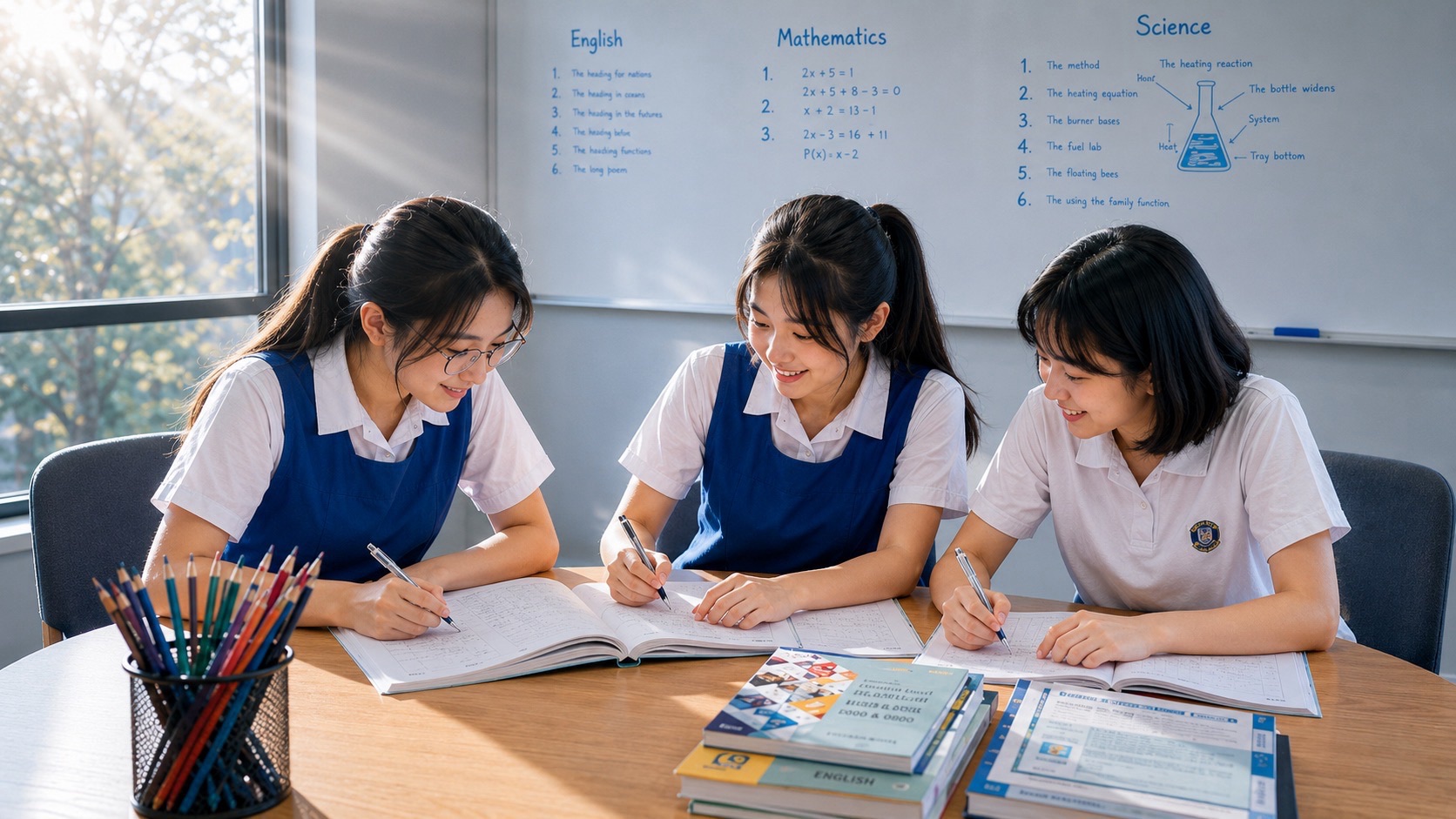
Punggol Secondary 1 English Tuition Near Waterway Point | 3-Pax Small Group English Tuition
Secondary 1 English Is Where a New Kind of English Begins
Secondary 1 is an interesting year.
For many students, nothing appears dramatically wrong at first.
They have completed the PSLE. They can read. They can write compositions. They know grammar. They have learnt vocabulary for yegins.
The passages become more sophisticated.
Questions expect greater precision.
Writing requires more maturity.
Vocabulary must sound natural rather than memorised.
Students are increasingly expected to understand not only what a text says, but what it implies, why a writer has chosen certain words, how tone changes meaning and how ideas should be evaluated.
That is when some parents begin to notice something.
Their child may still be reasonably good at English.
But being reasonably good is no longer producing reasonably good results.
This is precisely why Secondary 1 English matters so much.
At eduKate Singapore in Punggol, our Secondary 1 English Tuition is designed as a serious foundation year: a time to strengthen language, sharpen thinking and establish the habits students will need throughout secondary school.
Our classes are deliberately kept to small groups of 3 students, allowing the tutor to see how each student reads, thinks, writes and responds.
Because English is not improved simply by completing more worksheets.
It improves when someone can see why the student is getting things wrong.
And then teaches them how to do it better.
Secondary 1 English Tuition in Punggol: What Changes After Primary 6?
One of the biggest misunderstandings about Secondary 1 English is that it is simply Primary 6 English made slightly harder.
It is not.
The transition is more fundamental.
Primary-school English establishes important foundations in comprehension, composition, grammar, vocabulary, listening and oral communication.
Secondary English begins asking students to use those foundations with greater independence and sophistication.
A student may now have to:
- understand increasingly complex texts;
- infer meaning that is not directly stated;
- distinguish fact, opinion, attitude and implication;
- recognise tone and purpose;
- explain ideas precisely;
- organise longer and more mature pieces of writing;
- adapt language to audience, purpose and context;
- develop stronger vocabulary without sounding artificial;
- communicate ideas logically and persuasively;
- read beyond the literal meaning of words.
The Ministry of Education’s current Secondary English Language syllabus emphasises the development of increasingly sophisticated productive skills, close and critical reading, listening and viewing, as well as the ability to respond thoughtfully through speaking, writing and representation. Vocabulary is also developed for purposeful, context-appropriate use rather than as isolated word memorisation. an important distinction.
Secondary English is increasingly about thinking through language.
The better a student thinks, the better the student can understand.
The better the student understands, the better the student can answer.
And the better the student controls language, the more accurately those ideas can be expressed.
That is the work we begin in Secondary 1.
Why Students Who Were Good at Primary English Can Suddenly Struggle
Parents sometimes tell us:
“My child was doing quite well in Primary 6. Why is English suddenly becoming difficult?”
Usually, the child has not suddenly become weaker.
The demands have changed.
There are several common reasons.
1. Their reading is still too literal
A student reads:
Daniel glanced at the clock for the third time and began drumming his fingers against the table.
A literal reader sees:
Daniel looked at a clock and moved his fingers.
A stronger reader sees:
Daniel is probably impatient, nervous, restless or waiting anxiously for something.
Secondary English increasingly rewards the second kind of reading.
Students must learn to gather evidence, notice details and infer carefully.
That ability does not appear automatically.
It must be trained.
2. Their vocabulary is large enough to recognise, but not strong enough to use
There is an important difference between knowing a word and owning a word.
A student may recognise:
- apprehensive
- reluctant
- indignant
- meticulous
- dismissive
But can the student use each word naturally?
Can the student distinguish nervous from apprehensive?
Can the student recognise when furious is too strong?
Can the student choose language appropriate to a formal email, personal recount, discussion or argumentative response?
Strong vocabulary is not about inserting impressive words everywhere.
It is about having the right word available at the right moment.
That requires depth.
3. Their writing still depends on primary-school formulas
Some students enter Secondary 1 carrying a collection of memorised phrases:
The sun shone like a golden ball in the azure blue sky.
My heart was pounding like a sledgehammer.
Time flew at the speed of light.
These phrases may once have helped a young writer begin.
But mature writing requires something more.
A good secondary-school writer must learn to select details intelligently.
Instead of decorating every sentence, the student learns to create meaning.
Instead of:
I was extremely nervous and my heart was pounding very fast.
A more controlled writer might write:
I reread the message. Then I read it again, hoping the words would somehow change.
Nothing extravagant.
But we understand the emotion immediately.
That is maturity.
Good English Is Quietly Precise
At higher levels of English, the strongest writing is rarely the writing with the greatest number of difficult words.
It is the writing where everything feels deliberate.
The right noun.
The right verb.
The right detail.
The right sentence length.
The right amount of information.
The reader never has to struggle to understand what the writer means.
We teach students to move away from trying to sound clever.
We teach them to become clear enough that intelligence becomes visible naturally.
That distinction becomes increasingly important from Secondary 1 onwards.
What We Teach in Punggol Secondary 1 English Tuition
Our Secondary 1 English Tuition programme develops several abilities together.
They should not be treated as isolated chapters because they support one another.
Reading and Comprehension
Students learn to read actively rather than simply moving their eyes across a passage.
We train them to notice:
- context;
- key information;
- relationships between ideas;
- cause and effect;
- contrast;
- tone;
- attitude;
- purpose;
- implied meaning;
- evidence;
- language choices.
A comprehension question is not simply asking:
“Did you read the passage?”
It is often asking:
“Did you understand exactly what happened here, and can you prove it?”
That is a very different skill.
Students learn to return to the text, locate evidence, interpret what it means and construct an answer that responds precisely to the question.
We Teach Students to Read the Question Too
A surprising number of comprehension errors are not caused by poor reading.
They are caused by poor answering.
Consider the difference between:
What did the character do?
and
Why did the character do it?
and
What does this suggest about the character?
The evidence may come from the same paragraph.
But these are three different thinking tasks.
One asks for an action.
One asks for motivation.
One asks for inference.
Students who do not recognise the difference may know the passage perfectly and still lose marks.
We therefore teach students to understand the architecture of questions.
Before answering:
What exactly am I being asked to produce?
That small habit can make an enormous difference.
Secondary 1 Composition Writing
Writing improves when students stop seeing composition as one giant mysterious task.
A strong composition is built from smaller decisions.
What is the central idea?
Whose perspective are we following?
Where should the story begin?
What should the reader know now?
What should be withheld?
Which moment deserves more detail?
Where should the pace accelerate?
Where should it slow down?
What changes by the end?
This makes writing teachable.
Students learn to plan before they write so that creativity has direction.
Ideas Before Decoration
One of our priorities is helping students develop better ideas.
Weak writing often looks like a vocabulary problem.
It may actually be an idea problem.
Imagine a student writing about friendship.
A simple story might be:
My friend lost her wallet. I helped her find it. She thanked me. We became better friends.
There is nothing technically wrong with it.
But there is very little to explore.
A stronger writer might ask:
What happens if the narrator had previously argued with this friend?
What happens if finding the wallet requires the narrator to give up something important?
What happens if the narrator initially chooses not to help?
Now we have:
- conflict;
- motivation;
- choice;
- consequence;
- character development.
Better writing begins with better thinking.
Vocabulary then helps the student express that thinking.
It should not be used to hide the absence of it.
Situational and Functional Writing
Students must also learn that writing changes according to:
- audience;
- purpose;
- context;
- relationship;
- tone.
Writing to a close friend is different from writing to an organisation.
Persuading is different from informing.
Explaining is different from requesting.
A strong student does not simply memorise a format.
The student understands:
Who am I speaking to, what do I need this person to understand or do, and how should I communicate accordingly?
Once students understand this, writing becomes much more logical.
Format matters.
But communication matters more.
Vocabulary for Secondary 1 English
Vocabulary is one of the most powerful long-term investments a Secondary 1 student can make.
It affects almost everything.
A stronger vocabulary helps students:
- understand harder passages;
- detect subtle differences in meaning;
- infer more accurately;
- express ideas precisely;
- write with greater maturity;
- understand other academic subjects;
- communicate more confidently.
But vocabulary learning should not become:
Word + definition + memorise + forget.
Students need relationships.
Take:
angry
Around that idea we might develop:
- annoyed
- irritated
- frustrated
- indignant
- furious
- resentful
- exasperated
These words are related.
But they are not interchangeable.
Someone can be indignant because they believe they have been treated unfairly.
Someone can be frustrated because repeated attempts have failed.
Someone can be resentful because an unpleasant feeling has remained over time.
Understanding these distinctions gives students precision.
And precision is one of the great markers of sophisticated English.
Grammar Still Matters in Secondary 1
Grammar becomes more valuable as ideas become more complex.
A student may have excellent ideas.
But weak grammar can blur them.
Common problems include:
- tense inconsistency;
- subject-verb agreement;
- sentence fragments;
- run-on sentences;
- awkward pronoun references;
- punctuation errors;
- poorly controlled clauses;
- unclear sentence structures.
We do not treat grammar merely as a collection of correction exercises.
Students need to understand how grammar creates meaning.
Consider:
When Sarah arrived, Amelia left.
and:
Amelia had left before Sarah arrived.
and:
As soon as Sarah arrived, Amelia left.
The events may be related.
But the timing, emphasis and implication change.
Grammar is not decoration.
It is engineering.
It determines how meaning is assembled.
Speaking, Listening and Communication
English is larger than an examination paper.
A student who has good control of English should increasingly be able to:
- explain an idea clearly;
- respond thoughtfully;
- listen carefully;
- organise thoughts before speaking;
- adapt language to different situations;
- consider another person’s perspective;
- discuss rather than merely answer.
These abilities matter in school.
They also matter far beyond school.
Presentations.
Group projects.
Interviews.
Leadership.
Further education.
Work.
Relationships.
English is one of the principal tools through which a student makes thinking visible.
That is why we take its development seriously.
Secondary 1 Under Full Subject-Based Banding
Singapore’s secondary-school structure has changed significantly since the original version of this article was written.
From the 2024 Secondary 1 cohort, the former Express, Normal (Academic) and Normal (Technical) stream structure was replaced by Full Subject-Based Banding. Students are posted through Posting Groups and may study subjects at different G1, G2 or G3 levels according to their learning needs and strengths. es one principle especially important:
Teach the student in front of us.
Two Secondary 1 students can be the same age and yet require very different help.
One may need to repair grammar.
Another may read fluently but struggle with inference.
Another may have excellent ideas but cannot organise them.
Another may already be strong and need greater intellectual challenge.
Another may have lost confidence after finding Secondary 1 unexpectedly demanding.
The label “Secondary 1” tells us where the student is in school.
It does not tell us exactly where the student is in English.
We have to discover that.
Why Our Secondary 1 English Classes Are Kept to 3 Students
English contains a problem that large classes struggle to solve.
Students can produce the same wrong answer for completely different reasons.
Imagine three students answer a comprehension question incorrectly.
Student A did not understand one word.
Student B understood every word but missed the inference.
Student C understood the passage perfectly but answered a different question from the one asked.
Same result:
Wrong answer.
Three different causes.
Giving all three students another identical worksheet may not solve anything.
The tutor must see the thinking behind the mistake.
That is where a very small class becomes valuable.
With only 3 students, we can pay much closer attention to:
- how a student interprets a question;
- how ideas are organised;
- recurring grammar errors;
- vocabulary limitations;
- reading behaviour;
- writing habits;
- confidence;
- misconceptions;
- examination technique.
We are not simply marking the final answer.
We are watching the process that created it.
That tells us what to teach next.
Small Does Not Mean Easy
Our classes are small so that teaching can become more demanding, not less.
When there are only 3 students, it becomes difficult to disappear.
The tutor can ask:
Why?
Show me where you found that.
What makes you think this?
Is there another interpretation?
Which word proves your answer?
Can you say that more precisely?
What would happen if we changed this sentence?
Students have to think.
They have to explain.
They have to revise.
They have to improve.
Over time, this develops something more valuable than the ability to complete worksheets.
It develops independence.
We Teach From Where the Student Actually Is
Some Secondary 1 students arrive with excellent foundations.
We stretch them.
Their work may focus increasingly on:
- nuance;
- sophisticated interpretation;
- precision;
- mature vocabulary;
- stronger argument;
- stylistic control;
- more complex texts.
Other students arrive with gaps.
We repair them.
There is no embarrassment in going backwards briefly to move forward properly.
A weak foundation does not become strong because everyone agrees to ignore it.
If sentence construction is weak, fix it.
If vocabulary is limited, build it.
If comprehension is literal, train inference.
If writing lacks structure, teach structure.
If the student does not know why marks are being lost, show them.
Progress begins with an honest understanding of the problem.
The Four-Year View Begins in Secondary 1
Secondary 1 should not be treated as a year to relax simply because major national examinations appear far away.
Nor should it become four years of examination anxiety.
There is a better approach.
Use Secondary 1 to build.
A student who develops strong habits early has time on their side.
Build:
Reading Depth
Learn to read beyond the surface.
Vocabulary
Accumulate language steadily rather than cramming later.
Writing Control
Learn structure, clarity and expression before upper-secondary demands increase.
Grammar Accuracy
Remove recurring errors early.
Critical Thinking
Learn to question, infer, compare and evaluate.
Communication
Become comfortable explaining ideas clearly.
These abilities compound.
A vocabulary learned in Secondary 1 remains useful in Secondary 2.
A reading habit developed in Secondary 1 supports comprehension later.
A student who learns how to structure an argument can use that skill repeatedly.
Good education compounds quietly.
That is why foundations matter.
Preparing for the SEC Era
Singapore’s national secondary qualification moves into the Singapore-Cambridge Secondary Education Certificate, or SEC, from 2027, with subjects examined at the respective G1, G2 and G3 levels. SEAB states that the SEC continues the recognised examination standards while reflecting the different subject levels taken by students. condary 1 student, however, the best preparation is not to begin obsessing over a final examination years too early.
It is to become genuinely good at English.
Learn to read carefully.
Learn to think.
Learn to explain.
Learn to write.
Learn to choose language precisely.
Learn to correct mistakes.
Learn to communicate with confidence.
When these foundations are strong, examination preparation later becomes much more manageable.
We would rather build the student first.
Then train the examination performance on top of something solid.
What Parents Often Notice First
Progress in English does not always appear as a dramatic overnight jump in marks.
Sometimes the first improvements are quieter.
A child who once said:
“I don’t know what to write.”
starts producing ideas independently.
A student who guessed comprehension answers begins underlining evidence.
A student who used ten impressive adjectives begins choosing one accurate one.
A reluctant reader starts noticing why a writer used a particular phrase.
A child who once waited for the tutor to correct everything begins spotting mistakes alone.
These are important moments.
They show that something deeper is changing.
The student is beginning to take control of the language.
Marks usually matter to families.
They matter to us too.
But sustainable marks are usually the visible result of stronger abilities underneath.
We work on those abilities.
When Should a Child Start Secondary 1 English Tuition?
There is no single answer for every student.
But there are several useful situations.
Before Secondary 1
This can be valuable for students who want to make the Primary 6 to Secondary 1 transition more smoothly.
Instead of waiting for the first difficult assessment to discover the gap, students can begin adjusting to:
- more mature texts;
- deeper comprehension;
- secondary-level vocabulary;
- more independent writing.
Early Secondary 1
This is often an excellent time.
The student is beginning a new academic stage, so new habits can be established before weaker ones become entrenched.
After the First Poor Result
A disappointing result is information.
Do not panic.
Find out why.
Was it:
- comprehension?
- vocabulary?
- grammar?
- time management?
- answering technique?
- writing?
- lack of revision?
- misunderstanding of the question?
Once the cause is clear, the problem becomes much easier to approach intelligently.
When the Student Is Already Doing Well
Tuition does not have to exist only because something is broken.
A capable student may benefit from:
- more challenging reading;
- stronger writing;
- richer vocabulary;
- greater precision;
- advanced interpretation;
- intellectual discussion.
For strong students, the question becomes:
How good can this become?
That is a very different kind of education.
What Makes a Good Secondary 1 English Tutor?
A good English tutor should do more than provide answers.
The tutor should be able to see the gap between:
what the student currently does
and
what stronger students do differently.
Then make that difference teachable.
A good tutor should be able to explain:
Why is this answer incomplete?
Why is this word inappropriate?
Why does this paragraph feel weak?
Why is this introduction ineffective?
Why does the reader not believe this character?
Why is this inference unsupported?
Why does this sentence sound awkward?
Most importantly:
What should the student do instead?
“Try harder” is not a teaching method.
“Write better” is not instruction.
“Add more vocabulary” is not enough.
Students need specific guidance they can act upon.
That is how improvement becomes repeatable.
English Tuition Should Eventually Make the Student More Independent
The purpose of good tuition is not to make a student permanently dependent on tuition.
It should gradually build a student who can:
- notice problems independently;
- analyse questions;
- select strategies;
- edit writing;
- recognise weak reasoning;
- improve vocabulary;
- read critically;
- learn from mistakes.
At the beginning, the tutor may do much of the guiding.
Over time, the student should take over more of that thinking.
That is progress.
The student is not merely becoming better at English.
The student is becoming better at learning English.
That difference lasts.
A Calm Place to Become Better
Secondary school is already busy.
There are more subjects.
New teachers.
New classmates.
CCAs.
Longer school days.
New expectations.
Growing independence.
Students do not need tuition to become another source of noise.
A good learning environment should feel focused.
Clear.
Warm.
Serious when necessary.
Enjoyable when possible.
The student should know:
I can ask.
I can make mistakes here.
Someone will notice where I am stuck.
Someone will explain it properly.
And I will be expected to improve.
That balance matters.
Students learn well when they feel safe enough to attempt difficult things and challenged enough not to remain comfortable.
Why Families Choose eduKate Singapore for Secondary 1 English Tuition in Punggol
We keep the idea simple.
3 Students Per Class
A deliberately small learning environment where the tutor can see the individual student.
Teach the Foundations Properly
We do not rush past weaknesses simply to keep up appearances.
Build Real English Ability
Reading, vocabulary, grammar, writing, thinking and communication are developed together.
Prepare for School and Beyond
We help students perform better academically while building language that remains useful long after an examination.
Challenge Strong Students
Students who are already capable should not spend every lesson repeating what they already know.
Give Struggling Students a Way Forward
A weak result is not a personality.
It is a starting point.
Find the cause.
Teach the missing skill.
Practise intelligently.
Improve.
Punggol Secondary 1 English Tuition Near Waterway Point
For families looking for Secondary 1 English Tuition in Punggol, eduKate Singapore provides small-group English tuition at:
eduKate Singapore
83 Punggol Central, Singapore 828761
Classes are by appointment.
Our Punggol location serves families looking for Secondary English tuition in the Punggol area, including students from Punggol Central and the wider Punggol and Sengkang communities.
Our Secondary English classes are kept to 3 students per class.
This is intentional.
English is personal.
Every student has a different vocabulary.
A different reading history.
Different writing habits.
Different gaps.
Different strengths.
Different ways of thinking.
The smaller the class, the easier it becomes to see the student clearly.
And once we can see clearly, we can teach intelligently.
Frequently Asked Questions About Secondary 1 English Tuition in Punggol
Is Secondary 1 English much harder than Primary 6 English?
The transition is significant because students are expected to become more independent and analytical.
They encounter more sophisticated texts and are increasingly expected to infer, interpret, evaluate and express ideas with greater precision.
Students with strong foundations often adapt quickly.
Others may need time and structured guidance.
My child did well for PSLE English. Does he or she still need tuition?
Not necessarily.
A student who is progressing strongly and independently may not need additional help.
However, some strong students attend tuition because they want greater challenge, stronger writing, deeper vocabulary or more advanced reading.
The question is not simply:
“Does my child need tuition?”
A better question is:
“What does my child need next?”
Sometimes the answer is tuition.
Sometimes it is simply more reading and independent practice.
The important thing is to identify the next useful step.
My child dislikes English. Can tuition help?
Often, dislike has a reason.
Sometimes the student is struggling.
Sometimes English feels vague because nobody has explained how to improve.
Sometimes the student has repeatedly written compositions only to receive comments such as:
“More details.”
“Improve expression.”
“Weak vocabulary.”
Those comments may be correct.
But the student may still have no idea what to do next.
When improvement becomes concrete, English can become much less frustrating.
Do you focus only on examinations?
No.
Examinations matter, and students should know how to perform well in them.
But examination performance should sit on top of strong language ability.
We develop:
- comprehension;
- writing;
- grammar;
- vocabulary;
- reading;
- communication;
- critical thinking;
- examination technique.
A student who genuinely becomes better at English usually becomes easier to prepare for examinations.
Why only 3 students?
Because detailed language work requires attention.
We want time to look closely at:
- individual writing;
- recurring mistakes;
- comprehension reasoning;
- vocabulary;
- questions;
- progress.
Three students also allow interaction.
Students can hear other interpretations, discuss ideas and learn collaboratively without disappearing into a large room.
Can you help a weak Secondary 1 English student?
Yes, provided we first understand what “weak” means.
There is no single weak-English problem.
A student may struggle because of:
- vocabulary;
- grammar;
- comprehension;
- reading habits;
- writing structure;
- confidence;
- answering technique;
- accumulated foundation gaps.
The solution depends on the cause.
That is why diagnosis comes before acceleration.
Can you help a strong student aim higher?
Yes.
For stronger students, the work changes.
We can focus more deeply on:
- sophisticated interpretation;
- mature expression;
- nuanced vocabulary;
- advanced writing;
- precision;
- critical reading;
- argument and reasoning.
The goal is not to give a strong student more of the same work.
It is to increase the quality of the thinking.
The Best Time to Build English Is Before It Becomes Urgent
There is a familiar pattern in education.
A student struggles.
The marks fall.
Everyone becomes worried.
Then a great deal of energy is spent trying to repair everything quickly.
Sometimes that urgency is unavoidable.
But when we have time, there is a better way.
Build quietly.
Read.
Learn words.
Write.
Discuss ideas.
Correct mistakes.
Try again.
Become a little better each week.
English develops beautifully this way because language compounds.
One new word connects to another.
One book makes the next book easier.
One strong writing habit improves hundreds of future paragraphs.
One lesson in inference changes how a student reads many passages.
Secondary 1 gives us something precious:
time.
Used properly, it can become one of the most valuable years in a student’s English education.
Start Secondary 1 English Properly
Your child does not need to know everything on the first day of Secondary 1.
That is what the next few years are for.
But this is the year to begin building the right things.
A strong reader.
A precise writer.
A thoughtful speaker.
A student with growing vocabulary.
A learner who knows how to think through a question instead of guessing.
A young person who can take an idea in the mind and express it clearly enough for another human being to understand.
That is what good English eventually becomes.
Not merely a subject.
A capability.
And capabilities, when built properly, travel with a child for life.
Secondary 1 English Tuition Punggol — Small Groups of 3 Students
For enquiries about Punggol Secondary 1 English Tuition, class availability and consultations:
eduKate Singapore
83 Punggol Central
Singapore 828761
Call / WhatsApp: +65 8823 1234
Classes are by appointment and places are limited by our 3-student small-group format.
Start early enough that we have time to build properly—not simply enough time to repair before the next examination.
