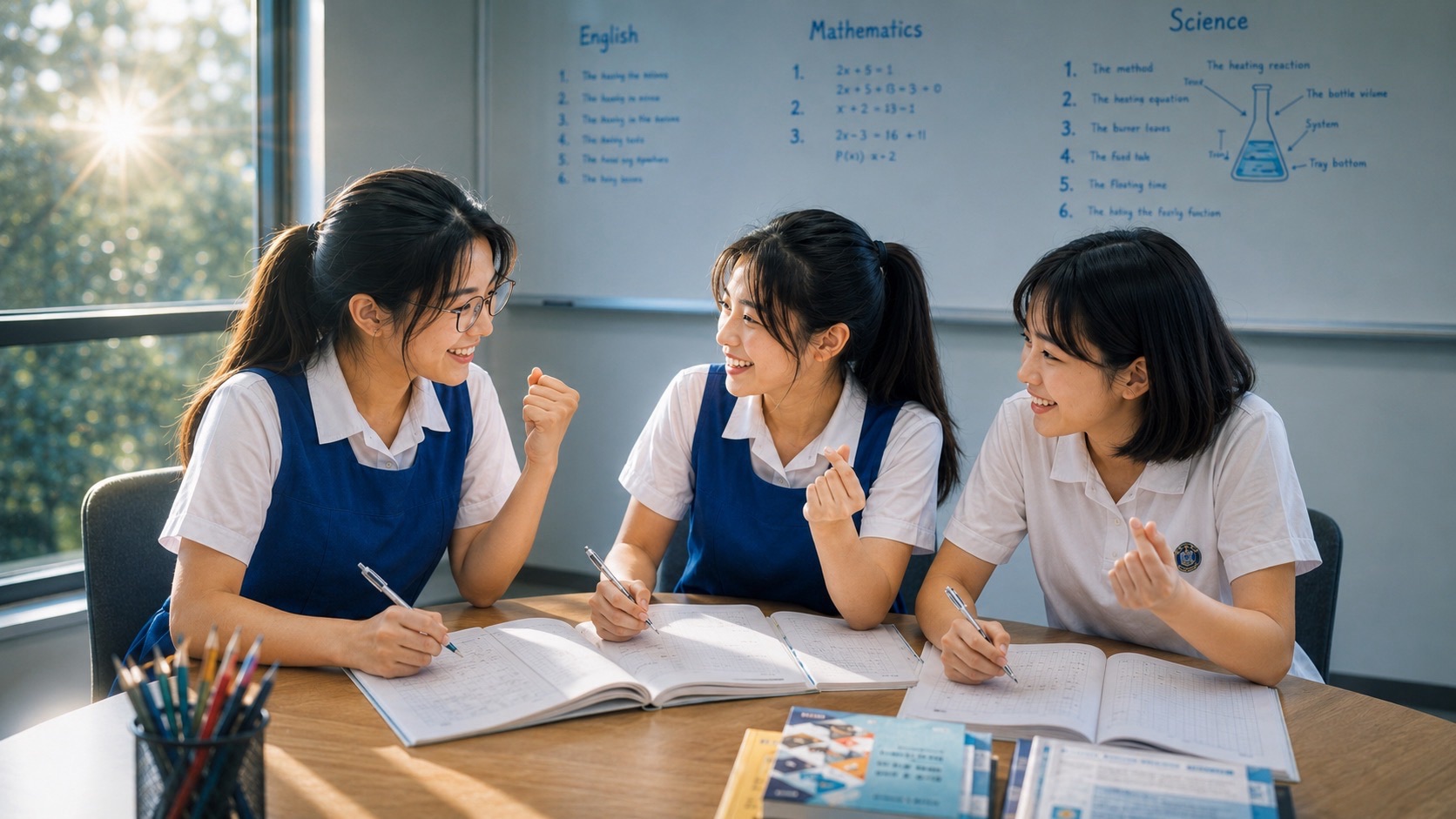
Punggol Secondary 3 Mathematics Tuition Centre | 3-Pax Small Group Math Tutor
Secondary 3 is the year Mathematics changes shape.
In Secondary 1 and Secondary 2, students can often progress by learning one topic at a time. They study a method, complete a set of similar questions and prepare for the next test.
By Secondary 3, this approach becomes less reliable.
Questions become longer. Algebra appears inside geometry. Graphs must be interpreted before an equation can be formed. Trigonometry may require careful diagram reading, accurate substitution and several connected steps. Students must decide which method to use rather than simply repeat the method shown in class.
This is why some capable students experience an unexpected fall in Secondary 3 Mathematics.
They may know the individual chapters, yet still struggle to connect them.
At eduKate Singapore, our Punggol Secondary 3 Mathematics tuition is conducted in carefully managed three-student small groups. Lessons are designed to help students understand the new Upper Secondary standard, repair earlier weaknesses and build the mathematical control required for Secondary 4 and the national examination year.
The aim is not merely to finish more worksheets.
It is to help the student think clearly, work accurately and become increasingly independent.
Secondary 3 Is the Beginning of Upper Secondary Mathematics
Secondary 3 is not simply another school year with a few additional chapters.
It is the point where Mathematics becomes more formal, connected and demanding.
Students are expected to:
- manipulate algebra accurately;
- understand functions, equations and graphs;
- translate written information into mathematical form;
- connect ideas across different topics;
- explain or justify their reasoning;
- present essential working clearly;
- solve unfamiliar problems in real-world contexts; and
- maintain accuracy across longer questions.
The current G3 Mathematics syllabus is organised around three broad strands: Number and Algebra, Geometry and Measurement, and Statistics and Probability. It also places clear emphasis on reasoning, communication, application and mathematical modelling. (Isomer User Content)
This means a student cannot depend only on memorised procedures.
They must recognise the structure of a question, select the correct route and carry the solution through without losing control of the details.
That is the real Secondary 3 transition.
Secondary 3 Mathematics Under Full Subject-Based Banding
Secondary school education in Singapore now operates under Full Subject-Based Banding.
Students are posted through Posting Groups 1, 2 and 3, while individual subjects may be studied at G1, G2 or G3 according to the student’s readiness and learning needs. The former Express, Normal (Academic) and Normal (Technical) streams are being replaced by this more flexible structure. (Ministry of Education)
For parents, the important question is no longer simply which stream a child is in.
The more useful questions are:
- At what level is the child studying Mathematics?
- Are the lower-secondary foundations secure?
- Can the child keep pace with the current school curriculum?
- Is the child ready for the standard of reasoning expected at Upper Secondary?
- Does the child need repair, consolidation or further challenge?
Two students taking Mathematics at the same subject level may still require very different tuition.
One may be struggling because of weak algebra from Secondary 2. Another may understand the concepts but lose marks through rushed working. A third may already be performing well and need stronger mixed problems to move towards a distinction.
Good tuition begins by identifying which student is sitting in front of us.
Why Secondary 3 Mathematics Can Feel Suddenly Difficult
Parents often tell us that their child was managing reasonably well in Secondary 2 but began struggling soon after entering Secondary 3.
This can happen for several reasons.
The Questions Become More Connected
A question may begin as a graph problem, require algebraic manipulation and end with an interpretation of the answer.
The difficulty is not always the individual calculation.
The difficulty is seeing how the different parts fit together.
Algebra Becomes the Working Language
Weak algebra affects almost every part of Upper Secondary Mathematics.
A student who is uncertain about expansion, factorisation, algebraic fractions, equations or changing the subject of a formula may struggle with graphs, coordinate geometry, trigonometry and later topics.
An algebra weakness is rarely contained within one chapter.
It travels.
Students Must Select the Method
At lower levels, the chapter heading often tells the student what to do.
In a mixed examination, that clue disappears.
The student must decide:
- What information has been provided?
- What is the question asking for?
- Which mathematical relationship applies?
- What should be calculated first?
- How should the answer be presented?
A student can remember many formulas and still become stuck because the route is unclear.
Essential Working Matters
Upper Secondary Mathematics is not assessed only by the final answer.
The official G3 Mathematics examination requirements state that omitting essential working can result in the loss of marks. The examination also expects students to handle both shorter questions and longer problems, including an extended real-world application in Paper 2.
Students therefore need to learn how to present a solution that another person can follow.
Neat working is not decoration.
It is part of mathematical communication.
Mistakes Begin to Accumulate
A missed negative sign, an inaccurate substitution or an incorrect algebraic step can affect everything that follows.
When questions become longer, small errors become expensive.
Students need a reliable checking process rather than simply hoping that the answer is correct.
The Three Main Secondary 3 Mathematics Journeys
Not every student enters tuition for the same reason.
Our Punggol Secondary 3 Mathematics tuition generally supports three broad journeys.
1. Recovering After a Fall
Some students enter Secondary 3 and experience a sharp drop in marks.
They may feel that Mathematics has suddenly become too difficult. In many cases, however, the problem is not a lack of intelligence. The new syllabus may have exposed an earlier weakness that was manageable when questions were shorter.
These students may need to:
- repair algebraic manipulation;
- relearn essential Secondary 1 and Secondary 2 concepts;
- slow down and organise their working;
- rebuild confidence through carefully graded questions; and
- return to the current school topic without leaving the foundation unresolved.
The first goal is stability.
Once the student can understand the lesson, complete the basic methods and follow a solution independently, progress becomes much more realistic.
2. Moving from Average Results Towards a Distinction
Some students understand most school lessons but remain around the middle of the class.
Their work may contain frequent careless errors. They may perform well in topical exercises but struggle in examinations. They may also know how to begin a question but fail to complete it efficiently.
These students usually need stronger control rather than complete reteaching.
We work on:
- identifying the correct route more quickly;
- connecting topics through mixed practice;
- reducing repeated errors;
- improving mathematical presentation;
- strengthening checking habits;
- recognising common question structures; and
- completing papers with better time control.
The difference between an average script and a distinction script is often not one brilliant idea.
It is the consistent removal of avoidable losses.
3. Preparing a Strong Student for More Demanding Pathways
A student who is already doing well also needs an appropriate level of training.
Simply giving more routine work may create volume without creating growth.
Stronger students need questions that require them to compare methods, explain decisions, work across topics and handle unfamiliar situations without becoming careless.
The aim is to develop:
- flexible problem-solving;
- deeper conceptual understanding;
- efficient solution selection;
- accuracy under time pressure;
- confidence with unfamiliar questions; and
- readiness for Additional Mathematics or more mathematically demanding post-secondary pathways.
A distinction should not be treated as the end of learning.
It can become the foundation for the next level.
What We Cover in Secondary 3 Mathematics Tuition
The exact order of topics can differ between schools. Tuition therefore needs to remain aligned with the student’s school progress while preserving the connections across the syllabus.
Depending on the student’s subject level and school sequence, Secondary 3 Mathematics support may include:
Algebraic Expressions and Formulae
Students learn to expand, simplify and factorise expressions, work with algebraic fractions, use algebraic identities and manipulate formulae accurately.
We pay close attention to line-by-line working because algebraic errors often affect several later topics.
Equations and Inequalities
Students may work with linear equations, simultaneous equations, quadratic equations, fractional equations and inequalities.
The objective is not only to solve the equation but also to understand how the equation was formed and why a particular method is appropriate.
Functions and Graphs
Students study relationships between variables through linear, quadratic, power and exponential graphs.
They need to understand gradients, intercepts, turning points, symmetry and the relationship between an equation and its graph.
Graph work becomes much easier when students stop seeing each feature as an isolated fact and begin to understand the structure represented by the graph.
Coordinate Geometry
Students learn to work with gradients, distances, straight-line equations and geometric relationships on the coordinate plane.
This topic draws heavily on algebra. Students who understand the geometry but cannot control the equation may still lose marks.
Congruence and Similarity
Students need to identify corresponding sides and angles, apply proportional reasoning and distinguish clearly between congruent and similar figures.
We teach students to mark diagrams carefully before calculating.
Properties of Circles
Circle questions require students to recognise angle and tangent properties, state the correct reason and use the available information in a logical sequence.
The difficulty is often not remembering the theorem. It is noticing which theorem is relevant within a crowded diagram.
Pythagoras’ Theorem and Trigonometry
Students work with trigonometric ratios, sine and cosine rules, bearings, angles of elevation and depression, and problems in two or three dimensions.
These questions require good diagram interpretation, accurate calculator use and disciplined working.
Mensuration
Students solve problems involving perimeter, area, arc length, sectors, surface area and volume.
Strong students learn to break composite shapes into manageable parts instead of searching for one formula that solves everything immediately.
Vectors
Vectors require students to understand direction, magnitude, position and geometric relationships.
The symbols are compact, but the thinking must remain precise.
Statistics and Probability
Students may work with statistical diagrams, grouped data, measures of central tendency and spread, cumulative frequency, standard deviation and combined probability events.
These topics require both calculation and interpretation. A correct number is not enough when the question asks what the result means.
How Our 3-Pax Secondary 3 Mathematics Tuition Works
A class of three creates a different learning environment from a large lecture-style class.
The tutor can observe each student’s working rather than seeing only the final answer.
This matters because two students can produce the same wrong answer for completely different reasons.
One may have misunderstood the concept. Another may have selected the correct method but made an algebraic error. A third may have copied a value incorrectly from the question.
The correction should not be the same for all three.
Every Student Must Participate
In a very small class, it is difficult for a student to disappear quietly.
Students are expected to show their working, answer questions, explain decisions and ask when something is unclear.
This gives the tutor more information about how each student thinks.
Questions Can Be Adjusted Carefully
One student may require a foundation question before attempting the school exercise. Another may be ready for an examination-level extension.
A three-student format allows the lesson to remain shared without treating all students as identical.
Corrections Can Happen Immediately
A misconception is easier to correct when it first appears.
When the tutor sees an incorrect step, the student can be asked to examine it, understand why it failed and redo the question properly.
The objective is not merely to replace a wrong answer with a correct one.
It is to change the thinking that produced the error.
Students Learn from One Another
A student may discover that a classmate solved the same question using a different valid method.
This creates useful mathematical discussion without turning the class into a crowded environment.
Students learn that Mathematics is not only about reaching the answer. It is also about selecting a clear, efficient and defensible route.
What Happens During a Mathematics Lesson
A productive Secondary 3 Mathematics lesson should do more than provide answers to school homework.
Our lessons generally move through five important stages.
1. Establish the Concept
The student first needs to understand the underlying idea.
We explain what the method does, why it works and how it connects to earlier learning.
This reduces dependence on blind memorisation.
2. Demonstrate a Clear Method
The tutor models an organised solution with complete working.
The student sees how information is extracted, how the route is selected and how each step is presented.
3. Guide the Student Through Practice
Students then attempt related questions with support.
The tutor can ask questions, provide a smaller clue or redirect the student without immediately giving away the whole solution.
4. Correct the Error Properly
When an error appears, we identify its source.
Was it a concept problem, a forgotten formula, a translation problem, an algebra mistake or a checking failure?
Students redo the relevant step so that the correction becomes part of their own working.
5. Return Through Mixed Practice
A student may look confident immediately after a lesson because the method is still fresh.
Real learning becomes visible when the topic returns later among other topics.
Mixed practice tests whether the student can recognise and retrieve the correct method independently.
Why Doing More Questions Is Not Always the Answer
Practice is essential in Mathematics, but volume alone does not guarantee improvement.
A student can complete many questions while repeating the same error.
Another can become highly familiar with one worksheet format but remain unable to solve the topic when it appears differently in an examination.
Useful practice should include:
- questions selected for a clear purpose;
- a progression from foundation to examination standard;
- correction of repeated weaknesses;
- delayed review after the lesson;
- mixed questions from different topics; and
- timed practice when the student is ready.
The purpose of practice is not to make the student busy.
It is to make the student better.
The Importance of an Error Record
Students often describe mistakes as careless without examining why they happened.
“Careless” is too broad to be useful.
A repeated mistake may have a recognisable cause:
- brackets were removed incorrectly;
- the calculator was in the wrong mode;
- a negative value was copied as positive;
- the student used diameter instead of radius;
- the final answer was rounded too early;
- the units were omitted;
- an angle property was used without checking its conditions;
- the student answered a different question from the one asked.
Recording repeated errors helps students detect patterns.
For each important mistake, the student should understand:
- What went wrong?
- Why did it happen?
- What rule will prevent it next time?
- Can the question now be completed correctly without help?
Improvement becomes more reliable when errors are converted into prevention habits.
Secondary 3 Mathematics and Additional Mathematics Are Different
Some Secondary 3 students take both Mathematics and Additional Mathematics.
The subjects are connected, but they should not be treated as the same course.
Mathematics develops broad competence across algebra, geometry, measurement, statistics, probability and real-world applications.
Additional Mathematics moves more deeply into algebraic structures and functions and is particularly important for students considering mathematically demanding pathways later.
A student can perform strongly in one subject and struggle in the other.
When both subjects are taken, the timetable and practice plan must be managed carefully. Additional Mathematics should not consume so much time that the student neglects Mathematics, while Mathematics should not be treated as automatically secure simply because the student is taking the additional subject.
Each paper requires its own preparation.
Preparing for the Singapore-Cambridge SEC Examination
From 2027, the previous N(T), N(A) and O-Level certificates are combined under the Singapore-Cambridge Secondary Education Certificate, or SEC.
Students sit their subjects at the respective G1, G2 or G3 subject levels, and their certificate reflects the subjects and levels taken. The overall examination standards remain aligned with the corresponding previous examination levels. (SEAB)
For Secondary 3 students, this makes the year especially important.
Secondary 4 should not be spent learning the entire Upper Secondary system from the beginning.
By the end of Secondary 3, students should ideally have:
- secure essential algebra;
- dependable basic methods;
- organised mathematical working;
- a functioning correction process;
- experience with mixed-topic questions;
- increasing speed without sacrificing accuracy; and
- enough confidence to begin full-paper preparation in Secondary 4.
Secondary 3 builds the machine.
Secondary 4 trains it for performance.
Signs That Your Child May Need Secondary 3 Mathematics Tuition
A temporary poor result does not always mean that tuition is necessary.
However, support may be useful when several of the following signs appear together:
- marks have fallen significantly since entering Secondary 3;
- the child understands examples but cannot begin questions independently;
- algebraic mistakes appear across many topics;
- homework takes an excessive amount of time;
- the child avoids showing working;
- corrections are copied but not understood;
- the child performs well in topical practice but poorly in mixed tests;
- formulas are memorised without knowing when to use them;
- school lessons feel too fast for questions to be clarified;
- confidence is falling together with performance; or
- the child is doing reasonably well but cannot move beyond the same grade range.
Starting earlier provides time to diagnose, repair and consolidate.
Waiting until Secondary 4 often compresses foundation repair and examination preparation into the same limited period.
What Parents Should Look for in a Secondary 3 Math Tutor
A good Secondary 3 Mathematics tutor should be able to do more than solve difficult questions.
The tutor should be able to see why the student cannot solve them.
Parents may wish to consider whether the tuition programme:
- identifies the student’s actual weak points;
- teaches concepts rather than distributing answers;
- checks the student’s working regularly;
- follows the current Singapore curriculum;
- adjusts the difficulty according to readiness;
- includes mixed and examination-style practice;
- provides a clear correction process;
- maintains a class size that permits genuine attention;
- builds confidence without lowering standards; and
- prepares the student for increasing independence.
A pleasant lesson is valuable.
A pleasant lesson that produces clearer thinking and stronger performance is better.
What Progress Should Look Like
Meaningful improvement is usually visible in stages.
The first sign may not be a dramatic jump in marks.
A student may first begin to:
- attempt questions that were previously left blank;
- show more complete working;
- make fewer repeated algebraic errors;
- ask more precise questions;
- understand school lessons more quickly;
- complete homework with less frustration;
- recognise familiar structures in unfamiliar questions; and
- recover more calmly after making a mistake.
These changes matter because marks are the visible result of many smaller systems working together.
Once understanding, working habits, correction and practice begin to align, stronger results become more sustainable.
Frequently Asked Questions
Is Secondary 3 Mathematics much harder than Secondary 2 Mathematics?
The increase is significant because questions become more connected and students are expected to select methods independently. Earlier weaknesses, especially in algebra, also become more visible.
Is three students really enough to create a group-learning environment?
Yes. Three students allow discussion, comparison of methods and peer learning while remaining small enough for the tutor to inspect each student’s working closely.
Can a weak student join a small group?
A weaker student can benefit when the group is appropriately matched and the tutor is able to provide foundation repair. The student’s present understanding and learning needs should be considered before placement.
Can tuition help a student who is already scoring well?
Yes. Stronger students may need greater question variety, mixed-topic practice, sharper examination control and more demanding reasoning rather than basic repetition.
Should my child take separate tuition for Mathematics and Additional Mathematics?
That depends on the child’s performance and workload. The two subjects overlap in certain skills but have different demands. A student may need support in one, both or neither.
When is the best time to begin Secondary 3 Mathematics tuition?
The best time is when there is a clear need and enough time to work properly. Early intervention is especially useful when lower-secondary algebra is weak or when the student begins falling behind during the first half of Secondary 3.
Will tuition guarantee a distinction?
No responsible tutor can guarantee a particular grade. Results depend on the student’s starting point, attendance, effort, school demands, practice and response to correction. Our role is to provide careful teaching, structured training and the strongest possible conditions for improvement.
Punggol Secondary 3 Mathematics Tuition with eduKate Singapore
At eduKate Singapore, we keep our Secondary Mathematics tutorials deliberately small.
With only three students in a class, we can see how each student approaches a question, correct weaknesses early and provide the appropriate balance of explanation, practice and challenge.
We help Secondary 3 students:
- repair weak foundations;
- understand difficult concepts;
- improve algebraic control;
- organise their mathematical working;
- reduce repeated mistakes;
- connect topics more effectively;
- prepare for school assessments;
- develop examination discipline; and
- work towards distinctions with confidence.
Secondary 3 Mathematics does not become manageable simply because a student receives more work.
It becomes manageable when the student understands what is happening, knows what to do next and has enough guided practice to carry the method independently.
That is the standard we work towards.
Start clearly. Build properly. Move forward with confidence.
For Secondary 3 Mathematics tuition enquiries in Punggol: