Primary 4 Science Specialist | Scientific Inquiry, Variables & Structured Reasoning
This page is a specialist room inside the Primary 4 Connection Year. Its job is narrow: help students turn observations, experiments, tables and diagrams into scientifically justified conclusions.
Observe → identify variables → find the relationship → select evidence → explain the mechanism → conclude.

Why this belongs in Primary 4
Primary 4 is where Science increasingly stops being a list of facts and starts becoming a network of relationships. Students encounter diagrams, changing conditions, measurements, comparisons and experimental setups. The difficulty is often not remembering a chapter. It is knowing what the evidence means.
The inquiry frame
| Question | What the learner should identify |
|---|---|
| What changed? | The variable deliberately changed. |
| What was measured or observed? | The resulting response. |
| What was kept the same? | Conditions needed for a fair comparison. |
| What pattern appears? | The relationship supported by the data. |
| Why did it happen? | The scientific mechanism. |
| What can we conclude? | A claim limited to what the evidence supports. |
Observation is not inference
A common Primary 4 failure is mixing what was directly observed with what the student thinks caused it.
Observation: what the senses or instrument show.
Inference: the explanation constructed from the observation and scientific knowledge.
Keeping these separate makes experiments easier to reason about and prevents students from treating guesses as evidence.
Variables are relationships, not vocabulary
Students do not need to memorise variable labels mechanically. They need to understand the experimental structure:
- Changed variable: what the experimenter deliberately changes.
- Measured/observed response: what is tracked to see the effect.
- Controlled conditions: what must remain comparable so the relationship is interpretable.
Fair test reasoning
A fair comparison asks whether the observed difference can reasonably be linked to the intended changed variable rather than to another uncontrolled difference.
If several important conditions change at once, the experiment becomes harder to interpret.
From data to explanation
For many structured questions, a useful reasoning chain is:
Evidence or condition → scientific mechanism → resulting change.
For example, “The water became warmer” is an observation. A scientific explanation connects the condition to the mechanism: the water gained heat from a hotter source, causing its temperature to increase.
Common inquiry failures
| Visible error | Likely failure | Repair |
|---|---|---|
| Copies numbers but gives no conclusion. | Evidence not converted into relationship. | Ask: what changed together? |
| States a conclusion stronger than the data. | Evidence boundary weak. | Limit the claim to what was actually tested. |
| Confuses observation with explanation. | Representation/model boundary weak. | Separate “what happened” from “why”. |
| Cannot identify a fair test. | Variable structure unclear. | Mark changed, measured and controlled conditions. |
| Handles one familiar diagram only. | Transfer weak. | Rotate, redraw or change the surface context. |
| Uses many keywords but no causal chain. | Expression detached from model. | Evidence → mechanism → result. |
How a three-student inquiry lesson helps
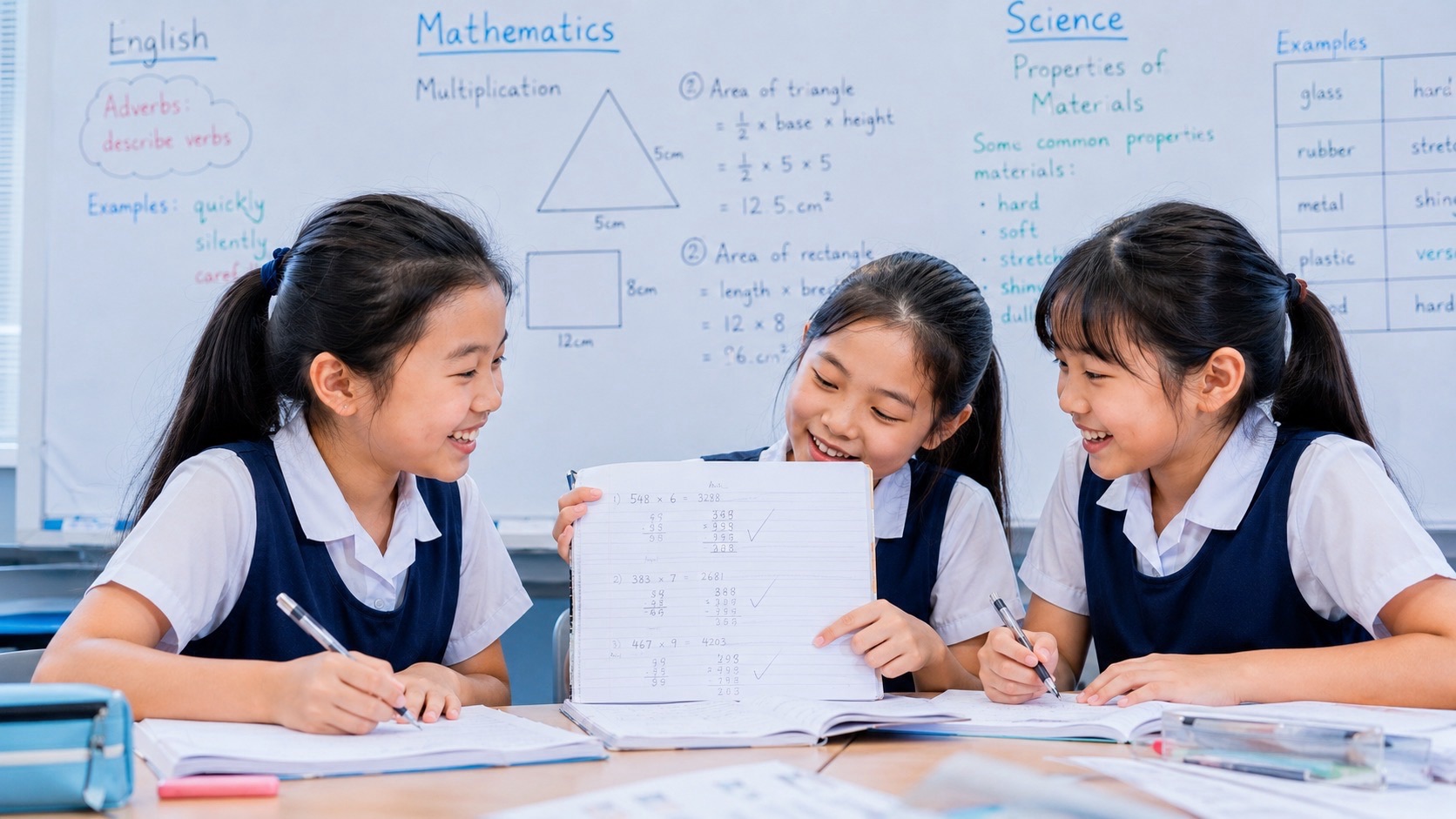
Three learners can inspect the same experiment and produce three different routes: one may misidentify the changed variable, one may read the data correctly but infer too much, and one may understand the mechanism but write an incomplete conclusion.
Same experiment. Different broken connection.
The tutor can compare those routes in real time, repair the specific failure, then give a changed representation to test whether the repair transfers.
A simple transfer test
- Give a familiar experiment and ask the learner to identify the relationship.
- Change the diagram, apparatus or context while preserving the same scientific relationship.
- Remove the chapter label.
- Ask the learner to select the evidence independently.
- Ask for a short explanation using evidence → mechanism → result.
If the reasoning survives the representation change, the connection is becoming usable rather than merely familiar.
Where this specialist room connects
- P4 Development: The Connection Year
- P4 Repair: Find the Broken Connection
- P4 Class Runtime: How a 3-Student Connection Lesson Works
- P4 Tutor Role: Find the Broken Connection
Specialist-room rule
This page survives because scientific inquiry is a distinct capability that cuts across topics. It does not duplicate the entire P4 programme. It makes one important function—turning evidence into justified scientific reasoning—more visible.