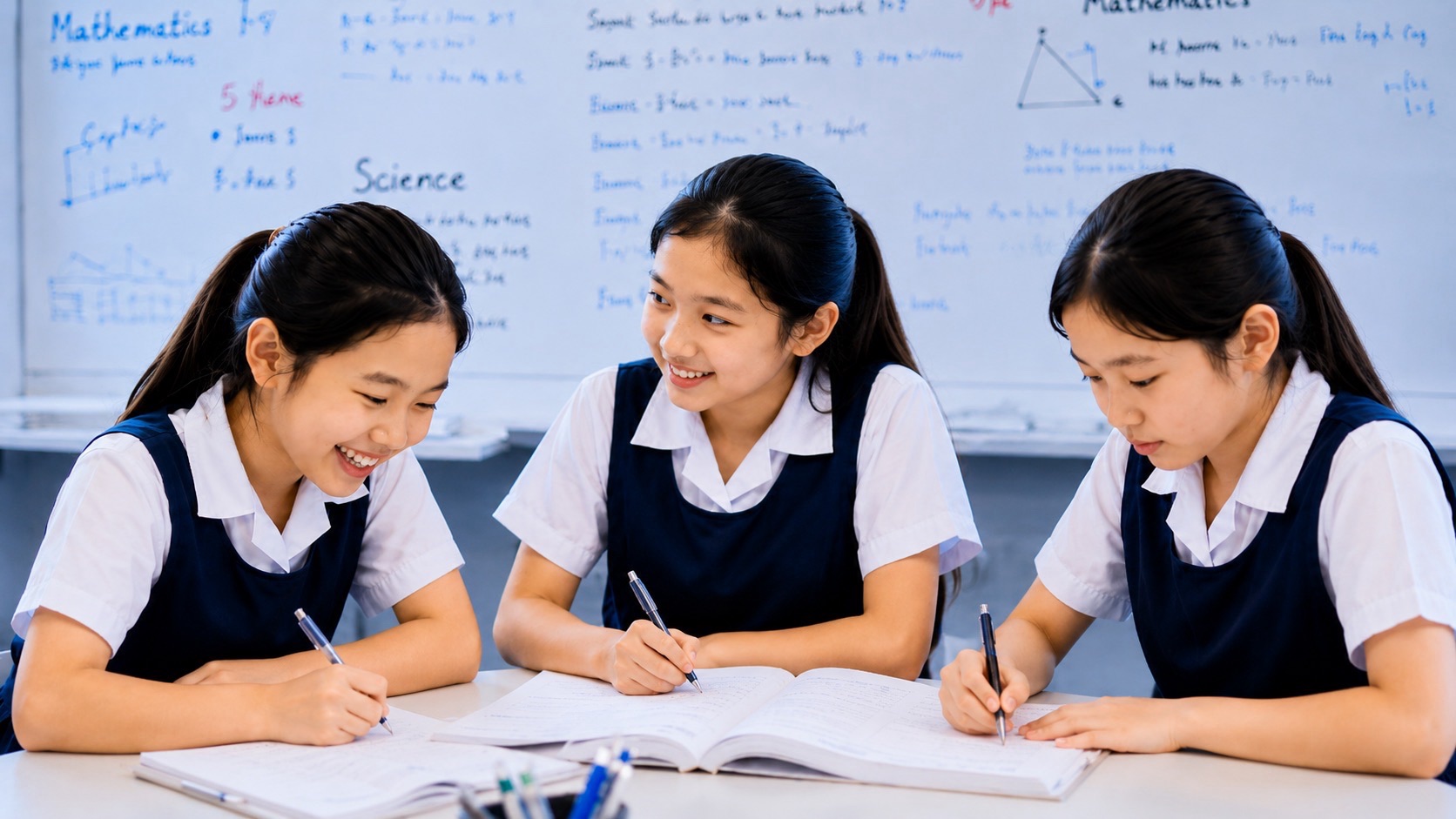
Punggol Secondary 1 Mathematics Tuition: A Stronger Start with an Experienced Sec 1 Maths Tutor
Secondary 1 Mathematics is not simply Primary 6 Mathematics with larger numbers.
It is the beginning of a different way of thinking.
Students must become comfortable with algebra, negative numbers, mathematical notation, geometric reasoning, data interpretation and questions that require several connected steps. They are also expected to present their working clearly, select appropriate methods and recognise when an answer is unreasonable.
For some students, the transition feels natural. For others, the first few months of Secondary 1 can be unexpectedly difficult. A child who performed well in Primary School may suddenly become slower, less certain or more dependent on examples.
This does not necessarily mean that the child is weak in Mathematics.
It often means that the child is still using Primary School methods in a subject that now requires Secondary School thinking.
At eduKate Singapore, our Punggol Secondary 1 Mathematics Tuition helps students make this transition carefully. Lessons are conducted in true small groups of up to three students, allowing the tutor to see how each child thinks, where the hesitation begins and what must be strengthened before the difficulty grows.
The aim is not merely to finish the next worksheet.
It is to give the student a dependable mathematical foundation for Secondary 1, Secondary 2 and the more demanding Mathematics that follows.
Secondary 1 Mathematics Has Changed with Full Subject-Based Banding
Students entering Secondary School today learn within Singapore’s Full Subject-Based Banding framework.
Beginning with the 2024 Secondary 1 cohort, the previous Express, Normal (Academic) and Normal (Technical) streams were removed. Students are now posted through Posting Groups 1, 2 and 3, with greater flexibility to take subjects such as Mathematics at G1, G2 or G3 according to their strengths and progress.
This creates a more flexible education system, but it also makes the child’s actual subject-level readiness more important.
Parents should look beyond the posting group and ask:
- At what subject level is my child taking Mathematics?
- Does my child understand the concepts or merely follow examples?
- Is the algebra foundation secure?
- Can my child explain the working independently?
- Is the present pace suitable?
- Is the child ready to progress to a more demanding subject level?
- Are early weaknesses beginning to affect confidence?
The Singapore-Cambridge Secondary Education Certificate, or SEC, will be implemented from the 2027 graduating cohort. Students will receive one certificate reflecting the subjects and subject levels they take across G1, G2 and G3.
For a Secondary 1 student, this future examination may still appear distant. However, the Mathematics examined at the end of Secondary School is built progressively. Algebra learned in Secondary 1 supports graphs, equations and more complex applications later. Weaknesses that remain unnoticed rarely stay in one chapter.
They travel forward.
A thoughtful Secondary 1 programme therefore does two things at the same time:
- It helps the student perform well in the present school year.
- It prepares the student for the Mathematics that will depend on these foundations later.
Why the Transition from PSLE Mathematics Can Be Difficult
Primary School Mathematics develops important arithmetic and problem-solving abilities. Students learn to work with whole numbers, fractions, percentages, ratios, geometry and structured word problems.
Secondary Mathematics retains these foundations but changes the language used to express them.
Instead of working mainly with known values, students begin working with variables. Instead of relying heavily on visual models, they must become increasingly fluent with symbols, equations and formal mathematical relationships.
The wider Secondary Mathematics curriculum develops across areas such as Number and Algebra, Geometry and Measurement, and Statistics and Probability.
This shift can expose several hidden problems.
A student may be accurate but too dependent on familiar question formats
The child can complete a question after seeing an example but struggles when the wording, diagram or order of information changes.
A student may know arithmetic but not algebra
The child can calculate numerical answers but becomes confused when letters replace numbers.
A student may understand verbally but cannot present the solution
The idea is present, but the written working is incomplete, disorganised or difficult to follow.
A student may be fast but careless
Speed can hide weak checking habits. Once questions become longer, small errors begin to affect several later steps.
A student may be hardworking but inefficient
The child spends many hours practising without understanding why the method works. Familiar questions improve, but unfamiliar questions remain difficult.
A student may have performed well in PSLE Mathematics but still struggle
A good Primary School result is valuable, but it does not automatically guarantee an easy transition. Secondary Mathematics requires a new level of abstraction, precision and independence.
The correct response is not panic.
The correct response is to identify where the transition has become unstable and strengthen it early.
What Students Commonly Learn in Secondary 1 Mathematics
The exact sequence differs between schools and subject levels, but Secondary 1 students generally begin developing stronger abilities in several important areas.
1. Number Sense and Numerical Control
Students work with integers, negative numbers, factors, multiples, prime numbers, approximation, estimation and different forms of numerical representation.
These topics may appear straightforward, but they influence almost every later chapter.
A student who is uncertain with negative signs may struggle in algebra. A student who estimates poorly may not notice an unreasonable calculator answer. A student with weak fraction control may find equations unnecessarily difficult.
We therefore pay close attention to numerical accuracy, not just the final answer.
2. Algebraic Expressions
Algebra is one of the most important changes in Secondary 1.
Students must learn to:
- Understand what variables represent
- Translate words into algebraic expressions
- Simplify expressions
- Expand brackets
- Factorise suitable expressions
- Substitute values accurately
- Work confidently with positive and negative terms
- Distinguish expressions, equations and identities
Algebra should not feel like a collection of mysterious rules.
When taught properly, it becomes an organised language for describing patterns and relationships. Once students understand this language, many later topics become more manageable.
When they do not, Mathematics can begin to feel fragmented.
3. Equations and Mathematical Relationships
Solving an equation is not simply “moving a number to the other side”.
Students need to understand that an equation expresses a balance. Each operation must preserve that balance.
This understanding becomes important when equations grow longer, involve fractions or appear inside word problems.
We teach students to solve equations with clear, legal and repeatable steps. The method should remain reliable even when the question looks unfamiliar.
4. Ratios, Rates, Percentages and Proportion
These concepts extend ideas learned in Primary School, but the questions may become more abstract or involve several relationships at once.
Students need to recognise whether a problem involves:
- A comparison
- A rate
- A percentage change
- Direct proportion
- Scale
- Repeated growth or reduction
- Conversion between different representations
Rather than memorising a separate trick for each question, students learn to identify the mathematical structure beneath the wording.
5. Geometry and Measurement
Secondary geometry requires more than recognising shapes or inserting values into formulas.
Students may need to:
- Interpret diagrams carefully
- Use angle properties
- Reason with lines and polygons
- Work with perimeter, area and volume
- Apply scale and measurement
- Present a sequence of geometric deductions
- Distinguish information given from information inferred
Geometry is especially revealing because it tests whether the student can observe, reason and justify.
6. Data Handling and Statistics
Students learn to read, organise and interpret information presented in tables, charts and graphs.
The challenge is often not calculation alone. Students must decide what the data shows, whether a conclusion is justified and which representation is most appropriate.
This is an increasingly important form of mathematical literacy. It teaches students to read information with care rather than accepting every number at face value.
7. Multi-Step Problem Solving
Secondary Mathematics questions often combine several skills.
A student may need to:
- Understand the situation.
- Identify the relevant information.
- Represent the unknown quantity.
- Select a mathematical method.
- Carry out the working accurately.
- Interpret the answer in context.
- Check whether the answer is reasonable.
Students who rush immediately into calculation frequently become lost halfway through.
We train them to pause, organise and solve with intention.
The Most Important Secondary 1 Mathematics Skill: Algebra Control
Parents often notice the first serious difficulty when algebra begins.
This is understandable. Algebra asks students to move from concrete quantities to symbolic relationships. The child is no longer working only with what is known. The child must reason about what could be known.
A student with good algebra control can:
- Read an expression without becoming intimidated
- Handle signs accurately
- See like terms
- Expand and factorise correctly
- Substitute without losing brackets
- Form equations from written information
- Solve equations systematically
- Check an answer by substitution
- Recognise when an expression can or cannot be simplified
A student with weak algebra control may still obtain reasonable marks in early tests because individual questions remain short. The difficulty becomes more visible when algebra appears inside graphs, geometry, rates and later Secondary Mathematics topics.
This is why algebra should be repaired at the first sign of uncertainty.
It is much easier to correct a small misconception in Secondary 1 than to repair several years of accumulated confusion in Secondary 3 or Secondary 4.
Why Clear Mathematical Working Matters
Many students believe that Mathematics is only about obtaining the correct final answer.
In school assessments, the method matters too.
Clear working allows the student to:
- Receive method marks
- Find an error before completing the question
- Communicate mathematical reasoning
- Return to an unfinished question efficiently
- Check whether each step follows logically
- Avoid copying numbers incorrectly
- Build disciplined examination habits
We teach students to present their work neatly without making it unnecessarily elaborate.
Good working should be concise, complete and easy to verify.
This includes:
- Writing one logical step at a time
- Aligning equations clearly
- Keeping negative signs visible
- Using brackets correctly
- Including units where required
- Avoiding unexplained jumps
- Stating the final answer appropriately
- Checking calculator entries against written working
These habits may seem small in Secondary 1.
By the examination years, they become part of the student’s reliability.
Why “More Practice” Is Not Always the Complete Answer
Practice is essential in Mathematics, but practice must be correctly designed.
Repeating twenty questions with the same format can make a student feel fluent without preparing the student for a different presentation of the same concept.
Effective practice should include several layers.
First: Understand the Concept
The student should know what the method means and why it is appropriate.
Second: Learn the Procedure
The student needs an accurate sequence of steps that can be repeated independently.
Third: Practise for Fluency
The student should complete enough questions to reduce hesitation and improve accuracy.
Fourth: Vary the Presentation
The same concept should appear through different wording, diagrams and arrangements.
Fifth: Combine Topics
Once individual skills are secure, students should solve questions requiring more than one idea.
Sixth: Work Under Time Conditions
As assessments approach, students need to maintain accuracy while managing time.
Seventh: Review Errors
An error should not disappear simply because the correction has been copied.
The student must understand:
- What went wrong
- Why it went wrong
- How to recognise the same risk again
- What checking method would have caught it
The purpose of practice is not to fill pages.
It is to make correct mathematical thinking more dependable.
How Our Punggol Secondary 1 Mathematics Tuition Works
Every student arrives with a different history.
One may have strong fundamentals but weak confidence. Another may be highly confident but careless. A third may have quietly carried gaps from fractions, percentages or problem sums.
Our first responsibility is to understand the child accurately.
1. We Identify the Actual Starting Point
We look at more than the school grade.
A single mark can conceal many different situations. Two students scoring 65 may require completely different forms of support.
We examine areas such as:
- Number fluency
- Fraction and percentage control
- Algebra readiness
- Accuracy with signs
- Ability to explain a method
- Question interpretation
- Working presentation
- Speed and stamina
- Checking habits
- Confidence when facing unfamiliar questions
This allows tuition to begin from the correct point rather than from assumptions.
2. We Teach Concepts from First Principles
Students should not have to memorise mathematics that can be understood.
We explain the structure beneath the method, using clear examples before moving towards more demanding applications.
When the foundation is strong, students are less dependent on memorised question types.
3. We Keep Classes to Three Students
Our Secondary 1 Mathematics Tuition in Punggol is conducted in small groups of up to three students.
This gives the tutor enough visibility to notice:
- Who is following confidently
- Who has become uncertain
- Who is copying without understanding
- Who has used an inefficient method
- Who is making repeated sign errors
- Who is ready for a greater challenge
In a group of three, students still benefit from hearing good questions and alternative approaches. At the same time, each student remains visible.
There is little room to hide confusion.
4. We Build Accuracy Before Speed
A fast incorrect method is not useful.
Students first learn to solve questions correctly and clearly. Speed develops after the thinking has become stable.
This creates a better form of examination confidence. The student is not simply rushing. The student knows what to do.
5. We Teach Students to Recognise Question Structure
Strong students do not see every problem as completely new.
They recognise familiar relationships beneath unfamiliar wording.
We train students to ask:
- What is known?
- What is unknown?
- Which quantities are related?
- What form should the answer take?
- Which method is efficient?
- Is there another way to check the result?
This gradually moves the child from imitation towards independent problem solving.
6. We Connect Weekly Learning to Long-Term Progress
A Secondary 1 topic should not be taught as an isolated chapter.
Where appropriate, we show students how present concepts support future work.
For example:
- Negative numbers support algebra and coordinates.
- Algebraic manipulation supports equations and graphs.
- Ratios support scale, rates and proportional reasoning.
- Geometry supports later mensuration and trigonometry.
- Data interpretation supports statistics and real-world modelling.
Students learn better when they can see that their knowledge belongs to one coherent subject.
7. We Prepare Students for School Assessments
As tests and examinations approach, lessons become increasingly focused on application, timing and error control.
Students practise:
- Reading questions accurately
- Selecting methods efficiently
- Showing complete working
- Managing multi-part questions
- Checking signs and units
- Moving on when a question becomes unproductive
- Returning to incomplete questions calmly
- Reviewing the paper systematically
Examination preparation should refine what has already been learned. It should not be the first time the student encounters the necessary skills.
Three Different Secondary 1 Students We Commonly Meet
The Student Who Is Falling Behind
This child may be confused by algebra, slower than classmates or increasingly reluctant to attempt homework.
The first objective is stability.
We identify the earliest weak point, rebuild it carefully and give the child a sequence of achievable tasks. Confidence begins to return when the student experiences genuine understanding.
The aim is not to pressure the child into advanced work immediately.
The aim is to stop the decline, restore control and create a foundation from which progress becomes possible.
The Student Who Is Doing Reasonably Well but Wants to Improve
This student may understand most school lessons but lose marks through carelessness, incomplete working or difficulty with unfamiliar questions.
The objective is refinement.
We strengthen method selection, question interpretation, accuracy and examination discipline. The student learns to turn partial understanding into dependable performance.
This is often where a student moves from average results towards distinctions.
The Strong Student Who Needs Greater Challenge
A capable student may complete routine schoolwork quickly but still need guidance in deeper reasoning, efficient methods and demanding applications.
The objective is expansion without unnecessary pressure.
We expose the student to richer questions, encourage multiple solution methods and develop the habit of explaining why an approach works.
A strong Secondary 1 student should not merely race ahead through chapters.
The student should become mathematically mature.
What Parents May Notice When Mathematics Is Improving
Progress is not always visible first as a dramatic jump in marks.
Earlier signs often include:
- Homework begins with less resistance.
- The child asks more precise questions.
- Working becomes neater and more complete.
- Fewer negative signs are lost.
- The child can explain why a method works.
- Corrections become more thoughtful.
- Unfamiliar questions cause less panic.
- The student checks answers without being reminded.
- Test preparation becomes calmer.
- The child begins attempting harder questions independently.
Marks matter, but these behaviours tell us that the child is becoming more reliable.
Reliable habits produce reliable results.
When Should a Student Begin Secondary 1 Mathematics Tuition?
There is no single answer for every child.
However, tuition is worth considering when:
- The child found Primary 6 Mathematics difficult.
- Algebra causes persistent confusion.
- School lessons move too quickly for secure understanding.
- Homework takes an unusually long time.
- The child relies heavily on worked solutions.
- The student knows the topic but performs inconsistently.
- Marks are falling across consecutive assessments.
- Careless errors remain frequent despite repeated reminders.
- The child has lost confidence.
- A strong student needs more purposeful challenge.
- The family wants a structured transition into Secondary School.
Parents do not need to wait for a serious failure.
Secondary 1 is one of the best times to correct small weaknesses because the syllabus is still building its foundations.
Early support is usually calmer, more precise and less expensive in effort than emergency repair during an examination year.
What Makes a Good Punggol Secondary 1 Maths Tutor?
A good Mathematics tutor should do more than demonstrate answers.
The tutor should be able to see the learning process from the student’s side.
This includes noticing:
- The exact step where understanding breaks down
- Whether the child has a concept problem or an accuracy problem
- Whether more explanation or more practice is required
- Whether the student is ready to move forward
- Whether the present method is efficient
- Whether confidence is supported by genuine competence
- Whether an old foundation is affecting a new chapter
The tutor must also maintain the correct level of challenge.
Work that is too easy creates comfort without growth. Work that is too difficult creates frustration without learning.
The best lessons sit at the point where the student must think carefully but can still succeed with appropriate guidance.
At eduKate Singapore, we bring more than two decades of teaching experience to this process. We understand that Mathematics improvement is not produced by pressure alone. It comes from accurate diagnosis, lucid explanation, deliberate practice and consistent standards.
Why Families Choose eduKate Singapore for Secondary 1 Mathematics Tuition in Punggol
True Three-Student Small Groups
Classes are capped at three students so that every child remains involved and receives meaningful tutor attention.
Experienced Mathematics Guidance
We teach with a long view of the Secondary Mathematics journey, not only the next worksheet or test.
Careful Foundation Building
We address weak arithmetic, algebra, question interpretation and working habits before they become larger obstacles.
Clear Explanations
Concepts are presented in an orderly manner so that students understand what they are doing and why.
Individual Correction
The tutor can examine each student’s written process, not merely confirm whether the final answer is correct.
Appropriate Challenge
Students receive work suited to their present readiness, including reinforcement, school preparation and more advanced applications where appropriate.
A Calm Learning Environment
Students learn best when standards are high but the room remains composed. Questions are welcomed, mistakes are examined and progress is built without embarrassment.
Convenient Punggol Location
eduKate Singapore is located at 83 Punggol Central, near Punggol MRT and Waterway Point. Lessons and consultations are available by appointment.
Frequently Asked Questions About Punggol Secondary 1 Mathematics Tuition
Is Secondary 1 Mathematics much harder than Primary 6 Mathematics?
The difficulty comes less from larger calculations and more from the change in thinking. Students encounter greater abstraction, formal notation, algebra and multi-step reasoning. They must also become more independent in selecting methods and presenting working.
Does my child need tuition immediately after PSLE?
Not every child requires tuition. However, early support can be useful when Primary School foundations are uneven, when the student is anxious about algebra or when the family wants a structured transition into Secondary Mathematics.
Do you teach G1, G2 and G3 Mathematics?
Support should always be matched to the child’s current subject level, school requirements and readiness. Under Full Subject-Based Banding, students may take Mathematics at different subject levels, so the learning plan must be based on the subject actually taken rather than the posting group alone.
Can a G2 Mathematics student progress to G3?
Full Subject-Based Banding provides greater flexibility for students to take subjects at different levels as they progress, subject to school-based criteria and the student’s readiness.
A student preparing for a more demanding level needs more than faster chapter coverage. The student should demonstrate secure foundations, accurate working, stronger reasoning and the ability to learn at the required pace.
Can tuition help a child who has lost confidence?
Yes, but confidence must be rebuilt through competence.
We do not simply tell students to believe in themselves. We give them clear explanations, achievable steps and enough guided practice to experience genuine improvement.
Is the class suitable for strong Mathematics students?
Yes. Strong students may need deeper questions, more efficient methods and greater independence rather than simple repetition. Small-group teaching allows the tutor to adjust the level of challenge more carefully.
Why are classes limited to three students?
Mathematics errors are often small and personal. One student loses signs, another misunderstands the question, while a third uses an unnecessarily long method.
With three students, the tutor can observe and correct these differences while preserving the energy and discussion of a group class.
Will the tutor help with school homework?
Schoolwork can provide useful information about the child’s current needs. However, tuition should not become a homework-completion service. The larger purpose is to teach the student how to understand, attempt and check the work independently.
How quickly will my child improve?
The pace depends on the starting point, consistency, attendance, school demands and the depth of any existing gaps.
Some students improve quickly once a single misconception is corrected. Others require a longer period of foundation repair. We prefer steady, visible progress to exaggerated promises.
A Better Beginning for Secondary Mathematics
Secondary 1 is not merely the first year after PSLE.
It is where students begin building the mathematical language and habits that will support the rest of Secondary School.
When the foundation is secure, students can approach algebra, graphs, geometry, statistics and future examination work with greater confidence. When the foundation remains uncertain, each new chapter requires more effort because the student is trying to learn new ideas while compensating for old gaps.
The difference is rarely talent alone.
It is often the quality of the early foundation, the clarity of the teaching and the consistency of the student’s practice.
Our Punggol Secondary 1 Mathematics Tuition is designed for parents who want careful teaching, close attention and a clear understanding of what their child needs next.
Each class is limited to three students.
Each student is taught as an individual.
Each lesson is part of a longer plan.
Arrange a Secondary 1 Mathematics Tuition Consultation
Speak with us about your child’s present Mathematics level, school demands, learning habits and intended outcome.
eduKate Singapore
Telephone: +65 8823 1234
Email: admin@edukatesg.com