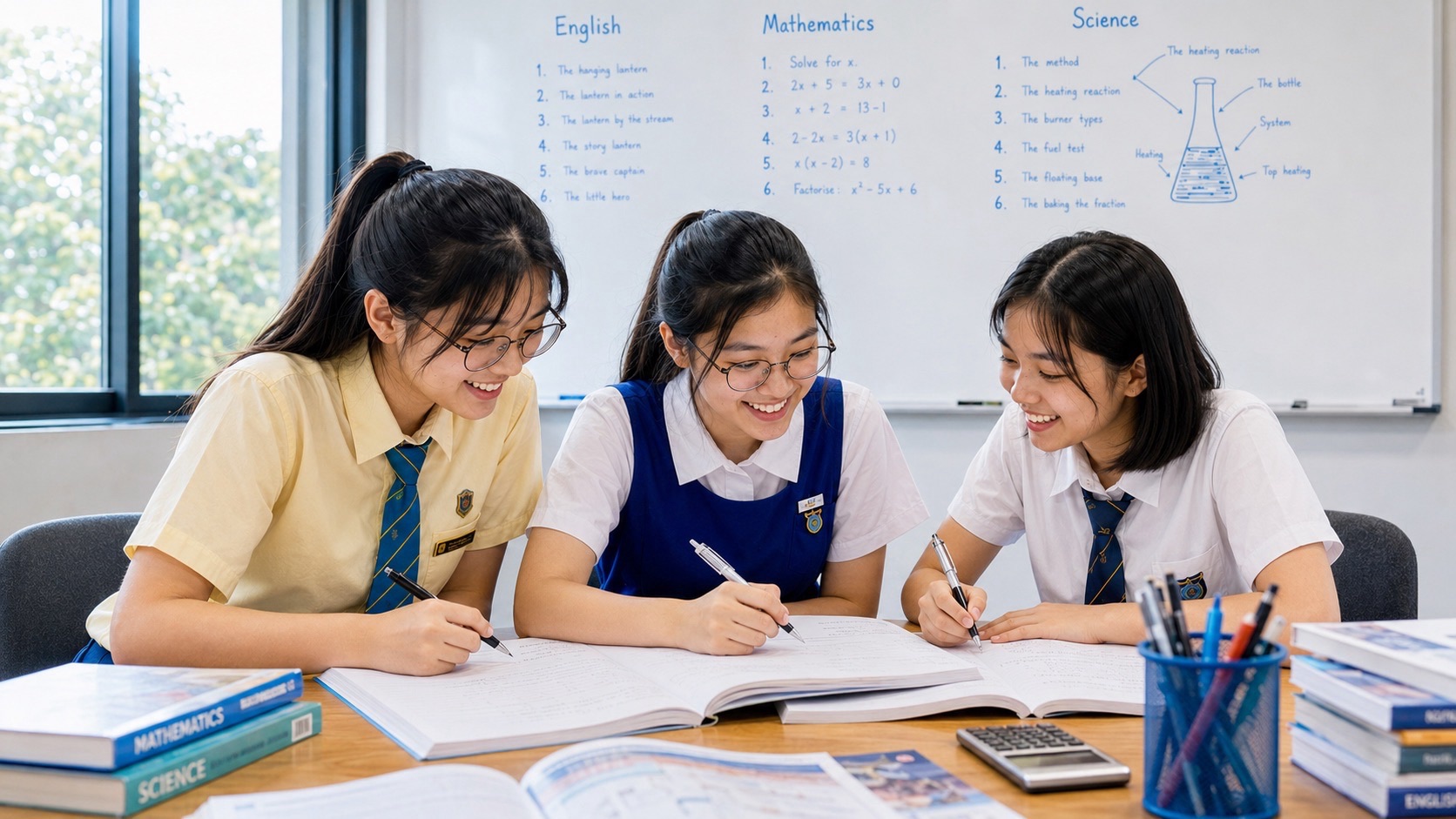
Secondary 2 is easy to underestimate. The dramatic transition into secondary school has passed, while the urgency of the final examination year still feels distant. That makes it a revealing year: routines have had time to settle, so recurring weaknesses are less likely to be explained away as “just adjusting.” For Pasir Ris families considering Secondary 2 English tuition, the important question is not how much work a student can complete with help. It is whether improvement has become reliable when the help, example and immediate correction are no longer present.
This is a parent progress-audit page, not an English lesson or syllabus guide. It is designed to help families judge whether support is changing the learner rather than merely improving the appearance of the work completed during tuition.
Secondary 2 is the year to separate familiarity from mastery
A student can look successful in a familiar environment for several reasons. The teacher may be giving well-timed prompts. The practice may closely resemble the worked example. The student may remember the correction from ten minutes earlier. None of these is useless, but none is strong evidence of durable learning by itself.
More convincing evidence appears when the student can retrieve what was learned after time has passed, recognise when to use it in a changed task, and explain the decision without being led there. This distinction matters in Secondary 2 because the year should gradually convert supported competence into independent competence.
The correction-dependence problem
One of the most common illusions of progress is the corrected page. A student receives feedback, changes the answer, and the final work looks strong. Parents see the neat result and reasonably assume the problem has been solved. But the key educational question is what happens next.
- Can the student explain why the original attempt failed?
- Can the student identify the same underlying issue in a different task?
- Can the student produce the improved response after a delay?
- Does the improvement survive when the tutor is silent?
- Does school work begin to show fewer repetitions of the same problem?
If the answer is repeatedly no, the system may be producing excellent corrections without producing enough learning. That is not a reason to blame the student or tutor. It is a signal to change the feedback loop so that the learner has to retrieve, decide and self-check before receiving another prompt.
A five-layer reliability audit
Parents can evaluate progress through five increasingly demanding layers. A learner does not need to be perfect at each layer; the value lies in seeing where performance breaks.
| Layer | Question | What success suggests |
|---|---|---|
| 1. Recognition | Does the student understand the correction when it is shown? | The explanation is accessible |
| 2. Immediate reproduction | Can the student do a similar task straight afterwards? | Short-term application is possible |
| 3. Delayed retrieval | Can the student recover the idea days later? | Retention is developing |
| 4. Transfer | Can the student use it when the surface of the task changes? | The learning is not tied to one example |
| 5. Independence | Can the student decide when and how to use it without a prompt? | The skill is becoming self-directed |
A tuition programme that consistently reaches only Layers 1 and 2 may feel productive because lessons move smoothly. The longer-term goal is to move more of the student’s performance into Layers 3 to 5.
Six recurring patterns that deserve attention
1. The same feedback returns every month
Repeated comments can indicate that the intervention is treating individual products rather than the underlying habit. The next step is to define the recurring error narrowly and test it on a changed task.
2. Performance collapses when time is limited
This may indicate that a skill is understood but not fluent enough to survive normal school conditions. More explanation is not always the answer; the student may need spaced retrieval and carefully reduced scaffolding.
3. The student waits for confirmation before every decision
This can develop when a helpful adult responds too quickly. A useful repair is to increase “productive wait time”: require an attempt, a reason and a self-check before the tutor intervenes.
4. Marks improve but homework time keeps expanding
The improvement may be too expensive in time and attention. Progress should eventually make work more manageable, not require indefinitely increasing supervision.
5. Tuition work is strong but school-return evidence is unchanged
This is a transfer warning. The tuition environment may be too predictable, or the practice may be too similar to the examples. A strong programme should deliberately test whether learning returns to school tasks.
6. The student cannot say what has improved
Students do not need technical terminology, but by Secondary 2 they should increasingly be able to describe a current strength, a current weakness and what they do when they get stuck. That metacognitive awareness is part of independence.
Use an eight-week dashboard, not a single test score
An assessment score is useful evidence, but it is noisy evidence. Different papers vary in difficulty and emphasis. A better review uses several indicators over roughly eight weeks.
| Indicator | Improving direction | Warning sign |
|---|---|---|
| Repeated errors | Frequency falls | Same issue returns unchanged |
| Prompting | Fewer and lighter prompts | Student waits for confirmation |
| Delayed recall | Learning survives days or weeks | Needs full reteaching each time |
| Transfer | Works on unfamiliar examples | Only works on near copies |
| Self-explanation | Student can name the reason for a choice | “Because teacher said so” |
| Workload | Time becomes stable or more efficient | Support continuously expands |
| School-return evidence | School work reflects the repair | Tuition and school performance remain disconnected |
When tuition should intensify
More support can be justified when a clearly diagnosed weakness is persistent, consequential and not improving under the present plan. Intensifying does not have to mean adding more hours. It can mean narrowing the goal, increasing diagnostic attention, changing the group format, improving the feedback cycle or temporarily increasing one-to-one support around a bottleneck.
- A foundational weakness is blocking several different tasks.
- The student cannot independently interpret feedback after repeated explanations.
- A small problem is beginning to spread into avoidance or missed work.
- School evidence confirms that the same weakness is recurring.
- The current format does not make the student’s thinking visible enough to diagnose the first wrong move.
When tuition should change
Changing a programme is rational when the mechanism is wrong for the learner. A highly social student may lose focus in a larger class; another student may become passive in one-to-one lessons because the adult intervenes too quickly. A student who mainly needs independent study routines may not need another teacher at all.
Ask whether the current format is solving the diagnosed problem. Do not ask whether the tutor is generally “good.” A good tutor can still be the wrong match for a particular need, just as a respected programme can be unnecessary for a student who already has the relevant skill.
When tuition should taper
Tapering is an important but often neglected test. If a learner is performing reliably, reduce the intensity of support and observe whether the improvement holds. The purpose is not to withdraw help suddenly. It is to check whether the learner has internalised enough of the process to carry more responsibility.
- Move from full prompts to questions.
- Move from questions to silent wait time.
- Increase the interval between checks.
- Use unfamiliar rather than near-identical examples.
- Review work after completion rather than during every step.
- Ask the learner to identify what still needs help.
If performance remains stable as support fades, that is strong evidence of progress. If it collapses, the family has learned something useful: the apparent mastery was still support-dependent.
Travel, timetable and the total learning load
Pasir Ris families should include transport and recovery time in the evaluation. A 90-minute class can consume far more than 90 minutes once travel, waiting, meals and transition time are counted. The relevant metric is not “hours of tuition” but the total weekly load created by the intervention.
More educational time is not automatically better. Students need time to consolidate, sleep, exercise and manage ordinary school responsibilities. If a support programme raises performance only by consuming all independent study time, the long-term trade-off deserves scrutiny.
A parent review conversation that produces useful information
Instead of asking “How is my child doing?”, ask questions that require evidence.
- What is the most important recurring issue you currently see?
- What evidence makes you think that is the issue?
- What can the student now do without help that they could not do eight weeks ago?
- Which correction has successfully transferred to school work?
- Where is the student still dependent on prompting?
- What would make you reduce support?
- What would make you change the plan?
These questions encourage a provider to describe mechanisms rather than impressions. “More confident” is useful if it is connected to observable behaviour, such as attempting unfamiliar work before asking for help. Evidence gives the phrase meaning.
The danger of permanent correction culture
Students naturally prefer immediate confirmation because uncertainty is uncomfortable. Adults also like correcting quickly because the lesson moves faster. But if every error is intercepted before the learner has to notice, test and revise it, the system can accidentally train dependence.
A healthier correction culture distinguishes between errors that need direct instruction and errors that the learner is ready to self-diagnose. The balance should shift over time. By Secondary 2, a growing proportion of checking should belong to the student.
What reliable progress looks like by the end of the year
Reliable progress does not mean perfection. It means the learner has a more stable system for dealing with difficulty. A stronger Secondary 2 student can usually begin work, tolerate uncertainty long enough to attempt, use feedback intelligently, recognise recurring errors, retrieve previous learning after a delay, and ask more precise questions when help is genuinely needed.
That profile matters because Secondary 3 increases the cost of dependence. Work becomes more demanding across the timetable, and students have less spare capacity for an adult to reconstruct every task. Secondary 2 is therefore an excellent year to make independence an explicit outcome rather than an accidental by-product.
Decision rule for Pasir Ris parents
Continue support when the diagnosed problem is becoming smaller and the student is becoming more independent. Change support when activity is high but transfer is weak. Intensify only when the evidence identifies a consequential bottleneck that the present plan cannot repair. Taper when performance remains reliable and prompting is no longer doing essential work.
This makes tuition accountable to learning rather than to habit. The programme exists to change the learner’s capability. The learner does not exist to keep the programme running.
Research and reference points
- Dunlosky, J. et al. (2013), Improving Students’ Learning With Effective Learning Techniques. https://doi.org/10.1177/1529100612453266
- Roediger, H. L. & Karpicke, J. D. (2006), retrieval practice and delayed learning. https://doi.org/10.1111/j.1467-9280.2006.01693.x
- Cepeda, N. J. et al. (2006), distributed practice. https://doi.org/10.1037/0033-2909.132.3.354
- Hattie, J. & Timperley, H. (2007), The Power of Feedback. https://doi.org/10.3102/003465430298487
- Education Endowment Foundation, Metacognition and Self-Regulated Learning. Guidance report
- For current Singapore school and examination information, check the Ministry of Education and Singapore Examinations and Assessment Board directly.