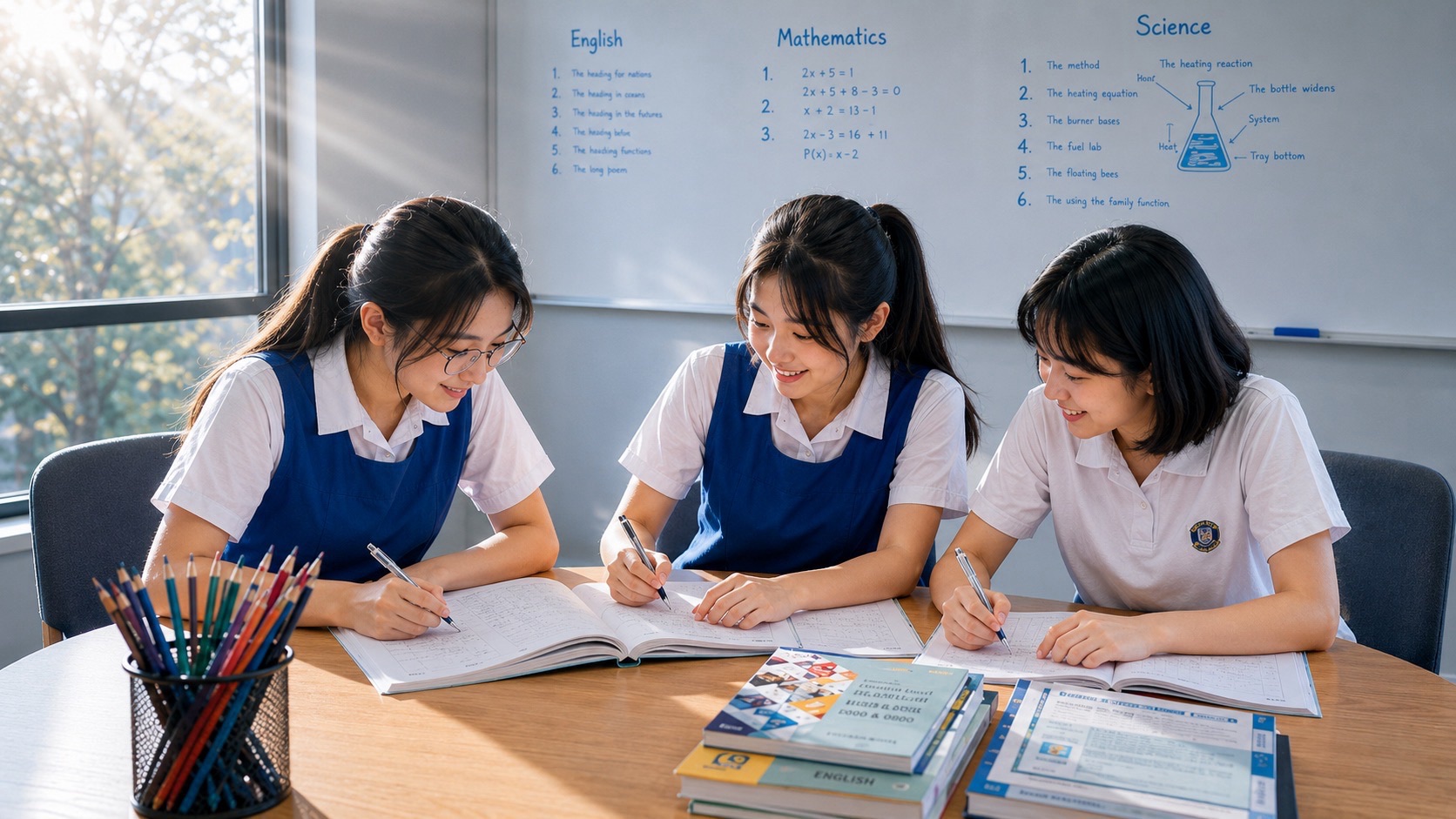
Punggol Secondary 4 English Tutor: Small-Group English Tuition for Confident National Examination Preparation
Secondary 4 English is not simply another subject to complete before the national examinations. It is the language through which students explain, evaluate, persuade, interpret and communicate across almost every part of their education.
By Secondary 4, however, many students discover that effort alone is no longer enough. They may read regularly, complete their homework and understand the general meaning of a passage, yet still lose marks because their answers are imprecise. Others have interesting ideas but cannot organise them into a convincing essay. Some write fluently but make repeated grammatical mistakes. Others know the content but become hesitant during oral examinations.
Our Punggol Secondary 4 English tuition provides calm, structured preparation for students who need to turn what they know into clear, accurate and examination-ready English.
Classes are conducted in small groups of three students, allowing the tutor to examine each student’s writing, identify recurring weaknesses and provide close guidance throughout the final year of secondary school.
Secondary 4 English Is a Test of Control
At the lower secondary levels, students can often make progress by learning more vocabulary, reading model essays and completing additional comprehension exercises.
At Secondary 4, these foundations still matter, but the examination asks for something more refined: control.
A strong student must be able to:
- understand what a question is really asking;
- select relevant ideas rather than writing everything that comes to mind;
- adapt language to the purpose, audience and context;
- explain evidence without merely repeating the passage;
- write with precision under time pressure;
- recognise the effect of words, images and language choices;
- summarise information concisely in the student’s own words;
- speak naturally while developing a thoughtful perspective; and
- check grammar, spelling and sentence construction efficiently.
This is why Secondary 4 English can feel unexpectedly difficult. The examination does not reward knowledge in isolation. It rewards the ability to use language deliberately.
What Is Tested in the Secondary 4 English Examination?
For students sitting the 2026 Singapore-Cambridge GCE O-Level English Language examination, Syllabus 1184 consists of four papers.
| Paper | Component | Weighting | Duration |
|---|---|---|---|
| Paper 1 | Writing | 35% | 1 hour 50 minutes |
| Paper 2 | Comprehension | 35% | 1 hour 50 minutes |
| Paper 3 | Listening | 10% | About 45 minutes |
| Paper 4 | Oral Communication | 20% | About 20 minutes, including preparation |
Writing and comprehension together make up 70 per cent of the final result. However, oral communication contributes a substantial 20 per cent, while listening contributes the remaining 10 per cent.
A student who concentrates only on essays and comprehension practices is therefore leaving a significant portion of the examination insufficiently prepared.
Paper 1: Writing
Paper 1 contains three sections:
- Editing
- Situational Writing
- Continuous Writing
Each section requires a different kind of thinking.
Editing: Small Errors, Important Marks
In the editing section, students identify and correct grammatical errors in a short passage.
The task may appear straightforward, but it reveals whether a student genuinely understands how English sentences work. Common weaknesses include:
- subject-verb agreement;
- verb tense consistency;
- incorrect word forms;
- pronoun agreement;
- articles and determiners;
- prepositions;
- countable and uncountable nouns; and
- sentence structures that sound natural but are grammatically inaccurate.
Students who rely only on instinct frequently overlook errors because an incorrect sentence may still sound familiar.
We teach students to examine sentences systematically. Instead of asking only, “Does this sound right?”, they learn to identify the grammatical relationship between the subject, verb, noun, modifier and surrounding clauses.
This turns editing from a guessing exercise into a controlled process.
Situational Writing: Writing for a Real Purpose
Situational Writing requires students to produce a response of approximately 250 to 350 words based on a given situation and visual text.
The response may take the form of an email, letter, report or speech. Students must understand:
- who is writing;
- who will read or hear the response;
- why the response is being written;
- which details must be included;
- what tone is appropriate; and
- how the information should be organised.
A student may write elegant sentences and still lose marks by overlooking a task point, adopting the wrong tone or failing to develop the supplied information.
Our Punggol English tutor trains students to read the question before beginning the response. They learn to annotate the task, identify every required point and decide how each point should be explained.
The aim is not to produce an unnecessarily elaborate answer. It is to produce a complete, purposeful and polished one.
Continuous Writing: Ideas Must Be Developed, Not Merely Mentioned
For Continuous Writing, students choose one of four topics and write approximately 350 to 500 words.
Depending on the question, students may need to narrate an experience, reflect on an issue, explain a viewpoint or construct an argument.
Many weaker essays are not short of ideas. Their difficulty lies in development.
A student may write:
“Technology is useful because it helps people communicate.”
The statement is reasonable, but it is only the beginning of a paragraph. A developed response must explain how communication is improved, who benefits, what limitations may exist and why the point matters in relation to the question.
We teach students to move beyond statements into explanations, evidence, implications and thoughtful conclusions.
For narrative writing, students learn to control:
- setting;
- character motivation;
- sequence;
- pace;
- tension;
- description;
- dialogue; and
- resolution.
For discursive and argumentative writing, students learn to develop:
- a clear position;
- relevant topic sentences;
- logical explanations;
- well-chosen examples;
- alternative perspectives;
- balanced evaluation; and
- a conclusion that answers the actual question.
The strongest essays usually do not contain the greatest number of impressive words. They contain the right words, placed inside sentences that carry a clear and considered idea.
Paper 2: Comprehension
Comprehension is often the component that causes the greatest frustration.
Students may understand a passage when they read it, yet obtain disappointing marks because examination comprehension requires more than general understanding. It demands precise interpretation and precise expression.
Students must work with visual, narrative and non-narrative texts. Questions may test:
- literal understanding;
- inference;
- writer’s purpose;
- tone and attitude;
- vocabulary in context;
- language use and effect;
- comparison of ideas;
- evaluation of evidence; and
- summary skills.
Why Comprehension Answers Lose Marks
Common reasons include:
- copying an entire sentence without selecting the relevant detail;
- paraphrasing so loosely that the original meaning changes;
- giving a personal opinion when evidence from the passage is required;
- identifying a literary device without explaining its effect;
- describing what happened without explaining what can be inferred;
- misreading the focus of the question;
- using vague words such as “bad”, “sad” or “nice”; and
- writing more than necessary while still missing the answer.
Our lessons teach students to distinguish among different question types. They learn that “What happened?”, “Why did it happen?”, “What does this suggest?” and “How does the writer make this effective?” require different forms of response.
This distinction matters. A student cannot improve comprehension simply by completing more passages if the same misunderstanding is repeated each time.
Language for Effect
Language-effect questions ask students to examine how a writer’s choice of words creates meaning, emotion or impact.
A weak response may state:
“The phrase shows that the place was frightening.”
A stronger response identifies the important word, explains its associations and connects these associations to the reader’s understanding of the scene.
Students are trained to ask:
- Which word carries the strongest meaning?
- What does that word usually suggest?
- What picture or feeling does it create?
- Why did the writer choose it here?
- How does it influence the reader?
Once this process becomes familiar, language analysis becomes less mysterious and considerably more manageable.
Summary Writing
The summary task requires students to select relevant points and present them concisely in approximately 80 words.
This tests several abilities at once:
- understanding the question’s scope;
- locating relevant information;
- distinguishing main points from examples;
- paraphrasing accurately;
- combining related ideas;
- maintaining grammatical control; and
- remaining within the word limit.
Students who copy large sections of the passage may run out of words. Students who paraphrase too aggressively may alter the meaning. Students who choose incomplete points may lose content marks even when the writing is fluent.
We train students to preserve meaning while reducing unnecessary language. This is a precise skill, and it improves through guided correction rather than repeated copying.
Paper 3: Listening
Listening is sometimes treated as a component that cannot be taught. This is not true.
Students can improve their ability to:
- identify the main idea;
- separate essential information from supporting detail;
- recognise changes in speaker, location or viewpoint;
- follow sequences and instructions;
- interpret emphasis and tone;
- take concise notes; and
- recover calmly after missing a word or phrase.
One part of the listening examination includes a note-taking task in which the recording is heard only once. Students therefore need a disciplined method for anticipating the kind of information required and recording it without becoming distracted.
Good listening is active. The student is not merely hearing words. The student is following the structure of the message.
Paper 4: Oral Communication
The oral examination consists of a Planned Response and Spoken Interaction.
During the Planned Response, students view a video clip, consider an accompanying prompt and deliver a response of up to two minutes. They must organise their thoughts quickly and speak with clarity, fluency and purpose.
During Spoken Interaction, students engage in a discussion with the examiners on a related topic.
Many students find oral communication difficult for one of two reasons.
The first is that they do not know what to say. Their answers remain brief because they have not learnt how to extend an idea.
The second is that they have ideas but become nervous, disorganised or repetitive when speaking.
We teach students to build an oral response using a simple internal structure:
- state a clear perspective;
- explain the reason;
- provide an example or observation;
- consider a broader implication; and
- return naturally to the question.
The aim is not to make students sound rehearsed. It is to help them sound prepared, thoughtful and comfortable with their own ideas.
Why Secondary 4 Students Often Plateau
A student may work hard throughout Secondary 3 and Secondary 4 without seeing a corresponding improvement in English marks.
This usually happens because the student is practising without identifying the precise weakness.
For example, a student receiving a C grade for writing may be told to:
- read more;
- use better vocabulary;
- add more details; or
- check the work carefully.
These suggestions are not wrong, but they may be too broad to produce change.
The actual weakness may be:
- poor question selection;
- weak paragraph development;
- repetitive sentence structures;
- unclear pronoun references;
- incorrect verb tenses;
- abrupt transitions;
- examples that do not support the argument;
- an unsuitable tone; or
- a conclusion that does not resolve the discussion.
Improvement begins when the student can see the problem clearly.
Our Approach to Punggol Secondary 4 English Tuition
1. We Diagnose Before We Add More Work
At the beginning, we examine the student’s recent examination scripts, school assignments and common error patterns.
We look beyond the overall grade and ask:
- Which component is pulling the result down?
- Are marks being lost through knowledge, interpretation or expression?
- Does the student understand corrections?
- Are the same errors recurring?
- Is the student finishing each paper?
- Is the student choosing suitable essay questions?
- Does performance change significantly under timed conditions?
This gives the tuition programme direction. The student does not need more work for its own sake. The student needs the right work.
2. We Strengthen the Language Underneath the Examination
Examination techniques are useful only when they rest on sufficient language ability.
Students therefore continue to develop:
- grammar;
- sentence construction;
- vocabulary;
- paragraph cohesion;
- reading accuracy;
- general knowledge;
- reasoning; and
- awareness of audience and tone.
A technique may help a student arrange an argumentative paragraph, but the paragraph still requires a meaningful argument. A summary method may help the student organise points, but the student must still understand the passage accurately.
We work on both the examination and the language that makes strong examination performance possible.
3. We Correct Patterns, Not Just Individual Pieces of Work
Marking an essay is not the same as teaching a student how to improve it.
When work is corrected, we identify patterns:
- Does every introduction take too long to reach the issue?
- Are paragraphs beginning clearly but ending weakly?
- Does the student change tense during narratives?
- Are examples too general?
- Is vocabulary ambitious but inaccurate?
- Does the student repeatedly misunderstand inference questions?
Once the pattern is visible, we can design focused exercises to repair it.
Students also learn to maintain an error record. This helps them recognise their own habits and check specifically for those weaknesses during future assignments.
4. We Teach Vocabulary in Context
Vocabulary is important, but memorising rare words without understanding their tone or usage can make writing less effective.
Students need to know:
- what a word means;
- how strong or subtle it is;
- which situations it suits;
- which words commonly appear with it;
- whether it carries a positive or negative association; and
- how it changes the rhythm and precision of a sentence.
We prefer accurate, natural vocabulary to decoration. A well-chosen verb can improve a sentence more effectively than several impressive adjectives.
5. We Build Examination Timing Gradually
Some students understand the work but perform poorly because they do not allocate time effectively.
They may spend too long planning an essay, become trapped by one comprehension question or leave insufficient time to check editing answers.
Timed work is introduced progressively. Students first learn the method without unnecessary pressure. They then complete sections within controlled limits before moving to full-paper practice.
This allows speed to develop from familiarity rather than panic.
Why Three Students Make a Difference
English requires close observation.
A tutor needs to see how a student thinks, not merely whether the final answer is right or wrong.
In a large class, it is difficult to:
- read every composition carefully;
- discuss individual word choices;
- identify each student’s grammatical patterns;
- conduct meaningful oral practice;
- question a student’s reasoning in depth; and
- adjust the pace for different weaknesses.
Our three-student Punggol English tuition classes retain the energy of group learning while allowing the tutor to provide individual attention.
Students can hear alternative viewpoints, discuss interpretations and learn from one another. At the same time, nobody disappears quietly at the back of the room.
What a Productive Secondary 4 English Lesson Looks Like
A productive lesson does not need to feel rushed or crowded.
Depending on the student’s stage of preparation, a lesson may include:
- reviewing recurring errors from previous work;
- learning a focused grammar or vocabulary skill;
- analysing an examination question;
- planning a situational or continuous writing response;
- improving one paragraph in depth;
- working through a comprehension passage;
- comparing weak and strong answers;
- practising summary selection and paraphrasing;
- developing an oral response; and
- completing a short timed exercise.
Not every lesson needs a complete paper. Sometimes the most valuable work is to slow down and repair the exact point at which a student’s thinking becomes unclear.
A Sensible Secondary 4 English Preparation Timeline
Beginning of Secondary 4: Establish Control
The beginning of the year should be used to diagnose weaknesses and rebuild essential skills.
Students should strengthen grammar, writing structure, comprehension methods and oral development before school demands intensify.
Middle of the Year: Convert Skills into Examination Performance
By the middle of the year, students should be completing more timed component practices and learning to sustain quality across an entire paper.
Oral preparation should already be active. It should not be left until shortly before the examination.
Before the Preliminary Examinations: Test the System
Preliminary examinations reveal whether the student can apply the method independently under realistic conditions.
The result is useful, but the script is even more useful. It shows where marks are still escaping and whether the cause is:
- misreading;
- weak content;
- poor expression;
- time management;
- careless errors; or
- incomplete revision.
Final Preparation: Refine, Do Not Overload
Near the examination, students need clarity.
This is not the time to collect dozens of new writing formats or memorise large quantities of unfamiliar vocabulary. The final stage should consolidate reliable methods, correct recurring errors and build calm examination routines.
A student should enter the examination knowing:
- how to begin each paper;
- how much time to allocate;
- which questions require evidence;
- how to check the work;
- which personal errors to watch for; and
- how to recover when a question feels difficult.
Is It Too Late to Improve English in Secondary 4?
It depends on the student’s starting point, available time and willingness to change established habits.
English is cumulative, so earlier preparation is always preferable. However, Secondary 4 improvement is still possible when the work is focused.
A student does not need to transform every aspect of English at once. Meaningful gains can come from:
- eliminating repeated grammatical errors;
- choosing more suitable essay questions;
- developing paragraphs more fully;
- answering comprehension questions more precisely;
- improving summary point selection;
- speaking with a clearer structure; and
- completing papers within the allocated time.
The later a student begins, the more important it becomes to diagnose accurately. There is less time available for unfocused practice.
Signs That Your Child May Need Secondary 4 English Tuition
Parents may wish to seek additional support when a student:
- has remained at the same grade despite regular practice;
- receives general comments but does not know how to act on them;
- cannot explain why comprehension answers are wrong;
- avoids writing because essays feel overwhelming;
- uses memorised phrases that do not fit the question;
- has ideas but struggles to express them clearly;
- repeatedly makes the same grammar mistakes;
- cannot complete papers on time;
- speaks very briefly during oral practice; or
- has become anxious or discouraged about English.
Tuition should not simply add another pile of worksheets. It should reduce confusion by giving the student a clear route forward.
Preparing for the Transition from O-Level to the SEC Examination
Students sitting their national examinations in 2026 remain under the current GCE O-Level system.
From the 2027 graduating cohort, students will sit for the Singapore-Cambridge Secondary Education Certificate, or SEC, at the appropriate G1, G2 or G3 subject level.
Under the announced arrangements, the overall assessment standards and modes remain aligned with the corresponding existing national examinations. For G3 English, the underlying requirements of accurate reading, purposeful writing, effective speaking and careful language use remain central.
One practical timetable change is that SEC English Language written examinations will be held in September from 2027.
This makes early preparation even more important for future Secondary 4 students. The objective should never be to prepare for a label alone. It should be to build language abilities that remain dependable regardless of the examination’s name.
English in a World of Artificial Intelligence
Students now have access to tools that can generate essays, summaries and polished sentences within seconds.
These tools can be useful for comparison, brainstorming and feedback when used responsibly. However, they can also conceal weaknesses.
A student may submit a fluent piece of writing without understanding why it works. The difficulty becomes visible again during a closed-book examination, oral discussion or unfamiliar comprehension passage.
The ability to think independently is therefore becoming more valuable, not less.
Students need to be able to:
- question information;
- recognise weak reasoning;
- form an individual perspective;
- select evidence;
- explain ideas clearly; and
- communicate without depending on automated assistance.
Good English tuition should prepare a student for the examination in front of them and the more complex world beyond it.
Frequently Asked Questions About Punggol Secondary 4 English Tuition
What does your Secondary 4 English tuition cover?
Lessons cover the major examination components, including editing, situational writing, continuous writing, comprehension, summary, listening preparation and oral communication. The balance changes according to the student’s needs and the examination calendar.
Do you teach O-Level English Paper 1 and Paper 2?
Yes. Students receive structured preparation for both writing and comprehension. We also prepare students for listening and oral communication because these components contribute meaningfully to the final result.
How large are the classes?
Our Punggol English tuition classes are kept to three students. This allows close marking, individual correction, discussion and regular speaking practice.
Can a student join during Secondary 4?
Yes, subject to available places. The programme will begin by identifying the student’s most important weaknesses so that the remaining preparation time is used carefully.
Can tuition help a student move from a pass to a stronger grade?
Improvement depends on the student’s foundation, consistency, available preparation time and response to correction. Our role is to identify what is preventing progress and provide a structured programme to address it. No responsible tutor should promise a particular grade without first understanding the student.
Do students receive homework?
Homework may be assigned when it serves a clear purpose, such as reinforcing a grammar point, completing a writing plan, correcting an essay or practising a particular comprehension skill. We value purposeful work more than volume.
Do you teach vocabulary?
Yes. Vocabulary is taught through meaning, context, tone, sentence construction and practical application. Students learn to use words accurately rather than inserting difficult vocabulary simply to sound impressive.
Does the class include oral practice?
Yes. Small classes allow students to develop Planned Responses, participate in discussions and receive feedback on fluency, pronunciation, organisation and development of ideas.
Where are the Punggol tuition classes conducted?
Classes are available at 83 Punggol Central, Singapore 828761, by appointment.
A Calm, Serious Approach to Secondary 4 English
The final year of secondary school is demanding. Students are balancing several subjects, school assessments, preliminary examinations and decisions about their next educational pathway.
English tuition should not add unnecessary noise.
It should give the student:
- a clear understanding of the examination;
- a realistic picture of current strengths and weaknesses;
- precise correction;
- reliable methods;
- regular practice;
- greater independence; and
- the confidence to communicate with clarity.
Our Punggol Secondary 4 English tutor works closely with each student in a three-student class, building the language control, examination judgement and composure needed for the final year.
For parents looking for Secondary 4 English tuition in Punggol, we welcome you to contact us for a consultation. We will first understand your child’s current results, learning habits and areas of difficulty before advising on the most appropriate next step.