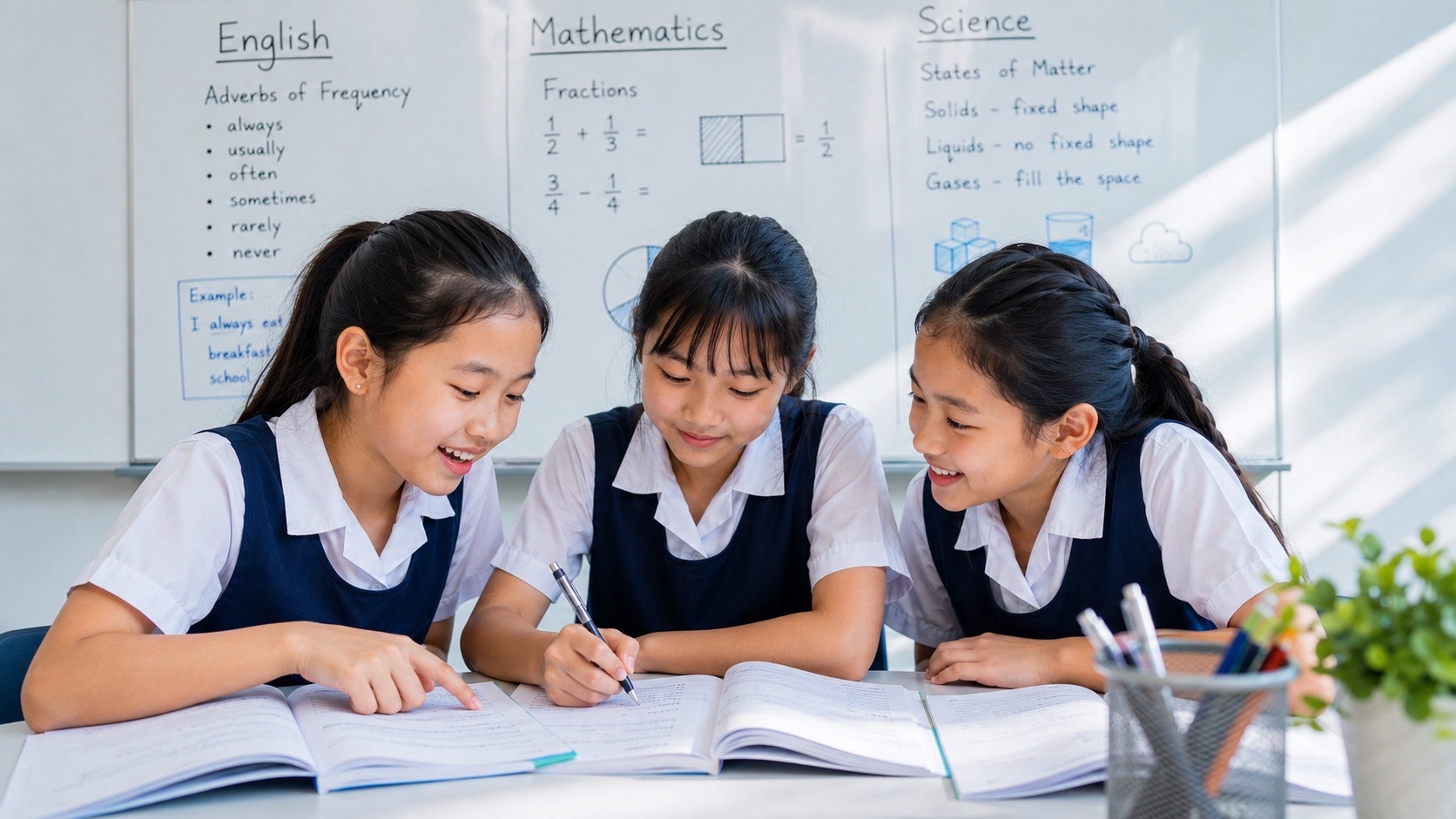
Parents often compare an individual Science tutor with a small-group Science class as though one format must be better.
That is too simple.
One-to-one support concentrates the tutor’s attention on a single learner. A three-student tutorial adds peer explanations, alternative representations and a social test of whether the student can make scientific reasoning clear to someone other than the tutor.
Both can be excellent. Both can also be badly matched.
The useful question is not “Which format is best?” but “Which format gives this learner the right diagnostic resolution, independence and scientific reasoning environment now?”
What One-to-One Science Does Best
An individual tutor can spend the full lesson following one student’s route.
If the learner has missed substantial content, carries an unusual misconception or needs a slower reconstruction of foundational ideas, that concentration can be valuable.
The tutor can stop immediately at the first wrong assumption, rebuild the model and test it again without needing to preserve a shared class pace.
The Risk of One-to-One: Invisible Tutor Support
One-to-one tuition can make a student look stronger than independent performance really is.
The tutor sees every hesitation and can provide perfectly timed cues. A small question, facial expression or partial hint may keep the student on the correct route.
Those interventions are useful during teaching. The risk appears when they never fade.
A good individual tutor should deliberately test whether the student can identify the concept, interpret the evidence and construct the explanation without rescue.
What Three Students Add
A three-student Science tutorial adds another kind of evidence: comparison.
Three students can look at the same experiment, diagram or open-ended question and expose different reasoning paths.
- One may know the concept but use the evidence poorly.
- One may interpret the question accurately but select the wrong scientific model.
- One may understand both but omit the causal link in writing.
These contrasts make hidden reasoning visible.
A Peer Is a Different Audience From a Tutor
Students often believe their own explanation is complete because the missing steps are obvious inside their own head.
A tutor may infer those missing steps because the tutor already knows the intended model.
A peer is less forgiving. If another student asks, “Why does that happen?” or “Where did you get that from?”, the learner discovers that the explanation was not yet complete.
That is one of the strongest educational advantages of a well-run small group.
The Risk of a Group: Borrowed Understanding
A three-student class can fail if one confident learner becomes the unofficial answer source.
The quieter students may wait, listen and reproduce the strongest explanation without owning it.
The tutor should therefore require independent thinking before discussion, vary who responds first and sometimes ask each learner to defend a different part of the causal chain.
Peer learning should increase ownership, not create dependence on classmates.
Group Fit Matters More Than the Number Three
Three students is not a magic number.
The format works when learners are compatible enough to share a central scientific problem and different enough to make comparison useful.
Three students with similar marks can still be poor matches. One may need foundational concept repair, another may need language-access support and a third may be ready for extension.
The tutor must see learner states, not only scores.
When One-to-One Is the Stronger Choice
- The student has missed substantial schooling.
- A foundational misconception sits well below the group’s level.
- The learner becomes overwhelmed by peer comparison.
- The student follows an unusually different school sequence.
- A short period of intensive reconstruction is needed before joining a group.
- The student needs highly individual pacing that cannot reasonably coexist with a shared task.
When Three Students Is the Stronger Choice
- The learner benefits from hearing alternative explanations.
- The student needs practice making reasoning clear to a real audience.
- The group shares compatible Science demands.
- The tutor can still inspect each student’s independent work closely.
- Peer contrast reveals misconceptions without becoming ranking.
- The learner needs more independence than a highly supported one-to-one setting naturally provides.
A Student Can Move Between Formats
The choice does not have to be permanent.
A student may begin with individual support to repair a large gap, then move into a three-student group once the learner can access the shared task.
Another student may work well in a group for years and temporarily need individual diagnosis when one unusual weakness appears.
Format should follow learner state rather than become an identity.
Compare Resolution per Hour, Not Only Tutor Attention
Parents often assume more exclusive attention must mean more learning.
The useful measure is what becomes visible and repairable during the hour.
Can the tutor identify the first wrong move? Can the student explain the Science independently? Does the lesson expose alternative reasoning? Do corrections transfer into school questions the tutor did not rehearse?
One-to-one may provide more direct attention. A small group may provide more comparative information. The learner problem decides which information is more valuable.
The Tutor Should Know When the Current Format Has Stopped Working
A strong programme should be willing to change format when evidence changes.
If a group student is repeatedly inaccessible to the shared task, individual repair may be needed. If a one-to-one student is becoming highly dependent on prompts, a well-matched group may increase productive independence.
Administrative convenience should not freeze the learner inside one delivery model.
Questions Parents Can Ask
- What learner problem makes this format suitable?
- How do you test independence rather than tutor-assisted performance?
- How are three students matched?
- What does each student have to produce independently?
- When would you recommend switching formats?
- How will we know the intervention is transferring to schoolwork?
What Progress Should Look Like in Either Format
- Scientific concepts become more connected.
- The student selects relevant evidence more reliably.
- Open-ended explanations contain clearer cause and consequence.
- Unfamiliar questions become less threatening.
- Corrections survive after time.
- Tutor prompting reduces.
- School performance improves beyond the exact tuition materials used.
The Better Parent Question
Instead of asking, “Is an individual Primary Science tutor better than a three-student class?”, ask: Does my child currently need maximum diagnostic focus, or will carefully managed peer explanation and comparison make the Science more independent and transferable?
The strongest format is the one that solves the learner problem without creating a new dependency.
Current route: This legacy Punggol Science Tutor URL now owns the individual-vs-three-student delivery-model decision rather than duplicating the current Primary Science programme. For the current owner, continue to Does My Child Need Primary Science Tuition? and the Tuition Programmes Directory.