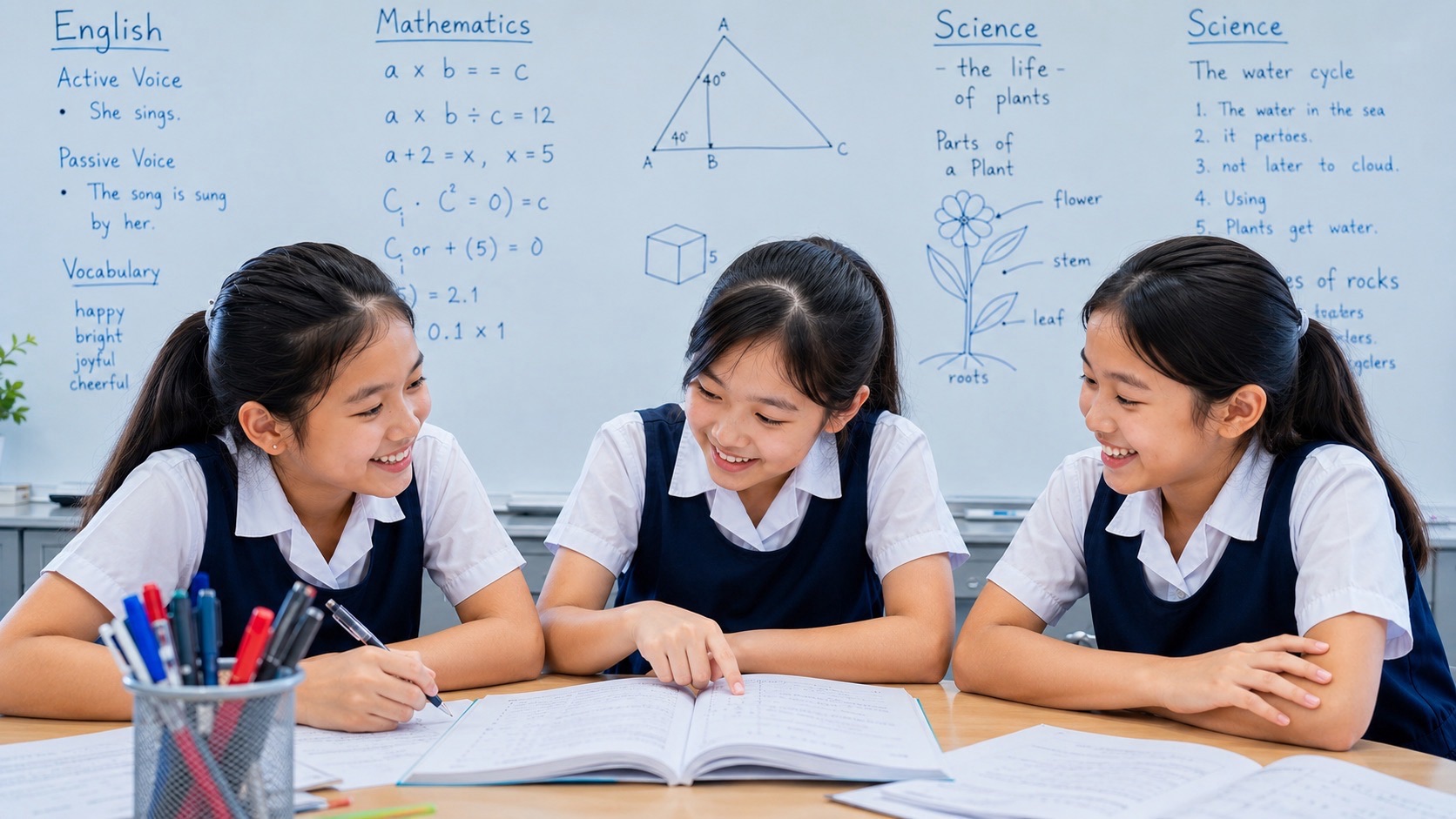
Primary 3 Small Group Science Tutor Punggol
Primary 3 is where Science begins to become a formal way of thinking.
Children arrive with natural curiosity. They notice insects, plants, magnets, rain, shadows and the materials used to make everyday objects. Yet school Science asks them to do something more disciplined with those observations.
They must learn to:
- notice the relevant detail;
- compare objects accurately;
- classify according to suitable characteristics;
- separate an observation from an assumption;
- recognise the scientific concept being tested;
- use evidence from a diagram, table or investigation;
- explain why something happens in precise language.
This transition can be exciting, but it is also where some capable children begin to feel uncertain. They may remember the facts taught in class but struggle when the question is presented through an unfamiliar picture, a changed example or a short written explanation.
Our Primary 3 small group Science tuition in Punggol is designed to help children make this transition properly.
Classes are limited to a maximum of three students. This allows the tutor to listen to each child’s reasoning, identify misconceptions early and teach the student how to build a complete scientific answer—not merely copy one.
Primary 3 Small Group Science Tuition in Punggol at a Glance
Level: Primary 3 Science
Class size: Maximum three students
Location: 83 Punggol Central, Singapore 828761
Curriculum: Current Singapore Primary Science syllabus
Main focus: Conceptual understanding, scientific language, application and careful answering
Suitable for: Students beginning Science, repairing gaps, improving school performance or developing deeper mastery
Enquiries: Call or WhatsApp +65 8823 1234
Email: admin@edukatesg.com
Lessons are conducted by appointment so that each child can be placed in a suitable class.
Why Primary 3 Science Matters
Primary 3 is not simply an introductory year to complete before the more difficult work begins.
It is the year in which a child starts forming a method for learning Science.
A student who develops the right habits learns to ask:
- What exactly can I observe?
- Which characteristic is relevant?
- How are these two things similar?
- How are they different?
- What changed?
- What remained the same?
- Which result supports my conclusion?
- What scientific idea explains the result?
- Have I answered the question that was actually asked?
These habits remain useful throughout Primary 4, Primary 5 and Primary 6.
A child who learns mainly through memorisation may perform reasonably well when a question resembles the worksheet used in class. The difficulty appears when the objects, wording or diagrams change.
The child may know that certain materials are waterproof but be unable to explain why waterproofness matters in a particular situation. The child may remember a butterfly’s life cycle but become confused when the stages are rearranged. The child may know that magnets attract some objects but assume that every metal is magnetic.
Good Primary 3 Science tuition therefore does more than prepare a child for the next test.
It builds the structure through which later Science can be understood.
What Students Learn in the Current Primary 3 Science Syllabus
The Singapore Primary Science syllabus is organised around the broad themes of Diversity, Cycles, Systems, Interactions and Energy.
At Primary 3, students begin with four principal areas:
- Diversity of living and non-living things
- Diversity of materials
- Cycles in plants and animals
- Interaction of forces through magnets
The topics are accessible to young learners, but the reasoning behind them is important.
Diversity of Living and Non-Living Things
Children learn about the characteristics of living things.
Living things need water, food and air to survive. They grow, respond and reproduce. Students also learn to recognise broad groups of living things and classify them according to shared characteristics.
The difficulty is not usually remembering that a bird is an animal or that a mushroom is a fungus.
The deeper task is learning how classification works.
A child must understand that a useful classification is based on a relevant and consistent characteristic. One visible feature is not always enough.
For example, a child may say that an organism is a bird because it has wings. However, insects and bats also have wings. The student must consider a suitable combination of characteristics before reaching a conclusion.
This introduces an important scientific habit:
Do not decide from the first clue. Examine the evidence carefully.
Students also learn that something does not have to move visibly to be alive. A seed may appear inactive, yet it can grow under suitable conditions. A toy car can move, but it does not grow or reproduce.
Science asks the child to look beyond appearances.
Diversity of Materials
Primary 3 students examine familiar materials such as:
- wood;
- metal;
- ceramic;
- rubber;
- glass;
- plastic;
- fabric.
They compare properties including:
- strength;
- flexibility;
- whether an object floats or sinks in water;
- waterproofness;
- how much light the material allows to pass through.
The central question is not merely:
What material is this?
A stronger question is:
Why is this material suitable for this particular use?
Knowing the name of a property is only the beginning. The child must connect the property to its purpose.
For example:
The material is waterproof, so it does not absorb water and helps to keep the object inside dry.
Or:
The material allows light to pass through it, so it is suitable for making a window.
This relationship can be expressed simply:
Property → Function → Result
Many children lose marks because one part of the relationship is missing. They may name the property but not explain why it matters.
A Primary 3 Science tutor must therefore teach both the concept and the language needed to complete the explanation.
Cycles in Plants and Animals
Life cycles introduce children to repeated patterns of change.
Students learn that different living things have different life cycles. They observe and compare the development of plants and animals over time.
For flowering plants, the Primary 3 focus is on stages such as:
- seed;
- young plant;
- adult plant.
Students may also examine the life cycles of animals such as chickens, frogs, butterflies, beetles, grasshoppers, cockroaches and mosquitoes.
The aim is not simply to memorise a row of pictures.
Children should understand:
- what changes from one stage to another;
- which stages are similar or different;
- whether the young resembles the adult;
- what stage comes before or after another;
- how the adult enables the cycle to continue;
- why the sequence is described as a cycle.
A child who understands the pattern can still answer when the diagram is rearranged, a stage is omitted or two life cycles must be compared.
A child who memorises only the familiar diagram often becomes lost as soon as its appearance changes.
Magnets and Forces
Magnets are frequently one of the most enjoyable Primary 3 topics because their effects can be observed directly.
Children learn that a magnet can exert a push or a pull. They study magnetic and non-magnetic materials, the poles of a magnet, attraction, repulsion and common uses of magnets.
They learn that:
- magnets have two poles;
- like poles repel;
- unlike poles attract;
- magnets attract magnetic materials;
- a magnetic force can act without direct contact;
- magnets are used in many everyday objects.
The topic also reveals several common misconceptions.
A child may believe that:
- all metals are magnetic;
- a larger magnet is always stronger;
- attraction and repulsion mean the same thing;
- a magnet must touch an object before it can affect it;
- only one pole of a magnet can attract an object.
These ideas can remain hidden when students simply copy notes.
A tutor must ask the child to predict, observe and explain.
For example:
- Which objects do you predict will be attracted to the magnet?
- What happened when each object was tested?
- Which observation supports your conclusion?
- Does the result support your original prediction?
- What can you conclude about the material?
An enjoyable demonstration becomes meaningful only when the child can express what the evidence shows.
Primary 3 Science Is More Than General Knowledge
Many children enter Primary 3 with excellent general knowledge.
They may know the names of unusual animals, recognise planets or explain how a machine works. This curiosity is valuable, but school Science requires a more controlled form of reasoning.
The student must learn to distinguish between:
- what is generally true;
- what is shown in the question;
- what can be observed directly;
- what can reasonably be inferred;
- what still requires evidence.
A child may know many facts about butterflies, but the question may ask only for a comparison between two life cycles.
Adding unrelated information does not strengthen the answer. It may cause the student to overlook the relationship being tested.
We teach students to ask:
What does this question require me to prove or explain?
This creates greater accuracy and reduces answers based on guesswork.
Why We Keep Our Primary 3 Science Classes to Three Students
The phrase “small group” can describe very different class sizes.
Our Primary 3 Science classes have a clear maximum: three students.
This is small enough for individual attention and large enough for carefully guided discussion.
The Tutor Can Hear Every Child Think
A correct answer does not always mean that the child understands.
A student may select the correct multiple-choice option because it looks familiar. Another may copy a classmate’s reasoning. A third may remember a sentence without understanding the relationship inside it.
In a class of three, the tutor can ask each student:
How did you decide?
The explanation reveals whether the child:
- understood the concept;
- noticed the correct evidence;
- eliminated the wrong options logically;
- used an assumption;
- guessed;
- remembered an unrelated rule;
- misunderstood a scientific term.
This is where meaningful correction begins.
Misconceptions Can Be Found Early
A misconception is not simply a careless mistake.
It is an inaccurate explanation that currently makes sense to the child.
For example:
All metal objects are attracted to magnets.
The child may have formed this idea after testing only iron or steel objects. Giving the correct answer once may not remove the misconception.
The student should be guided to:
- state the original idea;
- test it against new examples;
- notice the contradiction;
- form a more accurate conclusion;
- apply the corrected idea to another question.
In a larger class, a child can remain quiet and retain the misconception. In a class of three, the tutor can examine the reasoning directly.
Written Work Can Be Corrected Closely
Primary Science marks are often lost through small but important gaps.
A student may:
- omit the relevant property;
- describe the result without explaining the cause;
- use “it” when the subject is unclear;
- compare only one object;
- answer with an observation when an explanation is required;
- use a vague word such as “better” or “stronger”;
- provide a conclusion unsupported by evidence.
Close correction allows the tutor to show the child exactly where the explanation became incomplete.
The student then attempts a similar question again.
Correction is not complete when the child says, “I understand.”
It is complete when the child can use the corrected idea independently.
Quieter Children Still Have to Participate
Some children understand more than they are willing to express.
In a large group, they may allow more confident students to answer every question. Their uncertainty remains invisible.
A three-student class gives each child enough space to speak, think and respond.
The tutor can wait through a thoughtful pause, provide a smaller prompt when necessary and help the student organise the explanation without simply supplying it.
Confidence develops from successful thinking, not from praise alone.
Stronger Students Can Be Challenged Properly
A student who is already doing well does not necessarily need a thicker stack of repetitive worksheets.
The child may benefit more from:
- unfamiliar applications;
- more subtle comparisons;
- questions with incomplete information;
- explaining why an alternative answer is wrong;
- predicting how a result would change;
- identifying weaknesses in an investigation;
- using a concept in a different context.
A small class allows the tutor to extend the stronger student without leaving another child behind.
How We Identify What a Primary 3 Student Actually Needs
Two children can receive the same score for completely different reasons.
One may not understand the topic. Another may understand it orally but struggle to write. A third may know the content but rush. A fourth may misread the command word.
Before prescribing more practice, we look at the source of the difficulty.
Concept Knowledge
Does the child understand the scientific idea?
Can the student distinguish a property from an object, a stage from a process and an observation from a conclusion?
Vocabulary
Does the child understand words such as:
- characteristic;
- classify;
- property;
- flexible;
- waterproof;
- magnetic;
- attract;
- repel;
- stage;
- compare;
- observe;
- evidence;
- conclusion?
Scientific vocabulary must be connected to meaning. A memorised definition is not enough if the student cannot recognise when the word applies.
Question Interpretation
Does the child understand what the command word requires?
“State”, “describe”, “compare”, “explain”, “predict” and “conclude” do not ask for the same kind of response.
A child may possess the correct knowledge but answer a different question from the one set.
Application
Can the student use the idea when the objects or wording change?
Knowledge becomes dependable only when it can be transferred to a fresh context.
Written Explanation
Can the child connect the cause to the result?
A short answer can be complete. A long answer can still miss the point.
We teach students to write enough to express the scientific relationship clearly, without filling the response with unrelated information.
Attention and Checking
Does the child overlook arrows, labels, units, headings or changes in conditions?
Some students do not need more content. They need a more careful process.
Confidence
Does the child attempt unfamiliar questions calmly, or stop as soon as the answer is not obvious?
Confidence in Science grows when the child has a reliable method for beginning.
How a Primary 3 Small Group Science Lesson May Progress
A well-designed lesson should move the child from supported understanding towards independent use.
1. Retrieve Earlier Learning
The lesson begins with a short recall or application task.
Students may be asked to explain an earlier idea without immediately referring to their notes. This helps the tutor see whether the knowledge remains accessible and whether any misconception has returned.
Retrieval also teaches the child that learning is meant to be remembered and used, not merely recognised on a page.
2. Introduce One Clear Concept
A new idea may be introduced through:
- an object;
- a photograph;
- a demonstration;
- a simple investigation;
- a comparison;
- a diagram;
- an everyday situation;
- a carefully chosen question.
The purpose is not entertainment for its own sake.
The example gives the child something concrete to observe and discuss.
3. Separate Observation from Explanation
Students learn to distinguish between what they can see and what they think it means.
For example:
Observation: The two magnet poles moved away from each other.
Explanation: The poles facing each other were like poles, so they repelled.
This distinction becomes increasingly important as children encounter investigations, tables and experimental results.
4. Build the Scientific Relationship
The tutor helps the child connect the evidence to the relevant idea.
A useful answer structure may be:
Relevant concept or property → effect or process → result
For example:
The material is flexible, so it can bend without breaking and is suitable for making the object.
The structure is not a script to repeat blindly. It helps the student see which parts a complete explanation requires.
5. Apply the Concept in Different Forms
The child may then work through:
- multiple-choice questions;
- short structured questions;
- diagrams;
- comparison tables;
- sequencing tasks;
- simple investigations;
- unfamiliar everyday examples.
The appearance changes while the scientific idea remains constant.
This teaches transfer.
6. Correct the Reasoning
The tutor examines more than the final answer.
Students are shown:
- where their reasoning changed direction;
- which clue they overlooked;
- which term was inaccurate;
- where the cause-and-effect chain was incomplete;
- why another answer appears plausible but is incorrect.
7. Apply the Correction Again
The student completes another question requiring the same idea.
This final step matters. It confirms whether the correction can now be used without close guidance.
The Connection Between English and Primary Science
Science is not an English composition exercise, but language affects how scientific understanding is communicated.
A child may understand a concept but lose marks because the answer is vague.
For example:
Material A is better.
This does not identify the relevant property or explain why the material is suitable.
A clearer answer may be:
Material A is waterproof, so it does not absorb water and is more suitable for keeping the contents dry.
The child must know:
- what is being compared;
- which property is relevant;
- how that property affects the outcome;
- whether evidence from the question should be included.
Pronouns can also create problems.
An answer containing several uses of “it” may leave the examiner uncertain about which object, organism or material the child means.
We teach students to prefer clarity over unnecessary length.
The best scientific answer is not the longest. It is the one that completes the required relationship accurately.
Different Students Need Different Forms of Support
The Child Who Is Beginning Science Confidently
This student benefits from a clear introduction to scientific observation, classification, vocabulary and explanation.
The goal is to preserve curiosity while adding discipline.
Science should remain interesting, but the child must also learn that an answer requires evidence.
The Child Who Understands in Class but Scores Inconsistently
This child may know the content but struggle with:
- changed wording;
- diagrams;
- comparison questions;
- command words;
- incomplete explanations;
- careless reading;
- weak checking habits.
The aim is to turn occasional understanding into stable performance.
The Child Who Has Started Falling Behind
For this student, simply continuing with the next topic may deepen the confusion.
We identify the earliest weak point.
It may involve:
- basic vocabulary;
- classification;
- understanding material properties;
- sequencing;
- distinguishing attraction from repulsion;
- reading diagrams;
- recalling earlier learning;
- explaining cause and effect.
Repair begins where the learning first became unstable.
The Child Who Is Already Doing Very Well
A capable student may require depth rather than volume.
The child can be challenged to:
- justify classifications;
- compare several possible materials;
- identify insufficient evidence;
- predict alternative outcomes;
- explain common misconceptions;
- examine why one investigation is fairer than another;
- answer in increasingly precise language.
The objective is not to create unnecessary pressure.
It is to make the student’s understanding more flexible and dependable.
Keeping Tuition Aligned with School Learning
Different schools may teach the Primary 3 topics in different sequences or at different rates.
A useful tuition programme should remain aware of what the child is currently learning in school.
We may:
- reinforce a topic being taught;
- repair an earlier gap;
- introduce essential vocabulary before a new chapter;
- revise before a school assessment;
- deepen a topic that the child already understands;
- revisit misconceptions revealed by schoolwork.
Moving far ahead is not always the same as progressing well.
A child who has seen many advanced topics but cannot explain a basic Primary 3 relationship does not have a strong foundation.
Our priority is coherent learning.
The student should understand the present topic, retain earlier ideas and be prepared for what comes next.
Preparing for Upper Primary Science Without Premature Pressure
Primary 3 should not feel like three years of continuous PSLE drilling.
Young students first need to enjoy the subject, understand its language and develop confidence in their own reasoning.
However, the habits established now matter later.
The current PSLE Science assessment places importance on both knowledge and the application of knowledge through scientific inquiry. Students eventually need to interpret and analyse information, evaluate observations and methods, make predictions and communicate explanations with reasoning.
These abilities do not appear suddenly in Primary 6.
They develop gradually when children learn to:
- observe accurately;
- classify consistently;
- compare relevant features;
- recognise patterns;
- interpret evidence;
- form a conclusion;
- explain cause and effect;
- reconsider an incorrect idea.
Good Primary 3 Science tuition prepares for the future by teaching the present properly.
What Parents Can Do at Home
Parents do not need to recreate a tuition lesson at home.
A few thoughtful questions can help a child use scientific thinking in everyday life.
Ask for an Observation
Instead of beginning with “Why?”, ask:
What do you notice?
This encourages the child to collect information before forming a conclusion.
Ask for a Comparison
How are these two objects similar?
How are they different?
Which difference matters for this purpose?
Ask for Evidence
What in the diagram supports your answer?
Which result tells you that?
How do you know?
Ask the Child to Complete the Relationship
When the child gives a one-word answer, ask:
What does that property cause?
Why does that make the material suitable?
What happens as a result?
Allow Time to Think
A thoughtful pause does not always mean that the child has no answer.
Sometimes the student is learning to organise the explanation.
Providing the answer too quickly removes the opportunity to think.
Treat Mistakes as Information
A wrong answer shows how the child currently understands the idea.
Instead of correcting only the final word, ask:
What made you choose that answer?
The explanation often reveals the point that needs to be repaired.
Signs That Primary 3 Science Tuition Is Working
Improvement may first appear in the child’s behaviour before it appears fully in the marks.
Parents may notice that the student:
- reads questions more carefully;
- uses scientific terms more accurately;
- explains instead of guessing;
- notices evidence in diagrams and tables;
- compares according to relevant properties;
- asks more precise questions;
- remembers earlier concepts more reliably;
- corrects mistakes with less resistance;
- attempts unfamiliar questions more calmly;
- can explain what was learnt without reading directly from notes.
These are meaningful changes.
They show that the child is building a method for learning Science.
Over time, stronger marks should follow from stronger understanding, better application and more complete answers.
How to Choose a Primary 3 Small Group Science Tutor in Punggol
Parents should look beyond the quantity of worksheets offered.
Useful questions include:
- What is the actual maximum class size?
- Will the tutor check how my child reached an answer?
- How are misconceptions identified?
- Does the programme follow the current Primary Science syllabus?
- How are diagrams, tables and simple investigations taught?
- Does the tutor teach scientific vocabulary in context?
- Are students taught to explain, compare and conclude?
- What happens after an error is corrected?
- How are stronger and weaker students supported within the same class?
- How will the tutor determine whether my child is improving?
A programme may use many worksheets and still provide very little teaching.
The most valuable work often happens between questions—when the tutor listens, diagnoses, explains, challenges and checks whether the child can now proceed independently.
Why Families Choose eduKate Singapore for Primary 3 Science Tuition
At eduKate Singapore, we have more than two decades of teaching experience.
We understand that Primary 3 children can appear similar on paper while requiring very different forms of support.
One child may need concepts explained from the beginning. Another may understand the topic but write incomplete answers. A third may be capable but careless. A fourth may have become quiet because the school pace feels too fast.
Our three-student class format allows these differences to be seen.
Within each lesson, we can:
- listen to every student’s reasoning;
- inspect written work closely;
- adjust an explanation when necessary;
- identify misconceptions before they become established;
- revisit an earlier gap;
- teach precise answering;
- provide suitable challenge;
- help the child become more independent.
The atmosphere is calm, focused and purposeful.
Students are encouraged to ask questions, but they are also expected to think carefully, attempt their work and learn from correction.
The aim is not to keep a child dependent on tuition.
It is to help the student understand more, reason more clearly and gradually require less prompting.
Frequently Asked Questions
Is Primary 3 Too Early for Science Tuition?
Primary 3 can be an appropriate time to begin Science tuition when there is a clear purpose.
The purpose may be to introduce the subject properly, repair early confusion, improve school performance or develop stronger application skills.
Tuition should remain age-appropriate. It should create clarity rather than premature examination anxiety.
How Many Students Are in Each Class?
Our Primary 3 Science classes have a maximum of three students.
This allows the tutor to check each child’s reasoning, participation and written work during the lesson.
Does the Programme Follow the Current MOE Primary Science Syllabus?
Yes.
Lessons are aligned with the current Singapore Primary Science progression, including the Primary 3 topics of living and non-living things, materials, life cycles and magnets.
Will My Child Learn Open-Ended Answering Skills?
Yes.
At Primary 3, students begin learning how to identify the relevant concept and express a complete scientific relationship.
The emphasis remains on clear, concise and developmentally appropriate explanations.
Are Experiments Conducted?
Objects, demonstrations, models and simple investigations may be used when they help make a concept visible.
However, an activity is useful only when the child can explain:
- what was observed;
- what changed;
- what the result means;
- which conclusion is supported by the evidence.
The lesson therefore connects every activity to scientific language and question application.
Is a Three-Student Class Better Than One-to-One Tuition?
It depends on the child.
One-to-one tuition may be suitable for a student with extensive gaps or highly specific learning needs.
A carefully managed three-student class can provide close individual attention while allowing children to hear alternative explanations, compare reasoning and participate in discussion.
The quality of teaching and the suitability of the placement matter more than the label.
Can Tuition Help a Child Who Is Weak in English?
Yes, provided the tutor addresses both the scientific idea and the language required to express it.
Students may need help understanding command words, comparison structures, cause-and-effect sentences and subject-specific vocabulary.
Science language should be taught precisely but naturally.
What Should Parents Bring to a Consultation?
Recent materials are useful, including:
- school worksheets;
- topical reviews;
- test or assessment papers;
- corrected work;
- teacher comments;
- any questions the child found particularly difficult.
These materials allow us to examine the child’s actual error patterns rather than relying only on a reported score.
What Happens If My Child Is Already Scoring Well?
A strong student may be guided towards deeper application, more careful evidence use, unfamiliar contexts and more precise written explanations.
The purpose is not to create unnecessary work.
It is to make strong performance more dependable.
A Strong Beginning Changes the Rest of the Journey
Primary 3 Science should open the world rather than narrow it into a collection of model answers.
A child should discover that ordinary objects can be examined carefully, that an observation can become evidence and that a good explanation connects what happened to why it happened.
With patient teaching and close correction, students become more observant, more precise and more confident.
They begin to understand that Science is not about guessing what the teacher wants.
It is about looking carefully, thinking clearly and supporting an answer with the right idea.
That is the foundation we aim to build through our Primary 3 small group Science tuition in Punggol.
Arrange a Primary 3 Science Consultation
Parents looking for a Primary 3 small group Science tutor in Punggol may contact eduKate Singapore to discuss their child’s present needs and suitable class availability.
Call or WhatsApp: +65 8823 1234
Email: admin@edukatesg.com
Classes are conducted by appointment and limited to a maximum of three students.