Punggol Secondary 2 E Mathematics Tuition | Sec 2 E-Maths Tutor in Punggol
Secondary 2 Mathematics is often the year when a student’s direction becomes clearer.
The transition into secondary school is largely complete. Students are familiar with their teachers, classmates and school routines. Mathematics, however, begins to demand something more precise.
Algebra becomes longer. Topics connect more closely. Questions require several decisions rather than one familiar method. Students must interpret information, select an approach, present proper working and check whether the final answer makes sense.
For some students, Secondary 2 is the year Mathematics begins to feel difficult.
For others, it is the year they discover how well they can do when the subject is taught clearly.
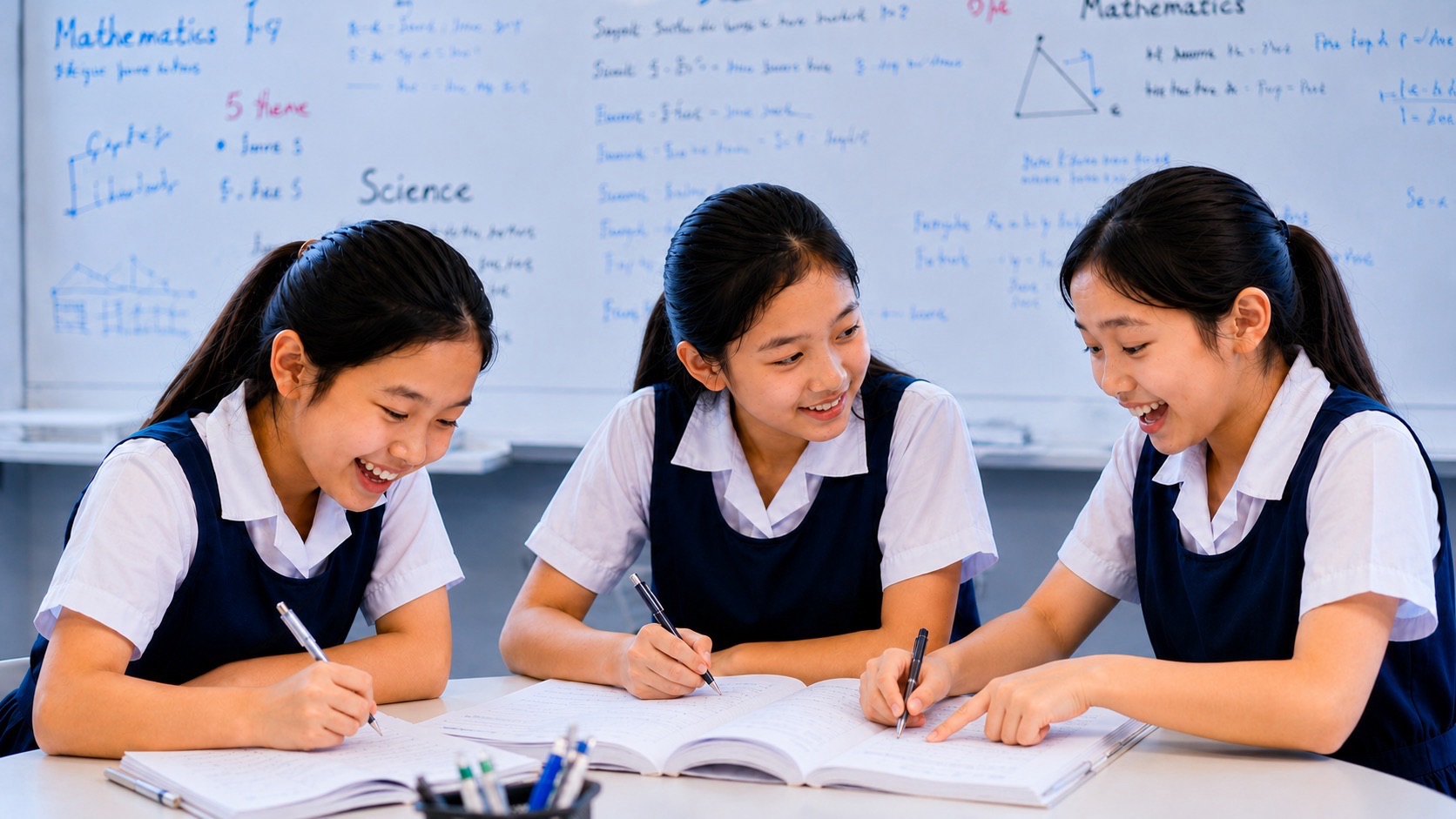
Our Punggol Secondary 2 E Mathematics Tuition provides focused guidance in true small groups of up to three students. We teach the concepts carefully, correct weak foundations and train students to solve unfamiliar questions with confidence.
The objective is not simply to help students complete more worksheets.
It is to build a dependable mathematical foundation for Secondary 3, upper-secondary Mathematics, Additional Mathematics where suitable, and the national examination pathway ahead.
Secondary 2 Is the Corridor Year of Secondary Mathematics
Secondary 1 introduces students to the language and structure of secondary-school Mathematics.
Secondary 3 begins the more demanding upper-secondary programme.
Secondary 2 sits between them.
It is the corridor connecting what the student knows now to what the student will soon be expected to handle.
A student who leaves Secondary 2 with strong algebra, disciplined working and accurate problem-solving habits will usually enter Secondary 3 from a position of confidence.
A student who leaves Secondary 2 with unresolved weaknesses may find that every new topic places additional weight on an already unstable foundation.
This is why Secondary 2 Mathematics tuition should not be treated only as emergency help before an examination. Used well, it can serve two important purposes.
It acts as insurance, preventing small gaps from becoming expensive problems later.
It also acts as an expressway, helping a capable student move more efficiently towards stronger grades, upper-secondary readiness and more demanding subject combinations.
E-Mathematics in the Current Singapore Secondary-School System
Many parents still use the familiar terms E-Math, Express Mathematics or Elementary Mathematics when searching for tuition.
Under Full Subject-Based Banding, students now take subjects at G1, G2 or G3 according to their learning needs and strengths. The former Express, Normal (Academic) and Normal (Technical) streams have been removed for cohorts entering Secondary 1 from 2024, while students have greater flexibility to study different subjects at different subject levels. (Ministry of Education)
This article is written mainly for students taking Secondary 2 G3 Mathematics, which most closely corresponds to what families traditionally call Secondary 2 E-Mathematics. Support can also be adjusted for students taking Mathematics at G2.
From 2027, the Singapore-Cambridge Secondary Education Certificate, or SEC, brings the previous N-Level and O-Level qualifications together under one certificate. Students sit each subject at its respective G1, G2 or G3 level, and the certificate reflects both the subjects and levels taken. (SEAB)
The names have changed, but the central requirement remains familiar: students need sound mathematical knowledge, clear reasoning, accurate application and the ability to communicate their working properly.
What Secondary 2 Mathematics Is Really Preparing Students For
Secondary 2 school examinations matter, but they are not the final destination.
The deeper purpose of the year is to prepare students for three important developments.
1. Upper-secondary Mathematics
Secondary 3 Mathematics moves more quickly and expects students to remember earlier methods without lengthy revision.
Teachers may begin a new topic assuming that students can already manipulate algebra, solve equations, interpret graphs and work accurately with fractions, indices and formulae.
When these foundations are secure, the transition is manageable.
When they are not, every lesson becomes harder than it needs to be.
2. Upper-secondary subject choices
Schools have their own subject-combination requirements and selection processes. A student’s Secondary 2 results may influence the range of subjects available in Secondary 3, including whether Additional Mathematics is a suitable option.
Additional Mathematics should not be chosen simply because it appears prestigious.
It should be chosen when the student has sufficient algebraic fluency, mathematical discipline and willingness to practise consistently.
A strong Secondary 2 year gives families a clearer and more reliable basis for that decision.
3. The national examination pathway
The current G3 Mathematics syllabus is organised around three broad strands:
- Number and Algebra
- Geometry and Measurement
- Statistics and Probability
It also assesses reasoning, communication, application and the ability to solve problems in different contexts—not only routine calculation. (Isomer User Content)
This means students need more than memorised steps. They must understand when a method applies, why it works and how to communicate the solution convincingly.
Why Secondary 2 E-Maths Often Feels More Difficult
Parents sometimes see a student who performed comfortably in Primary 6 or Secondary 1 begin to struggle in Secondary 2.
This does not necessarily mean that the student has become weaker.
The nature of the work has changed.
Questions require more interpretation
Earlier questions may make the required operation fairly obvious.
Secondary 2 questions increasingly expect students to decide:
- What information is relevant?
- What is the unknown?
- Which topic is being tested?
- Is an equation required?
- Should the answer be represented algebraically, graphically or numerically?
- Is the final answer reasonable?
The calculation may not be the hardest part.
The harder part is recognising what the question is asking the student to do.
Algebra becomes less forgiving
A missing negative sign, an incorrect expansion or a weak understanding of fractions can affect several lines of working.
Students who rely mainly on visual familiarity often become uncertain when a question is presented in a new form.
The solution is not simply to repeat the same exercise many times. The student needs to understand the underlying structure well enough to recognise it when the appearance changes.
Topics begin to connect
A single question may combine algebra with graphs, geometry with equations, or percentages with real-world interpretation.
The current examination direction explicitly includes connections across topics and the application of Mathematics to practical contexts. (Isomer User Content)
Students therefore need to move beyond isolated chapter knowledge.
They must learn to connect ideas.
Marks depend on working
A correct answer without sufficient working may not receive full credit. The current G3 Mathematics examination syllabus states that omission of essential working can result in the loss of marks. (Isomer User Content)
Students must learn to write solutions that are clear, efficient and mathematically complete.
Common Secondary 2 Mathematics Topics
The exact sequence of topics differs between schools, but Secondary 2 students commonly encounter a significant development in the following areas.
Algebraic manipulation
Students may work with:
- Expansion and simplification
- Factorisation
- Algebraic identities
- Algebraic fractions
- Substitution
- Changing the subject of a formula
- Translating statements into algebraic expressions
These are not merely Secondary 2 chapters.
They are tools that students will continue using throughout Secondary 3, Secondary 4 and Additional Mathematics.
Linear and simultaneous equations
Students need to understand more than the mechanical steps.
They must learn how to:
- Form equations from word problems
- Choose between substitution and elimination
- Keep both sides of an equation balanced
- Present the solution logically
- Check whether the answer fits the original situation
Graphs and coordinate geometry
Students may need to interpret and draw graphs, understand gradient, work with coordinates and connect an equation to its graphical representation.
The important shift is from treating graphs as pictures to understanding them as mathematical relationships.
Congruence and similarity
Students must recognise corresponding sides and angles, use proportional reasoning and distinguish between figures that are identical in size and shape and figures that share the same shape at different scales.
Pythagoras’ theorem and trigonometry
These topics require students to identify the correct sides, choose the appropriate relationship and work accurately with their calculators.
Weak diagram reading can lead to the wrong method even when the student remembers the formula.
Mensuration
Area, perimeter, surface area and volume questions become more complex when figures are composite or when dimensions must first be found using another method.
Statistics and probability
Students may be asked to organise, interpret and compare information rather than merely calculate a mean or probability.
This requires careful reading and an understanding of what the data actually represents.
Algebra Is the Language That Holds Secondary Mathematics Together
For many students, the most important part of Secondary 2 Mathematics is not one particular examination chapter.
It is algebra.
Algebra appears in equations, formulae, graphs, geometry, proportion, mensuration and later Additional Mathematics. It allows students to describe relationships that cannot be handled efficiently through arithmetic alone.
A student who is weak in algebra may appear to have difficulties in many different topics.
The visible problems may include:
- Difficulty with graphs
- Errors in mensuration
- Confusion in trigonometry
- Trouble forming equations
- Weakness in word problems
- Inability to complete multi-step questions
Yet the underlying issue may be the same: the student is not sufficiently fluent in manipulating symbols and preserving mathematical relationships.
This is why our Punggol Secondary 2 E-Maths tuition looks beneath the immediate mistake.
We do not only correct the line where the answer went wrong.
We identify the earliest weak link that caused it.
Why More Practice Does Not Always Produce Better Results
Practice is essential in Mathematics.
However, practice only becomes productive when the student is practising the right method with sufficient understanding.
A student may complete many questions while repeatedly making the same conceptual mistake.
Another student may remember the steps for one familiar question but remain unable to solve the same concept when the numbers, diagram or wording changes.
Productive practice should develop four abilities:
- Recognising the type of problem
- Selecting an appropriate method
- Carrying out the method accurately
- Checking and communicating the result
When one of these stages is weak, simply increasing the quantity of homework may create fatigue without creating mastery.
Our tutors therefore separate learning from drilling.
First, we make the concept clear.
Next, we guide the student through carefully selected examples.
Then, we reduce assistance and ask the student to solve independently.
Finally, we correct errors and revisit the question until the student can explain the method with confidence.
Diagnosis Before Acceleration
Parents often contact us because of a recent test result.
The mark is important, but it is only the surface.
Two students can receive the same score for entirely different reasons.
One may understand the topics but lose marks through careless working.
Another may have memorised procedures without understanding.
A third may be accurate in routine questions but become lost when several topics are combined.
A fourth may have unresolved Secondary 1 weaknesses that are now affecting Secondary 2 algebra.
The correct tuition plan depends on the cause.
We therefore examine areas such as:
- Algebraic fluency
- Accuracy with signs and fractions
- Ability to form equations
- Understanding of mathematical vocabulary
- Organisation of working
- Calculator use
- Topic recall
- Question interpretation
- Speed under timed conditions
- Ability to check answers independently
The aim is to avoid treating every student with the same worksheet and the same explanation.
A student improves more efficiently when the teaching responds to the actual problem.
Three Common Secondary 2 Student Profiles
The student recovering after a fall
This student may have previously performed well but received a disappointing result.
The immediate priority is not to rush ahead.
We first determine whether the fall came from one difficult topic, accumulated foundational gaps, weak examination technique or insufficient preparation.
The student is then given a structured recovery route:
- Repair the earliest weakness
- Rebuild accuracy
- Restore confidence through manageable success
- Return to current school topics
- Prepare for the next assessment
A poor result should become useful information, not a permanent label.
The student moving from average to distinction
This student generally understands lessons but remains around the middle range because of incomplete explanations, inconsistent working or difficulty with unfamiliar questions.
Improvement usually comes from refinement.
The student needs to:
- Recognise question structures more quickly
- Reduce repeated careless errors
- Present working more clearly
- Connect topics
- Practise higher-quality questions
- Review mistakes systematically
At this stage, progress is often less about learning more content and more about using existing knowledge with greater precision.
The student preparing for advanced Mathematics
This student may already be performing strongly and is considering Additional Mathematics or a demanding upper-secondary pathway.
The work should not become repetitive.
The student needs greater depth, flexibility and independence.
We may focus on:
- More demanding algebra
- Alternative solution methods
- Multi-topic questions
- Mathematical explanation
- Efficient working
- Questions requiring deeper interpretation
- Readiness for a faster upper-secondary pace
A strong student still needs guidance. The difference lies in the level of challenge.
Our Secondary 2 Mathematics Tuition Approach
Teach the concept from the beginning
We do not assume that a student understands a topic merely because it has already been taught in school.
When necessary, we return to the first principle.
We explain what the notation means, why the method works and how the topic connects with earlier knowledge.
This gives the student a stable structure rather than a collection of disconnected steps.
Build examples carefully
The first examples should make the structure visible.
We then vary the numbers, presentation and wording so that students learn to recognise the concept rather than memorise the appearance of one exercise.
Guide, then gradually remove support
Students may initially need prompts.
Over time, those prompts are reduced.
The student should eventually be able to begin a question, select the method and complete the solution without waiting for the tutor to rescue every difficult step.
Correct errors precisely
“Careless” is often too broad to be useful.
We identify what actually happened:
- A sign was lost during expansion
- A denominator was not preserved
- Corresponding sides were matched incorrectly
- The student answered before interpreting the graph
- The calculator was used in the wrong mode
- An answer was rounded too early
- Essential working was omitted
Precise correction allows precise improvement.
Revisit knowledge until it remains available
Understanding a topic once is not enough.
Students need spaced review and mixed practice so that earlier methods remain accessible after new chapters are introduced.
This is especially important in Mathematics because later topics regularly depend on earlier ones.
True Small-Group Secondary 2 Maths Tuition in Punggol
Our classes are kept to a maximum of three students.
This is deliberately small.
In a large class, a student can appear attentive while remaining confused. A tutor may only discover the misunderstanding when homework is marked or a test result arrives.
In a three-student class, the tutor can observe how each student begins a question, where hesitation occurs and which habits repeatedly cause errors.
This allows us to:
- Ask each student to explain the method
- Check working closely
- Adjust the level of difficulty
- Correct misconceptions immediately
- Provide sufficient independent practice
- Keep stronger students challenged
- Support weaker students without embarrassment
The class still has the energy of learning with peers, but each student remains visible.
That balance is particularly useful in Secondary 2, when students need both careful repair and steady progress.
Learning Ahead Without Creating Confusion
There is value in preparing students before a topic begins in school.
A well-prepared student enters the classroom with some familiarity. New terminology feels less intimidating, and the school lesson becomes a second encounter rather than the first.
However, learning ahead must be done carefully.
Moving too far ahead without sufficient understanding can create shallow knowledge and unnecessary confusion.
Our approach is measured.
We aim to:
- Build the necessary foundation
- Introduce the next concept clearly
- Give enough practice for understanding
- Keep the student aligned with school requirements
- Return to earlier topics through revision
The purpose of learning ahead is not to race through the textbook.
It is to give the student time to think.
Preparing for Secondary 2 Tests and Examinations
Good examination preparation should begin before the final revision period.
Throughout the year, students should be developing:
- Topic understanding
- Accurate working
- Question-recognition skills
- Calculator discipline
- Error awareness
- Time management
- Confidence with mixed questions
Closer to an examination, the emphasis changes.
We consolidate content, identify high-risk areas and increase exposure to questions that require several topics or decisions.
Students learn to approach a paper in stages:
Read accurately
Identify what the question provides and what it requires.
Select deliberately
Choose the method before beginning the calculation.
Show sufficient working
Write enough for the reasoning to be followed and marks to be awarded.
Check intelligently
Do not merely glance at the answer. Check signs, units, substitutions, calculator settings and whether the answer is reasonable.
Manage time
Do not spend too long protecting one difficult question while leaving easier marks untouched.
Examination confidence is rarely created by reassurance alone.
It grows when the student has a reliable process.
The Importance of Mathematical Communication
A student may understand an idea internally but still lose marks because the solution is incomplete or difficult to follow.
Mathematical communication includes:
- Using notation correctly
- Writing equations in a logical order
- Showing substitutions
- Labelling diagrams where necessary
- Including units
- Stating conclusions clearly
- Explaining reasoning when requested
The latest G3 Mathematics framework gives explicit attention to reasoning and communication, alongside standard techniques and problem-solving. (Isomer User Content)
We therefore teach students not only to arrive at an answer, but to produce a solution that deserves the marks.
Calculator Skills Are Part of Mathematics Skills
A calculator is a useful instrument, but it does not decide what Mathematics should be used.
Students still need to understand the expression they are entering, use brackets correctly, maintain suitable accuracy and interpret the result.
Common calculator problems include:
- Incorrect bracket placement
- Degree and radian mode confusion
- Premature rounding
- Copying a value incorrectly
- Trusting an unreasonable answer
- Entering a negative value incorrectly
- Failing to store or reuse values efficiently
An approved calculator may be used in both papers under the current G3 Mathematics assessment structure, but students remain responsible for choosing the correct method and presenting essential working. (Isomer User Content)
Calculator confidence should therefore be trained together with conceptual understanding.
When Should a Secondary 2 Student Begin Mathematics Tuition?
The best starting point depends on the student.
At the beginning of Secondary 2
This allows the tutor to establish strong habits early, repair Secondary 1 weaknesses and prepare the student before the workload becomes heavier.
After the first warning signs
These may include:
- Increasing homework time
- Repeated algebra errors
- Difficulty following school lessons
- Falling confidence
- Avoidance of Mathematics
- A noticeable decline in test performance
- Dependence on answer keys
- Inability to explain completed work
Early support is usually more efficient than waiting for several weak topics to accumulate.
After a poor examination result
A disappointing result can provide useful diagnostic information.
The priority is to analyse the paper carefully rather than immediately begin random revision.
During the year-end period
The period between Secondary 2 and Secondary 3 is valuable for foundation repair and upper-secondary preparation.
Students can consolidate algebra, equations, graphs and geometry before the faster Secondary 3 programme begins.
How Parents Can Tell Whether Tuition Is Working
Improvement may first appear in the student’s behaviour before it appears in a major examination result.
Parents may notice that the student:
- Starts homework with less hesitation
- Uses proper working more consistently
- Asks more precise questions
- Makes fewer repeated errors
- Can explain what a question is testing
- Checks answers independently
- Requires less prompting
- Approaches unfamiliar questions more calmly
- Recovers more quickly after making a mistake
Marks remain important, but durable improvement is built from these underlying changes.
The strongest outcome is not a student who can only perform while the tutor is beside them.
It is a student who has gradually learned how to think, practise and correct independently.
What to Look for in a Punggol Secondary 2 E-Maths Tutor
A suitable tutor should be able to do more than solve difficult questions quickly.
The tutor should be able to make the Mathematics understandable to the student.
Parents may wish to consider whether the tutor can:
- Diagnose the source of a weakness
- Explain concepts from the beginning
- Adapt explanations when the first one does not work
- Teach both routine and unfamiliar questions
- Correct working, not only final answers
- Prepare students for school assessments
- Develop independent problem-solving
- Support different levels within a genuinely small class
- Build foundations for Secondary 3 and beyond
Experience matters, but experience should be visible in the quality of the diagnosis, explanation and progression given to the student.
With more than 25 years of teaching experience, our focus remains simple: understand the student’s present position, teach what is missing and build the student towards the next stage.
Punggol Secondary 2 E-Maths Tuition for the Journey Ahead
Secondary 2 is not merely another school year to complete.
It is the point where foundational Mathematics begins to become a more mature system of algebra, reasoning, representation and application.
Handled well, the year can give a student:
- Stronger school results
- Better examination habits
- Greater confidence
- A smoother Secondary 3 transition
- Better readiness for upper-secondary Mathematics
- A clearer basis for considering Additional Mathematics
- More independence in learning
The work does not need to feel rushed or overwhelming.
A student needs clear teaching, appropriate practice, careful correction and enough time for the ideas to settle.
That is what our Punggol Secondary 2 Mathematics tuition is designed to provide.
Frequently Asked Questions
Is Secondary 2 E-Maths much harder than Secondary 1 Mathematics?
The change is usually felt through longer algebra, greater topic integration and questions requiring more interpretation. Students are expected to make more decisions independently rather than follow one obvious operation.
Is E-Math still the correct name?
Parents commonly use E-Math or Elementary Mathematics. Under Full Subject-Based Banding and the SEC system, the formal subject is Mathematics taken at G1, G2 or G3. This page mainly addresses students taking G3 Mathematics.
Does my child need tuition if the current grade is still acceptable?
An acceptable grade does not automatically mean tuition is required. Parents should also consider the student’s level of independence, algebraic foundation, confidence and readiness for Secondary 3. Tuition can be used for prevention and acceleration, not only recovery.
Can you help a student who is already failing?
Yes. The first step is to identify the earliest weakness rather than immediately pushing the student through current worksheets. The programme can then be adjusted to rebuild the required foundations while keeping contact with school topics.
Can a B-grade student improve towards a distinction?
Yes, when the student’s errors are identified accurately and practice is made more deliberate. The route commonly involves stronger question recognition, clearer working, fewer repeated mistakes and greater confidence with unfamiliar problems.
Do you prepare students for Additional Mathematics?
We build the algebraic strength and learning habits that support future Additional Mathematics. Whether a student should take Additional Mathematics also depends on school requirements, the student’s results, interests and willingness to practise consistently.
How large are the classes?
Our Punggol Mathematics tutorials are conducted in small groups of up to three students.
Do you teach from the basics?
Yes. When a foundation is weak, we return to the necessary starting point and rebuild the topic carefully. Students should not be expected to memorise advanced procedures when the underlying idea remains unclear.
Do you follow the school syllabus?
Lessons are aligned with the Singapore secondary Mathematics pathway. As schools may teach topics in different sequences, the tutor considers the student’s school progress, upcoming assessments and individual needs.
Is the programme only for weak students?
No. We support students recovering after a fall, students moving from average grades towards distinctions, and stronger students preparing for more demanding upper-secondary Mathematics.
Begin with a Mathematics Consultation
A consultation allows us to understand the student’s current level, recent results, school progress and immediate concerns before recommending the most suitable route.
For Punggol Secondary 2 E Mathematics Tuition, class availability and schedules:
Call or WhatsApp Yuet Ling at +65 8823 1234
True small-group Mathematics tuition in Punggol, with a maximum of three students per class.