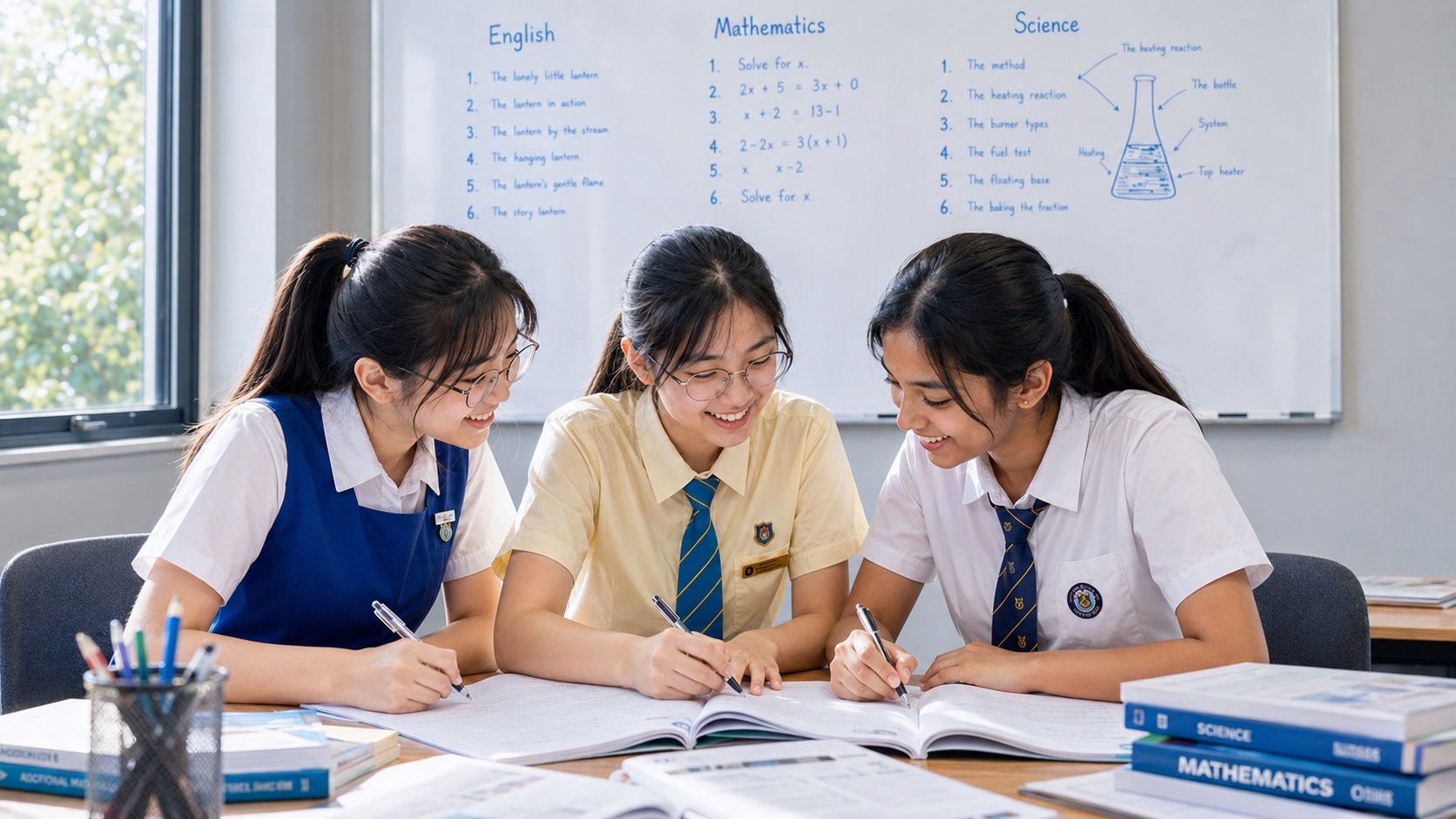
Punggol Additional Mathematics Tuition Secondary 4
Secondary 4 Additional Mathematics is not simply the final year of learning more chapters.
It is the year in which everything must begin working together.
A student may understand differentiation during a lesson, remember several trigonometric identities and complete logarithm exercises at home. Yet the examination asks a more demanding question:
Can the student recognise what is required, choose the correct method, connect several ideas and complete the solution accurately under time pressure?
This is where many capable students begin to feel the strain.
At eduKate Singapore, our Punggol Additional Mathematics Tuition for Secondary 4 helps students turn separate pieces of knowledge into a complete examination system. We work in focused classes of no more than three students, allowing us to see how each student thinks, where marks are being lost and what must be corrected next.
The goal is not to add more pressure to an already demanding year.
The goal is to bring clarity, structure and control.
Secondary 4 Is the Year of Mathematical Control
In Secondary 3, students are usually introduced to the language and structure of Additional Mathematics.
They learn new forms of algebra, trigonometry, coordinate geometry and calculus. Much of the year is spent becoming familiar with methods that did not exist in Lower Secondary Mathematics.
Secondary 4 is different.
Students must now:
- retain what they learned previously;
- understand the remaining syllabus;
- connect topics across different chapters;
- complete longer questions accurately;
- show sufficient mathematical working;
- recognise unfamiliar forms of familiar ideas;
- manage time across two full examination papers; and
- recover calmly when the first approach does not work.
A student who studies Additional Mathematics only as a collection of chapters may therefore struggle even after completing the syllabus.
The examination is not organised inside the student’s head as neatly as a textbook.
A question may begin with algebra, move into trigonometry and finish with calculus. Another may require the student to transform an expression before the correct method becomes visible.
Secondary 4 tuition must therefore do more than revise individual topics.
It must teach the student how the entire subject works.
What the Current Additional Mathematics Syllabus Requires
For the 2026 GCE O-Level examination, Additional Mathematics remains syllabus 4049. The official syllabus is organised into three main strands:
- Algebra
- Geometry and Trigonometry
- Calculus
The syllabus assumes that students already possess the required knowledge from O-Level Mathematics. It is also intended to provide preparation for further mathematical study, including H2 Mathematics, where strong algebraic manipulation and mathematical reasoning are important. (Isomer User Content)
The assessment is not built around routine calculation alone.
Approximately:
- 35% assesses the use of standard techniques;
- 50% assesses problem-solving in different contexts; and
- 15% assesses mathematical reasoning and communication.
Together, problem-solving and reasoning account for approximately 65% of the assessment. This is why repeatedly completing familiar exercises may not be sufficient. Students must also learn how to interpret, connect, justify and communicate their mathematics.
The examination consists of two papers, each lasting 2 hours and 15 minutes and carrying 90 marks. Students must answer every question. The official assessment notes also make clear that omitting essential working can lead to a loss of marks.
This changes how a student should prepare.
Speed matters, but speed without method is fragile.
Accuracy matters, but accuracy only on familiar questions is not enough.
The stronger student must be able to see the structure beneath the question.
The Transition from O-Level to the SEC Examination
Singapore is presently moving towards the Singapore-Cambridge Secondary Education Certificate.
The 2026 Secondary 4 cohort continues to sit the GCE O-Level Additional Mathematics syllabus 4049. From the 2027 SEC examination, G3 Additional Mathematics is listed under the new subject code K341, with 4049 shown as the corresponding earlier reference code. (SEAB)
For parents, the important point is simple.
The name and examination framework may evolve, but the central mathematical demands remain recognisable:
- strong algebra;
- connected reasoning;
- accurate mathematical communication;
- flexible problem-solving;
- trigonometric control; and
- a secure understanding of calculus.
A student still needs to understand the mathematics deeply enough to use it when the question changes its appearance.
Why Secondary 4 Additional Mathematics Becomes Difficult
Most students do not struggle because every part of Additional Mathematics is beyond them.
They struggle because several smaller weaknesses begin interacting.
A student may know the differentiation formula but make algebraic errors while simplifying the derivative.
Another may remember a trigonometric identity but fail to see which side of the equation should be transformed.
A third may understand logarithms during practice but become uncertain when logarithms appear inside a modelling question.
The visible problem may be calculus.
The underlying problem may be algebra.
The visible problem may be trigonometry.
The underlying problem may be weak manipulation, incomplete angle knowledge or uncertainty with exact values.
The visible problem may be examination speed.
The underlying problem may be that the student is taking too long to decide which method to use.
Good Secondary 4 A-Math tuition must identify the real source of the difficulty rather than responding with more undirected practice.
The Algebra Beneath the Whole Subject
Algebra is not merely one section of Additional Mathematics.
It is the working language of almost every section.
Students use algebra when they:
- manipulate logarithmic expressions;
- solve trigonometric equations;
- differentiate composite expressions;
- integrate functions;
- find stationary points;
- determine equations of tangents and normals;
- solve kinematics problems;
- work with coordinate geometry; and
- prove identities.
This is why a student can appear to understand a new topic while still losing marks throughout the question.
The concept may be correct, but the algebra carrying the concept is unstable.
Common algebraic weaknesses include:
- sign errors;
- incorrect expansion;
- weak factorisation;
- careless treatment of fractions;
- poor substitution;
- incorrect index laws;
- incomplete logarithmic manipulation;
- premature use of decimals; and
- skipping steps that were necessary for verification.
At our Punggol Secondary 4 Additional Mathematics tuition, algebra is not repaired only during an “algebra lesson”.
It is corrected wherever it appears.
When a student makes the same form of error repeatedly, we do not simply mark it wrong. We identify the pattern, explain why it occurs and establish a prevention rule that the student can use in future questions.
Trigonometry Is a System of Transformations
Trigonometry can be one of the most intimidating parts of Secondary 4 Additional Mathematics because students are required to work with several representations of the same relationship.
They must understand:
- trigonometric functions;
- exact values;
- identities;
- double-angle formulae;
- compound-angle formulae;
- trigonometric graphs;
- equations within a stated interval;
- proof of identities; and
- expressions involving (R\sin(\theta \pm \alpha)) or (R\cos(\theta \pm \alpha)).
The official syllabus expects students to simplify trigonometric expressions, solve equations and prove simple identities.
The difficulty is rarely solved by memorising more formulas.
The student needs to know:
- what form the expression is currently in;
- what form it needs to become;
- which identity can produce that change;
- whether to transform one side or both sides;
- how to preserve equivalence; and
- when the working has reached a useful stopping point.
We teach trigonometry as controlled transformation.
Instead of asking, “Which formula do I remember?”, the student learns to ask:
“What must this expression become?”
That small change in thinking can make a complicated question much more manageable.
Calculus Requires More Than Remembering Rules
Calculus is often the section students associate most strongly with Additional Mathematics.
The syllabus includes differentiation, integration, tangents, normals, stationary points, rates of change, maxima and minima, areas and straight-line motion involving displacement, velocity and acceleration.
Students may initially believe that calculus is mainly about remembering differentiation and integration rules.
Those rules are only the beginning.
A complete calculus question may require the student to:
- interpret the situation;
- construct or identify the correct expression;
- differentiate or integrate accurately;
- solve the resulting equation;
- check whether the value is valid;
- interpret the answer in context; and
- present the final answer with appropriate units or explanation.
The calculus may occupy only one line.
The reasoning surrounding it may occupy the rest of the question.
Our Secondary 4 A-Math tuition therefore separates three abilities:
Technical calculus
Can the student differentiate and integrate correctly?
Algebraic control
Can the student simplify, substitute and solve accurately after using calculus?
Applied reasoning
Can the student understand what the derivative, integral or stationary point means in the question?
A student may be strong in one ability and weak in another. Tuition becomes more effective when the precise weakness is identified.
Why Students Who Did Well in Secondary 3 Can Still Struggle
Some students enter Secondary 4 with respectable Secondary 3 results and assume that they are safely on course.
Then the marks begin to fall.
This does not always mean that the student has suddenly become weaker.
Several things may have changed.
The questions may now combine more topics. Teachers may be completing the remaining syllabus while beginning revision. Tests may contain a wider range of material. There may be less time between learning a topic and being assessed on it.
A student who previously relied on short-term memory may discover that earlier chapters are no longer readily available.
A student who performed well on topic exercises may struggle when questions are mixed.
A student who was comfortable following a demonstrated method may become uncertain when no method is indicated.
Secondary 4 exposes the difference between having seen the mathematics and being able to control it independently.
This is why early Secondary 4 results should be read carefully.
A lower mark is not only a judgement. It is information.
It shows us where the student’s preparation system is not yet strong enough.
The Three Secondary 4 A-Math Journeys
Not every student comes to tuition for the same reason.
At eduKate Singapore, we generally see three broad journeys.
1. Recovering After a Fall
These students may have failed or experienced a sharp drop in marks.
They may feel that there are too many missing chapters and too little time. Their confidence may already be affecting how they approach new questions.
The first priority is not to rush them into full papers.
We identify the earliest weakness that is still affecting current work. This may include algebra, logarithms, trigonometric manipulation or basic differentiation.
The sequence is:
- restore essential foundations;
- help the student complete accessible questions;
- reduce repeated errors;
- rebuild topic connections; and
- gradually increase examination demand.
Progress begins when the subject stops feeling like one large unsolved problem.
2. Moving from Average to Distinction
These students often understand much of the syllabus but produce inconsistent results.
They may score well on one test and poorly on the next. They may lose marks through incomplete working, weak question selection, careless algebra or an inability to finish the paper.
For this student, the work is less about relearning everything and more about strengthening control.
We focus on:
- recognising question types;
- selecting efficient methods;
- connecting topics;
- improving working presentation;
- reducing avoidable errors;
- building timed-paper stamina; and
- turning correction into a repeatable routine.
The aim is to make good performance less dependent on whether the paper happens to suit the student.
3. Moving from Distinction to High Performance
A student already scoring well has a different problem.
The broad understanding is present, but the remaining marks may be hidden inside small inefficiencies:
- a line of working that is not sufficiently justified;
- a slower-than-necessary approach;
- an overlooked restriction;
- a missing exact value;
- an incomplete proof;
- a failure to verify the final answer; or
- one difficult question that consumes too much time.
These students need greater precision, wider exposure and more demanding mixed practice.
The aim is not simply to do more questions.
It is to make every decision inside the solution cleaner.
What We Diagnose Before We Teach
When a Secondary 4 student joins us, we need to understand the present position accurately.
A school grade alone does not tell the full story.
Two students may both receive 55%, yet their needs may be completely different.
One may know the concepts but make repeated careless errors.
The other may be accurate on basic questions but unable to begin unfamiliar ones.
We examine areas such as:
- current school topics;
- Secondary 3 retention;
- algebraic fluency;
- trigonometric understanding;
- calculus techniques;
- ability to connect topics;
- quality of mathematical working;
- examination timing;
- repeated error patterns; and
- confidence when the route is not immediately visible.
Parents are encouraged to bring recent school papers, topical tests and relevant worksheets for the initial discussion.
These materials allow us to see not only which answers are wrong, but how the student arrived there.
The working often reveals more than the final mark.
Teaching from First Principles
Students sometimes try to remember Additional Mathematics as a large collection of procedures.
This can work temporarily.
It becomes unreliable when the question is changed.
We teach important methods from their underlying ideas so that students can reconstruct their understanding instead of depending entirely on memory.
For example, a student should not only know how to complete the square. The student should understand what the completed-square form reveals about the graph and its maximum or minimum value.
A student should not only memorise that differentiation finds a gradient. The student should understand how this connects to tangents, rates of change, stationary points and motion.
A student should not only copy the steps of a trigonometric proof. The student should understand why changing one expression makes the relationship visible.
First-principles teaching does not make lessons unnecessarily theoretical.
It gives the student a more dependable foundation for solving unfamiliar questions.
From Understanding to Independent Performance
A student can follow a tutor’s explanation and still be unable to complete the next question alone.
This is one of the most important distinctions in tuition.
Recognition is not yet mastery.
A productive lesson therefore moves through several stages.
Clear explanation
The tutor explains the concept and its mathematical purpose.
Guided application
The student completes a question with prompts, allowing misconceptions to surface.
Reduced support
The tutor removes some guidance and observes whether the student can choose the method independently.
Independent work
The student completes a new question without relying on the previous example.
Correction and explanation
The student reviews the error, corrects it and explains what should be done differently next time.
This final stage matters.
An answer that has merely been corrected by the tutor may be forgotten.
An error that has been understood by the student can become a lasting improvement.
Why Mixed Practice Matters in Secondary 4
Topic practice remains useful when a student is first learning a method.
However, the final examination does not announce the topic before every question.
Students must identify the required mathematics for themselves.
This is why Secondary 4 preparation must gradually move from isolated practice to mixed practice.
A mixed set may require the student to decide whether a question involves:
- factorisation;
- logarithms;
- coordinate geometry;
- trigonometric identities;
- differentiation;
- integration; or
- a combination of several ideas.
The first challenge is therefore not calculation.
It is recognition.
Mixed practice trains the student to retrieve the correct method without being told where it came from.
It also keeps earlier topics active while the school continues teaching new material.
Without this, students may repeatedly revise the newest chapter while quietly forgetting the rest of the syllabus.
Training for Paper 1 and Paper 2
Full-paper practice is necessary, but it should not begin as a mindless routine.
A student who completes paper after paper without examining the mistakes may simply practise the same weaknesses repeatedly.
We use examination papers in stages.
Stage One: Selected examination questions
Questions are chosen to expose a particular weakness or connection.
Stage Two: Mixed timed sections
Students learn to shift between topics while working under moderate time pressure.
Stage Three: Full papers
Students practise endurance, decision-making, working presentation and time allocation across the complete paper.
Stage Four: Paper analysis
The completed paper is studied carefully.
We ask:
- Which questions took too long?
- Where did the first error occur?
- Was the wrong method chosen?
- Was the method correct but poorly executed?
- Were marks lost through missing working?
- Did the student recognise the topic?
- Could the answer have been checked?
- Is the error isolated or repeated?
The paper is not finished when the timer ends.
The paper is finished when the student understands what it has revealed.
The Importance of Mathematical Working
Additional Mathematics is not a multiple-choice subject.
The route matters.
Students must present enough working for the reasoning to be followed. This is especially important because the official examination guidance states that omitting essential working can result in lost marks.
Clear working also helps the student.
When the solution is organised, it becomes easier to:
- locate a sign error;
- check a substitution;
- verify a derivative;
- notice an invalid value;
- recover after becoming stuck; and
- continue a multi-part question.
We teach students to write mathematics that is compact but complete.
Good working should not be unnecessarily long.
It should make the logic visible.
Learning to Check Without Repeating the Whole Question
Many students say that they have no time to check.
Often, this is because they believe checking means solving every question again.
Effective checking is more selective.
Depending on the question, a student may check:
- whether the answer satisfies the original equation;
- whether a gradient has the correct sign;
- whether an angle lies within the required interval;
- whether an exact answer was required;
- whether units have been included;
- whether a maximum has been distinguished from a minimum;
- whether the final expression has been simplified; or
- whether a value is reasonable in the given context.
Checking is not an activity reserved for the final five minutes.
It can be built into the solution itself.
A well-trained student leaves small points of verification throughout the paper.
Why We Teach in Small Groups of Three
Our Punggol Additional Mathematics classes are kept to a maximum of three students.
This is deliberately small.
It allows the tutor to observe each student’s working closely enough to identify hesitation, repeated errors and inefficient methods.
A three-student class provides:
Close individual attention
The tutor can respond to the student’s actual working rather than teaching only to the room.
Shared mathematical discussion
Students hear different questions and see alternative approaches without disappearing inside a large class.
Independent thinking
Each student still has to attempt the mathematics. The lesson does not become three separate private tutorials in which the tutor completes every difficult step.
Faster correction
Misunderstandings can be addressed before they become habits.
A calmer learning environment
Students have enough space to ask questions, think and make corrections without competing for attention.
Small-group tuition works best when it combines personal observation with the energy of learning beside others.
What a Secondary 4 A-Math Lesson Looks Like
Each lesson is shaped by the student’s school progress and present needs, but a typical session may include:
- a review of recent schoolwork or a previous weakness;
- explanation of the current concept;
- guided questions to establish the method;
- independent questions to test understanding;
- mixed questions connecting earlier topics;
- correction of repeated errors; and
- a clear task for the next stage of practice.
We do not measure the quality of a lesson by the number of worksheets completed.
A student may complete many questions and learn very little if the errors are not examined.
A smaller number of well-chosen questions can produce more progress when each one has a clear purpose.
A Practical Secondary 4 A-Math Training Calendar
The year should not be treated as one continuous rush towards the final examination.
Each period has a different job.
Term 1: Establish the Position
We identify inherited weaknesses, restore important Secondary 3 material and support the student’s current school topics.
This is the best period to correct structural problems before the pace increases.
Term 2: Complete and Connect
As more of the syllabus is completed, students begin connecting calculus, trigonometry, algebra and geometry through mixed practice.
The objective is to prevent the subject from separating into forgotten chapters.
June: Consolidate
The mid-year period provides an opportunity to repair unfinished work, revise earlier topics and increase examination exposure.
This should be purposeful consolidation, not a sudden flood of worksheets.
Term 3: Build Examination Fitness
Students work on preliminary examination readiness through timed sections, full papers and detailed correction.
At this stage, method selection and time control become increasingly important.
After the Preliminary Examinations: Refine
The preliminary paper provides valuable evidence.
The final phase should focus on the weaknesses that still cost the most marks rather than restarting the entire syllabus indiscriminately.
The aim is to enter the national examination with a smaller, clearer list of priorities.
Signs That Your Child May Need Additional Mathematics Support
Parents do not need to wait for a complete collapse before seeking help.
Some early signs include:
- the student understands lessons but cannot begin homework independently;
- algebraic mistakes appear across many chapters;
- earlier Secondary 3 topics have been forgotten;
- the student knows formulas but cannot decide when to use them;
- trigonometric proofs are attempted through trial and error;
- calculus techniques are remembered without understanding the applications;
- working is incomplete or difficult to follow;
- the student performs well only on recently taught topics;
- examination papers are regularly unfinished;
- the same mistake reappears after correction; or
- the student has become reluctant to attempt difficult questions.
One sign alone may not be serious.
A repeated pattern deserves attention.
The earlier the actual weakness is identified, the more calmly it can be corrected.
What Parents Can Do at Home
Parents do not need to teach calculus or trigonometry themselves.
The most useful support is often organisational.
Ask about the current difficulty
Instead of asking only, “What was your mark?”, ask:
- Which questions could you not begin?
- Which topic caused the most difficulty?
- Were the mistakes conceptual or careless?
- Did you finish the paper?
- What will you correct before the next test?
Keep school papers
Recent papers help both the student and tutor identify recurring patterns.
Protect regular practice time
Additional Mathematics improves through consistent contact. Long gaps make retrieval harder and increase the amount that must be relearned.
Encourage proper correction
A corrected answer should include an understanding of why the original method failed.
Watch the student’s confidence
Avoid interpreting every low mark as a lack of effort. Sometimes the student is working hard but using an ineffective method.
The solution is not always more pressure.
It may be better structure.
Choosing a Secondary 4 Additional Mathematics Tutor
A good Secondary 4 tutor should be able to do more than demonstrate solutions.
Parents should look for a tutor who can:
- identify the source of an error;
- explain difficult ideas clearly;
- rebuild weak algebra;
- connect chapters across the syllabus;
- teach students how to select methods;
- improve mathematical working;
- prepare students for timed papers;
- adjust the level of challenge;
- support both recovery and high performance; and
- explain the student’s present position honestly.
The tutor should not create dependence.
The long-term aim is for the student to become increasingly capable of solving questions without prompts.
A student who can only perform while the tutor is beside them is not yet examination-ready.
Why Families Choose eduKate Singapore in Punggol
At eduKate Singapore, we have spent more than two decades teaching students through important educational transitions.
Our Secondary 4 Additional Mathematics programme is built around several principles.
We begin with the student
The same worksheet is not the correct starting point for every learner.
We teach the mathematics clearly
Students should understand why a method works, not only imitate its steps.
We repair foundations where necessary
Advanced questions become more manageable when the underlying algebra is secure.
We train examination independence
Students must learn to recognise, choose, execute and verify their own methods.
We keep our classes small
With no more than three students, we can observe the details that are easily missed in a larger classroom.
We aim for meaningful progress
For one student, progress may begin with passing consistently.
For another, it may mean moving from a B to an A.
For a high-performing student, it may mean greater precision and readiness for more demanding mathematical study.
The destination may differ.
The teaching should still be careful, structured and ambitious.
Frequently Asked Questions
Is Secondary 4 too late to begin Additional Mathematics tuition?
It is not automatically too late, but the plan must be realistic.
A student with a few concentrated weaknesses may improve relatively quickly. A student with broad Secondary 3 gaps will require a more carefully prioritised programme.
The first step is to determine the actual position rather than making assumptions from the latest grade alone.
Can a student recover after failing Additional Mathematics?
Yes, improvement is possible, but the failure must be analysed.
The student may be losing marks through weak algebra, incomplete knowledge, poor method selection, unfinished papers or a combination of these.
Recovery becomes more likely when the most influential weakness is corrected first.
What if my child is also weak in Elementary Mathematics?
The official Additional Mathematics syllabus assumes knowledge from O-Level Mathematics. Weaknesses in algebra, graphs, equations or geometry can therefore affect A-Math performance indirectly. (Isomer User Content)
We may need to strengthen selected E-Math foundations while teaching the A-Math syllabus.
Do you focus on school topics or examination preparation?
Both are important.
Students need support with their current schoolwork, but they must also retain earlier topics and prepare for mixed examination questions.
The balance changes as the year progresses.
How many students are in each class?
Our small-group classes are limited to a maximum of three students.
Do students complete full papers during tuition?
Full papers are introduced when they will be useful.
Before that, students may work on selected questions, mixed sections and timed components. Full-paper practice is most productive when the student has enough foundation to learn from it.
Can a student join during the middle of the year?
Students may join subject to class availability.
We first examine the student’s present syllabus coverage, school performance and major weaknesses so that the tuition does not simply continue from an unsuitable starting point.
How quickly will results improve?
There is no honest single answer.
Some errors can be corrected quickly. Rebuilding weak foundations, examination stamina and independent problem-solving takes longer.
We look for early improvements in the quality of working, method selection, accuracy and confidence, followed by stronger test performance.
Does tuition guarantee an A1?
No responsible tutor should guarantee a particular examination grade.
Results also depend on the student’s starting point, attendance, practice, school demands and willingness to correct mistakes.
What we can provide is a carefully structured environment designed to improve the student’s understanding, performance and readiness.
Secondary 4 Additional Mathematics Can Become Clearer
Additional Mathematics feels overwhelming when every chapter appears to be a separate problem.
It becomes more manageable when the student begins to see the structure.
Algebra carries the working.
Trigonometry transforms expressions.
Coordinate geometry turns relationships into visible form.
Calculus describes change, gradient, movement and area.
Examination practice trains recognition, accuracy and control.
Correction turns mistakes into information.
Secondary 4 is a demanding year, but it is not only a year of pressure.
It is also a year in which a student’s trajectory can still change significantly.
A student can recover after a difficult Secondary 3.
An average student can become more consistent.
A strong student can develop the precision needed for distinction.
The important question is not simply whether the student is working hard.
It is whether the work is addressing the right problem.
Enquire About Punggol Additional Mathematics Tuition for Secondary 4
Our Punggol Additional Mathematics Tuition Secondary 4 programme provides focused teaching in small groups of no more than three students.
We help students strengthen algebra, gain control of trigonometry and calculus, connect topics, improve mathematical working and prepare systematically for Paper 1 and Paper 2.
Contact eduKate Singapore to discuss your child’s present Secondary 4 Additional Mathematics position, learning needs and class availability in Punggol.
Start clearly. Build properly. Move forward with confidence.
2026 rebuild: final-year A-Math as an integration programme
This preserved 2019 page has been expanded for the current Secondary 4 Additional Mathematics context. For 2026 GCE O-Level school candidates, SEAB lists Additional Mathematics as syllabus 4049. From 2027, the Singapore-Cambridge Secondary Education Certificate lists G3 Additional Mathematics as K341 and G3 Mathematics as K310. The codes change; the final-year learning problem does not. The learner must keep algebra, trigonometry, coordinate geometry and calculus available at the same time and apply them under mixed examination conditions.
The strongest tuition programme therefore stops behaving like a chapter-by-chapter course as the year progresses. New content still matters where it remains incomplete, but more lesson time should gradually move toward cumulative retrieval, mixed route selection, school-paper diagnosis, timed sections and self-correction. Secondary 4 should become quieter and more selective, not simply busier.
The final-year priority map
A useful Secondary 4 priority map is short. It may contain algebraic execution, logarithmic domains, trigonometric equation intervals, circle-equation signs, calculus modelling and one timing bottleneck. The exact list differs by learner. What matters is that the list is evidence-based and updated whenever one weakness becomes stable.
This is more useful than the instruction to “revise everything”. Stable topics can remain on a lighter retrieval schedule while lesson time concentrates on the few mechanisms still leaking marks. A large syllabus becomes manageable when attention is selective.
Paper review should change the next lesson
A full paper is valuable only when it produces a plan. Sort significant losses into Concept, Algebra, Route, Representation, Communication and Execution. A calculus question and a coordinate-geometry question may both be lost because of the same algebraic sign habit. One deep repair can therefore recover marks across several chapters.
After the correction, change the question. New values, a new representation or a different target test whether the repair transferred. Copying the original model answer mostly tests recognition. A changed follow-up reveals whether the learner owns the method.
Retrieval keeps the syllabus alive
Secondary 4 students often focus on the newest chapter and discover later that earlier A-Math has gone cold. Short closed-book retrieval prevents this. Quadratics, logarithms, trigonometry, coordinate geometry and calculus should all return at spaced intervals after they are learned.
Stable topics can return less frequently. Fragile topics should return sooner. This creates an adaptive revision system rather than equal treatment of every chapter. By the time full papers dominate the timetable, much of the syllabus remains accessible without reconstruction.
Interleaving trains route selection
Topical practice tells the learner which method to use. Mixed practice removes that cue. Once individual methods are stable, interleaving should become a major part of final-year tuition because the student must identify whether the structure is quadratic, logarithmic, trigonometric, coordinate or calculus-based before calculating.
This is one of the main differences between worksheet fluency and examination maturity. The final-year learner needs to recognise the mathematical family beneath unfamiliar wording, not wait for a chapter heading.
Timing should be diagnosed, not guessed
A student may run out of time because algebra is slow, route selection takes too long, calculator entry is inefficient or one difficult identity absorbs too much attention. Whole-paper timing tells us that time was lost; shorter timed sections reveal where.
Once the bottleneck is visible, practice can be targeted. Faster route classification, cleaner algebra or a move-on rule may improve paper completion more than simply asking the student to write faster.
Calculus should remain connected to functions
Differentiation should still mean gradient and rate of change, not only rule application. Integration should remain connected to reverse differentiation and accumulation. These meanings help students interpret stationary points, optimisation, connected rates, areas and motion instead of treating each application as a separate trick.
A final-year tutor should use independent checks where possible. Differentiate an antiderivative. Compare derivative sign with graph behaviour. Check units in connected-rate problems. These checks reduce dependence on memory and build examination resilience.
The last twelve weeks
In the last twelve weeks, increase mixed-paper work while continuing targeted repair. The weakness list should shrink, not expand. Full papers can become more frequent, but a repeated error that appears across several papers is asking for teaching, not another paper.
Every few weeks, review the priority map. Remove repaired weaknesses, promote the next recurring mechanism and keep the student’s checking routine current. This makes progress visible and prevents the entire syllabus from feeling equally urgent.
The final month and final week
The final month should protect stability. Continue mixed retrieval, revisit high-value corrections and use enough timed work to keep paper rhythm familiar. Avoid chasing rare question types simply because the examination is near. Core algebra, trigonometric control, calculus routines and paper management remain the foundation.
The final week should be lighter. Short retrieval, selected corrections, calculator checks and normal sleep are more useful than emergency syllabus reconstruction. The learner should arrive with the mathematical system available and enough cognitive control to use it.
The independent learner is the final goal
By examination time, the tutor should not be the only person who understands the revision plan. The learner should know which topics are secure, which few weaknesses remain, when to move on from a stalled question and how to check personally high-risk steps. That transfer of control is part of readiness.
This rebuilt page remains at its original Punggol URL as a learning-library guide. Current class venue, timetable and availability should be verified through current eduKate channels. Its durable standard is final-year integration: connected knowledge, precise diagnosis, proportionate paper practice and increasing independence.