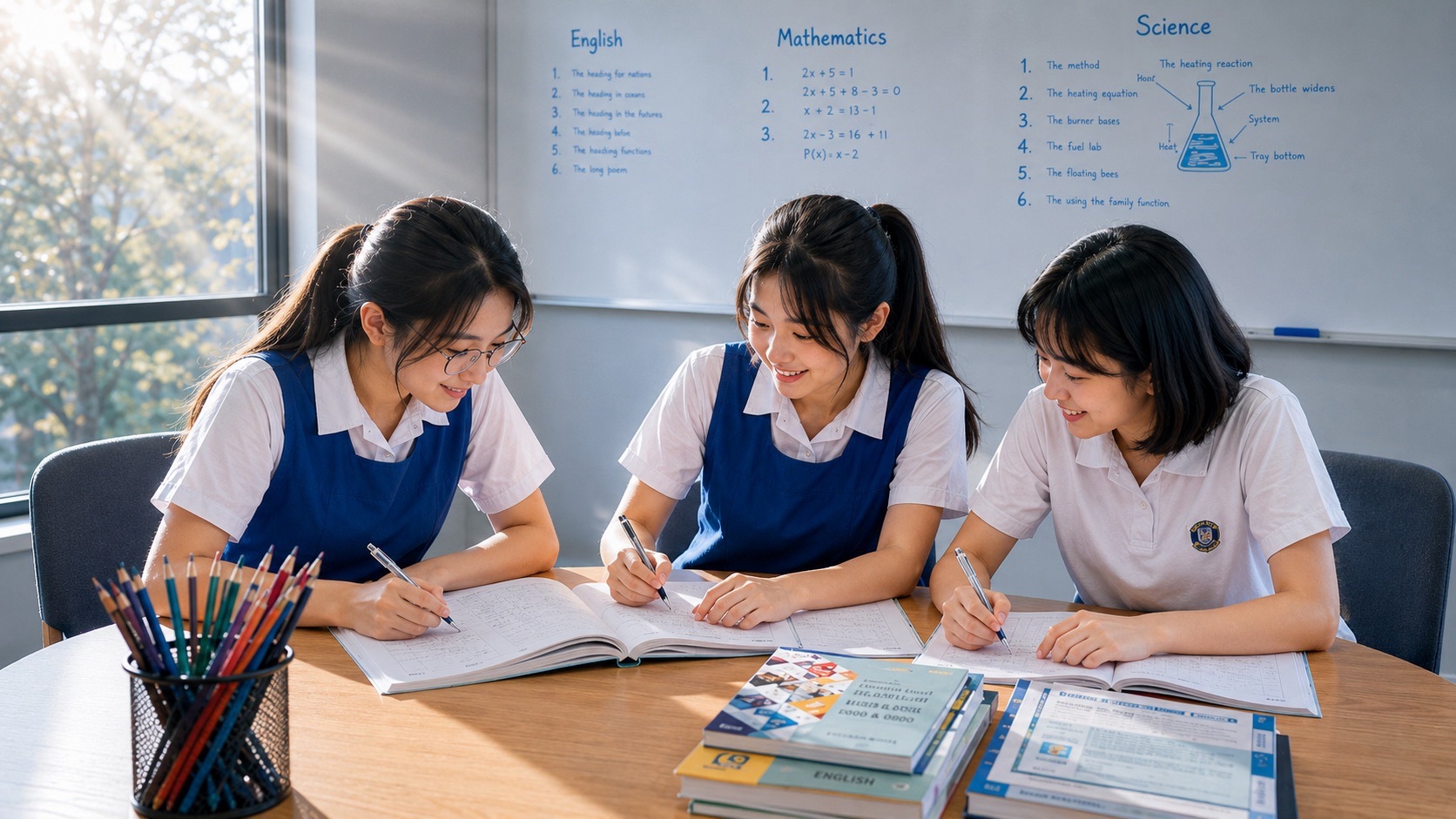
Additional Mathematics tuition for Woodlands Secondary 3 and Secondary 4 students who need to move from following worked examples to solving questions independently.
eduKate Singapore teaches G2 and G3 Additional Mathematics in carefully managed three-student classes near Sixth Avenue MRT.
Additional Mathematics Tuition for Woodlands Students
Many students do not struggle with Additional Mathematics because they understand nothing.
They struggle because their understanding remains dependent on support.
The student may:
- follow the teacher’s explanation;
- understand a completed example;
- recognise a method after someone names it;
- finish a question after receiving the first step;
- and complete homework by referring closely to notes.
However, when the question appears inside a test, the student cannot begin independently.
This creates the central problem addressed by the programme:
[
\text{Supported understanding}
\neq
\text{independent mathematical control}
]
eduKate Singapore’s three-student Additional Mathematics tuition helps Woodlands students close this gap.
The teaching process moves the student from:
[
\text{Watching}
\rightarrow
\text{following}
\rightarrow
\text{attempting}
\rightarrow
\text{choosing}
\rightarrow
\text{completing}
\rightarrow
\text{transferring}
]
The goal is not merely to help the student understand the tutor.
The goal is to help the student work without the tutor.
Additional Mathematics Tuition at a Glance
| Programme detail | Information |
|---|---|
| Subject | Additional Mathematics |
| Student levels | Secondary 3 and Secondary 4 |
| Subject levels | G2 and G3 Additional Mathematics |
| Class format | Maximum three students |
| Lesson duration | 1.5 hours weekly |
| Teaching location | 8 Fourth Avenue, near Sixth Avenue MRT |
| Students served | Woodlands and surrounding northern areas |
| Main focus | Independent problem-solving, algebra, functions, trigonometry, calculus and examination control |
| Suitable for | Foundation repair, school support, consolidation, examination preparation and extension |
| Placement | By consultation, timetable and class suitability |
A Clear Location Note
This programme serves students and families from Woodlands.
Lessons are not conducted at a Woodlands branch.
The teaching location described on this page is:
eduKate Singapore
8 Fourth Avenue, Singapore 268674
Near Sixth Avenue MRT
The relationship is therefore:
[
\text{Area served: Woodlands}
]
[
\text{Teaching location: Sixth Avenue}
]
Woodlands families should consider:
- travelling time;
- school and co-curricular schedules;
- lesson timing;
- the student’s learning needs;
- the class format;
- and whether the teaching approach justifies the journey.
A nearby programme may be suitable for a student who needs convenient routine revision.
The three-student format may be worth considering when the student needs close guidance while learning to become less dependent on guidance.
The Student Who Understands but Cannot Do
A common Additional Mathematics difficulty appears in the following conversation:
“I understood it when the teacher explained it.”
“I knew how to do it when I saw the example.”
“I could do the homework with my notes.”
“But during the test, I did not know how to start.”
This is not necessarily a contradiction.
Understanding an explanation and generating a solution are different cognitive tasks.
When following an example, much of the difficult decision-making has already been completed.
The example tells the student:
- which information matters;
- what topic is involved;
- which method should be used;
- what the first step looks like;
- how the working should be organised;
- and where the solution is heading.
During an examination, those decisions belong to the student.
The learner must independently determine:
- What is the question asking?
- Which information is relevant?
- What mathematical structure is present?
- Which earlier knowledge is required?
- Which method should be selected?
- How should the first line be written?
- How should the solution continue?
- How can the result be checked?
A student may understand every individual step once it is shown but remain unable to generate the complete route.
This is the independence gap.
What Is the Independence Gap?
The independence gap is the distance between what a student can complete with support and what the student can produce alone.
Consider four different performances.
Level 1: Recognition
The student sees a completed solution and says:
“I understand.”
Level 2: Guided completion
The tutor provides the method and first step. The student completes the remaining algebra.
Level 3: Cued production
The tutor gives a small hint, such as:
“What can you form from these two equations?”
The student then continues.
Level 4: Independent production
The student reads the question, identifies the structure, selects the method, completes the solution and checks the result without external prompting.
These are not equivalent performances.
A student who regularly succeeds at Level 2 may appear competent during tuition while remaining vulnerable during assessments.
Additional Mathematics tuition should therefore do more than produce successful guided lessons.
It should progressively reduce the amount of help required.
Why Additional Mathematics Exposes Prompt Dependence
Additional Mathematics places a heavier decision load on the student than routine one-step exercises.
A question may require the learner to coordinate:
- algebraic manipulation;
- earlier formulas;
- multiple representations;
- method selection;
- several transformations;
- accurate notation;
- and interpretation of the final result.
The student may not be told explicitly which topic is being tested.
A question involving differentiation may first require indices to be rewritten.
A coordinate geometry problem may depend on simultaneous equations.
A trigonometric problem may require an identity before an equation can be solved.
A logarithmic equation may first require algebraic restructuring.
The question therefore tests more than whether the student remembers a formula.
It tests whether the student can construct a route.
[
\text{Question}
\rightarrow
\text{structure}
\rightarrow
\text{method}
\rightarrow
\text{execution}
\rightarrow
\text{answer}
]
Students who rely heavily on examples often become uncertain between the question and the method.
They may know many procedures but lack a reliable way to select among them.
The Missing First Step
Parents often report that their child can continue once someone provides the first step.
This is useful evidence.
It suggests that the student may possess some of the required procedural knowledge.
However, the student has not yet learned how to enter the problem independently.
The missing first step can arise from several causes.
The student cannot classify the structure
The learner sees symbols but does not recognise the relationship they form.
The student remembers methods separately
The learner knows several techniques but cannot decide which one belongs to the question.
The student is waiting for a familiar surface form
The learner has memorised the appearance of earlier exercises rather than the underlying mathematical structure.
The student fears choosing incorrectly
The learner may know a possible route but waits for confirmation before committing to it.
The student cannot retrieve the relevant knowledge
The method was learned previously but is not available when required.
The student is cognitively overloaded
The learner is trying to hold too many pieces of information at once and cannot organise the first move.
These conditions require different interventions.
Repeatedly giving the first step may help the student finish more questions while preserving the underlying dependence.
The lesson must eventually teach the student how to generate that step.
Why Three Students Matter
A three-student Additional Mathematics class creates a balance between close tutor observation and a functioning group environment.
The tutor can see whether each student:
- begins without waiting;
- selects a method independently;
- refers excessively to notes;
- copies another student’s route;
- changes direction after seeing someone else’s work;
- becomes stuck at the first decision;
- can explain why a method applies;
- and can continue after making an error.
These details are difficult to detect from the final answer alone.
A correct answer may have been produced through genuine understanding.
It may also have been produced after:
- a tutor supplied the method;
- another student revealed the first step;
- notes were copied closely;
- a familiar example was matched;
- or repeated prompts guided the solution.
The small class allows the tutor to distinguish these possibilities.
Close teaching without permanent dependence
The purpose of three-student teaching is not to provide constant rescue.
It is to give support precisely enough that it can later be removed.
The tutor can adjust the assistance given to each student.
One learner may require a full explanation.
Another may need only a question that redirects attention.
Another may need the tutor to remain silent while the learner works through uncertainty.
This permits controlled movement from:
[
\text{High support}
\rightarrow
\text{reduced support}
\rightarrow
\text{independence}
]
What the format permits
- Inspection of every student’s working
- Frequent individual questioning
- Immediate correction of misconceptions
- Different levels of prompting within one lesson
- Close monitoring of hesitation and decision-making
- Practice explaining method choices
- Independent attempts before group discussion
- Delayed retrieval checks
- Carefully varied questions
- Greater accountability
- Extension for students who are already stable
The class size does not guarantee a particular grade.
It creates conditions in which the tutor can see more of the student’s mathematical process and respond with greater precision.
The Prompt Withdrawal Method
Support should not disappear suddenly.
It should be reduced systematically as the student becomes more stable.
eduKate Singapore uses a progression that can be understood as a prompt withdrawal ladder.
Stage 1: Full modelling
The tutor demonstrates the mathematical structure and method.
Attention is directed towards:
- what the question is asking;
- which information matters;
- why the method applies;
- how the working is organised;
- and how each step follows from the previous one.
The student is not merely watching calculations.
The student is learning how decisions are made.
Stage 2: Shared construction
The tutor and student construct a solution together.
Instead of supplying every step, the tutor asks the student to contribute:
- the relevant formula;
- the next transformation;
- the reason for a method;
- or the interpretation of an intermediate result.
Stage 3: First-step generation
The student receives a related question and must decide how to begin.
The tutor does not immediately provide the opening line.
The student may be asked:
What do you know?
What is being requested?
What relationship connects these quantities?
Which earlier topic may be useful?
These questions support thinking without supplying the complete route.
Stage 4: Strategic cue
If the student becomes stuck, the tutor gives the smallest useful cue.
A strategic cue may redirect attention without naming the method.
For example:
Compare the two expressions.
What must remain equal?
Can the function be written in another form?
Which quantity is fixed?
The cue should reopen the student’s search rather than complete it.
Stage 5: Independent attempt
The student completes a related question without assistance.
The tutor observes but does not intervene immediately.
This stage reveals whether the earlier success has become independently available.
Stage 6: Surface variation
The question is changed.
The tutor may alter:
- the numbers;
- the wording;
- the diagram;
- the order of information;
- the unknown quantity;
- or the combination of topics.
The student must detect the same underlying structure without relying on visual similarity.
Stage 7: Delayed retrieval
The concept returns after time has passed.
It may appear among unrelated questions.
The student must retrieve the method without being told which chapter is being tested.
Stage 8: Examination conversion
The student applies the knowledge under increasing time and decision pressure.
The objective is to make independent mathematical control available during the SEC Additional Mathematics Examination.
The Difference Between Help and Rescue
Effective tuition provides help.
However, help can become rescue when it arrives before the student has attempted to think.
Consider a learner who pauses for several seconds.
If the tutor immediately supplies the first step, the lesson continues smoothly.
The student completes more questions.
Everyone may feel productive.
However, the student may be learning an unintended pattern:
[
\text{Pause}
\rightarrow
\text{wait}
\rightarrow
\text{receive method}
\rightarrow
\text{continue}
]
This pattern becomes dangerous in an examination because the missing tutor never provides the next cue.
A more productive lesson may occasionally feel slower.
The tutor allows the student to:
- inspect the problem;
- test a possible route;
- make a recoverable error;
- revise the decision;
- and explain the reasoning.
The student is learning how to continue when the route is not immediately obvious.
That is part of mathematical independence.
Productive Struggle Without Abandonment
Removing help does not mean leaving the student unsupported.
There is a difference between productive struggle and unmanaged confusion.
Productive struggle
The student has enough knowledge to search for a route.
The task is difficult but reachable.
The tutor can see the learner’s process and intervene when necessary.
Unmanaged confusion
The student lacks a required foundation or does not understand the task.
The search has no viable starting point.
Continued struggle creates frustration without useful learning.
The tutor must decide which condition is present.
This is another reason the three-student format matters.
The tutor remains close enough to judge whether the student needs:
- more time;
- a small cue;
- a concept explanation;
- an earlier foundation;
- a simpler representation;
- or a complete reconstruction.
The aim is not to remove all difficulty.
It is to place difficulty at a level where thinking can develop.
Additional Mathematics Is More Than a Collection of Chapters
Additional Mathematics is commonly organised into topics such as:
- algebra;
- quadratic functions;
- equations and inequalities;
- indices and surds;
- logarithms and exponentials;
- functions;
- coordinate geometry;
- trigonometry;
- differentiation;
- and integration.
Students study these topics separately, but examination questions can connect them.
For example:
[
\text{Indices}
\rightarrow
\text{exponentials}
\rightarrow
\text{logarithms}
]
[
\text{Algebra}
\rightarrow
\text{functions}
\rightarrow
\text{differentiation}
]
[
\text{Equations}
\rightarrow
\text{coordinate geometry}
\rightarrow
\text{tangents}
]
[
\text{Trigonometric identities}
\rightarrow
\text{trigonometric equations}
\rightarrow
\text{calculus}
]
A student who memorises isolated procedures may perform well immediately after each chapter.
Difficulty appears later when the examination requires the student to decide which topic is relevant.
Independent control therefore requires a connected mathematical network.
The student must learn not only:
How do I perform this method?
but also:
When does this method become useful?
Five Forms of Dependence
Students can depend on support in different ways.
1. Example dependence
The student needs a nearly identical worked example beside the question.
When the appearance changes, the method is no longer recognised.
Teaching response
Use several surface forms for the same underlying structure.
2. Tutor dependence
The student waits for confirmation before making each important decision.
Teaching response
Delay intervention and require the student to justify a proposed route.
3. Formula dependence
The student searches for a formula before understanding the relationship in the question.
Teaching response
Build the representation first, then connect it to the formula.
4. Topic-label dependence
The student can solve questions only when told which chapter they belong to.
Teaching response
Use mixed-topic practice and require classification.
5. Recent-memory dependence
The student can complete a topic immediately after learning it but cannot retrieve it several weeks later.
Teaching response
Use spaced retrieval and cumulative review.
A student may display more than one form of dependence.
The lesson should identify which support is carrying the student and then gradually transfer that responsibility back to the learner.
Secondary 3 Additional Mathematics Tuition Woodlands
Secondary 3 is the installation year for many Additional Mathematics students.
The learner is adapting to:
- more abstract notation;
- longer chains of reasoning;
- unfamiliar functions;
- heavier algebra;
- new methods;
- and a larger upper-secondary workload.
At this stage, students often appear to understand because lessons are arranged by topic.
When the class is studying quadratic functions, every question is likely to involve quadratic functions.
The chapter heading has already reduced the method-selection demand.
The real test arrives when:
- topics are mixed;
- earlier content returns;
- the wording changes;
- or the student must choose a method without a chapter label.
The Secondary 3 objective
The objective is not merely to complete the first-year syllabus.
It is to establish habits that allow later independence.
A Secondary 3 student should gradually learn to:
- read mathematical notation accurately;
- identify the information given;
- state what must be found;
- recognise common structures;
- generate a possible first step;
- explain why a method applies;
- organise algebra clearly;
- test whether an answer is reasonable;
- and retrieve earlier knowledge.
Preventing hidden dependence
A Secondary 3 student may obtain acceptable results while relying heavily on:
- recent examples;
- topic-by-topic worksheets;
- school corrections;
- memorised question patterns;
- or parental and tutor prompts.
This dependence can remain hidden until later topics accumulate.
Early mixed practice and prompt withdrawal help reveal whether the student’s knowledge is becoming genuinely usable.
Secondary 4 Additional Mathematics Tuition Woodlands
Secondary 4 is the conversion year.
The student must convert accumulated knowledge into examination performance.
The SEC Additional Mathematics Examination does not reproduce the exact teaching sequence used in school.
The student must move between topics, identify unfamiliar forms and make decisions under time pressure.
Four Secondary 4 demands
Retrieval
Can the student access content learned in Secondary 3?
Selection
Can the student identify the correct method without being told the topic?
Execution
Can the student complete the method accurately?
Recovery
Can the student continue after becoming stuck or noticing an error?
A student may understand a large portion of the syllabus but still underperform because the knowledge is not independently available.
Moving beyond chapter completion
Secondary 4 preparation should not consist only of rushing to finish the syllabus and then completing paper after paper.
Practice papers are useful when they reveal what needs to be improved.
They become less useful when the student repeatedly:
- waits for corrections;
- copies model solutions;
- memorises isolated routes;
- or repeats the same decision failure.
Each paper should produce information.
The tutor should identify:
- where the student could not begin;
- which methods were not retrieved;
- which topics were confused;
- where excessive time was spent;
- what caused unfinished questions;
- and whether the student could repair the solution independently.
G2 Additional Mathematics Tuition
G2 Additional Mathematics students require genuine mathematical understanding and stable independent working.
The programme should be aligned with:
- the student’s subject level;
- graduating year;
- school teaching sequence;
- current foundation;
- and assessment requirements.
A G2 student may need support to:
- stabilise algebra;
- interpret unfamiliar questions;
- distinguish between possible methods;
- complete multi-step solutions;
- retain earlier learning;
- and build readiness for further mathematical study.
The objective is not to imitate G3 teaching at a faster or slower pace.
It is to develop secure control at the student’s actual level.
G3 Additional Mathematics Tuition
G3 Additional Mathematics requires sustained control across algebra, functions, trigonometry, coordinate geometry and calculus.
Students must increasingly manage complete solutions without external direction.
This requires:
- structural recognition;
- efficient method selection;
- accurate symbolic work;
- connection between topics;
- clear mathematical presentation;
- and disciplined use of examination time.
For stronger G3 students, independence also means being able to compare methods.
The student should learn to ask:
- Which route is shorter?
- Which route is less prone to error?
- Which representation makes the structure clearer?
- Can the result be verified another way?
- Does the answer satisfy the original conditions?
Extension should deepen control rather than merely increase worksheet volume.
Different Starting Positions
Not every Woodlands student begins from the same point.
Starting position 1: Cannot follow school lessons
The student is missing important foundations or cannot keep pace with current teaching.
First priority
Rebuild the minimum foundation needed to reconnect with the present topic.
Starting position 2: Understands with explanation
The student follows teaching but cannot reproduce the method alone.
First priority
Reduce prompts and practise generating the first step.
Starting position 3: Can do homework but not tests
The student relies on examples, notes or familiar question order.
First priority
Use mixed practice, delayed retrieval and timed independent work.
Starting position 4: Knows the methods but makes repeated errors
The student’s conceptual knowledge is stronger than the execution.
First priority
Stabilise notation, organisation, substitution and checking routines.
Starting position 5: Already performing strongly
The student is independent on routine work and needs deeper flexibility.
First priority
Use unfamiliar combinations, alternative methods and higher-transfer questions.
A student can occupy different starting positions across different topics.
Mathematical ability is not a single flat score.
Catch Up, Stabilise, Become Independent or Extend
Catch up
For students who have fallen behind:
[
\text{Rebuild}
\rightarrow
\text{reconnect}
\rightarrow
\text{practise}
\rightarrow
\text{retrieve}
]
Stabilise
For students who understand but remain inconsistent:
[
\text{Clarify}
\rightarrow
\text{organise}
\rightarrow
\text{repeat accurately}
\rightarrow
\text{check}
]
Become independent
For students who depend heavily on guidance:
[
\text{Model}
\rightarrow
\text{share}
\rightarrow
\text{cue}
\rightarrow
\text{withdraw}
\rightarrow
\text{transfer}
]
Extend
For students who already have stable foundations:
[
\text{Vary}
\rightarrow
\text{compare}
\rightarrow
\text{justify}
\rightarrow
\text{generalise}
]
The correct route should be determined by the student’s actual work.
What Progress Looks Like
Progress is not visible only when a test score rises.
Before the grade changes, parents and tutors may observe that the student:
- begins questions with less hesitation;
- asks more precise questions;
- refers to notes less frequently;
- can explain why a method applies;
- attempts an alternative when the first route fails;
- completes mixed-topic work more calmly;
- retrieves older concepts more reliably;
- organises algebra more clearly;
- checks answers more purposefully;
- and requires fewer prompts.
These are meaningful changes because they show that responsibility is moving from the tutor to the student.
A score remains important, but it compresses many separate capabilities into one number.
A student’s examination performance depends on the interaction of:
[
\text{Knowledge}
+
\text{retrieval}
+
\text{selection}
+
\text{execution}
+
\text{transfer}
+
\text{time control}
]
Improvement should therefore be monitored through both results and process.
When Additional Mathematics Tuition May Help
A Woodlands student may benefit from Additional Mathematics tuition when the learner:
- understands worked examples but cannot begin independently;
- needs the first step to be supplied;
- completes homework only while referring closely to notes;
- forgets methods when topics are mixed;
- repeatedly asks which formula should be used;
- performs well in practice but poorly in tests;
- becomes stuck when the wording changes;
- relies on memorised question patterns;
- cannot retrieve Secondary 3 topics;
- spends excessive time deciding how to begin;
- or needs structured preparation for the SEC Additional Mathematics Examination.
Tuition may also help a stronger student who needs:
- more challenging variations;
- greater efficiency;
- stronger reasoning;
- mixed-topic transfer;
- or more consistent distinction-level control.
Not every student automatically requires tuition.
A learner who can follow school teaching, practise independently, retrieve earlier topics and correct mistakes effectively may already have sufficient support.
The decision should be based on the student’s actual needs rather than fear.
When a Nearby Woodlands Programme May Be Preferable
Travelling time is a legitimate consideration.
A programme physically located in Woodlands may be preferable when:
- convenience is the family’s highest priority;
- the student already works independently;
- routine revision is sufficient;
- the local timetable fits better;
- or travelling to Sixth Avenue would create excessive weekly strain.
eduKate Singapore’s three-student programme becomes relevant when the family values:
- close observation;
- carefully reduced prompting;
- small-group accountability;
- individual correction;
- and a deliberate movement towards independent mathematical control.
No format is universally suitable for every learner.
The correct choice depends on the student, family and timetable.
Travelling from Woodlands to Sixth Avenue
eduKate Singapore’s teaching location is at 8 Fourth Avenue, near Sixth Avenue MRT.
One possible rail route from central Woodlands is:
[
\text{Woodlands}
\rightarrow
\text{Stevens}
\rightarrow
\text{Sixth Avenue}
]
Students can travel from Woodlands to Stevens on the Thomson-East Coast Line and transfer to the Downtown Line for Sixth Avenue.
Families nearer Marsiling, Admiralty, Woodlands South or Woodlands North may use a different starting route.
Journey planning should account for:
- the student’s home;
- school dismissal time;
- co-curricular activities;
- interchange time;
- lesson schedule;
- and current transport conditions.
The programme serves Woodlands students, but teaching takes place near Sixth Avenue MRT.
Preparing for a Consultation
A useful consultation begins with evidence from the student’s current work.
Parents may bring or describe:
- the student’s secondary level;
- G2 or G3 subject level;
- graduating year;
- current school topics;
- recent test papers;
- marked homework;
- incomplete corrections;
- recurring difficulties;
- available lesson times;
- and upcoming assessments.
A recent marked paper is particularly useful.
It can help distinguish between a student who:
- does not understand the concept;
- understands but cannot retrieve it;
- retrieves it but chooses the wrong method;
- selects the method but executes it inaccurately;
- or works accurately but too slowly.
The consultation should help answer:
- What can the student currently do alone?
- What can the student do only with support?
- What type of prompt is carrying the student?
- Which knowledge or decision process is unstable?
- What should the student learn to control next?
Class placement also depends on:
- timetable compatibility;
- subject level;
- present topic position;
- learning pace;
- and the requirements of the existing three-student group.
The purpose is to create an educationally workable class rather than simply occupy an available seat.
Frequently Asked Questions
Is the Additional Mathematics class located in Woodlands?
No.
The programme serves Woodlands students, but lessons are conducted at 8 Fourth Avenue, near Sixth Avenue MRT.
What is the maximum class size?
Each class is limited to three students.
How long is each lesson?
Each weekly lesson lasts 1.5 hours.
Which student levels are supported?
The programme supports Secondary 3 and Secondary 4 Additional Mathematics students.
Are G2 and G3 Additional Mathematics supported?
Teaching can be aligned with G2 or G3 Additional Mathematics, the student’s graduating year, school sequence and present readiness.
Is this programme only for struggling students?
No.
Students may require:
- foundation repair;
- stronger consistency;
- less dependence on prompts;
- examination preparation;
- or higher-level extension.
My child understands tuition but still performs poorly. Why?
Understanding during a supported lesson does not always transfer into independent examination performance.
The student may still depend on:
- examples;
- topic labels;
- first-step prompts;
- tutor confirmation;
- recent memory;
- or familiar question forms.
The lesson should identify which support is carrying the student and gradually reduce it.
Why not simply give more worksheets?
More practice can help when the student is practising the correct process.
However, additional worksheets may reinforce dependence when the student repeatedly refers to examples, waits for help or copies corrections without reconstructing the method.
The quality and timing of practice matter.
Will the tutor stop helping the student?
No.
Support is reduced progressively rather than removed without preparation.
The tutor continues to teach, question, observe and intervene.
The difference is that assistance is calibrated to help the student assume more responsibility over time.
What happens when the student cannot begin?
The tutor first determines why.
The student may lack:
- a foundation;
- a representation;
- a method-selection rule;
- retrieval;
- confidence;
- or sufficient time to think.
The response depends on the cause.
Can an E-Math weakness affect Additional Mathematics?
Yes.
Additional Mathematics depends heavily on algebra, equations, fractions, graphs, numerical control and mathematical notation.
An earlier weakness may need to be repaired when it is blocking present A-Math progress.
Will the entire earlier syllabus be repeated?
Not automatically.
Teaching should return only as far as necessary to rebuild the dependency affecting current performance.
Can a strong student benefit from three-student tuition?
Yes, subject to suitable class placement.
A strong student may work on:
- unfamiliar applications;
- alternative methods;
- efficiency;
- explanation;
- mixed-topic transfer;
- and more consistent examination control.
Can tuition guarantee an A1 or distinction?
No.
Tuition can improve the quality of teaching, practice, feedback, retrieval and examination preparation.
The final result also depends on attendance, effort, independent work, school demands and the student’s performance during the examination.
How quickly should improvement appear?
The timeline varies.
Some students show early improvements in independence, organisation and willingness to attempt questions.
Larger content gaps, weak algebra or long-standing prompt dependence may require more time.
Can a student join during the school year?
Yes, subject to a suitable timetable and class placement.
The student’s present topic position, subject level and learning needs should be reviewed first.
From Supported Success to Independent Control
The purpose of Additional Mathematics tuition is not to create a student who performs only when the tutor is nearby.
It is to build a learner who can:
- read an unfamiliar question;
- identify what matters;
- retrieve useful knowledge;
- choose a reasonable route;
- begin without waiting;
- continue through uncertainty;
- correct an error;
- and complete the solution independently.
The movement is gradual:
[
\text{Show me}
\rightarrow
\text{help me}
\rightarrow
\text{prompt me}
\rightarrow
\text{watch me}
\rightarrow
\text{leave it to me}
]
For Woodlands students, eduKate Singapore’s three-student Additional Mathematics programme provides close teaching while progressively transferring control back to the learner.
The immediate target may be the next school assessment.
The larger objective is independent mathematical performance during the SEC Additional Mathematics Examination and beyond.
Arrange a Parent–Student Consultation
Speak with eduKate Singapore about the student’s:
- secondary level;
- G2 or G3 Additional Mathematics programme;
- graduating year;
- recent results;
- current school topics;
- recurring difficulties;
- available lesson times;
- and upcoming assessments.
Bring a recent marked paper where possible.
The consultation can help determine whether the student needs:
[
\text{Foundation repair}
]
[
\text{stronger consistency}
]
[
\text{prompt withdrawal}
]
[
\text{examination conversion}
]
[
\text{or extension}
]
eduKate Singapore
8 Fourth Avenue, Singapore 268674
Near Sixth Avenue MRT
Three-student Additional Mathematics tuition
By consultation, timetable and class suitability
Properly taught kids shine a bright light into the future.