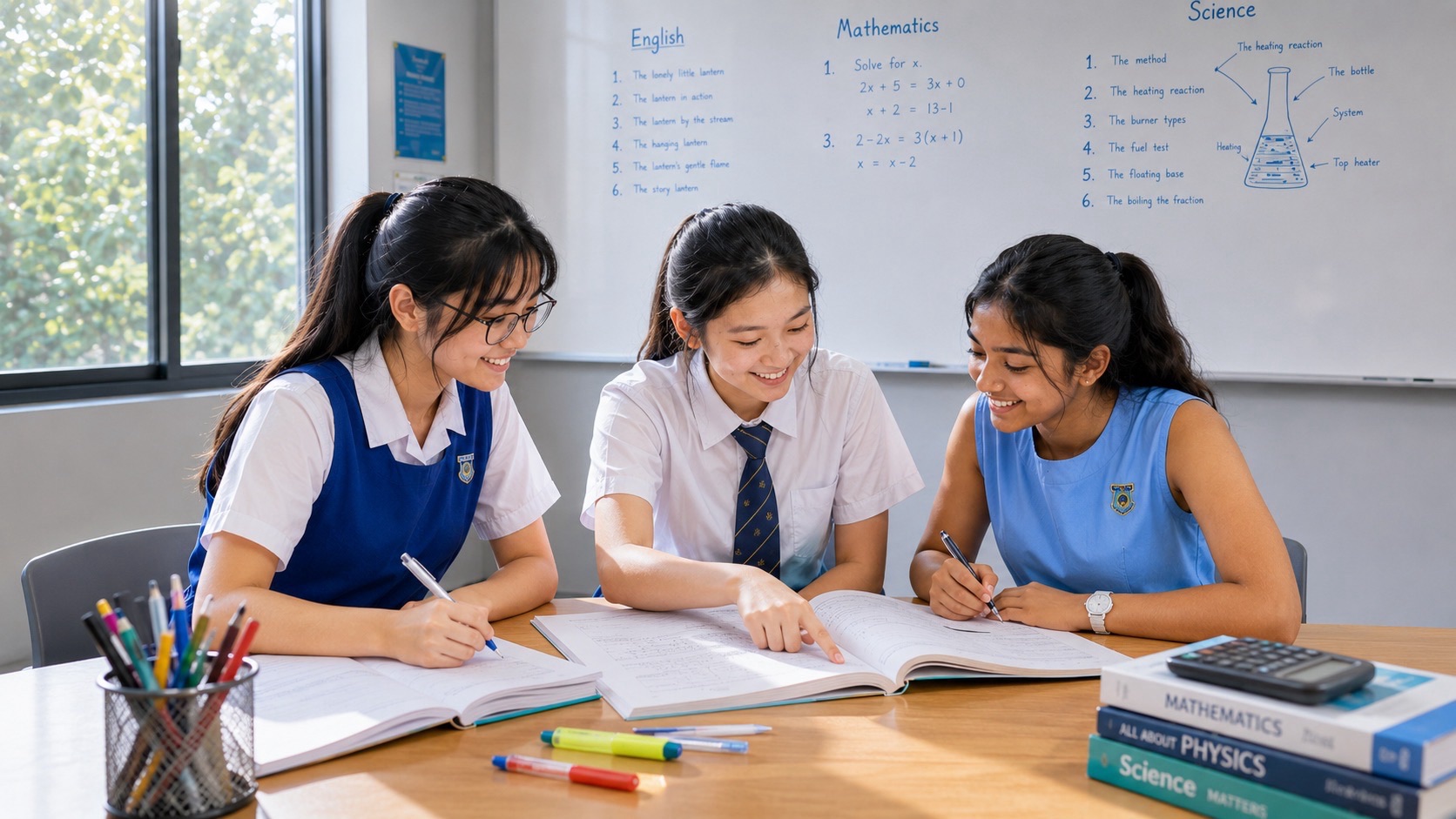
2026 rebuild: Sec 3 A-Math as a first-principles learning guide
This preserved 2019 page has been rebuilt as a Secondary 3 Additional Mathematics learning guide rather than another tuition-sales page. Its focus is the student’s first encounter with A-Math: how to understand the subject from first principles, how to connect new topics to existing Mathematics, how to build algebraic discipline before calculus arrives, and how to prevent the first year from becoming a collection of memorised shortcuts.
For Secondary 3 students in 2026, the 2027 Singapore-Cambridge Secondary Education Certificate is the relevant graduating framework. SEAB lists G3 Additional Mathematics as K341 and G3 Mathematics as K310. The K341 syllabus assumes G3 Mathematics and organises A-Math into Algebra, Geometry and Trigonometry, and Calculus. That official structure supports a useful learning principle: the subject should be built as a connected system, because every later strand depends on earlier algebra and function sense.
The student’s goal in Secondary 3 is not simply to accumulate methods. It is to learn how A-Math transforms one representation into another while preserving mathematical relationships. Factorisation reverses expansion. Logarithms invert exponentials. Graphs reveal what equations encode. Coordinate geometry turns spatial relationships into algebra. Differentiation describes how a function changes. Integration later reverses that process. These connections reduce memory load because new chapters can attach to structures the learner already understands.
The first year of A-Math should make the subject feel more connected each month, not more fragmented.
Call now for 2020 Secondary 3 Sec 3 Additional Maths classes. Punggol Maths Tutor. Sec 1 Sec 2 Sec 3 and Sec 4 GCE O levels A Maths and E Maths Tuition in Punggol with Small groups of 3 pax. Classes taught to help you understand and trained to get an A1. I’ve taught Secondary Math for 20+ years and with great effect. Call and find out how we are simple the best at helping you out of a fix.
Get A1.
Small Group of 3 pax.
1.5 hours.
Gain confidence
IN accordance to SEAB MOE syllabus.
Call now! Our 2020 Intake. Punggol Maths Tuition Small Groups for Secondary GCE O levels. Sec 1 2 3 4 Add Maths and E Maths.
I get students a 2-3 grade jump in 2-3 months. (some go from an F9 to B3, but who’s blowing his own trumpet now…?)
No magic involved. Just a lot of hardwork on both sides, we teach it right, students learn it right, and with some proper planning and cunning strategy, start scoring an A1 in Maths.
Always an optimist and taking right turns, I’ve been helping two decades of students get the grades for their examinations. Enjoy learning and understanding as we teach everything from scratch. I teach it step-by-step, in an easy manner so you can understand the syllabus. Then practice smart to score an A1. Add Math tutorials are easy to understand, helps students to do their school papers and build on a firm foundation to do well in the GCE O levels. Easy to understand, but by no means we only teach the easy stuff, we go into the nitty-gritty, take a dive into the complicated, simply it so that we can wrap our brains around the problem presented and formulate an elegant problem-solving solution. It isn’t rocket science, even though we’ll help you to become one. Call and find out how we do it: +65 8823 1234


The Sec 3 A-Math mindset: structure before speed
A-Math becomes fragile when students are trained to recognise page layouts instead of mathematical structure. The first-year learner should be encouraged to ask what kind of object is present: a quadratic function, polynomial, logarithmic relationship, trigonometric function, coordinate condition or rate-of-change problem. That first classification determines which tools are available. Speed should come later, after the student has a reliable model of what the symbols mean and why a transformation is valid.
This does not mean every solution must be slow or heavily explained. It means that when a shortcut fails, the learner can rebuild from something dependable: equivalence, factor structure, inverse functions, periodicity, geometric conditions or rate of change. That ability to reconstruct is one of the strongest protections against unfamiliar examination questions.
Algebra should become the student’s working language
Secondary 3 A-Math relies on symbolic manipulation so heavily that algebra must become ordinary. Expansion, factorisation, fractions, indices and equations should not consume all working memory. When these operations remain slow or unstable, every later topic feels more difficult because the learner is solving two problems at once: the new concept and the old algebra beneath it.
A useful study habit is reverse checking. Factorised expressions can be expanded. Equation roots can be substituted. Simplified forms can be tested numerically. These checks teach students that algebraic forms are related through equivalence, not merely through a sequence of remembered moves.
Quadratics should be learned as one connected idea
Quadratic equations, graphs, turning points, discriminants and completing the square belong together. The general form shows coefficients; factorised form exposes roots; completed-square form exposes the vertex. A student who sees only separate methods has to memorise several chapters. A student who sees one function expressed in several ways has a smaller, more connected memory load.
Sec 3 practice should therefore ask students to move deliberately among forms. Given a graph, infer likely roots or vertex information. Given a completed square, describe the turning point. Given a discriminant condition, explain the expected intersection behaviour. This is how algebra becomes interpretation rather than symbol pushing.
Exact form is a discipline, not a formatting preference
Surds and exact trigonometric values teach students to preserve mathematical information. Turning every exact quantity into a decimal too early can hide factor structure and introduce rounding noise. The goal is not to avoid decimals entirely, but to use them at the right stage. Exact form belongs to the reasoning phase; approximation belongs to checking or to the final answer when required.
Students should also learn to recognise when exactness gives them a route. A conjugate may simplify a surd expression. A special-angle value may turn a trigonometric identity into something transparent. Exact form is therefore part of mathematical strategy, not only presentation.
Polynomials should connect roots, factors and graphs
Polynomial work is where many students first feel the full weight of A-Math algebra. Division, factorisation and theorem-based reasoning can produce long lines of working. The subject becomes easier when the learner understands that roots, factors and function values describe the same structure from different directions.
If f(a)=0, the value a is a root, x-a is a factor and the graph crosses or touches the x-axis there. Those connections should be used repeatedly. They create natural checking methods and reduce the need to memorise theorem statements as isolated facts.
Partial fractions teach decomposition
Partial fractions are valuable because they reverse an operation students already know: combining rational expressions. The denominator factorisation determines the shape of the decomposition before any coefficient calculation begins. That makes the topic a strong test of structural recognition.
A common mistake is to begin solving coefficients before the decomposition form is correct. The fix is simple but important: factor, classify denominator structure, write the correct partial-fraction form, then solve. Recombining the result into the original fraction is a direct verification step that students should use routinely.
Binomial expansions should become selective
When the binomial theorem is first introduced, students often expand everything. That is understandable, but later questions may ask only for a particular coefficient or term. The general term is therefore a strategic tool. It allows the learner to target the required part without generating unnecessary working.
Sec 3 practice should include both full expansions and targeted-term questions. The learner should know how coefficient position, powers and combinatorial factors fit together. That structure becomes more important than remembering one standard row of numbers.
Logarithms should grow out of exponent thinking
Students often find logarithms unfamiliar because the notation is new. The cleanest route is to keep the inverse relationship with exponents visible. A logarithmic statement can be rewritten in exponential form, and the logarithm laws reflect exponent laws. This gives the learner a conceptual anchor rather than another list of formulae.
Domain conditions matter too. A transformed equation can produce a value that makes an original logarithm undefined. The student should therefore build the habit of returning to the original expression after solving. This turns domain checking into part of the solution, not an optional final decoration.
Trigonometry becomes a function topic
In lower secondary Mathematics, trigonometry is often experienced mainly through triangles. A-Math expands the idea into periodic functions, graphs, exact values and equations over intervals. The student needs a new mental model without losing the old one. Triangle ratios provide values; function thinking explains repetition, signs and graph behaviour.
Exact special-angle values should be linked to symmetry and periodicity rather than memorised as isolated numbers. This helps students predict calculator output and later manage identities and equations more confidently.
Identities require disciplined equivalence
Trigonometric identities can become messy when students transform both sides randomly. A stronger method is to inspect both sides, choose the one with more structure to simplify and preserve equivalence line by line. This keeps the target visible and reduces unnecessary algebra.
Identity work also reinforces a wider A-Math habit: every line should remain mathematically valid. This is the same discipline used in algebraic manipulation and later in proof. A clean identity solution is therefore training for the whole subject, not only for trigonometry.
Coordinate geometry should remain geometric
Gradient, line equations, midpoint and circle equations are algebraic tools describing spatial relationships. When students manipulate them without a sketch or geometric expectation, sign errors become hard to detect. A simple diagram can reveal whether a gradient should be positive, where an intersection should lie or whether a proposed centre makes sense.
Sec 3 learners should therefore practise moving both ways: geometry to equation and equation to geometry. This keeps symbols attached to meaning and makes later coordinate problems easier to audit.
Linearisation is a representation lesson
Linearisation can look like a long rearrangement exercise, but its purpose is modelling. A nonlinear relationship is transformed so that a straight-line graph makes unknown constants visible through gradient and intercept. The transformed axes are therefore part of the mathematics, not labels added after the algebra.
Students should define the new variables before plotting or interpreting. Once the graph is linear, the gradient and intercept must be translated back into the original relationship. That final translation is what makes the method meaningful.
Proof trains a habit A-Math needs everywhere
Plane geometry proof teaches students to distinguish what is given from what is inferred. A diagram may look as though lines are parallel or lengths are equal, but only stated conditions and valid theorems can justify a conclusion. This proof habit transfers directly into algebra and trigonometric identities because the learner becomes more sensitive to whether each step is actually allowed.
The goal is not to make every A-Math solution a formal proof. It is to normalise the question “why does this line follow?” When that question becomes automatic, long symbolic solutions become easier to trust and debug.
Early calculus should attach to graph sense
When differentiation is introduced, it should be connected to a familiar idea: gradient. The derivative describes the gradient of a function at a point and, more generally, rate of change. This meaning helps students interpret positive, negative and zero derivatives instead of seeing differentiation only as a rule for changing powers.
Product, quotient and chain rules should be introduced through structure recognition. Before differentiating, the learner names the form. This prevents formula selection from becoming a visual guess and prepares students for more complicated Secondary 4 calculus.
Integration should be introduced as reverse reasoning
If integration appears in Secondary 3, its connection to differentiation should remain explicit. An antiderivative can be checked by differentiation. This simple reverse check makes the new operation feel less arbitrary and gives students immediate feedback on coefficients and powers.
Definite integrals can then be related to area and accumulation. Sketching the graph before calculation helps students reason about sign, bounds and whether the final result is plausible.
A weekly study system for Sec 3 A-Math
A practical week can contain four short components: current-topic practice, one retrieval set from earlier topics, one mixed selection question and one correction from the error log. This structure is small enough to fit a busy Secondary 3 timetable but broad enough to keep the subject connected.
The error log should not store entire solutions. It should record the mechanism: lost negative sign during expansion, wrong identity selected, logarithm domain ignored, graph scale misread. Specific labels create specific checks. Over time, the student begins to anticipate personal risk areas before marks are lost.
How to know when a topic is secure
A topic is not secure simply because the student can solve it immediately after tuition. Security has several layers. The learner can retrieve the method after a delay, recognise it without a chapter heading, apply it when the representation changes and explain why the major steps are valid.
If only the recent worksheet version works, the knowledge is still cue-dependent. If the method is remembered but cannot be selected in a mixed set, route selection remains weak. This layered test helps decide whether to advance, consolidate or repair.
Twelve diagnostic cases for Sec 3 learners
- Quadratics are solved correctly but graph meaning is weak: move between forms and vertex/root interpretation.
- Surds become decimals immediately: preserve exact form and use approximation only as a check.
- Polynomial division drops a missing power: align terms and insert zero coefficients.
- Factor theorem is memorised but misapplied: reconnect roots, factors and f(a)=0.
- Logarithm laws are invented: rebuild them from exponent laws.
- Logarithmic roots violate the domain: check the original expression.
- Trig identities become random algebra: transform one side only.
- Trig equations report one principal value: use interval and periodicity.
- Circle centres have reversed signs: translate completed-square form deliberately.
- Linearised graphs have wrong axes: define transformed variables first.
- Chain-rule questions omit the inner derivative: mark outer and inner functions before differentiating.
- Old topics vanish after a month: shorten the retrieval interval.
The Sec 4 handoff
Before Secondary 3 ends, the learner should have a one-page handoff: strongest topics, weakest prerequisites, recurring algebra or calculator errors, and the first five retrieval targets for Secondary 4. This is more useful than the vague instruction to revise everything during the holiday.
The handoff should also list what has been repaired. Students often remember current weakness and forget previous progress. Seeing that quadratics, exact forms or basic differentiation are now dependable gives a more accurate picture of readiness and prevents unnecessary repetition when the final year begins.
Current operations and the legacy URL
This page keeps its original Punggol title because the URL is part of eduKate Singapore’s historical content architecture. The rebuilt article now functions as a Secondary 3 A-Math learning guide. Current class venue, timetable, consultation and availability information should be confirmed through current eduKate channels rather than inferred from a 2019 URL.
How to study A-Math without turning every evening into revision
Secondary 3 students already carry a full subject load, so A-Math study needs rhythm rather than constant intensity. A useful weekly pattern is one main lesson or study block, one shorter retrieval session later in the week, and small corrections woven into schoolwork. The shorter retrieval session matters because memory after a delay is different from performance immediately after tuition. Ten focused minutes can reveal whether a method is truly available without cues.
This approach also protects motivation. Students are more likely to persist when A-Math feels like a system they can maintain rather than an endless pile of unfinished exercises. The goal is not to remove difficulty. It is to make each difficult task identifiable: current concept, old retrieval, route selection, algebra repair or examination execution. Once the job of the task is clear, effort becomes easier to direct.
Why correction should be active
Copying a model solution creates familiarity, but familiarity is weaker than reconstruction. A stronger correction asks the student to identify the first failed step, explain why it failed, repair it and then close the model before solving a changed question. The learner should have to generate the method again. This changed-context follow-up is what distinguishes learning from neat rewriting.
An error log can remain compact. Record the topic, the first failed mechanism and the personal check that would have caught it. “Trig equation—forgot interval—draw quick graph and list period.” “Polynomial division—missing x² term—insert zero coefficient.” These short notes become useful prompts during later revision because they describe decisions rather than reproduce whole solutions.
Why mixed questions should arrive gradually
Interleaving is valuable, but it should not be introduced before the individual methods have enough stability. Mixing six fragile topics simply creates confusion. A better progression is blocked practice for the new method, then variation within the topic, then pairing with one plausible alternative, and finally broader mixed sets. The learner gradually takes responsibility for method selection rather than having the chapter title make the decision.
This progression is especially useful in A-Math because different topics can share surface features. A graph question may require quadratic reasoning, logarithmic interpretation or coordinate geometry. An algebraic expression may invite factorisation, an identity or differentiation depending on the target. Mixed practice teaches students to read the mathematical structure underneath the appearance.
How to use a calculator without surrendering judgment
Calculator skill should develop alongside mathematical judgment. The learner should check mode, brackets and expected magnitude before trusting a result. In trigonometry, degree or radian settings matter. In long expressions, missing brackets can change an entire numerator or denominator. In calculus and coordinate work, premature rounding can alter later values.
A useful habit is prediction before entry. Should the answer be positive or negative? Roughly how large? Should the angle be acute? Should the graph value be near a known reference point? The prediction does not need to be exact. It simply gives the student an independent expectation against which the calculator can be checked.
How parents can support Sec 3 A-Math
Parents do not need to become Additional Mathematics teachers. Their most useful role is to protect time, sleep and routine while allowing genuine difficulty to remain visible. If a learner needs extensive help to finish every assignment, that should be reported rather than hidden. A perfect homework page produced through rescue can mislead the tutor about what the student actually understands.
Useful parent questions are specific: Which topic is currently being built? Which old topic was retrieved this week? What error keeps recurring? Is homework taking longer because the method is weak or because the workload is simply large? These questions encourage a practical learning conversation instead of reducing every week to the latest mark.
What progress looks like before grades move dramatically
Secondary 3 A-Math progress often appears first in process. The student starts questions without waiting for a hint, keeps exact form longer, organises algebra more cleanly, notices when a result is implausible and can describe why an earlier solution failed. These changes make later practice more efficient even before every school assessment shows a large jump.
The distribution of errors should also change. Concept errors should become less common. Algebra errors should become more local and easier to self-correct. Route selection should improve as mixed practice increases. Execution mistakes may remain, but they should be predictable enough for the learner to check strategically. This movement from broad confusion to specific repair is one of the clearest signs of growth.
How strong students should be extended
High-performing students do not need endless pages of routine questions. Extension should deepen judgment. Ask the learner to compare two solution methods, prove why a shortcut works, create a counterexample to a false claim, design a question that exposes a common misconception, or translate a relationship into a different representation. These tasks make the learner more flexible instead of merely faster.
Strong students should also meet unfamiliarity. The goal is not to guarantee recognition of every paper question but to build confidence in the process of analysing a new one. A learner who can identify the structure beneath an unusual surface form is better prepared than a learner who has simply completed more routine chapters ahead of school.
How recovering students should be supported
A student who is already behind needs triage rather than a complete restart of every chapter. Identify the highest-leverage prerequisites first: sign control, factorisation, fractions, equation solving or graph interpretation. Keep the current school topic visible so the learner does not fall further behind while foundations are repaired. The plan may temporarily split each lesson between recovery and current content.
Early wins should come from genuine control rather than artificially easy work. When one algebraic weakness stops recurring across several topics, the learner experiences a meaningful improvement. That evidence can restore confidence more effectively than reassurance because it shows that a difficult subject can be changed through precise repair.
The final Secondary 3 standard
By the end of Secondary 3, the student does not need every A-Math chapter to be perfect. The stronger standard is organisation. The learner knows the subject’s main structures, can retrieve earlier methods, has a small set of known weaknesses and can approach a mixed question without waiting for the chapter heading. The error map is specific enough that revision has direction.
This organisation is what Secondary 4 needs. The final year can then deepen calculus, integrate the full syllabus, increase paper work and train examination control instead of spending the first months reconstructing forgotten foundations. That is the real purpose of a strong Sec 3 Additional Maths year in Punggol or anywhere else.
A final six-week Sec 3 bridge into Sec 4
The final six weeks of Secondary 3 can be used to create continuity rather than simply close the year. Week one revisits the most fragile algebraic prerequisite. Week two retrieves quadratics and polynomial structure. Week three revisits logarithmic and trigonometric relationships. Week four samples coordinate geometry and proof. Week five retrieves any calculus already taught. Week six mixes the major families without chapter labels and updates the Secondary 4 handoff map.
The sequence should remain adaptive. If a topic is already secure, it does not need an entire week. If one algebraic weakness continues to appear inside several chapters, it may deserve repeated short attention across the whole bridge. The purpose is not equal revision time. It is to leave the year with the highest-leverage foundations accessible and the remaining weaknesses clearly named.
Why this matters more than racing ahead
A student who starts Secondary 4 with a live, connected A-Math system is in a stronger position than a student who has seen more advanced pages but forgotten earlier structure. Final-year work becomes faster when factorisation, exact forms, logarithmic relationships, trigonometric reasoning and basic calculus can be retrieved without reconstruction. The saved working memory can then be used for unfamiliar questions, timing and interpretation.
This is the quiet advantage of a well-built Secondary 3 year. It does not always look dramatic in the moment. The real return appears later: fewer emergency repairs, less panic when papers become mixed, better self-correction and more time for genuine examination refinement. That is the standard this rebuilt legacy page is intended to preserve.
The final learner handoff
Before the year closes, the student should be able to answer four questions without opening a notebook: Which A-Math ideas are now secure? Which prerequisite still causes repeated losses? Which old topics need retrieval first in Secondary 4? What checking routine should be used when a solution feels uncertain? These questions convert revision from a vague obligation into a manageable plan.
The learner should also be able to start a mixed problem independently. The first attempt may not always be correct, but the student should identify the target, choose a plausible representation and make a mathematically meaningful first move. That is a more useful measure of readiness than whether every advanced chapter has already been previewed.
When these habits are present, Secondary 3 A-Math has created something durable: not only content knowledge, but a method for keeping that knowledge connected, diagnosing errors and recovering from difficulty. The final school year can then refine the system rather than rebuild it from scratch.
The strongest final sign is calm transfer. When the wording, values or diagram change, the student no longer treats the problem as entirely new. They look for the invariant structure: a factor, inverse relationship, periodic function, geometric condition or rate-of-change model. That ability to recognise mathematical structure beneath surface variation is what turns Secondary 3 A-Math from a year of new chapters into the foundation for a manageable Secondary 4.
For parents, that is also the most useful way to read progress. Look beyond how many chapters have been finished and ask whether the learner is retrieving older ideas, explaining mistakes more precisely, needing fewer prompts and managing changed questions with less hesitation. These process gains are the foundations of later examination performance because they show that the subject is becoming available to the student independently, not only while a tutor or worked example is present.
That independence is the real Secondary 3 finish line: connected knowledge, a usable error map, and enough control that Secondary 4 can focus on integration instead of reconstruction.
From there, later A-Math becomes deeper rather than merely harder, because new work attaches to a mathematical system the learner already knows how to manage.
That foundation is the real advantage to carry forward.