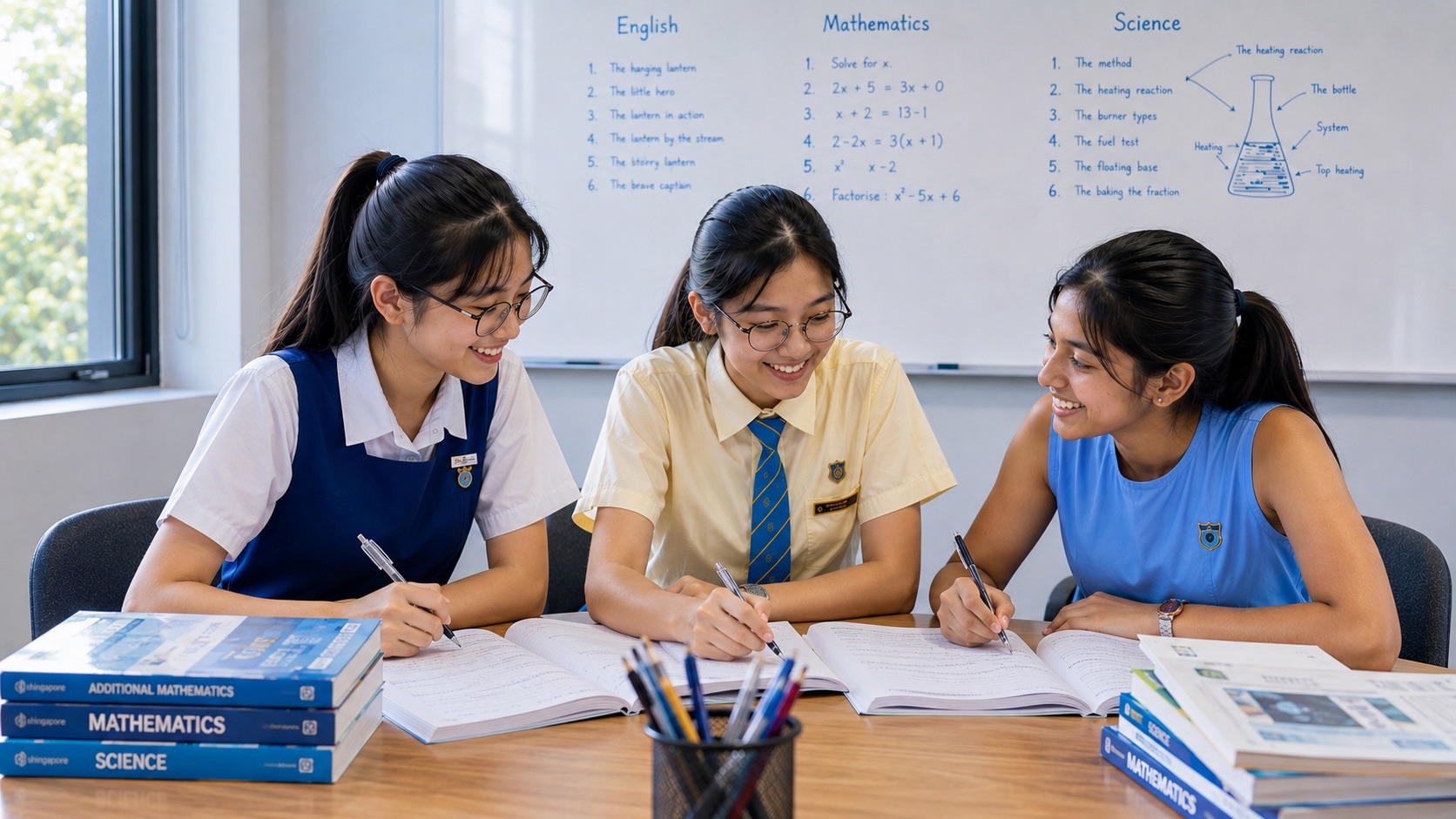
Punggol Sec 2 Maths is a rebuilt eduKate Singapore field guide for the second year of secondary Mathematics. The original 2019 title and URL are preserved. This page is intentionally different from the companion tuition page: it is a readiness audit for learners and parents who want to know whether lower-secondary Mathematics is genuinely secure before Secondary 3.
Secondary 2 is often the quiet year. Secondary 1 receives attention because the transition is new; Secondary 3 receives attention because upper-secondary choices become visible. Yet Secondary 2 is where algebra, proportion, graphs, geometry, data and mathematical communication should become stable enough that later topics can attach without constant repair.
The central question is therefore not simply the current grade. It is what the grade conceals. A reasonable score may hide heavy prompting, slow retrieval or dependence on chapter cues. A modest score may hide strong concepts with poor execution. The repair depends on the profile.
Secondary 2 should end with fewer hidden debts. The learner should know which foundations are strong, which are fragile and which need one more repair cycle before upper-secondary Mathematics begins.
Full Subject-Based Banding and subject-level fit
Under Full Subject-Based Banding, students may offer Mathematics at G1, G2 or G3 according to their strengths, interests and learning needs. In Secondary 2, this matters because the year is no longer introductory but not yet fully upper-secondary: weak structure can remain hidden under familiar exercises. The useful question is not whether the student has seen the topic, but whether the idea is retrievable, explainable and usable when the surface form changes.
Check whether difficulty reflects a mismatch with current subject-level demand, a specific prerequisite gap or a temporary school-topic issue. A tutor or learner should look for the first decision that fails rather than the final wrong answer. That distinction prevents broad remedial work when a narrow prerequisite is responsible, and it also prevents execution slips from being mistaken for a conceptual collapse.
Align examples and assessment language with the learner’s actual Mathematics level while keeping core reasoning visible. Practice should begin close to the underlying relationship, then vary gradually. The learner should first stabilise the method, then meet a changed representation or mixed context so the chapter label no longer supplies the route. Feedback is useful only when it changes the next attempt.
A strong learner should handle the same underlying relationship even when the question wording, diagram or numerical scale changes. The transfer test is independence. If the learner can reproduce the method only beside a worked example, the idea is not yet robust. A changed question, delayed retrieval and a brief explanation in the student’s own words provide better evidence that the repair will survive Secondary 3.
Directed numbers and negative-sign control
Negative signs travel through algebra, coordinates, equations and later upper-secondary work, so repeated sign errors are rarely trivial. This is one of the places where Secondary 2 becomes a preparation year rather than a holding year. The student is building a mathematical system that upper-secondary topics will assume is already available, so apparent small weaknesses deserve calm attention before they become expensive.
Look for whether the learner misunderstands order and opposites or simply loses signs during multi-step execution. The diagnosis should separate meaning from procedure. A learner can know the rule but choose the wrong route, or choose the right route and execute it poorly. Those cases look similar in a mark scheme but need different teaching.
Use number-line meaning, sign prediction and substitution checks before returning to faster symbolic work. A strong sequence is model, guided variation, silent independent attempt and correction. Each stage removes a little support. The tutor should resist explaining again merely because the student hesitates; a short pause or a precise prompt often reveals more about what the learner actually owns.
Change coefficients, term order and representation so the student cannot depend on one memorised visual pattern. When the idea is secure, place it beside another plausible method. Method selection is part of examination competence. The learner should be able to state why one structure applies and another does not, not merely recognise a familiar page layout.
Fractions as algebraic infrastructure
Fraction operations remain load-bearing because algebraic coefficients, ratios and later algebraic fractions depend on them. The topic also reveals how lower-secondary Mathematics is cumulative. What appears to be a new difficulty may be the visible end of an older chain involving number sense, fractions, algebra, units or representation. Good Secondary 2 work traces that chain backward without turning every lesson into a restart.
Temporarily remove the variable; if the numerical fraction version still fails, the true gap is arithmetic rather than algebra. One practical approach is to remove complexity temporarily. If the learner still struggles with a simpler numerical or visual version, the prerequisite is exposed. If the simple version is secure, restore the full symbolic form and observe where the reasoning changes.
Rebuild common denominators, multiplicative structure and valid cancellation with small examples before reintroducing symbols. The practice set should therefore be small enough to analyse. Ten carefully chosen questions can reveal more than fifty repetitive ones if they vary one structural feature at a time. Students should compare examples, explain the difference and record the exact condition that changes the method.
Ask the learner to explain why cancellation is permitted in one expression but invalid across addition in another. The goal is not merely a correct worksheet. It is a learner who can recover after forgetting. When a shortcut disappears from memory, the student should still have a principle, diagram, definition or equivalence relationship from which the procedure can be rebuilt.
Expansion, factorisation and equivalence
Expansion and factorisation are reverse views of the same multiplicative structure, not two unrelated tricks. Secondary 2 gives enough time for this capability to become ordinary before examination pressure rises. The learner should not need perfect confidence; the aim is a dependable routine that works even when the question looks slightly unfamiliar.
Watch whether the learner distributes to every term, handles negative factors and recognises common factors when term order changes. Repeated errors should be named precisely. “Careless” is too broad to teach from. A useful label might identify a sign error, wrong representation, missing condition, route-selection problem or interpretation failure. Precision turns frustration into a plan.
Verify factorisation by re-expanding and verify expansion with a simple substitution value. Practice should include one checking move appropriate to the topic: substitution, estimation, dimensional analysis, a second representation or a reasonableness test. Checking is most powerful when it is independent of the original route because it can catch a mistake the first method repeats.
Use reordered expressions, fractional coefficients and negative leading terms to test structural recognition. Over several weeks, the tutor should reduce prompts. The student first uses an explicit checklist, then a shorter self-cue, and eventually the behaviour becomes automatic. That fading scaffold is a better sign of progress than simply completing harder pages with the same amount of help.
Equation formation and solving
Secondary 2 students should be able not only to solve equations but also to create them from relationships. In Secondary 2, this matters because the year is no longer introductory but not yet fully upper-secondary: weak structure can remain hidden under familiar exercises. The useful question is not whether the student has seen the topic, but whether the idea is retrievable, explainable and usable when the surface form changes.
Separate modelling errors from algebra errors: a perfectly solved wrong equation is still a modelling failure. A tutor or learner should look for the first decision that fails rather than the final wrong answer. That distinction prevents broad remedial work when a narrow prerequisite is responsible, and it also prevents execution slips from being mistaken for a conceptual collapse.
Name the unknown, state the relationship in words, form the equation, solve, then interpret the result. Practice should begin close to the underlying relationship, then vary gradually. The learner should first stabilise the method, then meet a changed representation or mixed context so the chapter label no longer supplies the route. Feedback is useful only when it changes the next attempt.
Introduce an irrelevant number or change the context while preserving the same algebraic relationship. The transfer test is independence. If the learner can reproduce the method only beside a worked example, the idea is not yet robust. A changed question, delayed retrieval and a brief explanation in the student’s own words provide better evidence that the repair will survive Secondary 3.
Inequalities and solution sets
Inequalities describe ranges rather than one exact balancing point, so order meaning must accompany symbolic manipulation. This is one of the places where Secondary 2 becomes a preparation year rather than a holding year. The student is building a mathematical system that upper-secondary topics will assume is already available, so apparent small weaknesses deserve calm attention before they become expensive.
Check whether the learner can identify values that satisfy the statement and place the set correctly on a number line. The diagnosis should separate meaning from procedure. A learner can know the rule but choose the wrong route, or choose the right route and execute it poorly. Those cases look similar in a mark scheme but need different teaching.
Move between verbal comparison, symbolic form and number-line representation. A strong sequence is model, guided variation, silent independent attempt and correction. Each stage removes a little support. The tutor should resist explaining again merely because the student hesitates; a short pause or a precise prompt often reveals more about what the learner actually owns.
Use negative values and changed endpoints so memorised symbol direction is not enough. When the idea is secure, place it beside another plausible method. Method selection is part of examination competence. The learner should be able to state why one structure applies and another does not, not merely recognise a familiar page layout.
Ratio, rate and proportional reasoning
Ratio, rate, scale and percentage are different surfaces of multiplicative reasoning that continue far beyond Primary school. The topic also reveals how lower-secondary Mathematics is cumulative. What appears to be a new difficulty may be the visible end of an older chain involving number sense, fractions, algebra, units or representation. Good Secondary 2 work traces that chain backward without turning every lesson into a restart.
Look for additive thinking where a scale factor is required, or mismatched corresponding quantities in proportion problems. One practical approach is to remove complexity temporarily. If the learner still struggles with a simpler numerical or visual version, the prerequisite is exposed. If the simple version is secure, restore the full symbolic form and observe where the reasoning changes.
Write corresponding quantities in a table, identify the scale factor and predict whether the result should grow or shrink. The practice set should therefore be small enough to analyse. Ten carefully chosen questions can reveal more than fifty repetitive ones if they vary one structural feature at a time. Students should compare examples, explain the difference and record the exact condition that changes the method.
Move from maps to recipes, speed or similar figures while preserving the same proportional structure. The goal is not merely a correct worksheet. It is a learner who can recover after forgetting. When a shortcut disappears from memory, the student should still have a principle, diagram, definition or equivalence relationship from which the procedure can be rebuilt.
Successive percentage change
Successive percentage changes expose whether the learner understands that each percentage acts on a current base. Secondary 2 gives enough time for this capability to become ordinary before examination pressure rises. The learner should not need perfect confidence; the aim is a dependable routine that works even when the question looks slightly unfamiliar.
A common error is to add percentage changes as though every change were measured from the original quantity. Repeated errors should be named precisely. “Careless” is too broad to teach from. A useful label might identify a sign error, wrong representation, missing condition, route-selection problem or interpretation failure. Precision turns frustration into a plan.
Label the base at each step and estimate whether the final amount should sit above or below the start. Practice should include one checking move appropriate to the topic: substitution, estimation, dimensional analysis, a second representation or a reasonableness test. Checking is most powerful when it is independent of the original route because it can catch a mistake the first method repeats.
Use discount, growth and finance contexts so the learner sees one structure under different stories. Over several weeks, the tutor should reduce prompts. The student first uses an explicit checklist, then a shorter self-cue, and eventually the behaviour becomes automatic. That fading scaffold is a better sign of progress than simply completing harder pages with the same amount of help.
Graphs as relationships
By Secondary 2, graphs should be read as mathematical relationships rather than pictures to be described loosely. In Secondary 2, this matters because the year is no longer introductory but not yet fully upper-secondary: weak structure can remain hidden under familiar exercises. The useful question is not whether the student has seen the topic, but whether the idea is retrievable, explainable and usable when the surface form changes.
Check axes, scale, units, intercepts and whether the student can explain what a coordinate means in context. A tutor or learner should look for the first decision that fails rather than the final wrong answer. That distinction prevents broad remedial work when a narrow prerequisite is responsible, and it also prevents execution slips from being mistaken for a conceptual collapse.
Translate among tables, coordinate pairs, equations and graphs where appropriate. Practice should begin close to the underlying relationship, then vary gradually. The learner should first stabilise the method, then meet a changed representation or mixed context so the chapter label no longer supplies the route. Feedback is useful only when it changes the next attempt.
Use similar graph shapes with different axes so context and units must be read rather than assumed. The transfer test is independence. If the learner can reproduce the method only beside a worked example, the idea is not yet robust. A changed question, delayed retrieval and a brief explanation in the student’s own words provide better evidence that the repair will survive Secondary 3.
Gradient as rate of change
Gradient becomes meaningful when understood as one quantity’s change relative to another rather than as a formula to memorise. This is one of the places where Secondary 2 becomes a preparation year rather than a holding year. The student is building a mathematical system that upper-secondary topics will assume is already available, so apparent small weaknesses deserve calm attention before they become expensive.
Look for inconsistent point order, missing horizontal change or a sign that contradicts the graph’s direction. The diagnosis should separate meaning from procedure. A learner can know the rule but choose the wrong route, or choose the right route and execute it poorly. Those cases look similar in a mark scheme but need different teaching.
Annotate vertical and horizontal changes and predict sign or steepness before calculation. A strong sequence is model, guided variation, silent independent attempt and correction. Each stage removes a little support. The tutor should resist explaining again merely because the student hesitates; a short pause or a precise prompt often reveals more about what the learner actually owns.
Reverse point order deliberately and explain why both differences must reverse together. When the idea is secure, place it beside another plausible method. Method selection is part of examination competence. The learner should be able to state why one structure applies and another does not, not merely recognise a familiar page layout.
Geometry and theorem conditions
Secondary 2 geometry increasingly requires reasons; appearance is not evidence and a theorem applies only when its conditions are present. The topic also reveals how lower-secondary Mathematics is cumulative. What appears to be a new difficulty may be the visible end of an older chain involving number sense, fractions, algebra, units or representation. Good Secondary 2 work traces that chain backward without turning every lesson into a restart.
Identify whether the learner knows the property but applies it to a diagram that merely looks familiar. One practical approach is to remove complexity temporarily. If the learner still struggles with a simpler numerical or visual version, the prerequisite is exposed. If the simple version is secure, restore the full symbolic form and observe where the reasoning changes.
Annotate only given or derived facts, name the condition, then state the result. The practice set should therefore be small enough to analyse. Ten carefully chosen questions can reveal more than fifty repetitive ones if they vary one structural feature at a time. Students should compare examples, explain the difference and record the exact condition that changes the method.
Rotate or distort the drawing while preserving the mathematical relationships. The goal is not merely a correct worksheet. It is a learner who can recover after forgetting. When a shortcut disappears from memory, the student should still have a principle, diagram, definition or equivalence relationship from which the procedure can be rebuilt.
Similarity and scale
Similarity joins geometry to proportional reasoning because corresponding lengths change by a common scale while shape relationships are preserved. Secondary 2 gives enough time for this capability to become ordinary before examination pressure rises. The learner should not need perfect confidence; the aim is a dependable routine that works even when the question looks slightly unfamiliar.
Check whether corresponding sides are mapped correctly and whether similarity is established rather than assumed visually. Repeated errors should be named precisely. “Careless” is too broad to teach from. A useful label might identify a sign error, wrong representation, missing condition, route-selection problem or interpretation failure. Precision turns frustration into a plan.
Mark correspondence first, form ratios second, and use the result only after the mapping is secure. Practice should include one checking move appropriate to the topic: substitution, estimation, dimensional analysis, a second representation or a reasonableness test. Checking is most powerful when it is independent of the original route because it can catch a mistake the first method repeats.
Present figures at misleading visual scales so labels and conditions must govern reasoning. Over several weeks, the tutor should reduce prompts. The student first uses an explicit checklist, then a shorter self-cue, and eventually the behaviour becomes automatic. That fading scaffold is a better sign of progress than simply completing harder pages with the same amount of help.
Mensuration and composite figures
Composite measurement questions reward planning because the main challenge is often decomposition rather than formula recall. In Secondary 2, this matters because the year is no longer introductory but not yet fully upper-secondary: weak structure can remain hidden under familiar exercises. The useful question is not whether the student has seen the topic, but whether the idea is retrievable, explainable and usable when the surface form changes.
Watch whether the learner identifies the target quantity, required dimensions and hidden intermediate lengths before substituting. A tutor or learner should look for the first decision that fails rather than the final wrong answer. That distinction prevents broad remedial work when a narrow prerequisite is responsible, and it also prevents execution slips from being mistaken for a conceptual collapse.
Sketch, label, decompose and predict the dimensional unit before calculation. Practice should begin close to the underlying relationship, then vary gradually. The learner should first stabilise the method, then meet a changed representation or mixed context so the chapter label no longer supplies the route. Feedback is useful only when it changes the next attempt.
Change orientation or combine shapes so the learner has to reconstruct the plan rather than repeat a layout. The transfer test is independence. If the learner can reproduce the method only beside a worked example, the idea is not yet robust. A changed question, delayed retrieval and a brief explanation in the student’s own words provide better evidence that the repair will survive Secondary 3.
Statistics and interpretation
A statistical calculation is incomplete until the learner understands what the summary says and what it does not say. This is one of the places where Secondary 2 becomes a preparation year rather than a holding year. The student is building a mathematical system that upper-secondary topics will assume is already available, so apparent small weaknesses deserve calm attention before they become expensive.
Check whether the student confuses mean, median or mode and whether conclusions go beyond the information in the data. The diagnosis should separate meaning from procedure. A learner can know the rule but choose the wrong route, or choose the right route and execute it poorly. Those cases look similar in a mark scheme but need different teaching.
Compare small datasets with the same summary but different distributions and discuss what remains hidden. A strong sequence is model, guided variation, silent independent attempt and correction. Each stage removes a little support. The tutor should resist explaining again merely because the student hesitates; a short pause or a precise prompt often reveals more about what the learner actually owns.
Use tables and graphs with different scales so reading discipline accompanies computation. When the idea is secure, place it beside another plausible method. Method selection is part of examination competence. The learner should be able to state why one structure applies and another does not, not merely recognise a familiar page layout.
Probability and sample-space discipline
Probability becomes reliable when possible outcomes are represented systematically instead of counted from intuition. The topic also reveals how lower-secondary Mathematics is cumulative. What appears to be a new difficulty may be the visible end of an older chain involving number sense, fractions, algebra, units or representation. Good Secondary 2 work traces that chain backward without turning every lesson into a restart.
Look for omitted outcomes, double counting or final values outside the conceptual range from impossible to certain. One practical approach is to remove complexity temporarily. If the learner still struggles with a simpler numerical or visual version, the prerequisite is exposed. If the simple version is secure, restore the full symbolic form and observe where the reasoning changes.
Choose an ordered list, table or tree that makes every outcome visible before calculating. The practice set should therefore be small enough to analyse. Ten carefully chosen questions can reveal more than fifty repetitive ones if they vary one structural feature at a time. Students should compare examples, explain the difference and record the exact condition that changes the method.
Change the number of stages and let the learner choose the representation rather than prescribe it. The goal is not merely a correct worksheet. It is a learner who can recover after forgetting. When a shortcut disappears from memory, the student should still have a principle, diagram, definition or equivalence relationship from which the procedure can be rebuilt.
Mathematical communication and working
Secondary 2 solutions are long enough that clear written working becomes part of accuracy rather than presentation alone. Secondary 2 gives enough time for this capability to become ordinary before examination pressure rises. The learner should not need perfect confidence; the aim is a dependable routine that works even when the question looks slightly unfamiliar.
Invisible mental steps, false equals signs and unlabelled intermediate values make errors difficult to locate and repeat. Repeated errors should be named precisely. “Careless” is too broad to teach from. A useful label might identify a sign error, wrong representation, missing condition, route-selection problem or interpretation failure. Precision turns frustration into a plan.
Use mathematically true lines, visible substitutions, useful labels and units without turning the page into decorative neatness. Practice should include one checking move appropriate to the topic: substitution, estimation, dimensional analysis, a second representation or a reasonableness test. Checking is most powerful when it is independent of the original route because it can catch a mistake the first method repeats.
Ask another learner to audit the solution without verbal explanation; unclear reasoning becomes immediately visible. Over several weeks, the tutor should reduce prompts. The student first uses an explicit checklist, then a shorter self-cue, and eventually the behaviour becomes automatic. That fading scaffold is a better sign of progress than simply completing harder pages with the same amount of help.
Retrieval and spacing
Lower-secondary Mathematics should remain live across the year instead of being rebuilt before every examination. In Secondary 2, this matters because the year is no longer introductory but not yet fully upper-secondary: weak structure can remain hidden under familiar exercises. The useful question is not whether the student has seen the topic, but whether the idea is retrievable, explainable and usable when the surface form changes.
Test older Secondary 1 material without notes and note which topics require cues or recent rereading. A tutor or learner should look for the first decision that fails rather than the final wrong answer. That distinction prevents broad remedial work when a narrow prerequisite is responsible, and it also prevents execution slips from being mistaken for a conceptual collapse.
Use short mixed retrieval at increasing intervals, correcting immediately and returning fragile topics sooner. Practice should begin close to the underlying relationship, then vary gradually. The learner should first stabilise the method, then meet a changed representation or mixed context so the chapter label no longer supplies the route. Feedback is useful only when it changes the next attempt.
Place an older method beside current topics so the student must both remember and select it. The transfer test is independence. If the learner can reproduce the method only beside a worked example, the idea is not yet robust. A changed question, delayed retrieval and a brief explanation in the student’s own words provide better evidence that the repair will survive Secondary 3.
Interleaving and route selection
Topical worksheets teach execution; mixed sets teach the equally important skill of choosing the method. This is one of the places where Secondary 2 becomes a preparation year rather than a holding year. The student is building a mathematical system that upper-secondary topics will assume is already available, so apparent small weaknesses deserve calm attention before they become expensive.
A learner who performs strongly under chapter headings but poorly in mixed tests may have a route-selection problem rather than a knowledge gap. The diagnosis should separate meaning from procedure. A learner can know the rule but choose the wrong route, or choose the right route and execute it poorly. Those cases look similar in a mark scheme but need different teaching.
After basic stability, remove topic labels and ask the student to name the governing structure before solving. A strong sequence is model, guided variation, silent independent attempt and correction. Each stage removes a little support. The tutor should resist explaining again merely because the student hesitates; a short pause or a precise prompt often reveals more about what the learner actually owns.
Mix visually similar problems that require different methods so conditions, not surface cues, guide the choice. When the idea is secure, place it beside another plausible method. Method selection is part of examination competence. The learner should be able to state why one structure applies and another does not, not merely recognise a familiar page layout.
Calculator use, estimation and checking
Calculators are execution tools, not authorities; a student still needs an independent expectation about sign, scale and plausibility. The topic also reveals how lower-secondary Mathematics is cumulative. What appears to be a new difficulty may be the visible end of an older chain involving number sense, fractions, algebra, units or representation. Good Secondary 2 work traces that chain backward without turning every lesson into a restart.
Repeated bracket, mode, rounding or entry errors should be treated as stable procedures that can be retrained. One practical approach is to remove complexity temporarily. If the learner still struggles with a simpler numerical or visual version, the prerequisite is exposed. If the simple version is secure, restore the full symbolic form and observe where the reasoning changes.
Estimate before key entry, preserve working precision and choose a check independent of the original route. The practice set should therefore be small enough to analyse. Ten carefully chosen questions can reveal more than fifty repetitive ones if they vary one structural feature at a time. Students should compare examples, explain the difference and record the exact condition that changes the method.
Use a question where an incorrect entry produces a neat-looking result so reasonableness must override appearance. The goal is not merely a correct worksheet. It is a learner who can recover after forgetting. When a shortcut disappears from memory, the student should still have a principle, diagram, definition or equivalence relationship from which the procedure can be rebuilt.
Monthly audit and error distribution
A monthly audit reveals whether the learner’s whole lower-secondary system is improving rather than only the current chapter. Secondary 2 gives enough time for this capability to become ordinary before examination pressure rises. The learner should not need perfect confidence; the aim is a dependable routine that works even when the question looks slightly unfamiliar.
Sample number skills, algebra, graphs, geometry and data while recording accuracy, independence and time. Repeated errors should be named precisely. “Careless” is too broad to teach from. A useful label might identify a sign error, wrong representation, missing condition, route-selection problem or interpretation failure. Precision turns frustration into a plan.
Compare error categories across months and promote only the highest-value weaknesses into the next teaching cycle. Practice should include one checking move appropriate to the topic: substitution, estimation, dimensional analysis, a second representation or a reasonableness test. Checking is most powerful when it is independent of the original route because it can catch a mistake the first method repeats.
The learner should help interpret the audit and name one behaviour to make automatic before the next review. Over several weeks, the tutor should reduce prompts. The student first uses an explicit checklist, then a shorter self-cue, and eventually the behaviour becomes automatic. That fading scaffold is a better sign of progress than simply completing harder pages with the same amount of help.
Teach ahead as spaced preview
Teaching slightly ahead can reduce novelty when it creates a first exposure rather than a race to finish the syllabus. In Secondary 2, this matters because the year is no longer introductory but not yet fully upper-secondary: weak structure can remain hidden under familiar exercises. The useful question is not whether the student has seen the topic, but whether the idea is retrievable, explainable and usable when the surface form changes.
Before previewing a new topic, check whether its algebraic, numerical or graphical prerequisites are sufficiently stable. A tutor or learner should look for the first decision that fails rather than the final wrong answer. That distinction prevents broad remedial work when a narrow prerequisite is responsible, and it also prevents execution slips from being mistaken for a conceptual collapse.
Introduce the core idea, connect it to known structure and assign only enough practice to create familiarity. Practice should begin close to the underlying relationship, then vary gradually. The learner should first stabilise the method, then meet a changed representation or mixed context so the chapter label no longer supplies the route. Feedback is useful only when it changes the next attempt.
When school later reaches the topic, use that second exposure for deeper questions and mixed retrieval rather than repeating the same introduction. The transfer test is independence. If the learner can reproduce the method only beside a worked example, the idea is not yet robust. A changed question, delayed retrieval and a brief explanation in the student’s own words provide better evidence that the repair will survive Secondary 3.
Productive struggle and fading scaffolds
Difficulty is useful when the learner understands the goal, owns the prerequisites and can make a plausible attempt. This is one of the places where Secondary 2 becomes a preparation year rather than a holding year. The student is building a mathematical system that upper-secondary topics will assume is already available, so apparent small weaknesses deserve calm attention before they become expensive.
If the student has no viable starting point, the task may be producing confusion rather than productive struggle. The diagnosis should separate meaning from procedure. A learner can know the rule but choose the wrong route, or choose the right route and execute it poorly. Those cases look similar in a mark scheme but need different teaching.
Prompt attention before giving a method, suggest a representation before revealing a step, and remove support as soon as the learner can proceed. A strong sequence is model, guided variation, silent independent attempt and correction. Each stage removes a little support. The tutor should resist explaining again merely because the student hesitates; a short pause or a precise prompt often reveals more about what the learner actually owns.
Progress is visible when harder questions are attempted with fewer cues and the student can recover after a wrong turn. When the idea is secure, place it beside another plausible method. Method selection is part of examination competence. The learner should be able to state why one structure applies and another does not, not merely recognise a familiar page layout.
High-performing learners and depth
Strong Secondary 2 students need richer reasoning rather than endless easy volume or premature acceleration for its own sake. The topic also reveals how lower-secondary Mathematics is cumulative. What appears to be a new difficulty may be the visible end of an older chain involving number sense, fractions, algebra, units or representation. Good Secondary 2 work traces that chain backward without turning every lesson into a restart.
Check whether high scores depend on familiar layouts or whether the learner can justify, compare and generalise methods. One practical approach is to remove complexity temporarily. If the learner still struggles with a simpler numerical or visual version, the prerequisite is exposed. If the simple version is secure, restore the full symbolic form and observe where the reasoning changes.
Use counterexamples, alternative solutions, error analysis and question creation to deepen mathematical judgement. The practice set should therefore be small enough to analyse. Ten carefully chosen questions can reveal more than fifty repetitive ones if they vary one structural feature at a time. Students should compare examples, explain the difference and record the exact condition that changes the method.
Extension is successful when novelty changes the surface but does not break the learner’s ability to recognise structure. The goal is not merely a correct worksheet. It is a learner who can recover after forgetting. When a shortcut disappears from memory, the student should still have a principle, diagram, definition or equivalence relationship from which the procedure can be rebuilt.
Secondary 3 and Additional Mathematics readiness
The final Secondary 2 term should reduce the hidden prerequisites that upper-secondary Mathematics will assume. Secondary 2 gives enough time for this capability to become ordinary before examination pressure rises. The learner should not need perfect confidence; the aim is a dependable routine that works even when the question looks slightly unfamiliar.
Audit algebraic manipulation, equations, proportion, graphs, geometry, units and mixed selection before adding major new content. Repeated errors should be named precisely. “Careless” is too broad to teach from. A useful label might identify a sign error, wrong representation, missing condition, route-selection problem or interpretation failure. Precision turns frustration into a plan.
Create a short repair list and a twelve-week bridge that keeps old material retrievable while previewing only where readiness is clear. Practice should include one checking move appropriate to the topic: substitution, estimation, dimensional analysis, a second representation or a reasonableness test. Checking is most powerful when it is independent of the original route because it can catch a mistake the first method repeats.
The learner should enter Secondary 3 able to spend attention on genuinely new mathematics instead of repeatedly reopening lower-secondary gaps. Over several weeks, the tutor should reduce prompts. The student first uses an explicit checklist, then a shorter self-cue, and eventually the behaviour becomes automatic. That fading scaffold is a better sign of progress than simply completing harder pages with the same amount of help.
A Secondary 2 readiness checklist
- Basic algebra feels familiar rather than novel.
- Negative signs and fractions remain reliable inside algebra.
- Equations can be formed from relationships as well as solved.
- Graphs are read through axes, scale, units and meaning.
- Geometry answers include justified reasons rather than visual guesses.
- Proportion is recognised across ratio, percentage, scale and rate.
- Working is clear enough to audit.
- Older Secondary 1 knowledge remains retrievable.
- Mixed questions do not depend on chapter headings.
- The learner can name recurring error types and choose an appropriate check.
Frequently asked questions
Is Secondary 2 too late to repair Primary-school gaps?
No. Many gaps become easier to understand structurally at this age. The efficient approach is to identify the exact prerequisite that interferes with current work and repair it directly instead of restarting the entire Primary syllabus.
Should Secondary 2 students learn Secondary 3 topics early?
Selective preview can help when foundations are stable. It should create a second exposure later, not hide unresolved lower-secondary weaknesses. Readiness is more valuable than decorative acceleration.
How much algebra should be automatic by year end?
Enough that basic manipulation does not consume all working memory. The learner should still understand the principles, because automaticity without meaning becomes fragile when the form changes.
What if marks are acceptable but homework takes hours?
Audit efficiency and independence. A grade can conceal slow retrieval, excessive prompting or poor route selection. The total time needed to produce the mark matters.
How should Full SBB affect support?
Support should align with the learner’s actual G1, G2 or G3 Mathematics level and current school pathway, while keeping the focus on transferable mathematical capability.
Is this a current Punggol branch page?
No. It is a rebuilt educational guide on a preserved legacy URL. Current operational information should be verified separately.
Official references and companion page
Families can consult the MOE G2 and G3 Mathematics syllabuses and the SEAB Secondary Education Certificate syllabus pages. For the more tuition-focused companion, see Punggol Mathematics Tuition Secondary 2. For current programme details, use eduKateSG.
Conclusion: finish Secondary 2 with less hidden weakness
Secondary 2 is valuable precisely because there is still time. Algebra can be cleaned up, graph reading can become deliberate, geometry can become justified, proportional reasoning can be reconnected and checking habits can become routine before upper-secondary density arrives.
The best outcome is not merely a stronger year-end score. It is a clearer learner: one who knows which errors repeat, can retrieve older Mathematics, selects methods more reliably and needs less rescue when the question changes.
That is what makes Secondary 2 a bridge rather than a waiting room. The student enters Secondary 3 with fewer hidden debts and more capacity for genuinely new mathematics.
The final Secondary 2 term: turn revision into a handoff
The final term of Secondary 2 should not be treated as a long pause before upper secondary. It is the moment to turn two years of lower-secondary learning into a usable handoff. The student should be able to name the strongest areas, identify the weakest prerequisites, retrieve core algebra without reopening notes, and recognise which kinds of questions still create hesitation. A one-page handoff summary can be more useful than a thick pile of completed worksheets because it tells the learner what must remain active when Secondary 3 begins.
A practical handoff can contain five stable capabilities, five current weaknesses, three recurring execution errors and three topics to retrieve during the first month of Secondary 3. The list should be specific. “Weak in Maths” is useless; “algebraic fractions slow”, “gradient interpretation weak” and “geometry reasoning omitted” each point toward a teachable action. The student should help write the list so it becomes a learning map rather than an adult report.
The tutor can then design the final weeks around the map. Stable topics are sampled briefly to prevent decay. Fragile topics receive targeted repair. Mixed questions test whether method selection has improved. A small amount of upper-secondary preview can be added only after the lower-secondary system is sufficiently clean. The purpose of the bridge is to reduce future cognitive load, not to create the appearance of acceleration.
How to tell whether a foundation is actually secure
A foundation is not secure merely because the student can complete a worksheet immediately after a lesson. Security has several dimensions. The learner can retrieve the idea after a delay, recognise it when the question is not labelled by topic, explain why the method applies, execute with acceptable accuracy and adapt when the numbers or representation change. These are stronger tests than recent familiarity.
One useful sequence is delayed retrieval, changed representation and mixed selection. First, ask the student to solve a concept from several weeks ago without notes. Next, present the same structure as a graph, table, diagram or word problem where appropriate. Finally, place it among other topics and ask the learner to identify the correct route independently. If all three stages are reasonably stable, the foundation is probably ready to support more advanced work.
If only the first stage succeeds, the learner may remember the procedure but lack transfer. If the idea works when announced but not in a mixed set, route selection remains weak. If the concept is understood but execution is slow, fluency rather than reteaching may be the next target. This layered test prevents families from interpreting one good homework session as complete mastery.
The role of correction in building upper-secondary resilience
Secondary 2 is an ideal year to normalise correction as part of Mathematics rather than as evidence of failure. A useful correction does more than copy the model answer. The student identifies the first wrong decision, states why it was wrong, repairs the step and then solves a changed question that requires the same underlying idea. This creates a learning loop instead of a red-pen ritual.
Corrections should also be prioritised. A repeated algebraic sign error deserves more attention than a one-off copying slip because it is likely to reappear across future topics. A modelling error that affects several word-problem families may be more important than a rare difficult geometry question. The error map helps decide which corrections have the greatest likely return.
When students become skilled at correction, upper-secondary Mathematics becomes less threatening. A difficult question no longer has to be solved perfectly on the first attempt to be useful. The learner can inspect the path, identify the weak link and improve the system. That capacity to recover is part of mathematical resilience.
A four-week Secondary 2 reset when the year has gone badly
If a learner reaches the later part of Secondary 2 with significant gaps, the response should not be to assign every chapter at once. A four-week reset can begin with diagnosis. Week one identifies the biggest prerequisite failures and restores a small number of number and algebra foundations. Week two stabilises equation work, proportion and representation. Week three adds graphs and geometry. Week four mixes the repaired skills and tests independent transfer.
The reset should remain selective. The goal is to restore the structures that unlock many topics, not to create a miniature version of the entire lower-secondary curriculum. Fractions, directed numbers, algebraic manipulation, equation meaning, proportional reasoning and graph literacy often have high leverage because they recur so widely. The exact priorities should follow the learner’s evidence.
After four weeks, the tutor should not simply declare the reset complete. Re-test the same mechanisms in changed contexts. If the learner now retrieves and applies them more independently, the programme can move forward. If a weakness remains, the next cycle should focus on that specific area rather than restarting everything again.
What success at the end of Secondary 2 looks like
Success is not one universal score. A recovering learner may have moved from major concept gaps to stable core procedures. A steady learner may have become better at mixed selection and checking. A high-performing learner may have gained flexibility, cleaner reasoning and stronger transfer. The common thread is that the learner’s mathematical system is more coherent than it was at the beginning of the year.
Parents should be able to see the change in ordinary work: fewer hints, shorter recovery after mistakes, more deliberate graph reading, clearer working and better retrieval of earlier topics. The student should be able to describe the current weaknesses without collapsing them into a global judgement about ability. That precision is itself progress.
When Secondary 2 ends this way, Secondary 3 begins with less hidden debt. The learner has more working memory available for genuinely new Mathematics because old foundations are not demanding constant reconstruction. That is the real value of using Secondary 2 as an audit year.