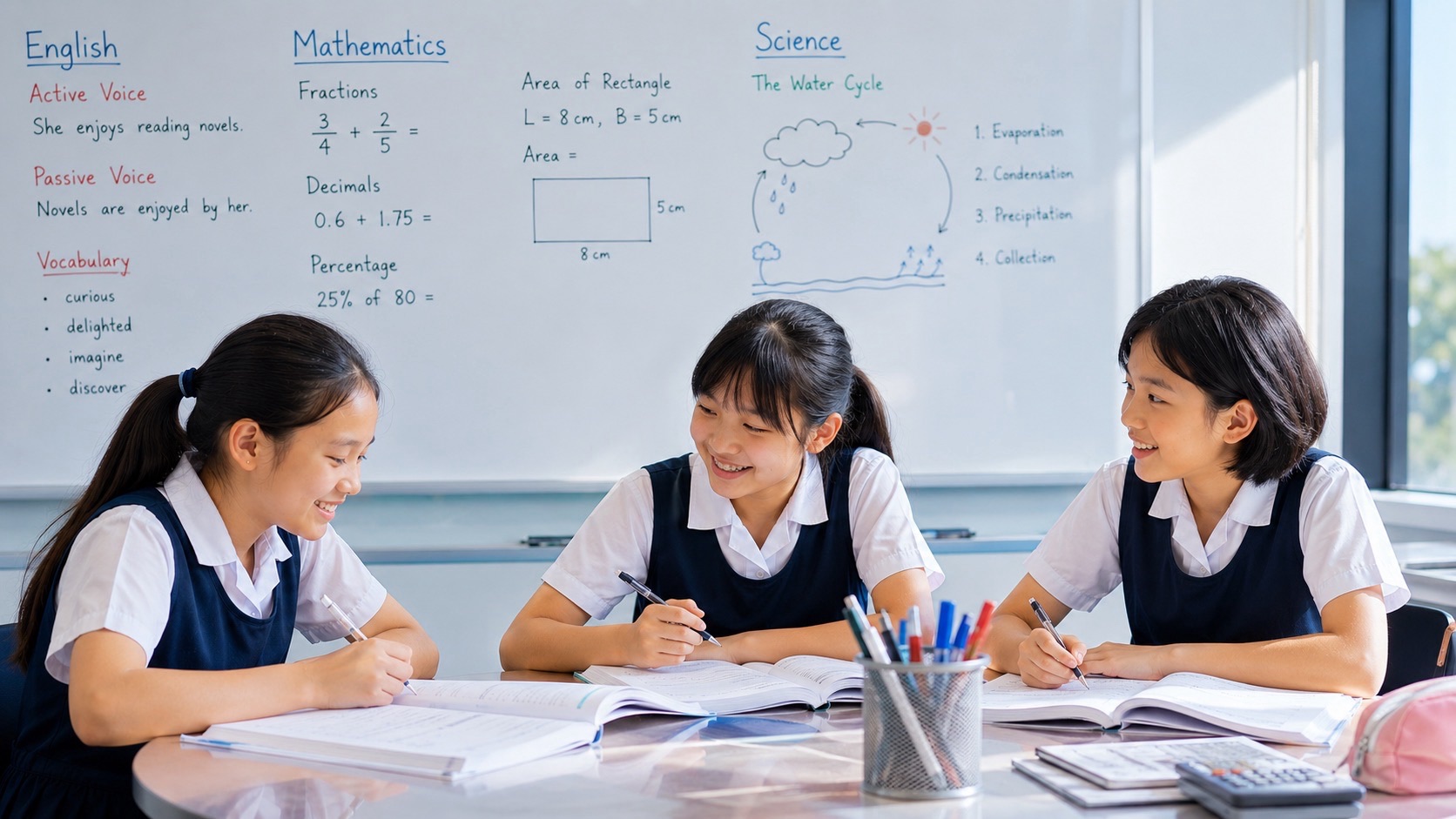
Punggol Science Tutor Small Groups Pri 3 is a rebuilt eduKate Singapore learning guide for families at the point where Science first becomes a formal primary-school subject. The original 2019 title and URL are preserved, but the article is written for the current 2026 curriculum context. Its focus is not simply what Primary 3 children learn. It is what a good Primary 3 Science tutor should notice, explain, ask, correct and gradually hand back to the learner as the child begins building a scientific way of seeing the world.
Primary 3 is easy to underestimate because its first topics look familiar. Children already know animals, plants, everyday materials and magnets. Yet school Science asks them to do something new with that familiarity. They must observe systematically, classify by defensible rules, connect properties to purposes, follow life cycles as ordered processes and use evidence to explain magnetic interactions. The difficulty is not that the world has suddenly become complicated. The difficulty is that ordinary noticing now has to become disciplined reasoning.
For Punggol families choosing tuition, that distinction matters. A useful tutor should not rush a nine-year-old into upper-primary papers simply to make the class look advanced. The better work is quieter: reveal the child’s current model, correct the earliest misconception, teach the language needed to express the idea and revisit it after enough time has passed to test whether learning lasted.
The first job of a Primary 3 Science tutor is not to make the child sound scientific. It is to help the child notice accurately, think causally and explain what the evidence actually supports.

What Primary 3 Science is really introducing
The current MOE Primary Science syllabus begins formal Science from Primary 3 with diversity of living and non-living things, diversity of materials, life cycles of plants and animals, and magnets. These are deliberately concrete topics. They give children something they can see, handle, sort, compare and discuss while the curriculum introduces the practices of Science. A strong tutor uses the topics as vehicles for habits: careful observation, explicit criteria, comparison, prediction, representation and evidence-based explanation.
This means the tutor should resist two weak extremes. The first is pure memorisation: lists of characteristics, definitions and model sentences learnt without context. The second is unstructured discovery in which children enjoy activities but never consolidate what the activity showed. Good teaching connects experience to language. The child observes, predicts, tests or compares; the tutor then helps the learner name the pattern and express it accurately.
The result should be usable understanding. A student who has learnt classification well should be able to classify unfamiliar examples using a stated rule. A student who understands materials should be able to choose a suitable material for a new purpose and justify the choice. A student who understands life cycles should be able to reconstruct order from an unfamiliar diagram. A student who understands magnets should be able to predict and explain an interaction rather than merely remember a worksheet picture.
The first month: establish how Science lessons work
The first few weeks of Primary 3 are an opportunity to establish a learning culture before weak habits become entrenched. A tutor can begin by showing that answers are not produced by guessing what the adult wants. They are produced by looking at the evidence, recalling the relevant idea and making the relationship clear. Even simple questions can be used to teach this sequence. What did you notice? Which feature matters? What rule are you using? What evidence supports your answer?
The tutor should also establish that uncertainty is useful. A child who says, “I am not sure because these two objects look similar but one is not living,” has revealed a boundary problem that can be explored. The learner who hides uncertainty behind a guessed answer gives the teacher less information. A calm small group can make it normal to revise an idea after seeing a counterexample. That is not weakness; it is a basic scientific habit.
At the same time, routines should be simple. Bring the necessary materials, begin with short retrieval, listen when another student explains, write a complete answer, correct visibly and record one thing to remember next time. Primary 3 learners do not need complicated study systems. They need a small number of repeatable behaviours that make thinking observable.
Observation before explanation
Many early Science errors begin when a child jumps from what is seen to what is assumed. A tutor can teach observation as a distinct act. Describe colour, shape, texture, movement, number, position or measured change before deciding what the observation means. This creates a pause between perception and inference. That pause is one of the foundations of scientific reasoning.
A useful classroom routine is “See, then say what it might mean.” Show two leaves, two materials, a magnet setup or stages in a life cycle. First ask for observations only. Then ask for an inference. Students quickly discover that the second category depends on the first. They also learn that two people can observe the same evidence but make different inferences, which is why explanations must remain accountable to what was actually seen.
This distinction becomes increasingly important in later Primary Science, especially in experiment questions. A child who learns it in Primary 3 has an easier time when Primary 5 asks for conclusions from data and Primary 6 asks whether evidence supports a claim. The tutor is therefore building a future examination skill through a very simple early habit.
Classification: rules, boundaries and counterexamples
Classification is more than putting similar things into groups. It teaches children that categories need criteria. A student may initially sort objects by colour because that feature is visually obvious. The tutor’s job is to ask whether colour is the relevant rule, whether the rule is applied consistently and whether a counterexample breaks it. This is early logical reasoning disguised as a simple Science task.
A strong tutor uses both examples and non-examples. If the child believes that everything that moves is living, show movement produced by wind, machines or rolling objects. Ask what additional characteristics are needed before deciding. The goal is not to confuse the learner with exceptions. It is to make the category boundary more precise so the child is not dependent on one superficial clue.
Classification also trains language. The child should be able to state the criterion clearly: “I grouped these together because…” or “These differ because…” This sentence structure matters because later Science requires students to justify a classification rather than merely name it. The tutor can therefore turn every sorting activity into a small exercise in evidence and explanation.
Materials: separate the object from what it is made of
Primary 3 students often confuse an object with its material. A bottle is an object; plastic, glass and metal are materials. A spoon is an object; stainless steel, wood or plastic may be materials used to make it. This distinction seems elementary, but if it is unstable, later questions about properties and suitability become unnecessarily difficult.
The tutor should then connect material properties to function. A property is not useful because it appears in a vocabulary list; it is useful because it constrains what the material can do well. If a rain cover must keep water out, waterproofness matters. If a window must allow light through, transparency matters. If a handle must bend without snapping, flexibility may matter. The learner should move from purpose to required property to justified choice.
This is an ideal place to use everyday objects. Compare bags, containers, rulers, cups or coverings. Ask how the required use changes which property matters. A material can be suitable for one purpose and unsuitable for another. That lesson is intellectually important because it teaches that good answers depend on criteria, not on one universal ranking of materials.
Life cycles: teach sequence as a model
Children enjoy life cycles because the images are memorable, but tutors should make sure the diagrams are being read as models rather than picture collections. Arrows indicate order. Repeated stages indicate continuity. A cycle differs from a straight sequence because the adult stage contributes to the next generation. The representation itself carries meaning.
A tutor can strengthen understanding by switching directions. Show the diagram and ask for a verbal description. Then remove the diagram and ask the learner to reconstruct it. Give the stages out of order and ask for the correct sequence. Compare two organisms and ask which stages are common and which differ. These small variations reveal whether the student knows the structure or merely recognises the textbook picture.
Life cycles also provide a gentle introduction to comparison. The tutor can ask students to describe one similarity and one difference using the same criterion. This is a skill that later appears in many Science questions. Primary 3 is a good time to make comparison complete and symmetrical before the stakes become higher.
Magnets: visible effects, invisible interactions
Magnets are ideal for developing scientific reasoning because the effect is visible while the force itself is not. Children can observe attraction and repulsion and learn that evidence allows us to infer an interaction we cannot see directly. A tutor can use this to distinguish observation from explanation: “The magnets moved apart” is an observation; “like poles repelled” is an explanation using the scientific model.
The topic also exposes overgeneralisation. Students may say that magnets attract all metals because common classroom examples include iron or steel. The tutor should use carefully chosen examples and non-examples so the child learns that material categories and magnetic response are not identical. The objective is to replace a broad everyday rule with a more accurate scientific one.
Magnets also create early fair-comparison questions. If two magnets are compared, what must stay the same? Should distance be controlled? Should the same object be used? How many paper clips can each magnet hold under the same conditions? The experiment can remain simple while the logic becomes disciplined. This becomes useful preparation for later variable-control work.
Scientific language without keyword worship
Primary 3 Science has a hidden language curriculum. Children encounter command words such as identify, state, describe, compare and explain. They also learn technical vocabulary that carries more precision than everyday speech. A tutor should teach this language directly, but not as a hunt for magic keywords. The purpose of a scientific term is to express a concept accurately.
A child may know the answer orally but write only fragments. One powerful strategy is oral rehearsal before writing. Ask the learner to explain the full idea in ordinary language. Then identify the scientific relationship that must appear. Finally, compress it into a complete sentence. This helps students see that writing is not a separate mystery; it is a representation of thinking.
The tutor should also model reference clearly. If a question contains two objects, vague pronouns such as “it” can create ambiguity. If a comparison is required, both sides need to be present. If a cause is asked for, the answer should include the connection between cause and effect. These habits become increasingly valuable in upper primary.
Reading the question before answering the Science
Some children lose marks even when they know the topic because they answer the question they expected rather than the question that was asked. A tutor can teach a simple demand routine. First identify the command word. Then identify what object, stage, setup or comparison the command refers to. Only then recall the concept.
This routine can be practised without turning every question into a formal annotation exercise. The tutor might ask, “What exactly must you give me here?” before the child answers. Over time the learner internalises the check. The result is not slower performance but more directed attention.
This skill also helps when questions contain extra information. Young learners often assume every sentence must be used. A tutor can show that some details establish context while others carry the evidence. Learning to discriminate relevant from irrelevant information is part of scientific reading and later examination control.
Diagrams as compressed explanations
Primary Science uses diagrams because they can show relationships more efficiently than long paragraphs. Yet students often treat labels as the whole task. A tutor should ask what the diagram is communicating: order, position, direction, structure, change or comparison. The child learns that arrows, relative placement and labels each carry information.
One useful exercise is to hide part of a diagram and ask what could logically fill the gap. Another is to ask the learner to convert the diagram into two or three sentences. A third is to give a paragraph and ask for a simple labelled sketch. These transformations reveal whether the underlying idea is stable across representations.
This representation flexibility is a long-term asset. By Primary 6, students will meet more complex experimental setups, tables and graphs. The child who already expects meaning to travel across forms will be less likely to freeze when a familiar concept appears in an unfamiliar visual format.
Hands-on Science that produces thinking
Hands-on work is useful when it produces a question, observation or comparison. It is not automatically better because objects are involved. A tutor should make the cognitive purpose visible. Before testing materials, ask for a prediction. Before using magnets, ask what will happen and why. Before observing a seedling, ask which change should be recorded.
The activity should then produce a record: a simple table, labelled drawing or sentence. This connects direct experience to representation. Children learn that scientific activity leaves evidence that can be examined rather than disappearing as soon as the demonstration ends.
Home Science can follow the same principle with safe everyday materials. Families do not need elaborate kits. Sorting objects, observing plant growth, comparing materials or testing magnetic response can all be useful if the child predicts, observes and explains. Adult questions should preserve thinking instead of supplying the answer immediately.
Retrieval: make learning survive the week
A Primary 3 child can understand a lesson and still forget much of it later. That is normal. The tutor’s job is not to prevent all forgetting through constant rereading, but to create opportunities for effortful retrieval. Close the notes, ask three old questions, then check. The attempt strengthens memory and shows what is still fragile.
Retrieval can remain playful and short. Draw a life cycle from memory. Name three material properties and give one use for each. Classify five objects and state the rule. Predict whether two poles will attract or repel. Five to ten minutes at the beginning of a lesson can create far more continuity than rereading an old worksheet.
Spacing matters because a concept retrieved after a delay is more useful than one repeated five times in the same sitting. A tutor can return to an idea after one week, then several weeks, gradually increasing the interval as memory stabilises. The child learns that old Science never really disappears; it remains part of the current knowledge system.
The Primary 3 error log
Young students do not need a complicated error taxonomy, but they can learn that mistakes have different causes. A simple log might use six labels: Did not know, forgot, misread, wrong rule, incomplete answer and rushed. The label helps decide what to do next. “Did not know” requires teaching; “forgot” requires retrieval; “misread” needs a reading routine.
The tutor can keep the language gentle and practical. The point is not to make the child self-conscious about errors. It is to show that a wrong answer is information about the learning process. When a child can say, “I knew the property but did not explain why it matched the use,” the problem already feels more repairable.
Over several weeks, patterns emerge. Perhaps the learner repeatedly misses comparison questions or loses meaning when information is shown in a diagram. The tutor can then target the pattern rather than treating every wrong answer as an isolated event. This is where small-group tutoring becomes genuinely personalised.
How three students can learn Science together
A three-student group is useful only if the lesson uses the interaction. One learner can make a prediction, another can identify evidence and the third can challenge the explanation. The tutor can rotate roles and require independent answers after discussion. Students learn that Science involves making claims, listening to alternatives and revising when evidence demands it.
The format also gives the tutor enough visibility to hear misconceptions that might remain hidden in a larger class. A child who says, “All things that move are alive,” or “All metals are magnetic,” has revealed a rule that can be tested immediately. The tutor can offer a counterexample and let the group decide whether the rule survives.
At the same time, small groups should not become social dependence. Every lesson needs quiet individual work. The tutor must know what each child can do without peer cues. Discussion builds reasoning; independent transfer verifies ownership.
Feedback that a nine-year-old can use
Feedback should tell the learner what to change, not simply whether an answer is wrong. “Your group is correct, but you did not state the rule.” “You named the material property but did not connect it to the purpose.” “Your life-cycle stages are correct, but the arrows do not show the cycle.” These comments identify an action.
Praise should be equally specific. “You used the observation from the picture to justify your answer” teaches more than “Good job”. Specific praise helps the child build confidence around a repeatable capability rather than around approval from the adult.
The tutor should then provide a second chance in a changed context. If the child corrects one question only after seeing the model answer, the learning may still be shallow. A new example tests whether the correction transferred. This makes feedback part of a loop instead of an ending.
Homework: short, spaced and purposeful
Primary 3 homework should earn its time. The child already has schoolwork, reading, play, family routines and sleep. A useful Science task can be short: two retrieval questions, one small explanation, one diagram and one correction. The purpose is to keep the concept alive and give the tutor information for the next lesson.
Parents should not need to reteach the homework. If the child cannot begin without extensive adult help, that is valuable information for the tutor. A completed page that hides the learner’s difficulty is less useful than an honest attempt. The tutoring system works best when the signal remains visible.
Homework can also include explanation rather than only written questions. Ask the child to teach one idea to a parent in two minutes, then write one sentence summarising it. Explaining to another person exposes gaps in sequence and vocabulary while keeping the task light.
Preparing for Primary 3 school assessments
School assessments vary, but the preparation logic is stable. Begin with the concepts and question forms already taught. Retrieve them without notes. Mix a few topics so the child has to choose the right idea. Include diagrams and open-ended sentences. Add timed work only when accuracy is reasonably secure.
The final days before a test should not become a crash course. Primary 3 is an important year to establish healthy assessment habits. Light retrieval, early sleep and a calm review of known weaknesses teach the child that preparation is a process rather than an emergency.
After the paper, do not discuss only the mark. Sort the lost marks by cause. Which errors came from missing knowledge? Which from incomplete language? Which from misreading? Repair one pattern, then test it with a changed question. This creates a feedback loop from assessment back into learning.
Three learner pathways: repair, stabilise and extend
Repair
Some Primary 3 learners begin Science with weak reading, limited academic vocabulary or fragile confidence. The tutor should reduce noise, use concrete examples and build one secure concept at a time. The goal is not to lower expectations but to make the next step visible. A child who can experience repeated cycles of understand, try, correct and retrieve begins to trust the learning process.
Stabilise
A learner who is doing reasonably well may still depend on familiar worksheet forms. Stabilisation means removing cues, changing representations and bringing back older topics. The tutor protects current performance by building transfer. The child should be able to explain the same concept when the picture, object or wording changes.
Extend
A strong Primary 3 learner does not need to race into Primary 5 content. Extension can deepen reasoning: design a classification rule, test a claim, find a counterexample, compare two ways of representing a life cycle or explain how to make a magnet comparison fair. Richer thinking creates a stronger foundation than premature acceleration.
The Primary 3 to Primary 4 handoff
Primary 4 introduces plant systems, the digestive system, matter, light and heat. The best preparation is not memorising those chapters early. It is leaving Primary 3 with durable habits: accurate observation, rule-based classification, property-and-purpose reasoning, process sequencing, diagram reading and complete explanation.
The tutor should therefore audit the learner near the end of Primary 3. Can the child retrieve old topics after several weeks? Can a diagram be converted into words? Can the student explain why a classification rule works? Can the learner distinguish what was observed from what was inferred? These capabilities determine whether Primary 4 feels like a manageable extension or an abrupt jump.
Learning continuity means the year does not end when the textbook ends. Important Primary 3 ideas should still be retrievable in Primary 4 because they become the foundation for denser systems. A tutor who protects that continuity is reducing future workload, not merely improving one year’s results.
Punggol family logistics: protect the whole week
For Punggol families, convenience matters because tuition is only one part of a child’s week. Count door-to-door time, meals, homework, recovery and bedtime rather than looking only at a 90-minute lesson. A nearby small group can be valuable when it delivers high-quality diagnosis while preserving family rhythm.
A farther class may still be worthwhile for a very specific need, and online support can reduce travel, but each format has trade-offs. Online learning demands more attention control. One-to-one teaching offers maximum individual focus but less peer explanation. A small group can combine tutor visibility with social reasoning. The best fit depends on the learner.
This page is an educational guide preserved at its original 2019 URL. It should not be read as a promise that eduKate Singapore currently operates a physical branch at every location named in legacy pages. Current venue, schedule and availability should be checked through current eduKate channels.
Frequently asked questions
Is Primary 3 too early for Science tuition?
Not every child needs tuition. Support is useful when a learner has persistent conceptual confusion, struggles to convert understanding into answers, needs closer feedback or would benefit from deliberate extension. The reason should be clear. Tuition should solve a learning problem rather than simply add another weekly activity.
Should a Primary 3 child do PSLE Science papers?
Usually not as a main strategy. The child has not learnt the complete upper-primary syllabus. Selected questions can sometimes be adapted for reasoning, but full PSLE papers introduce large amounts of untaught content. Build Primary 3 concepts and transferable practices first.
What if my child understands verbally but cannot write the answer?
Ask the child to explain orally, identify the essential scientific relationship and then compress it into one or two complete sentences. If the oral idea is correct, the problem is likely expression. If the oral explanation is also weak, rebuild the concept.
Are keywords important?
Yes, when they name precise concepts. No, when they are treated as magic words. A scientifically correct relationship matters more than a pile of disconnected terms. Teach the idea first, then use the correct vocabulary to express it.
How much homework is enough?
Enough to retrieve, apply and correct without overwhelming the week. For many Primary 3 learners, several short tasks spread across the week are more useful than one large packet.
Can a shy child succeed in a small group?
Yes, if the tutor gives individual think time before discussion and does not reward only fast verbal responses. A calm three-student format can make participation more predictable and less intimidating than a larger class.
What should a strong student do beyond the syllabus?
Read age-appropriate Science, observe the everyday world, make predictions, design simple fair comparisons and practise explaining why evidence supports a claim. Depth and curiosity are better extensions than merely starting later-year worksheets.
How can parents help without over-helping?
Protect routine, encourage the child to explain one idea and keep genuine difficulty visible. If parents rewrite answers or supply every missing step, the tutor loses useful diagnostic information and the child learns to wait for rescue.
Is this a current Punggol branch page?
No. This is a rebuilt learning guide on a preserved legacy URL. Current operational details should be verified separately.
How a tutor should teach question demand
Primary 3 students often treat every Science question as if it were asking for the same kind of answer. A tutor can prevent that habit by making command words visible early. “State” usually asks for the required fact or observation. “Describe” asks what is seen or what happens. “Compare” needs a relationship between two cases. “Explain” needs the scientific idea that accounts for the observation. Children do not need formal examination jargon; they need a practical sense that different questions require different jobs.
One useful routine is to ask the learner to finish the sentence, “This question wants me to…” before answering. If the student says, “It wants me to tell what happened,” the tutor can then check whether the question actually asks why. This small pause improves targeting and makes later open-ended work less mysterious. The tutor is teaching the child to read for function rather than simply scan for familiar nouns.
As the habit becomes secure, the prompt should disappear. The child begins to recognise demand independently. This is a good example of a scaffold that should be temporary. The aim is not to create a student who needs to annotate every question forever, but one who automatically notices what kind of thinking is required.
How a tutor should use questioning
Good tutoring is not a continuous stream of explanations. Questions allow the tutor to see the student’s model before changing it. “What makes you think that?” is often more informative than immediately saying an answer is wrong. “What evidence in the picture supports your idea?” reveals whether the child is reasoning from the representation or from memory. “Can you find an example that does not fit your rule?” tests the boundary of a classification.
The sequence of questions matters. Begin broad enough to reveal thinking, then narrow only when needed. If a child says all metals are attracted to magnets, the tutor might ask for the rule, then present an aluminium object and invite a prediction. When the prediction fails, the child has a reason to revise the rule. The new idea is anchored to evidence rather than imposed by authority.
Questioning should not become interrogation. Young learners need enough wait time to formulate an answer and enough psychological safety to say, “I don’t know yet.” The tutor’s tone should communicate that uncertainty is a place to start. A small group works well when each child can hear different routes without feeling that speed is the only sign of ability.
Building a Primary 3 Science notebook
A useful Science notebook should not duplicate the textbook. It should record the learner’s own thinking: a classification rule that was revised, a diagram reconstructed from memory, a material-property decision, a life-cycle comparison, a magnet prediction and the correction that followed. These entries become retrieval prompts rather than decorative notes.
The tutor can use a simple format: concept, my first idea, evidence, corrected idea, one question to try later. This makes learning visible over time. The child can literally see that an initial model became more precise. That is powerful because it frames correction as progress rather than as proof of failure.
Before a school assessment, this notebook is more useful than rereading every worksheet. It concentrates the places where thinking changed. In later years, the format can evolve into a fuller error log and concept map. Primary 3 is the right time to establish the habit that notes are tools for future retrieval, not archives of copied information.
When the learner says Science is boring
A child who says Science is boring may be describing several different experiences. The work may be too easy and repetitive, too difficult to understand, too language-heavy, too worksheet-driven or disconnected from anything the learner notices outside class. A tutor should not answer the complaint with entertainment alone. First identify which kind of friction is present.
If the work is too easy, add prediction, design and counterexamples. If the child is lost, return to concrete phenomena and rebuild the vocabulary. If worksheets dominate, move briefly into observation or discussion and then return to the written task with a clearer model. Curiosity grows when the learner can see a question that matters and has enough knowledge to make progress on it.
The goal is not to make every lesson spectacular. Real learning includes repetition and effort. The goal is to preserve a sense that Science explains something real. Once students experience that their predictions can be tested and their explanations can become more accurate, even ordinary topics gain intellectual texture.
How progress should look after six to eight weeks
A responsible Primary 3 programme should not promise a particular grade after a fixed number of lessons. It should, however, produce observable changes in how the learner approaches Science. The child may begin to give reasons instead of single words, retrieve older ideas without opening notes, state classification rules more clearly, read arrows in a life-cycle diagram or notice that a comparison needs both sides.
Progress may also appear as reduced prompting. At first the tutor may need to ask, “What did you observe?” or “Which property matters?” Later the child asks the question internally and begins the answer without assistance. That is an important sign because it shows the learning routine is moving from the tutor into the student.
If weeks pass and the same prompts are still required, the teaching plan should change. Perhaps the tasks are too difficult, retrieval intervals are too long, the learner’s reading is creating a bottleneck or the group format is not allowing enough individual attention. Tuition should be responsive to evidence just as Science itself is.
The tutor’s end-of-term audit
At the end of a term, the tutor should do more than total test marks. Review which concepts remain easy to retrieve, which question demands still cause hesitation, which representations are comfortable and which error types recur. A child may have improved substantially while one narrow weakness still depresses the school score. The audit separates those signals.
The tutor can then choose a few priorities for the next term. Perhaps classification is stable but written explanations remain incomplete. Perhaps materials are secure but the learner forgets life-cycle vocabulary after several weeks. Perhaps the child understands magnets yet rushes diagrams. A short priority list is more actionable than telling a nine-year-old to revise all of Science.
This audit also helps families decide whether tuition should continue in the same form. If the learner is becoming increasingly independent, support can become lighter. If progress has stalled, the method may need to change. The point is to use evidence to guide the programme rather than assume that another term of identical lessons is automatically the best answer.
Official curriculum and related routes
The national progression is set out in the MOE 2023 Primary Science syllabus. It describes the Primary 3 to Primary 6 content and the wider Science Curriculum Framework. Families looking ahead can also consult the SEAB PSLE formats examined in 2026 for current official examination information.
For the broader Primary 3 learning architecture, read Science Tuition Punggol Primary 3 Small Groups Tutorials. For current tuition-programme and enrolment information, use eduKateSG and verify present availability directly.
Conclusion: build the learner before the examination machine
Primary 3 is the beginning of formal Science, and that makes it unusually valuable. The child can learn how to observe, classify, compare, represent, explain and revise an idea before examination pressure becomes dominant. A good tutor protects that developmental opportunity instead of turning Primary 3 into early PSLE rehearsal.
The strongest small-group tutoring makes thinking visible. The tutor hears the rule behind the answer, tests it with a counterexample, helps the child express the repaired idea and brings it back after a delay. Over time, the learner begins to carry out those checks independently.
That is the useful legacy of Primary 3 Science tuition: not a thick file of worksheets, but a child who has started to think in a way that remains usable when Primary 4, Primary 5 and Primary 6 make the subject denser.