Secondary 4 Additional Mathematics Tuition Punggol | 3-Pax A-Math Tutor
Secondary 4 Additional Mathematics is the year when everything must come together.
Students are no longer learning isolated chapters simply to pass the next class test. They must connect two years of algebra, trigonometry, coordinate geometry and calculus, recognise which method a question requires, present sufficient working and complete two demanding papers accurately under examination conditions.
For some students, Secondary 4 begins with confidence.
For others, it begins with unfinished Secondary 3 foundations, uncertain algebra and the uncomfortable feeling that the class is moving faster than they can follow.
Both students can improve.
The route, however, will be different.
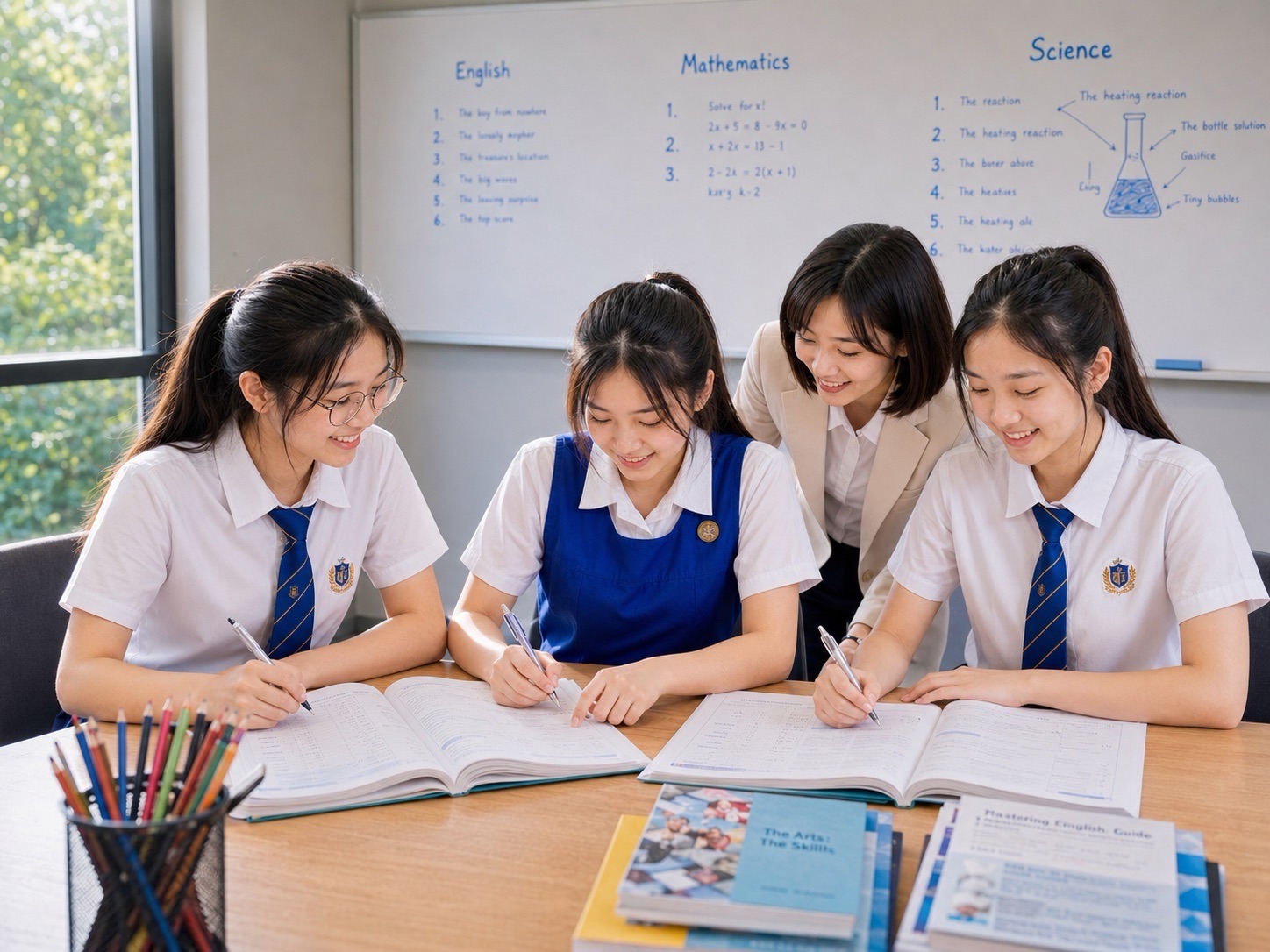
At eduKate Singapore, our Secondary 4 Additional Mathematics tuition in Punggol is conducted in focused small groups of three students. We teach the subject carefully from its foundations, strengthen the connections between topics and progressively prepare students for school examinations, preliminary examinations and the national examination. (eduKate Singapore)
The aim is not simply to complete more worksheets.
It is to help each student become capable of reading, planning and solving Additional Mathematics independently.
Secondary 4 A-Math Is the Final Examination Corridor
Secondary 3 is largely an introduction to a new mathematical language.
Students encounter deeper algebra, functions, logarithms, trigonometric identities, differentiation and other structures that feel very different from lower-secondary Mathematics. During Secondary 3, they may still be able to study one chapter at a time.
Secondary 4 changes the nature of the work.
The student now has to:
- retain the methods learned in Secondary 3;
- complete the remaining syllabus;
- connect ideas across chapters;
- recognise unfamiliar question forms;
- manage lengthy multi-part problems;
- show mathematically valid working;
- reduce careless algebraic errors;
- work accurately within time limits; and
- prepare for full examination papers.
This is why a student may understand individual lessons but still struggle in a full paper.
The problem is not always a lack of knowledge. Sometimes the knowledge remains separated into small compartments. The student knows differentiation when the worksheet is labelled “Differentiation”, but does not recognise it inside a question involving stationary points, tangents, rates of change or kinematics.
Secondary 4 tuition must therefore move beyond chapter completion.
It must turn separate methods into a connected and usable system.
The Current Additional Mathematics Examination
Students sitting the 2026 Singapore-Cambridge GCE O-Level take Additional Mathematics under syllabus 4049. From the 2027 Secondary Education Certificate examination, G3 Additional Mathematics is listed under syllabus K341. The syllabus continues to be organised around three major strands:
- Algebra;
- Geometry and Trigonometry; and
- Calculus.
The official syllabus also states that knowledge of the corresponding Mathematics syllabus is assumed. In other words, Additional Mathematics does not stand alone. Weaknesses in ordinary algebra, graphs, geometry and mathematical notation can continue to affect A-Math performance.
For both the 2026 O-Level syllabus and the 2027 G3 SEC syllabus, the examination comprises two papers:
- Paper 1: 2 hours 15 minutes, 90 marks, 50%;
- Paper 2: 2 hours 15 minutes, 90 marks, 50%.
Students are required to answer all questions in both papers. The official assessment notes also make clear that omitting essential working can result in the loss of marks.
This matters.
A student cannot prepare effectively by memorising final answers or relying on calculator output. The examination rewards the ability to select a suitable method, carry it through correctly and communicate the mathematical reasoning clearly.
The official assessment weightings reflect this:
- 35% for using and applying standard techniques;
- 50% for solving problems in a variety of contexts;
- 15% for reasoning and communicating mathematically.
Problem-solving therefore carries the largest approximate weighting. Students need more than procedural familiarity. They must recognise relationships, make connections and decide what to do when the question does not resemble the example directly.
That is the standard our Secondary 4 A-Math tuition is built around.
What Secondary 4 Additional Mathematics Covers
The Additional Mathematics syllabus is compact enough to look manageable on a contents page, but each major topic contains several layers of technique and application.
Algebra
Students work with areas such as:
- quadratic functions;
- equations and inequalities;
- surds;
- polynomials;
- factor and remainder theorems;
- cubic equations;
- partial fractions;
- binomial expansions;
- exponential functions;
- logarithmic functions; and
- mathematical modelling.
Algebra is not merely one part of Additional Mathematics.
It is the working language of almost the entire subject.
A student may understand differentiation conceptually but lose the question through weak factorisation. Another may know the trigonometric identities but make an error when rearranging an equation. A third may recognise the correct logarithmic law but apply it carelessly.
This is why we pay close attention to algebraic discipline.
We check whether the student can:
- manipulate expressions cleanly;
- preserve signs;
- factorise correctly;
- work confidently with fractions and indices;
- distinguish an identity from an equation;
- use brackets consistently;
- move between exact and numerical forms; and
- recognise when an expression should be simplified before proceeding.
Small weaknesses at this level can create large losses across an examination paper.
Geometry and Trigonometry
This strand includes:
- trigonometric functions;
- angles in degrees and radians;
- exact values;
- trigonometric graphs;
- identities;
- compound-angle and double-angle formulae;
- the R-formula;
- trigonometric equations;
- coordinate geometry;
- equations of circles;
- linearisation; and
- proofs in plane geometry.
Trigonometry often feels difficult because several forms may be mathematically equivalent.
A student must be able to look at an expression and decide whether to:
- convert everything into sine and cosine;
- apply a basic identity;
- use a compound-angle formula;
- use a double-angle formula;
- express the terms in R-form;
- solve within a stated interval; or
- transform the expression into the form required by the question.
The difficulty is not only remembering formulae.
It is selecting the right doorway.
Our lessons therefore train recognition as well as execution. Students learn what features to notice, why a particular method is suitable and how to check whether the final answer satisfies the original conditions.
Calculus
The calculus component includes:
- differentiation;
- gradients of curves;
- tangents and normals;
- rates of change;
- product, quotient and chain rules;
- stationary points;
- maxima and minima;
- second derivatives;
- integration;
- definite integrals;
- areas under curves; and
- displacement, velocity and acceleration.
Calculus is often seen as the defining Secondary 4 A-Math topic.
However, calculus problems are rarely solved by calculus alone.
A student still needs algebra to simplify the derivative, solve the resulting equation, determine coordinates and interpret the answer. In kinematics, the student must understand how displacement, velocity and acceleration are related. In optimisation, the student must translate the situation into a mathematical expression before differentiation can begin.
We therefore do not teach differentiation and integration as mechanical button-pressing procedures.
Students need to understand:
- what the derivative represents;
- why a stationary point occurs;
- how the sign of a derivative describes movement or shape;
- how a second derivative can distinguish a maximum from a minimum;
- what a definite integral represents;
- when an area becomes negative; and
- how calculus is applied within a physical or geometrical context.
The objective is reliable understanding, followed by reliable performance.
Why Students Struggle With Secondary 4 A-Math
A weak grade does not tell us enough.
Two students may both score 42%, yet require very different forms of help.
One may understand the concepts but work too slowly.
Another may have memorised methods without knowing when to use them.
A third may have missed several important Secondary 3 chapters.
A fourth may lose many marks through incomplete working, poor notation and sign errors.
A fifth may perform well in topical exercises but become disorganised when topics are mixed.
Before improvement can be planned, the source of the difficulty must be identified.
1. The Secondary 3 Foundation Is Incomplete
Secondary 4 A-Math is built directly on Secondary 3 work.
When quadratic functions, surds, polynomials, logarithms or basic trigonometry remain weak, later chapters become harder than they need to be. The student may appear to be struggling with calculus when the real obstruction is algebra.
In this situation, repeatedly assigning full papers may not solve the problem.
The missing foundation must first be repaired.
2. The Student Knows the Chapter but Cannot Recognise It
Topical worksheets contain a hidden clue: the chapter title.
In an examination, that clue disappears.
The student must decide whether the question involves a quadratic condition, a trigonometric identity, a tangent, an exponential model, differentiation or a combination of several ideas.
This recognition skill is developed through carefully chosen mixed practice.
3. Working Is Too Compressed
Some students try to complete an entire solution mentally and write only a few lines.
This may work for simple questions. It becomes dangerous in Additional Mathematics, where one incorrect sign or skipped substitution can affect several subsequent parts.
Clear working is not unnecessary decoration.
It protects accuracy, makes checking possible and allows method marks to be awarded when the final numerical answer is incorrect.
4. The Student Is Dependent on Examples
The student appears confident while following a demonstrated solution but becomes uncertain when working alone.
This usually means the method has been recognised but not yet mastered.
Understanding a tutor’s explanation is only the beginning. The student must subsequently reproduce the method without prompts and adapt it when the question changes.
5. Practice Is Too Narrow
Completing twenty nearly identical questions can create fluency, but it may also create false confidence.
The student becomes good at repeating one visible pattern.
Examination questions require variation. Numbers change, diagrams change, the required form changes and two familiar ideas may be combined in an unfamiliar way.
Practice must therefore progress from repetition to variation and finally to synthesis.
6. Corrections Are Not Converted Into Learning
Marking an answer wrong is not the same as correcting the weakness.
A useful correction process asks:
- Where did the solution first go wrong?
- Was it a concept error or an execution error?
- Was the wrong method selected?
- Was a condition overlooked?
- Was the calculator used incorrectly?
- Was the final answer given in the wrong form?
- Has the student made this error before?
Without this level of correction, the same mistake can return repeatedly.
7. Full-Paper Stamina Has Not Been Developed
Both national examination papers last 2 hours 15 minutes.
A student may be accurate for the first hour and deteriorate later through fatigue, rushing or poor time allocation.
Full-paper preparation must therefore include more than checking whether chapters have been covered. Students need experience maintaining concentration, deciding when to move on and preserving their quality of working throughout a long paper.
Three Routes Through Secondary 4 A-Math
Not every student enters Secondary 4 from the same starting point.
Our teaching is adjusted around three broad routes.
Route 1: Recovery After a Fall
This route is for the student who is failing, close to failing or increasingly unable to follow school lessons.
The immediate priority is not to rush through more advanced questions.
We first establish:
- which foundational topics are missing;
- whether basic algebra is secure;
- which current school chapters are causing difficulty;
- whether the student can complete routine questions independently; and
- whether the problem is knowledge, recognition, accuracy or speed.
We then rebuild the most important foundations while keeping the student connected to current schoolwork.
The objective is to stop the fall, restore understanding and create enough stability for further progress.
A student who has fallen behind does not need lower expectations.
The student needs a clearer sequence.
Route 2: From Average to Distinction
This route is for the student who can pass most school tests but remains around the middle range.
These students often understand standard questions. Their marks are lost in:
- unfamiliar applications;
- mixed-topic questions;
- incomplete reasoning;
- time pressure;
- algebraic inaccuracies; or
- questions requiring several stages of planning.
The work now shifts from basic familiarity to examination quality.
We increase variation, strengthen topic connections and require cleaner independent solutions. The student learns not merely to obtain an answer, but to produce a complete and dependable piece of mathematics.
The distinction is usually found in the details:
- the line of working that was previously skipped;
- the condition that was previously ignored;
- the exact value that was converted too early;
- the interval that was not checked;
- the diagram that was not interpreted carefully; or
- the final statement that was not written.
Route 3: From Distinction to Stronger Post-Secondary Readiness
This route is for students who are already performing well and want greater consistency, depth and readiness for the next stage.
Additional Mathematics is designed to support higher studies in mathematics and subjects that rely on strong mathematical reasoning. The official syllabus specifically notes its role in preparing students for H2 Mathematics, where algebraic manipulation and mathematical reasoning are important.
For stronger students, our lessons focus on:
- elegant and efficient solution paths;
- difficult synthesis questions;
- deeper understanding of why methods work;
- maintaining precision under time pressure;
- avoiding complacency on routine questions;
- evaluating alternative approaches; and
- developing a mature mathematical presentation.
A student aiming for A1 should not merely be capable of solving hard questions.
The student should also be consistently accurate on the questions that ought to be secured.
How Our 3-Pax Secondary 4 A-Math Tuition Works
Our Punggol Additional Mathematics classes are deliberately kept small, with three students in a group. (eduKate Singapore)
This gives the tutor sufficient space to observe how each student thinks.
We can see:
- where a solution begins to drift;
- whether the student understands the notation;
- which step is being completed mechanically;
- whether the student can explain the method;
- how quickly the student recognises the topic;
- whether mistakes are repeated; and
- when the student is ready for a harder variation.
In a large class, it is possible for a quiet student to copy a solution, mark the answer and leave without revealing that the method was not understood.
In a three-student class, there is much less room for passive learning.
Each student must work.
Each student’s written solution can be checked.
Each student can be questioned.
Each student can be given the next task at an appropriate level.
At the same time, the small-group environment retains a healthy sense of pace. Students can see good working habits, compare approaches and learn that difficult questions are meant to be engaged with rather than avoided.
What Happens During a Lesson
A well-structured A-Math lesson moves through several stages.
Current Work Is Checked
We begin with the student’s present position.
This may include:
- the chapter being taught in school;
- a recent test or examination;
- unfinished corrections;
- school homework;
- a recurring error; or
- an upcoming assessment.
The purpose is to keep tuition relevant to the student’s immediate needs without allowing short-term schoolwork to obscure deeper weaknesses.
The Concept Is Taught Clearly
When a topic is new or unstable, we teach it from the beginning.
Definitions, notation and relationships are made explicit. We do not assume that a student understands merely because the method was previously taught in school.
The tutor demonstrates how to read the question, select a method and organise the working.
The Student Reproduces the Method
Watching is followed by doing.
The student completes a similar question with decreasing levels of support. This reveals whether the explanation has genuinely been understood.
The Question Is Varied
Once the routine form is secure, the conditions change.
The student may be required to:
- work backwards;
- prove a result;
- use a different representation;
- combine two chapters;
- interpret a graph;
- explain a conclusion;
- identify an invalid solution; or
- solve within an unfamiliar context.
This is where flexible understanding begins to develop.
Mistakes Are Corrected at Their Source
We do not stop at the final wrong answer.
The tutor identifies the first incorrect decision or execution step. The student then corrects the question properly and may complete a related question to show that the correction has transferred.
Previous Knowledge Is Revisited
A-Math knowledge weakens when it is left unused.
Earlier chapters are therefore brought back through short mixed questions, reviews and examination practice. This keeps important methods available as the syllabus expands.
We Teach From Foundations to Full Papers
A strong Secondary 4 programme has several phases.
Phase 1: Foundation and Syllabus Control
The student secures essential methods and repairs important gaps.
At this stage, accuracy is more important than speed. The aim is to make each method understandable and reproducible.
Phase 2: Chapter Mastery
The student works through standard and advanced forms within each topic.
We check whether the student can handle the breadth of the chapter rather than only one familiar question type.
Phase 3: Mixed-Topic Recognition
Chapter labels disappear.
Questions are selected from different areas, and the student must identify the relevant mathematics independently.
This is a crucial transition. A student who cannot identify the topic cannot apply the method, even if the method was previously learned.
Phase 4: Examination Synthesis
The student works on longer questions, past-year questions, school papers and full-paper practice.
Attention is given to:
- time allocation;
- question selection and sequencing;
- presentation;
- checking;
- calculator use;
- exact values;
- accuracy requirements; and
- recovery when a question cannot immediately be solved.
Phase 5: Preliminary and National Examination Readiness
By this stage, the work becomes increasingly precise.
We identify the remaining marks being lost and determine whether they come from:
- unresolved content gaps;
- weak recognition;
- slow execution;
- careless errors;
- incomplete working;
- poor checking; or
- pressure during long papers.
The final stage is not about creating panic through endless papers.
It is about converting the remaining time into the highest-quality improvement possible.
Why We Do Not Only Give Easy Questions
Making Additional Mathematics understandable does not mean making the work easy.
A good explanation should make a difficult idea accessible. It should not protect the student from difficult mathematics.
We teach step by step so that students can eventually attempt:
- unfamiliar questions;
- multi-topic problems;
- proof and reasoning questions;
- advanced school examination questions;
- preliminary examination papers; and
- national examination questions.
Challenge is introduced progressively.
If the level is raised too quickly, the student becomes dependent on hints or gives up.
If it is never raised, the student remains comfortable but unprepared.
The tutor’s role is to judge the next suitable level of difficulty and ensure that the student continues to move forward.
Additional Mathematics Is Also a Study of Precision
A-Math rewards disciplined habits.
Students learn to:
- define variables;
- use correct notation;
- maintain equality from line to line;
- distinguish exact and approximate answers;
- state intervals and restrictions;
- organise multi-stage working;
- check whether an answer is reasonable; and
- communicate an argument clearly.
These habits are useful beyond a single examination.
They teach the student that advanced work cannot be built on vague thinking.
A mathematical solution is a visible record of thought. When the reasoning is orderly, the written work becomes easier to follow, easier to check and more likely to earn the available marks.
Signs That Your Child May Need Secondary 4 A-Math Support
Parents may wish to consider additional support when they notice that their child:
- understands during lessons but cannot start questions alone;
- performs well in homework but poorly in tests;
- repeatedly says that examination questions look unfamiliar;
- is still uncertain about important Secondary 3 topics;
- avoids showing working;
- depends heavily on answer keys;
- makes frequent sign, bracket and algebraic errors;
- cannot complete papers within the time;
- leaves many corrections unfinished;
- has marks that fluctuate greatly between papers;
- becomes overwhelmed when several chapters are tested together; or
- has lost confidence and begun to avoid the subject.
These signs do not all point to the same problem.
That is why the first task is to understand what is actually happening.
A student who needs foundation repair should not be taught in the same way as a student who already understands the syllabus but needs examination refinement.
Can a Failing Secondary 4 A-Math Student Still Improve?
Yes, but the plan must be realistic and properly ordered.
The student cannot repair everything simultaneously.
We first identify the chapters with the greatest influence on the rest of the syllabus. Algebraic foundations are often given priority because they affect so many other areas.
The recovery sequence may include:
- rebuilding essential algebra;
- stabilising the current school topic;
- securing high-frequency standard methods;
- practising independent recall;
- introducing mixed questions;
- improving presentation and working;
- developing timed accuracy; and
- moving into full-paper preparation.
The amount of progress possible depends on the starting point, the available time, attendance, practice and the student’s willingness to correct old habits.
We do not promise effortless results.
We provide a serious route forward.
Can an Average Student Reach A1 or A2?
An average student may already possess much of the required knowledge.
The difference between a mid-range result and a distinction is often found in consistency.
The student must secure the routine marks, reduce preventable losses and become more capable on questions requiring connection and reasoning.
This usually requires:
- stronger topic recognition;
- better algebraic accuracy;
- complete working;
- deliberate correction;
- mixed-topic practice;
- timed sections;
- full-paper experience; and
- the habit of checking important conditions.
A1 is not achieved by waiting for only the easiest paper.
It is built by becoming dependable across the syllabus.
What Makes a Good Secondary 4 A-Math Tutor?
A good Additional Mathematics tutor should do more than provide solutions.
The tutor should be able to:
- explain difficult ideas in clear stages;
- identify the earliest point of misunderstanding;
- distinguish a concept problem from a careless mistake;
- rebuild weak algebra without losing sight of the current syllabus;
- choose questions with an appropriate progression;
- teach students how to recognise methods;
- insist on correct mathematical presentation;
- monitor repeated errors;
- prepare students for mixed and full-paper conditions; and
- adjust the programme according to the student’s actual performance.
Parents are not simply looking for another source of worksheets.
They are looking for sound judgment.
The tutor must know what to teach now, what to postpone, what to revisit and when the student is ready to move from explanation to independent examination work.
Why Parents Choose eduKate Singapore for Punggol A-Math Tuition
Three Students Per Class
Our small-group format allows close checking, active participation and meaningful individual guidance.
Teaching From the Beginning When Necessary
We do not assume that a student has understood a chapter because it has already been taught elsewhere.
When the foundation is weak, we rebuild it.
Foundations and Distinction Preparation
Some students need recovery.
Others need the final refinement required for A1 or A2.
Our teaching recognises both needs.
Full Written Work Is Checked
We examine the student’s method, not only the final answer.
This allows us to identify where marks are actually being lost.
Progressive Difficulty
Students move from clear examples to independent questions, variations, mixed work and full papers.
Long Teaching Experience
Our work is shaped by more than 25 years of teaching students across different abilities, examination years and learning needs.
Experience matters because the same low mark can come from very different underlying problems.
Calm, Serious Learning
Additional Mathematics is demanding, but the classroom does not need to feel chaotic.
Students learn best when expectations are high, explanations are clear and corrections are handled constructively.
We are patient with the learning process and exacting about the quality of the work.
Frequently Asked Questions
Is your Secondary 4 Additional Mathematics tuition in Punggol conducted in a large class?
No. Our core class format is a small group of three students.
This gives the tutor time to check individual working, ask questions and adjust the level of practice while maintaining the pace of a proper class.
Do you teach students who are currently failing A-Math?
Yes.
We first determine whether the student’s difficulty comes from algebra, an unfinished Secondary 3 foundation, current Secondary 4 topics, weak question recognition, poor working habits or examination pressure.
The recovery plan is then built around the most important weaknesses.
Do you also teach students aiming for A1?
Yes.
For distinction-level students, the emphasis moves towards difficult variations, mixed-topic synthesis, efficiency, full-paper control and the elimination of preventable errors.
Do you teach the topic from scratch?
Yes, where necessary.
We explain the concept, demonstrate the method, guide the student through initial practice and then require independent work.
Will students only do Ten-Year-Series questions?
Past-year questions are important, but they are not the entire programme.
Students may also require foundation exercises, targeted chapter work, mixed-topic questions, school examination papers, timed sections and full-paper practice.
The material is chosen according to the stage of preparation.
Do you teach both the 2026 O-Level and the 2027 SEC syllabus?
The 2026 examination uses O-Level Additional Mathematics syllabus 4049, while G3 Additional Mathematics under the 2027 SEC is identified as K341. We prepare each student according to the syllabus and examination structure applicable to the student’s cohort. (SEAB)
Is Secondary 4 too late to begin A-Math tuition?
It is not automatically too late, but time should be used carefully.
A student beginning in Secondary 4 needs a clear assessment of the foundation, current topics and examination requirements. The programme should prioritise the weaknesses that affect the greatest number of marks.
Starting earlier provides more time. Starting now still provides a route.
How much homework will be given?
Homework depends on the student’s needs, school workload and stage of preparation.
The objective is not to create the largest possible stack of work. It is to provide enough purposeful practice for the student to retain methods, correct weaknesses and develop independent performance.
Is A-Math tuition useful when my child already understands school lessons?
Understanding a lesson and performing reliably in an examination are different stages.
A student may benefit from tuition for mixed-topic recognition, advanced questions, full-paper timing, presentation, consistency and preparation for higher-level mathematics.
Does Additional Mathematics help with future studies?
The official syllabus is designed to support higher studies in Mathematics and subjects that use mathematical reasoning, particularly though not exclusively the sciences. It is also intended to prepare students for the algebraic manipulation and reasoning required in H2 Mathematics.
Secondary 4 Additional Mathematics Tuition in Punggol
Secondary 4 is a demanding year, but difficulty does not mean that the situation is fixed.
A student can rebuild a weak foundation.
An average student can become more precise.
A strong student can become more consistent.
The work begins by identifying the right problem and teaching the next step properly.
At eduKate Singapore, our Punggol Additional Mathematics tuition provides focused three-student classes for students who need:
- foundation repair;
- clear chapter teaching;
- Secondary 3 revision;
- Secondary 4 syllabus support;
- stronger algebra;
- calculus and trigonometry mastery;
- examination technique;
- preliminary examination preparation;
- full-paper training; or
- distinction-level refinement.
We teach carefully, expect students to work seriously and guide them from understanding towards independent examination performance.
A1 is not a promise made lightly.
It is a standard we prepare the student to work towards.
Enquire About a Secondary 4 A-Math Class
eduKate Singapore
Email: admin@edukatesg.com (eduKate Singapore)