Science is a subject where students can arrive at the same wrong answer for very different reasons.
One student may remember the wrong concept. Another may know the concept but misunderstand the evidence. A third may understand both but write an incomplete causal explanation.
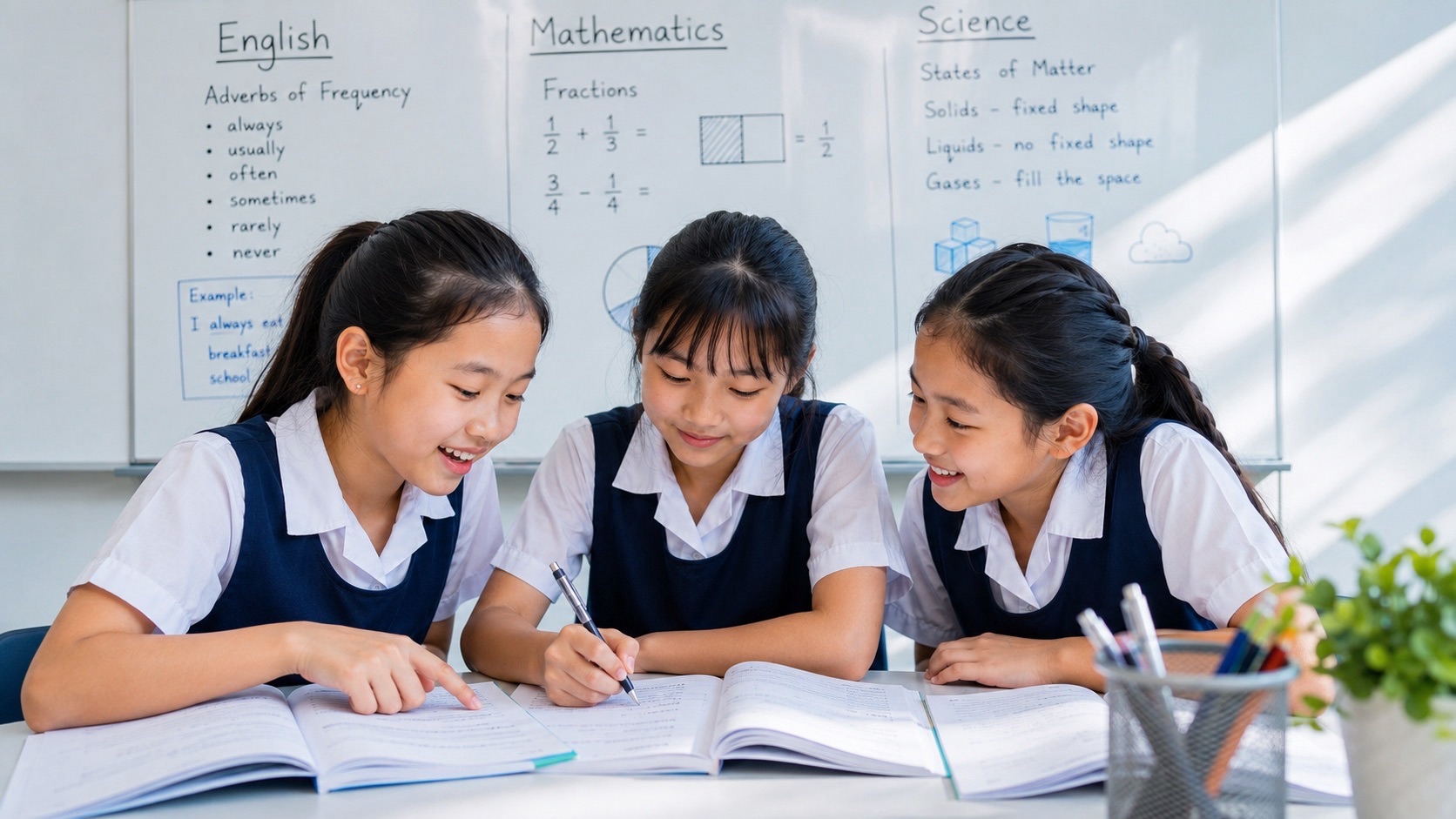
This is one reason a three-student Science tutorial can be useful. The group creates enough variation to make thinking visible, while remaining small enough for the tutor to inspect each learner closely.
But three students is not automatically better than one-to-one tuition. The value depends on what the learner problem actually needs.
Peer Explanation Can Expose Hidden Steps
When students explain the same scientific situation differently, the contrast is informative.
One explanation may name the correct concept without connecting it to the observation. Another may describe what happened but omit why. A third may preserve the full chain from condition to mechanism to result.
Hearing these differences helps students recognise that a complete Science answer is not simply “longer”. It contains the right relationships.
The Group Creates a Real Audience
A student often understands their own explanation because the missing steps exist in the student’s head.
A peer does not have access to those missing steps.
If another student asks, “But why did the temperature change?” or “Where did that evidence come from?”, the writer or speaker discovers that the explanation is incomplete.
This makes peer response useful without turning classmates into markers.
Three Students Also Reveal Alternative Representations
Science problems can often be organised in more than one useful way.
One learner may sketch the system. Another may organise variables in a table. Another may verbalise the causal chain first.
The tutor can compare these representations and ask which one makes the relationship easiest to inspect.
The goal is not to force one preferred method. It is to make scientific structure more visible.
The Tutor Still Needs Individual Resolution
A group becomes weak if peer discussion replaces diagnosis.
The tutor should still know which student needs concept repair, which student needs better evidence use and which student is ready for extension.
Three learners can share one central task while receiving different next questions.
- Student A may need the scientific model rebuilt.
- Student B may need to connect the model to the evidence in the question.
- Student C may need to compare an alternative explanation or test a boundary case.
The shared task gives coherence. The differentiated next question gives precision.
When Peer Explanation Becomes Copying
A small group can fail if one confident student becomes the unofficial answer source.
The quieter students may learn to wait for the strongest explanation and reproduce it.
The tutor should therefore vary who speaks first, ask students to write before discussion, and sometimes require each learner to defend a different part of the explanation.
Peer learning is valuable only when it increases ownership rather than borrowing.
When One-to-One Science May Be Better
Some learner problems require a temporarily narrower environment.
- The student has missed substantial schooling.
- A foundational misconception is far below the group’s current level.
- The learner becomes overwhelmed by peer comparison.
- The school curriculum sequence is unusually different from the group’s.
- The student needs intensive diagnosis before joining a group.
One-to-one support can repair the gap and prepare the learner to return to a suitable group later.
When a Larger Group May Be Enough
A larger Science class can work well for a student who is independent, conceptually secure and mainly needs structured coverage, regular practice and exposure to varied questions.
The student may not need high-resolution intervention on every answer.
Class size should solve the learner problem rather than function as a quality label.
Science Group Fit Depends on More Than Marks
Three students with similar scores can still be poor matches.
One may have strong knowledge but weak expression. Another may have weak concept recall. A third may be accurate but very slow.
A good group needs compatible learner states, not identical marks.
The students should be close enough to share a meaningful problem and different enough for the comparison to teach something.
Silence Is More Visible in a Group of Three
In a larger class, a quiet student can appear attentive while understanding very little.
In a three-student tutorial, the tutor can notice when a learner never volunteers a causal link, waits for peers before writing, or avoids committing to a prediction.
The tutor can then distinguish productive thinking time from genuine uncertainty.
The Best Peer Comparison Is About Reasoning, Not Ranking
Students should not leave the lesson thinking, “She is the smart one and I am the weak one.”
The comparison should be specific: one answer used stronger evidence; another explanation made the mechanism clearer; a third representation made the variable relationship easier to see.
That turns peer difference into information rather than hierarchy.
What Parents Can Ask About a Three-Student Science Class
- How do you decide whether the three students are compatible?
- How do you stop one student from supplying the answers?
- What does each student have to produce independently?
- How do you give different next questions inside one shared lesson?
- When would you recommend temporary one-to-one support?
- What would make you regroup the class?
The Better Parent Question
Instead of asking, “Is three-student Science tuition better than one-to-one?”, ask: Does my child benefit from seeing other reasoning while still receiving enough individual diagnosis to own the Science independently?
That is when the group becomes educationally useful.
Current route: This legacy Sengkang URL now owns the Science-specific peer-explanation decision rather than a local branch claim. For current Science programme ownership, use Does My Child Need Primary Science Tuition? and the Tuition Programmes Directory.