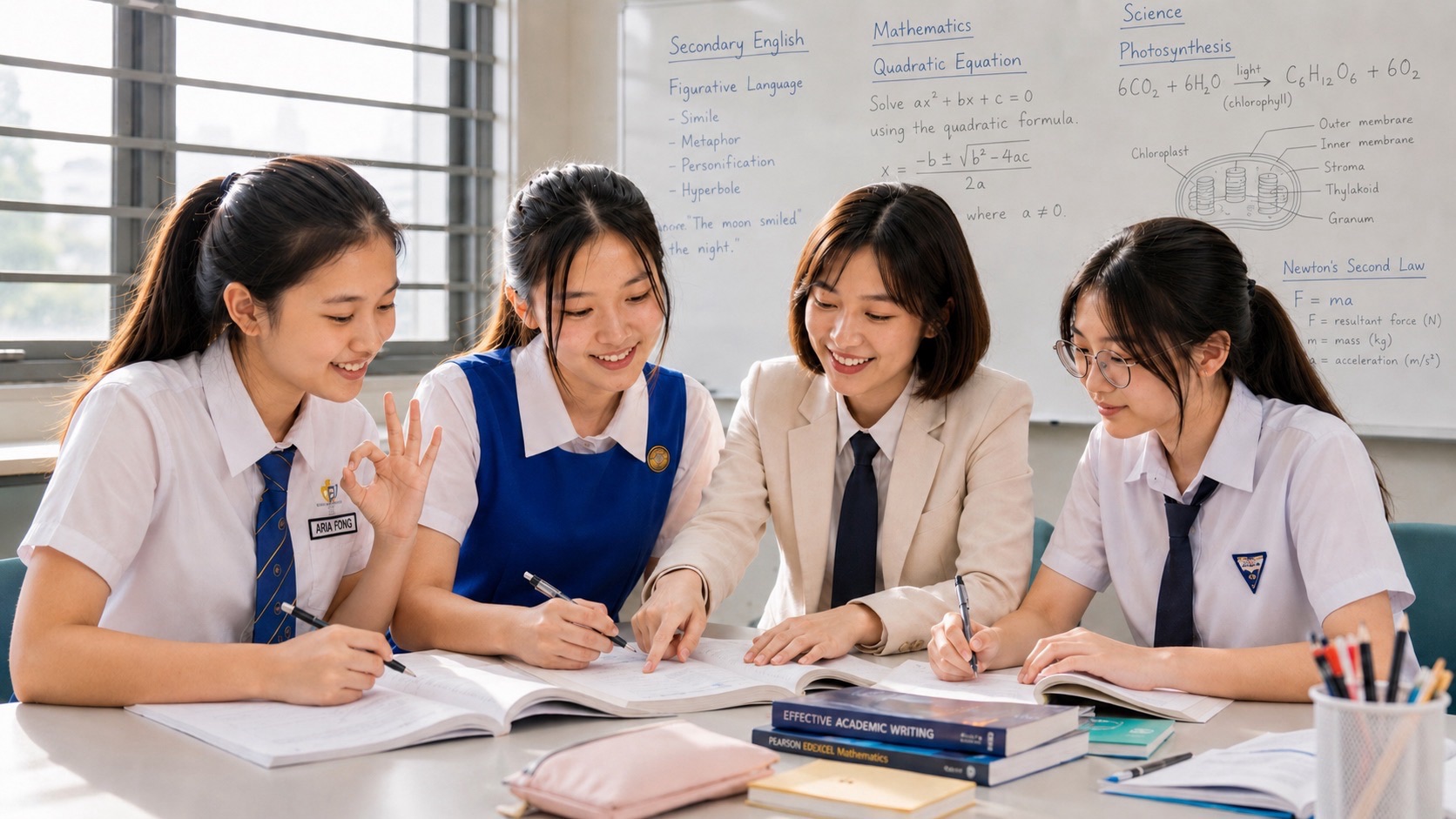
Secondary 3 Additional Mathematics Tuition in Punggol | 3-Student Small Group A-Math Tutor
Secondary 3 Additional Mathematics is often the first subject that makes a capable Mathematics student pause.
The formulas are unfamiliar. The algebra becomes longer. A single question may require several ideas to be connected correctly. Students who were comfortable with lower-secondary Mathematics can suddenly find themselves working slowly, making repeated errors or leaving questions unfinished.
This does not necessarily mean that the student is weak in Mathematics.
It usually means that the demands of the subject have changed.
At eduKate Singapore, our Secondary 3 Additional Mathematics tuition in Punggol is taught in a small group of up to three students. We help students understand the subject from its foundations, correct weaknesses early and develop the accuracy, reasoning and independence required for a distinction.
The aim is not merely to help students complete more questions.
It is to help them become better Additional Mathematics students.
Why Secondary 3 Additional Mathematics Feels So Different
Lower-secondary Mathematics introduces algebra, graphs, geometry, statistics and problem-solving. Additional Mathematics takes many of these ideas and develops them into a more formal and connected mathematical system.
A student is no longer only expected to carry out a familiar calculation. The student may need to:
- recognise the mathematical structure hidden inside a question;
- choose an appropriate method without being told which one to use;
- manipulate algebra accurately across several lines;
- connect ideas from different topics;
- justify a result;
- maintain correct notation and presentation; and
- check whether the final answer is mathematically sensible.
This is why Additional Mathematics can feel difficult even when the individual formulas appear manageable.
The real challenge is not usually one formula. It is the number of decisions that must be made correctly before the answer appears.
A student may understand the teacher’s example in school but still be unable to begin a new question independently. Another may know the correct method but lose marks through weak algebra. A third may complete routine exercises successfully but struggle when the question is presented in an unfamiliar form.
These are different problems and should not be treated with the same solution.
Good Secondary 3 A-Math tuition should first identify what is preventing the student from progressing. Only then should practice be increased.
Secondary 3 Additional Mathematics in Singapore’s Current Education Landscape
Singapore’s secondary-school system is moving fully into subject-level flexibility under Full Subject-Based Banding. The old Express, Normal (Academic) and Normal (Technical) streams have been removed for students entering Secondary 1 from 2024, with students taking subjects at levels suited to their progress and readiness. From 2026, this flexibility also extends to upper-secondary electives such as Additional Mathematics. (Ministry of Education)
Students graduating from 2027 will sit for the Singapore-Cambridge Secondary Education Certificate examinations at their respective subject levels. G3 Additional Mathematics is listed under the new subject code K341, corresponding to the earlier 4049 syllabus. (SEAB)
For parents, the important point is simple: subject selection may be more flexible, but the intellectual demands of Additional Mathematics remain substantial.
A student taking G3 Additional Mathematics still needs a strong command of G3 Mathematics. The official syllabus assumes that this foundation is already present. It then develops the student across three broad areas:
- Algebra;
- Geometry and Trigonometry; and
- Calculus.
The syllabus is also designed to prepare suitable students for more advanced mathematical study, including H2 Mathematics, where strong algebraic manipulation and mathematical reasoning are essential.
Secondary 3 is therefore not simply the first year of a new subject.
It is the foundation year for the entire upper-secondary Additional Mathematics journey.
The Main Secondary 3 Additional Mathematics Topics
The exact order in which topics are taught may differ between schools. Some schools introduce selected topics earlier, while others arrange the syllabus according to their own examination calendar.
Across the complete G3 Additional Mathematics syllabus, students encounter areas such as:
Algebra
- Quadratic functions
- Equations and inequalities
- Surds
- Polynomials
- Remainder and factor theorems
- Partial fractions
- Binomial expansions
- Exponential functions
- Logarithmic functions
Geometry and Trigonometry
- Trigonometric functions
- Trigonometric graphs
- Identities and equations
- Coordinate geometry
- Circles
- Transformation of relationships into linear form
- Proofs in plane geometry
Calculus
- Differentiation
- Gradients and rates of change
- Stationary points
- Maximum and minimum problems
- Integration
- Areas under curves
- Kinematics involving displacement, velocity and acceleration
These topics are not isolated chapters.
Quadratics reappear in coordinate geometry. Algebra supports logarithms. Trigonometric identities require accurate manipulation. Differentiation depends on functions and notation. Calculus questions may also require earlier algebra before the student can apply the calculus itself.
This is why unfinished weaknesses tend to travel forward.
A student who has not stabilised algebra in Secondary 3 may continue to struggle when more advanced trigonometry and calculus are introduced. The later topic may appear to be the problem, but the real difficulty may have started several months earlier.
Additional Mathematics Is Built on Algebra
Among all the foundations required for A-Math, algebra is usually the most important.
Students need to be comfortable with:
- expanding and factorising;
- working with algebraic fractions;
- rearranging expressions;
- solving equations;
- substituting accurately;
- handling indices and surds;
- recognising useful algebraic forms;
- changing the subject of a formula; and
- presenting several connected steps clearly.
Weak algebra affects almost every major topic.
A student may understand differentiation but be unable to simplify the derivative. The student may know a trigonometric identity but fail to transform one side of the equation correctly. The student may recognise a logarithmic law but make an index error during the solution.
These mistakes are often described as “careless”, but repeated algebraic errors are rarely random.
They usually indicate that a skill is not yet sufficiently secure.
The answer is not simply to tell the student to be more careful. The tutor must identify the specific operation that is unreliable, rebuild it and check whether the student can use it correctly in different situations.
Why Students Who Were Good at Mathematics Can Still Struggle
Additional Mathematics creates several new demands at the same time.
1. Familiar-looking questions may require unfamiliar thinking
A question may begin with a quadratic expression, but the real task could involve a discriminant, a tangent condition or a maximum-value argument.
Students who rely on surface features may choose the wrong method.
2. Methods become longer
There are more places for an error to occur. One incorrect sign in the middle of a solution may affect every line that follows.
3. Topics become increasingly connected
Students must retrieve knowledge from earlier chapters without being reminded. A question on calculus may require algebra, coordinates or trigonometry before the main method can be completed.
4. Mathematical presentation matters
Students must show enough essential working, use notation correctly and communicate the argument in a form that can receive method marks.
5. School lessons move quickly
The school must complete the syllabus. Once a topic has been taught, the class proceeds. A student who is still uncertain may have to learn the next chapter while carrying an unresolved weakness from the previous one.
6. Understanding an example is not the same as solving independently
Many students feel comfortable while watching a teacher work. The difficulty appears when the notes are closed and the student must decide how to begin.
This gap between recognition and independent execution is one of the most important issues to correct in Secondary 3.
Why More Practice Is Not Always the First Answer
Practice is essential in Mathematics, but practice only becomes useful when the student is practising a sound method.
If the student has misunderstood a concept, large quantities of work can reinforce the wrong idea. If the student copies solutions whenever stuck, the completed worksheet may create an impression of progress without genuine independence.
Effective practice should have a purpose.
A student may need practice to:
- strengthen a newly learned method;
- improve algebraic fluency;
- distinguish between similar question types;
- reduce repeated errors;
- increase working speed;
- connect several topics;
- develop examination stamina; or
- learn to recover when the first attempt does not work.
These are different forms of practice.
A good tutor should know which one the student currently needs.
What Our Secondary 3 A-Math Tuition in Punggol Does
Our lessons are designed to move students from explanation to independent performance.
A typical learning sequence includes the following stages.
Clear Explanation
The student first needs to understand what the topic means, how the method works and why each step is necessary.
We do not begin by asking students to memorise a long collection of unexplained procedures. When students understand the structure behind a method, they are more likely to recognise when and how it should be used.
Guided Examples
We work through carefully selected questions that show the central idea, the expected presentation and the common points of failure.
At this stage, the tutor can observe whether the student is following the reasoning or merely copying the visible steps.
Independent Attempt
The student then completes questions without having every decision supplied.
This is where genuine understanding becomes visible.
A tutor needs to see the student think: how the student begins, where hesitation occurs, which method is selected and what happens when the answer does not appear immediately.
Immediate Correction
Errors are corrected before they become habits.
The correction should not stop at revealing the right answer. The student should understand:
- where the solution changed direction;
- why the step was incorrect;
- what principle should have been used; and
- how to prevent the same error in future.
Variation
The student is given related questions with changes in wording, structure or difficulty.
This prevents learning from becoming too dependent on one familiar template.
Retrieval and Mixed Practice
Earlier topics are brought back regularly.
Additional Mathematics cannot be prepared effectively by studying a chapter once and leaving it untouched for several months. Students need repeated opportunities to retrieve older methods and use them alongside newer ones.
This becomes increasingly important as Secondary 4 approaches.
Why We Teach in a Small Group of Three Students
Our Secondary 3 Additional Mathematics tuition classes in Punggol are kept to a maximum of three students.
This is not simply a smaller version of a conventional classroom. It allows the lesson to function differently.
The Tutor Can Observe Each Student’s Working
In Mathematics, the final answer reveals only part of the story.
The tutor needs to see:
- how the student interprets the question;
- what is written in the first line;
- whether the algebra is organised properly;
- where the student pauses;
- whether notation is used consistently; and
- which errors continue to repeat.
With three students, there is enough proximity to examine this carefully.
Questions Can Be Addressed Early
A student does not need to remain silent for an entire lesson because the class is too large or moving too quickly.
Uncertainty can be addressed while the topic is still being built.
Students Still Learn Independently
A one-to-one lesson can be useful in particular situations, but constant individual prompting may sometimes make a student too dependent on the tutor.
A three-student class maintains a healthy balance. Each student receives close attention but must also work, wait, think and attempt questions independently.
The Group Creates Useful Mathematical Discussion
Students benefit from seeing that a question can be approached in more than one way. They can compare methods, explain reasoning and notice mistakes that they may not have recognised in their own work.
Work Can Be Adjusted
The students may be learning the same broad topic, but they do not need to receive identical support at every moment.
One student may require foundation repair. Another may need harder variations. A third may need examination-speed training.
The small group allows the tutor to teach a shared lesson while responding to individual needs.
Three Common Secondary 3 A-Math Student Profiles
The Student Who Has Just Started Falling Behind
This student may have understood the first few lessons but becomes increasingly confused as the chapters accumulate.
Homework takes longer. Notes look familiar, but the student cannot begin independently. Test results start to fall even though the student appears to be studying.
The priority is to identify the earliest unstable topic and repair it before the weakness spreads.
The Average Student Who Wants a Distinction
This student can complete routine exercises but loses marks in unfamiliar questions, multi-step problems or algebraically demanding work.
The student may remain in the middle range because practice is too predictable.
The next stage is to improve method selection, mathematical communication, accuracy and the ability to connect topics.
The Strong Student Who Wants to Stay Ahead
This student understands school lessons quickly and is already performing well.
The goal is not to overload the student with random difficult questions. It is to develop greater depth, cleaner working, flexibility and the ability to handle demanding questions without losing control of time.
Strong students also need correction. Their mistakes may be less frequent, but they can become costly when they occur in a high-mark question.
From Weak Foundations to Examination Readiness
Students do not all begin tuition from the same point.
A useful programme should be able to support three broad stages of progress.
Stage One: Regaining Control
The student may be failing, confused or unable to keep pace with school.
The first goal is not immediately to chase the hardest examination questions. It is to restore enough understanding for the student to follow current lessons and complete core questions correctly.
This includes rebuilding algebra, notation, basic methods and confidence.
Stage Two: Moving From Average to Distinction
Once the foundations are stable, the student needs broader question exposure, stronger connections between topics and more disciplined correction.
At this stage, the student learns to recognise question structures instead of waiting for familiar wording.
Stage Three: Preparing for Top-Level Performance
A student aiming for an A1 needs more than chapter completion.
The student must be able to:
- work accurately under time pressure;
- preserve marks through clear working;
- select methods efficiently;
- manage difficult questions without panic;
- switch between topics;
- detect unreasonable answers; and
- maintain performance across two full papers.
A distinction is not created by one final revision sprint. It is built through accumulated control.
What the Examination Actually Rewards
The G3 Additional Mathematics assessment is not limited to recalling formulas and carrying out routine procedures.
The official assessment weighting places approximately:
- 35% on standard techniques;
- 50% on solving problems in a variety of contexts; and
- 15% on mathematical reasoning and communication.
This means that a large part of the examination requires students to interpret information, identify the relevant mathematics, connect topics and explain or justify their work.
The examination consists of two papers of 2 hours 15 minutes each, with both papers carrying equal weight. Students must answer all questions, and the omission of essential working can result in a loss of marks.
For parents, this explains why simply memorising formulas is not enough.
Students require:
- procedural fluency;
- problem-solving judgement;
- accurate written working;
- endurance;
- topic retrieval; and
- the ability to think when the question does not look familiar.
Our tuition programme develops these capabilities progressively rather than leaving them until the final months before the examination.
The Importance of Showing Proper Working
Some students believe they should write as little as possible because a shorter solution appears more elegant.
Elegance is useful only when the mathematical argument remains complete.
Essential steps should be visible. This allows the examiner to follow the reasoning and award method marks where appropriate. It also allows the student to check the solution and locate an error.
We train students to write solutions that are:
- logically sequenced;
- sufficiently complete;
- mathematically accurate;
- easy to verify; and
- efficient enough for examination conditions.
Good working is not decorative.
It is part of mathematical thinking.
Common Additional Mathematics Mistakes We Correct
Sign Errors
A negative sign is lost during expansion, transposition or differentiation.
Weak Algebraic Fractions
Students attempt to cancel terms that cannot be cancelled or combine fractions incorrectly.
Incorrect Use of Identities
A formula is remembered but applied to the wrong expression.
Premature Calculator Use
Students convert exact values into decimals too early and lose accuracy or clarity.
Incomplete Solutions
The student solves for one value but overlooks another possible solution.
Incorrect Interval Handling
A trigonometric equation is solved without considering the required interval.
Confusion Between Similar Methods
The student knows several methods but cannot identify which one fits the question.
Skipped Logical Steps
The answer may be correct, but the reasoning is not presented clearly enough.
Repeated Errors Without Review
The same mistake appears in several worksheets because the student corrects the answer but never creates a prevention rule.
Our aim is to make mistakes useful.
A corrected mistake should lead to a better method, a clearer checking habit or a specific rule the student can apply next time.
The Role of School Homework and Tuition Work
Tuition should support the student’s school journey, not create a second unrelated curriculum.
We pay attention to:
- the topics currently taught in school;
- upcoming weighted assessments;
- the student’s school worksheets;
- incomplete or misunderstood homework;
- earlier topics that are affecting current work; and
- the longer-term Secondary 4 examination pathway.
At the same time, tuition should not become a homework-completion service.
Finishing tonight’s worksheet may solve an immediate problem. It does not necessarily solve the student’s learning problem.
Where needed, we use the school question to identify the underlying weakness, teach the relevant concept and then verify whether the student can solve a related question independently.
When Should a Secondary 3 Student Start A-Math Tuition?
The best time to begin is before the student has accumulated several connected weaknesses.
Parents may consider additional support when:
- the student regularly says that school lessons are too fast;
- homework requires extensive help;
- the student understands examples but cannot attempt new questions;
- algebraic errors appear repeatedly;
- test performance falls despite studying;
- the student avoids A-Math work;
- revision begins only immediately before a test;
- older topics are quickly forgotten;
- the student is passing but unable to progress beyond average marks; or
- the student wants a distinction but lacks a clear preparation system.
There is no benefit in waiting for the situation to become severe.
Early support usually allows correction to be calmer, more precise and less disruptive to the student’s other subjects.
What Progress Should Parents Look For?
Improvement is not measured only by the next test score.
Marks matter, but several earlier changes often show that the student is moving in the right direction.
Parents may notice that the student:
- begins homework with less hesitation;
- asks more specific questions;
- completes algebra with fewer interruptions;
- can explain why a method works;
- checks answers more intelligently;
- requires less prompting;
- retains older topics for longer;
- recovers more calmly after making a mistake;
- writes clearer solutions; and
- approaches tests with greater control.
These are important signs because they show that the student is becoming more independent.
A lasting improvement in Mathematics should reduce dependence, not increase it.
How We Prepare Students Through Secondary 3
A well-managed Secondary 3 year should accomplish more than completing the school syllabus.
By the end of the year, the student should have:
- a reliable algebraic foundation;
- a clear set of core methods;
- an organised collection of corrected mistakes;
- familiarity with mixed-topic work;
- stronger mathematical notation;
- improved working speed;
- the habit of revisiting earlier chapters; and
- enough stability to enter Secondary 4 without carrying a large repair burden.
Secondary 4 is already a demanding year.
Students must complete remaining content, prepare for school assessments, handle preliminary examinations and eventually perform across the full national examination syllabus.
The more that is properly built in Secondary 3, the more time Secondary 4 can devote to synthesis, advanced questions and examination performance.
A Calm but Serious Approach to A-Math
Additional Mathematics should be taught with patience, but it should not be treated casually.
Students need time to understand difficult ideas. They also need clear standards.
We expect students to:
- attempt their work seriously;
- show proper steps;
- correct mistakes fully;
- revisit weak topics;
- practise between lessons; and
- become increasingly responsible for their own progress.
The tutor provides explanation, structure, feedback and direction.
The student must gradually learn to carry the mathematics independently.
This combination of patient teaching and disciplined training is central to our Secondary 3 A-Math tuition programme.
Choosing a Secondary 3 Additional Mathematics Tutor
Parents may wish to consider several questions when selecting an A-Math tutor.
Can the Tutor Explain From First Principles?
Students should not be given only shortcuts and memorised templates.
Does the Tutor Examine the Student’s Working?
A final answer alone cannot reveal the true weakness.
Can the Tutor Repair Algebra?
Many apparent A-Math difficulties are actually algebraic difficulties.
Is the Student Required to Work Independently?
A lesson should not consist entirely of watching the tutor solve questions.
Are Mistakes Tracked and Revisited?
Correction should influence future performance.
Does the Programme Prepare for Both Understanding and Examination Conditions?
Students need conceptual clarity as well as speed, accuracy and stamina.
Is the Class Small Enough for Genuine Observation?
The tutor should be able to see how each student thinks and writes.
The right tuition arrangement should make the student’s learning more visible, not simply provide another stack of worksheets.
Frequently Asked Questions
Is Additional Mathematics much harder than E-Math?
Additional Mathematics is more abstract and algebraically demanding. It also requires students to connect topics and select methods more independently. A student who performs well in E-Math may still need time to adjust to the style and pace of A-Math.
Does a student need perfect E-Math before taking A-Math?
Perfection is not required, but the student should have a sound command of important G3 Mathematics foundations, particularly algebra, graphs, equations, coordinate geometry and trigonometry. Weaknesses in these areas should be corrected early.
Can a failing Secondary 3 student still recover?
Yes, particularly when the weakness is identified early and the student is willing to work consistently. Recovery usually begins by locating the earliest unstable skills rather than repeatedly attempting full difficult papers.
Can an average student reach an A1?
An average student can make substantial progress when the foundations are secure, practice is purposeful and mistakes are corrected systematically. An A1 requires sustained accuracy and examination readiness, not only topic familiarity.
Is the class suitable for strong students?
Yes. Strong students may work on more demanding variations, cleaner methods, mixed-topic questions and examination efficiency. The small-group structure allows the level of challenge to be adjusted.
Why limit the class to three students?
Three students allow the tutor to observe individual working closely while preserving independent effort and useful group interaction.
Will tuition follow the student’s school topics?
We consider the school’s current teaching sequence and assessments while also addressing earlier weaknesses and preparing the student for the complete Additional Mathematics journey.
Do students begin with examination papers immediately?
That depends on the student’s readiness. Full-paper practice is useful only when enough of the syllabus has been learned and the core methods are stable. Earlier in the journey, carefully selected topic and mixed-topic work is usually more productive.
How much practice should a student complete?
The amount depends on the student’s current level and the purpose of the practice. A smaller number of questions completed carefully, corrected properly and revisited can be more valuable than a large quantity completed mechanically.
Is Additional Mathematics useful beyond the examination?
Additional Mathematics develops algebraic reasoning, abstraction, modelling and problem-solving. It also provides an important foundation for students considering advanced Mathematics, sciences, engineering, computing and other quantitatively demanding pathways.
Secondary 3 Additional Mathematics Tuition in Punggol
At eduKate Singapore, we teach Secondary 3 Additional Mathematics in a focused small-group environment of up to three students.
We work with students who need to:
- rebuild weak foundations;
- keep pace with school;
- move from average results towards a distinction;
- strengthen algebra;
- prepare early for Secondary 4;
- improve accuracy and working presentation; or
- develop the depth required for advanced Mathematics.
Our role is to make the subject understandable, manageable and increasingly independent.
Students are taught carefully from the foundations, trained through appropriate practice and guided towards the standards required for strong examination performance.
The destination may be an A1.
The journey begins with knowing exactly what the student needs next.
Speak to Us About Secondary 3 A-Math Tuition
A consultation allows us to understand your child’s present results, school progress, learning difficulties and intended pathway before recommending the most suitable next step.
Start clearly. Build properly. Move forward with confidence.
The tutor’s first question is not “which chapter?”
A good Secondary 3 A-Math tutor begins by asking what kind of failure produced the lost mark. Was the concept misunderstood? Was the correct route chosen but the algebra executed badly? Did a graph or diagram get misread? Did the calculator or rounding create an execution error? This distinction matters because two students with the same score may need completely different teaching. The tutor’s value lies in identifying the earliest failed mathematical decision rather than simply assigning the next worksheet.
A tutor should build a prerequisite map
Additional Mathematics depends on G3 Mathematics. Fractions, indices, equations, factorisation, coordinate sense and graph literacy remain active underneath the new syllabus. The tutor should map which prerequisites feed which A-Math topics. If a logarithm equation fails because basic algebra is unstable, the repair should target algebra. If a coordinate question fails because gradient meaning is weak, more circle questions will not solve it. Prerequisite mapping keeps support precise and prevents over-teaching.
Prompts should have an exit condition
Tutor prompts such as “what is the target?” or “which relationship applies?” can be useful early scaffolds, but they should not remain permanent. A student who performs well only after the tutor supplies the first step is not yet independent. The tutor should delay the prompt, convert it into a learner checklist and eventually remove it. Progress is visible when the student generates the same question internally and starts the problem without waiting.
Worked examples should lead to transfer
Worked examples are valuable because they make expert thinking visible. The danger is that recognition of a familiar solution feels like understanding. A tutor should therefore follow a model with a partially completed example, then a changed independent question and later a delayed retrieval item. If the learner can adapt when values, representation or target change, the worked example has become knowledge. If the student waits for the original layout, the method remains cue-dependent.
Quadratic tutoring should compare forms and routes
A strong tutor connects general, factorised and completed-square forms rather than teaching them as unrelated techniques. Students should see how roots, turning points and graph shape emerge from different representations of the same quadratic function. The tutor should also compare factorisation, completing the square and the quadratic formula as alternative routes. Method selection becomes part of the lesson: why is one route efficient here, and what information does another form reveal that the first does not?
Logarithm tutoring should include domain discipline
Students often perform the algebra of a logarithmic equation correctly and still finish with an invalid root. A tutor should make domain checking a standard part of the method rather than a last-minute warning. The deeper teaching point is that algebraic transformations do not erase the constraints of the original function. This habit transfers to other A-Math problems where a mathematically generated value must still satisfy the original context or domain.
Trigonometry tutoring should reduce calculator dependence
The tutor should build exact values, symmetry, periodicity and graph sense before relying heavily on calculator output. Students need to know that the calculator’s principal value is only one part of an interval solution. Graphs can predict how many solutions are plausible, and exact special-angle values can check signs and identities. A learner who can anticipate the structure is much less likely to accept an incomplete or implausible numerical answer.
Identity tutoring should focus on route selection
Trigonometric identities are an excellent diagnostic of mathematical planning. Students who manipulate both sides randomly may know many formulae but lack route control. The tutor should ask which side has more structure, which identity reduces complexity and whether each transformation preserves equivalence. When the route stalls, the learner should recognise that evidence and reconsider rather than continue adding algebra. This habit later supports timed examination work.
The tutor should keep coordinate geometry visual
Line and circle questions can become symbol-heavy, but the geometry should never disappear. A quick sketch can reveal whether a gradient sign, centre or intersection makes sense. The tutor should encourage two-way translation: equation to object and object to equation. This provides a checking system independent of the algebra. It also reduces the risk that students memorise sign conventions without understanding what the symbols describe.
Differentiation tutoring should begin with meaning
Before product, quotient and chain rules become a formula set, the tutor should connect the derivative to gradient and rate of change. Graph behaviour provides an immediate interpretation: positive derivative, increasing function; negative derivative, decreasing function; zero derivative, stationary condition. Once the meaning is clear, structure recognition comes next. The learner identifies product, quotient or composition before choosing the differentiation rule.
School papers should change the next lesson
A school paper is useful only if it changes what happens afterward. The tutor should code significant losses by mechanism, identify repeated patterns and select a small repair set. One algebraic sign weakness may appear across polynomials, coordinate geometry and calculus. One route-selection problem may appear across trigonometry and graph questions. When the shared cause is repaired, several chapters can improve at once.
Parent updates should describe mechanisms
Parents benefit from specific statements such as “quadratic concepts are secure, but mixed trig-equation selection remains slow” or “the learner understands differentiation, but algebraic execution still leaks marks.” This language explains both progress and the next teaching move. Generic phrases such as “needs more practice” do not reveal whether the tutor has actually diagnosed the student. Specific reporting also makes it easier to adjust workload when school or CCA demands change.
A strong tutor should know when not to add work
More questions are not always the next answer. If a student already performs a procedure accurately, further blocked repetition may produce little return. The tutor may need to mix topics, change representation, delay retrieval or increase independence instead. Likewise, if fatigue is degrading algebraic attention, reducing homework can improve learning quality. Good tutoring is selective because it responds to the mechanism rather than measuring rigour by page count.
The Secondary 4 handoff belongs to the student
By the end of Secondary 3, the learner should know which A-Math topics are stable, which prerequisites remain weak, which execution errors repeat and what should be retrieved first in Secondary 4. The tutor can help create a one-page handoff map, but the student should be able to explain it without prompts. That transfer of the learning plan is itself a sign of readiness: the subject is becoming managed by the learner rather than only by the tutor.
This rebuilt page retains its original Punggol URL as a learning-library resource. Current class venue, timetable and availability should be checked through current eduKate channels. Its durable purpose is to define what good Secondary 3 A-Math tutoring should look like: precise diagnosis, connected teaching, cumulative retrieval and steadily increasing learner independence.
What the tutor should leave behind after one term
After one term, the learner should not only have covered several A-Math topics. The student should also have a clearer way to learn the subject. The tutor ought to be able to name which algebraic prerequisites are now stable, which topic still depends on prompts, which error category appears most often and what the next month of practice is designed to change. If the programme cannot explain those decisions, personalisation is probably too shallow.
The student should also be able to describe progress in process terms. Perhaps factorisation is now retrievable after a delay, logarithmic domain checks happen automatically, or trigonometric equations no longer stop at the principal value. These improvements may precede a dramatic school-score change, but they matter because they make every later practice session more efficient.
The tutor’s long-term exit condition
Good tutoring contains its own exit condition at the level of each skill. Once a learner can retrieve a method, recognise when it applies, execute it accurately, check it independently and transfer it into a changed question, heavy scaffolding should reduce. The tutor may continue to introduce harder material, but the old skill should no longer require permanent supervision.
This is the standard that protects learner agency. The tutor’s success is not measured by how indispensable the tutor remains, but by how much mathematical control the student can carry alone into Secondary 4, school assessments and eventually the national examination.
The final test is simple: can the learner start a changed A-Math problem, explain the chosen route and recover from an error without waiting for the tutor’s first hint? When the answer is increasingly yes, the tutoring system is transferring control in the right direction.
One last tutor-quality test is whether the student can explain the current learning plan without the tutor speaking first: which prerequisite is stable, which error still repeats, what will be retrieved next and what independent check belongs to the next difficult question. When the learner can answer those questions, tutoring has transferred more than content; it has transferred a method for managing A-Math.