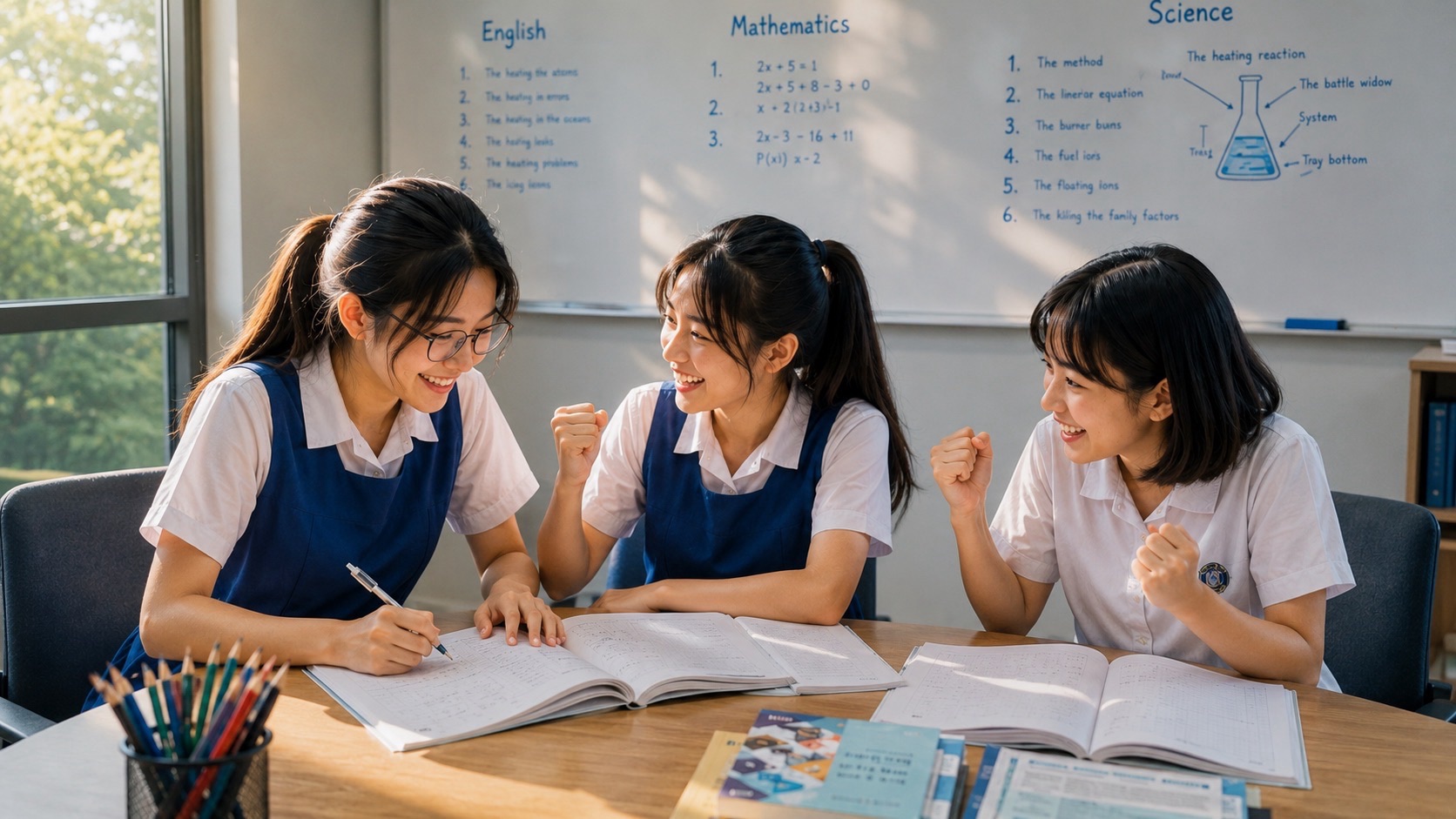
Maths Tuition Punggol (A Maths Sec 3) | G3 Additional Mathematics Tuition in a 3-Student Small Group
Secondary 3 Additional Mathematics is often the first subject that makes a capable Mathematics student feel uncertain.
The formulas are unfamiliar. The algebra becomes longer. Topics begin to connect across chapters. A small mistake made near the beginning of a solution can affect every line that follows.
This does not necessarily mean that the student is weak in Mathematics.
More often, it means that the student has entered a subject that requires a different level of precision, organisation and mathematical maturity.
At eduKateSingapore, our Secondary 3 A-Maths tuition in Punggol is conducted in small groups of no more than three students. We teach each topic carefully from the foundation, strengthen the algebra beneath the syllabus and gradually train students to solve more demanding examination questions with confidence.
Our aim is clear:
Understand the mathematics. Build reliable methods. Practise intelligently. Work towards distinction.
Secondary 3 Additional Mathematics Tuition in Punggol
| Programme | Details |
|---|---|
| Subject | Secondary 3 G3 Additional Mathematics |
| Common name | Sec 3 A-Maths or Add Maths |
| Class size | Maximum 3 students |
| Location | Punggol |
| Lesson duration | 1.5 hours |
| Teaching focus | Foundations, understanding, application and examination performance |
| Suitable for | Students catching up, keeping pace or aiming for A1 |
| Enquiries | +65 8823 1234 |
| Fees and availability | Please enquire for the latest intake |
Our Punggol A-Maths tuition is suitable for students who:
- have just started Additional Mathematics and find the pace uncomfortable;
- understand lessons but cannot complete questions independently;
- repeatedly lose marks through algebraic or presentation errors;
- are passing but remain stuck around the middle grades;
- want to move from a good result towards an A1 distinction;
- need a more structured preparation plan before Secondary 4.
We do not assume that every student should begin at the same point.
Some students require a careful reconstruction of lower-secondary algebra. Others already understand the content but need better question selection, working discipline and examination control. A strong student may require greater depth, unfamiliar questions and more demanding mixed practice.
The small class allows us to see these differences clearly.
Why Secondary 3 A-Maths Feels So Different
Additional Mathematics is not simply Elementary Mathematics with more difficult numbers.
It introduces a more abstract way of thinking.
In Elementary Mathematics, students can often identify a familiar question type and apply a known procedure. In Additional Mathematics, they must recognise mathematical structure, connect several ideas and decide which method should be used.
A question may appear to be about a tangent but depend on the discriminant of a quadratic equation. A calculus problem may eventually require careful factorisation. A trigonometric equation may test algebra as severely as it tests trigonometry.
This is why students sometimes say:
“I understand when the teacher explains it, but I cannot do the question myself.”
The explanation may have been understood. The student has not yet built enough connections to recognise the method independently.
Good A-Maths tuition must therefore do more than demonstrate solutions.
It must develop the student’s ability to:
- recognise the structure of a question;
- identify the relevant concept;
- choose an efficient method;
- carry out the algebra accurately;
- present sufficient working;
- check whether the answer is mathematically reasonable.
These abilities take time to build. Secondary 3 is the right year to build them properly.
The Current G3 Additional Mathematics Pathway
Singapore’s first Full Subject-Based Banding cohort entered Secondary 1 in 2024 and progressed to Secondary 3 in 2026. Under the system, Posting Groups guide students’ initial subject levels, while individual subjects may be offered at G1, G2 or G3 according to the student’s learning progress and school arrangements. MOE has also extended this flexibility to upper-secondary elective subjects, including Additional Mathematics. (Ministry of Education)
Students graduating from 2027 will sit for the Singapore-Cambridge Secondary Education Certificate, or SEC. The former N-Level and O-Level certificates are being brought together under this framework, while students continue to sit individual subjects at their respective G1, G2 or G3 levels. SEAB states that the overall examination standards remain unchanged. (SEAB)
For parents, the practical message is simple:
The name of the national examination is changing, but the need for strong mathematical understanding, clear working and disciplined preparation remains.
Our Secondary 3 programme focuses on G3 Additional Mathematics, the level corresponding to the established A-Maths examination standard.
What Students Learn in G3 Additional Mathematics
The current G3 Additional Mathematics syllabus is organised into three major strands:
- Algebra;
- Geometry and Trigonometry;
- Calculus.
The syllabus assumes that students already possess the required knowledge from G3 Mathematics. It is designed to develop algebraic manipulation, mathematical reasoning, problem-solving, communication and preparation for more advanced mathematical study, including H2 Mathematics. (Isomer User Content)
This assumption is important.
A student may have been admitted into A-Maths but still possess weaknesses in fractions, algebraic manipulation, indices, equations or graph interpretation. Those weaknesses do not disappear when the A-Maths syllabus begins. They become embedded inside more difficult questions.
That is why we check the foundation before simply moving forward.
1. Algebra: The Engine of Additional Mathematics
Algebra supports almost every part of A-Maths.
Students encounter topics such as:
- quadratic functions;
- equations and inequalities;
- surds;
- polynomials;
- the remainder and factor theorems;
- partial fractions;
- binomial expansions;
- exponential functions;
- logarithmic functions.
The official syllabus also expects students to use quadratic functions as models, solve equations involving surds, work with cubic equations and transform increasingly complicated expressions. (Isomer User Content)
Many students know the individual rules but cannot control a long sequence of algebra.
They may:
- expand correctly but factorise incorrectly;
- lose a negative sign when moving between lines;
- cancel terms that cannot legally be cancelled;
- substitute accurately but simplify poorly;
- recognise the factor theorem but use the wrong value;
- apply logarithmic laws without checking their conditions;
- reach the correct method but present insufficient working.
These are not minor inconveniences. Algebraic weakness affects trigonometry, coordinate geometry and calculus later.
For this reason, our Punggol Sec 3 A-Maths tuition treats algebra as a continuing skill rather than a collection of completed chapters.
We return to it repeatedly until the student’s working becomes cleaner, faster and more dependable.
2. Geometry and Trigonometry: From Formulas to Relationships
Secondary 3 students are introduced to a more advanced treatment of trigonometry.
They must work with:
- angles in degrees and radians;
- six trigonometric functions;
- exact values;
- trigonometric graphs;
- amplitude and periodicity;
- identities;
- addition and double-angle formulas;
- trigonometric equations;
- proofs of identities;
- the R-formula;
- coordinate geometry;
- equations of circles;
- geometrical proofs.
The challenge is not usually memorising one identity.
The challenge is knowing which identity will transform the expression into something useful.
A student can memorise several pages of formulas and still feel lost when faced with a proof. Successful students learn to examine the structure of an expression and ask:
- Should everything be written in sine and cosine?
- Is there a common factor?
- Is a double-angle identity hidden inside the expression?
- Would the Pythagorean identity simplify the denominator?
- Which side of the identity is more complicated?
- What form is the question trying to create?
This is mathematical judgement.
It grows through explanation, comparison and carefully selected practice—not through memorisation alone.
3. Calculus: A New Mathematical Language
Calculus is often the topic parents associate most strongly with Additional Mathematics.
Students learn differentiation and integration, including applications involving:
- gradients;
- tangents and normals;
- rates of change;
- stationary points;
- maximum and minimum problems;
- areas under curves;
- displacement, velocity and acceleration.
The current syllabus includes the product rule, quotient rule, chain rule, second derivative test, definite integration and applications of calculus to straight-line motion. (Isomer User Content)
Calculus can initially feel unfamiliar because the notation is new. However, the underlying ideas can be taught clearly.
Differentiation is closely related to gradient and rate of change. Integration can be understood as reversing differentiation and, in suitable contexts, finding accumulated area.
Once students understand these ideas, the formulas become easier to organise.
The greater difficulty usually appears in applications.
A student may know how to differentiate but struggle to:
- form the correct equation from the question;
- determine whether a stationary point is a maximum or minimum;
- interpret a negative velocity;
- distinguish displacement from distance;
- connect a rate of change to the variables involved;
- decide which boundaries should be used in an integration problem.
Our lessons therefore separate three stages:
First, understand the concept.
Second, master the technique.
Third, apply it in unfamiliar situations.
What the Examination Actually Rewards
The G3 Additional Mathematics examination consists of two papers. Each paper is 2 hours and 15 minutes, carries 90 marks and contributes 50 per cent of the final result. Students answer all questions, and SEAB specifically notes that omitting essential working may result in lost marks. (Isomer User Content)
The assessment objectives are approximately:
- 35% using and applying standard techniques;
- 50% solving problems in a variety of contexts;
- 15% mathematical reasoning and communication. (Isomer User Content)
This tells us something important about preparation.
Routine practice is necessary, but routine practice alone is not enough.
Half of the assessment is centred on solving problems in different contexts. Students must interpret information, translate between representations, connect topics and select suitable techniques.
A student who only practises questions immediately after learning each formula may appear competent during the chapter but struggle in a mixed examination paper.
That is why our programme gradually moves students through four levels:
- Foundation questions to establish the method.
- Standard examination questions to develop reliability.
- Mixed and connected questions to improve recognition.
- Timed papers and difficult questions to build examination readiness.
The First Problem May Not Be an A-Maths Problem
When a student performs poorly in Additional Mathematics, it is tempting to begin by giving more A-Maths worksheets.
Sometimes that helps. Sometimes it creates even more frustration.
The visible problem may be quadratic functions, surds or differentiation. The actual problem may be older:
- weak factorisation;
- uncertain manipulation of fractions;
- poor handling of negative signs;
- difficulty changing the subject of a formula;
- slow equation solving;
- weak understanding of graphs;
- incomplete written working.
Additional Mathematics places these skills under greater pressure.
During our lessons, we look for the earliest point at which the student’s solution becomes unstable.
For example, a student may believe that differentiation is the problem. After checking the work, we may find that the derivative was correct but the resulting quadratic equation was solved incorrectly.
The repair must begin where the error begins.
This is more efficient than repeatedly reteaching the final chapter.
Who Our Punggol A-Maths Tuition Is For
The Student Who Has Just Started and Feels Lost
Some students experience difficulty within the first few weeks of Secondary 3.
They may have been comfortable with lower-secondary Mathematics but suddenly face unfamiliar notation, faster lessons and much longer solutions.
For these students, we slow the subject down without lowering the standard.
We explain:
- what each symbol means;
- why each step is being performed;
- how a method relates to earlier Mathematics;
- what must be memorised;
- what should be understood;
- how to begin a question independently.
Once the student can see the structure, confidence usually begins to return.
The Student Who Understands but Still Scores Poorly
This student often says, “I knew how to do it.”
The examination script may show:
- incomplete working;
- repeated sign errors;
- poor time allocation;
- incorrect use of the calculator;
- failure to check restrictions;
- a correct first half followed by careless simplification;
- difficulty completing unfamiliar questions.
The student does not necessarily need more explanation. The student needs greater control.
We train accuracy, sequencing, checking habits and examination discipline until the quality of the written solution begins to match the student’s understanding.
The Student Who Is Passing but Cannot Reach Distinction
Moving from a pass to a good grade often requires stronger foundations.
Moving from a good grade to an A1 usually requires something more:
- faster recognition;
- fewer avoidable errors;
- confidence with unfamiliar combinations;
- complete command of standard methods;
- well-organised working;
- enough time to check;
- regular mixed practice.
At this level, the issue is no longer whether the student knows the chapter.
The question becomes:
Can the student use that knowledge accurately, efficiently and independently under examination conditions?
How We Teach Secondary 3 Additional Mathematics
Step 1: Check the Foundation
We begin by looking at the student’s present work.
This may include school worksheets, recent tests, examination papers or questions the student could not complete.
We check whether the difficulty comes from:
- missing knowledge;
- weak algebra;
- an incomplete understanding of the concept;
- poor recognition of question types;
- careless execution;
- insufficient practice;
- examination pressure.
A precise diagnosis prevents unnecessary work.
Step 2: Teach the Topic Clearly
We teach each topic from its underlying idea.
Students should not merely know that a formula works. They should understand what the formula is doing and when it can be used.
A clear explanation reduces the amount of disconnected information a student must memorise.
When the subject makes sense, practice becomes more productive.
Step 3: Build a Reliable Method
Understanding must be converted into a repeatable solution process.
We show students how to:
- organise each line of working;
- preserve exact values where necessary;
- select appropriate substitutions;
- label diagrams and variables;
- use correct mathematical notation;
- show enough working for method marks;
- check restrictions and final answers.
A good method protects the student when questions become longer.
Step 4: Practise at the Correct Difficulty
Giving a struggling student the most difficult paper immediately is rarely effective.
The student first needs enough successful repetitions to stabilise the method.
We increase the difficulty carefully:
- guided examples;
- independent standard questions;
- questions with small variations;
- mixed-topic questions;
- time-controlled examination questions.
The work should be demanding enough to create growth but structured enough for the student to learn from it.
Step 5: Correct Errors Properly
Simply seeing the correct answer does not remove a recurring mistake.
Students must understand:
- where the solution went wrong;
- why the error occurred;
- what rule would have prevented it;
- how the corrected solution should look;
- whether the same weakness appears in other topics.
A corrected question should eventually be attempted again without help.
That is how correction becomes improvement.
Step 6: Train for the Examination
As students become more stable, we introduce:
- mixed-topic sets;
- timed sections;
- full-paper practice;
- question-selection strategies;
- mark-allocation awareness;
- checking routines;
- methods for recovering when stuck.
Examination preparation should not begin only after the syllabus has ended.
It is built gradually throughout Secondary 3.
Why a Maximum of Three Students Matters
A-Maths difficulties are often hidden inside the student’s working.
In a large class, two students may obtain the same wrong answer for completely different reasons.
One may not understand the concept. Another may understand it but have made an algebraic error. A third may have used a valid but inefficient method.
These students should not receive exactly the same correction.
With a maximum of three students, the tutor can:
- inspect individual working;
- ask each student to explain the method;
- adjust the pace when necessary;
- assign different questions within the same topic;
- identify recurring errors;
- challenge stronger students without abandoning those who need repair;
- ensure that no student remains quietly lost.
The class still provides the energy of learning with peers, but remains small enough for close academic attention.
Our Secondary 3 A-Maths Training Calendar
Term 1: Establish the Algebra
The early months are used to secure the mathematical language needed for the year.
We focus on:
- clean algebraic manipulation;
- quadratics;
- equations and inequalities;
- surds;
- polynomials;
- proper written methods.
The aim is not to rush.
A stable beginning makes later topics easier.
Term 2: Build Connections
As the syllabus expands, students begin to encounter topics that depend on earlier work.
We strengthen:
- polynomial methods;
- binomial expansion;
- logarithms and exponentials;
- coordinate geometry;
- trigonometric relationships.
Students begin receiving more questions that require decisions rather than direct substitution.
June Period: Consolidate and Repair
The middle of the year is an important opportunity.
By this stage, we can usually see:
- which topics are secure;
- which mistakes are repeating;
- whether the student is practising consistently;
- whether earlier chapters are being forgotten;
- whether the student can work independently.
We revisit weak areas before the second half of the year accelerates.
Term 3: Increase Examination Fitness
Students begin working with more mixed questions and longer assessments.
The emphasis shifts towards:
- speed with control;
- recognising connected topics;
- choosing efficient methods;
- reducing careless errors;
- completing papers within the available time.
The objective is to finish Secondary 3 with a foundation strong enough for the more compressed Secondary 4 year.
Why It Is Better to Strengthen A-Maths in Secondary 3
Secondary 4 is not an ideal year to discover that the entire Secondary 3 foundation is unstable.
By then, students are balancing:
- new syllabus content;
- revision of older topics;
- school examinations;
- preliminary examinations;
- national examination preparation;
- demands from every other subject.
A student can still recover in Secondary 4, but the available runway is shorter.
Secondary 3 provides more room to:
- identify weaknesses;
- rebuild algebra;
- develop good working habits;
- practise without constant examination pressure;
- learn how topics connect;
- establish a sustainable revision routine.
Starting earlier is not about creating unnecessary pressure.
It is about reducing future pressure.
What Parents Should Look for in an A-Maths Tutor
A good Additional Mathematics tutor should be able to do more than solve difficult questions quickly.
The tutor should be able to:
- explain difficult ideas in language the student understands;
- identify whether the problem is conceptual or procedural;
- recognise weaknesses carried forward from earlier years;
- teach a method that can be reproduced independently;
- examine the student’s actual written work;
- select questions at an appropriate difficulty;
- prepare the student for unfamiliar examination problems;
- remain patient without lowering expectations.
The student should leave the lesson knowing more than the answer to one worksheet.
The student should understand how to approach the next question with greater independence.
Frequently Asked Questions
Is Additional Mathematics much harder than Elementary Mathematics?
It is more abstract and more algebraically demanding.
However, the subject becomes manageable when students possess strong foundations and learn each idea in the correct sequence. Many students struggle because they are trying to manage difficult A-Maths questions while still being uncertain about basic algebra.
Can a student who is failing A-Maths still improve?
Yes, but improvement should begin with an accurate diagnosis.
The student may not need to restart the entire syllabus. We first identify the earliest weakness, repair it and then reconnect it to the current school topic.
A failing grade is information. It tells us that the present learning method or foundation is not yet sufficient.
It does not define the student’s eventual result.
Do you teach Secondary 3 A-Maths from scratch?
Yes.
We can teach a topic from its foundation when necessary. At the same time, students who are already performing well will receive more demanding questions and deeper examination preparation.
Small-group teaching allows us to maintain a common lesson direction while adjusting the work for each student.
Is the class only for weak students?
No.
Our Punggol Additional Mathematics tuition supports three broad groups:
- students who need to catch up;
- students who want to keep pace confidently;
- students aiming to move towards distinction.
The teaching level is adjusted according to the student’s current performance and objective.
My child understands the topic but is careless. Can tuition help?
Carelessness is often a pattern rather than a random event.
Common patterns include dropped negative signs, skipped working, premature rounding, incorrect calculator settings and failure to check restrictions.
We identify these repeated errors and build specific prevention habits around them.
Should my child wait until the first poor examination result?
There is no need to wait for a serious decline when the warning signs are already visible.
These signs may include:
- increasing dependence on worked solutions;
- excessive time spent on homework;
- inability to begin questions independently;
- repeated algebraic mistakes;
- growing avoidance of the subject;
- understanding lessons but failing tests.
Early support is usually calmer and more efficient than emergency preparation later.
Does A-Maths help with future studies?
The official G3 Additional Mathematics syllabus is designed to support higher study in Mathematics and mathematically demanding subjects, with explicit preparation for A-Level H2 Mathematics. (Isomer User Content)
It is useful preparation for students considering pathways involving advanced Mathematics, sciences, computing, engineering, economics or other quantitatively demanding areas.
It is still important to check the latest admission and subject requirements for the particular course or institution being considered.
Will my child definitely obtain an A1?
No responsible tutor should guarantee a particular grade without considering the student’s starting point, attendance, practice and response to training.
Our programme is designed to give students the understanding, methods, practice and feedback needed to work towards distinction.
The tutor provides the structure and guidance. The student must still complete the training.
A Calm, Serious Approach to Additional Mathematics
Secondary 3 A-Maths can appear intimidating at the beginning.
The subject introduces unfamiliar symbols, longer methods and a more demanding form of reasoning. Yet it remains learnable.
The student does not need to become a different person overnight.
The student needs:
- a clear explanation;
- a stable foundation;
- an organised method;
- carefully chosen practice;
- proper correction;
- enough time for the learning to mature.
At eduKateSingapore, we keep the class small so that we can see how each student thinks, where the working begins to weaken and what should be taught next.
We teach patiently, but we do not lower the destination.
Start clearly. Build properly. Move forward with confidence.
Enquire About Secondary 3 A-Maths Tuition in Punggol
Our Maths Tuition Punggol programme for Secondary 3 Additional Mathematics is conducted in a maximum group of three students.
The programme is suitable for students who need to rebuild their foundation, strengthen school performance or prepare seriously for an A1 distinction.
Why a 3-student A-Math group is pedagogically different
A three-student group is small enough for the tutor to inspect each learner’s algebraic working, yet large enough for students to compare methods, hear different explanations and notice misconceptions that are not their own. The value is not the number itself. The value comes from what the tutor does with the number: individual think time, close diagnosis, structured comparison and independent transfer after discussion.
Protect silent individual thinking first
Before any student explains a method, all three should attempt the question independently. If the fastest learner speaks first, the others can appear to understand because the route has already been supplied. Silent commitment preserves the diagnostic value of the group. The tutor can see which learner recognised the structure, which chose a plausible but wrong route and which could not begin.
Rotate solver, checker and explainer roles
A small group can make peer reasoning deliberate. One student solves, another checks each mathematical transformation and a third explains why the route works or suggests an alternative. Roles then rotate. This structure prevents discussion from becoming casual agreement and trains students to evaluate reasoning, not only final answers.
Use differences between students as teaching material
Three learners rarely make the same mistake at the same time. One may lose a sign, another may choose the wrong identity and another may produce a correct but inefficient route. The tutor can use those contrasts to show that A-Math performance depends on several layers: concept, algebra, route selection and execution. Students learn from the comparison without needing three separate lectures.
Keep the group aligned without making it uniform
A small group can share the same topic while still receiving different prompts. One student may need a prerequisite fraction repair, another a harder transfer problem and another a reminder to show enough working. Personalisation does not require three unrelated lesson plans. It requires the tutor to see where each learner is and adjust the support while preserving a common mathematical conversation.
Quadratics in a small group
Quadratics are ideal for method comparison because the same equation can sometimes be solved by factorisation, completing the square or the quadratic formula. Students can compare which route is fastest, which reveals graph structure and which remains reliable when coefficients become awkward. The group becomes a place for mathematical judgment rather than a race to one answer.
Polynomial work benefits from visible auditing
Long polynomial division and factorisation chains are easier to debug when peers can inspect the working. A checker can identify the first misaligned power or sign error while the solver explains the intended structure. The tutor can then distinguish a layout problem from a conceptual misunderstanding and give a repair that matches the actual failure.
Partial fractions reward group comparison
Different students may choose different decomposition forms, making the structural decision visible immediately. The tutor can ask the group to justify which form matches the denominator factorisation before anyone solves coefficients. This creates a high-value discussion because the most important decision happens before the arithmetic.
Logarithms need precise peer language
Small-group explanation is useful only when students use mathematically accurate language. A learner who says “move the log” or “split this part” should be asked to state the actual law or inverse relationship being used. Peers can challenge invalid rules with simple counterexamples, turning the group into a check against fluent but false algebra.
Trigonometric identities benefit from route debates
Identity questions often have several plausible starting points. In a group of three, students can compare which side to transform and which identity reduces complexity. The tutor should reward clear route justification rather than only the first completed solution. This helps students recognise that efficiency and proof structure are part of A-Math expertise.
Trig equations need independent interval work
After a shared discussion of periodicity or symmetry, each learner should complete a changed equation independently. Otherwise students may borrow the solution set structure from one another. The tutor should check whether each student can move from principal values to all required interval solutions without peer prompting.
Coordinate geometry should mix sketch and algebra
One learner may visualise the geometry quickly while another is stronger symbolically. Small-group comparison allows both representations to become visible. Students should sketch lines or circles, predict signs and positions, then compare those expectations with the algebraic result. The group can use one representation to check the other.
Early calculus: compare interpretations before rules
When differentiation is introduced, the tutor can ask each learner to describe what the derivative means before applying a formula. One may talk about gradient, another about rate of change and another about graph behaviour. The tutor then unifies these views before procedural practice. This prevents calculus from becoming a rule table learned without function meaning.
Product, quotient and chain rules in groups
Each student should classify the function structure before differentiating. The group can compare labels—product, quotient or composition—before anyone computes. This simple pause makes route selection visible and reduces the common problem of applying a familiar differentiation rule to the wrong structural form.
Group correction should end individually
Corrections discussed together are useful because misconceptions become shared learning material. But the final proof of repair must be individual. Change the numbers, orientation or target and ask each student to solve alone. If one learner still depends on the earlier group explanation, the tutor has discovered that the repair has not yet transferred.
Use retrieval as the lesson opener
A 3-student lesson can begin with a short closed-book retrieval set containing one algebra prerequisite, one earlier A-Math topic and one current concept. Students attempt silently, then compare. This immediately shows what remains available after a delay and lets the tutor adjust the lesson before moving into the planned topic.
Different spacing for different learners
Even inside one small group, students can retrieve topics at different intervals. A stable learner may see factorisation again after several weeks, while another may need it next lesson. The tutor can vary one or two retrieval items without fragmenting the whole class. Small-group size makes this practical.
Homework can share a core and vary at the edge
All three learners can receive a short common core linked to the lesson, while each gets one or two personalised questions from their own error map. This preserves group coherence and keeps homework manageable. The individual edge questions are where the tutor targets recurring sign errors, route-selection gaps or representation problems.
Peer teaching should not become peer dependence
Explaining a method to another student can deepen understanding, but the tutor should ensure the listener still solves independently afterward. Peer teaching is a learning tool, not a substitute for individual ownership. The small group works best when discussion expands understanding and silent transfer confirms it.
Confidence calibration can be compared safely
Students can mark selected answers sure, unsure or guessed before checking. The group may discover that one learner is confidently wrong on certain trig questions while another is unnecessarily doubtful about correct algebra. This creates a useful conversation about calibration without turning the class into a public ranking.
Strong students need depth, not more pages
A high-performing student in a 3-pax class should not simply receive extra routine questions while peers catch up. Extension can ask for alternative methods, proof of a shortcut, counterexamples, parameter changes or question creation. This keeps the learner in the group while providing genuine mathematical depth.
Recovering students need protected repair time
A learner with accumulated gaps may need ten minutes of targeted prerequisite work while peers begin an extension or retrieval task. The tutor can then reunite the group around the main concept. This is one of the practical strengths of a three-student format: short individual interventions do not require abandoning the shared lesson.
Small-group timing practice
Timed sections can be useful once methods are stable. Each student works independently under the same time window, then the group compares not only answers but where time was spent. One learner may be slow at route selection, another at algebra and another because of excessive checking. The same clock can reveal different bottlenecks.
School-paper review in a small group
Students can bring different school-paper errors to the lesson. The tutor can select a small number with high transfer value and let the group analyse why the first wrong decision occurred. This exposes a broader set of misconceptions than one student’s paper alone while still returning to individual follow-up questions.
Parent communication remains individual
A shared class should not produce generic progress reports. Parents should hear about their own child’s current strengths, error patterns, retrieval and independence. Small-group teaching is valuable precisely because the tutor can maintain individual visibility while using group interaction as an instructional advantage.
The Sec 4 handoff should be individual
By year end, each learner should have a one-page handoff listing stable topics, weak prerequisites, recurring execution errors and first retrieval targets. The documents will not be identical even though the students shared a class. That difference is evidence that the group was small enough for genuine personalisation.
This rebuilt legacy page retains its original Punggol URL but now functions as a guide to the learning mechanics of a three-student Secondary 3 A-Math group. Current venue, timetable and availability should be checked through current eduKate channels. The educational standard is simple: individual thinking first, purposeful comparison second, and independent transfer at the end.
A three-student class should also make progress visible without turning the group into a ranking. Each learner can keep an individual error map, retrieval schedule and Secondary 4 handoff while sharing the same core lesson. The tutor can compare methods publicly but should compare progress privately. This protects the social value of the group while preserving individual goals.
The strongest evidence that the small-group model is working is what happens after discussion ends. Can each student solve a changed problem alone? Can the learner explain why a peer’s method worked? Can an earlier mistake be recognised before the tutor points to it? These are stronger indicators than how lively the group discussion felt in the moment.
By the end of Secondary 3, the group should have helped each learner become more independent, not more reliant on collective answers. Peer explanation, method comparison and close tutor visibility are useful only when they return the mathematical decision-making to the individual student.
One final small-group principle is worth keeping: the tutor should not use the same amount of support for all three students simply because they share a table. One learner may need a short prerequisite repair, another may need more transfer and a third may need pacing practice. The shared lesson creates common mathematical language, but the individual intervention keeps the group genuinely small.
That balance—shared challenge with individual visibility—is the real reason a three-student format can work well for Sec 3 A-Math. It gives students peers to think with while preserving enough tutor attention for the first wrong step, the recurring error and the next useful question to remain visible.
The final measure is independent transfer. When each learner can leave the discussion, face a changed A-Math problem alone and reconstruct the reasoning without borrowing another student’s route, the small-group format is doing what it should: using peers to deepen understanding while returning mathematical control to the individual.
The group is successful when every student can leave the table, meet a changed question alone, and still retrieve the structure, choose a sensible route, check the working and explain the result without waiting for another person to begin.
The strongest small-group outcome is not collective fluency but individual control. After peer discussion, each learner should still be able to identify the structure, choose a route, execute the algebra and check the result independently. That final individual step is what converts a good group conversation into durable A-Math learning.