Punggol Maths Tuition Secondary 1 Punggol Tutor | Continuing From Primary Years
Secondary 1 Mathematics does not begin from zero.
It begins with everything a child has already learnt in primary school—number sense, fractions, ratios, percentages, measurement, geometry and problem-solving—but asks the student to use that knowledge with greater precision.
The familiar foundations remain. What changes is the language, pace and depth of the subject.
Numbers are joined by letters.
Arithmetic develops into algebra.
Patterns become rules.
Word problems become equations.
Tables become graphs.
Answers require clearer working and stronger mathematical reasoning.
For students entering secondary school, this is an important transition. It is not simply Primary 7 Mathematics, yet it is not an entirely unfamiliar subject either.
The best Secondary 1 Maths tuition helps a child recognise that continuity.
It takes what the student already knows, strengthens any weak areas and carefully extends that knowledge into the more abstract world of secondary Mathematics.
Punggol Secondary 1 Maths Tuition at a Glance
Secondary 1 Mathematics tuition in Punggol should help students:
- move confidently from primary to secondary Mathematics;
- repair gaps in fractions, ratios, percentages and arithmetic;
- understand algebra rather than memorise steps;
- organise mathematical working clearly;
- cope with the faster pace of secondary school;
- improve accuracy, reasoning and problem-solving;
- prepare for school assessments;
- build a secure foundation for Secondary 2 Mathematics;
- develop the algebra needed for upper-secondary E-Mathematics and Additional Mathematics.
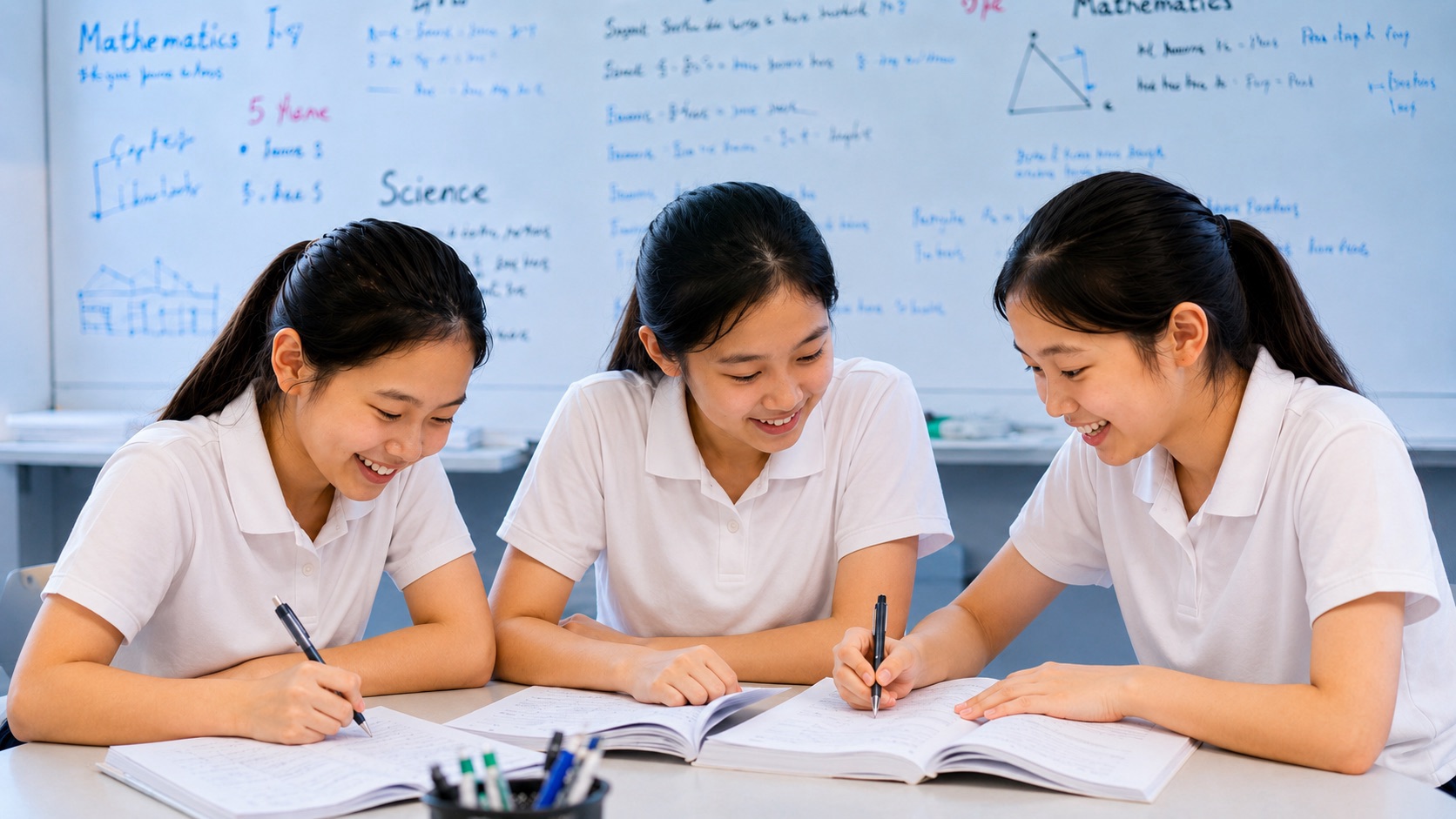
At eduKate Singapore, our Punggol Secondary 1 Maths tuition is conducted in true three-student small groups. This gives the tutor enough space to observe how each student thinks, correct misunderstandings early and adjust the level of explanation and practice.
The intention is not to give students an overwhelming quantity of worksheets.
It is to make sure that each important idea is properly understood.
Secondary 1 Mathematics Is a Continuation—and a Transformation
A Primary 6 student may already know how to work with fractions, solve ratio questions, calculate percentages and interpret word problems.
These abilities do not disappear in Secondary 1.
They become the foundation for more formal mathematical thinking.
A primary-school percentage question may ask a student to calculate a discount. In Secondary 1, the student may need to compare percentage changes, work backwards using reverse percentages or explain the difference between a percentage change and a percentage point.
A primary-school ratio problem may be solved using models or units. In Secondary 1, that same proportional reasoning may be represented using equations.
A primary-school pattern may be extended by observation. In Secondary 1, the student may be asked to describe the general pattern using an algebraic expression.
The mathematical ideas continue.
The representation becomes more sophisticated.
This is why a good Secondary 1 Mathematics tutor should never dismiss the student’s primary-school methods. Those methods contain valuable thinking. The tutor’s role is to help the student see how familiar reasoning can be expressed more efficiently through algebra, notation, graphs and formal working.
The child is not abandoning the primary years.
The child is building upon them.
The Current Secondary-School Mathematics Landscape
Under Full Subject-Based Banding, students are posted to secondary schools through Posting Groups 1, 2 and 3 and may take different subjects at G1, G2 or G3 according to their strengths and readiness. The former Express, Normal (Academic) and Normal (Technical) streams have been phased out for Secondary 1 cohorts beginning from 2024. (Ministry of Education)
From 2027, students will sit for the Singapore-Cambridge Secondary Education Certificate, or SEC. Their certificate will reflect the subjects taken and the corresponding G1, G2 or G3 subject levels. At subject level, G3 continues to use grades such as A1 and A2, while G2 and G1 use their respective grading structures. (SEAB)
For parents, this means tuition should not be based on a broad label alone.
A Secondary 1 Mathematics tutor must understand:
- the student’s actual subject level;
- the syllabus being taught by the school;
- the pace and difficulty of the school’s assessments;
- the student’s present mathematical foundation;
- whether the student needs repair, support or extension;
- whether movement to a more demanding subject level may eventually be appropriate.
Two students in Secondary 1 may require very different lessons even when they are the same age.
One may need to rebuild arithmetic fluency.
Another may understand concepts but lose marks through poor working.
A third may be ready for deeper algebra and more demanding problem-solving.
Good tuition begins by identifying the student in front of the tutor.
What Students Learn in Secondary 1 Mathematics
Within the current MOE G2 and G3 Mathematics syllabuses, Secondary 1 students encounter important areas such as numbers and operations, ratio and proportion, percentages, rate and speed, algebraic expressions and formulae, functions and graphs, equations, angles, polygons, mensuration and data analysis.
The exact order may differ from school to school, but the central development is clear.
Secondary 1 Mathematics begins joining previously separate ideas into a connected mathematical system.
Numbers and Operations
Students work with:
- primes and prime factorisation;
- highest common factor and lowest common multiple;
- squares, cubes, square roots and cube roots;
- negative numbers;
- integers, rational numbers and real numbers;
- approximation and estimation;
- significant figures and decimal places;
- calculator use.
These topics can appear elementary at first.
However, weaknesses here can affect almost every later chapter. A student who is uncertain with negative numbers will struggle when simplifying expressions, solving equations, interpreting graphs and working with coordinates.
The early chapters should therefore be taken seriously.
They are not merely revision.
They are the operating system for later Mathematics.
Ratio, Percentage, Rate and Speed
These topics continue directly from primary school, but the questions become more formal and less predictable.
Students may be asked to:
- simplify ratios involving rational numbers;
- solve multi-step ratio problems;
- work with percentages greater than 100%;
- calculate reverse percentages;
- compare percentage changes;
- convert units of speed;
- distinguish between constant speed and average speed;
- combine rate, time and quantity relationships.
A student who previously relied on one familiar template must now learn to identify the relationship hidden within the question.
The aim is not to remember one method for every question.
The aim is to recognise the mathematical structure.
Algebraic Expressions and Formulae
Algebra is the most visible change in Secondary 1 Mathematics.
Students begin using letters to represent numbers and quantities. They learn how to interpret notation, substitute values, simplify expressions, expand brackets, extract common factors and translate real situations into algebraic form.
This is where many capable students become uncertain.
They may understand the arithmetic but feel uncomfortable when the numbers are replaced by letters.
The problem is often not intelligence.
It is language.
Algebra has its own grammar.
For example:
- (3y) means three groups of (y);
- (a^2) means (a \times a);
- (3(x+y)) means the entire expression inside the brackets is multiplied by three;
- like terms can be combined;
- unlike terms cannot be combined merely because they appear together.
Once these conventions are understood, algebra becomes much less mysterious.
The tutor should explain what each symbol means, why each operation is permitted and how one line of working follows logically from the previous line.
Equations and Inequalities
An expression describes a quantity.
An equation states that two expressions are equal.
That distinction sounds simple, but it is essential.
Students learn to solve linear equations, including equations involving fractions, and formulate equations from word problems.
A student who only memorises “move this to the other side and change the sign” may obtain answers for simple questions but become lost when the equation changes form.
A stronger student understands balance.
The same operation must be applied appropriately so that equality is preserved.
This understanding supports future work in simultaneous equations, functions, coordinate geometry, algebraic fractions and Additional Mathematics.
Functions and Graphs
Students begin connecting algebra with visual representation.
They learn about:
- Cartesian coordinates;
- ordered pairs;
- relationships between variables;
- linear functions;
- graphs in the form (y=ax+b);
- positive and negative gradients.
This is an important moment in a student’s mathematical development.
An equation is no longer only something to solve.
It can describe a relationship.
That relationship can be displayed as a table, expressed as a formula and seen as a graph.
The student begins to understand that Mathematics has multiple representations—and that these representations describe the same underlying idea.
Geometry and Mensuration
Secondary 1 geometry includes more precise reasoning about:
- acute, obtuse, reflex and right angles;
- vertically opposite angles;
- angles on a straight line and at a point;
- angles formed by parallel lines and transversals;
- properties of triangles and quadrilaterals;
- interior and exterior angles of polygons;
- area and perimeter;
- surface area and volume;
- composite figures and solids.
Students must learn to identify relevant properties rather than rely only on visual appearance.
A diagram is not merely a picture.
It is a mathematical object containing information that must be interpreted carefully.
Data Handling and Analysis
Students work with tables, bar graphs, pictograms, line graphs and pie charts.
More importantly, they begin considering whether a statistical representation is appropriate or potentially misleading.
This moves the student beyond reading information.
The student must evaluate how information has been presented.
That is a valuable skill not only for examinations, but also for understanding the data-rich world around them.
Why Students Who Did Well in Primary School Can Still Struggle
A fall in Secondary 1 Mathematics results does not necessarily mean the child has suddenly become weak.
Often, the demands have changed faster than the student’s habits.
The Pace Is Faster
Secondary-school teachers have a substantial syllabus to cover. A chapter may be taught, practised and assessed within a relatively short period.
Students who do not understand an early lesson may discover that the class has already moved on.
The Work Is More Abstract
Primary Mathematics often provides concrete quantities and familiar situations.
Secondary Mathematics increasingly uses symbols, general rules and relationships.
Some students require time and careful explanation before they become comfortable with this abstraction.
Topics Are More Connected
Weaknesses no longer remain neatly contained within one chapter.
Poor fraction skills can affect algebra.
Weak algebra can affect equations.
Weak equations can affect graphs.
Weak number sense can affect almost everything.
One small gap can quietly travel through the syllabus.
Students Receive Less Hand-Holding
Secondary 1 students are expected to manage timetables, homework, files, online platforms, CCAs and several subject teachers.
A child who was closely guided in primary school may need time to develop greater independence.
School Tests May Feel Unfamiliar
The student may know the individual skills but struggle when questions are presented in unfamiliar forms.
Instead of asking directly for a calculation, the question may require the student to decide:
- what information matters;
- which concept applies;
- how to represent the problem;
- what sequence of steps is required;
- whether the final answer is reasonable.
This is why marks sometimes fall before parents see an obvious conceptual problem.
The student may know more than the result suggests, but the knowledge is not yet organised for examination use.
The Hidden Primary-School Gaps That Algebra Exposes
Secondary 1 Mathematics often reveals weaknesses that were present before the student entered secondary school.
These may include:
- uncertain multiplication and division facts;
- weak fraction operations;
- confusion between ratio and fraction;
- careless handling of negative numbers;
- difficulty converting units;
- weak estimation;
- poor understanding of order of operations;
- incomplete working;
- overdependence on model drawing;
- inability to explain why a method works.
A student may have survived these weaknesses through familiarity, repeated practice or examination techniques during the PSLE years.
Once algebra is introduced, the weaknesses become harder to hide.
For example, simplifying an algebraic fraction requires more than knowing algebra. It also depends on a secure understanding of factors, multiplication, division and equivalence.
Good Secondary 1 Maths tuition therefore does not begin by pushing ahead blindly.
It begins by finding the earliest weak link.
Once that link is strengthened, progress often becomes smoother because several later difficulties are repaired at the same time.
From Model Drawing to Algebra
One of the most useful bridges between primary and secondary Mathematics is the movement from model drawing to algebra.
Model drawing is not a childish method that must be discarded.
It trains students to see relationships between quantities.
Algebra expresses those relationships in a more general and compact form.
Consider a simple relationship:
Ali has three times as many cards as Ben.
A primary-school student may draw three units for Ali and one unit for Ben.
A secondary-school student may write:
[
A=3B
]
Both representations describe the same relationship.
The difference is that algebra can be used efficiently even when the quantities, conditions and relationships become much more complicated.
A thoughtful Secondary 1 Mathematics tutor helps the student see this connection.
Instead of announcing that the old method is wrong, the tutor shows how the earlier reasoning grows into the new method.
This preserves confidence while developing sophistication.
What Good Secondary 1 Maths Tuition Should Do
Tuition should provide more than additional exposure to questions.
It should improve the quality of the student’s thinking.
1. Diagnose Before Teaching
The tutor should first determine what the student understands.
This may involve checking:
- arithmetic fluency;
- fractions and decimals;
- ratio and percentage;
- negative numbers;
- algebraic notation;
- equation-solving;
- mathematical vocabulary;
- organisation of working;
- response to unfamiliar questions.
The objective is not to label the child.
It is to locate the most useful starting point.
2. Explain Concepts Clearly
Students should know why a method works.
Clear explanation reduces the amount of material that must be memorised because ideas begin connecting naturally.
When a student understands equivalence, balance and inverse operations, equation-solving becomes more logical.
When a student understands factors and distributive structure, expansion and factorisation become related rather than separate procedures.
3. Use Carefully Chosen Worked Examples
Effective algebra instruction includes examining solved examples, recognising the structure of algebraic representations and learning to choose suitable strategies rather than following one procedure mechanically. (Institute of Education Sciences)
A good worked example should reveal the thinking behind each step.
The tutor may ask:
- What changed from this line to the next?
- Why is this operation allowed?
- Which terms are alike?
- What would happen if the sign changed?
- Is there another valid method?
- How can we check the answer?
The student is not simply copying a solution.
The student is learning how solutions are built.
4. Move From Guidance to Independence
At the beginning of a topic, the tutor may model the process closely.
The student then completes partially guided questions.
Gradually, the support is reduced until the student can solve the question independently.
This matters because understanding a tutor’s explanation is not the same as being able to reproduce the reasoning alone during a test.
5. Correct Errors Properly
A wrong answer is useful when the cause is identified.
The error may come from:
- a conceptual misunderstanding;
- an arithmetic slip;
- a sign error;
- incorrect notation;
- misreading the question;
- poor method selection;
- incomplete working;
- failure to check the final result.
Simply replacing the wrong answer with the correct one does not prevent the mistake from returning.
The student must understand where the solution moved away from the correct path.
6. Build Examination Control
Students need to learn how to work accurately under time pressure.
This includes:
- reading questions carefully;
- identifying command words;
- selecting an efficient method;
- showing sufficient working;
- using the calculator responsibly;
- estimating before calculating;
- checking signs and units;
- reviewing answers intelligently.
Examination technique should sit on top of understanding.
It should not be used to cover the absence of understanding.
Why Three-Student Small Groups Work Well for Secondary 1 Mathematics
In a class of three students, the tutor can see much more than the final answer.
The tutor can observe:
- how the student begins;
- where hesitation appears;
- whether the student understands the notation;
- whether a method was selected deliberately;
- whether careless errors follow a pattern;
- whether the student can explain the solution;
- whether the student is ready for greater difficulty.
Research reviews on small-group tuition suggest that smaller groups can allow closer matching of work to individual needs, more sustained engagement and more frequent feedback. (EEF)
For Mathematics, this responsiveness is particularly valuable.
One student may need the concept explained with a diagram.
Another may need more algebraic practice.
A third may understand the chapter but require harder questions and better examination discipline.
A three-student class preserves the energy and discussion of a group while keeping the lesson personal.
Students can hear alternative methods, compare reasoning and learn from one another’s questions.
At the same time, it is difficult for a confused student to disappear quietly into the class.
How We Continue From the Primary Years
Our Punggol Secondary 1 Maths tuition begins with continuity.
We identify the primary-school knowledge that remains useful and show students how it develops.
Fractions Become Algebraic Structure
The rules of fractions continue to matter when students meet fractional equations and algebraic fractions.
Ratio Becomes Proportional Reasoning
The unit method and comparison skills developed in primary school support rates, speed, scale, similarity and later mathematical modelling.
Percentage Becomes Change
Students move from direct percentage calculations to percentage comparison, reverse percentages and more complex financial applications.
Models Become Equations
Visual relationships are gradually translated into symbolic relationships.
Patterns Become General Rules
Instead of extending a sequence only by observation, students learn to express the (n)th term.
Word Problems Become Mathematical Models
Students learn to convert a written situation into expressions, equations, diagrams, tables or graphs.
The student’s earlier knowledge is not thrown away.
It is refined, connected and made more powerful.
A Secondary 1 Mathematics Programme Should Change Across the Year
A student’s needs in January are not identical to the student’s needs near the year-end examinations.
Early Secondary 1: Settling the Transition
The early months should focus on:
- adjusting to secondary-school pace;
- checking primary-school foundations;
- learning correct notation;
- becoming comfortable with negative numbers;
- beginning algebra carefully;
- establishing organised working;
- developing a weekly revision routine.
This is the best period to prevent small uncertainties from becoming larger gaps.
Middle of the Year: Connecting the Topics
By the middle of the year, students should begin seeing how chapters relate.
The focus turns towards:
- stronger algebraic manipulation;
- equation-solving;
- functions and graphs;
- geometry reasoning;
- multi-step applications;
- mixed-topic practice;
- greater independence.
Students who only revise one isolated chapter at a time may struggle when school assessments combine skills.
Mixed practice helps them decide which method is needed.
Later Secondary 1: Consolidation and Examination Readiness
As year-end assessments approach, students need:
- cumulative revision;
- school-paper practice;
- correction of recurring errors;
- improved speed;
- better checking routines;
- confidence with unfamiliar questions;
- preparation for Secondary 2.
The objective is not merely to finish the year.
It is to enter Secondary 2 with a stable mathematical base.
Different Students Need Different Kinds of Support
The Strong Primary-School Student Who Suddenly Drops
This student may have excellent arithmetic and problem-solving ability but feel unsettled by algebraic notation or the speed of secondary school.
The tutor should protect the student’s confidence while teaching the new mathematical language carefully.
The fall in marks is often temporary when the transition is addressed early.
The Average Student Who Works Hard
This student may complete substantial practice but improve slowly because the practice is not targeted.
The tutor should identify the few weaknesses producing the largest number of errors.
Better selection and correction of questions may be more valuable than simply increasing volume.
The Student Who Says, “I Am Bad at Maths”
This statement often reflects repeated frustration rather than permanent inability.
The student needs manageable steps, visible progress and proof that difficult ideas can be understood.
Confidence should be rebuilt through genuine competence—not empty reassurance.
The Student Who Is Already Ahead
A strong student does not necessarily need to race through several future textbooks.
The student may benefit more from:
- deeper reasoning;
- non-routine questions;
- multiple solution methods;
- precise mathematical communication;
- stronger accuracy;
- richer connections between topics.
Acceleration is useful only when the underlying understanding remains secure.
Signs That a Secondary 1 Student May Need Maths Tuition
Parents may consider additional support when they notice:
- a sharp fall from Primary 6 results;
- growing fear of algebra;
- repeated mistakes with negative numbers;
- incomplete or untidy working;
- difficulty following school lessons;
- dependence on answer keys;
- excessive time spent on homework;
- avoidance of Mathematics;
- inability to explain completed solutions;
- weak test performance despite substantial revision;
- strong daily work but poor examination results;
- confusion that continues from one chapter into the next.
Marks are important, but they are not the only signal.
A student may still be scoring reasonably while confidence, understanding or organisation is beginning to weaken.
Early support is often gentler than emergency repair after several chapters have accumulated.
When Should Secondary 1 Maths Tuition Begin?
There is no single date that suits every child.
Some students benefit from beginning before Secondary 1 so that the primary-to-secondary bridge can be introduced calmly.
Others begin during the first term when they see how their school teaches and assesses Mathematics.
Some students require support only after the first common test reveals a difficulty.
The important principle is not to wait for complete collapse.
Tuition is most efficient when the tutor can correct the route while the student is still moving forward.
It becomes more demanding when the student must learn the current chapter while simultaneously repairing several earlier chapters.
A useful time to begin is when parents first observe a persistent pattern rather than a single disappointing mark.
What Parents Can Do at Home
Parents do not need to reteach the syllabus.
A calm home structure is often more valuable.
Ask the Student to Explain
Instead of asking only, “Did you get the answer?”, ask:
- How did you know which method to use?
- Why does this step work?
- How could you check the answer?
- Which part was difficult?
Explaining reveals understanding.
Protect a Regular Revision Time
Short, consistent Mathematics practice is generally more sustainable than a large last-minute session before a test.
Keep Corrected Work
Corrections should not disappear once they are completed.
Recurring errors show parents and tutors where attention is needed.
Watch the Trend
One low mark may come from illness, adjustment or an unusually difficult paper.
A repeated pattern deserves closer attention.
Avoid Turning Every Mistake Into a Crisis
Secondary 1 is a year of change.
Students need correction, but they also need room to adapt.
Calm, timely intervention usually produces better learning than fear.
Choosing a Secondary 1 Maths Tutor in Punggol
A good Punggol Maths tutor should offer more than convenience.
Parents should look for a tutor who can:
- teach the relevant G1, G2 or G3 syllabus;
- understand the transition from PSLE Mathematics;
- diagnose foundational gaps;
- explain algebra clearly;
- teach proper mathematical notation;
- adjust the lesson to the student’s school progress;
- provide suitable levels of practice;
- analyse errors;
- prepare students for assessments;
- communicate meaningful progress to parents;
- build both understanding and independence.
The child should not leave tuition knowing only how to complete that day’s worksheet.
The child should leave with a clearer mind.
Frequently Asked Questions About Secondary 1 Maths Tuition in Punggol
Is Secondary 1 Mathematics much harder than Primary 6 Mathematics?
It is different rather than simply harder.
The subject becomes more abstract, formal and connected. Students encounter more algebra, notation, graphs and structured working. Those who adapt their learning habits usually become more comfortable with time.
Is Secondary 1 Mathematics mainly algebra?
Algebra is a major development, but students also study numbers, ratios, percentages, rates, speed, geometry, mensuration, graphs and data handling.
Algebra becomes important because it begins connecting many of these areas.
Can a student do well without tuition?
Yes. Some students adapt successfully through school lessons and independent practice.
Tuition becomes useful when the student needs clearer explanation, closer correction, structured practice, foundation repair or a more suitable pace.
Should tuition teach ahead of school?
Teaching ahead can be helpful when the student’s foundation is secure.
However, moving ahead should not replace the repair of misunderstandings. A student who has seen a chapter early but does not understand it has not gained a meaningful advantage.
My child scored well for PSLE Mathematics. Why are the Secondary 1 results lower?
Possible reasons include algebraic unfamiliarity, faster school pace, weaker organisation, more demanding test questions or hidden foundation gaps.
The student may need a period of adjustment rather than a complete restart.
How much homework should a Secondary 1 student do?
The amount depends on the student.
Homework should be sufficient to consolidate the lesson and reveal whether the student can work independently. Excessive repetition is not automatically better, particularly when mistakes are being repeated without correction.
Is three-student tuition suitable for a shy child?
It can be particularly suitable.
The group is small enough for the tutor to notice hesitation and invite the student into the discussion without the pressure of speaking before a large class.
Does Secondary 1 Mathematics affect future Additional Mathematics?
Yes.
The algebra, equations, functions, graphs and mathematical working developed in lower secondary form an important foundation for Additional Mathematics.
Students do not need to decide their entire future in Secondary 1, but building the foundation keeps more options open.
Can tuition help a student move to a more demanding subject level?
Tuition can help strengthen the knowledge, performance and confidence needed for progression, but subject-level movement is determined by the student’s school according to its criteria and the student’s readiness.
The first objective should be genuine mastery at the present level.
What is the main goal of Secondary 1 Maths tuition?
The immediate goal may be better school performance.
The deeper goal is to help the student become a more capable and independent mathematical thinker—someone who understands concepts, selects methods carefully, works accurately and can recover when a question is unfamiliar.
Continuing the Journey Well
Secondary 1 is not the year to forget everything that came before.
It is the year to take the child’s primary-school knowledge and give it a stronger form.
Arithmetic becomes algebra.
Visual models become equations.
Patterns become functions.
Diagrams become evidence.
Answers become reasoned solutions.
This development should feel challenging.
But it should also feel possible.
With careful teaching, suitable practice and timely correction, students can move into secondary Mathematics without losing the confidence they built during their primary years.
At eduKate Singapore, our Punggol Secondary 1 Maths tuition supports this transition through true three-student small-group lessons, clear explanation, targeted foundation repair and progressive preparation for school assessments.
We help students understand where their earlier knowledge fits, what the new syllabus requires and how to move forward with greater precision.
Because Secondary 1 is not only the beginning of secondary school.
It is the beginning of the mathematical foundation that will support everything that follows.
Book a Consultation for Punggol Secondary 1 Maths Tuition
For enquiries about our three-student Secondary 1 Mathematics tuition classes in Punggol:
Call or WhatsApp: +65 8823 1234
Email: admin@edukatesg.com
Lessons: By appointment only