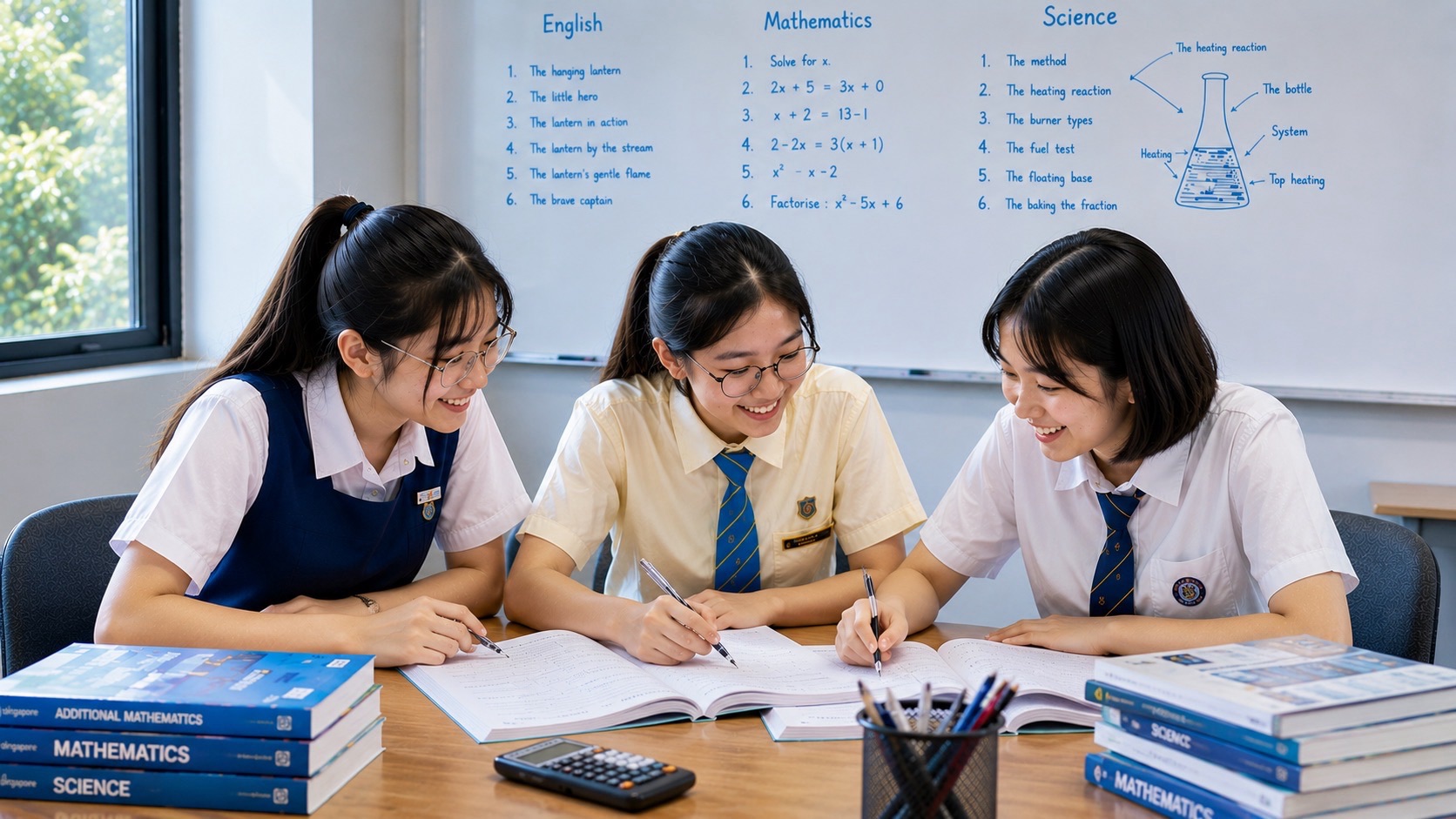
Secondary 1 English is not simply Primary 6 English with longer passages. One of the important changes is that students are increasingly expected to ask not only what does this text say? but also why was it written this way, for whom, and to what effect?
This article now owns that Primary-to-Secondary transition in reading. It is not the current commercial Punggol tuition page. For programme information, use the Punggol English tuition estate; this page remains an eduKateSingapore learning guide.
The reader’s job changes after Primary 6
Primary comprehension already includes inference and vocabulary in context, so Secondary 1 does not begin from zero. The change is one of resolution. Texts can carry more layered purposes. A writer may inform while persuading, entertain while criticising, or appear neutral while selecting details that guide the reader.
The student therefore needs a richer model of reading: content + purpose + audience + language choice + effect.
Purpose is not a label to guess
Students sometimes memorise four verbs—instruct, inform, persuade, entertain—and choose one by instinct. A stronger answer treats purpose as a claim that must be supported. What does the writer want the reader to know, believe, feel or do? Which features of the text support that interpretation?
If a charity advertisement uses a direct appeal, emotive photographs, urgent statistics and a donation link, those features are evidence for persuasive purpose. Purpose becomes something the student can prove.
Audience changes what counts as appropriate English
The same idea will not be expressed identically to a close friend, a school leader and a public audience. Secondary 1 is a useful year to make that difference explicit. Register, vocabulary, sentence structure, detail and tone are choices made for a receiver.
This insight connects reading and writing. In reading, the student asks why the writer made those choices for that audience. In writing, the student must make equivalent choices deliberately.
Tone comes from patterns, not one magic word
A text may feel sarcastic, hopeful, critical, concerned or enthusiastic. Students should resist choosing a tone label first and searching backward for proof. Instead, notice repeated wording, punctuation, sentence rhythm, imagery, contrast and selection of detail. The tone label should summarise the evidence.
Reading visually is part of reading
Modern English texts can combine words, layout, images, captions, typography and sequencing. A student who reads only the paragraph may miss part of the message. Ask what the visual foregrounds, what information is made easy to notice and how image and language reinforce or complicate one another.
Evidence must move from quotation to explanation
At this stage, copying evidence is no longer enough for many analytical tasks. The student needs a three-part move: identify the feature or evidence, explain what it suggests, then connect that meaning to purpose, character, audience or effect.
This is the beginning of analytical writing. The evidence is not decoration after the answer; it is the reason the answer is defensible.
Secondary writing asks for a clearer reader model
Students often write what they want to say without modelling what the reader needs. A stronger writer asks: What does my reader already know? What needs explanation? What tone is appropriate? What order will make the idea easiest to follow?
That is why audience awareness is not only an examination trick. It is a general communication skill.
The SEC pathway is now explicit
From the 2027 Singapore-Cambridge Secondary Education Certificate framework, English Language appears at G1 K100, G2 K200 and G3 K300. Those subject levels differ in assessment demands, but the underlying learning principle remains: the student needs to understand text, communicate meaning and control language for the task.
This page does not collapse G1, G2 and G3 into one examination description. Its job is earlier: build the reading-for-purpose habit that can travel into the student’s actual English route.
Diagnose the earliest reading failure
- Can the student explain the literal content?
- Can the student identify who the text addresses?
- Can the student state a plausible purpose?
- Can the student point to language or visual evidence?
- Can the student explain what that evidence does?
- Can the student distinguish their own opinion from the writer’s position?
If literal meaning is unstable, higher analysis will float. If literal meaning is secure but explanation is weak, more basic comprehension worksheets may not target the real gap.
A practical Secondary 1 reading routine
- Summarise the text in one or two sentences.
- Name the likely audience.
- State the writer’s immediate purpose.
- Underline one language choice and one structural or visual choice.
- Explain how each choice affects meaning.
- Identify one alternative interpretation and test it against the evidence.
Transfer matters more than memorised labels
Use a news report, advertisement, school notice, opinion piece, personal recount and informational webpage. The surface changes, but the questions remain: what is this text doing, for whom, and how do we know?
If the student can carry that routine across genres, Secondary English begins to feel like one coherent subject rather than a set of unrelated worksheets.
Current Punggol tuition information
This eduKateSingapore URL now serves a Secondary 1 reading-transition job. For current classes, start at English Tuition at eduKatePunggol or the Secondary 1 English Tuition Punggol owner.
The Secondary 1 shift is complete when a student stops seeing a text as words followed by questions and starts seeing it as a deliberate act of communication.