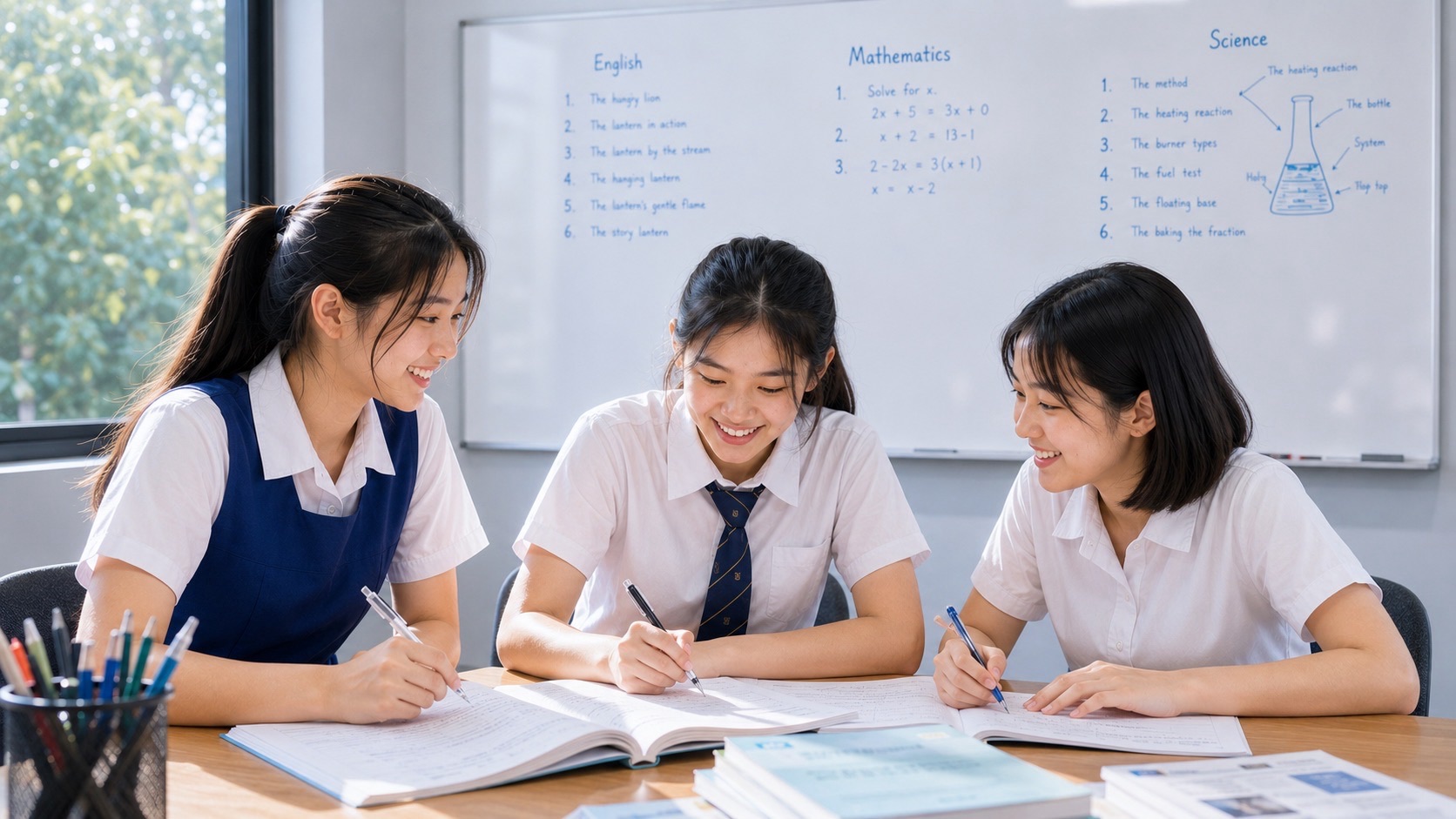
Canossa Catholic Primary English tuition should help a child recognise that different texts ask the reader to do different kinds of thinking.
A narrative invites the learner to track character, motive, conflict, sequence and change. An informational text asks the learner to follow ideas, evidence, explanation, classification, comparison or cause-and-effect. A student who uses one reading method for everything may appear “inconsistent” when the deeper problem is genre recognition.
This rebuilt page therefore owns a distinct RFE: narrative ↔ informational reading transfer. Broad Canossa Catholic Primary School English tuition already exists elsewhere in the eduKateSingapore estate. Here, the focus is helping students identify text purpose, choose an appropriate reading strategy and transfer comprehension skills across genres.
eduKate teaches in groups of up to three students, generally for 90 minutes. Small groups are useful because students can compare how the same question type behaves differently when the underlying text structure changes.
Independent-provider note: eduKate is not affiliated with Canossa Catholic Primary School. The school name identifies the learner/family route served by this guide. Current class location and availability should be confirmed during consultation.
Narrative and Informational Reading Are Related—But Not Identical
| Narrative text | Informational text |
|---|---|
| Who wants what? | What idea or process is being explained? |
| What changed? | How is information organised? |
| Why did the character act? | What evidence or example supports the point? |
| What is the conflict? | What is the cause, effect, category or comparison? |
| How does tone reveal emotion? | How do headings, definitions and transitions guide meaning? |
| What does the ending resolve? | What conclusion or key idea should the reader retain? |
Students need a flexible reading system that can switch emphasis without losing core habits such as evidence and vocabulary reasoning.
The 2026 Primary English Context
MOE’s Primary English Language Syllabus 2020 develops English through oracy, reading and writing and recognises a wide range of texts and multiliteracies. Learners need to make meaning across different purposes and representations.
For the 2026 PSLE, English Language continues to include Language Use and Comprehension alongside Writing, Listening Comprehension and Oral Communication. Parents can verify the current examination format on the SEAB PSLE Formats Examined in 2026 page.
This variety makes genre flexibility valuable well before Primary 6.
The Core Reading Habits That Survive Both Genres
Some habits are universal:
- read the question accurately;
- identify relevant evidence;
- track pronouns and reference;
- infer from context;
- understand vocabulary;
- separate what is stated from what is concluded;
- express the answer clearly.
These are the invariant skills. Genre changes how they are applied.
Narrative Reading: Track the Human System
Character Goal
What does the character want or fear?
Cause and Effect
Which event changes what can happen next?
Motive
Why does the character choose this action?
Tone and Emotion
What do dialogue, behaviour and word choice suggest?
Turning Point
Where does the direction of the story change?
Resolution
What has been solved, learned or changed?
Students learn to read narrative as a dynamic model rather than a sequence of isolated facts.
Informational Reading: Track the Idea System
Main Idea
What is this section mainly explaining?
Structure
Is the writer using cause/effect, comparison, sequence, problem/solution, classification or description?
Evidence and Example
Which facts or examples support the claim?
Definitions
Which terms must be understood for the passage to make sense?
Transitions
Words such as however, therefore, for example, in contrast and as a result reveal relationships.
Conclusion
What should the reader understand after the explanation?
Why Students Over-Transfer the Wrong Method
A student comfortable with stories may search an informational passage for characters and events instead of argument structure. A student trained heavily on factual texts may treat a narrative inference as if the answer must be explicitly stated.
We therefore teach a first question:
What kind of text is this, and what does that suggest I should pay attention to?
This does not replace close reading. It gives the learner a useful prior.
Vocabulary Across Genres
Narrative vocabulary often includes emotion, action, dialogue and sensory detail. Informational vocabulary may be more abstract and relational.
Students need both:
- character and emotion language;
- process and sequence language;
- cause/effect vocabulary;
- comparison language;
- evidence and explanation terms;
- domain vocabulary from common topics.
We teach contextual inference so unknown words do not automatically stop the entire passage.
Paragraph Structure Across Genres
Narrative paragraphs often move through event, reaction and consequence. Informational paragraphs often move through point, explanation and example.
Students learn to ask what job each paragraph performs.
This improves comprehension and later writing because the child begins to recognise structure as transferable.
How Narrative Reading Improves Composition
Students learn to observe:
- how motives are shown;
- how tension is built;
- how dialogue reveals character;
- how settings affect action;
- how endings return to earlier events.
These become writing resources rather than memorised phrases.
How Informational Reading Improves Explanation
Informational texts teach students to:
- define terms;
- organise cause and effect;
- compare alternatives;
- support points with examples;
- compress information;
- distinguish main idea from detail.
Those habits support comprehension answers, oral responses and later academic writing.
The Canossa Reading Diagnostic
Genre Recognition
Can the learner identify what kind of text is being read?
Structure Detection
Can the student see event structure or idea structure?
Vocabulary
Can the learner infer meaning from context?
Evidence
Can relevant support be located?
Inference
Can the child infer appropriately without demanding everything be stated?
Answer Expression
Can the response preserve the right level of detail?
Transfer
Can the learner switch methods when the genre changes?
Six Common Genre-Transfer Failures
1. Story Bias
The child expects every passage to operate like a narrative. We teach informational structure.
2. Fact Bias
The learner expects every answer to be explicitly stated and struggles with motive or tone. We strengthen inference.
3. Heading Blindness
Informational headings are ignored. We teach layout as structure.
4. Main-Idea Drift
The learner remembers interesting details but misses the central explanation.
5. Vocabulary Lock
Unknown domain words stop reading. We use context and morphology.
6. One-Method Dependence
The child performs only when a familiar question type appears in a familiar genre. We mix surfaces deliberately.
What a 90-Minute 3-Pax Lesson Can Look Like
0–10 minutes: Retrieval
Students recall a narrative and an informational structure signal.
10–25 minutes: Compare Two Texts
The class reads short examples and identifies how the reading job changes.
25–45 minutes: Explicit Teaching
The tutor models structure detection, evidence or inference.
45–65 minutes: Guided Comprehension
Students answer while explaining which genre cues guided them.
65–80 minutes: Genre Switch
A fresh text of the other genre tests method flexibility.
80–90 minutes: Error Close
Students identify where they applied the wrong reading assumption.
Why Three Students Helps Genre Reading
Different students often notice different structures.
- One sees a character motive.
- Another sees a cause/effect connector.
- A third identifies the main idea.
The group discussion makes those structures visible while each learner still has to answer independently.
Primary 1–2: Build Text Variety Early
Young learners should encounter stories, simple informational texts, instructions, labels and visual texts so “reading” does not become synonymous with one genre.
Primary 3–4: Make Structure Explicit
Students learn common narrative and informational relationships and begin explaining how they know.
Primary 5–6: Build Flexible Transfer Under Time
Upper-Primary learners need to identify genre and structure quickly enough to support PSLE Paper 2 without overthinking.
Genre Reading and PSLE
PSLE English exposes students to varied text and question surfaces. We therefore use practice to ask whether the learner can:
- identify purpose;
- detect structure;
- interpret vocabulary;
- select evidence;
- infer appropriately;
- compress answers;
- switch methods without tutor labels.
Three Learner Routes
Repair
For learners whose vocabulary or basic comprehension prevents genre recognition from being useful. We repair the foundation first.
Stabilise
For students who understand one genre better than another. We deliberately alternate text types and compare structures.
Extend
For strong readers. We use mixed genres, hybrid texts, ambiguous purposes and more subtle evidence relationships.
What Parents Can Bring
- recent comprehension papers;
- examples of strong and weak passage types;
- teacher comments;
- reading interests;
- visual/informational text work;
- assessment dates;
- independent reading samples where available.
We look for whether performance changes by genre rather than assuming a general comprehension weakness.
What Progress Looks Like
- the learner identifies text purpose more quickly;
- narrative inference becomes stronger;
- informational main ideas become clearer;
- headings and transitions are used as structure signals;
- unknown vocabulary causes less disruption;
- answers use more appropriate evidence;
- the student switches reading strategy independently;
- writing benefits from both narrative and explanatory structures.
Frequently Asked Questions
Is eduKate affiliated with Canossa Catholic Primary School?
No. eduKate is an independent tuition provider.
Why does this page focus on narrative and informational reading?
Because broad school-specific tuition pages already exist. This URL owns genre-flexible comprehension.
Should children use different comprehension techniques for every genre?
The core habits remain—question reading, evidence, vocabulary and clear answers—but attention shifts according to text structure and purpose.
What if my child reads fiction but avoids non-fiction?
We can introduce informational reading through topics the child already finds interesting, then explicitly teach structure and vocabulary.
Can informational reading improve composition?
Yes. It adds world knowledge, explanation structures and precise vocabulary.
Can narrative reading improve comprehension?
Yes. It strengthens motive, tone, cause/effect and inference.
How do you teach text structure?
Through signals such as headings, sequence, transitions, paragraph jobs, character goals and cause/effect relationships.
Can strong readers be extended?
Yes. We use hybrid texts, subtle viewpoints and less obvious structure.
Ten Checks for Genre-Flexible English Tuition
- Does the learner identify text type and purpose?
- Can narrative structure be tracked?
- Can informational structure be tracked?
- Is vocabulary inferred contextually?
- Is evidence selected appropriately?
- Does inference remain text-bound?
- Are headings and transitions used?
- Can the student switch methods?
- Does reading transfer into writing?
- Does tutor labelling decrease?
Read the Structure Beneath the Surface
A flexible reader does not approach every passage with the same assumptions.
That is the purpose of this Canossa Catholic Primary English tuition route:
identify genre → detect structure → read evidence → infer → answer → switch → transfer.
Families may also explore eduKate’s Primary English Small Group Tuition pathway. This page remains the narrative/informational transfer owner.
Almost-Code Summary
LEARNER_ROUTE = Canossa_Catholic_Primary
PAGE_RFE = narrative_informational_transfer
INVARIANTS = question + evidence + vocabulary + clear_answer
NARRATIVE = character + motive + event + tone
INFORMATIONAL = idea + structure + evidence + explanation
CLASS = max_3
LESSON = 90_minutes
STATE = repair | stabilise | extend
GOAL = genre_flexible_reader