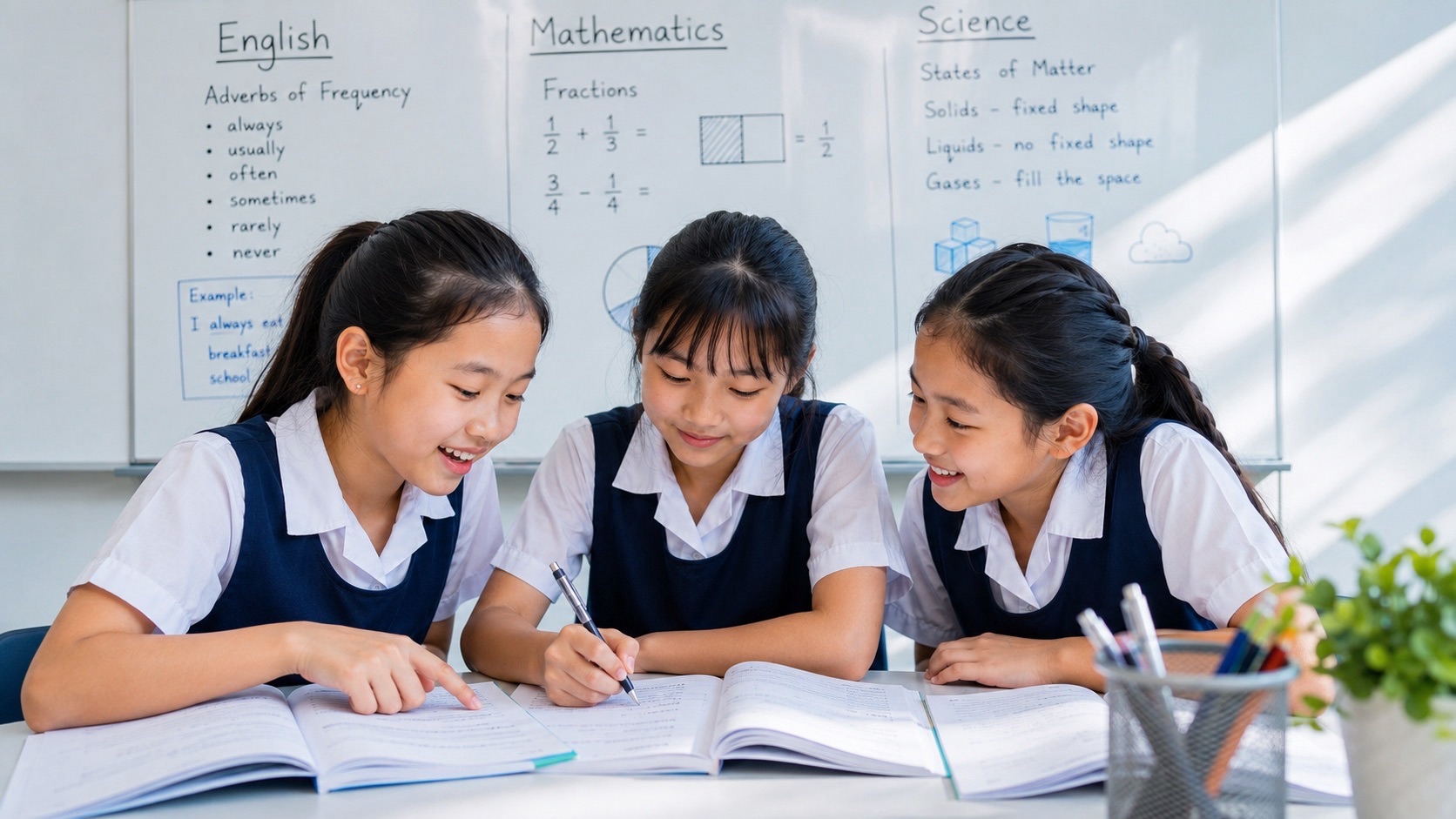
Naval Base Primary School Primary 2 English tuition should help a child turn spoken ideas into connected written language.
Primary 2 learners often know more than they can write. A child may tell a story clearly, explain what happened first and next, or describe a picture in detail—then produce short, repetitive or incomplete written sentences. The educational job is not simply to “make the child write more”. It is to preserve the meaning that already exists orally and improve the representation.
This rebuilt page therefore owns a distinct RFE: oral sequencing → connected sentence and early paragraph writing. Broad Naval Base Primary School English tuition is already served elsewhere in the eduKateSingapore estate. This URL now focuses on the P2 bridge from spoken language and vocabulary into increasingly independent writing.
eduKate teaches in groups of up to three students, generally for 90 minutes. At P2, the small group gives each learner repeated speaking and writing turns while keeping sentence-level difficulties visible.
Independent-provider and location note: eduKate is not affiliated with Naval Base Primary School. This legacy Yishun URL serves the family/learner route; current class location and availability should be confirmed directly.
The P2 Language Route
| Oral state | Written upgrade |
|---|---|
| Can name objects and actions | Build complete sentences |
| Can tell what happened first/next | Write clear sequence |
| Can explain why something happened | Use cause-and-effect language |
| Can describe feelings | Retrieve more precise vocabulary |
| Can tell a short story | Build connected sentence groups |
| Can revise when spoken to | Begin simple self-checking |
The goal is a child who increasingly writes what they mean without needing an adult to supply the wording.
The 2026 Primary English Floor
MOE’s Primary English Language Syllabus 2020 develops English through oracy, reading and writing, with grammar and vocabulary supporting meaning. The future 2026 PSLE assessment includes Writing, Language Use and Comprehension, Listening Comprehension and Oral Communication.
Parents can verify the current PSLE structure on the SEAB PSLE Formats Examined in 2026 page.
P2 tuition should not imitate P6. It should build the language foundations that later make higher-order English possible.
Oral Language Comes First More Often Than Parents Expect
Before a child can write a clear paragraph, the idea must often exist in spoken form.
We ask learners to:
- describe a picture;
- retell a short sequence;
- explain a choice;
- say what happened before and after;
- give a simple reason.
If the child cannot organise the idea orally, writing may become an additional burden rather than a useful test.
From Naming to Explaining
Early vocabulary often begins with nouns and simple verbs. P2 should increasingly add relationships.
We develop words for:
- where;
- when;
- how;
- why;
- emotion;
- sequence;
- cause;
- comparison.
These words help the learner build more informative sentences rather than simply longer ones.
Complete Sentences
Students learn to check:
- Who or what is the sentence about?
- What happened or what is being said?
- Is the thought complete?
- Does punctuation show where it ends?
We prioritise clear complete meaning before stylistic complexity.
Sentence Expansion
Once the basic sentence is secure, we can add information.
For example:
Base: The girl ran.
Expanded: The girl ran quickly towards the gate because she was late.
The expansion works because it adds manner, direction and cause. It does not simply add adjectives.
Sequence: First, Next, Then, Finally
Sequence language helps the learner turn oral retelling into written order.
We use:
- picture sequences;
- daily routines;
- short stories;
- instructions;
- cause-and-effect chains.
Students gradually move beyond repeated then by learning more natural transitions.
Cause and Effect
Primary 2 learners can begin expressing why something happened.
We use:
- because;
- so;
- therefore in simple contexts;
- as a result where developmentally appropriate.
The important idea is the relationship, not the sophistication of the connector.
Early Paragraphs
A P2 paragraph may simply be a few connected sentences about one event or idea.
We teach:
- one central idea;
- clear sequence;
- relevant detail;
- simple ending or consequence.
The learner should feel that several sentences can work together rather than existing as separate exercises.
Vocabulary Retrieval
We begin reducing list dependence.
Instead of always showing the target word, we may ask:
- What word means very tired?
- What verb describes looking quickly?
- What adjective fits someone who keeps trying?
Retrieval is the bridge between knowing and using.
Grammar as Meaning
At P2, useful grammar includes:
- basic tense;
- subject–verb agreement;
- pronouns;
- articles;
- prepositions;
- simple conjunctions;
- punctuation.
We teach grammar through sentences that mean something to the child, then retest it in original writing.
Reading Feeds Writing
Short texts provide examples of:
- sentence order;
- sequence;
- dialogue;
- descriptive words;
- cause and effect.
Students notice a pattern and produce a new example rather than copying the original sentence.
The Naval Base P2 Diagnostic
Oral Meaning
Can the child explain the idea aloud?
Vocabulary
Are useful words available?
Sentence Completeness
Can one complete thought be written?
Sequence
Can several events be ordered?
Grammar
Are basic relationships stable?
Connection
Can sentences work together?
Independence
Can the learner write without adult wording?
Six Common P2 Failure Modes
1. Adult Sentence Construction
The parent or tutor supplies most of the wording. We accept simpler student-owned language first.
2. Fragment Writing
The child records pieces of thought. We rebuild complete meaning.
3. Vocabulary Recognition Only
Words are familiar but unavailable in writing. We increase retrieval.
4. “Then” Repetition
Every sentence uses the same connector. We teach sequence relationships gradually.
5. Grammar Only in Worksheets
Rules disappear in original sentences. We move grammar into production.
6. Premature Composition Pressure
The child is asked for long stories before connected sentences are stable. We build the bridge in order.
What a 90-Minute 3-Pax P2 Lesson Can Look Like
0–10 minutes: Retrieval
Older vocabulary returns through oral prompts.
10–25 minutes: Reading and Talk
A short story or picture sequence supplies meaning.
25–40 minutes: Sentence Teaching
The tutor models one language relationship.
40–60 minutes: Guided Production
Students speak and write original sentences.
60–80 minutes: Connection
Several sentences become a short paragraph or sequence.
80–90 minutes: Self-Check
Students check completeness, punctuation and one personal grammar target.
Why Three Students Helps P2
- Students hear multiple oral sentences.
- Each learner gets repeated turns.
- Peer language provides models without adult takeover.
- The tutor can see who understands but cannot write.
- The class has enough social energy for young learners.
Preparing for P3
Useful end-P2 readiness includes:
- stable reading fluency;
- growing vocabulary;
- complete written sentences;
- basic sequence and cause;
- short connected writing;
- some self-correction;
- less adult wording.
This makes P3’s shift toward inference and academic reading more manageable.
What Parents Can Bring
- recent school English work;
- short writing samples;
- spelling/vocabulary lists;
- teacher comments;
- reading records;
- examples of independent vs assisted homework.
What Progress Looks Like
- spoken ideas appear more fully in writing;
- sentences are more complete;
- sequence is clearer;
- vocabulary is retrieved more often;
- basic grammar errors decrease;
- several sentences connect around one event;
- adult prompting decreases.
Frequently Asked Questions
Is eduKate affiliated with Naval Base Primary School?
No. eduKate is an independent tuition provider.
Why focus on oral-to-written transfer?
Because P2 learners often have richer spoken language than written output. This page owns that developmental bridge.
Should P2 students write long compositions?
Only when their sentence and sequence systems are ready. Developmentally appropriate connected writing matters more than length.
Can strong P2 learners be extended?
Yes. We increase vocabulary precision, paragraph connection and reading depth rather than rushing into exam drills.
Ten Checks for a Strong P2 Bridge
- Can the child explain orally?
- Can vocabulary be retrieved?
- Are sentences complete?
- Is punctuation stable?
- Can sequence be written?
- Can cause be expressed?
- Can several sentences connect?
- Does reading feed writing?
- Can the child self-check something?
- Is adult wording decreasing?
Write More of What the Child Already Knows How to Say
That is the purpose of this Naval Base Primary School Primary 2 English tuition route:
listen → speak → sequence → sentence → connect → paragraph → independence.
Families may also use the broader Naval Base Primary English route and eduKate’s Primary English Small Group Tuition pathway.
Almost-Code Summary
LEARNER_ROUTE = Naval_Base_Primary_P2
PAGE_RFE = oral_to_written_connection
ORAL = meaning + sequence + vocabulary
WRITE = complete_sentence -> connected_sentences -> early_paragraph
CLASS = max_3
LESSON = 90_minutes
STATE = repair | stabilise | extend
GOAL = student_owned_written_language_before_P3