A Primary 3 English paragraph should not be improved only by adding more words. Often the better revision move is to delete, move, connect or clarify what is already there.
Primary 3 learners are frequently told to “add more details”. That advice can help thin writing, but it can also produce repetition, sentence piles and paragraphs with several competing ideas. Revision becomes more useful when the learner has a small set of operations for improving structure after the first draft exists.
This rebuilt legacy Yishun page therefore owns a distinct RFE: paragraph revision through Delete / Move / Connect / Clarify. It supports rather than competes with stronger Primary 3 Yishun tuition owners by focusing on a practical revision method that can be used across narrative and explanatory writing.
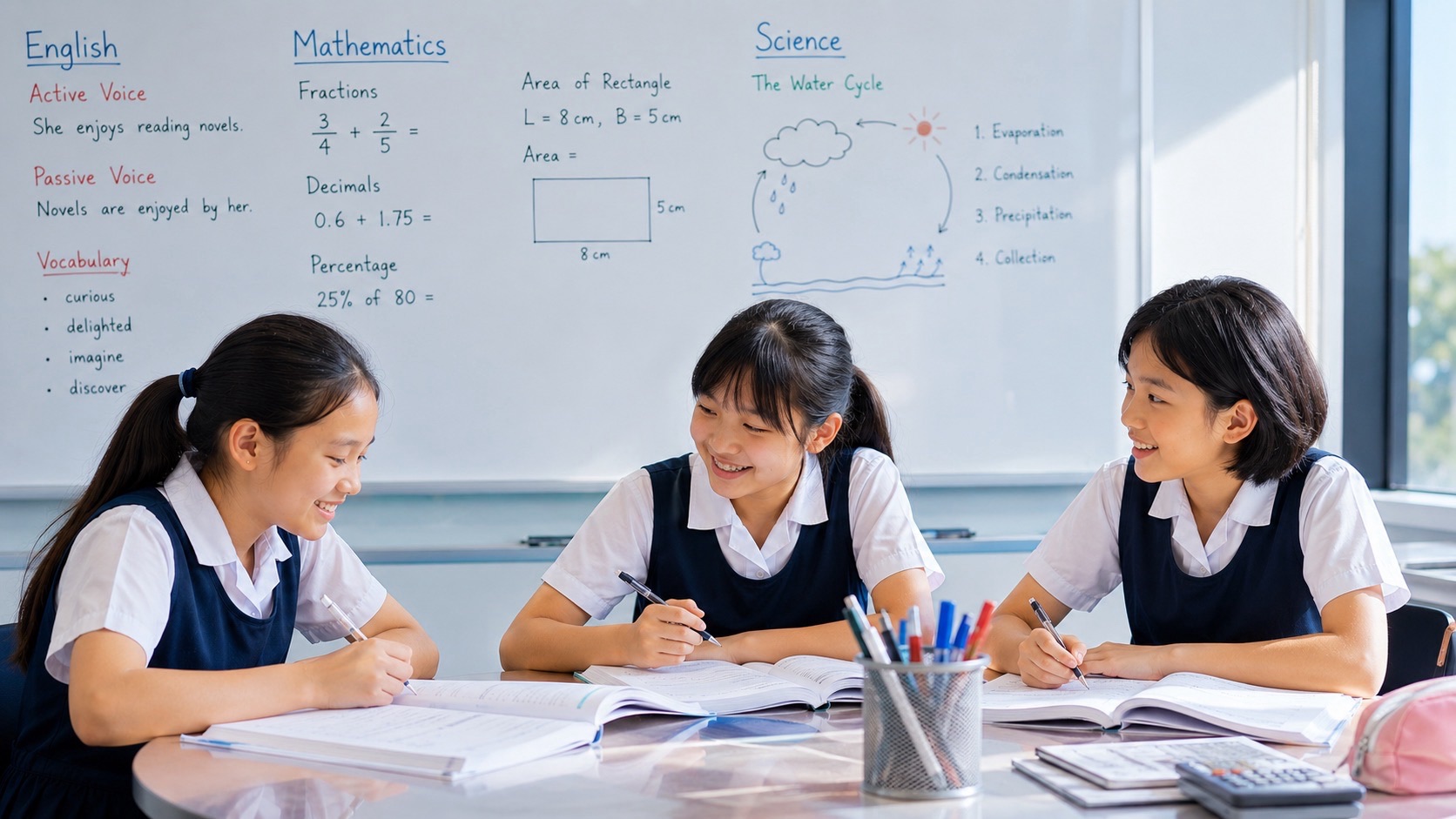
eduKate teaches in groups of up to three students, generally for 90 minutes. In a 3-pax class, students can compare different paragraph revisions and see that improving writing does not require everyone to produce the same final version.
Location-integrity note: this legacy URL serves a Yishun learner route and does not establish a current physical branch. Current class location and availability should be confirmed directly.
The Four Revision Operations
| Operation | Question | Use when |
|---|---|---|
| Delete | Can this sentence disappear without losing necessary meaning? | Repetition, irrelevant detail, filler |
| Move | Would this sentence work better somewhere else? | Wrong sequence, weak paragraph order |
| Connect | What relationship links these ideas? | Choppy sentences, missing cause/contrast |
| Clarify | What is unclear or vague? | Pronoun ambiguity, generic vocabulary, incomplete meaning |
These four operations turn revision into a decision process rather than a vague instruction.
Why Revision Matters at P3
P3 is a useful year to move from “write and submit” toward “write, inspect, improve”. The learner does not need advanced editing terminology. They need a few concrete actions that help paragraphs become more coherent and student-owned.
Delete: Remove Repetition and Noise
Example:
Ali was very scared. He was frightened and afraid. He felt really scared because the dog was barking loudly.
Revision:
Ali was frightened because the dog was barking loudly.
The paragraph becomes stronger by removing repeated meaning rather than adding more description.
The Deletion Test
Ask:
If this sentence is removed, does the paragraph lose a necessary event, reason, detail or relationship?
If no, consider deleting it.
This also builds comprehension answer economy later.
Move: Fix the Order
A paragraph may contain all the right sentences in the wrong sequence.
We ask:
- What happened first?
- What caused the next event?
- Does this explanation come before or after the example?
- Should the reaction follow the event that caused it?
Moving a sentence can improve coherence without rewriting it.
Connect: Make the Relationship Visible
Students learn to identify:
- addition;
- cause;
- consequence;
- contrast;
- time;
- example.
Then they choose language that represents the relationship.
Example:
The road was flooded. We took another route.
Connected:
Because the road was flooded, we took another route.
or:
The road was flooded, so we took another route.
Clarify: Replace Vague Language
Vague:
He did the thing and went there.
Clearer:
He packed the medicine into his bag and hurried to the clinic.
Clarification may involve:
- stronger nouns;
- stronger verbs;
- clear pronouns;
- specific place/time;
- complete cause.
Clarify Pronoun Reference
Example:
When Sarah spoke to Mei, she was upset.
Who was upset?
The learner revises to make reference clear:
Sarah was upset when she spoke to Mei.
or:
Mei looked upset while Sarah spoke to her.
Meaning determines the revision.
Revision Begins With the Paragraph Job
Before editing sentences, ask:
What is this paragraph supposed to do?
Possible jobs:
- introduce an event;
- explain a reason;
- show a consequence;
- build tension;
- give an example;
- resolve a small problem.
Delete/move/connect/clarify decisions become easier when the job is known.
Read the Paragraph Aloud
Oral reading can reveal:
- repetition;
- awkward order;
- missing connection;
- unclear pronouns;
- run-ons;
- sentence fragments.
The learner hears the paragraph as a reader would.
Revision Is Not Adult Rewriting
We avoid replacing the child’s paragraph with a polished adult version.
A useful scaffold progression:
- tutor identifies which operation is needed;
- tutor asks the learner to choose between two operations;
- learner identifies the operation;
- learner revises independently.
The revision process becomes owned.
Use Revision in Reading Too
We can give students a deliberately weak paragraph and ask:
- Which sentence should be deleted?
- Which should move?
- Where is a connector missing?
- Which reference is unclear?
This lets reading and writing reinforce each other.
From Paragraph Revision to Comprehension
The same skills support reading:
- Delete → distinguish main idea from low-value detail.
- Move → understand sequence.
- Connect → recognise cause/contrast.
- Clarify → resolve reference and vocabulary.
Revision therefore strengthens language structure broadly.
The Pri 3 Revision Diagnostic
Paragraph Job
Can the learner state the purpose?
Delete
Can repetition/irrelevance be identified?
Move
Can sentence order be improved?
Connect
Can logical relationships be identified?
Clarify
Can vague language/reference be improved?
Independence
Can a revision move be selected without adult rewriting?
Transfer
Can the method work on a new paragraph?
Six Common P3 Revision Failure Modes
1. “Add More” Only
The paragraph grows but structure does not improve.
2. Adult Rewrite
The final product is strong but the learner makes few decisions.
3. Grammar-Only Editing
Spelling and punctuation improve while paragraph logic remains weak.
4. Delete Fear
The learner thinks every written sentence must stay. We use the deletion test.
5. Connector Decoration
Words are added without real relationships.
6. Revision Without Transfer
The child improves one paragraph with heavy guidance but cannot repeat the process.
What a 90-Minute 3-Pax P3 Lesson Can Look Like
0–10 minutes: Retrieval
Students recall the four revision operations.
10–25 minutes: Read a Weak Paragraph
The group identifies possible improvements.
25–40 minutes: Explicit Revision
The tutor models one operation.
40–60 minutes: Guided Revision
Students revise different paragraphs.
60–80 minutes: Original Writing
Each learner writes and then performs one or two self-selected operations.
80–90 minutes: Explain the Revision
Students justify why the change improved meaning.
Why Three Students Helps
- Several valid revisions can be compared.
- Students learn that editing is not one correct sentence only.
- Peers notice repetition or unclear reference.
- Every learner keeps individual voice.
- The tutor can distinguish a good final paragraph from a good revision process.
Home Use
Parents can ask only four questions:
- Anything to delete?
- Anything to move?
- Anything that needs connecting?
- Anything unclear?
Then let the child make the revision.
What Progress Looks Like
- paragraphs become less repetitive;
- sentence order improves;
- cause/contrast become clearer;
- pronoun ambiguity decreases;
- the learner can explain revision decisions;
- adult rewriting decreases.
Frequently Asked Questions
Does this page claim a current Yishun tuition centre?
No. This is a legacy Yishun learner route.
Should P3 children revise every paragraph heavily?
No. Use one or two high-value revisions so revision remains manageable.
What about grammar and spelling?
They still matter. Delete/move/connect/clarify adds a paragraph-level layer on top of sentence-level checks.
Can strong P3 learners be extended?
Yes. Use subtler paragraph jobs, tone, viewpoint and more independent editorial decisions.
Ten Checks for P3 Paragraph Revision
- What is the paragraph job?
- Is anything repeated?
- Is anything irrelevant?
- Should any sentence move?
- What relationship is missing?
- Is a connector needed?
- Is any pronoun unclear?
- Is any word too vague?
- Can the learner explain the revision?
- Can the method transfer?
Good Revision Often Means Making the Paragraph Smaller, Clearer and Better Connected
That is the purpose of this Yishun Pri 3 English support route:
draft → identify paragraph job → delete → move → connect → clarify → reread.
For the stronger later level owner, see Yishun English Tuition Centre (Primary 3 Small Group).
Almost-Code Summary
PAGE_RFE = P3_paragraph_revision
OPERATIONS = delete | move | connect | clarify
CONSTRAINT = preserve_student_voice
CHECK = meaning + cohesion + relevance
LOCATION = legacy_Yishun_route_not_branch_claim
GOAL = learner_owned_revision_not_more_words