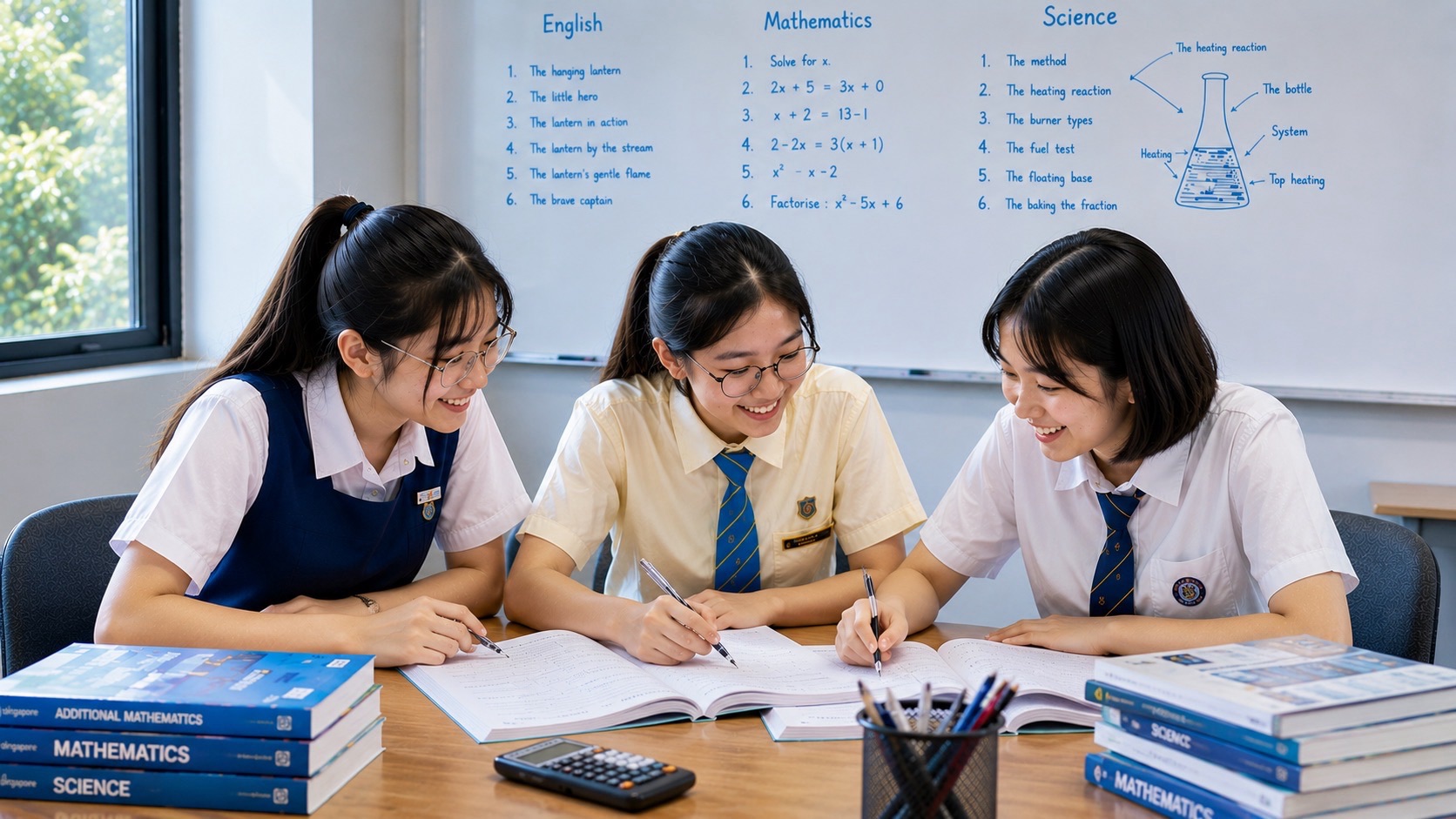
Oasis Primary School English tuition should help a learner face an unfamiliar writing prompt without reaching immediately for a memorised plot.
Many Primary students write confidently when the topic resembles something they have rehearsed, then stall when the prompt changes. The issue is not always vocabulary or grammar. It may be idea generation under novelty: how to move from stimulus → possible meanings → relevant central event → paragraph plan without copying a model composition.
This rebuilt legacy page therefore owns a distinct RFE: unfamiliar-prompt idea generation. Oasis Primary School already has broader English tuition owners. This older URL now focuses specifically on producing relevant, workable ideas and planning them before writing.
eduKate teaches in groups of up to three students, generally for 90 minutes. In a 3-pax class, students can generate several legitimate interpretations from the same stimulus, which helps prevent the belief that every prompt has one “correct” story.
Independent-provider and location note: eduKate is not affiliated with Oasis Primary School. This legacy URL may contain historical Yishun/Punggol wording; current class location and availability should be confirmed directly.
The Idea-Generation Pipeline
| Stage | Question |
|---|---|
| Read prompt | What is the topic really asking? |
| Read stimulus | What possibilities are suggested? |
| Generate | What 3–5 possible central events could fit? |
| Test relevance | Which idea best answers the topic? |
| Build causality | What causes what? |
| Choose turning point | What changes the direction? |
| Plan paragraphs | What job does each paragraph do? |
The learner should generate before committing, then commit before drafting.
The 2026 Primary English Context
For the 2026 PSLE, Paper 1 Writing includes Situational Writing and Continuous Writing. Continuous Writing requires at least 150 words on the given topic, and current assessment continues to allow room for relevant development, originality and personal voice.
Parents can verify the current Paper 1 structure on the SEAB PSLE Formats Examined in 2026 page.
The strongest preparation is therefore not one memorised story per theme, but an idea-generation method that survives unfamiliar prompts.
Step 1: Read the Topic Before the Pictures
A common mistake is to see an image, think of a familiar plot and then force the topic to fit.
We reverse the order:
- read the topic;
- state it in own words;
- identify what kind of event or experience would genuinely answer it;
- then examine the stimulus.
The topic remains the controlling constraint.
Step 2: Extract Possibilities, Not a Plot
From a stimulus, ask:
- What could be happening?
- What happened just before?
- What could happen next?
- Who might be involved?
- What conflict or decision is possible?
The image or words are a launch point, not a full story supplied by the examiner.
Step 3: Generate More Than One Central Event
Before drafting, produce three possibilities.
Example topic: A difficult decision.
- Return a lost item even though keeping it would help the family.
- Tell the truth about breaking something valuable.
- Choose whether to leave a competition to help an injured teammate.
Multiple options reduce dependence on the first familiar plot.
Step 4: Run the Relevance Test
For each idea:
- Does the difficult decision sit at the centre?
- Will the reader understand why it is difficult?
- Can the consequences be developed?
- Will the topic remain visible through the story?
If the topic disappears after the introduction, the idea is weak.
Step 5: Build Cause Before Description
Use:
TRIGGER
-> consequence
-> pressure
-> choice
-> turning point
-> after-effect
Once the causal skeleton works, add setting, dialogue and vocabulary that serve it.
Step 6: Make the Turning Point Earned
The turning point should arise from earlier events.
Weak:
A stranger suddenly appears and solves everything.
Stronger:
The character’s earlier choice creates the situation that later forces a difficult response.
This gives the story structural maturity.
Step 7: Give Each Paragraph a Job
Example:
P1 = establish normal situation
P2 = trigger
P3 = consequence/pressure
P4 = decision/turning point
P5 = after-effect/ending
This is a planning aid, not a mandatory five-paragraph formula.
Use the Stimulus Without Being Trapped by It
If the stimulus includes three images, the learner should understand how the examination instructions allow those images to be used and should remain relevant to the given topic. The images should support the writing, not replace planning.
We practise using one stimulus element in several different story routes.
World Knowledge Helps Idea Generation
Reading broadly gives students more possible situations:
- school events;
- public transport;
- sports;
- community spaces;
- family responsibilities;
- weather;
- technology;
- travel;
- everyday ethical choices.
World knowledge creates raw material; relevance determines what belongs in the composition.
Vocabulary Comes After Meaning
Do not choose the plot because it allows a memorised phrase.
Instead:
meaning → event → paragraph job → vocabulary.
Strong verbs and precise emotion words should serve the story already chosen.
Dialogue as a Decision Tool
Dialogue can:
- reveal conflicting goals;
- introduce new information;
- increase pressure;
- force a choice.
Dialogue that merely repeats known facts should be shortened or deleted.
What If No Idea Comes?
Use a low-load sequence:
- name one person;
- name one place;
- name one normal goal;
- introduce one change/problem;
- ask what decision follows.
The learner creates a small causal world instead of waiting for inspiration.
What If Too Many Ideas Come?
Use the relevance gate:
- Which idea places the topic at the centre?
- Which can be completed within the available time?
- Which has a clear turning point?
- Which does not require too much explanation?
Idea selection is as important as idea generation.
The Oasis Prompt Diagnostic
Topic Reading
Can the learner paraphrase the topic?
Generation
Can several ideas be produced?
Relevance
Can weak ideas be rejected?
Causality
Does the chosen plot have cause/effect?
Turning Point
Is change prepared?
Planning
Can paragraph jobs be mapped?
Transfer
Can the process survive a new unfamiliar prompt?
Six Common Prompt Failure Modes
1. Memorised Plot Capture
The topic is bent to fit a familiar story.
2. Stimulus Capture
The learner describes an image rather than creating a relevant composition.
3. One-Idea Panic
The first idea is accepted without testing.
4. Vocabulary-Led Plot
The story is chosen to use memorised phrases.
5. Random Turning Point
The solution arrives without setup.
6. Overplanning
The plan becomes another composition and consumes writing time.
What a 90-Minute 3-Pax Lesson Can Look Like
0–10 minutes: Idea-Routine Retrieval
Topic→possibilities→relevance→causality returns.
10–25 minutes: Prompt 1 Generation
Students create three possible routes.
25–40 minutes: Relevance and Causality
Ideas are compared and one is selected.
40–65 minutes: Independent Drafting
Students write with their own plans.
65–80 minutes: Structural Revision
Check turning point and ending.
80–90 minutes: Prompt 2 Transfer
A fresh prompt is planned rapidly without a model.
Why Three Students Helps
- One prompt produces several valid routes.
- Peers demonstrate flexibility without copying.
- The tutor can challenge relevance directly.
- Students see that originality is not random novelty.
- Individual voice remains visible.
What Parents Can Bring
- recent composition prompts;
- writing where the child stalled;
- stories that feel recycled;
- teacher comments about relevance;
- assessment dates.
What Progress Looks Like
- the learner generates several options faster;
- memorised plots are used less rigidly;
- topic relevance remains visible;
- causal planning improves;
- turning points feel more earned;
- new prompts create less anxiety.
Frequently Asked Questions
Is eduKate affiliated with Oasis Primary School?
No. eduKate is an independent tuition provider.
Should children memorise model plots?
Model texts can teach craft, but the learner should abstract structure and generate fresh content rather than force one memorised story onto many topics.
Can strong writers benefit?
Yes. Use more ambiguous prompts, subtler constraints and tighter planning time.
Ten Checks for Unfamiliar Prompts
- What is the topic?
- Can I say it in my own words?
- What does the stimulus suggest?
- Can I generate three routes?
- Which is most relevant?
- What triggers the problem?
- What consequences follow?
- What is the turning point?
- What job does each paragraph do?
- Can I repeat this process on a new prompt?
Do Not Memorise the Story; Memorise the Process for Building One
That is the purpose of this Oasis Primary School English tuition support route:
topic → possibilities → relevance → causality → turning point → plan → write → transfer.
Families may also use the broader Oasis Primary School English tuition route.
Almost-Code Summary
LEARNER_ROUTE = Oasis_unfamiliar_prompt
PAGE_RFE = idea_generation_without_model_dependence
GENERATE = multiple_routes
SELECT = relevance + causality + feasibility
CLASS = max_3
LESSON = 90_minutes
GOAL = adaptable_original_writing