Bendemeer Primary School English tuition should help a learner use oral rehearsal as a temporary bridge into independent writing—not as a permanent script supplied by the tutor.
Bendemeer already has a stronger support owner focused on reducing working-memory load in comprehension and writing. This legacy page therefore needs a different job. Its RFE is oral rehearsal → independent writing transfer: say the idea clearly, organise it, encode it in writing, then fade the oral scaffold so the learner can eventually plan and write without needing to speak every sentence first.
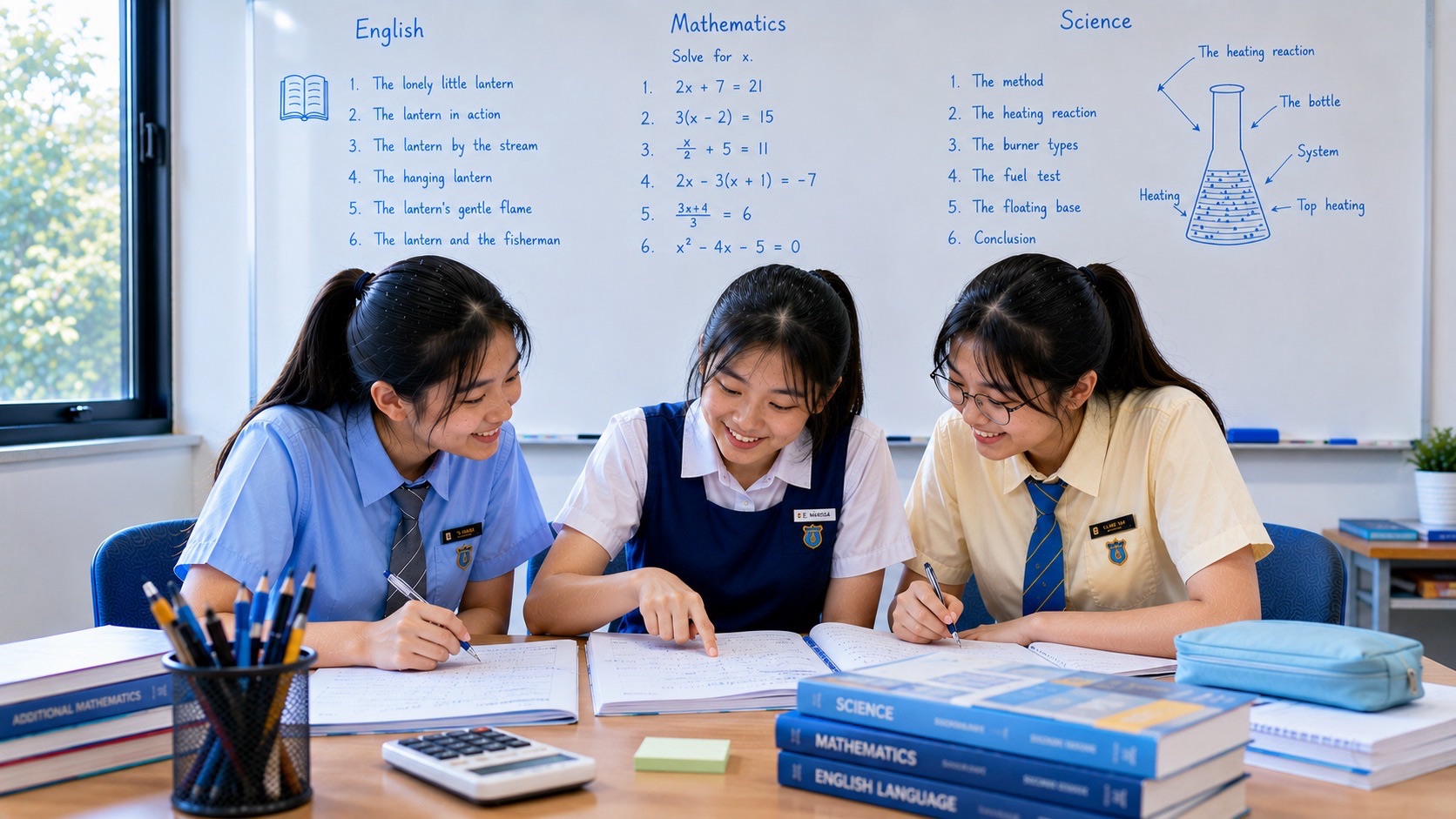
eduKate teaches in groups of up to three students, generally for 90 minutes. In a 3-pax class, oral rehearsal works well because each learner gets speaking turns, hears age-near alternatives and then produces individual writing rather than copying one model.
Independent-provider and location note: eduKate is not affiliated with Bendemeer Primary School. This legacy URL contains historical location wording and should not be read as proof of a current branch. Current class location and availability should be confirmed directly.
Why Oral Rehearsal Helps
Writing combines several tasks at once:
- generate an idea;
- choose vocabulary;
- build sentence structure;
- spell;
- punctuate;
- remember what comes next;
- monitor relevance.
Speaking can temporarily remove some of that load. If the learner can say the idea well but cannot write it well, oral rehearsal helps isolate the transfer problem.
The Oral-to-Writing Ladder
| Stage | Support |
|---|---|
| 1 | Tutor models one example |
| 2 | Learner answers guided questions aloud |
| 3 | Learner says the full sentence/paragraph |
| 4 | Learner writes from own oral version |
| 5 | Learner uses only a short oral plan |
| 6 | Learner plans silently and writes independently |
The goal is movement down the ladder, not permanent dependence on the earlier stages.
The 2026 Primary English Context
MOE’s Primary English Language Syllabus 2020 integrates oracy, reading and writing, with grammar and vocabulary supporting communication. For 2026 PSLE candidates, English includes Writing, Language Use and Comprehension, Listening Comprehension and Oral Communication.
Parents can verify the current structure on the SEAB PSLE Formats Examined in 2026 page.
Oral rehearsal is therefore not separate from writing development. It can be a bridge between meaning and written representation.
Use Oral Rehearsal for Idea Generation
Before writing, ask:
- Who is involved?
- What happened?
- Why did it happen?
- What changed?
- What happened next?
The learner says the story or explanation first. The tutor listens for missing logic rather than immediately supplying language.
Use Oral Rehearsal for Sentence Formation
If a learner produces fragments in writing, ask for a complete spoken thought first.
Spoken:
The girl ran back to the classroom because she had forgotten her project.
Written:
The girl ran back to the classroom because she had forgotten her project.
Once the sentence form becomes more stable, the spoken stage can be shortened.
Use Oral Rehearsal for Paragraph Planning
A paragraph can be spoken in a simple sequence:
- main event;
- cause;
- reaction;
- consequence.
Then the learner writes the paragraph independently rather than transcribing an adult-created script.
Use Oral Rehearsal for Vocabulary Retrieval
Before giving a vocabulary bank, ask the learner to describe the meaning aloud.
Prompt:
What word would fit someone who does not want to go but finally agrees?
The learner may retrieve reluctant. Then use it orally, write it, and retrieve it later in a different context.
Do Not Turn Oral Rehearsal Into Dictation
Weak:
Tutor says polished sentence → learner repeats → learner writes.
Stronger:
Tutor asks discriminating question → learner generates meaning → learner says sentence → learner writes in own language.
The source of the language should increasingly be the learner.
Fade the Scaffold Deliberately
Possible fading sequence:
- full oral rehearsal;
- only first sentence orally;
- oral paragraph keywords;
- silent three-point plan;
- independent draft.
If writing collapses when one level is removed, restore only the smallest scaffold necessary.
Compare Oral and Written Versions
Ask:
- Did the written version lose a reason?
- Did vocabulary become simpler?
- Did sentence structure collapse?
- Did the learner forget the sequence?
- Did spelling consume attention?
The gap identifies the current transfer bottleneck.
Reading Can Supply Oral Rehearsal
After reading a paragraph or story:
- retell;
- summarise the paragraph job;
- explain a character motive or cause;
- write one original paragraph using the same structure on a new topic.
Reading becomes input; oral explanation becomes abstraction; writing becomes transfer.
The Bendemeer Transfer Diagnostic
Idea Generation
Can the learner produce content orally?
Sentence Formation
Can the spoken idea become a complete sentence?
Vocabulary
Can useful words be retrieved without a full bank?
Paragraph Structure
Can the spoken sequence become written organisation?
Encoding
Does spelling/punctuation reduce quality sharply?
Scaffold Fading
Can oral support be reduced?
Transfer
Can the learner write on a new topic without repeating a script?
Six Common Failure Modes
1. Tutor Language Capture
The learner writes excellent adult language but owns little of it.
2. Oral Dependence
The learner must speak every sentence before writing forever. We fade.
3. No Oral-to-Written Comparison
The transfer bottleneck remains hidden.
4. Vocabulary Bank Dependence
Oral language weakens when the list disappears.
5. Spelling Suppresses Ideas
The learner simplifies content to avoid difficult words.
6. Model Plot Dependence
Oral rehearsal reproduces memorised content rather than new ideas.
What a 90-Minute 3-Pax Lesson Can Look Like
0–10 minutes: Retrieval
Vocabulary and writing architecture return.
10–25 minutes: Reading/Stimulus Input
A short text or picture provides content.
25–40 minutes: Oral Rehearsal
Students explain and organise their own ideas.
40–65 minutes: Independent Writing
Students encode without tutor dictation.
65–80 minutes: Scaffold-Fading Retest
A new task uses less oral support.
80–90 minutes: Error Close
Was the bottleneck ideas, sentence formation, vocabulary or encoding?
Why Three Students Helps
- Every learner gets oral turns.
- Peers provide multiple age-appropriate language routes.
- The tutor can wait rather than constantly prompt.
- Different scaffold levels can coexist.
- Each student still writes independently.
What Parents Can Bring
- recent compositions;
- examples where the child explains well but writes weakly;
- teacher comments;
- writing completed with and without help;
- spelling/vocabulary work.
What Progress Looks Like
- written output approaches oral quality;
- vocabulary retrieves more naturally;
- sentence formation becomes more stable;
- paragraphs remain organised after oral support fades;
- adult wording decreases;
- new prompts remain manageable.
Frequently Asked Questions
Is eduKate affiliated with Bendemeer Primary School?
No. eduKate is an independent tuition provider.
Why is this different from the Bendemeer working-memory page?
The working-memory owner explains cognitive load broadly. This page focuses specifically on oral rehearsal as a temporary bridge into independent writing.
Should a child always plan aloud?
No. Oral planning should fade as the learner becomes capable of internal planning.
Can strong writers benefit?
Yes. Use oral rehearsal selectively for complex argument, narrative architecture or vocabulary precision, then remove it quickly.
Ten Checks for Oral-to-Writing Transfer
- Can the idea be generated orally?
- Can the sentence be spoken?
- Can vocabulary be retrieved?
- Can the paragraph sequence be explained?
- Can it be written?
- What quality drops during encoding?
- Can oral support shrink?
- Can tutor wording be avoided?
- Can a new topic be handled?
- Is independence increasing?
Use Speech to Build the Bridge, Then Let the Learner Cross Without It
That is the purpose of this Bendemeer Primary School English tuition support route:
idea → oral rehearsal → written encoding → compare → fade scaffold → independent transfer.
Families may also use the Bendemeer working-memory support route.
Almost-Code Summary
LEARNER_ROUTE = Bendemeer_oral_to_writing
PAGE_RFE = oral_rehearsal_to_independent_writing
SCAFFOLD = full_oral -> partial -> keywords -> silent_plan -> independent
CLASS = max_3
LESSON = 90_minutes
GOAL = written_output_owned_without_permanent_oral_dependency