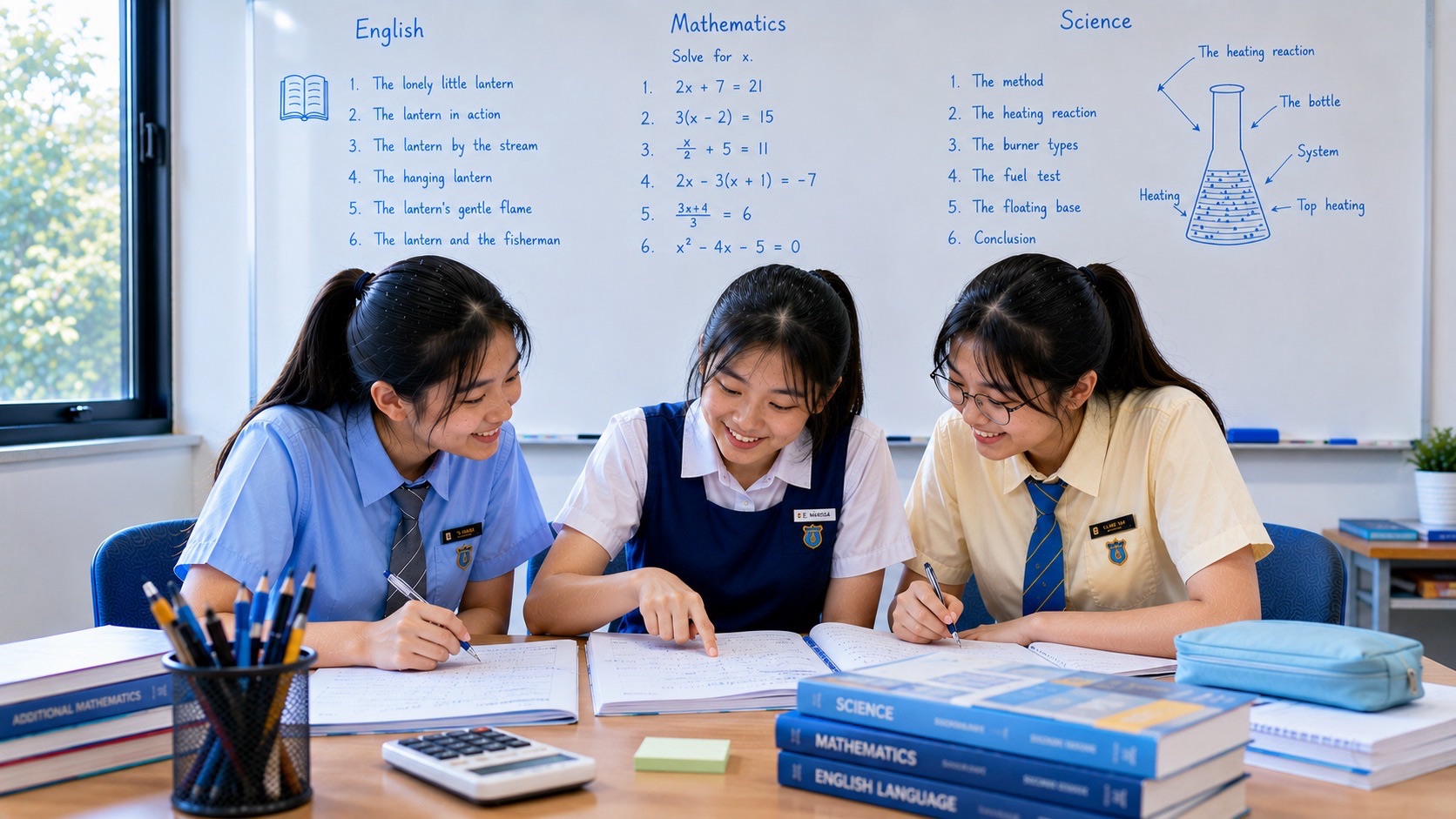
Ngee Ann Primary School English tuition should help a learner keep track of who, what and which idea continues across longer paragraphs.
Students can understand individual sentences yet lose the text when pronouns, connectors, repeated ideas and paragraph shifts begin carrying meaning across several lines. The result is a familiar pattern: reading appears fluent, but comprehension answers become unstable because the learner no longer knows exactly what he, this, however, therefore or the problem refers back to.
This rebuilt legacy page therefore owns a distinct RFE: cohesion and reference across longer paragraphs. Ngee Ann Primary School already has broader English tuition owners, so this URL should not compete as another generic school-name page. Its job is to make whole-text continuity visible.
eduKate teaches in groups of up to three students, generally for 90 minutes. In a 3-pax class, students can compare different interpretations of a reference chain, justify which noun or idea a phrase points to, and then apply the same cohesion principles in writing.
Independent-provider and location note: eduKate is not affiliated with Ngee Ann Primary School. This legacy URL contains historical Yishun/Marina Bay wording and should not be read as proof of a current branch. Current class location and availability should be confirmed directly.
The 2026 Primary English Context
MOE’s Primary English Language Syllabus 2020 develops reading, writing and oracy as connected capabilities, with grammar and vocabulary supporting communication. For 2026 PSLE candidates, English includes Writing, Language Use and Comprehension, Listening Comprehension and Oral Communication.
Parents can verify the current assessment structure on the SEAB PSLE Formats Examined in 2026 page.
What Is Cohesion?
Cohesion is the set of language relationships that help sentences and paragraphs hang together.
Signals include:
- pronouns;
- repeated nouns/ideas;
- synonyms and related words;
- connectors;
- sequence;
- cause and effect;
- contrast;
- reference phrases such as this problem or these changes.
A learner who tracks these signals builds a more stable model of the text.
Reference Tracking
When the text says he, she, it, they, this or that, ask:
- What are the possible referents nearby?
- Which fits number and grammar?
- Which fits the meaning?
- Does the next sentence confirm it?
This prevents pronouns from becoming invisible.
Reference Can Point to an Idea, Not Just a Noun
Example:
The road flooded after hours of heavy rain. This forced several buses to change their routes.
This refers to the flooding situation, not simply to the word rain.
Students learn to track idea-level reference as texts become more complex.
Connectors Are Meaning Instructions
Students should know what relationship a connector signals:
- however → contrast;
- therefore → consequence;
- because → cause;
- meanwhile → simultaneous/parallel sequence;
- although → concession;
- for example → illustration.
Connector knowledge helps the reader anticipate how the next idea relates to the previous one.
Paragraph Jobs
Longer texts become easier when each paragraph has a job.
Possible jobs:
- introduce a situation;
- give a reason;
- show a consequence;
- provide an example;
- contrast two ideas;
- develop a problem;
- resolve or conclude.
The learner should see the paragraph as part of a larger structure.
Track Repeated Ideas Even When the Words Change
A text may shift from:
the elderly residents → the seniors → they → the group
or:
plastic waste → discarded plastic → this material → the waste
Students learn to recognise semantic continuity despite different wording.
Cohesion in Narrative Text
Track:
- character references;
- location changes;
- time sequence;
- cause/effect between events;
- emotional shifts;
- turning points.
Confusion often begins when the learner loses one transition and then carries the wrong interpretation forward.
Cohesion in Informational Text
Track:
- topic continuity;
- definition → example;
- cause → effect;
- problem → solution;
- claim → evidence;
- comparison/contrast.
Headings and repeated technical vocabulary can help anchor the structure.
Repair the Earliest Broken Link
If a comprehension answer is wrong near the end of a passage, the true failure may have occurred two paragraphs earlier when a reference was misread.
We ask:
- Where did the learner’s text model first diverge?
- Which pronoun/connector/paragraph shift was missed?
- Can the relationship be repaired there?
- Does the later question now become easier?
This avoids correcting only the final symptom.
Reference Questions
For explicit reference questions, answer with the exact noun or idea required—neither too broad nor too narrow.
We teach:
reference word → candidate → grammar check → meaning check → exact answer.
Inference Depends on Cohesion
Strong inference usually depends on integrating more than one clue.
Example:
- Paragraph 1 establishes a character’s goal.
- Paragraph 2 introduces an obstacle.
- Paragraph 3 shows a reaction.
The inference may require the learner to preserve all three states.
Writing Return: Create the Cohesion You Read
Students apply the same ideas in writing:
- clear pronoun reference;
- connectors that reflect real relationships;
- one paragraph job;
- controlled repetition of key ideas;
- logical sequence.
Reading cohesion becomes writing cohesion.
The Ngee Ann Cohesion Diagnostic
Reference
Can pronouns and idea-level references be resolved?
Connectors
Can relationships be interpreted?
Paragraph Jobs
Can each paragraph’s purpose be stated?
Continuity
Can the same topic/entity be tracked across wording changes?
Inference
Can clues be integrated across sentences/paragraphs?
Writing Transfer
Can the learner create clear cohesion?
Recovery
Can a broken reference chain be repaired?
Six Common Failure Modes
1. Pronoun Drift
The learner loses who/what a pronoun refers to.
2. Connector Blindness
Contrast or consequence signals are ignored.
3. Paragraph-Island Reading
Each paragraph is understood separately but not connected.
4. Word-Form Fixation
The learner misses that different words refer to the same idea.
5. Late-Symptom Correction
Only the wrong final answer is discussed.
6. Writing Reference Ambiguity
Pronouns are used before a clear referent exists.
What a 90-Minute 3-Pax English Lesson Can Look Like
0–10 minutes: Connector/Reference Retrieval
Students recall key relationships.
10–30 minutes: Long-Text Reading
Reference chains and paragraph jobs are marked.
30–45 minutes: Cohesion Map
Students explain how ideas connect.
45–65 minutes: Comprehension Questions
Reference and inference are answered from the map.
65–80 minutes: Writing Return
Students create one cohesive paragraph.
80–90 minutes: Fresh Transfer
A new passage tests whether the method survives.
Why Three Students Helps
- Different reference interpretations become visible.
- Peers challenge ambiguous answers.
- Students compare paragraph-job summaries.
- The tutor can see where each learner’s text model first breaks.
- Every learner writes independently.
What Parents Can Bring
- recent comprehension papers;
- questions involving pronoun/reference;
- longer passages;
- compositions with unclear pronouns;
- teacher comments.
What Progress Looks Like
- reference questions improve;
- long passages feel less fragmented;
- inference becomes more stable;
- paragraph jobs are recognised faster;
- pronoun ambiguity in writing decreases;
- students recover earlier when meaning becomes unclear.
Frequently Asked Questions
Is eduKate affiliated with Ngee Ann Primary School?
No. eduKate is an independent tuition provider.
Why focus on cohesion?
Because strong comprehension depends on maintaining relationships across sentences and paragraphs, and Ngee Ann already has broader generic English tuition owners.
Can strong learners benefit?
Yes. Use longer reference chains, subtle connectors, implied paragraph relationships and tighter writing cohesion.
Ten Checks for Whole-Text Continuity
- Who/what is being discussed?
- What does this pronoun refer to?
- What idea does this phrase point back to?
- What does the connector signal?
- What is the paragraph job?
- How does it connect to the previous paragraph?
- What changed?
- Which clue supports the inference?
- Where did understanding first break?
- Can the learner create the same cohesion in writing?
Comprehension Becomes More Reliable When the Text Stays Connected in the Learner’s Mind
That is the purpose of this Ngee Ann Primary School English tuition support route:
reference → relationship → paragraph job → whole-text model → evidence → answer.
Families may also use the broader English Tuition Ngee Ann Primary School route.
Almost-Code Summary
LEARNER_ROUTE = Ngee_Ann_Primary_cohesion
PAGE_RFE = reference_and_whole_text_continuity
READ = referent + connector + paragraph_job + topic_continuity
CLASS = max_3
LESSON = 90_minutes
GOAL = stable_long_text_model_for_comprehension_and_writing