Bedok Science tuition should help a Primary learner judge whether a scientific conclusion is supported by strong enough evidence—not just whether one result appears to match the expected answer.
This rebuilt legacy page owns a distinct RFE: repeated trials, anomalous results, measurement consistency and strength of evidence. Bedok already has stronger generic Science tuition owners, so this URL should not compete as another location page. Its job is to build evidence-quality reasoning.
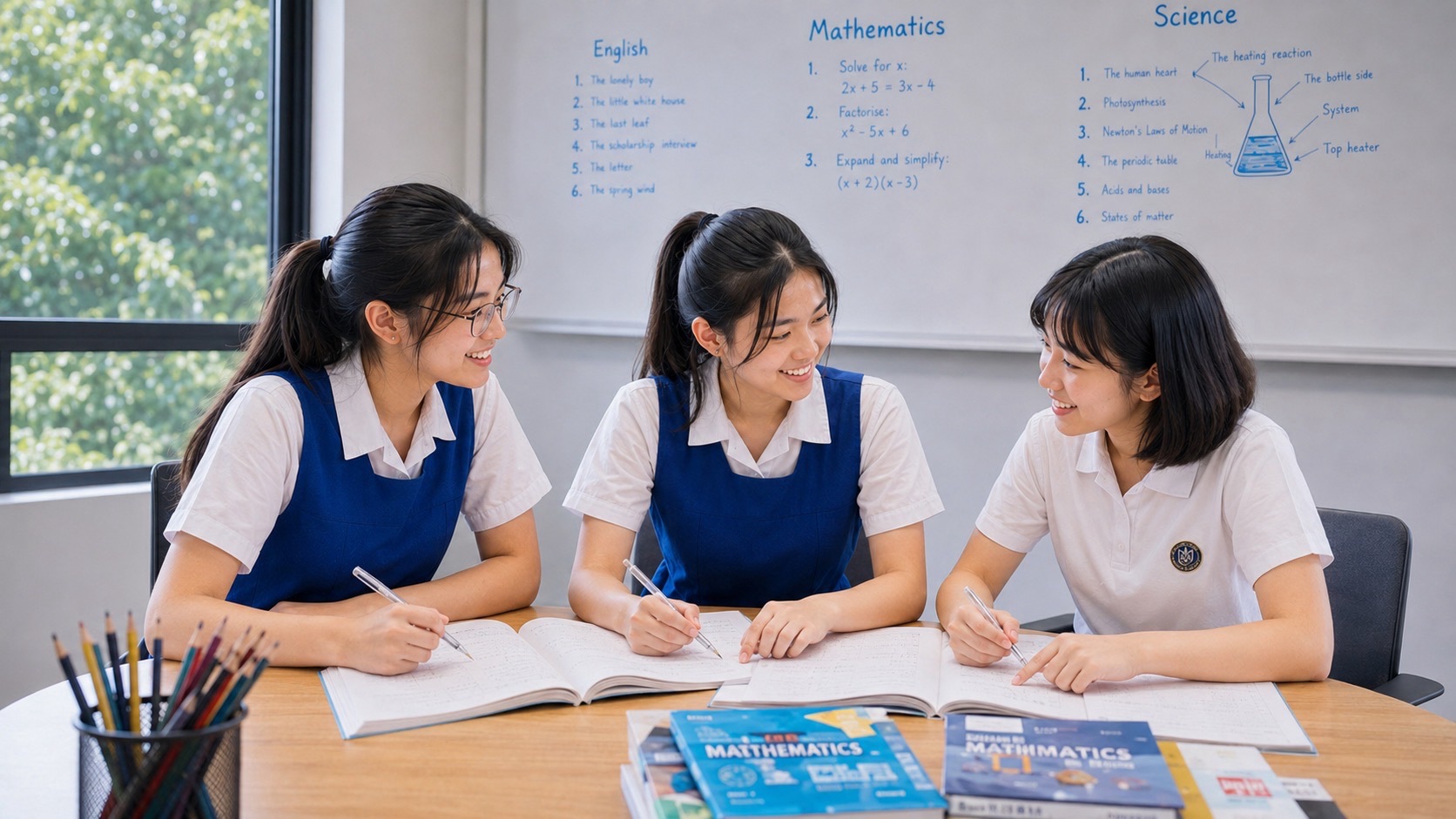
eduKate teaches in groups of up to three students, generally for 90 minutes. In a 3-pax Science class, students can compare repeated measurements, decide whether an unusual result should change a conclusion and explain what makes one data set more reliable than another.
Location-integrity note: this legacy URL contains historical Yishun/Marina Bay/Bedok wording. It should not be read as proof of a current branch at any old address. Current class location and availability should be confirmed directly.
The 2026 Primary Science Context
For the 2026 PSLE, Science is subject code 0009 and is based on the 2023 Primary Science syllabus. Students are expected to interpret and analyse information, evaluate observations and methods, and communicate scientific reasoning.
Parents can verify the current syllabus through the 2026 PSLE Science syllabus and the SEAB PSLE formats page.
One Result Is Evidence, but Not Always Strong Evidence
Suppose a learner measures how long an ice cube takes to melt under two conditions.
If only one measurement is taken, the result may be influenced by:
- measurement error;
- slightly different starting conditions;
- timing inconsistency;
- unexpected disturbance.
Repeated trials can help show whether the pattern is consistent.
Reliability vs Accuracy
At Primary level, students can begin distinguishing the ideas carefully.
Reliability is about consistency: do repeated measurements/results agree reasonably?
Accuracy concerns closeness to the true/correct value where such a reference is meaningful.
Students should avoid writing “repeat to make it accurate” automatically. Repetition mainly helps us judge consistency and reduce the influence of one unusual trial.
The Evidence-Strength Map
| Question | Why it matters |
|---|---|
| Was the test fair? | Competing causes should be controlled |
| Was measurement appropriate? | Poor instruments weaken evidence |
| Were trials repeated? | Consistency can be checked |
| Were results similar? | Pattern strength increases |
| Was there an anomaly? | One unusual result may need investigation |
| Does the conclusion match the range tested? | Avoid overgeneralising |
Why Repeat Trials?
Useful reasons:
- check whether the result is consistent;
- reduce the influence of an unusual measurement;
- provide more evidence before drawing a conclusion.
The exact wording should fit the experiment and what is being measured.
Repeated Trials Are Not Magic
If the method is badly designed, repeating it many times can repeatedly produce misleading evidence.
Ask first:
- Is the comparison fair?
- Is the instrument suitable?
- Are the starting conditions comparable?
- Is the measurement defined consistently?
Reliability cannot rescue a fundamentally irrelevant method.
Anomalous Results
An anomalous result is a result that does not fit the broader pattern.
Students should not immediately:
- delete it;
- average it away;
- invent a reason.
Instead ask:
- Is it genuinely unusual compared with the other trials?
- Could there have been measurement/method error?
- Would repeating the trial help?
- Does the anomaly weaken confidence in the conclusion?
Consistency of Measurement
To compare repeated trials properly, measure in the same way.
Examples:
- same time interval;
- same measuring point;
- same unit;
- same instrument/procedure where relevant.
If one trial measures height from the soil and another from the pot base, the numbers are not directly comparable.
Average Values
Where appropriate and taught in context, an average can summarise repeated numerical measurements.
But students should still inspect the individual values.
Example:
10, 11, 10, 30
An average alone may hide an obviously unusual result. Evidence quality requires looking at the pattern, not only one summary number.
Sample Size and Evidence
In simple school investigations, students can understand that observing more than one individual/item may reduce the chance that one unusual case dominates the conclusion.
Example:
One plant may grow unusually for reasons unrelated to the variable being studied. A broader set can provide stronger comparative evidence if the method is otherwise appropriate.
Keep claims within the level and information provided.
Measurement Resolution
If the expected difference is very small, an instrument with coarse markings may not distinguish it clearly.
Students ask:
- Can this instrument measure the change we care about?
- Are the units/markings suitable?
- Would a more precise measuring tool produce more useful evidence?
This connects method quality to evidence strength.
Evidence Strength and Conclusions
Strong conclusion:
Within the tested conditions, Set-up A consistently showed a greater change than Set-up B across repeated trials.
Overclaim:
Set-up A will always be better in every situation.
The conclusion should remain inside the evidence boundary.
When Results Disagree
If repeated trials vary widely:
- inspect method consistency;
- check measuring tools;
- look for uncontrolled variables;
- repeat if appropriate;
- avoid overconfident conclusion.
Variation is information about the strength of the evidence.
Evidence Quality in Open-Ended Questions
When asked whether a conclusion is reliable or supported, students should identify the specific evidence feature:
- repeated trials;
- consistent results;
- fair comparison;
- appropriate measurement;
- presence/absence of anomalies.
“Yes, because the experiment is fair” is not enough if the relevant issue is repeated measurement.
The Bedok Reliability Diagnostic
Fairness
Can competing variables be recognised?
Repetition
Can the purpose of repeated trials be explained?
Consistency
Can repeated results be compared?
Anomaly
Can an unusual value be identified cautiously?
Measurement
Can method/instrument limitations be recognised?
Conclusion
Can claims stay within the evidence?
Transfer
Can the reasoning move to a new experiment?
Six Common Evidence-Reliability Failure Modes
1. “Repeat for Accuracy”
Memorised phrase replaces explanation of consistency.
2. Delete the Anomaly
Unusual results are removed automatically.
3. Average Blindness
A summary value hides inconsistent trials.
4. Repeated Bad Method
More trials are assumed to fix poor experimental design.
5. Overgeneralisation
The conclusion extends beyond the tested conditions.
6. Instrument Blindness
Measurement limits are ignored.
What a 90-Minute 3-Pax Science Lesson Can Look Like
0–10 minutes: Reliability Vocabulary
Students retrieve repeat, consistent, anomaly, measurement and conclusion.
10–30 minutes: Trial Data
Several repeated results are compared.
30–45 minutes: Anomaly Reasoning
Students decide what can and cannot be concluded.
45–60 minutes: Method Evaluation
Instrument/control limitations are inspected.
60–80 minutes: Fresh Experiment Transfer
A different set-up tests evidence-quality reasoning.
80–90 minutes: Conclusion Audit
Students shorten claims to the evidence boundary.
Why Three Students Helps
- Students can disagree productively about evidence strength.
- Peers catch overconfident conclusions.
- The tutor can probe why repetition matters.
- Different interpretations of anomalies can be compared.
- Every learner writes independent evaluations.
What Parents Can Bring
- method/evaluation questions;
- repeated-trial data;
- marked open-ended answers;
- teacher comments;
- assessment dates.
What Progress Looks Like
- repetition is explained precisely;
- anomalies are handled cautiously;
- measurement quality is considered;
- students inspect individual data before averages;
- conclusions become less absolute;
- evidence-strength reasoning transfers across topics.
Frequently Asked Questions
Does this page claim a current Bedok Science tuition centre?
No. It is a legacy Bedok/Yishun learner route; current class location and availability must be confirmed directly.
Do repeated trials guarantee a correct conclusion?
No. The method also needs to be relevant and appropriately controlled, and measurements need to be meaningful.
Should an anomalous result always be ignored?
No. It should be investigated and interpreted in context. Repeating the measurement may help where appropriate.
Ten Checks for Evidence Reliability
- Is the comparison fair?
- Is the measurement suitable?
- Were trials repeated?
- Are results consistent?
- Is there an anomaly?
- Could method error explain variation?
- Would more evidence help?
- Does an average hide anything?
- Is the conclusion inside the tested range?
- How strong is the evidence really?
Scientific Confidence Should Grow With the Quality and Consistency of the Evidence
That is the purpose of this Bedok Science tuition support route:
fair method → repeated evidence → inspect consistency → investigate anomalies → bound conclusion.
Families may also use the broader Bedok Science Tuition route.
Almost-Code Summary
LEARNER_ROUTE = Bedok_Primary_Science_evidence_reliability
PAGE_RFE = repeated_trials_anomalies_measurement
PSLE_2026 = subject_0009 + 2023_primary_science_syllabus
CLASS = max_3
LESSON = 90_minutes
GOAL = calibrated_confidence_from_evidence_quality