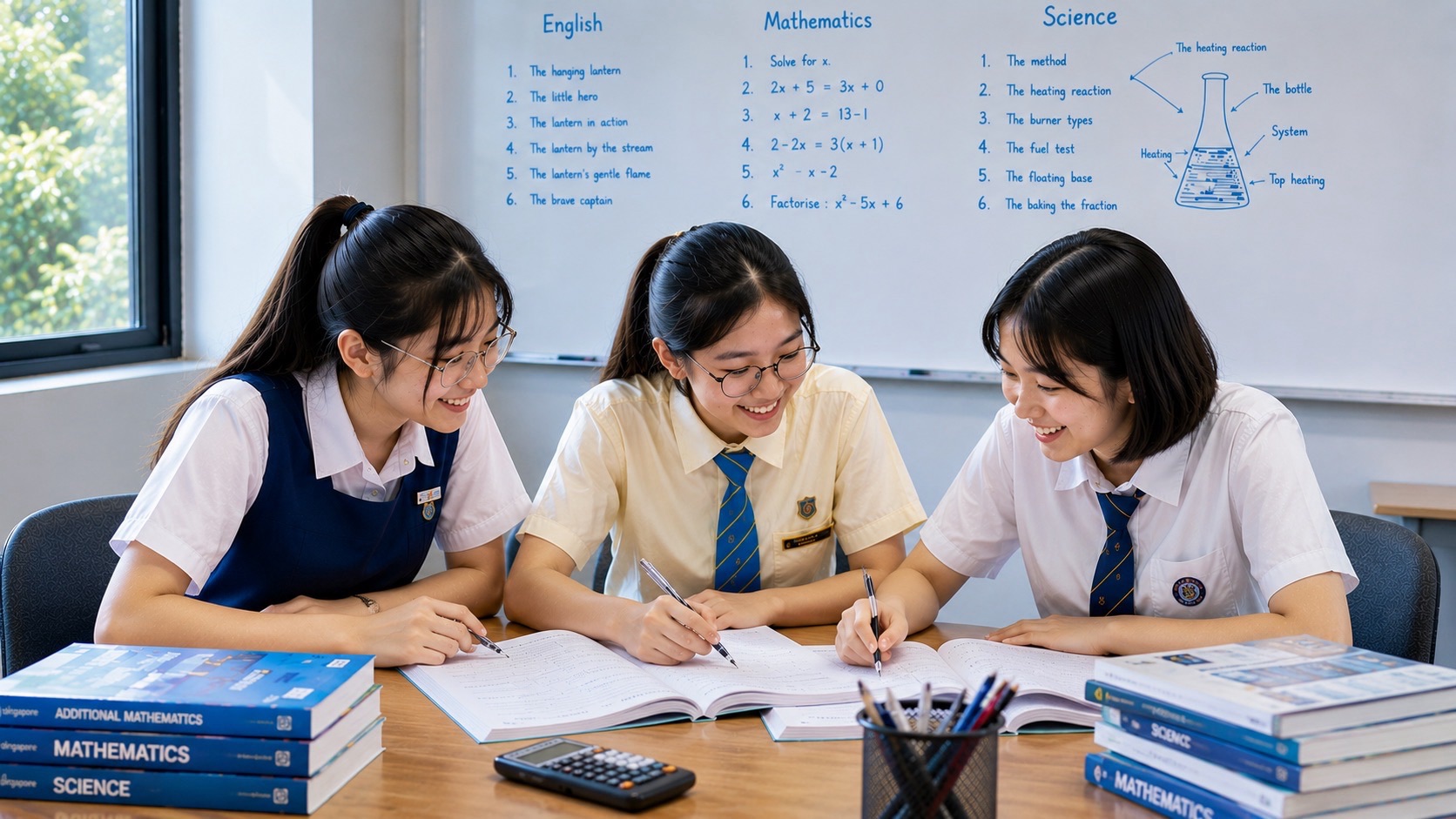
Holland Village English tuition should protect continuity as the learner moves from Primary English into the more independent demands of Secondary English.
The difficult part of transition is not that English suddenly becomes a different language. It is that the same language abilities—reading, vocabulary, grammar, writing, listening and speaking—must now operate at greater density, with less scaffolding and more judgment.
This page therefore owns a specific role within eduKateSingapore’s English estate: continuity across the Primary-to-Secondary boundary. It is written for Holland Village families who want a long-form guide to what should remain stable, what should change, how Full Subject-Based Banding affects the secondary route, and how a three-student class can preserve the learner’s strengths while repairing the first weak link.
eduKate teaches in small groups of up to three students, generally in 90-minute lessons. The purpose is not simply to maintain marks from one year to the next. It is to carry forward a language system that can handle greater complexity.
Integrity note: eduKate is an independent tuition provider. The Holland Village name identifies the family/search route served by this page; it does not imply an eduKate branch at every locality named across the site. Current class location and availability should be confirmed during consultation.
The Continuity Problem at a Glance
| Primary capability | Secondary demand | Transition risk |
|---|---|---|
| Read for facts and inference | Read denser texts and sustain interpretation | Child understands surface meaning but misses nuance |
| Write narratives and situational tasks | Write with greater control, purpose and sustained development | Old templates become too narrow |
| Learn vocabulary by theme | Use vocabulary across disciplines and argument | Recognition remains high but retrieval is slow |
| Use grammar accurately | Maintain control in longer, more complex sentences | Error rate rises as ideas become harder |
| Answer guided questions | Make more independent decisions | Student waits for technique labels or model answers |
| Prepare for PSLE components | Manage subject-level progression and later SEC/O-Level-style demands | Parents use old stream assumptions instead of current subject readiness |
The 2026–2027 Singapore English Context
At Primary level, MOE’s English Language Syllabus 2020 continues to emphasise integrated oracy, reading and writing, with vocabulary and grammar supporting meaning. The 2026 PSLE English Language examination includes Writing, Language Use and Comprehension, Listening Comprehension and Oral Communication. Parents can check the current subject listing on the SEAB 2026 PSLE formats page.
At secondary level, 2026 O-Level English Language is syllabus 1184. Full Subject-Based Banding has been fully implemented since 2024. From 2027, students will sit the Singapore-Cambridge Secondary Education Certificate (SEC), with subjects taken at G1, G2 or G3 according to the student’s subject level and school arrangements.
For parents, the practical point is not the label. It is the capability:
What can the student currently read, understand, produce and sustain—and what must become stable next?
What Should Survive the Transition?
Reading Discipline
The learner should continue reading the actual question carefully, tracking evidence and separating stated meaning from inference.
Vocabulary Precision
Words learned in Primary school should not disappear after PSLE. The student should be able to retrieve and adapt them to new genres, subjects and purposes.
Sentence Control
Grammar should remain reliable as sentences become more complex. A longer sentence is not automatically a better sentence; clarity still governs.
Writing Architecture
The learner should understand that writing has purpose, audience, structure and revision. The exact task type may change, but those control principles remain.
Oral Reasoning
The ability to organise a response, support a point and adjust language to the situation becomes increasingly valuable in class discussion and assessment.
Error Recovery
Strong students are not error-free. They recognise when something is wrong, diagnose it and continue.
What Must Change?
Less Reliance on Templates
Primary scaffolds are useful while they reveal structure. They become limiting when students cannot adapt them to a new task.
Greater Text Density
Secondary students meet more information, more abstract vocabulary and more varied text forms. Reading stamina and annotation habits become important.
More Independent Method Selection
The chapter name or technique is not always announced. Students must decide whether a task requires inference, comparison, evidence, summary, explanation or argument.
Longer Chains of Thought
A response may require several linked decisions. Weakness in one early step can contaminate the rest.
More Demanding Time Control
Students need efficient reading, planning and checking rather than rushing. Speed should be built on stable processes.
How We Diagnose Continuity
We do not assume that a good PSLE result means every Primary skill is secure. Nor do we assume a weak transition means the entire Primary foundation is broken.
Layer 1: Foundation
Vocabulary, sentence structure, grammar, reading fluency and basic comprehension must be strong enough to support denser work.
Layer 2: Meaning
Can the learner interpret cause, tone, motive, perspective and implied relationships?
Layer 3: Representation
Can the student move between a passage, notes, an oral explanation and a written response while preserving the important meaning?
Layer 4: Organisation
Can ideas be sequenced clearly across sentences and paragraphs?
Layer 5: Retrieval
Can earlier learning return without the same worksheet, teacher prompt or topic label?
Layer 6: Transfer
Can the student use the skill in a new genre or unfamiliar task?
Layer 7: Reliability
Can performance remain stable under time pressure and across a full school term?
Six Transition Patterns We Commonly See
1. Strong PSLE Student, Difficult Secondary Start
The learner may have been highly adapted to Primary task structures. We preserve the language strength and increase novelty, independence and text complexity gradually.
2. Average Primary Student Who Improves After Transition
Some students respond well to the more analytical secondary environment. Tuition should not keep treating them as their old mark. We update the model of the learner.
3. Vocabulary Plateau
The student knows everyday and Primary-level vocabulary but struggles with abstract words, tone or academic phrasing. We expand vocabulary through reading and application, not isolated lists alone.
4. Grammar Collapse Under Longer Writing
As ideas become more complex, sentence control weakens. We repair grammar inside authentic extended writing and editing.
5. Comprehension Without Evidence
The learner understands a text but answers too generally. We teach evidence boundaries and explicit reasoning.
6. Good Knowledge, Poor Examination Reliability
Slow planning, overlong answers, weak checking or poor recovery can turn knowledge into unstable marks. We work on execution only after the academic foundation is understood.
The 90-Minute Continuity Lesson
0–10 minutes: Retrieval Across Time
Older vocabulary, grammar or reading strategies are reactivated. Transition is stronger when Primary knowledge remains available.
10–25 minutes: Current School Connection
We identify the present task or upcoming demand and connect it to the foundation it requires.
25–45 minutes: Explicit Teaching
The tutor demonstrates the new level of decision-making—denser inference, tighter paragraph control, more formal tone or greater independence.
45–65 minutes: Guided Practice
Students attempt carefully chosen work. The tutor observes where the old system fails to carry the new load.
65–80 minutes: Independent Transfer
A fresh text or writing task removes the immediate scaffold.
80–90 minutes: Error Close and Route Update
Students repair the error, identify what survives and set the next continuation task.
Why Three Students Helps During Transition
Transition problems are often subtle. A student may look correct while depending heavily on prompts. In a 3-pax class, the tutor can observe the level of independence more accurately.
- Each learner explains reasoning.
- Drafts can be seen while they are being built.
- Students hear alternative interpretations.
- Comparison reveals different valid language choices.
- Prompts can be reduced student by student.
- The tutor can distinguish a one-off mistake from a repeated pattern.
Three Continuity Routes
Repair
Return to the specific Primary foundation damaging current Secondary work. We do not restart the whole syllabus. We repair only what the next layer depends on.
Stabilise
For students who understand but fluctuate. We strengthen retrieval, mixed practice, time control and independent checking.
Extend
For secure learners. We increase reading density, vocabulary precision, rhetorical awareness, argument quality and independent revision.
Teaching Ahead Without Breaking Continuity
Pre-teaching can be useful. A calm first encounter with a concept or text type reduces cognitive load when the student later meets it at school.
But teaching ahead should not mean racing through labels. We use a readiness rule:
- Is the prerequisite stable?
- Can the learner retrieve it?
- Can it transfer?
- If yes, introduce the next layer.
- If not, repair before accelerating.
Being “ahead” is valuable only if the learner can carry what came before.
How Full Subject-Based Banding Changes the Parent Conversation
Older tuition pages often used broad stream labels. That language is no longer the best way to understand the secondary learner.
Under Full SBB, students may study subjects at different levels according to strengths and school arrangements. From 2027, SEC subjects are examined at G1, G2 or G3.
For English tuition, we therefore ask:
- What subject level is the student currently taking?
- What does the school expect next?
- Which English capabilities are secure?
- What is limiting performance?
- Is the goal stability, readiness for greater demand or examination reliability?
The responsible target is genuine readiness, not a label chased for its own sake.
What Parents Can Bring
- Primary 6 or recent Secondary school papers;
- marked writing;
- comprehension work;
- teacher comments;
- the school’s English subject level and current assessment schedule;
- examples of homework completed independently;
- examples where heavy prompting was required.
We use these to build a transition map rather than treating the first tuition worksheet as the diagnosis.
What Continuity Looks Like in the World
Parents should eventually notice more than marks.
- The student reads new texts with less anxiety.
- Old vocabulary returns in new subjects and writing.
- Grammar remains clearer as sentences become longer.
- Paragraphs become more purposeful.
- The learner asks better questions when confused.
- Teacher feedback is acted on rather than merely read.
- Less tutor prompting is required.
- Performance becomes more stable across different tasks.
Frequently Asked Questions
Is this a Holland Village tuition centre page?
This page serves Holland Village families searching for English support. It does not claim an eduKate branch within Holland Village. Confirm current class location during consultation.
Does a child need tuition immediately after PSLE?
No. If the student transitions confidently and school support is sufficient, extra tuition may be unnecessary. Tuition becomes useful when a specific gap or extension goal is identified.
Should Secondary English start during Primary 6?
We prefer to strengthen transferable foundations rather than impose unnecessary Secondary workload. Some pre-exposure can be useful if the learner is ready.
How does G1/G2/G3 affect the class?
The student’s subject level and school programme inform text complexity, task demand and assessment preparation. We do not treat subject levels as labels of worth.
Do you still prepare 2026 O-Level students for 1184?
Yes. Students sitting the 2026 O-Level examination remain on the current 1184 syllabus. Younger cohorts move into the SEC framework from 2027.
What if my child’s English mark drops only after Secondary 1 begins?
We compare the new demand with the old foundation. The problem may be reading density, independence, writing control, vocabulary, time or adaptation to unfamiliar formats.
Can a strong student join for extension?
Yes, if the group fit and objective are appropriate. Extension should increase judgment and independence rather than add repetitive volume.
How do you know when a student is becoming independent?
Prompts reduce, self-correction increases, old skills return without reminders and school tasks improve without the tutor present.
Ten Questions for Choosing Holland Village English Tuition
- Does the programme understand the Primary-to-Secondary transition?
- Can it identify which Primary skills must remain active?
- Does it use current Full SBB/SEC language?
- Is reading depth developed, not only speed?
- Does vocabulary transfer across contexts?
- Does grammar survive longer writing?
- Are prompts deliberately faded?
- Are new tasks used to test transfer?
- Does school evidence update the teaching plan?
- Does the learner become more independent?
Carry the System Forward
A good transition does not discard Primary English and start again. It preserves the useful architecture and increases its capacity.
The learner reads denser texts with the same discipline. Vocabulary becomes more abstract but still precise. Writing grows longer but still needs purpose and structure. Grammar becomes more demanding but still protects meaning. The student receives less guidance but develops stronger internal control.
That is the job of this Holland Village English tuition route:
preserve → diagnose → strengthen → increase demand → transfer → return.
Families may also review eduKate’s Primary English Small Group Tuition pathway and current Secondary English resources, then bring recent school work to a consultation.
Almost-Code Summary
FAMILY_ROUTE = Holland_Village
TRANSITION = Primary -> Secondary
PRESERVE = reading + vocabulary + grammar + writing + oral
INCREASE = density + abstraction + independence + time_demand
SECONDARY_STATE = G1 | G2 | G3
CLASS = max_3
LESSON = 90_minutes
PATH = repair | stabilise | extend
GOAL = continuity_without_dependency