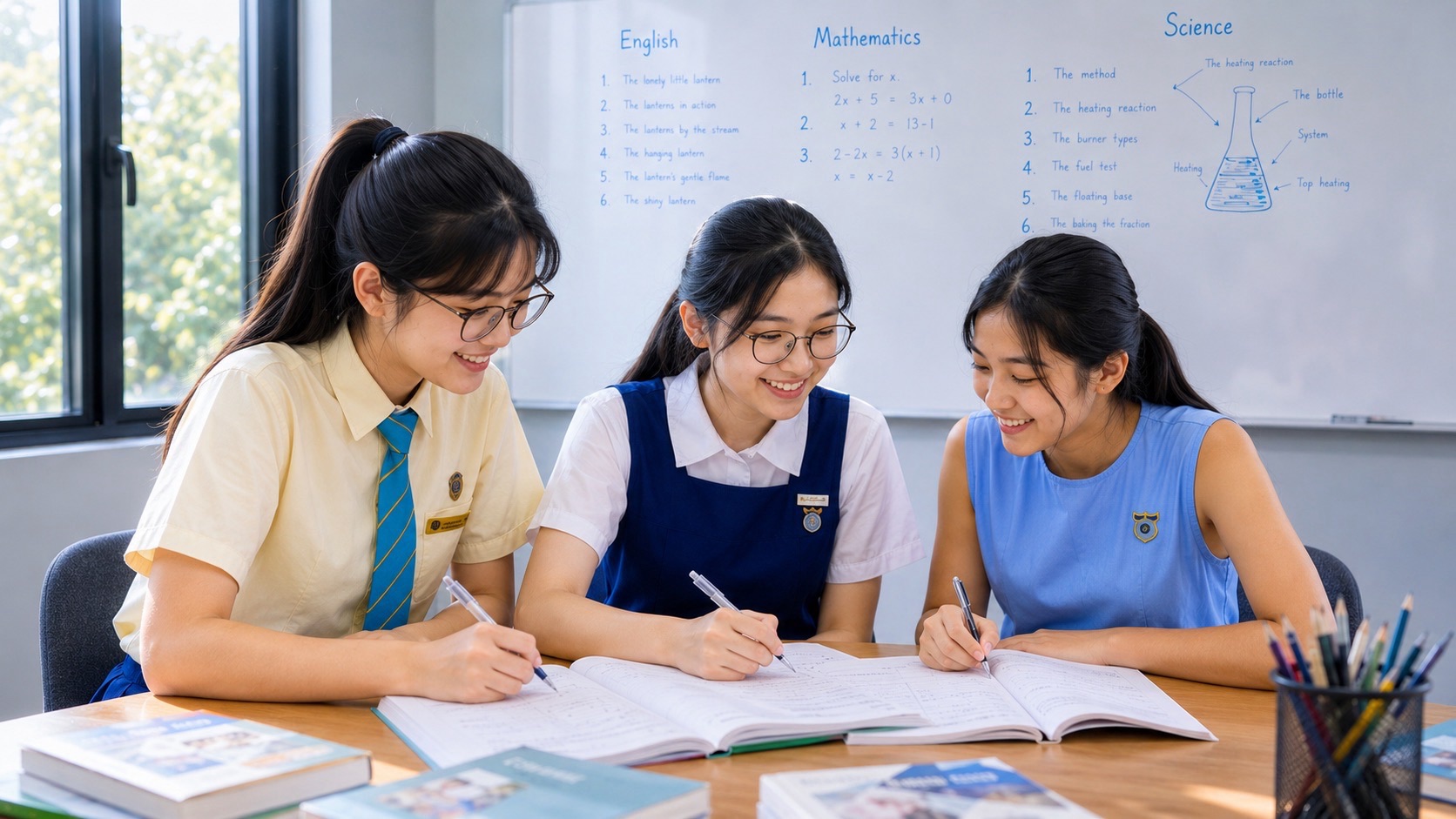
Bedok English tuition should begin with a decision: what kind of support does this learner actually need now?
eduKateSingapore already has a current Secondary English Tuition | Bedok — 3-Pax Small Groups page. This older URL should therefore not compete with that page by becoming another broad Secondary English clone.
Its Phase 4 role is different. This is a Bedok parent decision and routing guide: Primary foundation versus Secondary route, repair versus stabilisation versus extension, and when a three-student class is likely to be useful.
That distinction matters because “English tuition” can describe very different interventions. A Primary 3 learner building inference and paragraph writing should not receive the same programme as a Secondary 3 learner preparing for sustained examination writing. A strong student should not be given remedial worksheets simply because they attend tuition. A struggling student should not be pushed into full papers when one earlier language gap is contaminating everything.
eduKate teaches in small groups of up to three students, generally in 90-minute lessons. The purpose is to make each learner visible, diagnose accurately and gradually reduce dependence.
Integrity note: eduKate is an independent tuition provider. “Bedok” identifies the family/search route this guide serves and does not imply a branch at every locality named across eduKateSingapore. Confirm current class location and availability during consultation.
The Bedok Decision Tree
| If your child is… | Start by asking… | Likely route |
|---|---|---|
| Primary 1–2 | Are reading, vocabulary and sentence foundations developing securely? | Foundation |
| Primary 3–4 | Can the child infer, explain and write developed paragraphs? | Development |
| Primary 5–6 | Can the whole English system operate reliably under PSLE conditions? | Integration / PSLE |
| Secondary 1–2 | Has the student adapted to denser texts, longer writing and less scaffolding? | Transition / stability |
| Secondary 3–4 | Is knowledge translating into reliable timed performance? | Examination / independence |
| Already strong | What higher-resolution ability should be developed next? | Extension |
The Current Singapore English Context
At Primary level, MOE’s English Language Syllabus 2020 develops oracy, reading and writing as connected capabilities and treats grammar and vocabulary as resources for meaning. The 2026 PSLE English Language examination continues to assess Writing, Language Use and Comprehension, Listening Comprehension and Oral Communication. Parents can verify the current listing on the SEAB 2026 PSLE formats page.
For 2026 O-Level candidates, English Language remains syllabus 1184. Full Subject-Based Banding has been fully implemented since 2024, and from 2027 the Singapore-Cambridge Secondary Education Certificate (SEC) replaces the former N- and O-Level certificates. Subjects are taken at G1, G2 or G3 according to the student’s subject level and school arrangements.
Parents should therefore choose tuition based on the child’s actual English state and current subject level, not on old stream-era assumptions.
Decision 1: Primary Support or Secondary Route?
Primary Support
Primary English builds the language machine. The priorities change by age, but the connected system includes:
- reading accuracy and fluency;
- vocabulary growth and retrieval;
- grammar and sentence control;
- comprehension reasoning;
- paragraph and composition writing;
- listening;
- oral communication.
The nearer the student gets to PSLE, the more important integration and timed reliability become. But examination practice should sit on top of language capability rather than replace it.
Secondary Route
Secondary English increases the density of reading, the independence expected of the learner and the complexity of writing decisions. Students need stronger:
- inference and evidence;
- vocabulary precision;
- purpose and audience awareness;
- sustained paragraph development;
- argument and explanation;
- editing under time pressure;
- self-directed correction.
Families specifically looking for the current Bedok Secondary small-group route can use the Bedok Secondary English 3-Pax page.
Decision 2: Does the Student Need Repair, Stabilisation or Extension?
Repair
The student has a clear breakdown. We identify the earliest high-leverage gap rather than treating the final mark as one problem.
Examples:
- weak vocabulary slows comprehension;
- sentence boundaries damage composition;
- question-reading errors make correct knowledge unusable;
- the child cannot infer from evidence;
- planning is so weak that writing never develops.
Stabilisation
The learner understands but results are inconsistent. We work on retrieval, mixed practice, time control, checking and transfer so performance becomes less dependent on the exact task.
Extension
The learner is already secure. We increase nuance, text complexity, precision, rhetorical control and independence. Extension should not be disguised remediation.
Decision 3: Is 3-Pax the Right Format?
Three students can be a strong fit when the tutor needs to see each learner’s process while preserving peer discussion and comparison.
Good Reasons to Choose a 3-Pax Format
- The child’s errors are subtle and need close observation.
- The learner benefits from hearing alternative interpretations.
- Writing drafts need feedback during construction, not only after completion.
- The student needs prompts to be calibrated and gradually removed.
- The family wants a small group but does not require constant one-to-one attention.
When 3-Pax May Not Be the Best Answer
- The child needs intensive one-to-one remediation for a period.
- The learner has needs that cannot be safely or effectively supported in the group.
- The student is already highly independent and does not need additional tuition.
- The class match in level, pace or temperament is poor.
Class size should follow the learning problem, not become a marketing slogan.
The Seven-Layer Diagnostic
1. Input
Can the student accurately read the text, question, image or task requirements?
2. Meaning
Can the learner distinguish fact, inference, cause, tone and purpose?
3. Vocabulary
Can words be understood, retrieved and selected accurately?
4. Grammar and Sentence Control
Does language remain clear during authentic production?
5. Organisation
Can answers and longer writing be structured logically?
6. Transfer
Can the student use a skill on a new passage, topic or prompt?
7. Reliability
Does the system survive time pressure, fatigue and a full assessment?
What “Careless” Usually Hides
Parents often describe a child as careless. We try to convert that label into an observable mechanism.
“Careless” may mean:
- rushing before understanding the question;
- slow vocabulary retrieval creating time pressure later;
- weak checking routines;
- poor handwriting or visual organisation;
- misunderstanding hidden by a lucky earlier answer;
- attention collapse near the end of a long paper;
- overconfidence with familiar question types.
The repair depends on the cause.
The Primary Route in More Detail
Primary 1–2: Build Fluency and Complete Ideas
Students learn to read increasingly fluently, grow vocabulary, form complete sentences and respond orally with greater confidence. The teaching is explicit and language-rich.
Primary 3–4: Move Into Inference and Paragraph Control
Reading becomes denser. Vocabulary must support academic meaning. Students need to explain, infer, use evidence and write connected paragraphs.
Primary 5–6: Integrate and Prepare for PSLE
The full system is brought under greater time pressure. Practice papers are used to identify repeated errors and build reliability without replacing real teaching.
The Secondary Route in More Detail
Secondary 1: Transition
The learner adapts to new text demands, increased independence and more sustained writing. Old Primary strengths must remain active.
Secondary 2: Stability
The student should increasingly manage reading and writing without needing every task to be pre-labelled. Retrieval and transfer become important.
Secondary 3: Build Examination Capacity
Language control, comprehension depth, writing range and timing need to support the heavier upper-secondary workload.
Secondary 4: Protect Performance Under Pressure
The focus shifts toward reliable execution: efficient reading, writing decisions, error control, timing, stamina and recovery.
What a 90-Minute 3-Pax Lesson Can Look Like
0–10 minutes: Retrieval
Bring back earlier learning without immediate notes.
10–25 minutes: Diagnostic Entry
A school task, passage or short writing problem reveals the current state.
25–45 minutes: Explicit Teaching
The tutor makes the hidden decision visible: inference, paragraph function, vocabulary fit, grammar relationship or audience control.
45–65 minutes: Guided Practice
Students attempt while the tutor observes and uses the smallest useful prompt.
65–80 minutes: Independent Transfer
The context changes and support reduces.
80–90 minutes: Error Close
The error is classified, repaired and converted into focused continuation work.
Vocabulary: Recognition Is Not Ownership
We want words to move from exposure into retrieval and use.
A useful vocabulary cycle is:
meaning → contrast → sentence → paragraph → authentic use → delayed return.
This applies at Primary and Secondary levels. The difference is the sophistication of the words and contexts.
Writing: From Prompt to Controlled Output
Students learn to:
- understand the task;
- generate content;
- organise the response;
- draft with purpose;
- develop with relevant evidence/detail;
- revise for clarity and effect;
- proofread known error types.
The tutor should gradually disappear from this sequence.
Comprehension: From Text to Evidence-Based Answer
Students learn to classify the question, locate the relevant area, distinguish literal information from inference, select evidence and compress the answer.
Strong comprehension is not merely finding a sentence. It is understanding the relationship between the question and the text.
Exam Preparation: Build Reliability, Not Panic
Paper practice is most useful when it reveals where the system fails.
We look for:
- repeated question-reading errors;
- slow sections;
- grammar failure under load;
- weak planning;
- poor answer compression;
- vocabulary bottlenecks;
- checking failures;
- recovery after a difficult question.
Timing is introduced progressively. Speed without control simply produces mistakes faster.
What Parents Can Bring
- recent school English papers;
- marked compositions;
- comprehension work;
- teacher comments;
- Secondary subject level where relevant;
- assessment calendar;
- examples of independent work;
- examples that required heavy help.
We use evidence to decide whether the next route is Primary foundation, PSLE integration, Secondary transition, examination support or extension.
How to Know the Programme Is Working
- the student begins work with less prompting;
- vocabulary returns across new contexts;
- comprehension answers become better supported;
- writing becomes more organised;
- grammar errors repeat less often;
- timed work becomes calmer;
- school feedback shows the same improvements;
- the learner can explain and correct mistakes independently.
Frequently Asked Questions
Why is this Bedok page a decision guide?
Because eduKateSingapore already has a newer Bedok Secondary English 3-pax page. This older URL is more useful as a parent routing layer than as a duplicate.
Where should a Secondary parent go next?
Use the Secondary English Tuition | Bedok — 3-Pax Small Groups page for the dedicated Secondary route.
Is there an eduKate branch in Bedok?
This page serves Bedok families but does not make a branch-location claim. Confirm current class location during consultation.
Does a Primary student need PSLE tuition from Primary 1?
No. Early Primary should prioritise language development. Examination reliability becomes increasingly important as the child approaches Primary 6.
Does a strong student need tuition?
Not automatically. Extension should have a clear purpose—greater precision, reading depth, writing range or independence.
Can 3-pax support weak students?
Yes, when the child can function productively in the group and the class is well matched. Some learners may need more intensive one-to-one intervention first.
How does Full SBB affect Secondary English?
We consider the student’s actual English subject level and school programme. From 2027, SEC subjects are examined at G1, G2 or G3.
Do you teach only to the exam?
No. We teach language capability and then train how that capability operates under assessment constraints.
Ten Questions Before Choosing Bedok English Tuition
- Is this Primary or Secondary support?
- What specific problem is being solved?
- Does the learner need repair, stabilisation or extension?
- Is 3-pax the right format?
- Is the current syllabus framework used?
- Are reading, vocabulary, grammar and writing connected?
- Are prompts reduced over time?
- Is transfer tested?
- Does school evidence update the plan?
- Does the learner become more independent?
Choose the Route Before Increasing the Work
The best next action is not always “more English”.
It may be a narrow vocabulary repair, a comprehension evidence intervention, a Primary writing system, a Secondary transition route, an examination-reliability programme or no tuition at all.
This Bedok English tuition page exists to make that choice clearer:
identify stage → diagnose state → choose format → teach the smallest justified route → test transfer → read the return.
Primary families can begin with eduKate’s Primary English Small Group Tuition pathway. Secondary families can move to the dedicated Bedok Secondary English 3-Pax page. Bring recent school work to a consultation so the route is based on evidence.
Almost-Code Summary
FAMILY_ROUTE = Bedok
THIS_PAGE_ROLE = decision_router
LEVEL = Primary | Secondary
STATE = repair | stabilise | extend | no_tuition_needed
FORMAT = 3_pax_if_fit
PRIMARY_NEXT = primary_english_small_group
SECONDARY_NEXT = bedok_secondary_3_pax
LESSON = 90_minutes
DIAGNOSE = input + meaning + vocabulary + grammar + organisation + transfer + reliability
GOAL = correct_route + increasing_independence