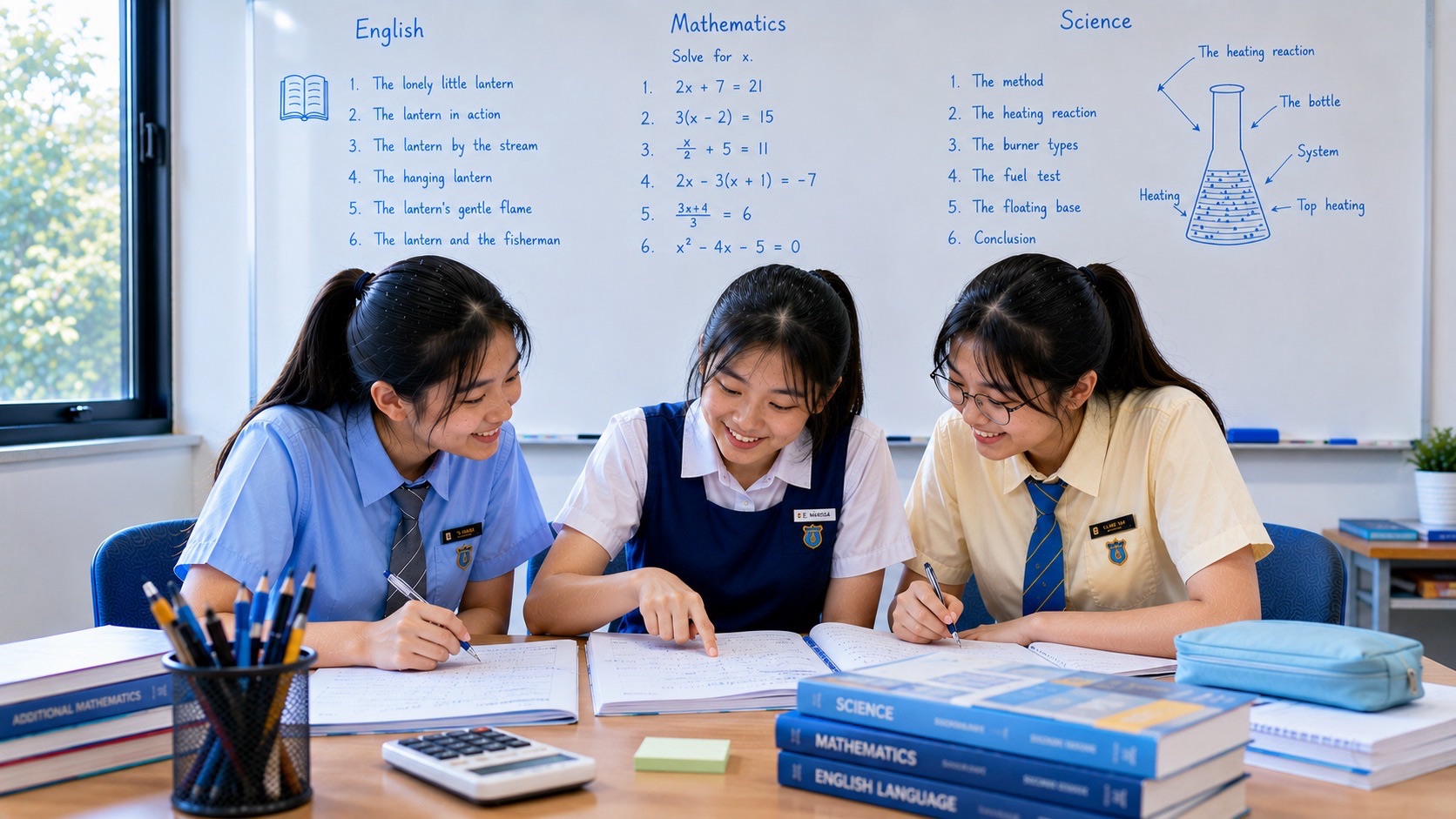
Jurong West Science tuition should help a Primary learner improve an investigation by identifying the actual limitation, changing the relevant part of the method, and explaining why the revised evidence would be stronger.
This rebuilt legacy page owns a distinct RFE: method limitation → targeted procedural change → stronger evidence. Jurong West already has broader Science tuition owners, so this old URL should not compete as another generic location page. Its job is to teach method evaluation rather than generic “be more careful” answers.
eduKate teaches in groups of up to three students, generally for 90 minutes. In a 3-pax Science class, students can compare several proposed improvements and decide which one actually fixes the weakness in the investigation.
Location-integrity note: this legacy URL contains historical Yishun/Bedok/Jurong West wording. It should not be read as proof of a current branch at any old address. Current class location and availability should be confirmed directly.
The 2026 Primary Science Context
For the 2026 PSLE, Science is subject code 0009 and is based on the 2023 Primary Science syllabus. Students are expected to evaluate observations and methods, interpret evidence and communicate scientific reasoning.
Parents can verify the current syllabus through the 2026 PSLE Science syllabus and the SEAB PSLE formats page.
The Investigation-Improvement Pipeline
| Stage | Question |
|---|---|
| Purpose | What is the investigation trying to find out? |
| Limitation | What makes the current evidence weak or unfair? |
| Change | What exact part of the method should be altered? |
| Reason | How does that change address the limitation? |
| Evidence | Why would the new result be easier to interpret? |
Do Not Improve the Wrong Part
Weak answer:
“Repeat the experiment.”
That helps only if the main limitation concerns consistency or one-off variation.
If the investigation changes two variables at once, the stronger improvement is to control the competing variable. Repeating the same unfair comparison does not fix the design.
Limitation 1: More Than One Variable Changed
If Set-up A differs from Set-up B in both light and water, a result cannot isolate the effect of light.
Improvement:
keep water amount the same while changing only the light condition.
Reason:
then any observed difference is less confounded by water amount.
Limitation 2: Measurement Is Too Crude
If a tiny change is measured using a tool with very large scale intervals, evidence may be too coarse.
Improvement:
- use a more suitable instrument;
- use finer scale resolution where appropriate;
- define exactly where the measurement starts and ends.
Reason:
The revised method can distinguish smaller changes more consistently.
Limitation 3: One Trial Only
If a conclusion depends on a single measurement, an unusual event can dominate the result.
Improvement:
repeat the trial under the same controlled conditions and compare the results.
Reason:
Repeated evidence allows the learner to judge consistency and identify anomalous results.
Limitation 4: Starting Conditions Differ
If two plants begin at different sizes, comparing final height alone may be misleading.
Improvement:
- use comparable starting specimens;
- measure change from the starting value;
- keep relevant initial conditions consistent.
The exact improvement depends on the question.
Limitation 5: Measurement Time Differs
If Set-up A is measured after three days and Set-up B after five, the comparison is weak.
Improvement:
measure both after the same duration.
Reason:
Time no longer provides an alternative explanation for the difference.
Limitation 6: Sample Is Too Narrow
When the outcome varies naturally among individual organisms or objects, one example may not represent the broader pattern well.
Where appropriate, students can suggest:
- testing more comparable samples;
- repeating across several individuals;
- looking for consistency across the group.
Claims should remain within the evidence actually collected.
Limitation 7: The Outcome Is Not Clearly Defined
“See which plant is healthier” is vague.
A better method might define:
- height increase;
- number of leaves;
- mass change;
- another measurable outcome appropriate to the investigation.
A clear dependent variable produces more interpretable evidence.
Limitation 8: Observer Judgement Is Too Subjective
If two students might judge the result differently, improve the method by defining a measurable criterion.
Example:
Instead of “which colour is darker?”, use a consistent comparison scale if one is provided or appropriate.
The principle is reproducibility.
Improvement Must Match the Limitation
| Limitation | Useful improvement |
|---|---|
| Two variables changed | Control one variable |
| Single trial | Repeat under same conditions |
| Poor measuring tool | Use suitable instrument/resolution |
| Unequal duration | Standardise time |
| Vague outcome | Define measurable dependent variable |
| Inconsistent procedure | Standardise the method |
This matching exercise is the core of method evaluation.
“Be More Careful” Is Usually Too Vague
Students should specify:
- what action changes;
- what variable it controls;
- what measurement becomes more consistent;
- what ambiguity is reduced.
Scientific improvement requires a mechanism.
Evaluate Before You Improve
Ask:
- Is the investigation fair?
- Is the outcome measured appropriately?
- Are repeated trials needed?
- Are starting conditions comparable?
- Can the conclusion be supported from this design?
Only then choose the highest-value change.
Do Not Add Complexity Without Need
A good improvement is the smallest change that fixes the identified weakness.
Adding five new instruments, many extra variables or an elaborate procedure can make a simple investigation worse rather than better.
The Jurong West Method Diagnostic
Purpose
Can the research question be stated?
Variables
Can changed/measured/controlled factors be identified?
Limitation
Can the specific weakness be named?
Improvement
Can one targeted change be proposed?
Reason
Can the learner explain why the change helps?
Evidence
Would the resulting data be easier to interpret?
Transfer
Can the same reasoning work in a new investigation?
Six Common Method-Improvement Failure Modes
1. Repeat Everything
Repetition is used as a universal answer.
2. “Be Careful”
No procedural change is stated.
3. Fixing the Outcome Instead of the Method
The learner proposes changing the result rather than improving how it is measured.
4. New Confounder
The suggested improvement accidentally changes another variable.
5. Instrument Name Without Reason
A tool is named but its advantage is not explained.
6. Overengineering
The revised method becomes unnecessarily complex.
What a 90-Minute 3-Pax Science Lesson Can Look Like
0–10 minutes: Variables Retrieval
Students recall changed, measured and controlled variables.
10–30 minutes: Flawed Investigation
A method is analysed for limitations.
30–45 minutes: Improvement Proposals
Each learner suggests one repair.
45–60 minutes: Reasoning Audit
Students explain how the change strengthens evidence.
60–80 minutes: Fresh Investigation Transfer
A different topic tests the same method-evaluation logic.
80–90 minutes: Minimal-Fix Challenge
Students choose the smallest sufficient improvement.
Why Three Students Helps
- Several plausible improvements can be compared.
- Peers identify hidden new confounders.
- The tutor can challenge vague method language.
- Students learn that improvement depends on the actual limitation.
- Every learner writes an independent evaluation.
What Parents Can Bring
- experiment-method questions;
- questions asking for improvements;
- marked open-ended answers;
- teacher comments;
- assessment dates.
What Progress Looks Like
- limitations become specific;
- improvements match the weakness;
- “repeat” is used only when appropriate;
- measurement reasoning improves;
- fair-test logic becomes clearer;
- method evaluation transfers across topics.
Frequently Asked Questions
Does this page claim a current Jurong West Science tuition centre?
No. It is a legacy Jurong West/Yishun learner route; current class location and availability must be confirmed directly.
Is repeating an experiment always good?
Repetition can strengthen evidence about consistency, but it does not repair an unfair or irrelevant method by itself.
Can strong learners be extended?
Yes. Use investigations with more than one limitation and ask which improvement should be prioritised first.
Ten Checks for Improving an Investigation
- What is the investigation asking?
- What is changed?
- What is measured?
- What should be controlled?
- What is the main limitation?
- What exact change fixes it?
- Does the change introduce a new problem?
- Why would evidence become stronger?
- Is this the smallest sufficient fix?
- Can the method transfer?
Improve the Part of the Method That Is Actually Weak
That is the purpose of this Jurong West Science tuition support route:
identify limitation → change method → explain why → collect stronger evidence.
Almost-Code Summary
LEARNER_ROUTE = Jurong_West_Primary_Science_method_improvement
PAGE_RFE = limitation_to_targeted_method_repair
PSLE_2026 = subject_0009 + 2023_primary_science_syllabus
CLASS = max_3
LESSON = 90_minutes
GOAL = specific_method_evaluation_not_generic_carefulness