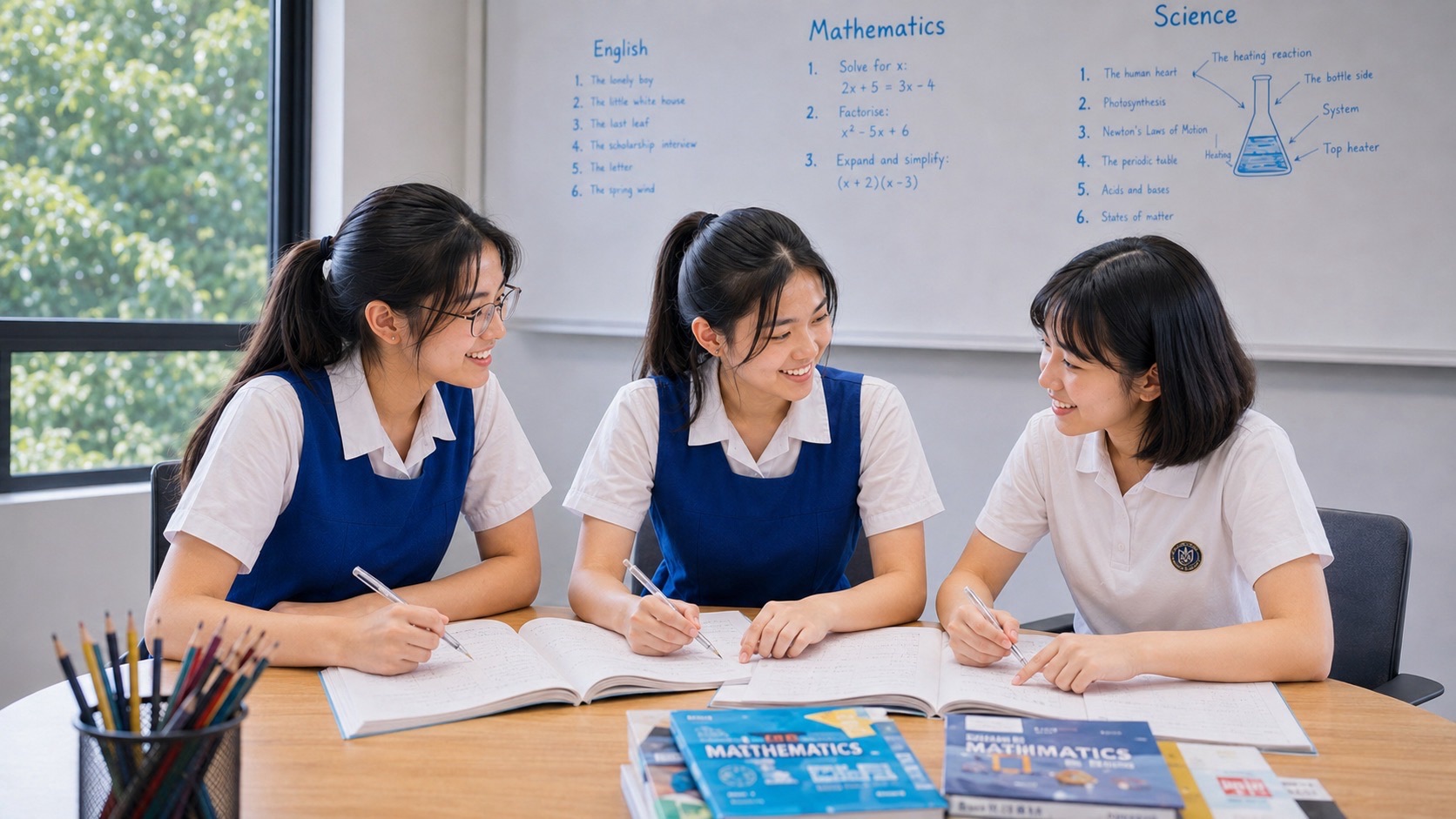
Strong comprehension begins before the child searches the passage. The student should predict what kind of proof the answer will need: a stated fact, a cause, a character action, a comparison, a vocabulary clue or a pair of details that together support an inference.
This page uses Paya Lebar Methodist Girls’ School (Primary) only as the school-family context named in the preserved 2019 URL. Its reader job is evidence-first comprehension: predict what proof the answer needs. It is not a generic school-tuition landing page.
The old page contained historic Yishun centre, tutor, telephone and generic syllabus claims. Those are not carried forward. eduKate Singapore is an independent tuition provider and is not affiliated with Paya Lebar Methodist Girls’ School (Primary), MOE or SEAB.
Evidence Search Works Better When the Proof Type Is Known
Many children reread broadly because they do not know what they are looking for. Before searching, translate the question into an evidence job.
| Question pattern | Likely proof needed |
|---|---|
| Why did…? | Cause, reason or motive |
| What showed…? | Observable action, dialogue or description |
| How were A and B different? | One comparable detail for each side |
| What does this word mean? | Local context, grammar and collocation |
| What can you infer? | One or more clues supporting a bounded conclusion |
Build the Answer Contract Before the Search
- Identify the action verb.
- Name the question anchor.
- Count how many parts are required.
- Predict the evidence type.
- Only then search the passage.
This prevents the first familiar sentence from becoming the answer simply because it contains the same keyword as the question.
Literal Evidence
For directly stated information, the student should find the smallest passage region that fully satisfies the question. Do not turn a literal question into an unnecessary inference.
Causal Evidence
A cause question may require the sentence before the event rather than the sentence containing the event itself. Students should search for the relationship, not merely the keyword.
Character Evidence
- action;
- dialogue;
- reaction;
- change in behaviour;
- choice under pressure.
These details can support emotion, motive or relationship inferences when interpreted carefully.
Vocabulary Evidence
Vocabulary-in-context questions often need a tighter evidence radius:
- the sentence containing the word;
- the grammatical role of the word;
- nearby contrast or cause;
- natural collocation;
- the paragraph’s overall meaning.
Inference Evidence
A good inference follows:
Clue → interpretation → boundary.
If one clue is ambiguous, look for a second independent clue before increasing the strength of the claim.
Evidence-First Does Not Mean Quote-First
Students should not copy whole sentences simply because evidence is required. The better sequence is to identify the proof, understand why it matters, then express the answer concisely.
The Strongest-Proof Test
- Does this detail directly support the answer?
- Does it cover the whole required relationship?
- Does it require extra assumptions?
- Is another detail more precise?
A Comprehension Diagnostic
| Observed pattern | Likely issue |
|---|---|
| Rereads whole passage | Proof type not predicted |
| Copies first keyword sentence | Evidence relevance weak |
| Correct claim, weak support | Evidence selection |
| Strong clue, overstrong conclusion | Inference calibration |
How a 3-Pax Class Trains Evidence Prediction
In a maximum three-student group, learners can read the same question and predict the proof type before seeing each other’s answers. The tutor can then compare whether the error occurred at question interpretation, evidence search or written response.
Current MOE English Context
The MOE Primary English Language Syllabus 2020 develops students’ ability to construct meaning and apply reading strategies flexibly. Evidence-first comprehension is one practical way to make those strategies more deliberate.
School Context Boundary
This article uses Paya Lebar Methodist Girls’ School (Primary) only as the school-family context named in the preserved URL. It does not imply endorsement, partnership or affiliation.
Signs Evidence-First Reading Is Improving
- Students predict the proof type before rereading.
- Evidence search becomes more local.
- Copied text decreases.
- Inference is better calibrated.
- Answers become shorter and more complete.
Predict the Proof: Almost-Code Summary
QUESTION:
    identify_action()
    identify_anchor()
    identify_parts()
    predict_proof_type()

SEARCH:
    smallest_relevant_region()

SELECT:
    strongest_sufficient_evidence()

ANSWER:
    concise_and_complete()

OUTPUT:
    faster_comprehension
    stronger_evidence_control